
A English
Chemical analysis of organic compounds Questions in English
Class 11 Chemistry · 8-3.Organic Chemistry : Purification and characterization · Chemical analysis of organic compounds
114+
Questions
English
Language
100%
With Solutions
Showing 49 of 114 questions in English
51
MediumMCQ
In the Lassaigne's test for nitrogen in an organic compound,the Prussian blue colour is obtained due to the formation of:
A
$Na_{4}[Fe(CN)_{6}]$
B
$Fe_{4}[Fe(CN)_{6}]_{3}$
C
$Fe_{2}[Fe(CN)_{6}]$
D
$Fe_{3}[Fe(CN)_{6}]_{4}$
Solution
(B) In the Lassaigne's test for nitrogen in an organic compound,the sodium fusion extract is boiled with iron $(II)$ sulphate and then acidified with sulphuric acid.
In the process,sodium cyanide first reacts with iron $(II)$ sulphate to form sodium hexacyanoferrate $(II)$.
Then,on heating with sulphuric acid,some iron $(II)$ gets oxidised to iron $(III)$,which reacts with hexacyanoferrate $(II)$ to form iron $(III)$ hexacyanoferrate $(II)$,which is Prussian blue in colour.
The chemical equations involved in the reaction are:
$6CN^{-} + Fe^{2+} \longrightarrow [Fe(CN)_{6}]^{4-}$
$3[Fe(CN)_{6}]^{4-} + 4Fe^{3+} \xrightarrow{xH_{2}O} Fe_{4}[Fe(CN)_{6}]_{3} \cdot xH_{2}O$ (Prussian blue)
Hence,the Prussian blue colour is due to the formation of $Fe_{4}[Fe(CN)_{6}]_{3}$.
In the process,sodium cyanide first reacts with iron $(II)$ sulphate to form sodium hexacyanoferrate $(II)$.
Then,on heating with sulphuric acid,some iron $(II)$ gets oxidised to iron $(III)$,which reacts with hexacyanoferrate $(II)$ to form iron $(III)$ hexacyanoferrate $(II)$,which is Prussian blue in colour.
The chemical equations involved in the reaction are:
$6CN^{-} + Fe^{2+} \longrightarrow [Fe(CN)_{6}]^{4-}$
$3[Fe(CN)_{6}]^{4-} + 4Fe^{3+} \xrightarrow{xH_{2}O} Fe_{4}[Fe(CN)_{6}]_{3} \cdot xH_{2}O$ (Prussian blue)
Hence,the Prussian blue colour is due to the formation of $Fe_{4}[Fe(CN)_{6}]_{3}$.
0 likes
View Solution52
MediumMCQ
How is the purity of a compound determined?
A
By measuring its density.
B
By determining its melting or boiling point.
C
By calculating its molecular weight.
D
By checking its color.
Solution
(B) $(i)$ The purity of a compound is ascertained by determining its melting or boiling point. Most pure compounds exhibit sharp melting and boiling points.
$(ii)$ Modern methods for checking the purity of an organic compound are based on various chromatographic and spectroscopic techniques.
$(ii)$ Modern methods for checking the purity of an organic compound are based on various chromatographic and spectroscopic techniques.
0 likes
View Solution53
Medium
How are carbon and hydrogen detected in an organic compound? Explain with reactions.
Solution
(N/A) In an organic compound,carbon and hydrogen are detected by heating the compound with copper$(II)$ oxide $(CuO)$.
$i$. Detection of carbon: Carbon present in the compound is oxidized to carbon dioxide $(CO_2)$,which turns lime water milky due to the formation of calcium carbonate.
Reaction: $C + 2CuO \rightarrow 2Cu + CO_{2(g)}$
$CO_{2(g)} + Ca(OH)_{2(aq)} \rightarrow CaCO_{3(s)} + H_2O_{(l)}$
$ii$. Detection of hydrogen: Hydrogen present in the compound is oxidized to water $(H_2O)$. This water is tested using anhydrous copper$(II)$ sulphate $(CuSO_4)$,which turns blue due to the formation of hydrated copper sulphate.
Reaction: $2H + CuO \xrightarrow{\Delta} Cu + H_2O$
$5H_2O + CuSO_{4(white)} \rightarrow CuSO_4 \cdot 5H_2O_{(blue)}$
$i$. Detection of carbon: Carbon present in the compound is oxidized to carbon dioxide $(CO_2)$,which turns lime water milky due to the formation of calcium carbonate.
Reaction: $C + 2CuO \rightarrow 2Cu + CO_{2(g)}$
$CO_{2(g)} + Ca(OH)_{2(aq)} \rightarrow CaCO_{3(s)} + H_2O_{(l)}$
$ii$. Detection of hydrogen: Hydrogen present in the compound is oxidized to water $(H_2O)$. This water is tested using anhydrous copper$(II)$ sulphate $(CuSO_4)$,which turns blue due to the formation of hydrated copper sulphate.
Reaction: $2H + CuO \xrightarrow{\Delta} Cu + H_2O$
$5H_2O + CuSO_{4(white)} \rightarrow CuSO_4 \cdot 5H_2O_{(blue)}$
0 likes
View Solution54
Advanced
Discuss the chemistry of Lassaigne's test.
Solution
(N/A) Nitrogen $(N)$,Sulphur $(S)$,Halogens $(Cl, Br, I)$,and Phosphorus $(P)$ present in an organic compound are detected by "Lassaigne's test".
$(a)$ The elements $(N, X, S)$ present in the compound are converted from covalent form into the ionic form by fusing the compound with sodium metal. The following reactions take place:
$(i)$ $Na + C + N \xrightarrow{\Delta} NaCN$
$(ii)$ $2Na + S \xrightarrow{\Delta} Na_{2}S$
$(iii)$ $Na + X \xrightarrow{\Delta} NaX$ (where $X = Cl, Br, \text{ or } I$)
Cyanide,sulphide,and halide of sodium so formed on sodium fusion are extracted from the fused mass by boiling it with distilled water. This extract is known as sodium fusion extract.
$(b)$ Test for Nitrogen:
Procedure: The sodium fusion extract is boiled with iron $(II)$ sulphate and then acidified with concentrated sulphuric acid. The formation of Prussian blue colour confirms the presence of nitrogen. Sodium cyanide first reacts with iron $(II)$ sulphate and forms sodium hexacyanidoferrate $(II)$. On heating with concentrated sulphuric acid,some iron $(II)$ ions are oxidised to iron $(III)$ ions which react with sodium hexacyanidoferrate $(II)$ to produce iron $(III)$ hexacyanidoferrate $(II)$ (ferriferrocyanide),which is Prussian blue in colour.
$6CN_{(aq)}^{-} + Fe_{(aq)}^{2+} \rightarrow [Fe(CN)_{6}]_{(aq)}^{4-}$
$3[Fe(CN)_{6}]_{(aq)}^{4-} + 4Fe^{3+} \xrightarrow{xH_{2}O} Fe_{4}[Fe(CN)_{6}]_{3} \cdot xH_{2}O$ (Prussian blue)
$(c)$ Test for Sulphur: Following two tests occur for detection of sulphur:
$(i)$ The sodium fusion extract is acidified with acetic acid and lead acetate is added to it. $A$ black precipitate of lead sulphide indicates the presence of sulphur.
$S_{(aq)}^{2-} + Pb_{(aq)}^{2+} \rightarrow PbS_{(s)}$ (Black precipitate)
$(ii)$ On treating sodium fusion extract with sodium nitroprusside,the appearance of a violet colour further indicates the presence of sulphur.
$(a)$ The elements $(N, X, S)$ present in the compound are converted from covalent form into the ionic form by fusing the compound with sodium metal. The following reactions take place:
$(i)$ $Na + C + N \xrightarrow{\Delta} NaCN$
$(ii)$ $2Na + S \xrightarrow{\Delta} Na_{2}S$
$(iii)$ $Na + X \xrightarrow{\Delta} NaX$ (where $X = Cl, Br, \text{ or } I$)
Cyanide,sulphide,and halide of sodium so formed on sodium fusion are extracted from the fused mass by boiling it with distilled water. This extract is known as sodium fusion extract.
$(b)$ Test for Nitrogen:
Procedure: The sodium fusion extract is boiled with iron $(II)$ sulphate and then acidified with concentrated sulphuric acid. The formation of Prussian blue colour confirms the presence of nitrogen. Sodium cyanide first reacts with iron $(II)$ sulphate and forms sodium hexacyanidoferrate $(II)$. On heating with concentrated sulphuric acid,some iron $(II)$ ions are oxidised to iron $(III)$ ions which react with sodium hexacyanidoferrate $(II)$ to produce iron $(III)$ hexacyanidoferrate $(II)$ (ferriferrocyanide),which is Prussian blue in colour.
$6CN_{(aq)}^{-} + Fe_{(aq)}^{2+} \rightarrow [Fe(CN)_{6}]_{(aq)}^{4-}$
$3[Fe(CN)_{6}]_{(aq)}^{4-} + 4Fe^{3+} \xrightarrow{xH_{2}O} Fe_{4}[Fe(CN)_{6}]_{3} \cdot xH_{2}O$ (Prussian blue)
$(c)$ Test for Sulphur: Following two tests occur for detection of sulphur:
$(i)$ The sodium fusion extract is acidified with acetic acid and lead acetate is added to it. $A$ black precipitate of lead sulphide indicates the presence of sulphur.
$S_{(aq)}^{2-} + Pb_{(aq)}^{2+} \rightarrow PbS_{(s)}$ (Black precipitate)
$(ii)$ On treating sodium fusion extract with sodium nitroprusside,the appearance of a violet colour further indicates the presence of sulphur.
0 likes
View Solution55
EasyMCQ
In the test for halogens,why is nitric acid added to the sodium fusion extract before adding silver nitrate?
A
To increase the concentration of silver ions.
B
To decompose sodium cyanide and sodium sulphide,which interfere with the test.
C
To make the solution basic for the reaction.
D
To act as a catalyst for the precipitation reaction.
Solution
(B) The sodium fusion extract often contains sodium cyanide $(NaCN)$ and sodium sulphide $(Na_2S)$ if nitrogen and sulphur are present in the organic compound.
If $AgNO_3$ is added directly,these ions would form precipitates like $AgCN$ and $Ag_2S$,which interfere with the halide test.
Adding $HNO_3$ decomposes these species:
$NaCN + HNO_3 \rightarrow NaNO_3 + HCN \uparrow$
$Na_2S + 2HNO_3 \rightarrow 2NaNO_3 + H_2S \uparrow$
This ensures that only the halide ions ($Cl^-$,$Br^-$,$I^-$) react with $Ag^+$ to form the characteristic silver halide precipitate.
If $AgNO_3$ is added directly,these ions would form precipitates like $AgCN$ and $Ag_2S$,which interfere with the halide test.
Adding $HNO_3$ decomposes these species:
$NaCN + HNO_3 \rightarrow NaNO_3 + HCN \uparrow$
$Na_2S + 2HNO_3 \rightarrow 2NaNO_3 + H_2S \uparrow$
This ensures that only the halide ions ($Cl^-$,$Br^-$,$I^-$) react with $Ag^+$ to form the characteristic silver halide precipitate.
0 likes
View Solution56
Medium
Explain the reason for the fusion of an organic compound with metallic sodium for testing nitrogen,sulphur,and halogens.
Solution
(N/A) Organic compounds contain elements like nitrogen,sulphur,and halogens in a covalent form.
These elements cannot be detected directly by standard chemical tests.
Fusion with metallic sodium converts these elements into their corresponding water-soluble ionic salts.
The reactions are as follows:
$Na + C + N \rightarrow NaCN$
$2Na + S \rightarrow Na_{2}S$
$Na + X \rightarrow NaX$ (where $X = Cl, Br, I$).
These ionic salts can then be easily detected using specific reagents.
These elements cannot be detected directly by standard chemical tests.
Fusion with metallic sodium converts these elements into their corresponding water-soluble ionic salts.
The reactions are as follows:
$Na + C + N \rightarrow NaCN$
$2Na + S \rightarrow Na_{2}S$
$Na + X \rightarrow NaX$ (where $X = Cl, Br, I$).
These ionic salts can then be easily detected using specific reagents.
0 likes
View Solution57
EasyMCQ
What happens when an organic compound is fused with sodium metal?
A
Formation of covalent compounds
B
Conversion of covalently bonded elements into ionic compounds
C
Decomposition of the organic compound into carbon and hydrogen
D
No reaction occurs
Solution
(B) When an organic compound is fused with sodium metal,the elements present in the compound (such as $N$,$S$,and halogens $X$) are converted from their covalent form into their corresponding ionic forms (such as $NaCN$,$Na_2S$,and $NaX$). This is the principle behind the Lassaigne's test.
0 likes
View Solution58
Easy
Give the chemical reaction for the detection of nitrogen in an organic compound using the Lassaigne's test.
Solution
(N/A) The detection of nitrogen involves the following steps:
$1$. Fusion with sodium metal: $N + C + Na \longrightarrow NaCN$
$2$. Formation of ferrocyanide: $6 CN^{-} + Fe^{2+} \longrightarrow [Fe(CN)_{6}]^{4-}$
$3$. Formation of ferric ferrocyanide (Prussian blue): $4 Fe^{3+} + 3 [Fe(CN)_{6}]^{4-} \cdot x H_{2}O \longrightarrow Fe_{4}[Fe(CN)_{6}]_{3} \cdot x H_{2}O$
$1$. Fusion with sodium metal: $N + C + Na \longrightarrow NaCN$
$2$. Formation of ferrocyanide: $6 CN^{-} + Fe^{2+} \longrightarrow [Fe(CN)_{6}]^{4-}$
$3$. Formation of ferric ferrocyanide (Prussian blue): $4 Fe^{3+} + 3 [Fe(CN)_{6}]^{4-} \cdot x H_{2}O \longrightarrow Fe_{4}[Fe(CN)_{6}]_{3} \cdot x H_{2}O$
0 likes
View Solution59
EasyMCQ
In the detection test of nitrogen,the Prussian blue colour is due to which compound?
A
$Fe_{4}[Fe(CN)_{6}]_{3}$
B
$Fe_{3}[Fe(CN)_{6}]_{2}$
C
$Fe_{2}[Fe(CN)_{6}]$
D
$Fe[Fe(CN)_{6}]$
Solution
(A) In the Lassaigne's test for nitrogen,the sodium fusion extract containing sodium cyanide $(NaCN)$ is treated with ferrous sulphate $(FeSO_{4})$.
This leads to the formation of sodium ferrocyanide,$Na_{4}[Fe(CN)_{6}]$.
On further reaction with ferric chloride $(FeCl_{3})$,it forms ferric ferrocyanide,which is known as Prussian blue.
The chemical formula is $Fe_{4}[Fe(CN)_{6}]_{3} \cdot x H_{2}O$.
This compound is chemically known as Iron$(III)$ hexacyanoferrate$(II)$.
This leads to the formation of sodium ferrocyanide,$Na_{4}[Fe(CN)_{6}]$.
On further reaction with ferric chloride $(FeCl_{3})$,it forms ferric ferrocyanide,which is known as Prussian blue.
The chemical formula is $Fe_{4}[Fe(CN)_{6}]_{3} \cdot x H_{2}O$.
This compound is chemically known as Iron$(III)$ hexacyanoferrate$(II)$.
0 likes
View Solution60
EasyMCQ
Why is the test for nitrogen,sulphur,or halogens not carried out by the direct addition of reagents to an organic compound?
A
They are present as ionic species.
B
They are covalently bonded to the carbon skeleton.
C
They are too reactive to be tested directly.
D
They are present in the form of gases.
Solution
(B) In organic compounds,elements like nitrogen,sulphur,and halogens are covalently bonded to the carbon skeleton.
Because they are not present as free ions,they do not react directly with reagents to give characteristic ionic tests.
Therefore,the organic compound is fused with sodium metal to convert these covalent elements into their corresponding water-soluble ionic salts (e.g.,$NaCN$,$Na_2S$,$NaCl$),which can then be detected using standard reagents.
Because they are not present as free ions,they do not react directly with reagents to give characteristic ionic tests.
Therefore,the organic compound is fused with sodium metal to convert these covalent elements into their corresponding water-soluble ionic salts (e.g.,$NaCN$,$Na_2S$,$NaCl$),which can then be detected using standard reagents.
0 likes
View Solution61
EasyMCQ
What happens to the halogen when $AgNO_3$ is added to the Lassaigne solution acidified with $HNO_3$?
A
$A$ white precipitate of silver halide is formed.
B
$A$ yellow precipitate of silver halide is formed.
C
$A$ precipitate of silver halide is formed.
D
No reaction occurs.
Solution
(C) When $AgNO_3$ is added to the Lassaigne solution acidified with $HNO_3$,the halide ions $(X^-)$ react with silver ions $(Ag^+)$ to form a precipitate of silver halide $(AgX)$.
$Ag^+ (aq) + X^- (aq) \longrightarrow AgX (s) \downarrow$
$Ag^+ (aq) + X^- (aq) \longrightarrow AgX (s) \downarrow$
0 likes
View Solution62
Easy
How is the silver halide obtained from an organic compound distinguished?
Solution
(N/A) $i$. White precipitate: Chlorine is present,and these precipitates are more soluble in $NH_4OH$.
$ii$. Light yellowish precipitate: Bromine is present. The precipitate is sparingly soluble in ammonium hydroxide and becomes soluble upon heating.
$iii$. Yellow precipitate: It is insoluble in $NH_4OH$,indicating the presence of iodine.
$ii$. Light yellowish precipitate: Bromine is present. The precipitate is sparingly soluble in ammonium hydroxide and becomes soluble upon heating.
$iii$. Yellow precipitate: It is insoluble in $NH_4OH$,indicating the presence of iodine.
0 likes
View Solution63
EasyMCQ
Why is nitric acid $(HNO_3)$ added to sodium extract before adding silver nitrate $(AgNO_3)$ for testing halogens?
A
To increase the concentration of $Ag^+$ ions.
B
To decompose sodium cyanide $(NaCN)$ and sodium sulphide $(Na_2S)$ if present.
C
To act as a catalyst for the precipitation reaction.
D
To neutralize the excess sodium metal.
Solution
(B) The sodium extract often contains sodium cyanide $(NaCN)$ and sodium sulphide $(Na_2S)$ along with sodium halides $(NaX)$.
If these are not removed,they would react with silver nitrate $(AgNO_3)$ to form silver cyanide $(AgCN)$ and silver sulphide $(Ag_2S)$,which are also precipitates and would interfere with the test for halogens.
Nitric acid $(HNO_3)$ is added to decompose these interfering ions into volatile gases like hydrogen cyanide $(HCN)$ and hydrogen sulphide $(H_2S)$,which are then boiled off.
Therefore,the correct reason is to decompose sodium cyanide and sodium sulphide if present.
If these are not removed,they would react with silver nitrate $(AgNO_3)$ to form silver cyanide $(AgCN)$ and silver sulphide $(Ag_2S)$,which are also precipitates and would interfere with the test for halogens.
Nitric acid $(HNO_3)$ is added to decompose these interfering ions into volatile gases like hydrogen cyanide $(HCN)$ and hydrogen sulphide $(H_2S)$,which are then boiled off.
Therefore,the correct reason is to decompose sodium cyanide and sodium sulphide if present.
0 likes
View Solution64
Medium
Give the answers for the Lassaigne test:
$(i)$ If nitrogen and sulphur are both present,what observation is observed?
$(ii)$ If bromine is present,what is the observation?
$(iii)$ In the Lassaigne extract,if black precipitates are not obtained upon adding $CH_3COOH$ and lead acetate,what does this indicate?
$(iv)$ What is the reason for adding $FeSO_4$ to the Lassaigne extract?
$(v)$ Why is the Prussian blue colour observed?
$(vi)$ What does the violet colour with sodium nitroprusside in the Lassaigne extract indicate?
$(i)$ If nitrogen and sulphur are both present,what observation is observed?
$(ii)$ If bromine is present,what is the observation?
$(iii)$ In the Lassaigne extract,if black precipitates are not obtained upon adding $CH_3COOH$ and lead acetate,what does this indicate?
$(iv)$ What is the reason for adding $FeSO_4$ to the Lassaigne extract?
$(v)$ Why is the Prussian blue colour observed?
$(vi)$ What does the violet colour with sodium nitroprusside in the Lassaigne extract indicate?
Solution
(N/A) $(i)$ $A$ blood-red colour is obtained due to the formation of $[Fe(SCN)]^{2+}$.
$(ii)$ By adding $AgNO_3$,a pale yellow precipitate of $AgBr$ is formed.
$(iii)$ It indicates that sulphur is absent in the organic compound.
$(iv)$ $FeSO_4$ is added to react with $CN^-$ ions to form ferrocyanide ions,which then react with $Fe^{3+}$ ions.
$(v)$ It is due to the formation of ferric ferrocyanide,$Fe_4[Fe(CN)_6]_3$.
$(vi)$ It indicates that sulphur is present in the compound,forming $Na_4[Fe(CN)_5NOS]$.
$(ii)$ By adding $AgNO_3$,a pale yellow precipitate of $AgBr$ is formed.
$(iii)$ It indicates that sulphur is absent in the organic compound.
$(iv)$ $FeSO_4$ is added to react with $CN^-$ ions to form ferrocyanide ions,which then react with $Fe^{3+}$ ions.
$(v)$ It is due to the formation of ferric ferrocyanide,$Fe_4[Fe(CN)_6]_3$.
$(vi)$ It indicates that sulphur is present in the compound,forming $Na_4[Fe(CN)_5NOS]$.
0 likes
View Solution65
Easy
In the detection of halogens,what is formed by adding $AgNO_3$? What is its colour?
Solution
(N/A) When $AgNO_3$ is added to the sodium fusion extract (acidified with $HNO_3$),a precipitate of silver halide $(AgX)$ is formed.
$(i)$ $AgCl$ forms a white precipitate.
(ii) $AgBr$ forms a light yellow precipitate.
(iii) $AgI$ forms a yellow precipitate.
$(i)$ $AgCl$ forms a white precipitate.
(ii) $AgBr$ forms a light yellow precipitate.
(iii) $AgI$ forms a yellow precipitate.
0 likes
View Solution66
EasyMCQ
The volume of nitrogen is measured by which apparatus in the Dumas method?
A
Eudiometer
B
Nitrometer
C
Graduated cylinder
D
Burette
Solution
(B) In the Dumas method,the organic compound is heated with copper oxide $(CuO)$ in an atmosphere of carbon dioxide. The nitrogen gas evolved is collected over a potassium hydroxide $(KOH)$ solution. The volume of nitrogen gas is measured using an apparatus called a $Nitrometer$.
0 likes
View Solution67
Easy
Match column $-I$ and column $-II$ with the correct relation:
| Column $-I$ | Column $-II$ |
|---|---|
| $(i).$ Prussian blue | $(a).$ Presence of phosphorus |
| $(ii).$ Yellow precipitate | $(b).$ Presence of sulphur |
| $(iii).$ Purple solution | $(c).$ Presence of nitrogen |
| $(iv).$ Black precipitate | $(d).$ Presence of chlorine |
Solution
(C) The correct matches are as follows:
$(i).$ Prussian blue is formed in the test for the presence of nitrogen $(Fe_4[Fe(CN)_6]_3)$.
$(ii).$ Yellow precipitate is formed in the test for the presence of phosphorus (ammonium phosphomolybdate).
$(iii).$ Purple solution is formed in the test for the presence of sulphur (sodium nitroprusside test).
$(iv).$ Black precipitate is formed in the test for the presence of sulphur (lead sulphide).
Therefore,the correct matching is $(i-c, ii-a, iii-b, iv-b)$.
$(i).$ Prussian blue is formed in the test for the presence of nitrogen $(Fe_4[Fe(CN)_6]_3)$.
$(ii).$ Yellow precipitate is formed in the test for the presence of phosphorus (ammonium phosphomolybdate).
$(iii).$ Purple solution is formed in the test for the presence of sulphur (sodium nitroprusside test).
$(iv).$ Black precipitate is formed in the test for the presence of sulphur (lead sulphide).
Therefore,the correct matching is $(i-c, ii-a, iii-b, iv-b)$.
0 likes
View Solution68
Easy
Match column $-I$ and column $-II$ with the correct relation:
| Column $-I$ | Column $-II$ |
|---|---|
| $(i).$ Lassaigne's test | $(a).$ By sodium peroxide |
| $(ii).$ Test for nitrogen | $(b).$ Acidify with acetic acid |
| $(iii).$ Test for sulphur | $(c).$ Acidify with conc. sulphuric acid |
| $(iv).$ Test for phosphorus | $(d).$ Fusion with sodium |
Solution
(D) The correct matches are as follows:
$(i).$ Lassaigne's test involves $(d).$ Fusion with sodium.
$(ii).$ Test for nitrogen involves $(c).$ Acidify with conc. sulphuric acid (to form Prussian blue).
$(iii).$ Test for sulphur involves $(b).$ Acidify with acetic acid (to detect sulphide ions).
$(iv).$ Test for phosphorus involves $(a).$ By sodium peroxide (oxidative fusion).
Therefore,the correct sequence is $(i-d), (ii-c), (iii-b), (iv-a)$.
$(i).$ Lassaigne's test involves $(d).$ Fusion with sodium.
$(ii).$ Test for nitrogen involves $(c).$ Acidify with conc. sulphuric acid (to form Prussian blue).
$(iii).$ Test for sulphur involves $(b).$ Acidify with acetic acid (to detect sulphide ions).
$(iv).$ Test for phosphorus involves $(a).$ By sodium peroxide (oxidative fusion).
Therefore,the correct sequence is $(i-d), (ii-c), (iii-b), (iv-a)$.
0 likes
View Solution69
MediumMCQ
For testing halogens in an organic compound with $AgNO_{3}$ solution,sodium extract (Lassaigne's test) is acidified with dilute $HNO_{3}$. What will happen if a student acidifies the extract with dilute $H_{2}SO_{4}$ in place of dilute $HNO_{3}$?
A
The test will be more sensitive.
B
$Ag_{2}SO_{4}$ will precipitate,which may be mistaken for $AgCl$.
C
The reaction will not occur at all.
D
The solution will turn black.
Solution
(B) In the Lassaigne's test,the sodium extract is acidified with dilute $HNO_{3}$ to decompose any $NaCN$ or $Na_{2}S$ present,which would otherwise interfere with the test.
If dilute $H_{2}SO_{4}$ is used instead of $HNO_{3}$,$Ag^{+}$ ions from $AgNO_{3}$ will react with $SO_{4}^{2-}$ ions to form $Ag_{2}SO_{4}$.
$2AgNO_{3} + H_{2}SO_{4} \rightarrow Ag_{2}SO_{4} + 2HNO_{3}$
Since $Ag_{2}SO_{4}$ has low solubility,it forms a white precipitate that can be incorrectly identified as $AgCl$,leading to a false positive result.
If dilute $H_{2}SO_{4}$ is used instead of $HNO_{3}$,$Ag^{+}$ ions from $AgNO_{3}$ will react with $SO_{4}^{2-}$ ions to form $Ag_{2}SO_{4}$.
$2AgNO_{3} + H_{2}SO_{4} \rightarrow Ag_{2}SO_{4} + 2HNO_{3}$
Since $Ag_{2}SO_{4}$ has low solubility,it forms a white precipitate that can be incorrectly identified as $AgCl$,leading to a false positive result.
0 likes
View Solution70
Medium
Three students,Manish,Ramesh,and Rajni were determining the extra elements present in an organic compound given by their teacher. They prepared the Lassaigne's extract $(L.E.)$ independently by the fusion of the compound with sodium metal. Then they added solid $FeSO_4$ and dilute sulphuric acid to a part of the Lassaigne's extract. Manish and Rajni obtained prussian blue colour,but Ramesh got red colour.
Ramesh repeated the test with the same Lassaigne's extract,but again got red colour only. They were surprised and went to their teacher and told him about their observation. Teacher asked them to think over the reason for this. Can you help them by giving the reason for this observation? Also,write the chemical equations to explain the formation of compounds of different colours.
Ramesh repeated the test with the same Lassaigne's extract,but again got red colour only. They were surprised and went to their teacher and told him about their observation. Teacher asked them to think over the reason for this. Can you help them by giving the reason for this observation? Also,write the chemical equations to explain the formation of compounds of different colours.
Solution
(A) If the organic compound contains both $N$ and $S$,then during fusion it may form either sodium thiocyanate $(NaSCN)$ or a mixture of sodium cyanide $(NaCN)$ and sodium sulphide $(Na_2S)$ depending upon the amount of sodium metal used. If the sodium metal used is less,only $NaSCN$ is produced.
This then reacts with $Fe^{3+}$ ions (produced by oxidation of $Fe^{2+}$ ions during the preparation of Lassaigne's extract) to give red colouration due to the formation of ferric thiocyanate.
$Fe^{2+} \xrightarrow{\text{Aerial oxidation}} Fe^{3+}$; $Fe^{3+} + 3SCN^- \longrightarrow [Fe(SCN)_3]$ (Blood red colour)
If excess sodium is used,$NaCN$ and $Na_2S$ are formed. $NaCN$ reacts with $FeSO_4$ to give Prussian blue colour due to the formation of ferric ferrocyanide,$Fe_4[Fe(CN)_6]_3$.
$6NaCN + FeSO_4 \longrightarrow Na_4[Fe(CN)_6] + Na_2SO_4$
$3Na_4[Fe(CN)_6] + 4Fe^{3+} \longrightarrow Fe_4[Fe(CN)_6]_3 + 12Na^+$
From the above discussion,it follows that Manish and Rajni used excess sodium,forming $NaCN$ which gave Prussian blue colour,while Ramesh used less sodium,forming $NaSCN$ which gave red colouration.
This then reacts with $Fe^{3+}$ ions (produced by oxidation of $Fe^{2+}$ ions during the preparation of Lassaigne's extract) to give red colouration due to the formation of ferric thiocyanate.
$Fe^{2+} \xrightarrow{\text{Aerial oxidation}} Fe^{3+}$; $Fe^{3+} + 3SCN^- \longrightarrow [Fe(SCN)_3]$ (Blood red colour)
If excess sodium is used,$NaCN$ and $Na_2S$ are formed. $NaCN$ reacts with $FeSO_4$ to give Prussian blue colour due to the formation of ferric ferrocyanide,$Fe_4[Fe(CN)_6]_3$.
$6NaCN + FeSO_4 \longrightarrow Na_4[Fe(CN)_6] + Na_2SO_4$
$3Na_4[Fe(CN)_6] + 4Fe^{3+} \longrightarrow Fe_4[Fe(CN)_6]_3 + 12Na^+$
From the above discussion,it follows that Manish and Rajni used excess sodium,forming $NaCN$ which gave Prussian blue colour,while Ramesh used less sodium,forming $NaSCN$ which gave red colouration.
0 likes
View Solution71
Easy
Match Column $-I$ with Column $-II$.
| Column $-I$ | Column $-II$ |
|---|---|
| $(A).$ Dumas method | $(3).$ Nitrogen gas |
| $(B).$ Kjeldahl's method | $(5).$ Ammonium sulphate |
| $(C).$ Carius method | $(1).$ $AgNO_3$ |
| $(D).$ Chromatography | $(2).$ Silica gel |
| $(E).$ Homolytic fission | $(4).$ Free radical |
Solution
(A-3, B-5, C-1, D-2, E-4) The correct matching is: $A-3, B-5, C-1, D-2, E-4$.
$(A).$ Dumas method: In this method,nitrogen is estimated as nitrogen gas $(N_2)$.
$(B).$ Kjeldahl's method: In this method,nitrogen is converted into ammonium sulphate $((NH_4)_2SO_4)$.
$(C).$ Carius method: This method is used for the estimation of halogens,where the compound is heated with $AgNO_3$ in the presence of $HNO_3$.
$(D).$ Chromatography: In thin layer chromatography,a thin layer $(0.2 \ mm)$ of an adsorbent such as silica gel is spread over a glass plate,which acts as a stationary phase.
$(E).$ Homolytic fission: When the homolytic fission of a covalent bond occurs,free radicals are formed.
$(A).$ Dumas method: In this method,nitrogen is estimated as nitrogen gas $(N_2)$.
$(B).$ Kjeldahl's method: In this method,nitrogen is converted into ammonium sulphate $((NH_4)_2SO_4)$.
$(C).$ Carius method: This method is used for the estimation of halogens,where the compound is heated with $AgNO_3$ in the presence of $HNO_3$.
$(D).$ Chromatography: In thin layer chromatography,a thin layer $(0.2 \ mm)$ of an adsorbent such as silica gel is spread over a glass plate,which acts as a stationary phase.
$(E).$ Homolytic fission: When the homolytic fission of a covalent bond occurs,free radicals are formed.
0 likes
View Solution72
MediumMCQ
Match List-$I$ with List-$II$:
The correct match is:
| List-$I$ (Test/Reagents/Observation) | List-$II$ (Species detected) |
| $(a)$ Lassaigne's Test | $(i)$ Carbon |
| $(b)$ $Cu(II)$ oxide | $(ii)$ Sulphur |
| $(c)$ Silver nitrate | $(iii)$ $N, S, P,$ and halogen |
| $(d)$ The sodium fusion extract gives black precipitate with acetic acid and lead acetate | $(iv)$ Halogen specifically |
The correct match is:
A
$(a)-(iii), (b)-(i), (c)-(ii), (d)-(iv)$
B
$(a)-(i), (b)-(iv), (c)-(iii), (d)-(ii)$
C
$(a)-(iii), (b)-(i), (c)-(iv), (d)-(ii)$
D
$(a)-(i), (b)-(ii), (c)-(iv), (d)-(iii)$
Solution
(C) The correct matches are as follows:
$(a)$ Lassaigne's test is used for the detection of nitrogen,sulphur,phosphorus,and halogens in organic compounds. Thus,$(a)-(iii)$.
$(b)$ $Cu(II)$ oxide is used in the detection of carbon in organic compounds (via the formation of $CO_2$). Thus,$(b)-(i)$.
$(c)$ Silver nitrate $(AgNO_3)$ is used specifically for the detection of halogens. Thus,$(c)-(iv)$.
$(d)$ The sodium fusion extract gives a black precipitate with acetic acid and lead acetate,which confirms the presence of sulphur $(PbS)$. Thus,$(d)-(ii)$.
Therefore,the correct sequence is $(a)-(iii), (b)-(i), (c)-(iv), (d)-(ii)$.
$(a)$ Lassaigne's test is used for the detection of nitrogen,sulphur,phosphorus,and halogens in organic compounds. Thus,$(a)-(iii)$.
$(b)$ $Cu(II)$ oxide is used in the detection of carbon in organic compounds (via the formation of $CO_2$). Thus,$(b)-(i)$.
$(c)$ Silver nitrate $(AgNO_3)$ is used specifically for the detection of halogens. Thus,$(c)-(iv)$.
$(d)$ The sodium fusion extract gives a black precipitate with acetic acid and lead acetate,which confirms the presence of sulphur $(PbS)$. Thus,$(d)-(ii)$.
Therefore,the correct sequence is $(a)-(iii), (b)-(i), (c)-(iv), (d)-(ii)$.
0 likes
View Solution73
MediumMCQ
Nitrogen can be estimated by Kjeldahl's method for which of the following compounds?
A
$CH_3-CH_2-NO_2$
B
$CH_3-CH_2-NH_2$
C
$C_6H_5-N=N-C_6H_5$
D
$C_5H_5N$
0 likes
View Solution74
EasyMCQ
Which of the following compounds is added to the sodium extract before the addition of silver nitrate for the testing of halogens?
A
Nitric acid
B
Ammonia
C
Hydrochloric acid
D
Sodium hydroxide
Solution
(A) For the testing of halogens,$HNO_3$ (Nitric acid) is added to the sodium extract.
This is done because if $CN^-$ or $S^{2-}$ ions are present in the extract,they would interfere with the test by forming $AgCN$ or $Ag_2S$ precipitates.
$HNO_3$ decomposes these ions into $HCN$ and $H_2S$ gases,respectively,which are then removed by boiling,ensuring that only halides react with $AgNO_3$.
This is done because if $CN^-$ or $S^{2-}$ ions are present in the extract,they would interfere with the test by forming $AgCN$ or $Ag_2S$ precipitates.
$HNO_3$ decomposes these ions into $HCN$ and $H_2S$ gases,respectively,which are then removed by boiling,ensuring that only halides react with $AgNO_3$.
0 likes
View Solution75
MediumMCQ
Which one of the following sets of elements can be detected using sodium fusion extract?
A
Halogens,Nitrogen,Oxygen,Sulfur
B
Sulfur,Nitrogen,Phosphorous,Halogens
C
Nitrogen,Phosphorous,Carbon,Sulfur
D
Phosphorous,Oxygen,Nitrogen,Halogens
Solution
(B) The sodium fusion extract (Lassaigne's extract) is used to detect elements like nitrogen,sulfur,halogens,and phosphorous in organic compounds.
These elements are converted into their respective water-soluble ionic forms by fusing the organic compound with sodium metal.
For example,nitrogen is converted to $NaCN$,sulfur to $Na_2S$,halogens to $NaX$ (where $X = Cl, Br, I$),and phosphorous to $Na_3PO_4$.
These elements are converted into their respective water-soluble ionic forms by fusing the organic compound with sodium metal.
For example,nitrogen is converted to $NaCN$,sulfur to $Na_2S$,halogens to $NaX$ (where $X = Cl, Br, I$),and phosphorous to $Na_3PO_4$.
0 likes
View Solution76
EasyMCQ
The Kjeldahl's method for the estimation of nitrogen can be used to estimate the amount of nitrogen in which one of the following compounds?
A
B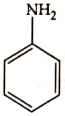
C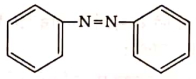
D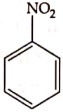
Solution
(B) The Kjeldahl's method is not applicable to compounds containing nitrogen in nitro $(-NO_2)$ or azo $(-N=N-)$ groups,or nitrogen present in a ring (like pyridine),because the nitrogen in these compounds is not quantitatively converted to ammonium sulphate under the conditions of the Kjeldahl's method.
Among the given options:
$A$. Nitrobenzene contains a nitro group.
$B$. Aniline $(C_6H_5NH_2)$ contains an amino group,which is easily converted to ammonium sulphate.
$C$. Azobenzene contains an azo group.
$D$. Pyridine contains nitrogen in the ring.
Therefore,the Kjeldahl's method can be used for Aniline.
Among the given options:
$A$. Nitrobenzene contains a nitro group.
$B$. Aniline $(C_6H_5NH_2)$ contains an amino group,which is easily converted to ammonium sulphate.
$C$. Azobenzene contains an azo group.
$D$. Pyridine contains nitrogen in the ring.
Therefore,the Kjeldahl's method can be used for Aniline.
0 likes
View Solution77
MediumMCQ
During the halogen test,the sodium fusion extract is boiled with concentrated $HNO_3$ to ... .
A
remove unreacted sodium
B
decompose cyanide or sulphide of sodium
C
extract halogen from organic compound
D
maintain the $pH$ of the extract
Solution
(B) The sodium fusion extract is boiled with concentrated $HNO_3$ to decompose sodium cyanide $(NaCN)$ and sodium sulphide $(Na_2S)$ present in the extract.
This is necessary because these ions interfere with the silver nitrate $(AgNO_3)$ test for halogens by forming precipitates like $AgCN$ or $Ag_2S$.
This is necessary because these ions interfere with the silver nitrate $(AgNO_3)$ test for halogens by forming precipitates like $AgCN$ or $Ag_2S$.
0 likes
View Solution78
MediumMCQ
Given below are two statements :
Statement $I$ : In Lassaigne's Test,when both nitrogen and sulphur are present in an organic compound,sodium thiocyanate is formed.
Statement $II$ : If both nitrogen and sulphur are present in an organic compound,then the excess of sodium used in sodium fusion will decompose the sodium thiocyanate formed to give $NaCN$ and $Na_{2}S$.
In the light of the above statements,choose the most appropriate answer from the options given below.
Statement $I$ : In Lassaigne's Test,when both nitrogen and sulphur are present in an organic compound,sodium thiocyanate is formed.
Statement $II$ : If both nitrogen and sulphur are present in an organic compound,then the excess of sodium used in sodium fusion will decompose the sodium thiocyanate formed to give $NaCN$ and $Na_{2}S$.
In the light of the above statements,choose the most appropriate answer from the options given below.
A
Both Statement $I$ and Statement $II$ are correct.
B
Both Statement $I$ and Statement $II$ are incorrect.
C
Statement $I$ is correct but Statement $II$ is incorrect.
D
Statement $I$ is incorrect but Statement $II$ is correct.
Solution
(A) In Lassaigne's test,if an organic compound contains both nitrogen and sulphur,they react with fused sodium to form sodium thiocyanate $(NaSCN)$.
The chemical reaction is: $Na + C + N + S \rightarrow NaSCN$.
However,if an excess of sodium is used,the sodium thiocyanate is decomposed into sodium cyanide $(NaCN)$ and sodium sulphide $(Na_{2}S)$.
The chemical reaction is: $NaSCN + 2Na \rightarrow NaCN + Na_{2}S$.
Therefore,both Statement $I$ and Statement $II$ are correct.
The chemical reaction is: $Na + C + N + S \rightarrow NaSCN$.
However,if an excess of sodium is used,the sodium thiocyanate is decomposed into sodium cyanide $(NaCN)$ and sodium sulphide $(Na_{2}S)$.
The chemical reaction is: $NaSCN + 2Na \rightarrow NaCN + Na_{2}S$.
Therefore,both Statement $I$ and Statement $II$ are correct.
0 likes
View Solution79
MediumMCQ
The formula of the purple colour formed in $Lassaigne's$ test for sulphur using sodium nitroprusside is ......
A
$Na_4[Fe(CN)_5(NOS)]$
B
$Na[Cr(NH_3)_2(NCS)_4]$
C
$Na_2[Fe(CN)_5(NO)]$
D
$Na_3[Fe(CN)_5(NOS)]$
Solution
(A) In $Lassaigne's$ test for sulphur,the sodium fusion extract is treated with sodium nitroprusside.
The reaction is: $Na_2S + Na_2[Fe(CN)_5NO] \rightarrow Na_4[Fe(CN)_5(NOS)]$.
The complex $Na_4[Fe(CN)_5(NOS)]$ is responsible for the deep violet or purple colouration.
The reaction is: $Na_2S + Na_2[Fe(CN)_5NO] \rightarrow Na_4[Fe(CN)_5(NOS)]$.
The complex $Na_4[Fe(CN)_5(NOS)]$ is responsible for the deep violet or purple colouration.
0 likes
View Solution80
DifficultMCQ
Which of the following compounds will give a positive Lassaigne's test for both nitrogen and halogen?
A
$N_2H_4 \cdot HCl$
B
$CH_3NH_2 \cdot HCl$
C
$NH_4Cl$
D
$NH_2OH \cdot HCl$
Solution
(B) Lassaigne's test is used to detect elements like nitrogen,sulfur,and halogens in organic compounds.
For a positive test,the compound must contain carbon along with nitrogen and halogen to form sodium cyanide $(NaCN)$ and sodium halide $(NaX)$ upon fusion with sodium metal.
$CH_3NH_2 \cdot HCl$ is an organic compound containing carbon,nitrogen,and chlorine.
Upon fusion with sodium $(Na)$,it forms $NaCN$ (which gives a positive test for nitrogen) and $NaCl$ (which gives a positive test for halogen).
$N_2H_4 \cdot HCl$,$NH_4Cl$,and $NH_2OH \cdot HCl$ are inorganic compounds that do not contain carbon,hence they do not form $NaCN$ during the fusion process.
For a positive test,the compound must contain carbon along with nitrogen and halogen to form sodium cyanide $(NaCN)$ and sodium halide $(NaX)$ upon fusion with sodium metal.
$CH_3NH_2 \cdot HCl$ is an organic compound containing carbon,nitrogen,and chlorine.
Upon fusion with sodium $(Na)$,it forms $NaCN$ (which gives a positive test for nitrogen) and $NaCl$ (which gives a positive test for halogen).
$N_2H_4 \cdot HCl$,$NH_4Cl$,and $NH_2OH \cdot HCl$ are inorganic compounds that do not contain carbon,hence they do not form $NaCN$ during the fusion process.
0 likes
View Solution81
EasyMCQ
Match List-$I$ with List-$II$.
Choose the correct answer from the options given below:
| List-$I$ Element detected | List-$II$ Reagent used/Product formed |
| $A$. Nitrogen | $I$. $Na_2[Fe(CN)_5NO]$ |
| $B$. Sulphur | $II$. $AgNO_3$ |
| $C$. Phosphorus | $III$. $Fe_4[Fe(CN)_6]_3$ |
| $D$. Halogen | $IV$. $(NH_4)_2MoO_4$ |
Choose the correct answer from the options given below:
A
$A-II, B-IV, C-I, D-III$
B
$A-IV, B-II, C-I, D-III$
C
$A-II, B-I, C-IV, D-III$
D
$A-III, B-I, C-IV, D-II$
Solution
(D) The correct matches are:
$A$. Nitrogen: Detected by forming Prussian blue,$Fe_4[Fe(CN)_6]_3$ $(III)$.
$B$. Sulphur: Detected by Sodium nitroprusside,$Na_2[Fe(CN)_5NO]$ $(I)$.
$C$. Phosphorus: Detected by ammonium molybdate,$(NH_4)_2MoO_4$ $(IV)$.
$D$. Halogen: Detected by $AgNO_3$ $(II)$.
Therefore,the correct sequence is $A-III, B-I, C-IV, D-II$.
$A$. Nitrogen: Detected by forming Prussian blue,$Fe_4[Fe(CN)_6]_3$ $(III)$.
$B$. Sulphur: Detected by Sodium nitroprusside,$Na_2[Fe(CN)_5NO]$ $(I)$.
$C$. Phosphorus: Detected by ammonium molybdate,$(NH_4)_2MoO_4$ $(IV)$.
$D$. Halogen: Detected by $AgNO_3$ $(II)$.
Therefore,the correct sequence is $A-III, B-I, C-IV, D-II$.
0 likes
View Solution82
MediumMCQ
In Lassaigne's extract of an organic compound,both nitrogen and sulphur are present,which gives blood red colour with $Fe^{3+}$ due to the formation of-
A
$[Fe(SCN)]^{2+}$
B
$Fe_4[Fe(CN)_6]_3 \cdot xH_2O$
C
$NaSCN$
D
$[Fe(CN)_5NOS]^{4-}$
Solution
(A) When both nitrogen and sulphur are present in an organic compound,sodium thiocyanate $(NaSCN)$ is formed during the preparation of Lassaigne's extract.
$Na + C + N + S \rightarrow NaSCN$
This $NaSCN$ reacts with $Fe^{3+}$ ions to form a blood-red coloured complex,$[Fe(SCN)]^{2+}$.
$Fe^{3+} + SCN^{-} \rightarrow [Fe(SCN)]^{2+}$
Since all nitrogen is consumed in the formation of $SCN^-$,no free cyanide ions $(CN^-)$ are available to form the prussian blue precipitate.
$Na + C + N + S \rightarrow NaSCN$
This $NaSCN$ reacts with $Fe^{3+}$ ions to form a blood-red coloured complex,$[Fe(SCN)]^{2+}$.
$Fe^{3+} + SCN^{-} \rightarrow [Fe(SCN)]^{2+}$
Since all nitrogen is consumed in the formation of $SCN^-$,no free cyanide ions $(CN^-)$ are available to form the prussian blue precipitate.
0 likes
View Solution83
DifficultMCQ
Appearance of blood red colour,on treatment of the sodium fusion extract of an organic compound with $FeSO_4$ in presence of concentrated $H_2SO_4$ indicates the presence of element/s
A
$Br$
B
$N$
C
$N$ and $S$
D
$S$
Solution
(C) The sodium fusion extract contains $NaCN$ and $Na_2S$ if both nitrogen and sulphur are present in the organic compound.
These react to form sodium thiocyanate: $Na^{+} + CN^{-} + S^{2-} \rightarrow NaSCN$.
In the presence of $Fe^{3+}$ ions (formed by the oxidation of $Fe^{2+}$ by concentrated $H_2SO_4$),the thiocyanate ion forms a blood-red complex: $Fe^{3+} + SCN^{-} \rightarrow [Fe(SCN)]^{2+}$.
Thus,the appearance of a blood-red colour confirms the presence of both $N$ and $S$.
These react to form sodium thiocyanate: $Na^{+} + CN^{-} + S^{2-} \rightarrow NaSCN$.
In the presence of $Fe^{3+}$ ions (formed by the oxidation of $Fe^{2+}$ by concentrated $H_2SO_4$),the thiocyanate ion forms a blood-red complex: $Fe^{3+} + SCN^{-} \rightarrow [Fe(SCN)]^{2+}$.
Thus,the appearance of a blood-red colour confirms the presence of both $N$ and $S$.
0 likes
View Solution84
DifficultMCQ
The Lassaigne's extract is boiled with dilute $HNO_3$ before testing for halogens because,
A
$AgCN$ is soluble in $HNO_3$
B
Silver halides are soluble in $HNO_3$
C
$Ag_2S$ is soluble in $HNO_3$
D
$Na_2S$ and $NaCN$ are decomposed by $HNO_3$
Solution
(D) In the Lassaigne's test,if the organic compound contains nitrogen or sulphur,the sodium fusion extract will contain $NaCN$ or $Na_2S$ respectively.
These ions interfere with the silver nitrate test for halogens by forming precipitates like $AgCN$ or $Ag_2S$.
Boiling the extract with dilute $HNO_3$ decomposes these species into volatile gases ($HCN$ and $H_2S$),thereby removing them from the solution before the addition of $AgNO_3$.
These ions interfere with the silver nitrate test for halogens by forming precipitates like $AgCN$ or $Ag_2S$.
Boiling the extract with dilute $HNO_3$ decomposes these species into volatile gases ($HCN$ and $H_2S$),thereby removing them from the solution before the addition of $AgNO_3$.
0 likes
View Solution85
MediumMCQ
Which of the following nitrogen-containing compounds does not give Lassaigne's test?
A
Phenyl hydrazine
B
Glycine
C
Urea
D
Hydrazine
Solution
(D) Lassaigne's test is used to detect nitrogen,sulfur,and halogens in organic compounds.
It involves the fusion of the organic compound with sodium metal,which converts the elements present into their corresponding sodium salts.
For nitrogen,it forms sodium cyanide $(NaCN)$.
Since $NaCN$ requires both carbon and nitrogen,the organic compound must contain both elements.
Hydrazine $(NH_2-NH_2)$ contains nitrogen but lacks carbon,therefore it cannot form $NaCN$ and does not give a positive Lassaigne's test.
It involves the fusion of the organic compound with sodium metal,which converts the elements present into their corresponding sodium salts.
For nitrogen,it forms sodium cyanide $(NaCN)$.
Since $NaCN$ requires both carbon and nitrogen,the organic compound must contain both elements.
Hydrazine $(NH_2-NH_2)$ contains nitrogen but lacks carbon,therefore it cannot form $NaCN$ and does not give a positive Lassaigne's test.
0 likes
View Solution86
AdvancedMCQ
Match the compounds in Column $I$ with their characteristic test$(s)$ reaction$(s)$ given in Column $II$.
| Column $I$ | Column $II$ |
|---|---|
| $A. H_2N-NH_3^+Cl^-$ | $p. \text{Sodium fusion extract of the compound gives Prussian blue colour with } FeSO_4$ |
| $B. HO-C_6H_4-CH(NH_3^+)COOH \text{ (with } I^- \text{ counterion)}$ | $q. \text{Gives positive } FeCl_3 \text{ test}$ |
| $C. HO-C_6H_4-NH_3^+Cl^-$ | $r. \text{Gives white precipitate with } AgNO_3$ |
| $D. (NO_2)_2C_6H_3-NH-NH_3^+Br^-$ | $s. \text{Reacts with aldehydes to form the corresponding hydrazone derivative}$ |
A
$A-r, s; B-p, q; C-p, q, r; D-p, s$
B
$A-r, q; B-p, s; C-p, q, s; D-p, r$
C
$A-q, s; B-r, q; C-s, p, r; D-q, s$
D
$A-r, q; B-r, s; C-q, r, p; D-p, q$
Solution
(A) $A. H_2N-NH_3^+Cl^-$ contains $Cl^-$ (gives white precipitate with $AgNO_3$,$r$) and contains $N$ (gives Prussian blue with $Na$ fusion,$p$). It also reacts with aldehydes to form hydrazones $(s)$.
$B. HO-C_6H_4-CH(NH_3^+)COOH$ (with $I^-$) contains $I^-$ (gives yellow precipitate with $AgNO_3$,not white,so $r$ is excluded). It has a phenol group (gives $FeCl_3$ test,$q$) and contains $N$ (gives $p$).
$C. HO-C_6H_4-NH_3^+Cl^-$ contains $Cl^-$ (gives $r$),phenol group (gives $q$),and $N$ (gives $p$).
$D. (NO_2)_2C_6H_3-NH-NH_3^+Br^-$ contains $Br^-$ (gives cream/white precipitate with $AgNO_3$,$r$),$N$ (gives $p$),and is a hydrazine derivative (reacts with aldehydes,$s$).
Matching the options: $A-p, r, s; B-p, q; C-p, q, r; D-p, r, s$. Based on the provided options,$A-r, s; B-p, q; C-p, q, r; D-p, s$ is the most accurate match.
$B. HO-C_6H_4-CH(NH_3^+)COOH$ (with $I^-$) contains $I^-$ (gives yellow precipitate with $AgNO_3$,not white,so $r$ is excluded). It has a phenol group (gives $FeCl_3$ test,$q$) and contains $N$ (gives $p$).
$C. HO-C_6H_4-NH_3^+Cl^-$ contains $Cl^-$ (gives $r$),phenol group (gives $q$),and $N$ (gives $p$).
$D. (NO_2)_2C_6H_3-NH-NH_3^+Br^-$ contains $Br^-$ (gives cream/white precipitate with $AgNO_3$,$r$),$N$ (gives $p$),and is a hydrazine derivative (reacts with aldehydes,$s$).
Matching the options: $A-p, r, s; B-p, q; C-p, q, r; D-p, r, s$. Based on the provided options,$A-r, s; B-p, q; C-p, q, r; D-p, s$ is the most accurate match.
0 likes
View Solution87
AdvancedMCQ
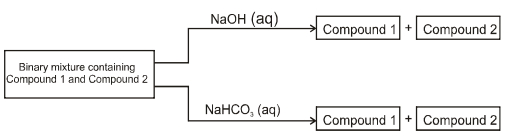
Identify the binary mixture$(s)$ that can be separated into individual compounds by differential extraction,as shown in the given scheme.
$(A)$ $C_6H_5OH$ and $C_6H_5COOH$
$(B)$ $C_6H_5COOH$ and $C_6H_5CH_2OH$
$(C)$ $C_6H_5CH_2OH$ and $C_6H_5OH$
$(D)$ $C_6H_5CH_2OH$ and $C_6H_5CH_2COOH$
$(A)$ $C_6H_5OH$ and $C_6H_5COOH$
$(B)$ $C_6H_5COOH$ and $C_6H_5CH_2OH$
$(C)$ $C_6H_5CH_2OH$ and $C_6H_5OH$
$(D)$ $C_6H_5CH_2OH$ and $C_6H_5CH_2COOH$
A
$(B, D)$
B
$(B, C)$
C
$(A, D)$
D
$(C, D)$
Solution
(A) The scheme shows that one component of the mixture reacts with both $NaOH(aq)$ and $NaHCO_3(aq)$ to become soluble,while the other remains insoluble.
$1.$ $C_6H_5COOH$ (benzoic acid) is a strong acid $(pK_a \approx 4.2)$ and reacts with both $NaOH$ and $NaHCO_3$ to form soluble sodium benzoate.
$2.$ $C_6H_5CH_2COOH$ (phenylacetic acid) is also a strong acid and reacts with both $NaOH$ and $NaHCO_3$ to form soluble sodium phenylacetate.
$3.$ $C_6H_5OH$ (phenol) is a weak acid $(pK_a \approx 10)$ and reacts with $NaOH$ to form soluble sodium phenoxide,but it does not react with $NaHCO_3$.
$4.$ $C_6H_5CH_2OH$ (benzyl alcohol) is neutral and does not react with either $NaOH$ or $NaHCO_3$.
Analyzing the options:
- $(B)$ Mixture of $C_6H_5COOH$ (acid) and $C_6H_5CH_2OH$ (neutral): $C_6H_5COOH$ reacts with both $NaOH$ and $NaHCO_3$ (soluble),while $C_6H_5CH_2OH$ does not (insoluble). This fits the scheme.
- $(D)$ Mixture of $C_6H_5CH_2COOH$ (acid) and $C_6H_5CH_2OH$ (neutral): $C_6H_5CH_2COOH$ reacts with both $NaOH$ and $NaHCO_3$ (soluble),while $C_6H_5CH_2OH$ does not (insoluble). This fits the scheme.
Therefore,both $(B)$ and $(D)$ follow the given separation scheme.
$1.$ $C_6H_5COOH$ (benzoic acid) is a strong acid $(pK_a \approx 4.2)$ and reacts with both $NaOH$ and $NaHCO_3$ to form soluble sodium benzoate.
$2.$ $C_6H_5CH_2COOH$ (phenylacetic acid) is also a strong acid and reacts with both $NaOH$ and $NaHCO_3$ to form soluble sodium phenylacetate.
$3.$ $C_6H_5OH$ (phenol) is a weak acid $(pK_a \approx 10)$ and reacts with $NaOH$ to form soluble sodium phenoxide,but it does not react with $NaHCO_3$.
$4.$ $C_6H_5CH_2OH$ (benzyl alcohol) is neutral and does not react with either $NaOH$ or $NaHCO_3$.
Analyzing the options:
- $(B)$ Mixture of $C_6H_5COOH$ (acid) and $C_6H_5CH_2OH$ (neutral): $C_6H_5COOH$ reacts with both $NaOH$ and $NaHCO_3$ (soluble),while $C_6H_5CH_2OH$ does not (insoluble). This fits the scheme.
- $(D)$ Mixture of $C_6H_5CH_2COOH$ (acid) and $C_6H_5CH_2OH$ (neutral): $C_6H_5CH_2COOH$ reacts with both $NaOH$ and $NaHCO_3$ (soluble),while $C_6H_5CH_2OH$ does not (insoluble). This fits the scheme.
Therefore,both $(B)$ and $(D)$ follow the given separation scheme.
0 likes
View Solution88
AdvancedMCQ
Match the compounds in List-$I$ with the observations in List-$II$,and choose the correct option.
| List-$I$ | List-$II$ |
|---|---|
| $I$. Aniline | $P$. Sodium fusion extract of the compound on boiling with $FeSO_4$,followed by acidification with conc. $H_2SO_4$,gives Prussian blue color. |
| $II$. $o$-Cresol | $Q$. Sodium fusion extract of the compound on treatment with sodium nitroprusside gives blood red color. |
| $III$. Cysteine | $R$. Addition of the compound to a saturated solution of $NaHCO_3$ results in effervescence. |
| $IV$. Caprolactam | $S$. The compound reacts with bromine water to give a white precipitate. |
| $T$. Treating the compound with neutral $FeCl_3$ solution produces violet color. |
A
$I$ $\rightarrow P, Q; II$ $\rightarrow S; III$ $\rightarrow Q, R; IV$ $\rightarrow P$
B
$I$ $\rightarrow P; II$ $\rightarrow R, S; III$ $\rightarrow R; IV$ $\rightarrow Q, S$
C
$I$ $\rightarrow Q, S; II$ $\rightarrow P, T; III$ $\rightarrow P; IV$ $\rightarrow S$
D
$I$ $\rightarrow P, S; II$ $\rightarrow T; III$ $\rightarrow Q, R; IV$ $\rightarrow P$
Solution
(D) $1$. $I$. Aniline $(C_6H_5NH_2)$: Contains $N$,so it gives a positive Lassaigne's test for nitrogen (Prussian blue color with $FeSO_4/H_2SO_4$),matching $P$. It also reacts with bromine water to form $2,4,6$-tribromoaniline (white precipitate),matching $S$.
$2$. $II$. $o$-Cresol: It is a phenol,so it gives a violet color with neutral $FeCl_3$,matching $T$.
$3$. $III$. Cysteine: Contains $N$ and $S$. Sodium fusion extract with sodium nitroprusside gives a violet/blood red color due to $S^{2-}$ ions,matching $Q$. It also contains a carboxylic acid group $(-COOH)$,which reacts with $NaHCO_3$ to release $CO_2$ gas (effervescence),matching $R$.
$4$. $IV$. Caprolactam: Contains $N$,so it gives a positive Lassaigne's test for nitrogen,matching $P$.
Matching: $I \rightarrow P, S$; $II \rightarrow T$; $III \rightarrow Q, R$; $IV \rightarrow P$. The correct option is $D$.
$2$. $II$. $o$-Cresol: It is a phenol,so it gives a violet color with neutral $FeCl_3$,matching $T$.
$3$. $III$. Cysteine: Contains $N$ and $S$. Sodium fusion extract with sodium nitroprusside gives a violet/blood red color due to $S^{2-}$ ions,matching $Q$. It also contains a carboxylic acid group $(-COOH)$,which reacts with $NaHCO_3$ to release $CO_2$ gas (effervescence),matching $R$.
$4$. $IV$. Caprolactam: Contains $N$,so it gives a positive Lassaigne's test for nitrogen,matching $P$.
Matching: $I \rightarrow P, S$; $II \rightarrow T$; $III \rightarrow Q, R$; $IV \rightarrow P$. The correct option is $D$.
0 likes
View Solution89
MediumMCQ
Given below are two statements :
Statement $I$ : Nitrogen,sulphur,halogen and phosphorus present in an organic compound are detected by Lassaigne's Test.
Statement $II$ : The elements present in the compound are converted from covalent form into ionic form by fusing the compound with Magnesium in Lassaigne's test.
In the light of the above statements,choose the correct answer from the options given below :
Statement $I$ : Nitrogen,sulphur,halogen and phosphorus present in an organic compound are detected by Lassaigne's Test.
Statement $II$ : The elements present in the compound are converted from covalent form into ionic form by fusing the compound with Magnesium in Lassaigne's test.
In the light of the above statements,choose the correct answer from the options given below :
A
Both Statement $I$ and Statement $II$ are true
B
Both Statement $I$ and Statement $II$ are false
C
Statement $I$ is true but Statement $II$ is false
D
Statement $I$ is false but Statement $II$ is true
Solution
(C) Statement $I$ is true because Lassaigne's test is used to detect nitrogen,sulphur,halogens,and phosphorus in organic compounds.
Statement $II$ is false because in Lassaigne's test,the organic compound is fused with metallic sodium,not magnesium,to convert the elements from covalent form into ionic form.
Statement $II$ is false because in Lassaigne's test,the organic compound is fused with metallic sodium,not magnesium,to convert the elements from covalent form into ionic form.
0 likes
View Solution90
DifficultMCQ
Given below are two statements :
Statement $I :$ In Lassaigne's test,the covalent organic molecules are transformed into ionic compounds.
Statement $II :$ The sodium fusion extract of an organic compound having $N$ and $S$ gives prussian blue colour with $FeSO_4$ and $FeCl_3$.
In the light of the above statements,choose the correct answer from the options given below.
Statement $I :$ In Lassaigne's test,the covalent organic molecules are transformed into ionic compounds.
Statement $II :$ The sodium fusion extract of an organic compound having $N$ and $S$ gives prussian blue colour with $FeSO_4$ and $FeCl_3$.
In the light of the above statements,choose the correct answer from the options given below.
A
Both Statement $I$ and Statement $II$ are true
B
Both Statement $I$ and Statement $II$ are false
C
Statement $I$ is false but Statement $II$ is true
D
Statement $I$ is true but Statement $II$ is false
Solution
(D) Statement $I$ is true because in Lassaigne's test,covalent organic compounds are fused with sodium metal to form ionic salts like $NaCN$,$Na_2S$,and $NaSCN$.
Statement $II$ is false because an organic compound containing both $N$ and $S$ forms sodium thiocyanate $(NaSCN)$. When this extract is treated with $Fe^{3+}$ ions (usually from $FeCl_3$),it forms ferric thiocyanate,which gives a blood-red colour,not Prussian blue. Prussian blue is obtained only when $N$ is present without $S$.
Statement $II$ is false because an organic compound containing both $N$ and $S$ forms sodium thiocyanate $(NaSCN)$. When this extract is treated with $Fe^{3+}$ ions (usually from $FeCl_3$),it forms ferric thiocyanate,which gives a blood-red colour,not Prussian blue. Prussian blue is obtained only when $N$ is present without $S$.
0 likes
View Solution91
DifficultMCQ
Match the List-$I$ with List-$II$:
Choose the correct answer from the options given below:
| List-$I$ (Reagent) | List-$II$ (Functional Group detected) |
| $A$. Sodium bicarbonate solution | $I$. Double bond/unsaturation |
| $B$. Neutral ferric chloride | $II$. Carboxylic acid |
| $C$. Ceric ammonium nitrate | $III$. Phenolic $-OH$ |
| $D$. Alkaline $KMnO_4$ | $IV$. Alcoholic $-OH$ |
Choose the correct answer from the options given below:
A
$A-II, B-III, C-IV, D-I$
B
$A-II, B-III, C-I, D-IV$
C
$A-III, B-II, C-IV, D-I$
D
$A-II, B-IV, C-III, D-I$
Solution
(A) $(1)$ Carboxylic acid reacts with sodium bicarbonate solution to release $CO_2$ gas,causing effervescence.
$(2)$ Phenolic $-OH$ group reacts with neutral $FeCl_3$ to form a violet-coloured complex.
$(3)$ Alcoholic $-OH$ group reacts with ceric ammonium nitrate to produce a red-coloured complex.
$(4)$ Alkaline $KMnO_4$ (Baeyer's reagent) reacts with unsaturated compounds (alkenes or alkynes) to cause the disappearance of the purple colour,indicating unsaturation.
$(2)$ Phenolic $-OH$ group reacts with neutral $FeCl_3$ to form a violet-coloured complex.
$(3)$ Alcoholic $-OH$ group reacts with ceric ammonium nitrate to produce a red-coloured complex.
$(4)$ Alkaline $KMnO_4$ (Baeyer's reagent) reacts with unsaturated compounds (alkenes or alkynes) to cause the disappearance of the purple colour,indicating unsaturation.
0 likes
View Solution92
MediumMCQ
Which one of the following reactions does $NOT$ belong to "Lassaigne's test"?
A
$Na + C + N \xrightarrow[\Delta]{ } NaCN$
B
$2 Na + S \xrightarrow[\Delta]{ } Na_2S$
C
$Na + X \xrightarrow[\Delta]{ } NaX$
D
$2 CuO + C \xrightarrow[\Delta]{ } 2 Cu + CO_2$
Solution
(D) $2 CuO + C \xrightarrow[\Delta]{ } 2 Cu + CO_2$ is not part of "Lassaigne's test".
"Lassaigne's test" involves the fusion of an organic compound with metallic sodium to convert covalently bonded elements like $N$,$S$,and $X$ (halogens) into their ionic forms ($NaCN$,$Na_2S$,and $NaX$).
The reaction $2 CuO + C \xrightarrow[\Delta]{ } 2 Cu + CO_2$ is used for the detection of carbon in organic compounds (Liebig's method),not for the elements detected by "Lassaigne's test".
"Lassaigne's test" involves the fusion of an organic compound with metallic sodium to convert covalently bonded elements like $N$,$S$,and $X$ (halogens) into their ionic forms ($NaCN$,$Na_2S$,and $NaX$).
The reaction $2 CuO + C \xrightarrow[\Delta]{ } 2 Cu + CO_2$ is used for the detection of carbon in organic compounds (Liebig's method),not for the elements detected by "Lassaigne's test".
0 likes
View Solution93
MediumMCQ
Under which circumstances is Kjeldahl's method not useful?
A
When nitrogen is present in a nitro group.
B
When nitrogen is present in an azo group.
C
When nitrogen is present in a cyclic structure.
D
All of these
Solution
(D) Kjeldahl's method is used for the estimation of nitrogen in organic compounds.
It is not applicable to compounds containing nitrogen in nitro $(-NO_2)$ groups,azo $(-N=N-)$ groups,or nitrogen present in a ring (cyclic) structure (e.g.,pyridine,quinoline).
This is because the nitrogen in these functional groups or structures is not quantitatively converted to ammonium sulfate under the conditions of the Kjeldahl method.
Therefore,the correct answer is $D$.
It is not applicable to compounds containing nitrogen in nitro $(-NO_2)$ groups,azo $(-N=N-)$ groups,or nitrogen present in a ring (cyclic) structure (e.g.,pyridine,quinoline).
This is because the nitrogen in these functional groups or structures is not quantitatively converted to ammonium sulfate under the conditions of the Kjeldahl method.
Therefore,the correct answer is $D$.
0 likes
View Solution94
MediumMCQ
The compound that gives a blood-red colour in Lassaigne's test is $:$
A
$4-$(methylthiomethyl)benzoic acid
B
$4-$(aminomethyl)benzoic acid
C
$1-$(aminomethyl)$-4-$(chloromethyl)benzene
D
$4-$(methylthiomethyl)benzylamine
Solution
(D) Lassaigne's test is used to detect the presence of nitrogen $(N)$,sulfur $(S)$,and halogens $(X)$ in organic compounds.
When both nitrogen $(N)$ and sulfur $(S)$ are present in an organic compound,they react during the fusion with sodium metal to form sodium thiocyanate $(NaSCN)$.
$Na + C + N + S \rightarrow NaSCN$
This sodium thiocyanate reacts with ferric ions $(Fe^{3+})$ to form a blood-red coloured complex,ferric thiocyanate,$[Fe(SCN)]^{2+}$.
$Fe^{3+} + SCN^- \rightarrow [Fe(SCN)]^{2+} \text{ (Blood Red Colour)}$
Therefore,the compound must contain both nitrogen $(N)$ and sulfur $(S)$.
Option $D$ contains both an amino group ($-NH_2$,source of $N$) and a methylthio group ($-SCH_3$,source of $S$). Thus,it will give a blood-red colour.
When both nitrogen $(N)$ and sulfur $(S)$ are present in an organic compound,they react during the fusion with sodium metal to form sodium thiocyanate $(NaSCN)$.
$Na + C + N + S \rightarrow NaSCN$
This sodium thiocyanate reacts with ferric ions $(Fe^{3+})$ to form a blood-red coloured complex,ferric thiocyanate,$[Fe(SCN)]^{2+}$.
$Fe^{3+} + SCN^- \rightarrow [Fe(SCN)]^{2+} \text{ (Blood Red Colour)}$
Therefore,the compound must contain both nitrogen $(N)$ and sulfur $(S)$.
Option $D$ contains both an amino group ($-NH_2$,source of $N$) and a methylthio group ($-SCH_3$,source of $S$). Thus,it will give a blood-red colour.
0 likes
View Solution95
MediumMCQ
Consider the following table$-$
The correct match is$-$
| Column-$I$ | Column-$II$ |
|---|---|
| $A$. Best and latest technique for isolation,purification and separation of organic compounds | $i$. Chromatography |
| $B$. In Lassaigne's test for $N$ | $ii$. Vacuum distillation |
| $C$. In Lassaigne's test for $S$ | $iii$. Violet coloured complex is formed |
| $D$. Aniline is separated from water by | $iv$. Prussian blue coloured complex is formed |
| $E$. Glycerol is purified from spent lye | $v$. Steam distillation |
The correct match is$-$
A
$A-i, B-iv, C-iii, D-v, E-ii$
B
$A-iv, B-v, C-iii, D-ii, E-i$
C
$A-i, B-iv, C-iii, D-v, E-ii$
D
$A-v, B-iii, C-iv, D-ii, E-i$
Solution
(A) The correct matches are as follows:
$A$. Chromatography is the most modern and versatile technique for the separation and purification of organic compounds.
$B$. In Lassaigne's test for $N$,sodium fusion extract reacts with ferrous sulphate to form Prussian blue coloured complex,$Fe_4[Fe(CN)_6]_3$.
$C$. In Lassaigne's test for $S$,the sodium fusion extract reacts with sodium nitroprusside to form a violet coloured complex,$Na_4[Fe(CN)_5NOS]$.
$D$. Aniline is separated from water by steam distillation as it is steam volatile.
$E$. Glycerol is purified from spent lye by vacuum distillation because it decomposes at its boiling point.
Thus,the correct sequence is $A-i, B-iv, C-iii, D-v, E-ii$.
$A$. Chromatography is the most modern and versatile technique for the separation and purification of organic compounds.
$B$. In Lassaigne's test for $N$,sodium fusion extract reacts with ferrous sulphate to form Prussian blue coloured complex,$Fe_4[Fe(CN)_6]_3$.
$C$. In Lassaigne's test for $S$,the sodium fusion extract reacts with sodium nitroprusside to form a violet coloured complex,$Na_4[Fe(CN)_5NOS]$.
$D$. Aniline is separated from water by steam distillation as it is steam volatile.
$E$. Glycerol is purified from spent lye by vacuum distillation because it decomposes at its boiling point.
Thus,the correct sequence is $A-i, B-iv, C-iii, D-v, E-ii$.
0 likes
View Solution96
MediumMCQ
In the preparation of sodium fusion extract,the purpose of fusing organic compound with a piece of sodium metal is to
A
Convert the organic compound into vapour state
B
Convert the elements of the compound from covalent form to ionic form
C
Convert the elements of the compound from ionic form to covalent form
D
Decrease the melting point of the compound
Solution
(B) The purpose of the sodium fusion test (Lassaigne's test) is to convert the elements present in the organic compound (like $N$,$S$,and halogens) from their covalent form into their corresponding water-soluble ionic forms (like $NaCN$,$Na_2S$,and $NaX$).
This allows for the subsequent qualitative detection of these elements using standard chemical reagents.
This allows for the subsequent qualitative detection of these elements using standard chemical reagents.
0 likes
View Solution97
MediumMCQ
The sodium fusion extract is boiled with concentrated nitric acid while testing for halogens. By doing so,it
A
helps in precipitation of $AgCl$
B
increases the solubility of $AgCl$
C
increases the concentration of $NO_3^-$ ion
D
decomposes $Na_2S$ and $NaCN$,if formed
Solution
(D) The sodium fusion extract is boiled with concentrated nitric acid before adding silver nitrate $(AgNO_3)$ to test for halogens.
This step is essential to decompose any sodium sulfide $(Na_2S)$ or sodium cyanide $(NaCN)$ present in the extract,which would otherwise interfere with the test by forming precipitates like $Ag_2S$ or $AgCN$.
This step is essential to decompose any sodium sulfide $(Na_2S)$ or sodium cyanide $(NaCN)$ present in the extract,which would otherwise interfere with the test by forming precipitates like $Ag_2S$ or $AgCN$.
0 likes
View Solution98
DifficultMCQ
During the fusion of an organic compound with sodium metal,the nitrogen present in the organic compound is converted into:
A
$NaNO_{2}$
B
$NaNH_{2}$
C
$NaCN$
D
$NaNC$
Solution
(C) During the Lassaigne's test,when an organic compound containing nitrogen is fused with sodium metal,the nitrogen present in the compound reacts with carbon and sodium to form sodium cyanide.
The chemical reaction involved is:
$Na + C + N \xrightarrow{\Delta} NaCN$
The chemical reaction involved is:
$Na + C + N \xrightarrow{\Delta} NaCN$
0 likes
View Solution99
MediumMCQ
Acidified sodium fusion extract on addition of ferric chloride solution gives blood red colouration,which confirms the presence of:
A
$S$ and $Cl$
B
$N$ and $S$
C
$N$
D
$S$
Solution
(B) When both nitrogen $(N)$ and sulfur $(S)$ are present in an organic compound,sodium fusion produces sodium thiocyanate $(NaCNS)$.
Upon adding acidified ferric chloride $(FeCl_3)$ solution to the extract,the ferric ions react with thiocyanate ions to form ferric thiocyanide,which exhibits a blood-red colouration.
The chemical reaction is: $3 \ NaCNS + FeCl_3 \longrightarrow Fe(CNS)_3 + 3 \ NaCl$ (blood-red colour).
Upon adding acidified ferric chloride $(FeCl_3)$ solution to the extract,the ferric ions react with thiocyanate ions to form ferric thiocyanide,which exhibits a blood-red colouration.
The chemical reaction is: $3 \ NaCNS + FeCl_3 \longrightarrow Fe(CNS)_3 + 3 \ NaCl$ (blood-red colour).
0 likes
View Solution8-3.Organic Chemistry : Purification and characterization — Chemical analysis of organic compounds · Frequently Asked Questions
1Are these 8-3.Organic Chemistry : Purification and characterization questions useful for JEE and NEET?
Yes. All questions in this section are mapped to JEE Main and NEET exam patterns. Previous year questions from JEE Main, NEET, GUJCET and state-level exams are included with full solutions.
2Can I switch to Hindi or Gujarati for these questions?
Yes. Use the language tabs in the hero section or the sidebar to view the same questions and solutions in English, Hindi or Gujarati.
3How do I generate a question paper from this subtopic?
Use the Vedclass Exam Paper Generator — select the chapter and subtopic, set difficulty, and generate Sets A, B, C, D automatically. First 3 chapters of every subject are free.
Vedclass Products
For Students
Vedclass Test Series
Mock tests in real JEE/NEET style with performance analysis. 5-day free trial.
Start Free TrialFor Teachers
Exam Paper Generator
Generate Set A/B/C/D papers from this chapter in 2 minutes. 3 chapters free.
Try FreeFor Institutes
Online Exam Module
Live online exams with unlimited students, 360° analytics & white-label branding.
See DemoFor Teachers & Institutes
Generate a 8-3.Organic Chemistry : Purification and characterization Exam Paper in 2 Minutes
Select subtopic & difficulty — Sets A, B, C, D auto-generated with No Repeat logic.
First 3 chapters of every subject are free — no payment required.