
A English
Plant Life Cycles and Alternation of Generations Questions in English
Class 11 Biology · Plant Kingdom · Plant Life Cycles and Alternation of Generations
69+
Questions
English
Language
100%
With Solutions
Showing 19 of 69 questions in English
51
Easy
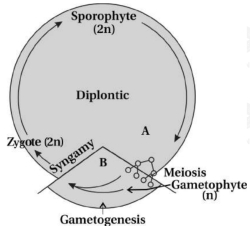
What is a diplontic life cycle? Explain through a chart.
Solution
(N/A) In a diplontic life cycle,the diploid sporophyte is the dominant,photosynthetic,and independent phase of the plant. The gametophytic phase is represented by a single to few-celled haploid gametophyte.
Key features of the diplontic life cycle include:
$1$. The sporophyte $(2n)$ undergoes meiosis to produce haploid spores $(n)$.
$2$. These spores germinate to form the gametophyte $(n)$.
$3$. The gametophyte produces gametes through gametogenesis.
$4$. Syngamy (fusion of gametes) results in the formation of a diploid zygote $(2n)$,which develops back into the sporophyte.
All seed-bearing plants,i.e.,all gymnosperms and angiosperms,follow this pattern.
Key features of the diplontic life cycle include:
$1$. The sporophyte $(2n)$ undergoes meiosis to produce haploid spores $(n)$.
$2$. These spores germinate to form the gametophyte $(n)$.
$3$. The gametophyte produces gametes through gametogenesis.
$4$. Syngamy (fusion of gametes) results in the formation of a diploid zygote $(2n)$,which develops back into the sporophyte.
All seed-bearing plants,i.e.,all gymnosperms and angiosperms,follow this pattern.
0 likes
View Solution52
Easy
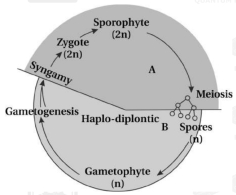
Provide an explanation of the haplo-diplontic life cycles in bryophytes and pteridophytes.
Solution
(N/A) $\rightarrow$ Bryophytes and pteridophytes exhibit an intermediate condition known as the haplo-diplontic life cycle. In this cycle,both the haploid and diploid phases are multicellular,but they differ in their dominant phases.
$\rightarrow$ In bryophytes,the dominant,independent,photosynthetic,thalloid or erect phase is the haploid gametophyte. It alternates with a short-lived,multicellular sporophyte that is totally or partially dependent on the gametophyte for its anchorage and nutrition.
$\rightarrow$ In pteridophytes,the diploid sporophyte is the dominant,independent,photosynthetic,vascular plant body. It alternates with a multicellular,saprophytic or autotrophic,independent,but short-lived haploid gametophyte. This pattern of alternation between a multicellular haploid phase and a multicellular diploid phase is termed the haplo-diplontic life cycle.
$\rightarrow$ In bryophytes,the dominant,independent,photosynthetic,thalloid or erect phase is the haploid gametophyte. It alternates with a short-lived,multicellular sporophyte that is totally or partially dependent on the gametophyte for its anchorage and nutrition.
$\rightarrow$ In pteridophytes,the diploid sporophyte is the dominant,independent,photosynthetic,vascular plant body. It alternates with a multicellular,saprophytic or autotrophic,independent,but short-lived haploid gametophyte. This pattern of alternation between a multicellular haploid phase and a multicellular diploid phase is termed the haplo-diplontic life cycle.
0 likes
View Solution53
Easy
Provide definitions/explanations for the following terms:
$(i)$ Alternation of generation
$(ii)$ Fungus
$(i)$ Alternation of generation
$(ii)$ Fungus
Solution
(N/A) $(i)$ Alternation of generation: It is a life cycle that occurs in those plants and algae in the distinct multicellular forms,which occur in two generations: the haploid gametophyte $(n)$ and the diploid sporophyte $(2n)$. These generations alternate with each other during the life cycle.
$(ii)$ Fungus: Fungi are a unique kingdom of heterotrophic organisms. They are eukaryotic,achlorophyllous,and mostly multicellular (except yeast). They have cell walls made of chitin and obtain nutrients through absorption (saprophytic,parasitic,or symbiotic).
$(ii)$ Fungus: Fungi are a unique kingdom of heterotrophic organisms. They are eukaryotic,achlorophyllous,and mostly multicellular (except yeast). They have cell walls made of chitin and obtain nutrients through absorption (saprophytic,parasitic,or symbiotic).
0 likes
View Solution54
Medium
Define the following terms:
$(i)$ Prothallus
$(ii)$ Alternation of generation
$(i)$ Prothallus
$(ii)$ Alternation of generation
Solution
(N/A) $(i)$ In $Pteridophytes$,spores produced by meiosis germinate to form small,multicellular,free-living,and photosynthetic gametophytes,which are called $Prothallus$.
$(ii)$ In plants,the life cycle involves an alternation between a haploid gametophytic stage (producing gametes) and a diploid sporophytic stage (producing spores). This phenomenon is known as $Alternation$ $of$ $generation$.
$(ii)$ In plants,the life cycle involves an alternation between a haploid gametophytic stage (producing gametes) and a diploid sporophytic stage (producing spores). This phenomenon is known as $Alternation$ $of$ $generation$.
0 likes
View Solution55
Medium
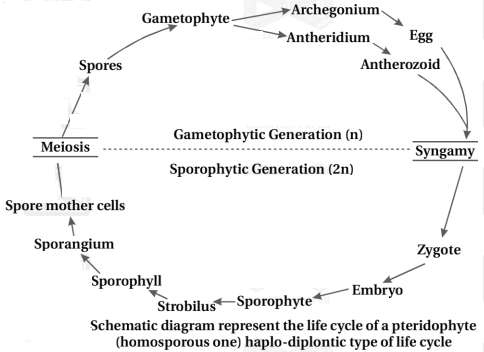
With the help of a schematic diagram,describe the haplo-diplontic life cycle pattern of a plant group.
Solution
(N/A) The haplo-diplontic life cycle is characterized by the alternation between a multicellular haploid gametophytic phase and a multicellular diploid sporophytic phase.
This pattern is observed in bryophytes and pteridophytes.
$1$. Gametophytic phase $(n)$: This phase is haploid and produces male and female gametes through mitosis. The male sex organ is the antheridium (producing antherozoids) and the female sex organ is the archegonium (producing an egg).
$2$. Syngamy: The fusion of the male gamete (antherozoid) and the female gamete (egg) results in the formation of a diploid zygote $(2n)$.
$3$. Sporophytic phase $(2n)$: The zygote undergoes mitosis to develop into a multicellular diploid sporophyte. The sporophyte produces sporangia,which contain spore mother cells.
$4$. Meiosis: The spore mother cells undergo meiosis to produce haploid spores $(n)$,which germinate to form a new gametophyte,thus completing the cycle.
This alternation of generations is a hallmark of the plant life cycle.
This pattern is observed in bryophytes and pteridophytes.
$1$. Gametophytic phase $(n)$: This phase is haploid and produces male and female gametes through mitosis. The male sex organ is the antheridium (producing antherozoids) and the female sex organ is the archegonium (producing an egg).
$2$. Syngamy: The fusion of the male gamete (antherozoid) and the female gamete (egg) results in the formation of a diploid zygote $(2n)$.
$3$. Sporophytic phase $(2n)$: The zygote undergoes mitosis to develop into a multicellular diploid sporophyte. The sporophyte produces sporangia,which contain spore mother cells.
$4$. Meiosis: The spore mother cells undergo meiosis to produce haploid spores $(n)$,which germinate to form a new gametophyte,thus completing the cycle.
This alternation of generations is a hallmark of the plant life cycle.
0 likes
View Solution56
Medium
Give an example of plants with:
$(a)$ Haplontic life cycle
$(b)$ Diplontic life cycle
$(c)$ Haplo-diplontic life cycle
$(a)$ Haplontic life cycle
$(b)$ Diplontic life cycle
$(c)$ Haplo-diplontic life cycle
Solution
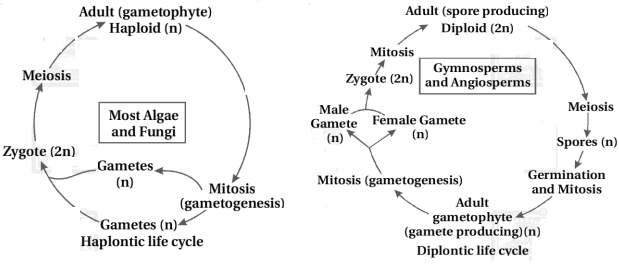
(N/A) Haplontic life cycle: It is seen in Volvox,Spirogyra,and Chlamydomonas. In this cycle,the sporophytic generation is represented only by the one-celled zygote. There are no free-living sporophytes. Meiosis in the zygote results in haploid spores that divide mitotically to form the gametophyte.
$(b)$ Diplontic life cycle: It is seen in gymnosperms and angiosperms. The diploid sporophyte is the dominant,photosynthetic,and independent phase of the plant. The gametophytic phase is represented by the single to few-celled haploid gametophyte.
$(c)$ Haplo-diplontic life cycle: It is seen in bryophytes and pteridophytes. Both phases are multicellular and often free-living,though they differ in their dominant phase. In bryophytes,the dominant phase is the gametophyte,while in pteridophytes,the dominant phase is the sporophyte.
$(b)$ Diplontic life cycle: It is seen in gymnosperms and angiosperms. The diploid sporophyte is the dominant,photosynthetic,and independent phase of the plant. The gametophytic phase is represented by the single to few-celled haploid gametophyte.
$(c)$ Haplo-diplontic life cycle: It is seen in bryophytes and pteridophytes. Both phases are multicellular and often free-living,though they differ in their dominant phase. In bryophytes,the dominant phase is the gametophyte,while in pteridophytes,the dominant phase is the sporophyte.
0 likes
View Solution57
MediumMCQ
Which of the following statements is correct about the gametophytic stage in the alternation of generations within the life cycle?
A
Generation that produces the gametes
B
Generation that produces the spores
C
Generation that produces vascular tissue
D
The diploid generation
Solution
(A) The gametophyte is the haploid,multicellular stage in the life cycle of many plants that produces gametes. It begins with the germination of haploid spores and ends at fertilization,where the fusion of gametes forms a diploid zygote.
0 likes
View Solution58
MediumMCQ
In haplontic life cycle,the dominant generation is
A
Sporophyte
B
Gametophyte
C
Both $(a)$ and $(b)$
D
None of the above
Solution
(B) In a haplontic life cycle,the gametophyte is the dominant,free-living,and photosynthetic phase.
The sporophyte generation is represented only by a single-celled zygote,which undergoes meiosis to produce haploid spores.
Examples of organisms with a haplontic life cycle include:
$(i)$ Most fungi
$(ii)$ Some green algae,e.g.,$Chlamydomonas$
$(iii)$ Many Protozoa,e.g.,$Plasmodium$
The sporophyte generation is represented only by a single-celled zygote,which undergoes meiosis to produce haploid spores.
Examples of organisms with a haplontic life cycle include:
$(i)$ Most fungi
$(ii)$ Some green algae,e.g.,$Chlamydomonas$
$(iii)$ Many Protozoa,e.g.,$Plasmodium$
0 likes
View Solution59
MediumMCQ
In the alternation of generations,the sporophytic generation is ...$A$... and the gametophytic generation is ...$B$.... Here $A$ and $B$ refer to:
A
$A - 2n; B - n$
B
$A - n; B - 2n$
C
$A - n; B - n$
D
$A - 2n; B - 2n$
Solution
(A) In the life cycle of plants,alternation of generations occurs between two distinct phases: the sporophytic generation and the gametophytic generation.
$1$. The sporophytic generation is diploid $(2n)$,meaning it contains two sets of chromosomes. It produces spores through meiosis.
$2$. The gametophytic generation is haploid $(n)$,meaning it contains a single set of chromosomes. It produces gametes through mitosis.
Therefore,$A$ refers to $2n$ and $B$ refers to $n$.
$1$. The sporophytic generation is diploid $(2n)$,meaning it contains two sets of chromosomes. It produces spores through meiosis.
$2$. The gametophytic generation is haploid $(n)$,meaning it contains a single set of chromosomes. It produces gametes through mitosis.
Therefore,$A$ refers to $2n$ and $B$ refers to $n$.
0 likes
View Solution60
MediumMCQ
Which of the following statements is true about the sporophytic stage in the plant life cycle?
A
The haploid generation
B
Generation that produces the gametes
C
Generation that produces the spores
D
Generation that produces vascular tissue
Solution
(C) The plant life cycle involves an alternation of generations between a sporophyte and a gametophyte.
The sporophytic stage is the diploid $(2n)$ phase of the plant life cycle.
This stage is responsible for producing spores through the process of meiosis.
These spores subsequently germinate to form the gametophyte generation.
The sporophytic stage is the diploid $(2n)$ phase of the plant life cycle.
This stage is responsible for producing spores through the process of meiosis.
These spores subsequently germinate to form the gametophyte generation.
0 likes
View Solution61
MediumMCQ
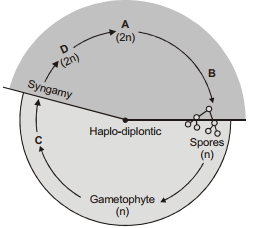
Identify the labels $A, B, C$ and $D$ in the figure given below representing the haplo-diplontic life cycle.
A
$A$ - Sporophyte; $B$ - Meiosis; $C$ - Gametogenesis; $D$ - Endosperm
B
$A$ - Sporophyte; $B$ - Mitosis; $C$ - Gametogenesis; $D$ - Zygote
C
$A$ - Gametophyte; $B$ - Meiosis; $C$ - Gametogenesis; $D$ - Zygote
D
$A$ - Sporophyte; $B$ - Meiosis; $C$ - Gametogenesis; $D$ - Zygote
Solution
(D) The provided figure represents the haplo-diplontic life cycle found in plants like bryophytes and pteridophytes.
$A$ represents the $2n$ (diploid) phase,which is the Sporophyte.
$B$ represents the process where the diploid sporophyte produces haploid spores,which is Meiosis.
$C$ represents the process where the haploid gametophyte produces gametes,which is Gametogenesis.
$D$ represents the diploid cell formed after syngamy,which is the Zygote $(2n)$.
$A$ represents the $2n$ (diploid) phase,which is the Sporophyte.
$B$ represents the process where the diploid sporophyte produces haploid spores,which is Meiosis.
$C$ represents the process where the haploid gametophyte produces gametes,which is Gametogenesis.
$D$ represents the diploid cell formed after syngamy,which is the Zygote $(2n)$.
0 likes
View Solution62
MediumMCQ
$A$: Different plant groups show different patterns of life cycles.
$R$: During the life cycle,there is an alternation of generation between a diploid gametophyte and a haploid sporophyte.
$R$: During the life cycle,there is an alternation of generation between a diploid gametophyte and a haploid sporophyte.
A
Assertion and Reason both are correct and Reason is the correct explanation of Assertion.
B
Assertion and Reason both are correct but Reason is not the correct explanation of Assertion.
C
Assertion is correct,but Reason is incorrect.
D
Both Assertion and Reason are incorrect.
Solution
(C) The Assertion is correct because different plant groups (like algae,bryophytes,pteridophytes,gymnosperms,and angiosperms) exhibit distinct life cycle patterns such as haplontic,diplontic,or haplo-diplontic.
However,the Reason is incorrect because the alternation of generation occurs between a haploid gametophyte $(n)$ and a diploid sporophyte $(2n)$,not the other way around. In plants,the gametophyte is haploid and the sporophyte is diploid.
However,the Reason is incorrect because the alternation of generation occurs between a haploid gametophyte $(n)$ and a diploid sporophyte $(2n)$,not the other way around. In plants,the gametophyte is haploid and the sporophyte is diploid.
0 likes
View Solution63
MediumMCQ
Read the following statement carefully: "Further development of zygote depends on the type of life cycle the organism has and the environment it is exposed to." Identify the correctly matched pair with respect to the above statement.
A
Thick-walled zygote - Haplontic life cycle
B
Zygote forms new generation by mitosis - Haplodiplontic life cycle
C
Zygote undergoes meiosis to form haploid generation - Diplontic life cycle
D
Zygote forms multicellular diploid generation - Haplontic life cycle
Solution
(A) In organisms with a haplontic life cycle, the zygote develops a thick wall to withstand adverse environmental conditions (zygospore).
It then undergoes meiosis to produce haploid spores, which grow into haploid individuals.
Therefore, the pair 'Thick-walled zygote - Haplontic life cycle' is correctly matched.
It then undergoes meiosis to produce haploid spores, which grow into haploid individuals.
Therefore, the pair 'Thick-walled zygote - Haplontic life cycle' is correctly matched.
0 likes
View Solution64
MediumMCQ
What is the dominant phase in Gymnosperms and Angiosperms?
A
Gametophyte $\quad\quad$ Sporophyte
B
Sporophyte $\quad\quad$ Gametophyte
C
Gametophyte $\quad\quad$ Gametophyte
D
Sporophyte $\quad\quad$ Sporophyte
Solution
(D) In the life cycle of plants,the dominant phase is the one that is independent,photosynthetic,and long-lived.
In both Gymnosperms and Angiosperms,the plant body is a sporophyte.
The sporophyte is diploid $(2n)$ and represents the dominant phase of the life cycle.
The gametophyte is highly reduced and dependent on the sporophyte for nutrition and support.
Therefore,both Gymnosperms and Angiosperms have a sporophyte as their dominant phase.
In both Gymnosperms and Angiosperms,the plant body is a sporophyte.
The sporophyte is diploid $(2n)$ and represents the dominant phase of the life cycle.
The gametophyte is highly reduced and dependent on the sporophyte for nutrition and support.
Therefore,both Gymnosperms and Angiosperms have a sporophyte as their dominant phase.
0 likes
View Solution65
MediumMCQ
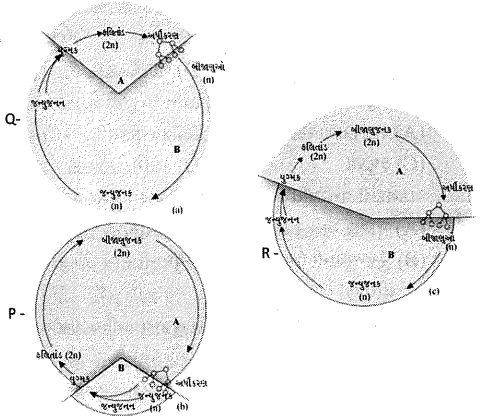
Identify the life cycles given below.
A
$Diplontic, Haplodiplontic, Haplontic$
B
$Diplontic, Haplontic, Haplodiplontic$
C
$Haplodiplontic, Haplontic, Diplontic$
D
$Diplontic, Haplodiplontic, Haplontic$
Solution
(D) The provided image shows three types of plant life cycles:
$1$. Cycle $P$ represents the $Diplontic$ life cycle,where the diploid sporophyte is the dominant,photosynthetic,and independent phase.
$2$. Cycle $Q$ represents the $Haplodiplontic$ life cycle,where both haploid and diploid phases are multicellular and often free-living.
$3$. Cycle $R$ represents the $Haplontic$ life cycle,where the haploid gametophyte is the dominant,photosynthetic,and free-living phase,while the sporophyte is represented by a single-celled zygote.
Therefore,the correct sequence is $Diplontic (P), Haplodiplontic (Q), Haplontic (R)$.
$1$. Cycle $P$ represents the $Diplontic$ life cycle,where the diploid sporophyte is the dominant,photosynthetic,and independent phase.
$2$. Cycle $Q$ represents the $Haplodiplontic$ life cycle,where both haploid and diploid phases are multicellular and often free-living.
$3$. Cycle $R$ represents the $Haplontic$ life cycle,where the haploid gametophyte is the dominant,photosynthetic,and free-living phase,while the sporophyte is represented by a single-celled zygote.
Therefore,the correct sequence is $Diplontic (P), Haplodiplontic (Q), Haplontic (R)$.
0 likes
View Solution66
MediumMCQ
Match the following columns:
| Column-$I$ (Life Cycles) | Column-$II$ |
|---|---|
| $P$. Haplontic | $I$. Volvox,Spirogyra,Chlamydomonas |
| $Q$. Diplontic | $II$. Gymnosperms,Angiosperms |
| $R$. Haplo-diplontic | $III$. Bryophytes,Pteridophytes |
A
$(P-I), (Q-II), (R-III)$
B
$(P-I), (Q-III), (R-II)$
C
$(P-II), (Q-I), (R-III)$
D
$(P-II), (Q-III), (R-I)$
Solution
(A) The correct matches are as follows:
$1$. Haplontic life cycle: In this type,the sporophytic generation is represented only by the one-celled zygote. There are no free-living sporophytes. Examples include Volvox,Spirogyra,and some species of Chlamydomonas. Thus,$P-I$.
$2$. Diplontic life cycle: In this type,the diploid sporophyte is the dominant,photosynthetic,independent phase of the plant. The gametophytic phase is represented by the single to few-celled haploid gametophyte. All seed-bearing plants (Gymnosperms and Angiosperms) follow this pattern. Thus,$Q-II$.
$3$. Haplo-diplontic life cycle: This is an intermediate condition where both phases are multicellular and often free-living. Bryophytes and Pteridophytes exhibit this pattern. Thus,$R-III$.
Therefore,the correct matching is $(P-I), (Q-II), (R-III)$.
$1$. Haplontic life cycle: In this type,the sporophytic generation is represented only by the one-celled zygote. There are no free-living sporophytes. Examples include Volvox,Spirogyra,and some species of Chlamydomonas. Thus,$P-I$.
$2$. Diplontic life cycle: In this type,the diploid sporophyte is the dominant,photosynthetic,independent phase of the plant. The gametophytic phase is represented by the single to few-celled haploid gametophyte. All seed-bearing plants (Gymnosperms and Angiosperms) follow this pattern. Thus,$Q-II$.
$3$. Haplo-diplontic life cycle: This is an intermediate condition where both phases are multicellular and often free-living. Bryophytes and Pteridophytes exhibit this pattern. Thus,$R-III$.
Therefore,the correct matching is $(P-I), (Q-II), (R-III)$.
0 likes
View Solution67
MediumMCQ
In which type of life cycle is the sporophyte generation limited to the zygote?
A
Haplontic life cycle
B
Diplontic life cycle
C
Haplodiplontic life cycle
D
All of the above
Solution
(A) In a $Haplontic$ life cycle,the dominant phase is the free-living gametophyte $(n)$.
The sporophyte generation is represented only by the single-celled zygote $(2n)$,which undergoes meiosis to produce haploid spores.
This type of life cycle is commonly observed in many algae,such as $Volvox$ and $Spirogyra$.
The sporophyte generation is represented only by the single-celled zygote $(2n)$,which undergoes meiosis to produce haploid spores.
This type of life cycle is commonly observed in many algae,such as $Volvox$ and $Spirogyra$.
0 likes
View Solution68
MediumMCQ
In this life cycle,the zygote undergoes meiosis immediately.
A
Haplontic
B
Diplontic
C
Haplo-diplontic
D
All of the above
Solution
(A) In a $Haplontic$ life cycle,the dominant phase is the free-living gametophyte $(n)$.
The zygote $(2n)$ is the only diploid stage in the life cycle.
It undergoes meiosis immediately to form haploid spores,which then germinate to produce the gametophyte.
This type of life cycle is characteristic of many algae,such as $Volvox$ and $Spirogyra$.
The zygote $(2n)$ is the only diploid stage in the life cycle.
It undergoes meiosis immediately to form haploid spores,which then germinate to produce the gametophyte.
This type of life cycle is characteristic of many algae,such as $Volvox$ and $Spirogyra$.
0 likes
View Solution69
MediumMCQ
Select the correct option regarding the zygote in organisms exhibiting a haplontic life cycle.
A
The zygote provides the ability to survive in adverse conditions.
B
The sporophytic stage is limited only to the zygote.
C
Meiosis of the zygote produces haploid spores that develop into haploid algae.
D
All of the above.
Solution
(D) In organisms with a haplontic life cycle,the main plant body is haploid $(n)$. During sexual reproduction,the fusion of male and female gametes results in the formation of a diploid $(2n)$ zygote. This zygote develops a thick wall to survive in adverse conditions. In this life cycle,the sporophytic stage is limited only to the zygote. Subsequently,the zygote undergoes meiosis,resulting in the production of haploid spores,which germinate to form the haploid plant body again. Therefore,all the given options are correct.
0 likes
View SolutionPlant Kingdom — Plant Life Cycles and Alternation of Generations · Frequently Asked Questions
1Are these Plant Kingdom questions useful for JEE and NEET?
Yes. All questions in this section are mapped to JEE Main and NEET exam patterns. Previous year questions from JEE Main, NEET, GUJCET and state-level exams are included with full solutions.
2Can I switch to Hindi or Gujarati for these questions?
Yes. Use the language tabs in the hero section or the sidebar to view the same questions and solutions in English, Hindi or Gujarati.
3How do I generate a question paper from this subtopic?
Use the Vedclass Exam Paper Generator — select the chapter and subtopic, set difficulty, and generate Sets A, B, C, D automatically. First 3 chapters of every subject are free.
Vedclass Products
For Students
Vedclass Test Series
Mock tests in real JEE/NEET style with performance analysis. 5-day free trial.
Start Free TrialFor Teachers
Exam Paper Generator
Generate Set A/B/C/D papers from this chapter in 2 minutes. 3 chapters free.
Try FreeFor Institutes
Online Exam Module
Live online exams with unlimited students, 360° analytics & white-label branding.
See DemoFor Teachers & Institutes
Generate a Plant Kingdom Exam Paper in 2 Minutes
Select subtopic & difficulty — Sets A, B, C, D auto-generated with No Repeat logic.
First 3 chapters of every subject are free — no payment required.