
A English
Plant Life Cycles and Alternation of Generations Questions in English
Class 11 Biology · Plant Kingdom · Plant Life Cycles and Alternation of Generations
69+
Questions
English
Language
100%
With Solutions
Showing 49 of 69 questions in English
1
EasyMCQ
Formation of a sporophyte from a gametophyte and vice versa is termed as:
A
Sexual reproduction
B
Asexual reproduction
C
Alternation of generation
D
Transformation
Solution
(C) The life cycle of plants involves two distinct phases: the haploid gametophyte and the diploid sporophyte. The process where these two phases alternate with each other during the life cycle of an organism is known as $Alternation \ of \ generation$. In this cycle, the sporophyte produces spores through meiosis, which develop into the gametophyte, and the gametophyte produces gametes that fuse to form the sporophyte.
0 likes
View Solution2
EasyMCQ
The development of a gametophyte from the vegetative parts of a sporophyte without the intervention of spores is called:
A
Parthenocarpy
B
Parthenogenesis
C
Apogamy
D
Apospory
Solution
(D) The development of a gametophyte directly from the vegetative cells of a sporophyte,bypassing the formation of spores,is known as $Apospory$.
In contrast,$Apogamy$ refers to the development of a sporophyte directly from the gametophyte cells without fertilization.
$Parthenocarpy$ is the development of fruit without fertilization.
$Parthenogenesis$ is the development of an embryo from an unfertilized egg.
In contrast,$Apogamy$ refers to the development of a sporophyte directly from the gametophyte cells without fertilization.
$Parthenocarpy$ is the development of fruit without fertilization.
$Parthenogenesis$ is the development of an embryo from an unfertilized egg.
0 likes
View Solution3
EasyMCQ
In a haplontic life cycle,the zygote divides by meiosis to form which type of nuclei before germination?
A
Two haploid
B
Three diploid
C
Four haploid
D
Four diploid
Solution
(C) In a haplontic life cycle (e.g.,in many algae like $Volvox$,$Spirogyra$,and some species of $Chlamydomonas$),the dominant phase is the haploid gametophyte $(n)$.
$1$. The fusion of gametes results in the formation of a diploid zygote $(2n)$.
$2$. The zygote does not undergo mitosis to form a multicellular sporophyte; instead,it undergoes meiosis (reduction division) to restore the haploid state.
$3$. This meiotic division of the zygote results in the formation of $4$ haploid nuclei (or cells) which then germinate to form new haploid individuals.
Therefore,the correct option is $C$.
$1$. The fusion of gametes results in the formation of a diploid zygote $(2n)$.
$2$. The zygote does not undergo mitosis to form a multicellular sporophyte; instead,it undergoes meiosis (reduction division) to restore the haploid state.
$3$. This meiotic division of the zygote results in the formation of $4$ haploid nuclei (or cells) which then germinate to form new haploid individuals.
Therefore,the correct option is $C$.
0 likes
View Solution4
EasyMCQ
Which of the following plants exhibits a haplontic life cycle?
A
Ectocarpus
B
Moss
C
Fern
D
Volvox
Solution
(D) In a haplontic life cycle,the dominant phase is the free-living gametophyte $(n)$. The sporophyte generation is represented only by the one-celled zygote $(2n)$.
Meiosis occurs in the zygote to form haploid spores,which grow into gametophytes.
Among the given options,$Volvox$ is a green alga that exhibits a haplontic life cycle.
$Ectocarpus$ exhibits a haplodiplontic life cycle,while mosses (bryophytes) and ferns (pteridophytes) exhibit a diplohaplontic (haplodiplontic) life cycle.
Meiosis occurs in the zygote to form haploid spores,which grow into gametophytes.
Among the given options,$Volvox$ is a green alga that exhibits a haplontic life cycle.
$Ectocarpus$ exhibits a haplodiplontic life cycle,while mosses (bryophytes) and ferns (pteridophytes) exhibit a diplohaplontic (haplodiplontic) life cycle.
0 likes
View Solution5
EasyMCQ
In which of the following is the alternation of generations $NOT$ observed?
A
Haplontic life cycle
B
Diplontic life cycle
C
Haplo-diplontic life cycle
D
None of the above
Solution
(D) Alternation of generations refers to the shift between the haploid gametophyte and the diploid sporophyte phases in the life cycle of plants.
In the $Haplontic$ life cycle,the sporophyte generation is represented only by the one-celled zygote,and there is no free-living sporophyte; however,the process of meiosis and fertilization still occurs,meaning alternation of generations is technically present.
In the $Diplontic$ life cycle,the gametophyte is reduced to a few cells,but alternation still occurs.
In the $Haplo-diplontic$ life cycle,both phases are multicellular and free-living.
Since all these life cycles involve an alternation between haploid and diploid phases,the correct answer is that alternation of generations is observed in all of them. Therefore,the option 'None of the above' is the correct choice.
In the $Haplontic$ life cycle,the sporophyte generation is represented only by the one-celled zygote,and there is no free-living sporophyte; however,the process of meiosis and fertilization still occurs,meaning alternation of generations is technically present.
In the $Diplontic$ life cycle,the gametophyte is reduced to a few cells,but alternation still occurs.
In the $Haplo-diplontic$ life cycle,both phases are multicellular and free-living.
Since all these life cycles involve an alternation between haploid and diploid phases,the correct answer is that alternation of generations is observed in all of them. Therefore,the option 'None of the above' is the correct choice.
0 likes
View Solution6
EasyMCQ
What is the phenomenon of the alternating occurrence of the gametophytic and sporophytic generations called?
A
Conjugation
B
Gametogenesis
C
Alternation of generations
D
Syngamy
Solution
(C) In the life cycle of plants, the haploid gametophyte $(n)$ produces gametes by mitosis, which fuse to form a diploid zygote. The zygote develops into a diploid sporophyte $(2n)$, which produces haploid spores by meiosis. These spores germinate to form a new gametophyte. This cycle of alternating between the haploid gametophytic generation and the diploid sporophytic generation is known as the $\text{Alternation of generations}$.
0 likes
View Solution7
MediumMCQ
Which of the following characteristics is false for a diplontic life cycle?
A
The main plant body is gametophytic.
B
Fusion of gametes results in a diploid zygote.
C
Bryophytes and Pteridophytes follow this pattern.
D
The gametophyte alternates with the sporophyte.
Solution
(A) In a diplontic life cycle,the dominant phase is the diploid sporophyte $(2n)$. The gametophytic phase is highly reduced and represented by single-celled or few-celled gametes. Option $(A)$ is false because the main plant body is sporophytic,not gametophytic. Option $(C)$ is also false as Bryophytes and Pteridophytes exhibit a haplodiplontic life cycle. However,in the context of standard biology questions,option $(A)$ is the primary characteristic that defines the falsity regarding the dominant phase of a diplontic cycle.
0 likes
View Solution8
MediumMCQ
Which of the following statements is incorrect regarding the diplontic life cycle?
A
The gametophytic phase is short-lived and reduced.
B
The sporophytic phase is photosynthetic and independent.
C
Fucus algae exhibit a diplontic life cycle.
D
Bryophytes and Pteridophytes follow this pattern.
Solution
(D) In a diplontic life cycle,the diploid sporophyte is the dominant,photosynthetic,and independent phase of the plant. The gametophytic phase is represented by a single to few-celled haploid gametophyte. Fucus (an alga) is a classic example of this cycle. However,Bryophytes and Pteridophytes do not follow the diplontic life cycle; they exhibit haplodiplontic life cycles (haplo-diplontic). Therefore,statement $D$ is incorrect.
0 likes
View Solution9
EasyMCQ
Which feature is inconsistent with the haplontic life cycle?
A
Gametophytic phase is dominant and photosynthetic.
B
Zygote undergoes meiosis to form haploid spores.
C
It is found in gymnosperms and angiosperms.
D
Haploid and diploid phases alternate with each other.
Solution
(C) In a haplontic life cycle,the sporophytic generation is represented only by the one-celled zygote. There are no free-living sporophytes. Meiosis in the zygote results in the formation of haploid spores,which divide mitotically to form the gametophyte. This type of life cycle is characteristic of many algae like Volvox and Spirogyra. Gymnosperms and angiosperms,however,exhibit a diplontic life cycle where the diploid sporophyte is the dominant,independent,and photosynthetic phase. Therefore,option $C$ is inconsistent with the haplontic life cycle.
0 likes
View Solution10
MediumMCQ
Which of the following exhibits alternation of generations in their life cycle?
A
Gymnosperms
B
Pteridophytes
C
Bryophytes
D
All of the above
Solution
(D) Alternation of generations is a characteristic feature of the plant life cycle where a haploid gametophyte $(n)$ alternates with a diploid sporophyte $(2n)$.
$1$. In Bryophytes,the dominant phase is the gametophyte,and the sporophyte is dependent on it.
$2$. In Pteridophytes,the dominant phase is the sporophyte,and both phases are independent.
$3$. In Gymnosperms,the dominant phase is the sporophyte,and the gametophyte is highly reduced and dependent on the sporophyte.
Since all these plant groups exhibit this phenomenon in varying degrees,the correct answer is $D$.
$1$. In Bryophytes,the dominant phase is the gametophyte,and the sporophyte is dependent on it.
$2$. In Pteridophytes,the dominant phase is the sporophyte,and both phases are independent.
$3$. In Gymnosperms,the dominant phase is the sporophyte,and the gametophyte is highly reduced and dependent on the sporophyte.
Since all these plant groups exhibit this phenomenon in varying degrees,the correct answer is $D$.
0 likes
View Solution11
MediumMCQ
Which of the following exhibits a haplontic life cycle?
A
Polytrichum
B
Ustilago
C
Wheat
D
Funaria (Moss)
Solution
(B) In a haplontic life cycle,the dominant phase is the free-living gametophyte $(n)$. The sporophyte generation $(2n)$ is represented only by the zygote,which undergoes meiosis to produce haploid spores. Among the given options,$Ustilago$ (a fungus) exhibits a haplontic life cycle. $Polytrichum$,$Wheat$,and $Funaria$ exhibit a diplohaplontic (haplodiplontic) life cycle where both gametophytic and sporophytic phases are multicellular.
0 likes
View Solution12
MediumMCQ
The most prominent alternation of generations is observed in $..........$.
A
Thallophyta
B
Bryophyta
C
Pteridophyta
D
Spermatophyta
Solution
(C) In the plant kingdom, the life cycle involves an alternation between a haploid gametophyte and a diploid sporophyte.
In $Bryophyta$, the gametophyte is the dominant, independent phase, while the sporophyte is dependent on it.
In $Pteridophyta$, the sporophyte is the dominant, independent, and photosynthetic phase, which represents a significant evolutionary advancement.
In $Spermatophyta$ (Gymnosperms and Angiosperms), the sporophyte is even more dominant, but the gametophyte is highly reduced.
Therefore, $Pteridophyta$ is often cited as the group where the alternation of generations is most clearly and prominently observed as a transition between two independent phases.
In $Bryophyta$, the gametophyte is the dominant, independent phase, while the sporophyte is dependent on it.
In $Pteridophyta$, the sporophyte is the dominant, independent, and photosynthetic phase, which represents a significant evolutionary advancement.
In $Spermatophyta$ (Gymnosperms and Angiosperms), the sporophyte is even more dominant, but the gametophyte is highly reduced.
Therefore, $Pteridophyta$ is often cited as the group where the alternation of generations is most clearly and prominently observed as a transition between two independent phases.
0 likes
View Solution13
MediumMCQ
In which of the following is sporic meiosis observed?
A
Animals
B
Thallophytes
C
Bryophytes
D
All plants except Thallophytes
Solution
(D) Sporic meiosis (also known as intermediate meiosis) is a characteristic feature of the life cycle of plants.
In this process,the diploid sporophyte undergoes meiosis to produce haploid spores.
These spores then germinate to form a haploid gametophyte.
This type of life cycle is observed in all plants except for the algae (Thallophytes),which typically exhibit zygotic meiosis.
In this process,the diploid sporophyte undergoes meiosis to produce haploid spores.
These spores then germinate to form a haploid gametophyte.
This type of life cycle is observed in all plants except for the algae (Thallophytes),which typically exhibit zygotic meiosis.
0 likes
View Solution14
MediumMCQ
What is the name of the meiosis that occurs during spore formation?
A
Zygotic meiosis
B
Haploid meiosis
C
Sporic meiosis
D
Intermediate meiosis
Solution
(C) In plants,the life cycle involves an alternation of generations between a diploid sporophyte and a haploid gametophyte.
Meiosis occurs during the formation of spores from the diploid sporophyte mother cells.
This type of meiosis,which results in the production of haploid spores,is known as sporic meiosis or intermediate meiosis.
Therefore,the correct term for meiosis occurring during spore formation is sporic meiosis.
Meiosis occurs during the formation of spores from the diploid sporophyte mother cells.
This type of meiosis,which results in the production of haploid spores,is known as sporic meiosis or intermediate meiosis.
Therefore,the correct term for meiosis occurring during spore formation is sporic meiosis.
0 likes
View Solution15
MediumMCQ
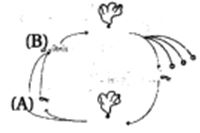
In the given figure,what do $''A''$ and $''B''$ represent respectively?
A
$2n, 2n$
B
$n, 2n$
C
$2n, n$
D
$n, n$
Solution
(B) The provided figure represents the life cycle of a typical alga (like Fucus) showing diplontic life cycle.
In this cycle,the main plant body is diploid $(2n)$.
$A$ represents the process of meiosis,which occurs in the diploid plant body to produce haploid $(n)$ gametes.
$B$ represents the process of fertilization (syngamy),where two haploid $(n)$ gametes fuse to form a diploid $(2n)$ zygote,which then develops into the diploid plant body.
Therefore,$A$ represents the haploid state $(n)$ resulting from meiosis,and $B$ represents the diploid state $(2n)$ resulting from fertilization.
Thus,the correct option is $B$.
In this cycle,the main plant body is diploid $(2n)$.
$A$ represents the process of meiosis,which occurs in the diploid plant body to produce haploid $(n)$ gametes.
$B$ represents the process of fertilization (syngamy),where two haploid $(n)$ gametes fuse to form a diploid $(2n)$ zygote,which then develops into the diploid plant body.
Therefore,$A$ represents the haploid state $(n)$ resulting from meiosis,and $B$ represents the diploid state $(2n)$ resulting from fertilization.
Thus,the correct option is $B$.
0 likes
View Solution16
EasyMCQ
What is the phenomenon of alternating generation between the gametophytic and sporophytic phases called?
A
Conjugation
B
Gametogenesis
C
Alternation of generations
D
Syngamy
Solution
(C) The life cycle of plants involves two distinct phases: the haploid gametophytic phase and the diploid sporophytic phase.
These two phases alternate with each other during the life cycle of the plant.
This phenomenon is known as the $Alternation of generations$.
These two phases alternate with each other during the life cycle of the plant.
This phenomenon is known as the $Alternation of generations$.
0 likes
View Solution17
EasyMCQ
In which of the following plants is a haplontic life cycle observed?
A
Fucus
B
Spirogyra
C
Maize
D
Gymnosperms
Solution
(B) In a haplontic life cycle,the sporophytic generation is represented only by the one-celled zygote. There are no free-living sporophytes. Meiosis in the zygote results in haploid spores,which divide mitotically to form the gametophyte. The dominant photosynthetic phase in such plants is the free-living gametophyte. Many algae,such as $Volvox$ and $Spirogyra$,and some species of $Chlamydomonas$ represent this pattern. $Fucus$ exhibits a diplontic life cycle,while maize and gymnosperms exhibit a diplontic life cycle.
0 likes
View Solution18
EasyMCQ
In a haplontic life cycle,out of the four haploid nuclei produced by the meiosis of a zygote...
A
One degenerates and the remaining three germinate into a plant body.
B
Two degenerate and the remaining two germinate into a plant body.
C
Three degenerate and the remaining one germinates into a plant body.
D
All four germinate into a plant body.
Solution
(C) In a haplontic life cycle (e.g.,in many algae like $Volvox$ and $Spirogyra$),the sporophytic generation is represented only by the one-celled zygote. There are no free-living sporophytes. Meiosis occurs in the zygote to form four haploid spores (or nuclei). In many cases,three of these nuclei degenerate,and only one remains functional to germinate and develop into a new haploid plant body.
0 likes
View Solution19
EasyMCQ
In a diplontic life cycle,the zygote:
A
Divides by meiosis.
B
Develops into a haploid sporophyte.
C
Develops into a diploid sporophyte.
D
Develops into a haploid gametophyte.
Solution
(C) In a diplontic life cycle,the dominant phase is the diploid sporophyte. The gametophytic phase is represented by a single to few-celled haploid gametophyte. The zygote undergoes mitosis to develop into a diploid sporophyte. Therefore,the correct option is $C$.
0 likes
View Solution20
EasyMCQ
In a haplontic life cycle,what type of division does the zygote undergo?
A
Mitosis
B
Meiosis
C
Amitosis
D
Equational division
Solution
(B) In a haplontic life cycle,the dominant phase is the haploid $(n)$ gametophyte.
The zygote $(2n)$ is the only diploid stage in the life cycle.
Since the organism must return to the haploid state to continue the cycle,the zygote undergoes meiosis (reduction division) to produce haploid spores.
These spores then germinate to form the haploid gametophyte.
The zygote $(2n)$ is the only diploid stage in the life cycle.
Since the organism must return to the haploid state to continue the cycle,the zygote undergoes meiosis (reduction division) to produce haploid spores.
These spores then germinate to form the haploid gametophyte.
0 likes
View Solution21
EasyMCQ
In all seed-bearing plants,the alternation of generations is of this type:
A
Haplontic life cycle
B
Diplontic life cycle
C
Haplodiplontic life cycle
D
Polyplontic life cycle
Solution
(B) In all seed-bearing plants (gymnosperms and angiosperms),the dominant phase is the diploid sporophyte $(2n)$.
The gametophytic phase is highly reduced and represented by only a few cells.
Since the diploid sporophyte is the main plant body and the gametophyte is dependent on it,this type of life cycle is known as the Diplontic life cycle.
The gametophytic phase is highly reduced and represented by only a few cells.
Since the diploid sporophyte is the main plant body and the gametophyte is dependent on it,this type of life cycle is known as the Diplontic life cycle.
0 likes
View Solution22
EasyMCQ
In this life cycle,the sporophytic phase is limited to the zygote.
A
Haplontic life cycle
B
Diplontic life cycle
C
Both haplontic and diplontic life cycles
D
Haplodiplontic life cycle
Solution
(A) In a haplontic life cycle,the dominant phase is the free-living gametophyte $(n)$.
The sporophytic generation is represented only by the single-celled zygote $(2n)$.
The zygote undergoes meiosis to produce haploid spores,which germinate to form the gametophyte.
Therefore,the sporophytic phase is limited to the zygote.
The sporophytic generation is represented only by the single-celled zygote $(2n)$.
The zygote undergoes meiosis to produce haploid spores,which germinate to form the gametophyte.
Therefore,the sporophytic phase is limited to the zygote.
0 likes
View Solution23
EasyMCQ
Which of the following types of alternation of generations is observed in plants?
A
Haplontic life cycle
B
Diplontic life cycle
C
Haplo-diplontic life cycle
D
All of the above
Solution
(D) In plants,both haploid and diploid cells can divide by mitosis. This ability leads to the formation of different plant bodies—haploid and diploid. The haploid plant body produces gametes by mitosis. This plant body represents a gametophyte. Following fertilization,the zygote also divides by mitosis to produce a diploid sporophytic plant body. Haploid spores are produced by this plant body by meiosis. Thus,during the life cycle of any sexually reproducing plant,there is an alternation of generations between gamete-producing haploid gametophyte and spore-producing diploid sporophyte. Depending on whether the haploid or diploid phases are dominant,plants exhibit different patterns: $1$. Haplontic life cycle,$2$. Diplontic life cycle,and $3$. Haplo-diplontic life cycle. Therefore,all these types are observed in plants.
0 likes
View Solution24
EasyMCQ
In a haplontic life cycle,the zygote undergoes meiosis to form which type of cells before germination?
A
Two haploid cells
B
Three diploid cells
C
Four haploid cells
D
Four diploid cells
Solution
(C) In a haplontic life cycle,the dominant phase is the haploid gametophyte $(n)$.
The zygote $(2n)$ is the only diploid stage in the life cycle.
Following fertilization,the zygote undergoes meiosis (reduction division) to produce haploid spores.
Typically,this process results in the formation of four haploid cells (spores) which then germinate to form new haploid gametophytes.
The zygote $(2n)$ is the only diploid stage in the life cycle.
Following fertilization,the zygote undergoes meiosis (reduction division) to produce haploid spores.
Typically,this process results in the formation of four haploid cells (spores) which then germinate to form new haploid gametophytes.
0 likes
View Solution25
EasyMCQ
In which type of plant life cycle is the diploid $(2n)$ phase limited to only the zygote?
A
Haplontic
B
Diplontic
C
Haplodiplontic
D
Diplohaplontic
Solution
(A) In a haplontic life cycle,the dominant phase is the haploid gametophyte $(n)$.
The diploid $(2n)$ phase is represented only by the zygote,which undergoes meiosis to produce haploid spores.
This type of life cycle is commonly observed in many algae,such as Volvox and Spirogyra,and some species of Chlamydomonas.
The diploid $(2n)$ phase is represented only by the zygote,which undergoes meiosis to produce haploid spores.
This type of life cycle is commonly observed in many algae,such as Volvox and Spirogyra,and some species of Chlamydomonas.
0 likes
View Solution26
MediumMCQ
In a haplontic life cycle,the zygote undergoes meiosis to form what kind of cells before germination?
A
Two haploid
B
Three diploid
C
Four haploid
D
Four diploid
Solution
(C) In a haplontic life cycle,the dominant phase is the gametophyte $(n)$. The zygote $(2n)$ is the only diploid stage. The zygote undergoes meiosis to produce four haploid $(n)$ spores. These spores then germinate to form the new gametophytic plant body. Therefore,the zygote divides by meiosis to form four haploid cells.
0 likes
View Solution27
MediumMCQ
Which of the following show alternation of generations in their life cycle?
A
Gymnosperms
B
Pteridophytes
C
Bryophytes
D
All of the above
Solution
(D) In plants,both haploid and diploid cells can divide by mitosis. This ability leads to the formation of different plant bodies—haploid and diploid. The haploid plant body produces gametes by mitosis and represents a gametophyte. Following fertilization,the zygote also divides by mitosis to produce a diploid sporophytic plant body. Haploid spores are produced by this plant body by meiosis. These in turn divide by mitosis to form a haploid plant body once again. Thus,during the life cycle of any sexually reproducing plant,there is an alternation of generations between gamete-producing haploid gametophyte and spore-producing diploid sporophyte. This phenomenon is observed in all plant groups including Bryophytes,Pteridophytes,Gymnosperms,and Angiosperms.
0 likes
View Solution28
EasyMCQ
Which of the following statements is $NOT$ false regarding the diplontic life cycle?
A
The gametophytic phase is short-lived and dependent.
B
The sporophytic phase is photosynthetic and independent.
C
Bryophytes and Pteridophytes follow this pattern.
D
The alga Fucus exhibits a diplontic life cycle.
Solution
(D) In a diplontic life cycle,the dominant phase is the diploid sporophyte $(2n)$.
$1$. The gametophytic phase is represented by single to few-celled haploid gametes,which are short-lived.
$2$. The sporophytic phase is the main,photosynthetic,and independent plant body.
$3$. Bryophytes and Pteridophytes exhibit a 'haplodiplontic' life cycle,making option $C$ incorrect.
$4$. The alga $Fucus$ is a classic example that exhibits a diplontic life cycle.
Since the question asks for the statement that is $NOT$ false (i.e.,true),options $A$,$B$,and $D$ are technically correct descriptions. However,in the context of standard biology curriculum,$D$ is the most definitive factual statement regarding the life cycle pattern of specific organisms.
$1$. The gametophytic phase is represented by single to few-celled haploid gametes,which are short-lived.
$2$. The sporophytic phase is the main,photosynthetic,and independent plant body.
$3$. Bryophytes and Pteridophytes exhibit a 'haplodiplontic' life cycle,making option $C$ incorrect.
$4$. The alga $Fucus$ is a classic example that exhibits a diplontic life cycle.
Since the question asks for the statement that is $NOT$ false (i.e.,true),options $A$,$B$,and $D$ are technically correct descriptions. However,in the context of standard biology curriculum,$D$ is the most definitive factual statement regarding the life cycle pattern of specific organisms.
0 likes
View Solution29
EasyMCQ
Which of the following characteristics is incorrect for a diplontic life cycle?
A
The main plant body is the gametophyte.
B
Fusion of gametes results in a diploid zygote.
C
Gymnosperms and angiosperms follow this pattern.
D
The gametophyte alternates with the sporophyte.
Solution
(A) In a $diplontic$ life cycle,the diploid $sporophyte$ is the dominant,photosynthetic,and independent phase of the plant.
The $gametophytic$ phase is represented by a single to few-celled gametophyte.
Option $A$ is incorrect because the main plant body in a $diplontic$ life cycle is the $sporophyte$,not the $gametophyte$.
Gymnosperms and angiosperms exhibit this type of life cycle.
The $gametophytic$ phase is represented by a single to few-celled gametophyte.
Option $A$ is incorrect because the main plant body in a $diplontic$ life cycle is the $sporophyte$,not the $gametophyte$.
Gymnosperms and angiosperms exhibit this type of life cycle.
0 likes
View Solution30
MediumMCQ
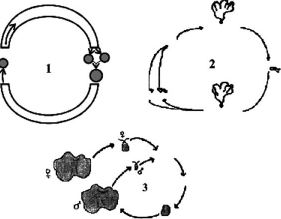
Select the correct sequence of life cycles shown in the figure from the given options:
A
$(1)$ Diplontic $(2)$ Haplodiplontic $(3)$ Haplontic
B
$(1)$ Haplodiplontic $(2)$ Haplontic $(3)$ Diplontic
C
$(1)$ Haplontic $(2)$ Diplontic $(3)$ Haplodiplontic
D
$(1)$ Diplontic $(2)$ Haplontic $(3)$ Haplodiplontic
Solution
(D) In the provided figure:
$(1)$ represents the Diplontic life cycle,where the diploid sporophyte is the dominant,photosynthetic phase.
$(2)$ represents the Haplontic life cycle,where the haploid gametophyte is the dominant,photosynthetic phase.
$(3)$ represents the Haplodiplontic life cycle,where both phases are multicellular and often free-living.
Therefore,the correct sequence is $(1)$ Diplontic,$(2)$ Haplontic,$(3)$ Haplodiplontic.
$(1)$ represents the Diplontic life cycle,where the diploid sporophyte is the dominant,photosynthetic phase.
$(2)$ represents the Haplontic life cycle,where the haploid gametophyte is the dominant,photosynthetic phase.
$(3)$ represents the Haplodiplontic life cycle,where both phases are multicellular and often free-living.
Therefore,the correct sequence is $(1)$ Diplontic,$(2)$ Haplontic,$(3)$ Haplodiplontic.
0 likes
View Solution31
EasyMCQ
Which of the following represents the beginning of the gametophytic generation?
A
Gametes
B
Spore
C
Sporangium
D
Zygote
Solution
(B) In the life cycle of plants, the alternation of generations involves a haploid gametophytic generation and a diploid sporophytic generation.
$1$. The sporophytic generation begins with the formation of a $Zygote$ $(2n)$ following fertilization.
$2$. The sporophytic generation produces spores $(n)$ through meiosis.
$3$. These spores $(n)$ germinate to form the gametophyte.
$4$. Therefore, the spore represents the first cell of the gametophytic generation.
$1$. The sporophytic generation begins with the formation of a $Zygote$ $(2n)$ following fertilization.
$2$. The sporophytic generation produces spores $(n)$ through meiosis.
$3$. These spores $(n)$ germinate to form the gametophyte.
$4$. Therefore, the spore represents the first cell of the gametophytic generation.
0 likes
View Solution32
MediumMCQ
Statement $X$: $Allium$ $cepa$ shows a diplontic life cycle.
Statement $Y$: The diploid sporophytic phase is the main,long-lived,dominant,photosynthetic,and independent phase.
Statement $Y$: The diploid sporophytic phase is the main,long-lived,dominant,photosynthetic,and independent phase.
A
Statement $Y$ is correct and Statement $X$ is incorrect.
B
Both Statement $X$ and $Y$ are correct.
C
Statement $X$ is correct and Statement $Y$ is incorrect.
D
Both Statement $X$ and $Y$ are incorrect.
Solution
(B) In a diplontic life cycle,the diploid sporophyte is the dominant,photosynthetic,and independent phase of the plant. The gametophytic phase is represented by the single to few-celled gametophyte.
$Allium$ $cepa$ (onion) is an angiosperm. All seed-bearing plants (gymnosperms and angiosperms) follow a diplontic life cycle.
Therefore,Statement $X$ is correct because $Allium$ $cepa$ exhibits a diplontic life cycle.
Statement $Y$ is also correct as it accurately describes the characteristics of the sporophytic phase in a diplontic life cycle.
Thus,both statements are correct.
$Allium$ $cepa$ (onion) is an angiosperm. All seed-bearing plants (gymnosperms and angiosperms) follow a diplontic life cycle.
Therefore,Statement $X$ is correct because $Allium$ $cepa$ exhibits a diplontic life cycle.
Statement $Y$ is also correct as it accurately describes the characteristics of the sporophytic phase in a diplontic life cycle.
Thus,both statements are correct.
0 likes
View Solution33
EasyMCQ
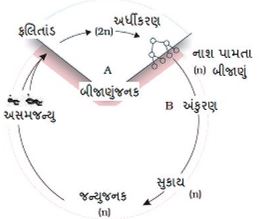
Which is the dominant phase observed in the given figure?
A
Sporophyte
B
Gametophyte
C
Both $(A)$ and $(B)$
D
None of these
Solution
(B) The provided figure represents the Haplontic life cycle,which is characteristic of many algae like Volvox,Spirogyra,and some species of Chlamydomonas.
In the Haplontic life cycle,the free-living gametophyte is the dominant,photosynthetic,and independent phase of the plant body.
The sporophytic generation is represented only by the one-celled zygote $(2n)$,which undergoes meiosis to form haploid spores $(n)$.
Since the gametophyte $(n)$ occupies the major part of the life cycle,it is the dominant phase.
In the Haplontic life cycle,the free-living gametophyte is the dominant,photosynthetic,and independent phase of the plant body.
The sporophytic generation is represented only by the one-celled zygote $(2n)$,which undergoes meiosis to form haploid spores $(n)$.
Since the gametophyte $(n)$ occupies the major part of the life cycle,it is the dominant phase.
0 likes
View Solution34
EasyMCQ
In which plants is the given plant life cycle observed?
A
Volvox
B
Spirogyra
C
Ectocarpus
D
Both $(A)$ and $(B)$
Solution
(D) The provided diagram illustrates the Haplontic life cycle.
In a Haplontic life cycle,the dominant phase is the free-living gametophyte $(n)$,while the sporophyte generation is represented only by the one-celled zygote $(2n)$.
Meiosis occurs in the zygote to form haploid spores,which divide mitotically to form the gametophyte.
This type of life cycle is characteristic of many algae,including Volvox and Spirogyra.
Therefore,both Volvox and Spirogyra exhibit this life cycle.
In a Haplontic life cycle,the dominant phase is the free-living gametophyte $(n)$,while the sporophyte generation is represented only by the one-celled zygote $(2n)$.
Meiosis occurs in the zygote to form haploid spores,which divide mitotically to form the gametophyte.
This type of life cycle is characteristic of many algae,including Volvox and Spirogyra.
Therefore,both Volvox and Spirogyra exhibit this life cycle.
0 likes
View Solution35
EasyMCQ
What is the nature of the main plant body in the given plant life cycle?
A
Haploid
B
Diploid
C
Triploid
D
All $(A), (B)$ and $(C)$
Solution
(A) The provided image represents a Haplontic life cycle. In a haplontic life cycle,the main,free-living,and photosynthetic plant body is the gametophyte,which is haploid $(n)$. The sporophyte generation is represented only by the one-celled zygote $(2n)$,which undergoes meiosis to produce haploid spores $(n)$. These spores germinate to form the haploid gametophyte. Therefore,the main plant body is haploid.
0 likes
View Solution36
MediumMCQ
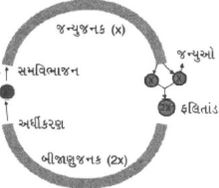
What type of life cycle in plants is indicated by the given figure?
A
Haplontic
B
Haplodiplontic
C
Diplontic
D
All $(A), (B)$ and $(C)$
Solution
(B) The provided figure shows a life cycle where both haploid $(n)$ and diploid $(2n)$ phases are multicellular and exist for significant periods.
Specifically,the diagram shows the alternation between a multicellular gametophyte $(n)$ and a multicellular sporophyte $(2n)$.
This pattern is characteristic of the Haplodiplontic life cycle,which is observed in Bryophytes and Pteridophytes.
Specifically,the diagram shows the alternation between a multicellular gametophyte $(n)$ and a multicellular sporophyte $(2n)$.
This pattern is characteristic of the Haplodiplontic life cycle,which is observed in Bryophytes and Pteridophytes.
0 likes
View Solution37
MediumMCQ
Which dominant phase is observed in the given figure?
A
Gametophyte
B
Sporophyte
C
Both $(A)$ and $(B)$
D
None of these
Solution
(C) The provided figure illustrates the Haplodiplontic life cycle,where both the gametophytic $(n)$ and sporophytic $(2n)$ phases are multicellular and dominant.
In this type of life cycle,the gametophyte produces gametes through mitosis,which fuse to form a zygote.
The zygote then undergoes mitosis to form a multicellular sporophyte.
The sporophyte produces spores through meiosis,which then germinate to form a multicellular gametophyte.
Since both phases are significant and multicellular,the correct answer is both $(A)$ and $(B)$.
In this type of life cycle,the gametophyte produces gametes through mitosis,which fuse to form a zygote.
The zygote then undergoes mitosis to form a multicellular sporophyte.
The sporophyte produces spores through meiosis,which then germinate to form a multicellular gametophyte.
Since both phases are significant and multicellular,the correct answer is both $(A)$ and $(B)$.
0 likes
View Solution38
EasyMCQ
In which plants is the life cycle shown in the given figure observed?
A
Cycas
B
Sunflower
C
Fucus
D
All of the above $(A), (B)$ and $(C)$
Solution
(D) The provided figure represents a Haplodiplontic life cycle,which is characteristic of Bryophytes and Pteridophytes. However,in the context of the options provided,the question likely refers to a Diplontic life cycle (where the dominant phase is diploid) or a Haplodiplontic cycle. Looking at the diagram,it shows a Haplodiplontic cycle. Among the options,Cycas (Gymnosperm) and Sunflower (Angiosperm) exhibit a Diplontic life cycle,while Fucus (an alga) exhibits a Diplontic life cycle. If the diagram is interpreted as a Haplodiplontic cycle,none of these are the primary examples. However,if the question intends to identify organisms with a Diplontic life cycle,then Cycas,Sunflower,and Fucus all exhibit a Diplontic life cycle. Given the standard curriculum,$A, B,$ and $C$ all show a Diplontic life cycle.
0 likes
View Solution39
MediumMCQ
In the given life cycle,which is the secondary stage and what is its nature?
A
Haploid
B
Gametophyte
C
Diploid
D
Both $(A)$ and $(B)$
Solution
(C) The provided image represents a Haplontic life cycle.
In a Haplontic life cycle,the dominant,photosynthetic phase is the free-living gametophyte ($n$ or haploid).
The sporophytic generation ($2n$ or diploid) is represented only by the one-celled zygote.
Since the gametophyte is the primary/dominant phase,the secondary stage is the sporophyte,which is diploid $(2n)$.
In a Haplontic life cycle,the dominant,photosynthetic phase is the free-living gametophyte ($n$ or haploid).
The sporophytic generation ($2n$ or diploid) is represented only by the one-celled zygote.
Since the gametophyte is the primary/dominant phase,the secondary stage is the sporophyte,which is diploid $(2n)$.
0 likes
View Solution40
EasyMCQ
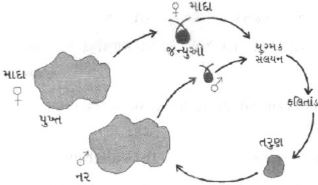
Which plant group exhibits the life cycle shown in the given figure?
A
Bryophytes
B
Angiosperms
C
Pteridophytes
D
Both $(A)$ and $(C)$
Solution
(B) The provided figure illustrates a diplontic life cycle where the dominant phase is the diploid sporophyte. In this cycle,the gametophyte phase is reduced to a few-celled structure. This type of life cycle is characteristic of seed-bearing plants,including gymnosperms and angiosperms. However,looking at the options provided and the standard $NCERT$ representation of life cycles,the diplontic life cycle is the primary pattern for angiosperms. Bryophytes and pteridophytes exhibit haplodiplontic life cycles. Therefore,the correct option is $(B)$.
0 likes
View Solution41
DifficultMCQ
In which alga is the life cycle shown in the given figure observed?
A
Spirogyra
B
Ectocarpus
C
Volvox
D
Fucus
Solution
(D) The provided figure illustrates a diplontic life cycle,where the diploid sporophyte is the dominant,photosynthetic,and independent phase of the plant. The gametophytic phase is represented only by the single to few-celled haploid gametophytes. This type of life cycle is characteristic of all seed-bearing plants (gymnosperms and angiosperms) and some algae such as Fucus. In contrast,Spirogyra and Volvox exhibit a haplontic life cycle,while Ectocarpus exhibits a haplo-diplontic life cycle. Therefore,the correct option is Fucus.
0 likes
View Solution42
MediumMCQ
In the given diagram,what can be the dominant phase in the plant life cycle?
A
Gametophyte only
B
Sporophyte only
C
Gametophyte or sporophyte
D
None of these
Solution
(C) The provided diagram illustrates a life cycle where the adult plants produce gametes,which fuse to form a zygote,subsequently developing into a new plant. This cycle represents the alternation of generations in plants. Depending on the plant group,the dominant phase can be either the haploid gametophyte (as seen in bryophytes) or the diploid sporophyte (as seen in pteridophytes,gymnosperms,and angiosperms). Therefore,the dominant phase in a plant life cycle can be either the gametophyte or the sporophyte.
0 likes
View Solution43
MediumMCQ
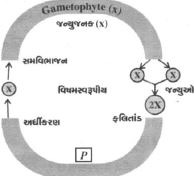
What is true for the '$P$' stage in the given figure?
A
Photosynthetic and independent.
B
Photosynthetic,dependent.
C
Photosynthetic,short-lived.
D
Heterotrophic,independent.
Solution
(A) The provided figure represents the life cycle of a plant showing a 'diplontic' life cycle pattern,which is characteristic of gymnosperms and angiosperms. In this cycle,the diploid sporophyte $(2X)$ is the dominant,photosynthetic,and independent phase. The '$P$' stage represents the sporophyte generation. Therefore,the sporophyte is photosynthetic and independent.
0 likes
View Solution44
MediumMCQ
Zygotic meiosis is characteristic of
A
Fucus
B
Funaria
C
Chlamydomonas
D
Marchantia
Solution
(C) The correct answer is $C$. In $Chlamydomonas$,the life cycle is of the haplontic type. In this type of life cycle,the dominant phase is the haploid gametophyte. The zygote is the only diploid stage,which undergoes meiosis to produce haploid zoospores. Therefore,zygotic meiosis is a characteristic feature of $Chlamydomonas$.
0 likes
View Solution45
MediumMCQ
Alternation of generations is not observed in bacteria because they lack:
A
Syngamy and meiosis.
B
Distinct chromosomes.
C
Syngamy.
D
Genetic recombination.
Solution
(A) Alternation of generations involves the regular alternation between a haploid $(n)$ gametophyte phase and a diploid $(2n)$ sporophyte phase. This process requires the occurrence of syngamy (fusion of gametes) to restore the diploid state and meiosis (reduction division) to return to the haploid state. Bacteria are prokaryotic organisms that reproduce primarily through binary fission. They do not undergo true sexual reproduction involving the formation of gametes (syngamy) or reduction division (meiosis). Therefore,they cannot exhibit an alternation of generations.
0 likes
View Solution46
MediumMCQ
The life cycles of $Ectocarpus$ and $Fucus$ are respectively ....... .
A
Haplontic,Diplontic
B
Diplontic,Haplodiplontic
C
Haplodiplontic,Diplontic
D
Haplodiplontic,Haplontic
Solution
(C) In $Ectocarpus$,the life cycle is haplodiplontic,where both haploid and diploid phases are multicellular and often free-living.
In $Fucus$,the life cycle is diplontic,where the diploid sporophyte is the dominant,photosynthetic phase,and the gametophyte is represented by only a few-celled gametophyte.
In $Fucus$,the life cycle is diplontic,where the diploid sporophyte is the dominant,photosynthetic phase,and the gametophyte is represented by only a few-celled gametophyte.
0 likes
View Solution47
Medium
Provide an explanation of the life cycles in plants.
Solution
(N/A) $\rightarrow$ In plants,both haploid and diploid cells can divide by mitosis. This ability leads to the formation of different plant bodies - haploid and diploid.
$\rightarrow$ The haploid body produces gametes by mitosis. This plant body represents a gametophyte.
$\rightarrow$ Following fertilisation,the zygote also divides by mitosis to produce a diploid sporophytic plant body. Haploid spores are produced by this plant body by meiosis. These,in turn,divide by mitosis to form a haploid plant body once again.
$\rightarrow$ Thus,any plant possessing sexual reproduction forms the body. During the life cycle of any sexually reproducing plant,there is an alternation of generations between the gamete-producing haploid gametophyte and the spore-producing diploid sporophyte.
$\rightarrow$ However,different plant groups,as well as individuals representing them,differ in the following patterns:
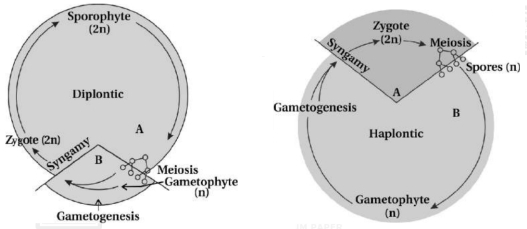
$(1)$ Haplontic: Meiosis in the zygote results in the formation of haploid spores. The haploid spores divide mitotically and form the gametophyte. The dominant,photosynthetic phase in such plants is the free-living gametophyte. This kind of life cycle is termed as haplontic. Many algae such as $Volvox$,$Spirogyra$,and some species of $Chlamydomonas$ represent this pattern.
$(2)$ Diplontic: In all gymnosperms and angiosperms,the sporophyte is the dominant,photosynthetic,independent phase of the plant. The gametophytic phase is represented by the single to few-celled haploid gametophyte. This type of life cycle is termed as diplontic.
$\rightarrow$ The haploid body produces gametes by mitosis. This plant body represents a gametophyte.
$\rightarrow$ Following fertilisation,the zygote also divides by mitosis to produce a diploid sporophytic plant body. Haploid spores are produced by this plant body by meiosis. These,in turn,divide by mitosis to form a haploid plant body once again.
$\rightarrow$ Thus,any plant possessing sexual reproduction forms the body. During the life cycle of any sexually reproducing plant,there is an alternation of generations between the gamete-producing haploid gametophyte and the spore-producing diploid sporophyte.
$\rightarrow$ However,different plant groups,as well as individuals representing them,differ in the following patterns:
$(1)$ Haplontic: Meiosis in the zygote results in the formation of haploid spores. The haploid spores divide mitotically and form the gametophyte. The dominant,photosynthetic phase in such plants is the free-living gametophyte. This kind of life cycle is termed as haplontic. Many algae such as $Volvox$,$Spirogyra$,and some species of $Chlamydomonas$ represent this pattern.
$(2)$ Diplontic: In all gymnosperms and angiosperms,the sporophyte is the dominant,photosynthetic,independent phase of the plant. The gametophytic phase is represented by the single to few-celled haploid gametophyte. This type of life cycle is termed as diplontic.
0 likes
View Solution48
EasyMCQ
What are the gametophyte and sporophyte stages? Explain.
A
Gametophyte is diploid and sporophyte is haploid.
B
Gametophyte is haploid and produces gametes; sporophyte is diploid and produces spores.
C
Both stages are identical in structure and function.
D
Sporophyte is the dominant stage in all plant groups.
Solution
(B) In the life cycle of plants,there is an alternation of generations between two distinct phases:
$1$. Gametophyte stage: This is the haploid $(n)$ phase of the plant life cycle. It produces male and female gametes through mitosis. These gametes fuse during fertilization to form a diploid zygote.
$2$. Sporophyte stage: This is the diploid $(2n)$ phase that develops from the zygote. The sporophyte undergoes meiosis to produce haploid spores. These spores germinate to form a new gametophyte,thus completing the cycle.
$1$. Gametophyte stage: This is the haploid $(n)$ phase of the plant life cycle. It produces male and female gametes through mitosis. These gametes fuse during fertilization to form a diploid zygote.
$2$. Sporophyte stage: This is the diploid $(2n)$ phase that develops from the zygote. The sporophyte undergoes meiosis to produce haploid spores. These spores germinate to form a new gametophyte,thus completing the cycle.
0 likes
View Solution49
Medium
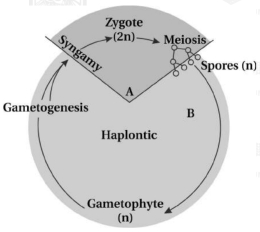
What is a haplontic life cycle? Explain through a chart.
Solution
(N/A) $\rightarrow$ In a haplontic life cycle,the dominant,photosynthetic phase is the free-living gametophyte $(n)$.
$\rightarrow$ The gametophyte produces gametes through gametogenesis,which fuse during syngamy to form a diploid zygote $(2n)$.
$\rightarrow$ The zygote undergoes meiosis to form haploid spores $(n)$.
$\rightarrow$ These haploid spores divide mitotically to form the new gametophyte $(n)$.
$\rightarrow$ Many algae,such as $Volvox$,$Spirogyra$,and some species of $Chlamydomonas$,represent this pattern.
Chart Description:
- $A$: Represents the diploid $(2n)$ phase (Zygote).
- $B$: Represents the haploid $(n)$ phase (Gametophyte/Spores).
$\rightarrow$ The gametophyte produces gametes through gametogenesis,which fuse during syngamy to form a diploid zygote $(2n)$.
$\rightarrow$ The zygote undergoes meiosis to form haploid spores $(n)$.
$\rightarrow$ These haploid spores divide mitotically to form the new gametophyte $(n)$.
$\rightarrow$ Many algae,such as $Volvox$,$Spirogyra$,and some species of $Chlamydomonas$,represent this pattern.
Chart Description:
- $A$: Represents the diploid $(2n)$ phase (Zygote).
- $B$: Represents the haploid $(n)$ phase (Gametophyte/Spores).
0 likes
View SolutionPlant Kingdom — Plant Life Cycles and Alternation of Generations · Frequently Asked Questions
1Are these Plant Kingdom questions useful for JEE and NEET?
Yes. All questions in this section are mapped to JEE Main and NEET exam patterns. Previous year questions from JEE Main, NEET, GUJCET and state-level exams are included with full solutions.
2Can I switch to Hindi or Gujarati for these questions?
Yes. Use the language tabs in the hero section or the sidebar to view the same questions and solutions in English, Hindi or Gujarati.
3How do I generate a question paper from this subtopic?
Use the Vedclass Exam Paper Generator — select the chapter and subtopic, set difficulty, and generate Sets A, B, C, D automatically. First 3 chapters of every subject are free.
Vedclass Products
For Students
Vedclass Test Series
Mock tests in real JEE/NEET style with performance analysis. 5-day free trial.
Start Free TrialFor Teachers
Exam Paper Generator
Generate Set A/B/C/D papers from this chapter in 2 minutes. 3 chapters free.
Try FreeFor Institutes
Online Exam Module
Live online exams with unlimited students, 360° analytics & white-label branding.
See DemoFor Teachers & Institutes
Generate a Plant Kingdom Exam Paper in 2 Minutes
Select subtopic & difficulty — Sets A, B, C, D auto-generated with No Repeat logic.
First 3 chapters of every subject are free — no payment required.