
A English
Angiosperms Questions in English
Class 11 Biology · Plant Kingdom · Angiosperms
119+
Questions
English
Language
100%
With Solutions
Showing 19 of 119 questions in English
101
MediumMCQ
Angiosperms are the dominant group of terrestrial plants because of:
A
Ability to adapt in diverse habitats.
B
Production of a large number of seeds.
C
Nature of self-pollination.
D
Domestication by humans.
Solution
(A) Angiosperms (flowering plants) are the most successful and dominant group of land plants.
This dominance is primarily due to their remarkable ability to adapt to diverse and extreme environmental conditions,ranging from deserts to aquatic habitats.
Additionally,they possess highly developed vascular tissues (xylem and phloem) for efficient transport and specialized reproductive structures (flowers and fruits) that protect the embryo and aid in seed dispersal.
This dominance is primarily due to their remarkable ability to adapt to diverse and extreme environmental conditions,ranging from deserts to aquatic habitats.
Additionally,they possess highly developed vascular tissues (xylem and phloem) for efficient transport and specialized reproductive structures (flowers and fruits) that protect the embryo and aid in seed dispersal.
0 likes
View Solution102
MediumMCQ
Monocotyledon is a:
A
Class
B
Order
C
Family
D
Genus
Solution
(A) In biological classification, the taxonomic hierarchy follows the order: Kingdom, Phylum (or Division for plants), Class, Order, Family, Genus, and Species.
Monocotyledonae (or Monocotyledon) is a group of flowering plants characterized by having a single cotyledon in their seeds.
According to the standard botanical classification system, Monocotyledonae is ranked as a $Class$ within the Division Angiospermae.
Monocotyledonae (or Monocotyledon) is a group of flowering plants characterized by having a single cotyledon in their seeds.
According to the standard botanical classification system, Monocotyledonae is ranked as a $Class$ within the Division Angiospermae.
0 likes
View Solution103
EasyMCQ
Angiosperms are divided into how many classes?
A
$1$
B
$2$
C
$4$
D
$5$
Solution
(B) Angiosperms,also known as flowering plants,are primarily divided into $2$ classes based on the number of cotyledons present in their seeds.
These two classes are:
$1$. Dicotyledonae (Dicots): Plants with two cotyledons in their seeds.
$2$. Monocotyledonae (Monocots): Plants with a single cotyledon in their seeds.
These two classes are:
$1$. Dicotyledonae (Dicots): Plants with two cotyledons in their seeds.
$2$. Monocotyledonae (Monocots): Plants with a single cotyledon in their seeds.
0 likes
View Solution104
MediumMCQ
$Wolffia$ is an example of....
A
Gymnosperms
B
Angiosperms
C
Pteridophytes
D
Bryophytes
Solution
(B) $Wolffia$ is a genus of minute,free-floating aquatic plants belonging to the family $Araceae$.
It is recognized as the smallest flowering plant on Earth.
Since it produces flowers and seeds,it is classified under $Angiosperms$ (flowering plants).
Therefore,the correct option is $B$.
It is recognized as the smallest flowering plant on Earth.
Since it produces flowers and seeds,it is classified under $Angiosperms$ (flowering plants).
Therefore,the correct option is $B$.
0 likes
View Solution105
MediumMCQ
Angiosperms are dominant on the land surface due to their $........$.
A
Adaptability in diverse habitats
B
Property of producing a very large number of seeds
C
Nature of some pollination
D
Domination by humans
Solution
(A) Angiosperms (flowering plants) are the most successful and dominant group of plants on Earth. Their dominance is primarily attributed to their remarkable $Adaptability$ in diverse habitats,ranging from polar regions to tropical rainforests and deserts. While they also produce many seeds and have efficient pollination mechanisms,their ability to survive and thrive in varied environmental conditions is the fundamental reason for their widespread distribution and dominance.
0 likes
View Solution106
MediumMCQ
Vivipary is a characteristic of . . . . . . .
A
Mesophytes
B
Xerophytes
C
Hydrophytes
D
Halophytes
Solution
(D) Vivipary is a phenomenon where seeds germinate while still attached to the parent plant.
This is a specialized adaptation found in plants growing in saline,marshy,or swampy environments,known as halophytes (e.g.,Rhizophora).
In these environments,the high salt concentration and lack of oxygen in the soil make it difficult for seeds to germinate if they fall directly into the mud.
Therefore,the embryo grows out of the seed coat and fruit while attached to the parent tree,allowing the seedling to establish itself quickly once it drops into the soft mud.
This is a specialized adaptation found in plants growing in saline,marshy,or swampy environments,known as halophytes (e.g.,Rhizophora).
In these environments,the high salt concentration and lack of oxygen in the soil make it difficult for seeds to germinate if they fall directly into the mud.
Therefore,the embryo grows out of the seed coat and fruit while attached to the parent tree,allowing the seedling to establish itself quickly once it drops into the soft mud.
0 likes
View Solution107
EasyMCQ
The angiosperm that produces the largest flower is a ........
A
Total stem parasite
B
Partial stem parasite
C
Total root parasite
D
Partial root parasite
Solution
(C) The angiosperm that produces the largest flower is $Rafflesia$ $arnoldii$.
$Rafflesia$ is a genus of parasitic flowering plants.
It does not have visible leaves,stems,or roots,and it lives inside the host plant's tissue.
It absorbs nutrients from the host plant,specifically from the roots of the genus $Tetrastigma$.
Therefore,it is classified as a total root parasite.
$Rafflesia$ is a genus of parasitic flowering plants.
It does not have visible leaves,stems,or roots,and it lives inside the host plant's tissue.
It absorbs nutrients from the host plant,specifically from the roots of the genus $Tetrastigma$.
Therefore,it is classified as a total root parasite.
0 likes
View Solution108
MediumMCQ
The "Ordines Anomali" of Bentham and Hooker includes:
A
seed plants showing abnormal forms of growth and development.
B
plants represented only in fossil state.
C
plants described in the literature but which Bentham and Hooker did not see in original.
D
a few orders which could not be placed satisfactorily in the classification.
Solution
(D) In the classification system proposed by Bentham and Hooker, the "Ordines Anomali" (meaning anomalous orders) was a category created to include families that did not fit well into the established classification scheme.
These were groups of plants with uncertain affinities or characteristics that made them difficult to place within the existing taxonomic hierarchy of the time.
Therefore, it represents a few orders which could not be placed satisfactorily in the classification.
These were groups of plants with uncertain affinities or characteristics that made them difficult to place within the existing taxonomic hierarchy of the time.
Therefore, it represents a few orders which could not be placed satisfactorily in the classification.
0 likes
View Solution109
Medium
Write a note on Angiosperms.
Solution
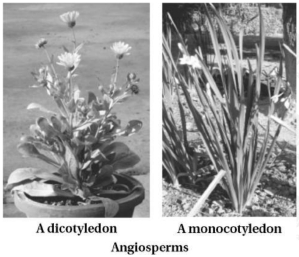
(N/A) $\rightarrow$ In the Angiosperms or flowering plants,the pollen grains and ovules are developed in specialised structures called flowers.
$\rightarrow$ Seeds are enclosed by fruits.
$\rightarrow$ The angiosperms are an exceptionally large group of plants occurring in a wide range of habitats. They range in size from tiny,almost microscopic $Wolffia$ to tall trees of $Eucalyptus$ (over $100 \ m$) that grow in Australia.
$\rightarrow$ They provide us with food,fodder,fuel,medicines,and several other commercially important products.
$\rightarrow$ Classification of Angiosperms: Angiosperms are classified into two classes:
$(i)$ Dicotyledons and $(ii)$ Monocotyledons.
$(i)$ The Dicotyledons: There are two cotyledons in the seeds of dicotyledons. Leaves possess reticulate venation and flowers are tetramerous or pentamerous (meaning there are four to five members in each floral whorl).
$(ii)$ The Monocotyledons: There is only one cotyledon in the seeds of monocotyledons. Leaves possess parallel venation and flowers are trimerous (meaning there are three members in each floral whorl).
$\rightarrow$ The male sex organ in a flower is the stamen. Each stamen consists of a slender filament with an anther at the tip. The anthers,following meiosis,produce pollen grains. The pistil consists of an ovary enclosing one to many ovules,a style,and a stigma.
$\rightarrow$ Seeds are enclosed by fruits.
$\rightarrow$ The angiosperms are an exceptionally large group of plants occurring in a wide range of habitats. They range in size from tiny,almost microscopic $Wolffia$ to tall trees of $Eucalyptus$ (over $100 \ m$) that grow in Australia.
$\rightarrow$ They provide us with food,fodder,fuel,medicines,and several other commercially important products.
$\rightarrow$ Classification of Angiosperms: Angiosperms are classified into two classes:
$(i)$ Dicotyledons and $(ii)$ Monocotyledons.
$(i)$ The Dicotyledons: There are two cotyledons in the seeds of dicotyledons. Leaves possess reticulate venation and flowers are tetramerous or pentamerous (meaning there are four to five members in each floral whorl).
$(ii)$ The Monocotyledons: There is only one cotyledon in the seeds of monocotyledons. Leaves possess parallel venation and flowers are trimerous (meaning there are three members in each floral whorl).
$\rightarrow$ The male sex organ in a flower is the stamen. Each stamen consists of a slender filament with an anther at the tip. The anthers,following meiosis,produce pollen grains. The pistil consists of an ovary enclosing one to many ovules,a style,and a stigma.
0 likes
View Solution110
MediumMCQ
Angiosperms differ from gymnosperms in having
A
Fruits
B
Cotyledons
C
Tracheids
D
Broad leaves
Solution
(A) The primary difference between angiosperms and gymnosperms lies in the nature of their seeds.
In angiosperms,the seeds are enclosed within an ovary,which develops into a fruit.
In contrast,gymnosperms produce 'naked' seeds that are not enclosed within an ovary or fruit.
In angiosperms,the seeds are enclosed within an ovary,which develops into a fruit.
In contrast,gymnosperms produce 'naked' seeds that are not enclosed within an ovary or fruit.
0 likes
View Solution111
EasyMCQ
Which of the following angiosperms is almost microscopic?
A
Eucalyptus
B
Wolffia
C
Acacia
D
Colocasia
Solution
(B) Wolffia is a genus of rootless aquatic plants in the family Araceae. It is known as the smallest flowering plant on Earth and is almost microscopic in size.
0 likes
View Solution112
MediumMCQ
Which of the following is not a dicot?
A
Eucalyptus
B
Sunflower
C
Acacia
D
Banana
Solution
(D) The banana plant belongs to the family $Musaceae$,which is a group of monocotyledonous plants. Monocots are characterized by having a single cotyledon in their seeds,parallel venation in leaves,and fibrous root systems. In contrast,$Eucalyptus$,$Sunflower$,and $Acacia$ are all dicotyledonous plants,which typically possess two cotyledons,reticulate venation,and taproot systems. Therefore,the correct answer is $D$ (Banana).
0 likes
View Solution113
MediumMCQ
The diploid sporophyte is dominant in the life cycle of
A
Volvox
B
Spirogyra
C
Chlamydomonas
D
Eucalyptus
Solution
(D) $Eucalyptus$ is an angiosperm.
In the life cycle of angiosperms,the diploid sporophyte is the dominant,independent,and photosynthetic phase.
In contrast,$Volvox$,$Spirogyra$,and $Chlamydomonas$ are algae that exhibit a haplontic life cycle,where the haploid gametophyte is the dominant phase.
In the life cycle of angiosperms,the diploid sporophyte is the dominant,independent,and photosynthetic phase.
In contrast,$Volvox$,$Spirogyra$,and $Chlamydomonas$ are algae that exhibit a haplontic life cycle,where the haploid gametophyte is the dominant phase.
0 likes
View Solution114
MediumMCQ
Angiosperms differ from gymnosperms in
A
Seeds
B
Fruits
C
Male gametophyte
D
Female gametophyte
Solution
(B) Fruit formation is the characteristic feature of angiosperms. In gymnosperms,the ovules are naked and are not enclosed by any ovary wall,hence they do not produce fruits. In contrast,angiosperms have ovaries that develop into fruits after fertilization.
0 likes
View Solution115
EasyMCQ
The smallest Angiospermic flower is
A
Wolffia
B
Ranunculus
C
Rafflesia
D
Stellaria
Solution
(A) Wolffia sp. (duckweed) is a floating,aquatic Angiospermic plant.
It has the smallest flowers,measuring about $1 \, mm$ in diameter.
In contrast,Rafflesia arnoldii (a total root parasite) produces the largest flowers,which can reach about $1 \, m$ in diameter.
It has the smallest flowers,measuring about $1 \, mm$ in diameter.
In contrast,Rafflesia arnoldii (a total root parasite) produces the largest flowers,which can reach about $1 \, m$ in diameter.
0 likes
View Solution116
MediumMCQ
Which element of xylem is the characteristic feature of angiosperms?
A
Tracheids
B
Phloem
C
Vessels
D
Xylem fibre
Solution
(C) vessel is a long cylindrical tube-like structure made up of many cells called vessel members,each with lignified walls and a large central cavity.
The vessel cells are devoid of protoplasm at maturity.
Vessel members are interconnected through perforations in their common walls.
The presence of vessels is a characteristic feature of angiosperms.
The vessel cells are devoid of protoplasm at maturity.
Vessel members are interconnected through perforations in their common walls.
The presence of vessels is a characteristic feature of angiosperms.
0 likes
View Solution117
EasyMCQ
Which is the most important source of food and fodder?
A
Algae
B
Fungi
C
Cereals
D
Gymnosperms
Solution
(C) Cereals (such as wheat,rice,maize,barley,and sorghum) are the most important source of food for humans and fodder for livestock globally.
They provide the majority of the caloric intake for the human population and are widely cultivated for their high yield and nutritional value.
Therefore,the correct option is $C$.
They provide the majority of the caloric intake for the human population and are widely cultivated for their high yield and nutritional value.
Therefore,the correct option is $C$.
0 likes
View Solution118
MediumMCQ
Which is the smallest angiosperm?
A
Zamia
B
Wolffia
C
Eucalyptus
D
Sequoia
Solution
(B) The smallest angiosperm is $Wolffia$. It is a genus of rootless aquatic plants belonging to the family $Araceae$ (subfamily $Lemnoideae$). These plants are microscopic and float on the surface of water. In contrast,$Sequoia$ is one of the tallest gymnosperms,$Eucalyptus$ is a tall angiosperm tree,and $Zamia$ is a gymnosperm.
0 likes
View Solution119
MediumMCQ
In which of the following is the sporophytic phase dominant,photosynthetic,and independent?
A
Algae
B
Bryophytes
C
Angiosperms
D
All of the above
Solution
(C) In the plant kingdom,the life cycle involves an alternation of generations between a haploid gametophytic phase and a diploid sporophytic phase.
In $Algae$ and $Bryophytes$,the gametophytic phase is dominant,photosynthetic,and independent.
In $Pteridophytes$,$Gymnosperms$,and $Angiosperms$,the sporophytic phase is dominant,photosynthetic,and independent.
Therefore,among the given options,$Angiosperms$ is the correct answer where the sporophyte is the main plant body.
In $Algae$ and $Bryophytes$,the gametophytic phase is dominant,photosynthetic,and independent.
In $Pteridophytes$,$Gymnosperms$,and $Angiosperms$,the sporophytic phase is dominant,photosynthetic,and independent.
Therefore,among the given options,$Angiosperms$ is the correct answer where the sporophyte is the main plant body.
0 likes
View SolutionPlant Kingdom — Angiosperms · Frequently Asked Questions
1Are these Plant Kingdom questions useful for JEE and NEET?
Yes. All questions in this section are mapped to JEE Main and NEET exam patterns. Previous year questions from JEE Main, NEET, GUJCET and state-level exams are included with full solutions.
2Can I switch to Hindi or Gujarati for these questions?
Yes. Use the language tabs in the hero section or the sidebar to view the same questions and solutions in English, Hindi or Gujarati.
3How do I generate a question paper from this subtopic?
Use the Vedclass Exam Paper Generator — select the chapter and subtopic, set difficulty, and generate Sets A, B, C, D automatically. First 3 chapters of every subject are free.
Vedclass Products
For Students
Vedclass Test Series
Mock tests in real JEE/NEET style with performance analysis. 5-day free trial.
Start Free TrialFor Teachers
Exam Paper Generator
Generate Set A/B/C/D papers from this chapter in 2 minutes. 3 chapters free.
Try FreeFor Institutes
Online Exam Module
Live online exams with unlimited students, 360° analytics & white-label branding.
See DemoFor Teachers & Institutes
Generate a Plant Kingdom Exam Paper in 2 Minutes
Select subtopic & difficulty — Sets A, B, C, D auto-generated with No Repeat logic.
First 3 chapters of every subject are free — no payment required.