
A English
Angiosperms Questions in English
Class 11 Biology · Plant Kingdom · Angiosperms
119+
Questions
English
Language
100%
With Solutions
Showing 50 of 119 questions in English
51
MediumMCQ
The plant group with the most reduced gametophyte is known as:
A
Bryophytes
B
Pteridophytes
C
Gymnosperms
D
Angiosperms
Solution
(D) In the plant kingdom,the gametophyte generation becomes progressively more reduced as evolution proceeds from lower to higher plants.
In $Bryophytes$,the gametophyte is the dominant,independent phase.
In $Pteridophytes$,the gametophyte is small but independent.
In $Gymnosperms$,the gametophyte is further reduced and dependent on the sporophyte.
In $Angiosperms$,the gametophyte is the most reduced,consisting of only a few cells (e.g.,the pollen grain is the male gametophyte and the embryo sac is the female gametophyte),and it is completely dependent on the sporophyte for nutrition and protection.
In $Bryophytes$,the gametophyte is the dominant,independent phase.
In $Pteridophytes$,the gametophyte is small but independent.
In $Gymnosperms$,the gametophyte is further reduced and dependent on the sporophyte.
In $Angiosperms$,the gametophyte is the most reduced,consisting of only a few cells (e.g.,the pollen grain is the male gametophyte and the embryo sac is the female gametophyte),and it is completely dependent on the sporophyte for nutrition and protection.
0 likes
View Solution52
EasyMCQ
What does the term 'Angiosperm' mean?
A
Naked seeds
B
Covered seeds
C
Leaf fall
D
Seed bud
Solution
(B) The term 'Angiosperm' is derived from two Greek words: 'angio' meaning 'covered' or 'enclosed' and 'sperma' meaning 'seed'.
In angiosperms,the seeds are developed inside an ovary which is modified into a fruit.
Therefore,they are known as flowering plants with covered seeds.
In angiosperms,the seeds are developed inside an ovary which is modified into a fruit.
Therefore,they are known as flowering plants with covered seeds.
0 likes
View Solution53
MediumMCQ
Which of the following plant groups includes seed-bearing plants?
A
Algae
B
Bryophytes
C
Angiosperms
D
Fungi
Solution
(C) Seed-bearing plants are known as Spermatophytes. This group includes Gymnosperms and Angiosperms. Among the given options,Angiosperms are seed-bearing plants. Algae,Bryophytes,and Fungi do not produce seeds.
0 likes
View Solution54
MediumMCQ
In which plants are vessels and companion cells found as part of the xylem and phloem,respectively?
A
Gymnosperms
B
Pteridophytes
C
Angiosperms
D
Bryophytes
Solution
(C) The presence of vessels in the xylem and companion cells in the phloem is a characteristic feature of $Angiosperms$.
$1$. $Xylem$ in $Angiosperms$ consists of tracheids,vessels,xylem fibers,and xylem parenchyma.
$2$. $Phloem$ in $Angiosperms$ consists of sieve tube elements,companion cells,phloem parenchyma,and phloem fibers.
$3$. $Gymnosperms$ lack vessels in their xylem (they have tracheids) and lack companion cells in their phloem (they have albuminous cells).
Therefore,the correct option is $C$.
$1$. $Xylem$ in $Angiosperms$ consists of tracheids,vessels,xylem fibers,and xylem parenchyma.
$2$. $Phloem$ in $Angiosperms$ consists of sieve tube elements,companion cells,phloem parenchyma,and phloem fibers.
$3$. $Gymnosperms$ lack vessels in their xylem (they have tracheids) and lack companion cells in their phloem (they have albuminous cells).
Therefore,the correct option is $C$.
0 likes
View Solution55
MediumMCQ
Sieve tubes and companion cells are a characteristic feature of ........
A
Gymnosperms
B
Angiosperms
C
Pteridophytes
D
Bryophytes
Solution
(B) The phloem of angiosperms is composed of sieve tube elements,companion cells,phloem parenchyma,and phloem fibers.
Sieve tubes and companion cells are specialized cells found exclusively in the phloem of angiosperms.
Gymnosperms lack true sieve tubes and companion cells; instead,they possess sieve cells and albuminous cells.
Therefore,the presence of sieve tubes and companion cells is a characteristic feature of angiosperms.
Sieve tubes and companion cells are specialized cells found exclusively in the phloem of angiosperms.
Gymnosperms lack true sieve tubes and companion cells; instead,they possess sieve cells and albuminous cells.
Therefore,the presence of sieve tubes and companion cells is a characteristic feature of angiosperms.
0 likes
View Solution56
MediumMCQ
Which of the following is a characteristic feature of angiosperms?
A
Flowers
B
Roots
C
Seeds
D
All of the above
Solution
(A) Angiosperms,also known as flowering plants,are characterized by the presence of flowers,fruits,and seeds enclosed within a fruit.
While roots and seeds are present in other plant groups (like gymnosperms),the presence of flowers is the unique and defining characteristic of angiosperms.
While roots and seeds are present in other plant groups (like gymnosperms),the presence of flowers is the unique and defining characteristic of angiosperms.
0 likes
View Solution57
MediumMCQ
Angiosperms are the dominant group of land plants primarily because of:
A
Ability to adapt in diverse habitats.
B
Production of a large number of seeds.
C
Nature of self-pollination.
D
Cultivation by humans.
Solution
(A) Angiosperms (flowering plants) are the most successful and dominant group of land plants today. This dominance is primarily due to their remarkable ability to adapt to diverse and often extreme environmental conditions. They possess advanced vascular tissues (xylem and phloem),efficient reproductive mechanisms (flowers and fruits),and the ability to produce seeds protected within fruits,which ensures their survival and dispersal across various habitats.
0 likes
View Solution58
EasyMCQ
Based on the classification by Oswald Tippo,angiosperms are placed in which of the following groups?
A
Atracheata
B
Thallophyta
C
Tracheophyta
D
Spermatophyta
Solution
(C) Oswald Tippo $(1942)$ proposed a phylogenetic classification of the plant kingdom.
He divided the plant kingdom into two major sub-kingdoms: $Thallophyta$ and $Embryophyta$.
$Embryophyta$ was further divided into $Atracheata$ (non-vascular plants like Bryophyta) and $Tracheophyta$ (vascular plants).
$Tracheophyta$ includes $Pteridophyta$,$Gymnospermae$,and $Angiospermae$.
Therefore,angiosperms are placed under the group $Tracheophyta$.
He divided the plant kingdom into two major sub-kingdoms: $Thallophyta$ and $Embryophyta$.
$Embryophyta$ was further divided into $Atracheata$ (non-vascular plants like Bryophyta) and $Tracheophyta$ (vascular plants).
$Tracheophyta$ includes $Pteridophyta$,$Gymnospermae$,and $Angiospermae$.
Therefore,angiosperms are placed under the group $Tracheophyta$.
0 likes
View Solution59
EasyMCQ
Which of the following plants are known as flowering plants?
A
Flowering and seedless
B
Seed-bearing and non-flowering
C
Flowering and seed-bearing
D
Non-flowering and seedless
Solution
(C) The term 'flowering plants' refers to $Angiosperms$.
$Angiosperms$ are a group of plants that produce flowers and bear seeds enclosed within fruits.
Therefore,they are characterized by being both flowering and seed-bearing.
$Angiosperms$ are a group of plants that produce flowers and bear seeds enclosed within fruits.
Therefore,they are characterized by being both flowering and seed-bearing.
0 likes
View Solution60
EasyMCQ
Into how many groups are the flowering plants (Angiosperms) divided?
A
Four
B
Five
C
One
D
Two
Solution
(D) Flowering plants,known as Angiosperms,are primarily divided into two groups based on the number of cotyledons present in their seeds:
$1$. Monocotyledons (Monocots): These plants have seeds with a single cotyledon.
$2$. Dicotyledons (Dicots): These plants have seeds with two cotyledons.
Therefore,the correct answer is $D$.
$1$. Monocotyledons (Monocots): These plants have seeds with a single cotyledon.
$2$. Dicotyledons (Dicots): These plants have seeds with two cotyledons.
Therefore,the correct answer is $D$.
0 likes
View Solution61
EasyMCQ
Into how many classes are angiosperms classified?
A
One
B
Two
C
Three
D
Four
Solution
(B) Angiosperms (flowering plants) are divided into two classes based on the number of cotyledons present in their seeds:
$1$. Dicotyledonae (Dicotyledons): These have two cotyledons in their seeds.
$2$. Monocotyledonae (Monocotyledons): These have only one cotyledon in their seeds.
$1$. Dicotyledonae (Dicotyledons): These have two cotyledons in their seeds.
$2$. Monocotyledonae (Monocotyledons): These have only one cotyledon in their seeds.
0 likes
View Solution62
EasyMCQ
Dicotyledonous and monocotyledonous plants are included in which group?
A
Gymnosperms
B
Pteridophytes
C
Angiosperms
D
Bryophytes
Solution
(C) Angiosperms are flowering plants in which the seeds are enclosed within fruits. They are divided into two classes: $1$. Dicotyledons (having two cotyledons) and $2$. Monocotyledons (having one cotyledon). Therefore,both are included in the group Angiosperms.
0 likes
View Solution63
EasyMCQ
Which of the following kingdoms includes multicellular producers?
A
Monera
B
Plantae
C
Animalia
D
Fungi
Solution
(B) The kingdom $Plantae$ consists of eukaryotic,multicellular organisms that are autotrophic,meaning they produce their own food through photosynthesis. Therefore,they are classified as multicellular producers. Kingdom $Monera$ contains unicellular prokaryotes. Kingdom $Animalia$ consists of multicellular heterotrophs (consumers). Kingdom $Fungi$ consists of heterotrophic organisms that obtain nutrients through absorption (decomposers/saprophytes).
0 likes
View Solution64
EasyMCQ
In which of the following kingdoms does embryo formation occur during sexual reproduction?
A
Fungi
B
Protista
C
Monera
D
Plantae
Solution
(D) In the biological classification system,the kingdom $Plantae$ is characterized by the presence of an embryo stage during sexual reproduction,which is why they are often referred to as $Embryophyta$.
In $Monera$,$Protista$,and $Fungi$,a multicellular embryo stage is not formed during their life cycles.
Therefore,the correct answer is $Plantae$.
In $Monera$,$Protista$,and $Fungi$,a multicellular embryo stage is not formed during their life cycles.
Therefore,the correct answer is $Plantae$.
0 likes
View Solution65
MediumMCQ
Which kingdom consists of multicellular,aquatic or terrestrial,photosynthetic eukaryotic organisms?
A
Animalia
B
Plantae
C
Fungi
D
Protista
Solution
(B) The kingdom $Plantae$ includes eukaryotic,multicellular organisms that are photosynthetic. These organisms can be found in both aquatic and terrestrial habitats. They possess cell walls made of cellulose and contain chlorophyll for photosynthesis.
0 likes
View Solution66
MediumMCQ
Which of the following is $NOT$ a characteristic of angiosperms?
A
Endosperm is formed after fertilization.
B
Double fertilization is observed.
C
The ovary develops into a fruit.
D
True fruits are absent.
Solution
(D) Angiosperms (flowering plants) are characterized by the presence of flowers,seeds enclosed within fruits,and double fertilization.
$1$. $A$: In angiosperms,the fusion of one male gamete with the secondary nucleus forms the primary endosperm nucleus $(PEN)$,which develops into the endosperm after fertilization.
$2$. $B$: Double fertilization (syngamy and triple fusion) is a unique feature of angiosperms.
$3$. $C$: After fertilization,the ovary matures into a fruit and the ovules mature into seeds.
$4$. $D$: The presence of true fruits (developed from the ovary) is a defining characteristic of angiosperms. Therefore,the statement that 'true fruits are absent' is incorrect and is not a characteristic of angiosperms.
$1$. $A$: In angiosperms,the fusion of one male gamete with the secondary nucleus forms the primary endosperm nucleus $(PEN)$,which develops into the endosperm after fertilization.
$2$. $B$: Double fertilization (syngamy and triple fusion) is a unique feature of angiosperms.
$3$. $C$: After fertilization,the ovary matures into a fruit and the ovules mature into seeds.
$4$. $D$: The presence of true fruits (developed from the ovary) is a defining characteristic of angiosperms. Therefore,the statement that 'true fruits are absent' is incorrect and is not a characteristic of angiosperms.
0 likes
View Solution67
EasyMCQ
How many orders does the series Superi contain?
A
$5$
B
$4$
C
$3$
D
$8$
Solution
(C) In the Bentham and Hooker classification system,the series $Superi$ (under the class $Dicotyledonae$,subclass $Polypetalae$) includes $3$ orders: $Ranales$,$Parietales$,and $Polygalinae$.
0 likes
View Solution68
MediumMCQ
Which of the following is not associated with Monocots?
A
Possess $7$ series
B
Flowers are trimerous
C
Leaves have parallel venation
D
Possess $3$ orders
Solution
(D) In the Bentham and Hooker classification system,the Monocotyledonae class is divided into $7$ series. Monocots are characterized by trimerous flowers (floral parts in multiples of $3$) and parallel venation in their leaves. The statement 'Possess $3$ orders' is not a defining characteristic or a standard classification feature associated with the Monocot group in this context,making it the correct choice for what is not associated.
0 likes
View Solution69
EasyMCQ
Which group of plants has seeds enclosed within fruits and ovules enclosed within the ovary?
A
Angiosperms
B
Gymnosperms
C
Thallophytes
D
Bryophytes
Solution
(A) The plant group characterized by seeds enclosed within fruits and ovules enclosed within the ovary is known as $Angiosperms$. In $Angiosperms$ (flowering plants),the pollen grains and ovules are developed in specialized structures called flowers. The seeds are enclosed by fruits,which develop from the ovary after fertilization. In contrast,$Gymnosperms$ have naked seeds,and $Thallophytes$ and $Bryophytes$ do not produce seeds at all.
0 likes
View Solution70
EasyMCQ
Which plant group is known as the largest and most dominant plant group?
A
Bryophytes
B
Pteridophytes
C
Gymnosperms
D
Angiosperms
Solution
(D) Angiosperms $( \text{flowering plants} )$ are the most diverse and dominant group of plants on Earth today.
They have evolved specialized structures like flowers for reproduction and fruits for seed dispersal, which allow them to thrive in a wide variety of habitats.
They constitute the largest group of plants in the plant kingdom, comprising approximately $ 300,000 $ species.
They have evolved specialized structures like flowers for reproduction and fruits for seed dispersal, which allow them to thrive in a wide variety of habitats.
They constitute the largest group of plants in the plant kingdom, comprising approximately $ 300,000 $ species.
0 likes
View Solution71
EasyMCQ
How many classes are included in the division Angiospermae?
A
$2$
B
$3$
C
$4$
D
$5$
Solution
(A) The division Angiospermae (flowering plants) is traditionally divided into two main classes based on the number of cotyledons present in the seed:
$1$. Dicotyledonae (Dicotyledons): Seeds have two cotyledons.
$2$. Monocotyledonae (Monocotyledons): Seeds have one cotyledon.
Therefore,there are $2$ classes included in the division Angiospermae.
$1$. Dicotyledonae (Dicotyledons): Seeds have two cotyledons.
$2$. Monocotyledonae (Monocotyledons): Seeds have one cotyledon.
Therefore,there are $2$ classes included in the division Angiospermae.
0 likes
View Solution72
EasyMCQ
Which is the smallest angiosperm in size?
A
Agave
B
Rafflesia globosa
C
Wolffia globosa
D
Zamia pygmaea
Solution
(C) $Wolffia$ is a genus of nine to eleven species which include the smallest flowering plants on Earth. $Wolffia$ $globosa$ is commonly known as the Asian watermeal. It is a rootless,free-floating aquatic plant belonging to the family $Lemnaceae$ (duckweed family). It is microscopic in size,often appearing as green specks on the water surface.
0 likes
View Solution73
MediumMCQ
Which plant group is currently known as the largest and most dominant plant group?
A
Bryophytes
B
Pteridophytes
C
Gymnosperms
D
Angiosperms
Solution
(D) Angiosperms $(Angiospermae)$ are the most diverse and dominant group of plants in the current biosphere.
They are characterized by the presence of flowers,fruits,and seeds enclosed within an ovary.
Due to their highly developed vascular system and efficient reproductive mechanisms,they have successfully colonized diverse habitats across the globe,making them the largest group in the plant kingdom.
They are characterized by the presence of flowers,fruits,and seeds enclosed within an ovary.
Due to their highly developed vascular system and efficient reproductive mechanisms,they have successfully colonized diverse habitats across the globe,making them the largest group in the plant kingdom.
0 likes
View Solution74
EasyMCQ
Which plant group possesses ovules that are enclosed and covered by an ovary?
A
Angiosperms
B
Gymnosperms
C
Thallophytes
D
Bryophytes
Solution
(A) The plant group in which the ovules are enclosed within an ovary and develop into seeds inside a fruit is known as $Angiosperms$ (flowering plants).
In contrast,$Gymnosperms$ have naked seeds that are not enclosed by an ovary.
$Thallophytes$ and $Bryophytes$ do not produce seeds at all.
Therefore,the correct option is $A$.
In contrast,$Gymnosperms$ have naked seeds that are not enclosed by an ovary.
$Thallophytes$ and $Bryophytes$ do not produce seeds at all.
Therefore,the correct option is $A$.
0 likes
View Solution75
EasyMCQ
Which plants exhibit a cosmopolitan distribution?
A
Gymnosperms
B
Angiosperms
C
Bryophytes
D
Pteridophytes
Solution
(B) Angiosperms,also known as flowering plants,are the most diverse and widespread group of land plants.
They exhibit a cosmopolitan distribution,meaning they are found in almost all types of habitats,including terrestrial,aquatic,tropical,and polar regions.
This wide distribution is due to their highly developed vascular system and the ability to produce seeds enclosed within fruits,which aids in protection and dispersal.
They exhibit a cosmopolitan distribution,meaning they are found in almost all types of habitats,including terrestrial,aquatic,tropical,and polar regions.
This wide distribution is due to their highly developed vascular system and the ability to produce seeds enclosed within fruits,which aids in protection and dispersal.
0 likes
View Solution76
MediumMCQ
Which of the following groups includes hydrophytes,xerophytes,mesophytes,and halophytes?
A
Angiosperms
B
Thallophytes
C
Bryophytes
D
Gymnosperms
Solution
(A) Angiosperms $(A)$ are the most diverse group of plants that have adapted to a wide range of ecological conditions. They include hydrophytes (water-loving plants),xerophytes (plants adapted to dry conditions),mesophytes (plants adapted to moderate moisture),and halophytes (plants adapted to saline environments). This wide range of adaptations allows them to dominate almost all terrestrial and aquatic habitats.
0 likes
View Solution77
EasyMCQ
Into which classes did Bentham and Hooker classify the Angiosperms?
A
Dicotyledonae
B
Monocotyledonae
C
Gymnospermae
D
Both $(A)$ and $(B)$
Solution
(D) George Bentham and Joseph Dalton Hooker proposed a natural system of classification for seed plants in their work 'Genera Plantarum'.
They classified Angiosperms into three classes: Dicotyledonae,Gymnospermae,and Monocotyledonae.
However,in the context of the provided options,they specifically categorized Angiosperms into Dicotyledonae and Monocotyledonae as the primary flowering plant groups.
Therefore,the correct answer is $(D)$ Both $(A)$ and $(B)$.
They classified Angiosperms into three classes: Dicotyledonae,Gymnospermae,and Monocotyledonae.
However,in the context of the provided options,they specifically categorized Angiosperms into Dicotyledonae and Monocotyledonae as the primary flowering plant groups.
Therefore,the correct answer is $(D)$ Both $(A)$ and $(B)$.
0 likes
View Solution78
EasyMCQ
What is the size of the smallest angiosperm (in $mm$)?
A
$0.1$
B
$0.5$
C
$1.0$
D
$2.0$
Solution
(A) The smallest angiosperm is $Wolffia$ (also known as watermeal).
Its size is approximately $0.1$ mm to $0.5$ mm in length.
Among the given options, the most accurate representation of its microscopic size is $0.1$ mm.
Its size is approximately $0.1$ mm to $0.5$ mm in length.
Among the given options, the most accurate representation of its microscopic size is $0.1$ mm.
0 likes
View Solution79
MediumMCQ
Which plant group is the most dominant and largest group of plants?
A
Angiosperms
B
Gymnosperms
C
Pteridophytes
D
Thallophytes
Solution
(A) Angiosperms (flowering plants) are the most dominant and largest group of plants in the plant kingdom.
They have evolved to occupy a wide range of habitats due to the development of specialized structures like flowers,fruits,and seeds enclosed within an ovary.
These adaptations allow them to survive and reproduce efficiently in diverse environmental conditions,making them the most successful group of plants on Earth today.
They have evolved to occupy a wide range of habitats due to the development of specialized structures like flowers,fruits,and seeds enclosed within an ovary.
These adaptations allow them to survive and reproduce efficiently in diverse environmental conditions,making them the most successful group of plants on Earth today.
0 likes
View Solution80
MediumMCQ
Angiosperms occupy the first position in the plant world because -
A
They possess a wide variety of plant species.
B
They possess large flowers.
C
They possess well-developed vascular tissues.
D
They include the maximum number of species.
Solution
(D) Angiosperms (flowering plants) are the most dominant and successful group of plants in the plant kingdom. This is primarily because they have evolved highly efficient mechanisms for pollination,seed dispersal,and fertilization,allowing them to adapt to diverse habitats. Consequently,they exhibit the highest level of biodiversity among all plant groups,encompassing the maximum number of species compared to algae,bryophytes,pteridophytes,and gymnosperms.
0 likes
View Solution81
EasyMCQ
Plants are known as $Angiosperms$ because -
A
They possess well-developed vascular tissues.
B
They produce flowers.
C
The ovules are enclosed by the ovary.
D
They possess the maximum number of species.
Solution
(C) The term $Angiosperms$ is derived from two Greek words: $angeion$ (meaning vessel or container) and $sperma$ (meaning seed).
In $Angiosperms$,the ovules are not naked as in $Gymnosperms$; instead,they are enclosed within the ovary.
After fertilization,the ovules develop into seeds and the ovary develops into a fruit.
Therefore,the defining characteristic of $Angiosperms$ is that the seeds are enclosed within fruits (formed from the ovary).
In $Angiosperms$,the ovules are not naked as in $Gymnosperms$; instead,they are enclosed within the ovary.
After fertilization,the ovules develop into seeds and the ovary develops into a fruit.
Therefore,the defining characteristic of $Angiosperms$ is that the seeds are enclosed within fruits (formed from the ovary).
0 likes
View Solution82
MediumMCQ
Which feature is common to both sunflower and maize?
A
Both are pentamerous.
B
Both have dicotyledonous seeds.
C
Both are types of angiosperms.
D
Both have a well-developed nucleus.
Solution
(C) Sunflower $(Helianthus \ annuus)$ is a dicotyledonous plant,while maize $(Zea \ mays)$ is a monocotyledonous plant. Both belong to the division Angiospermae (flowering plants). Since they are eukaryotic organisms,they both possess a well-developed,membrane-bound nucleus. Therefore,the common feature is that both are angiosperms and both have a well-developed nucleus. However,in the context of biological classification questions,the most fundamental shared characteristic among these options is that they are both angiosperms.
0 likes
View Solution83
EasyMCQ
In which of the following are vessels and companion cells found?
A
Angiosperms
B
Gymnosperms
C
Pteridophytes
D
Viruses
Solution
(A) Vessels are the characteristic feature of the xylem in $Angiosperms$.
Companion cells are specialized parenchymatous cells closely associated with sieve tube elements in the phloem of $Angiosperms$.
$Gymnosperms$ and $Pteridophytes$ lack true vessels and companion cells; instead,they have tracheids and albuminous cells,respectively.
Therefore,the correct answer is $Angiosperms$.
Companion cells are specialized parenchymatous cells closely associated with sieve tube elements in the phloem of $Angiosperms$.
$Gymnosperms$ and $Pteridophytes$ lack true vessels and companion cells; instead,they have tracheids and albuminous cells,respectively.
Therefore,the correct answer is $Angiosperms$.
0 likes
View Solution84
MediumMCQ
Assertion $(A)$: Hibiscus is called an angiosperm.
Reason $(R)$: In Hibiscus,the ovules are enclosed and covered by the ovary.
Reason $(R)$: In Hibiscus,the ovules are enclosed and covered by the ovary.
A
$A$ and $R$ are both true,and $R$ is the correct explanation of $A$.
B
$A$ and $R$ are both true,but $R$ is not the correct explanation of $A$.
C
$A$ is true,but $R$ is false.
D
$A$ is false,but $R$ is true.
Solution
(A) Angiosperms are flowering plants in which the seeds are enclosed within fruits.
In angiosperms,the ovules are always enclosed within the ovary,which later develops into the fruit.
Hibiscus is a typical flowering plant (angiosperm) where the ovules are protected inside the ovary.
Therefore,both the assertion and the reason are true,and the reason correctly explains why Hibiscus is classified as an angiosperm.
In angiosperms,the ovules are always enclosed within the ovary,which later develops into the fruit.
Hibiscus is a typical flowering plant (angiosperm) where the ovules are protected inside the ovary.
Therefore,both the assertion and the reason are true,and the reason correctly explains why Hibiscus is classified as an angiosperm.
0 likes
View Solution85
EasyMCQ
Into how many classes are angiosperms (flowering plants) classified?
A
One
B
Two
C
Three
D
Four
Solution
(B) Angiosperms,or flowering plants,are primarily classified into two classes based on the number of cotyledons present in their seeds:
$1$. $Dicotyledonae$ (Dicots): These plants have seeds with two cotyledons.
$2$. $Monocotyledonae$ (Monocots): These plants have seeds with only one cotyledon.
Therefore,the correct answer is $B$ (Two).
$1$. $Dicotyledonae$ (Dicots): These plants have seeds with two cotyledons.
$2$. $Monocotyledonae$ (Monocots): These plants have seeds with only one cotyledon.
Therefore,the correct answer is $B$ (Two).
0 likes
View Solution86
EasyMCQ
Organisms of a kingdom that possess both a rigid cell wall and the ability to form embryos are characterized as what?
A
Autotrophic
B
Parasitic
C
Saprophytic
D
Parasitic or saprophytic
Solution
(A) The kingdom that possesses organisms with a rigid cell wall (made of cellulose) and the ability to form embryos is the kingdom $Plantae$.
Plants are primarily autotrophic,meaning they synthesize their own food through the process of photosynthesis using sunlight,water,and carbon dioxide.
While some plants may exhibit parasitic or saprophytic modes of nutrition (e.g.,$Cuscuta$ as a parasite or $Monotropa$ as a saprophyte),the defining characteristic of the kingdom $Plantae$ as a whole is their autotrophic nature.
Plants are primarily autotrophic,meaning they synthesize their own food through the process of photosynthesis using sunlight,water,and carbon dioxide.
While some plants may exhibit parasitic or saprophytic modes of nutrition (e.g.,$Cuscuta$ as a parasite or $Monotropa$ as a saprophyte),the defining characteristic of the kingdom $Plantae$ as a whole is their autotrophic nature.
0 likes
View Solution87
MediumMCQ
Which is the correct option for the angiosperm plants having the following characteristics?
$i.$ Name of the plant with size $2-5 \ mm$
$ii.$ Name of the tallest plant
$iii.$ Name of the plant with the heaviest and largest flower
$iv.$ Name of the plant with the tallest and largest inflorescence
$i.$ Name of the plant with size $2-5 \ mm$
$ii.$ Name of the tallest plant
$iii.$ Name of the plant with the heaviest and largest flower
$iv.$ Name of the plant with the tallest and largest inflorescence
A
$i$ Zamia,$ii$ Eucalyptus,$iii$ Bennettites,$iv$ Thuja
B
$i$ Zamia,$ii$ Sequoia,$iii$ Rafflesia,$iv$ Agave
C
$i$ Wolffia,$ii$ Sequoia,$iii$ Rafflesia,$iv$ Agave
D
$i$ Wolffia,$ii$ Eucalyptus,$iii$ Rafflesia,$iv$ Agave
Solution
(D) $i.$ The smallest angiosperm is $Wolffia$,which is about $2-5 \ mm$ in size.
$ii.$ The tallest angiosperm is $Eucalyptus$ (some species reach over $100 \ m$). Note: $Sequoia$ is a gymnosperm.
$iii.$ The plant with the largest and heaviest flower is $Rafflesia$ $arnoldii$.
$iv.$ The plant with the tallest and largest inflorescence is $Agave$ (Century plant).
Therefore,the correct sequence is $i$ Wolffia,$ii$ Eucalyptus,$iii$ Rafflesia,$iv$ Agave.
$ii.$ The tallest angiosperm is $Eucalyptus$ (some species reach over $100 \ m$). Note: $Sequoia$ is a gymnosperm.
$iii.$ The plant with the largest and heaviest flower is $Rafflesia$ $arnoldii$.
$iv.$ The plant with the tallest and largest inflorescence is $Agave$ (Century plant).
Therefore,the correct sequence is $i$ Wolffia,$ii$ Eucalyptus,$iii$ Rafflesia,$iv$ Agave.
0 likes
View Solution88
EasyMCQ
Which of the following is a common feature between dicots and monocots?
A
Both have one cotyledon.
B
Both have reticulate venation.
C
Both have pentamerous flowers.
D
Both are included in Angiosperms.
Solution
(D) Both dicots and monocots belong to the group $Angiosperms$ (flowering plants).
$1$. Dicots have two cotyledons,while monocots have one.
$2$. Dicots typically show reticulate venation,while monocots show parallel venation.
$3$. Dicots typically have pentamerous or tetramerous flowers,while monocots are usually trimerous.
Therefore,the common feature is that both are classified under $Angiosperms$.
$1$. Dicots have two cotyledons,while monocots have one.
$2$. Dicots typically show reticulate venation,while monocots show parallel venation.
$3$. Dicots typically have pentamerous or tetramerous flowers,while monocots are usually trimerous.
Therefore,the common feature is that both are classified under $Angiosperms$.
0 likes
View Solution89
MediumMCQ
Which of the following groups is correct for flowering plants?
A
Gymnosperms-Angiosperms
B
Bryophytes-Pteridophytes
C
Dicotyledons-Monocotyledons
D
Thallophyta-Bryophytes
Solution
(C) Flowering plants are scientifically known as $Angiosperms$.
$Angiosperms$ are further classified into two main classes based on the number of cotyledons present in their seeds:
$1$. $Dicotyledons$ (plants with two cotyledons).
$2$. $Monocotyledons$ (plants with one cotyledon).
Therefore,the group $Dicotyledons-Monocotyledons$ correctly represents the classification of flowering plants.
$Angiosperms$ are further classified into two main classes based on the number of cotyledons present in their seeds:
$1$. $Dicotyledons$ (plants with two cotyledons).
$2$. $Monocotyledons$ (plants with one cotyledon).
Therefore,the group $Dicotyledons-Monocotyledons$ correctly represents the classification of flowering plants.
0 likes
View Solution90
EasyMCQ
Identify the incorrect pair from the following.
A
Eucalyptus: $90-100 \ m$
B
Zamia pygmaea: Smallest gymnosperm
C
Rafflesia arnoldii: Largest flower
D
Wolffia globosa: Underground rhizome stem
Solution
(D) The correct answer is $D$.
$A$. Eucalyptus is one of the tallest trees,reaching heights of $90-100 \ m$. This is correct.
$B$. Zamia pygmaea is known as the smallest gymnosperm. This is correct.
$C$. Rafflesia arnoldii produces the largest flower in the world. This is correct.
$D$. Wolffia globosa is the smallest angiosperm (a free-floating aquatic plant),not an underground rhizome. Therefore,this pair is incorrect.
$A$. Eucalyptus is one of the tallest trees,reaching heights of $90-100 \ m$. This is correct.
$B$. Zamia pygmaea is known as the smallest gymnosperm. This is correct.
$C$. Rafflesia arnoldii produces the largest flower in the world. This is correct.
$D$. Wolffia globosa is the smallest angiosperm (a free-floating aquatic plant),not an underground rhizome. Therefore,this pair is incorrect.
0 likes
View Solution91
EasyMCQ
Into how many groups are flowering plants classified?
A
One
B
Two
C
Three
D
Five
Solution
(B) Flowering plants,also known as $Angiosperms$,are primarily classified into two groups based on the number of cotyledons present in their seeds:
$1$. $Monocotyledons$ $(Monocots)$: Plants with a single cotyledon in the seed.
$2$. $Dicotyledons$ $(Dicots)$: Plants with two cotyledons in the seed.
Therefore,the correct answer is $B$.
$1$. $Monocotyledons$ $(Monocots)$: Plants with a single cotyledon in the seed.
$2$. $Dicotyledons$ $(Dicots)$: Plants with two cotyledons in the seed.
Therefore,the correct answer is $B$.
0 likes
View Solution92
MediumMCQ
Which of the following is a class of angiosperms?
A
Dicotyledonae
B
Bryophyta
C
Pteridophyta
D
Thallophyta
Solution
(A) Angiosperms are flowering plants that are divided into two main classes: $Dicotyledonae$ (dicots) and $Monocotyledonae$ (monocots).
$Bryophyta$,$Pteridophyta$,and $Thallophyta$ are separate divisions within the plant kingdom,not classes of angiosperms.
Therefore,$Dicotyledonae$ is the correct class of angiosperms.
$Bryophyta$,$Pteridophyta$,and $Thallophyta$ are separate divisions within the plant kingdom,not classes of angiosperms.
Therefore,$Dicotyledonae$ is the correct class of angiosperms.
0 likes
View Solution93
EasyMCQ
In which major aspect do flowering plants and non-flowering plants differ from each other?
A
Size
B
Ovules
C
Flowers
D
Habitat
Solution
(C) Flowering plants (Angiosperms) are characterized by the presence of flowers and seeds enclosed within fruits.
Non-flowering plants (such as Algae,Bryophytes,Pteridophytes,and Gymnosperms) do not produce flowers.
Therefore,the presence or absence of flowers is the primary morphological distinction between these two groups.
Non-flowering plants (such as Algae,Bryophytes,Pteridophytes,and Gymnosperms) do not produce flowers.
Therefore,the presence or absence of flowers is the primary morphological distinction between these two groups.
0 likes
View Solution94
MediumMCQ
What can be the habitat of angiosperm species?
A
Hydrophytes
B
Xerophytes
C
Mesophytes
D
All of the above $(A), (B)$ and $(C)$
Solution
(D) Angiosperms,or flowering plants,are the most diverse group of land plants.
They have adapted to a wide range of environments across the globe.
$1$. Hydrophytes: Angiosperms like $Hydrilla$ and $Lotus$ grow in aquatic environments.
$2$. Xerophytes: Angiosperms like $Opuntia$ (cactus) are adapted to survive in arid or desert conditions.
$3$. Mesophytes: Most common angiosperms,such as trees and shrubs,grow in environments with moderate water availability.
Therefore,angiosperms can be found in all these habitats.
They have adapted to a wide range of environments across the globe.
$1$. Hydrophytes: Angiosperms like $Hydrilla$ and $Lotus$ grow in aquatic environments.
$2$. Xerophytes: Angiosperms like $Opuntia$ (cactus) are adapted to survive in arid or desert conditions.
$3$. Mesophytes: Most common angiosperms,such as trees and shrubs,grow in environments with moderate water availability.
Therefore,angiosperms can be found in all these habitats.
0 likes
View Solution95
EasyMCQ
Into how many subclasses is the class $Dicotyledonae$ divided?
A
One
B
Two
C
Three
D
Four
Solution
(C) The class $Dicotyledonae$ (or $Dicotyledoneae$) is traditionally divided into three subclasses based on the arrangement of the perianth (calyx and corolla). These subclasses are:
$1$. $Polypetalae$: Petals are free.
$2$. $Gamopetalae$: Petals are fused.
$3$. $Monochlamydeae$: Perianth is either absent or undifferentiated into calyx and corolla.
$1$. $Polypetalae$: Petals are free.
$2$. $Gamopetalae$: Petals are fused.
$3$. $Monochlamydeae$: Perianth is either absent or undifferentiated into calyx and corolla.
0 likes
View Solution96
EasyMCQ
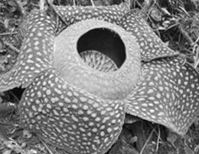
To which group does the plant shown in the given figure belong?
A
Pteridophytes
B
Bryophytes
C
Angiosperms
D
Gymnosperms
Solution
(C) The plant shown in the figure is $Rafflesia$ $arnoldii$.
$Rafflesia$ is a parasitic plant known for producing the largest individual flower on Earth.
It belongs to the group of flowering plants,which are classified as Angiosperms.
Therefore,the correct option is $C$.
$Rafflesia$ is a parasitic plant known for producing the largest individual flower on Earth.
It belongs to the group of flowering plants,which are classified as Angiosperms.
Therefore,the correct option is $C$.
0 likes
View Solution97
EasyMCQ
Which plant is shown in the given figure?
A
Wolffia globosa
B
Rafflesia
C
Zamia
D
Sequoia
Solution
(B) The figure shows the flower of $Rafflesia$.
$Rafflesia$ is known for having the largest individual flower in the world.
It is a parasitic plant that lacks visible leaves,stems,or roots.
Therefore,the correct option is $B$.
$Rafflesia$ is known for having the largest individual flower in the world.
It is a parasitic plant that lacks visible leaves,stems,or roots.
Therefore,the correct option is $B$.
0 likes
View Solution98
EasyMCQ
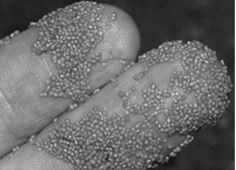
Which plant is shown in the figure?
A
Zamia
B
Wolffia globosa
C
Sequoia
D
Rafflesia
Solution
(B) The image shows the smallest known flowering plant,$Wolffia$ $globosa$. It is a tiny aquatic plant belonging to the family $Lemnaceae$ (duckweed family). Its size is comparable to a grain of sand,which is clearly visible in the provided image where many individuals are resting on human fingers.
0 likes
View Solution99
EasyMCQ
What is the characteristic of the plant shown in the figure?
A
Smallest angiosperm
B
Largest angiosperm
C
Smallest gymnosperm
D
Largest gymnosperm
Solution
(A) The figure shows Wolffia,which is a genus of rootless aquatic plants in the family Araceae. It is known as the smallest flowering plant (angiosperm) on Earth. Therefore,the correct characteristic is that it is the smallest angiosperm.
0 likes
View Solution100
EasyMCQ
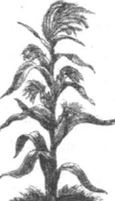
To which class does the plant shown in the given figure belong?
A
Angiosperms
B
Monocots
C
Dicots
D
Gymnosperms
Solution
(B) The figure shows a maize (corn) plant,which is a classic example of a monocotyledonous plant (monocot).
Monocots are characterized by having seeds with a single cotyledon,parallel venation in leaves,and fibrous root systems.
Therefore,the plant belongs to the class of monocots.
Monocots are characterized by having seeds with a single cotyledon,parallel venation in leaves,and fibrous root systems.
Therefore,the plant belongs to the class of monocots.
0 likes
View SolutionPlant Kingdom — Angiosperms · Frequently Asked Questions
1Are these Plant Kingdom questions useful for JEE and NEET?
Yes. All questions in this section are mapped to JEE Main and NEET exam patterns. Previous year questions from JEE Main, NEET, GUJCET and state-level exams are included with full solutions.
2Can I switch to Hindi or Gujarati for these questions?
Yes. Use the language tabs in the hero section or the sidebar to view the same questions and solutions in English, Hindi or Gujarati.
3How do I generate a question paper from this subtopic?
Use the Vedclass Exam Paper Generator — select the chapter and subtopic, set difficulty, and generate Sets A, B, C, D automatically. First 3 chapters of every subject are free.
Vedclass Products
For Students
Vedclass Test Series
Mock tests in real JEE/NEET style with performance analysis. 5-day free trial.
Start Free TrialFor Teachers
Exam Paper Generator
Generate Set A/B/C/D papers from this chapter in 2 minutes. 3 chapters free.
Try FreeFor Institutes
Online Exam Module
Live online exams with unlimited students, 360° analytics & white-label branding.
See DemoFor Teachers & Institutes
Generate a Plant Kingdom Exam Paper in 2 Minutes
Select subtopic & difficulty — Sets A, B, C, D auto-generated with No Repeat logic.
First 3 chapters of every subject are free — no payment required.