
A English
Pigments involved in photo synthesis Questions in English
Class 11 Biology · Photosynthesis in Higher Plants · Pigments involved in photo synthesis
195+
Questions
English
Language
100%
With Solutions
Showing 45 of 195 questions in English
151
EasyMCQ
Which light of the visible spectrum is absorbed by carotenoids in higher plants from solar radiation?
A
Violet and blue
B
Blue and green
C
Green and red
D
Red and violet
Solution
(A) Carotenoids are accessory pigments in higher plants. They primarily absorb light in the blue and violet regions of the visible spectrum. By absorbing these wavelengths,they protect the chlorophyll molecules from photo-oxidation and transfer the absorbed energy to chlorophyll-$a$ for photosynthesis.
0 likes
View Solution152
EasyMCQ
In a chloroplast,chlorophyll is found in:
A
Grana
B
Pyrenoid
C
Stroma
D
Both Grana and Stroma
Solution
(A) Chlorophyll is the primary photosynthetic pigment responsible for capturing light energy.
In the chloroplast,chlorophyll molecules are embedded within the thylakoid membranes.
These thylakoid membranes are stacked to form structures known as $Grana$.
Therefore,chlorophyll is specifically located in the $Grana$ of the chloroplast,where the light-dependent reactions of photosynthesis occur.
In the chloroplast,chlorophyll molecules are embedded within the thylakoid membranes.
These thylakoid membranes are stacked to form structures known as $Grana$.
Therefore,chlorophyll is specifically located in the $Grana$ of the chloroplast,where the light-dependent reactions of photosynthesis occur.
0 likes
View Solution153
MediumMCQ
Assertion : $Rhoeo$ leaves contain anthocyanin pigments in epidermal cells.
Reason : Anthocyanins are accessory photosynthetic pigments.
Reason : Anthocyanins are accessory photosynthetic pigments.
A
If both Assertion and Reason are correct and the Reason is a correct explanation of the Assertion.
B
If both Assertion and Reason are correct but Reason is not a correct explanation of the Assertion.
C
If the Assertion is correct but Reason is incorrect.
D
If both the Assertion and Reason are incorrect.
Solution
(C) The Assertion is correct because $Rhoeo$ leaves possess anthocyanin pigments in their epidermal cells,which provide a purple or reddish coloration to the leaves.
However,the Reason is incorrect. Anthocyanins are water-soluble vacuolar pigments that provide red,purple,or blue colors to plant parts like petals,fruits,and leaves. They are not involved in photosynthesis and do not act as accessory photosynthetic pigments. Accessory photosynthetic pigments include chlorophyll $b$,xanthophylls,and carotenoids,which capture light energy and transfer it to chlorophyll $a$.
However,the Reason is incorrect. Anthocyanins are water-soluble vacuolar pigments that provide red,purple,or blue colors to plant parts like petals,fruits,and leaves. They are not involved in photosynthesis and do not act as accessory photosynthetic pigments. Accessory photosynthetic pigments include chlorophyll $b$,xanthophylls,and carotenoids,which capture light energy and transfer it to chlorophyll $a$.
0 likes
View Solution154
Medium
Suppose there were plants that had a high concentration of Chlorophyll-$b$,but lacked Chlorophyll-$a$. Would they carry out photosynthesis? Then why do plants have Chlorophyll-$b$ and other accessory pigments?
Solution
(D) Chlorophyll-$a$ is the primary photosynthetic pigment and acts as the reaction center in both Photosystem-$I$ and Photosystem-$II$. It is the only pigment capable of converting light energy into chemical energy by emitting electrons during the light reaction.
Chlorophyll-$b$,carotenoids,and xanthophylls are accessory pigments. They absorb light energy at different wavelengths and transfer it to Chlorophyll-$a$,thereby increasing the efficiency of photosynthesis. Additionally,they protect the Chlorophyll-$a$ molecule from photo-oxidation.
If a plant lacks Chlorophyll-$a$,it cannot perform the primary photochemical reaction. Therefore,such a plant would not be able to carry out photosynthesis,even if it has a high concentration of Chlorophyll-$b$.
Chlorophyll-$b$,carotenoids,and xanthophylls are accessory pigments. They absorb light energy at different wavelengths and transfer it to Chlorophyll-$a$,thereby increasing the efficiency of photosynthesis. Additionally,they protect the Chlorophyll-$a$ molecule from photo-oxidation.
If a plant lacks Chlorophyll-$a$,it cannot perform the primary photochemical reaction. Therefore,such a plant would not be able to carry out photosynthesis,even if it has a high concentration of Chlorophyll-$b$.
0 likes
View Solution155
Medium
Why is the colour of a leaf kept in the dark frequently yellow,or pale green? Which pigment do you think is more stable?
Solution
(N/A) Leaves require light to perform photosynthesis. When a leaf is kept in the dark,the production of chlorophyll,which is essential for photosynthesis,stops. Existing chlorophyll molecules gradually break down,causing the leaf to change from a dark green to a pale green shade.
As the chlorophyll content decreases,other pigments like xanthophylls and carotenoids,which were previously masked,become visible. This causes the leaf to turn yellow.
These pigments (xanthophylls and carotenoids) are more stable than chlorophyll because their production is not dependent on light. They are always present in the plant tissues.
As the chlorophyll content decreases,other pigments like xanthophylls and carotenoids,which were previously masked,become visible. This causes the leaf to turn yellow.
These pigments (xanthophylls and carotenoids) are more stable than chlorophyll because their production is not dependent on light. They are always present in the plant tissues.
0 likes
View Solution156
MediumMCQ
How many pigments take part in photosynthesis?
A
Two
B
Three
C
Four
D
Five
Solution
(C) $\Rightarrow$ The pigments of plant leaves can be separated and studied using paper chromatography.
$\Rightarrow$ Chromatographic separation of leaf pigments reveals that the color observed in leaves is not due to a single pigment,but rather a combination of four distinct pigments:
$(1)$ Chlorophyll $a$ (bright or blue-green in the chromatogram),
$(2)$ Chlorophyll $b$ (yellow-green),
$(3)$ Xanthophylls (yellow),
$(4)$ Carotenoids (yellow to yellow-orange).
Therefore,there are four major pigments involved in photosynthesis.
$\Rightarrow$ Chromatographic separation of leaf pigments reveals that the color observed in leaves is not due to a single pigment,but rather a combination of four distinct pigments:
$(1)$ Chlorophyll $a$ (bright or blue-green in the chromatogram),
$(2)$ Chlorophyll $b$ (yellow-green),
$(3)$ Xanthophylls (yellow),
$(4)$ Carotenoids (yellow to yellow-orange).
Therefore,there are four major pigments involved in photosynthesis.
0 likes
View Solution157
Medium
Explain the role of pigments in photosynthesis.
Solution
(N/A) $ \Rightarrow $ Pigments are substances that have the ability to absorb light at specific wavelengths.
$ \Rightarrow $ The most abundant plant pigment in the world is chlorophyll-$a$.
$ \Rightarrow $ We are familiar with the wavelength of the visible spectrum of light as well as the $VIBGYOR$: $V=$ Violet,$I=$ Indigo,$B=$ Blue,$G=$ Green,$Y=$ Yellow,$O=$ Orange,$R=$ Red.
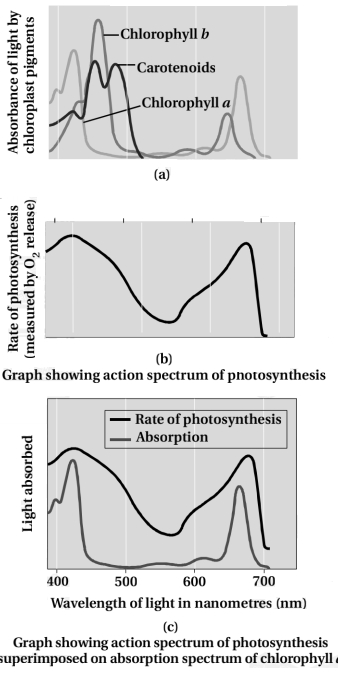
$ \Rightarrow $ Looking at figure $(a)$,we can determine the wavelengths at which chlorophyll-$a$ absorbs the most light.
$ \Rightarrow $ Figure $(b)$ shows the wavelengths at which maximum photosynthesis occurs in a plant. We can see that the wavelengths at which there is maximum absorption by chlorophyll-$a$ are in the blue and red regions.
$ \Rightarrow $ This shows a higher rate of photosynthesis. Hence,we can conclude that chlorophyll-$a$ is the chief pigment associated with photosynthesis.
$ \Rightarrow $ By observing figure $(c)$,we can say that there is a complete one-to-one overlap between the absorption spectrum of chlorophyll-$a$ and the action spectrum of photosynthesis.
$ \Rightarrow $ These graphs together show that most of the photosynthesis takes place at these wavelengths of the visible spectrum.
$ \Rightarrow $ Though chlorophyll-$a$ is the major pigment responsible for trapping light,other thylakoid pigments like chlorophyll-$b$,xanthophylls,and carotenoids,which are called accessory pigments,also absorb light and transfer the energy to chlorophyll-$a$.
$ \Rightarrow $ Indeed,they not only enable a wider range of wavelengths of incoming light to be utilized for photosynthesis but also protect chlorophyll-$a$ from photo-oxidation.
$ \Rightarrow $ The most abundant plant pigment in the world is chlorophyll-$a$.
$ \Rightarrow $ We are familiar with the wavelength of the visible spectrum of light as well as the $VIBGYOR$: $V=$ Violet,$I=$ Indigo,$B=$ Blue,$G=$ Green,$Y=$ Yellow,$O=$ Orange,$R=$ Red.
$ \Rightarrow $ Looking at figure $(a)$,we can determine the wavelengths at which chlorophyll-$a$ absorbs the most light.
$ \Rightarrow $ Figure $(b)$ shows the wavelengths at which maximum photosynthesis occurs in a plant. We can see that the wavelengths at which there is maximum absorption by chlorophyll-$a$ are in the blue and red regions.
$ \Rightarrow $ This shows a higher rate of photosynthesis. Hence,we can conclude that chlorophyll-$a$ is the chief pigment associated with photosynthesis.
$ \Rightarrow $ By observing figure $(c)$,we can say that there is a complete one-to-one overlap between the absorption spectrum of chlorophyll-$a$ and the action spectrum of photosynthesis.
$ \Rightarrow $ These graphs together show that most of the photosynthesis takes place at these wavelengths of the visible spectrum.
$ \Rightarrow $ Though chlorophyll-$a$ is the major pigment responsible for trapping light,other thylakoid pigments like chlorophyll-$b$,xanthophylls,and carotenoids,which are called accessory pigments,also absorb light and transfer the energy to chlorophyll-$a$.
$ \Rightarrow $ Indeed,they not only enable a wider range of wavelengths of incoming light to be utilized for photosynthesis but also protect chlorophyll-$a$ from photo-oxidation.
0 likes
View Solution158
Medium
Explain Light harvesting complexes $(LHC)$.
Solution
(N/A) Light harvesting complexes $(LHC)$ are clusters of pigment molecules that function to capture light energy for photosynthesis.
$1$. Composition: Each $LHC$ consists of hundreds of pigment molecules bound to proteins.
$2$. Pigments: These include chlorophyll $a$,chlorophyll $b$,carotenoids,and xanthophylls.
$3$. Function: These pigments absorb light of different wavelengths,making photosynthesis more efficient by capturing a broader spectrum of light.
$4$. Energy Transfer: The absorbed energy is passed from one pigment molecule to another through resonance energy transfer until it reaches the reaction center (chlorophyll $a$ molecule).
$5$. Role: LHCs ensure that the reaction center is constantly supplied with energy,even when light intensity is low.
$1$. Composition: Each $LHC$ consists of hundreds of pigment molecules bound to proteins.
$2$. Pigments: These include chlorophyll $a$,chlorophyll $b$,carotenoids,and xanthophylls.
$3$. Function: These pigments absorb light of different wavelengths,making photosynthesis more efficient by capturing a broader spectrum of light.
$4$. Energy Transfer: The absorbed energy is passed from one pigment molecule to another through resonance energy transfer until it reaches the reaction center (chlorophyll $a$ molecule).
$5$. Role: LHCs ensure that the reaction center is constantly supplied with energy,even when light intensity is low.
0 likes
View Solution159
Medium
Explain the construction of the $LHC$ (Light Harvesting Complex) with a diagram.
Solution
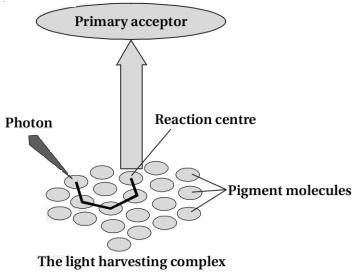
- Each photosystem consists of all the pigments (except one molecule of chlorophyll-$a$) forming a light-harvesting system,also called antennae.
- These pigments help to make photosynthesis more efficient by absorbing different wavelengths of light.
- The single chlorophyll-$a$ molecule forms the reaction centre.
- In $PS-I$,the reaction centre of chlorophyll-$a$ has an absorption peak at $700 \ nm$,hence it is called $P_{700}$.
- In $PS-II$,it has an absorption maximum at $680 \ nm$,and is called $P_{680}$.
- These pigments help to make photosynthesis more efficient by absorbing different wavelengths of light.
- The single chlorophyll-$a$ molecule forms the reaction centre.
- In $PS-I$,the reaction centre of chlorophyll-$a$ has an absorption peak at $700 \ nm$,hence it is called $P_{700}$.
- In $PS-II$,it has an absorption maximum at $680 \ nm$,and is called $P_{680}$.
0 likes
View Solution160
MediumMCQ
What are the types of pigments involved in photosynthesis?
A
Chlorophylls,Carotenoids,and Phycobilins
B
Chlorophylls and Anthocyanins
C
Carotenoids and Flavonoids
D
Only Chlorophylls
Solution
(A) Photosynthetic pigments are substances that absorb light energy for photosynthesis. They are primarily categorized into three main groups:
$1$. Chlorophylls: These are the primary pigments,including $Chlorophyll \ a$ (the reaction center) and $Chlorophyll \ b$ (an accessory pigment).
$2$. Carotenoids: These include carotenes and xanthophylls,which act as accessory pigments by absorbing light and protecting chlorophyll from photo-oxidation.
$3$. Phycobilins: These are water-soluble pigments found in cyanobacteria and red algae (e.g.,phycocyanin and phycoerythrin).
$1$. Chlorophylls: These are the primary pigments,including $Chlorophyll \ a$ (the reaction center) and $Chlorophyll \ b$ (an accessory pigment).
$2$. Carotenoids: These include carotenes and xanthophylls,which act as accessory pigments by absorbing light and protecting chlorophyll from photo-oxidation.
$3$. Phycobilins: These are water-soluble pigments found in cyanobacteria and red algae (e.g.,phycocyanin and phycoerythrin).
0 likes
View Solution161
EasyMCQ
What is the full form of $NADP$?
A
Nicotinamide Adenine Dinucleotide Phosphate
B
Nicotinamide Adenine Dinucleotide
C
Nicotinamide Adenine Dinucleotide Pyrophosphate
D
Nicotinic Adenine Dinucleotide Phosphate
Solution
(A) $NADP$ stands for Nicotinamide Adenine Dinucleotide Phosphate.
It is a coenzyme that acts as an electron carrier in various metabolic reactions,particularly in photosynthesis.
It is a coenzyme that acts as an electron carrier in various metabolic reactions,particularly in photosynthesis.
0 likes
View Solution162
Easy
Provide the full forms of the following abbreviations:
$(1)$ $LHC$
$(2)$ $PS$
$(1)$ $LHC$
$(2)$ $PS$
Solution
(N/A) $(1)$ $LHC$ stands for Light Harvesting Complex. It consists of hundreds of pigment molecules bound to proteins.
$(2)$ $PS$ stands for Photosystem. It is a functional unit of photosynthesis,consisting of a reaction center surrounded by light-harvesting complexes.
$(2)$ $PS$ stands for Photosystem. It is a functional unit of photosynthesis,consisting of a reaction center surrounded by light-harvesting complexes.
0 likes
View Solution163
Easy
Chlorophyll $a$ is the primary pigment for the light reaction. What are accessory pigments? What is their role in photosynthesis?
Solution
(N/A) Chlorophyll $b$,xanthophylls,and carotenoids are accessory pigments.
They are also photosynthetic pigments.
They are not directly associated with the excitation of electrons in the reaction center.
However,they absorb solar energy at different wavelengths and transfer this energy towards chlorophyll $a$.
Chlorophyll $a$ absorbs the maximum radiation in the blue and red regions of the spectrum,making it the primary pigment,whereas chlorophyll $b$,xanthophylls,and carotenoids act as accessory pigments by broadening the spectrum of light absorption.
They are also photosynthetic pigments.
They are not directly associated with the excitation of electrons in the reaction center.
However,they absorb solar energy at different wavelengths and transfer this energy towards chlorophyll $a$.
Chlorophyll $a$ absorbs the maximum radiation in the blue and red regions of the spectrum,making it the primary pigment,whereas chlorophyll $b$,xanthophylls,and carotenoids act as accessory pigments by broadening the spectrum of light absorption.
0 likes
View Solution164
Medium
Which property of the pigment is responsible for its ability to initiate the process of photosynthesis? Why is the rate of photosynthesis higher in the red and blue regions of the spectrum of light?
Solution
(A) The primary property of the pigment (chlorophyll) responsible for initiating photosynthesis is its ability to absorb light energy and become excited,leading to the emission of high-energy electrons $(e^-)$.
$1$. When chlorophyll molecules absorb light,they reach an excited state and lose electrons. These electrons are then transferred to an electron transport system.
$2$. The electron deficiency in chlorophyll is compensated by electrons derived from the photolysis (splitting) of water molecules.
The rate of photosynthesis is higher in the red and blue regions of the light spectrum because:
$1$. Chlorophyll pigments have peak absorption spectra in the blue ($430-450$ $nm$) and red ($640-680$ $nm$) wavelengths.
$2$. These wavelengths fall within the Photosynthetically Active Radiation $(PAR)$ range ($400-700$ $nm$),providing optimal energy to excite the electrons required for the light-dependent reactions.
$1$. When chlorophyll molecules absorb light,they reach an excited state and lose electrons. These electrons are then transferred to an electron transport system.
$2$. The electron deficiency in chlorophyll is compensated by electrons derived from the photolysis (splitting) of water molecules.
The rate of photosynthesis is higher in the red and blue regions of the light spectrum because:
$1$. Chlorophyll pigments have peak absorption spectra in the blue ($430-450$ $nm$) and red ($640-680$ $nm$) wavelengths.
$2$. These wavelengths fall within the Photosynthetically Active Radiation $(PAR)$ range ($400-700$ $nm$),providing optimal energy to excite the electrons required for the light-dependent reactions.
0 likes
View Solution165
Medium
What can we conclude from the statement that the action and absorption spectrum of photosynthesis overlap? At which wavelengths do they show peaks?
Solution
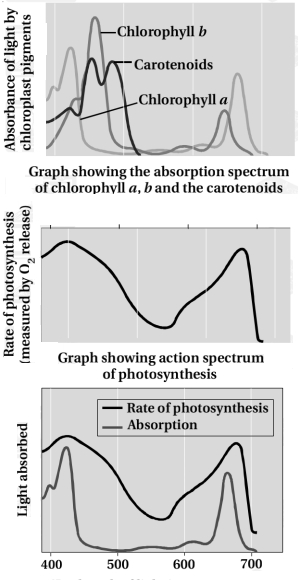
(N/A) $1$. The overlap between the action spectrum and the absorption spectrum of chlorophyll $a$ indicates that chlorophyll $a$ is the primary pigment responsible for photosynthesis.
$2$. The absorption spectrum shows the light wavelengths absorbed by pigments like chlorophyll $a$,chlorophyll $b$,and carotenoids. The action spectrum shows the rate of photosynthesis at different wavelengths.
$3$. Both spectra show peaks in the blue and red regions of the visible light spectrum.
$4$. Specifically,they show peaks in the blue region (approximately $430-470 \ nm$) and the red region (approximately $660-680 \ nm$).
$5$. This confirms that light energy absorbed by chlorophyll $a$ in these specific wavelengths is most effective in driving the photosynthetic process.
$2$. The absorption spectrum shows the light wavelengths absorbed by pigments like chlorophyll $a$,chlorophyll $b$,and carotenoids. The action spectrum shows the rate of photosynthesis at different wavelengths.
$3$. Both spectra show peaks in the blue and red regions of the visible light spectrum.
$4$. Specifically,they show peaks in the blue region (approximately $430-470 \ nm$) and the red region (approximately $660-680 \ nm$).
$5$. This confirms that light energy absorbed by chlorophyll $a$ in these specific wavelengths is most effective in driving the photosynthetic process.
0 likes
View Solution166
Medium
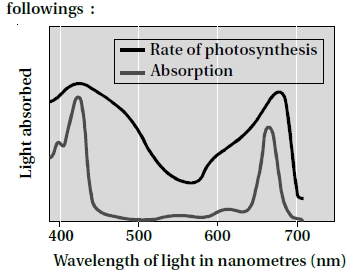
In the figure given below,the black line (upper) indicates the action spectrum for photosynthesis and the lighter line (lower) indicates the absorption spectrum of chlorophyll-$a$. Answer the following:
$(a)$ What does the action spectrum indicate? How can we plot an action spectrum? Explain with an example.
$(b)$ How can we derive an absorption spectrum for any substance?
$(c)$ If chlorophyll-$a$ is responsible for the light reaction of photosynthesis,why do the action spectrum and absorption spectrum not overlap?
$(a)$ What does the action spectrum indicate? How can we plot an action spectrum? Explain with an example.
$(b)$ How can we derive an absorption spectrum for any substance?
$(c)$ If chlorophyll-$a$ is responsible for the light reaction of photosynthesis,why do the action spectrum and absorption spectrum not overlap?
Solution
(N/A) An action spectrum indicates the rate of photosynthesis at different wavelengths of light. It can be plotted by measuring the rate of photosynthesis (e.g.,oxygen evolution or $CO_2$ uptake) at various specific wavelengths of light and plotting these rates against the corresponding wavelengths.
$(b)$ An absorption spectrum for any substance is derived by measuring the amount of light of different wavelengths absorbed by that substance using a spectrophotometer and plotting the absorbance values against the wavelengths.
$(c)$ The action spectrum and absorption spectrum do not overlap perfectly because chlorophyll-$a$ is the primary pigment,but other accessory pigments like chlorophyll-$b$,xanthophylls,and carotenoids also absorb light energy at different wavelengths and transfer this energy to chlorophyll-$a$. These accessory pigments broaden the range of light absorption and also protect chlorophyll-$a$ from photo-oxidation.
$(b)$ An absorption spectrum for any substance is derived by measuring the amount of light of different wavelengths absorbed by that substance using a spectrophotometer and plotting the absorbance values against the wavelengths.
$(c)$ The action spectrum and absorption spectrum do not overlap perfectly because chlorophyll-$a$ is the primary pigment,but other accessory pigments like chlorophyll-$b$,xanthophylls,and carotenoids also absorb light energy at different wavelengths and transfer this energy to chlorophyll-$a$. These accessory pigments broaden the range of light absorption and also protect chlorophyll-$a$ from photo-oxidation.
0 likes
View Solution167
Medium
Analogy type question:
$(1)$ Chlorophyll-$a$ : Blue-green color :: Chlorophyll-$b$ : .......
$(2)$ Chlorophyll-$a$ molecule in $PS-I$ : Absorption of $700 \,nm$ wavelength :: In $PS-II$ : .......
$(1)$ Chlorophyll-$a$ : Blue-green color :: Chlorophyll-$b$ : .......
$(2)$ Chlorophyll-$a$ molecule in $PS-I$ : Absorption of $700 \,nm$ wavelength :: In $PS-II$ : .......
Solution
(N/A) $(1)$ Chlorophyll-$a$ appears blue-green in chromatograms,whereas Chlorophyll-$b$ appears yellow-green.
$(2)$ In $PS-I$,the reaction center chlorophyll-$a$ has an absorption peak at $700 \,nm$ (known as $P_{700}$),while in $PS-II$,the reaction center chlorophyll-$a$ has an absorption peak at $680 \,nm$ (known as $P_{680}$).
$(2)$ In $PS-I$,the reaction center chlorophyll-$a$ has an absorption peak at $700 \,nm$ (known as $P_{700}$),while in $PS-II$,the reaction center chlorophyll-$a$ has an absorption peak at $680 \,nm$ (known as $P_{680}$).
0 likes
View Solution168
MediumMCQ
Select the correct statement regarding the color of photosynthetic pigments:
$(1)$ Chlorophyll $a$ appears yellow-orange in color.
$(1)$ Chlorophyll $a$ appears yellow-orange in color.
A
True
B
False
Solution
(B) The statement is incorrect. Chlorophyll $a$ appears bright or blue-green in chromatograms. Chlorophyll $b$ appears yellow-green,Xanthophylls appear yellow,and Carotenoids appear yellow to yellow-orange.
0 likes
View Solution169
MediumMCQ
Grana are
A
protein storing plastids.
B
coloured plastids.
C
stacks of thylakoids.
D
individual thylakoids present in stroma.
Solution
(C) Grana are stacked membranous structures within the chloroplasts of plants and green algae that contain chlorophyll (green pigment).
They are the site of the light-dependent reactions of photosynthesis.
The individual sac-like membranes that make up the grana are known as thylakoids.
They are the site of the light-dependent reactions of photosynthesis.
The individual sac-like membranes that make up the grana are known as thylakoids.
0 likes
View Solution170
EasyMCQ
Which element is located at the centre of the porphyrin ring in chlorophyll?
A
Potassium
B
Manganese
C
Calcium
D
Magnesium
Solution
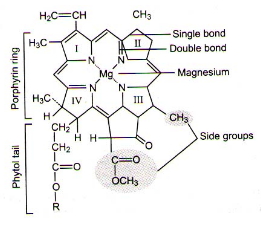
(D) The chlorophyll molecule consists of a porphyrin ring (a head) and a phytol tail.
The porphyrin ring is a tetrapyrrole structure with a central $Mg^{2+}$ ion coordinated to the four nitrogen atoms of the pyrrole rings.
Therefore,magnesium $(Mg)$ is the element located at the centre of the porphyrin ring in chlorophyll.
The porphyrin ring is a tetrapyrrole structure with a central $Mg^{2+}$ ion coordinated to the four nitrogen atoms of the pyrrole rings.
Therefore,magnesium $(Mg)$ is the element located at the centre of the porphyrin ring in chlorophyll.
0 likes
View Solution171
MediumMCQ
If a chloroplast is burnt,which of the following elements remains as ash?
A
Magnesium
B
Manganese
C
Iron
D
Sulphur
Solution
(A) Chlorophyll is the primary pigment found in chloroplasts. The structure of the chlorophyll molecule consists of a porphyrin ring (a tetrapyrrole ring) with a central magnesium $(Mg^{2+})$ ion. When a chloroplast is burnt,the organic components (carbon,hydrogen,oxygen,nitrogen) are oxidized and released as gases,while the mineral component,specifically the magnesium ion,remains as part of the ash.
0 likes
View Solution172
MediumMCQ
The absorption spectrum of chlorophyll and the action spectrum of photosynthesis are identical because
A
carotenoids act as antennary molecules in the blue spectrum
B
chlorophyll is the chief pigment of light absorption in the red spectrum
C
chlorophyll absorbs maximum light in the blue and red spectrum,which also shows a higher rate of photosynthesis
D
maximum photosynthesis is observed in green light
Solution
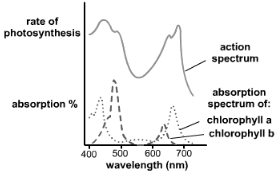
(C) The Action Spectrum is the curve depicting the relative rate of photosynthesis at different wavelengths of light.
It shows that the maximum rate of photosynthesis occurs in the blue and red regions of the light spectrum.
These regions correspond to the peak absorption regions of chlorophyll-$a$.
Therefore,the action spectrum of photosynthesis is almost identical to the absorption spectrum of chlorophyll-$a$.
It shows that the maximum rate of photosynthesis occurs in the blue and red regions of the light spectrum.
These regions correspond to the peak absorption regions of chlorophyll-$a$.
Therefore,the action spectrum of photosynthesis is almost identical to the absorption spectrum of chlorophyll-$a$.
0 likes
View Solution173
MediumMCQ
What is the function performed by plant pigments?
A
Absorb $CO_{2}$
B
Absorb $O_{2}$
C
Absorb $H_{2}O$
D
Absorb light
Solution
(D) Pigments are substances that have the ability to absorb light at specific wavelengths.
Among all pigments,$Chlorophyll-a$ absorbs the maximum amount of light in the blue and red regions of the spectrum.
In these regions,$Chlorophyll-a$ performs the maximum rate of photosynthesis.
Thus,$Chlorophyll-a$ is called the primary photosynthetic pigment.
Among all pigments,$Chlorophyll-a$ absorbs the maximum amount of light in the blue and red regions of the spectrum.
In these regions,$Chlorophyll-a$ performs the maximum rate of photosynthesis.
Thus,$Chlorophyll-a$ is called the primary photosynthetic pigment.
0 likes
View Solution174
MediumMCQ
By which plant pigment does maximum absorption of radiation take place in the blue and red regions of the absorption spectrum?
A
Chlorophyll-$a$
B
Chlorophyll-$b$
C
Xanthophyll
D
Carotenoid
Solution
(A) The absorption spectrum of photosynthetic pigments shows that Chlorophyll-$a$ is the primary pigment involved in photosynthesis.
Chlorophyll-$a$ shows maximum absorption in the blue and red wavelengths of the visible light spectrum.
These regions correspond to the peaks of the absorption spectrum,which drive the light-dependent reactions of photosynthesis.
Therefore,Chlorophyll-$a$ is the correct answer.
Chlorophyll-$a$ shows maximum absorption in the blue and red wavelengths of the visible light spectrum.
These regions correspond to the peaks of the absorption spectrum,which drive the light-dependent reactions of photosynthesis.
Therefore,Chlorophyll-$a$ is the correct answer.
0 likes
View Solution175
MediumMCQ
Light Harvesting Complex $(LHC)$ is
A
One molecule of chlorophyll-$a$
B
Very few molecules of chlorophyll-$a$
C
Hundreds of pigment molecules bound to proteins
D
Chlorophyll-$a$ + chlorophyll-$c$ + protein + $DNA$
Solution
(C) The Light Harvesting Complex $(LHC)$ consists of hundreds of pigment molecules bound to proteins.
These pigments include chlorophyll-$a$,chlorophyll-$b$,and carotenoids.
They help in absorbing light energy and transferring it to the reaction center.
These pigments include chlorophyll-$a$,chlorophyll-$b$,and carotenoids.
They help in absorbing light energy and transferring it to the reaction center.
0 likes
View Solution176
EasyMCQ
Which of the following represents the correct molecular formula of chlorophyll-$b$?
A
$C_{55}H_{72}O_{6}N_{4}Mg$
B
$C_{55}H_{72}O_{5}N_{4}Mg$
C
$C_{55}H_{72}O_{4}N_{4}Mg$
D
$C_{55}H_{70}O_{6}N_{4}Mg$
Solution
(D) The molecular formulas for chlorophyll-$a$ and chlorophyll-$b$ are as follows:
Chlorophyll-$a$: $C_{55}H_{72}O_{5}N_{4}Mg$
Chlorophyll-$b$: $C_{55}H_{70}O_{6}N_{4}Mg$
Chlorophyll-$b$ differs from chlorophyll-$a$ by having a formyl group $(-CHO)$ instead of a methyl group $(-CH_{3})$ at the third carbon position of the porphyrin ring. This substitution results in the loss of two hydrogen atoms and the gain of one oxygen atom compared to chlorophyll-$a$.
Chlorophyll-$a$: $C_{55}H_{72}O_{5}N_{4}Mg$
Chlorophyll-$b$: $C_{55}H_{70}O_{6}N_{4}Mg$
Chlorophyll-$b$ differs from chlorophyll-$a$ by having a formyl group $(-CHO)$ instead of a methyl group $(-CH_{3})$ at the third carbon position of the porphyrin ring. This substitution results in the loss of two hydrogen atoms and the gain of one oxygen atom compared to chlorophyll-$a$.
0 likes
View Solution177
MediumMCQ
$I$. $PS-I$ has more chlorophyll-a than chlorophyll-b.
$II$. $PS-II$ has more chlorophyll-b than chlorophyll-a.
Choose the correct option.
$II$. $PS-II$ has more chlorophyll-b than chlorophyll-a.
Choose the correct option.
A
$I$ statement is wrong,$II$ is right.
B
$I$ statement is right,$II$ is wrong.
C
Both statements are wrong.
D
Both statements are right.
Solution
(B) $(I)$ $PS-I$ contains a higher proportion of chlorophyll-a compared to chlorophyll-b (approximately $2:1$ ratio).
$(II)$ $PS-II$ contains chlorophyll-a and chlorophyll-b in roughly equal amounts,or sometimes slightly more chlorophyll-a,but it does not have more chlorophyll-b than chlorophyll-a.
Therefore,statement $I$ is correct and statement $II$ is incorrect.
$(II)$ $PS-II$ contains chlorophyll-a and chlorophyll-b in roughly equal amounts,or sometimes slightly more chlorophyll-a,but it does not have more chlorophyll-b than chlorophyll-a.
Therefore,statement $I$ is correct and statement $II$ is incorrect.
0 likes
View Solution178
MediumMCQ
Chlorophyll-$a$ and $b$ differ in having
A
Chlorophyll-$a$ has a methyl group and chlorophyll-$b$ has an aldehyde group in position $X$
B
Chlorophyll-$a$ has an aldehyde group and chlorophyll-$b$ has a methyl group in position $X$
C
Chlorophyll-$a$ has a carboxyl group and chlorophyll-$b$ has an aldehyde group in position $X$
D
Chlorophyll-$a$ has an ethyl group and chlorophyll-$b$ has an aldehyde group in position $X$
Solution
(A) Chlorophylls are magnesium porphyrin compounds. Chlorophyll-$a$ $(C_{55}H_{72}O_{5}N_{4}Mg)$ and chlorophyll-$b$ $(C_{55}H_{70}O_{6}N_{4}Mg)$ both consist of a magnesium porphyrin head,which is hydrophilic,and a phytol tail,which is lipophilic.
Chlorophyll-$b$ differs from chlorophyll-$a$ only in one of the functional groups bonded to the porphyrin ring.
Specifically,in chlorophyll-$b$,there is a $-CHO$ (aldehyde) group instead of a $-CH_{3}$ (methyl) group at the third carbon atom in the second pyrrole ring.
Chlorophyll-$b$ differs from chlorophyll-$a$ only in one of the functional groups bonded to the porphyrin ring.
Specifically,in chlorophyll-$b$,there is a $-CHO$ (aldehyde) group instead of a $-CH_{3}$ (methyl) group at the third carbon atom in the second pyrrole ring.
0 likes
View Solution179
MediumMCQ
Photosystem is composed of
A
Light harvesting complex
B
Reaction centre
C
Accessory pigments
D
More than one is correct
Solution
(D) $Photosystem$ $(PS)$ consists of a $Reaction$ $Centre$ surrounded by many $Light$ $Harvesting$ $Complexes$ $(LHCs)$.
These $LHCs$ are composed of hundreds of pigment molecules bound to proteins,including chlorophyll $a$,chlorophyll $b$,and accessory pigments like carotenoids and xanthophylls.
Since both the $Light$ $Harvesting$ $Complex$ and the $Reaction$ $Centre$ (which contains accessory pigments) are integral parts of the $Photosystem$,option $D$ is the correct answer.
These $LHCs$ are composed of hundreds of pigment molecules bound to proteins,including chlorophyll $a$,chlorophyll $b$,and accessory pigments like carotenoids and xanthophylls.
Since both the $Light$ $Harvesting$ $Complex$ and the $Reaction$ $Centre$ (which contains accessory pigments) are integral parts of the $Photosystem$,option $D$ is the correct answer.
0 likes
View Solution180
MediumMCQ
Choose the correct statement.
A
Chlorophyll-$a$ is soluble in petroleum ether and shows maximum absorption peak at $453 \ nm$ and $642 \ nm$.
B
In chlorophyll-$b$,$-CH_3$ replaces $-CHO$ at $3-C$ of chlorophyll-$a$.
C
Chlorophyll-$b$ is soluble in methyl alcohol and shows maximum absorption peak at $429 \ nm$ and $660 \ nm$.
D
For biosynthesis of chlorophyll,raw materials required are succinyl $CoA$ and glycine.
Solution
(D) Chlorophyll-$a$ is the primary pigment and is soluble in petroleum ether. It shows maximum absorption peaks at approximately $430 \ nm$ and $662 \ nm$.
Chlorophyll-$b$ is an accessory pigment and is soluble in methyl alcohol. It shows maximum absorption peaks at approximately $453 \ nm$ and $642 \ nm$.
In the molecular structure of chlorophyll-$b$,the methyl group $(-CH_3)$ present at the $3-C$ position in chlorophyll-$a$ is replaced by an aldehyde group $(-CHO)$.
Therefore,the statement regarding the biosynthesis of chlorophyll using succinyl $CoA$ and glycine is the correct biological fact,as these are the precursors for the porphyrin ring synthesis.
Chlorophyll-$b$ is an accessory pigment and is soluble in methyl alcohol. It shows maximum absorption peaks at approximately $453 \ nm$ and $642 \ nm$.
In the molecular structure of chlorophyll-$b$,the methyl group $(-CH_3)$ present at the $3-C$ position in chlorophyll-$a$ is replaced by an aldehyde group $(-CHO)$.
Therefore,the statement regarding the biosynthesis of chlorophyll using succinyl $CoA$ and glycine is the correct biological fact,as these are the precursors for the porphyrin ring synthesis.
0 likes
View Solution181
MediumMCQ
$A$: Carotenoids protect plants from excessive heat and prevent photooxidation of chlorophyll.
$R$: Carotenoids enable a wider range of wavelengths of incoming light to be utilized for photosynthesis.
$R$: Carotenoids enable a wider range of wavelengths of incoming light to be utilized for photosynthesis.
A
Assertion and Reason both are correct and Reason is the correct explanation of Assertion.
B
Assertion and Reason both are correct but Reason is not the correct explanation of Assertion.
C
Assertion is correct,but Reason is incorrect.
D
Both Assertion and Reason are incorrect.
Solution
(B) The Assertion is correct: Carotenoids act as accessory pigments that protect chlorophyll molecules from photooxidation by absorbing excess light energy and dissipating it as heat.
The Reason is also correct: Carotenoids absorb light in the blue-violet region and transfer this energy to chlorophyll $a$,thereby expanding the range of wavelengths that can be used for photosynthesis.
Since both statements are scientifically accurate and describe distinct functional roles of carotenoids,the Reason does not directly explain the mechanism of protection mentioned in the Assertion. Therefore,both are correct but the Reason is not the correct explanation of the Assertion.
The Reason is also correct: Carotenoids absorb light in the blue-violet region and transfer this energy to chlorophyll $a$,thereby expanding the range of wavelengths that can be used for photosynthesis.
Since both statements are scientifically accurate and describe distinct functional roles of carotenoids,the Reason does not directly explain the mechanism of protection mentioned in the Assertion. Therefore,both are correct but the Reason is not the correct explanation of the Assertion.
0 likes
View Solution182
EasyMCQ
The location of chlorophyll is $.........$.
A
Thylakoid membrane
B
Stroma
C
Outer membrane
D
Epidermal cell
Solution
(A) Chlorophyll is the primary photosynthetic pigment found in plants.
In eukaryotic cells,photosynthesis occurs within organelles called chloroplasts.
Inside the chloroplast,the thylakoid membranes contain the photosystems and chlorophyll pigments necessary for the light-dependent reactions of photosynthesis.
Therefore,the correct location of chlorophyll is the thylakoid membrane.
In eukaryotic cells,photosynthesis occurs within organelles called chloroplasts.
Inside the chloroplast,the thylakoid membranes contain the photosystems and chlorophyll pigments necessary for the light-dependent reactions of photosynthesis.
Therefore,the correct location of chlorophyll is the thylakoid membrane.
1 likes
View Solution183
MediumMCQ
In the structure of chlorophyll,$.........$ is required,and for its synthesis,$.............$ is required.
A
$Mg, Fe$
B
$Fe, Mg$
C
$Fe, Mn$
D
$Mn, Fe$
Solution
(A) Chlorophyll is a magnesium-porphyrin complex,meaning that $Mg^{2+}$ is the central metal ion in the structure of the chlorophyll molecule.
Iron $(Fe)$ is not a structural component of chlorophyll,but it is essential for the synthesis of chlorophyll because it acts as a cofactor for enzymes involved in the chlorophyll biosynthetic pathway.
Therefore,$Mg$ is required for the structure,and $Fe$ is required for its synthesis.
Iron $(Fe)$ is not a structural component of chlorophyll,but it is essential for the synthesis of chlorophyll because it acts as a cofactor for enzymes involved in the chlorophyll biosynthetic pathway.
Therefore,$Mg$ is required for the structure,and $Fe$ is required for its synthesis.
0 likes
View Solution184
MediumMCQ
Which part of the electromagnetic spectrum is useful for photosynthesis?
A
$UV$ rays
B
Visible light
C
Infrared rays
D
All of the above
Solution
(B) Photosynthesis primarily utilizes the visible spectrum of light,specifically the range known as Photosynthetically Active Radiation $(PAR)$.
$PAR$ ranges from $400 \ nm$ to $700 \ nm$ in wavelength.
Chlorophyll pigments absorb light most efficiently in the blue and red regions of this visible spectrum.
$UV$ rays and infrared rays are generally not used for the light-dependent reactions of photosynthesis.
$PAR$ ranges from $400 \ nm$ to $700 \ nm$ in wavelength.
Chlorophyll pigments absorb light most efficiently in the blue and red regions of this visible spectrum.
$UV$ rays and infrared rays are generally not used for the light-dependent reactions of photosynthesis.
0 likes
View Solution185
MediumMCQ
How many types of pigments are found in the leaves of higher plants?
A
$1$
B
$2$
C
$3$
D
$4$
Solution
(D) In higher plants,the pigments involved in photosynthesis are primarily categorized into four types based on paper chromatography:
$1$. Chlorophyll $a$ (bright or blue-green in the chromatogram).
$2$. Chlorophyll $b$ (yellow-green).
$3$. Xanthophylls (yellow).
$4$. Carotenoids (yellow to yellow-orange).
Therefore,there are $4$ main types of pigments found in the leaves of higher plants.
$1$. Chlorophyll $a$ (bright or blue-green in the chromatogram).
$2$. Chlorophyll $b$ (yellow-green).
$3$. Xanthophylls (yellow).
$4$. Carotenoids (yellow to yellow-orange).
Therefore,there are $4$ main types of pigments found in the leaves of higher plants.
0 likes
View Solution186
MediumMCQ
Identify the correct sequence of pigments based on their molecular weight (from higher to lower).
A
Chlorophyll $b$ > Chlorophyll $a$ > Xanthophylls > Carotenoids
B
Chlorophyll $a$ > Chlorophyll $b$ > Xanthophylls > Carotenoids
C
Carotenoids > Xanthophylls > Chlorophyll $b$ > Chlorophyll $a$
D
Carotenoids > Xanthophylls > Chlorophyll $a$ > Chlorophyll $b$
Solution
(A) The molecular formulas and approximate molecular weights of these photosynthetic pigments are as follows:
$1$. Chlorophyll $a$ $(C_{55}H_{72}O_5N_4Mg)$: Molecular weight $\approx 893.5 \text{ g/mol}$.
$2$. Chlorophyll $b$ $(C_{55}H_{70}O_6N_4Mg)$: Molecular weight $\approx 907.5 \text{ g/mol}$.
$3$. Xanthophylls (e.g., Lutein, $C_{40}H_{56}O_2$): Molecular weight $\approx 568.8 \text{ g/mol}$.
$4$. Carotenoids (e.g., $\beta$-carotene, $C_{40}H_{56}$): Molecular weight $\approx 536.8 \text{ g/mol}$.
Comparing these values, the order from higher to lower molecular weight is: Chlorophyll $b$ $(907.5)$ > Chlorophyll $a$ $(893.5)$ > Xanthophylls $(568.8)$ > Carotenoids $(536.8)$.
Thus, the correct sequence is Chlorophyll $b$ > Chlorophyll $a$ > Xanthophylls > Carotenoids.
$1$. Chlorophyll $a$ $(C_{55}H_{72}O_5N_4Mg)$: Molecular weight $\approx 893.5 \text{ g/mol}$.
$2$. Chlorophyll $b$ $(C_{55}H_{70}O_6N_4Mg)$: Molecular weight $\approx 907.5 \text{ g/mol}$.
$3$. Xanthophylls (e.g., Lutein, $C_{40}H_{56}O_2$): Molecular weight $\approx 568.8 \text{ g/mol}$.
$4$. Carotenoids (e.g., $\beta$-carotene, $C_{40}H_{56}$): Molecular weight $\approx 536.8 \text{ g/mol}$.
Comparing these values, the order from higher to lower molecular weight is: Chlorophyll $b$ $(907.5)$ > Chlorophyll $a$ $(893.5)$ > Xanthophylls $(568.8)$ > Carotenoids $(536.8)$.
Thus, the correct sequence is Chlorophyll $b$ > Chlorophyll $a$ > Xanthophylls > Carotenoids.
0 likes
View Solution187
MediumMCQ
Match the following columns:
| Column-$I$ (Pigments) | Column-$II$ (Color) |
| $P$. Chlorophyll $a$ | $I$. Yellow-orange |
| $Q$. Chlorophyll $b$ | $II$. Yellow-green |
| $R$. Carotenoids | $III$. Bright or blue-green |
| $S$. Xanthophylls | $IV$. Yellow |
A
$(P-II), (Q-III), (R-I), (S-IV)$
B
$(P-III), (Q-II), (R-I), (S-IV)$
C
$(P-III), (Q-II), (R-IV), (S-I)$
D
$(P-II), (Q-III), (R-IV), (S-I)$
Solution
(B) The correct matches for the photosynthetic pigments and their colors are as follows:
$1$. Chlorophyll $a$: Bright or blue-green $(P-III)$
$2$. Chlorophyll $b$: Yellow-green $(Q-II)$
$3$. Carotenoids: Yellow to yellow-orange $(R-I)$
$4$. Xanthophylls: Yellow $(S-IV)$
Therefore, the correct matching is $(P-III), (Q-II), (R-I), (S-IV)$.
$1$. Chlorophyll $a$: Bright or blue-green $(P-III)$
$2$. Chlorophyll $b$: Yellow-green $(Q-II)$
$3$. Carotenoids: Yellow to yellow-orange $(R-I)$
$4$. Xanthophylls: Yellow $(S-IV)$
Therefore, the correct matching is $(P-III), (Q-II), (R-I), (S-IV)$.
0 likes
View Solution188
MediumMCQ
Which molecule acts as the reaction center in photosynthesis?
A
Chlorophyll-$a$
B
Chlorophyll-$b$
C
Carotenoids
D
Xanthophylls
Solution
(A) In the light-harvesting complex of photosynthesis,various pigments (accessory pigments) absorb light energy and transfer it to the reaction center. The reaction center is composed of a specific molecule of Chlorophyll-$a$. This molecule is responsible for the primary photochemical reaction,where it loses an electron upon excitation,initiating the electron transport chain.
0 likes
View Solution189
MediumMCQ
Which of the following act as accessory pigments?
A
Chlorophyll-$b$
B
Carotenoids
C
Xanthophylls
D
All of the above
Solution
(D) Accessory pigments are pigments that absorb light energy and transfer it to chlorophyll-$a$,which is the primary pigment involved in photosynthesis.
Chlorophyll-$b$,carotenoids,and xanthophylls all function as accessory pigments.
They broaden the spectrum of light that can be absorbed for photosynthesis and also protect chlorophyll-$a$ from photo-oxidation.
Therefore,all the given options are correct.
Chlorophyll-$b$,carotenoids,and xanthophylls all function as accessory pigments.
They broaden the spectrum of light that can be absorbed for photosynthesis and also protect chlorophyll-$a$ from photo-oxidation.
Therefore,all the given options are correct.
0 likes
View Solution190
MediumMCQ
How many molecules of chlorophyll-$a$ are present in each photosystem?
A
$1$
B
$2$
C
Thousands
D
$350$ to $400$
Solution
(A) In a photosystem,the reaction center is formed by a single molecule of chlorophyll-$a$.
This chlorophyll-$a$ molecule acts as the primary electron donor in the light-dependent reactions of photosynthesis.
While there are hundreds of accessory pigment molecules (such as chlorophyll-$b$,carotenoids,and xanthophylls) that form the light-harvesting complex $(LHC)$,the reaction center itself consists of only one molecule of chlorophyll-$a$.
This chlorophyll-$a$ molecule acts as the primary electron donor in the light-dependent reactions of photosynthesis.
While there are hundreds of accessory pigment molecules (such as chlorophyll-$b$,carotenoids,and xanthophylls) that form the light-harvesting complex $(LHC)$,the reaction center itself consists of only one molecule of chlorophyll-$a$.
0 likes
View Solution191
MediumMCQ
Match List $I$ with List $II$.
Choose the option with all correct matches.
| List $I$ | List $II$ |
| $A$. Chlorophyll $a$ | $I$. Yellow-green |
| $B$. Chlorophyll $b$ | $II$. Yellow |
| $C$. Xanthophylls | $III$. Blue-green |
| $D$. Carotenoids | $IV$. Yellow to Yellow-orange |
Choose the option with all correct matches.
A
$A-III, B-IV, C-II, D-I$
B
$A-III, B-I, C-II, D-IV$
C
$A-I, B-II, C-IV, D-III$
D
$A-I, B-IV, C-III, D-II$
Solution
(B) The pigments involved in photosynthesis exhibit specific colors in chromatograms:
$1$. Chlorophyll $a$ appears as bright or blue-green in the chromatogram.
$2$. Chlorophyll $b$ appears as yellow-green.
$3$. Xanthophylls appear as yellow.
$4$. Carotenoids appear as yellow to yellow-orange.
Therefore,the correct matching is: $A-III, B-I, C-II, D-IV$.
$1$. Chlorophyll $a$ appears as bright or blue-green in the chromatogram.
$2$. Chlorophyll $b$ appears as yellow-green.
$3$. Xanthophylls appear as yellow.
$4$. Carotenoids appear as yellow to yellow-orange.
Therefore,the correct matching is: $A-III, B-I, C-II, D-IV$.
0 likes
View Solution192
MediumMCQ
Photosynthetic pigments are present in which part of chloroplast?
A
Inner membrane
B
Thylakoid membrane
C
Stroma
D
Thylakoid lumen
Solution
(B) Chloroplasts are double-membrane organelles found in plant cells.
Inside the chloroplast,there is a system of flattened,sac-like structures called thylakoids.
The membranes of these thylakoids contain photosynthetic pigments such as chlorophyll $a$,chlorophyll $b$,and carotenoids.
These pigments are essential for capturing light energy during the light-dependent reactions of photosynthesis.
Therefore,the correct location for photosynthetic pigments is the thylakoid membrane.
Inside the chloroplast,there is a system of flattened,sac-like structures called thylakoids.
The membranes of these thylakoids contain photosynthetic pigments such as chlorophyll $a$,chlorophyll $b$,and carotenoids.
These pigments are essential for capturing light energy during the light-dependent reactions of photosynthesis.
Therefore,the correct location for photosynthetic pigments is the thylakoid membrane.
0 likes
View Solution193
MediumMCQ
Chlorophyll $a$ appears ------ in colour $\&$ chlorophyll $b$ appears ------ in colour on chromatogram :-
A
Blue green,Yellow green
B
Yellow green,Blue green
C
Blue,Red
D
Green,Red
Solution
(A) In paper chromatography,pigments are separated based on their solubility in the solvent system.
Chlorophyll $a$ is the primary photosynthetic pigment and appears blue-green in the chromatogram.
Chlorophyll $b$ is an accessory pigment and appears yellow-green in the chromatogram.
Therefore,the correct sequence is blue-green and yellow-green.
Chlorophyll $a$ is the primary photosynthetic pigment and appears blue-green in the chromatogram.
Chlorophyll $b$ is an accessory pigment and appears yellow-green in the chromatogram.
Therefore,the correct sequence is blue-green and yellow-green.
0 likes
View Solution194
EasyMCQ
Match the pigments given in List-Iwith their colour in chromatogram given in List-II.
Choose the correct option from the following:
| List-I(Pigments) | List-II(Colour in chromatogram) |
| 1. Chlorophyll 'b' | p. Yellow orange |
| 2. Carotenoids | q. Orange red |
| 3. Chlorophyll 'a' | s. Blue green |
| 4. Xanthophylls | r. Yellow |
| - | t. Yellow green |
A
$1-s, 2-p, 3-q, 4-r$
B
$1-t, 2-p, 3-s, 4-r$
C
$1-t, 2-q, 3-s, 4-p$
D
$1-s, 2-t, 3-q, 4-r$
Solution
(B) According to the paper chromatography of leaf pigments,the colours observed are as follows:
$1$. Chlorophyll '$b$' appears as Yellow green $(t)$.
$2$. Carotenoids appear as Yellow to Yellow orange $(p)$.
$3$. Chlorophyll '$a$' appears as Blue green $(s)$.
$4$. Xanthophylls appear as Yellow $(r)$.
Therefore,the correct matching is $1-t, 2-p, 3-s, 4-r$.
$1$. Chlorophyll '$b$' appears as Yellow green $(t)$.
$2$. Carotenoids appear as Yellow to Yellow orange $(p)$.
$3$. Chlorophyll '$a$' appears as Blue green $(s)$.
$4$. Xanthophylls appear as Yellow $(r)$.
Therefore,the correct matching is $1-t, 2-p, 3-s, 4-r$.
0 likes
View Solution195
EasyMCQ
Identify from the following,a characteristic pigment associated with chlorophyll-$b$ molecules.
A
Ferredoxin
B
Plastoquinone
C
Plastocyanin
D
Cytochrome
Solution
(B) The correct answer is $B$.
Plastoquinone $(PQ)$ is a mobile electron carrier in the electron transport chain of photosynthesis.
It is functionally associated with the movement of electrons from Photosystem $II$ to the Cytochrome $b_6f$ complex.
Chlorophyll-$b$ is an accessory pigment that transfers energy to chlorophyll-$a$ and is primarily found in the light-harvesting complexes of Photosystem $II$,where Plastoquinone acts as the primary electron acceptor.
Plastoquinone $(PQ)$ is a mobile electron carrier in the electron transport chain of photosynthesis.
It is functionally associated with the movement of electrons from Photosystem $II$ to the Cytochrome $b_6f$ complex.
Chlorophyll-$b$ is an accessory pigment that transfers energy to chlorophyll-$a$ and is primarily found in the light-harvesting complexes of Photosystem $II$,where Plastoquinone acts as the primary electron acceptor.
0 likes
View SolutionPhotosynthesis in Higher Plants — Pigments involved in photo synthesis · Frequently Asked Questions
1Are these Photosynthesis in Higher Plants questions useful for JEE and NEET?
Yes. All questions in this section are mapped to JEE Main and NEET exam patterns. Previous year questions from JEE Main, NEET, GUJCET and state-level exams are included with full solutions.
2Can I switch to Hindi or Gujarati for these questions?
Yes. Use the language tabs in the hero section or the sidebar to view the same questions and solutions in English, Hindi or Gujarati.
3How do I generate a question paper from this subtopic?
Use the Vedclass Exam Paper Generator — select the chapter and subtopic, set difficulty, and generate Sets A, B, C, D automatically. First 3 chapters of every subject are free.
Vedclass Products
For Students
Vedclass Test Series
Mock tests in real JEE/NEET style with performance analysis. 5-day free trial.
Start Free TrialFor Teachers
Exam Paper Generator
Generate Set A/B/C/D papers from this chapter in 2 minutes. 3 chapters free.
Try FreeFor Institutes
Online Exam Module
Live online exams with unlimited students, 360° analytics & white-label branding.
See DemoFor Teachers & Institutes
Generate a Photosynthesis in Higher Plants Exam Paper in 2 Minutes
Select subtopic & difficulty — Sets A, B, C, D auto-generated with No Repeat logic.
First 3 chapters of every subject are free — no payment required.