
A English
Pigments involved in photo synthesis Questions in English
Class 11 Biology · Photosynthesis in Higher Plants · Pigments involved in photo synthesis
195+
Questions
English
Language
100%
With Solutions
Showing 50 of 195 questions in English
101
EasyMCQ
Chlorophyll is present in the ......... of the chloroplast.
A
Grana of the chloroplast
B
Surface of the chloroplast
C
Dispersed throughout the chloroplast
D
Stroma of the chloroplast
Solution
(A) Chlorophyll is the primary photosynthetic pigment responsible for trapping light energy.
In eukaryotic plants,chlorophyll is located within the thylakoid membranes of the chloroplast.
The thylakoids are stacked to form structures known as $Grana$ (singular: $Granum$).
Therefore,chlorophyll is specifically found in the $Grana$ of the chloroplast,where the light-dependent reactions of photosynthesis occur.
In eukaryotic plants,chlorophyll is located within the thylakoid membranes of the chloroplast.
The thylakoids are stacked to form structures known as $Grana$ (singular: $Granum$).
Therefore,chlorophyll is specifically found in the $Grana$ of the chloroplast,where the light-dependent reactions of photosynthesis occur.
0 likes
View Solution102
EasyMCQ
Which of the following is a $Cu^{++}$ containing protein complex?
A
Ferredoxin
B
Plastocyanin
C
Cytochrome
D
All of the above
Solution
(B) Plastocyanin is a copper-containing protein that acts as an electron carrier in the photosynthetic electron transport chain.
It facilitates the transfer of electrons from the cytochrome $b_6f$ complex to Photosystem $I$ $(PSI)$.
Ferredoxin is an iron-sulfur protein,and cytochromes are heme-containing proteins (iron-porphyrin complexes).
Therefore,the correct answer is Plastocyanin.
It facilitates the transfer of electrons from the cytochrome $b_6f$ complex to Photosystem $I$ $(PSI)$.
Ferredoxin is an iron-sulfur protein,and cytochromes are heme-containing proteins (iron-porphyrin complexes).
Therefore,the correct answer is Plastocyanin.
0 likes
View Solution103
MediumMCQ
The photosynthetic pigment phycobilin is $NOT$ associated with which of the following?
A
$PS-II$
B
Cyanobacteria
C
$PS-I$
D
All of the above
Solution
(D) Phycobilins are water-soluble accessory pigments found in cyanobacteria and red algae.
They function as light-harvesting complexes that capture light energy and transfer it to the reaction centers of photosystems.
Phycobilins are associated with both $PS-I$ and $PS-II$ in these organisms to facilitate efficient energy transfer.
Since phycobilins are present in cyanobacteria and are associated with both photosystems,none of the given options correctly identify what they are $NOT$ associated with.
However,in the context of standard textbook questions where this is often posed,if the question implies which system they are $NOT$ exclusively part of,it is a trick question.
Given the options provided,since they are associated with $PS-I$,$PS-II$,and cyanobacteria,the correct answer is that they are associated with all of these,making the premise of the question '$NOT$ associated' invalid for the given choices.
They function as light-harvesting complexes that capture light energy and transfer it to the reaction centers of photosystems.
Phycobilins are associated with both $PS-I$ and $PS-II$ in these organisms to facilitate efficient energy transfer.
Since phycobilins are present in cyanobacteria and are associated with both photosystems,none of the given options correctly identify what they are $NOT$ associated with.
However,in the context of standard textbook questions where this is often posed,if the question implies which system they are $NOT$ exclusively part of,it is a trick question.
Given the options provided,since they are associated with $PS-I$,$PS-II$,and cyanobacteria,the correct answer is that they are associated with all of these,making the premise of the question '$NOT$ associated' invalid for the given choices.
0 likes
View Solution104
EasyMCQ
Photosynthetic pigment $Chlorophyll$ is soluble in .........
A
Water
B
Inorganic solvents
C
Organic solvents
D
Both water and organic solvents
Solution
(C) $Chlorophyll$ is a lipid-soluble pigment.
It is insoluble in water but dissolves readily in organic solvents such as $acetone$,$ether$,$alcohol$,and $chloroform$.
It is insoluble in water but dissolves readily in organic solvents such as $acetone$,$ether$,$alcohol$,and $chloroform$.
0 likes
View Solution105
MediumMCQ
Which of the following is the correct order of effectiveness for photosynthesis?
A
Blue > Yellow > Orange > Red
B
Blue > Red > Yellow > Orange
C
Red > Blue > Yellow > Orange
D
Yellow > Orange > Blue > Red
Solution
(B) The effectiveness of light for photosynthesis is determined by the absorption spectrum of chlorophyll pigments. Chlorophyll $a$ and $b$ absorb light most efficiently in the blue and red regions of the visible spectrum. Among these,the blue region $(430-450 \ nm)$ is generally more effective than the red region $(640-680 \ nm)$. Yellow and orange wavelengths are absorbed much less efficiently by these pigments. Therefore,the correct order of photosynthetic effectiveness is $Blue > Red > Yellow > Orange$.
0 likes
View Solution106
EasyMCQ
Which of the following molecules gets excited during photosynthesis?
A
Chlorophyll
B
Oxygen
C
Carbon dioxide
D
Water
Solution
(A) During the process of photosynthesis,the light-harvesting complexes $(LHC)$ contain pigment molecules.
When light energy (photons) strikes the chlorophyll molecules,the electrons in the chlorophyll absorb this energy and jump to a higher energy state,becoming 'excited'.
This excitation of chlorophyll is the primary photochemical event that initiates the light-dependent reactions of photosynthesis.
When light energy (photons) strikes the chlorophyll molecules,the electrons in the chlorophyll absorb this energy and jump to a higher energy state,becoming 'excited'.
This excitation of chlorophyll is the primary photochemical event that initiates the light-dependent reactions of photosynthesis.
0 likes
View Solution107
MediumMCQ
Carotenes present in chloroplasts help in .........
A
Synthesis of $ATP$
B
Transfer of light energy to chemical energy
C
Protecting chlorophyll molecules from photo-oxidation
D
Absorption of long wavelengths of light
Solution
(C) Carotenes and xanthophylls are accessory pigments found in chloroplasts.
These pigments absorb light energy and transfer it to chlorophyll-$a$.
Crucially,they also protect the chlorophyll molecules from photo-oxidation by absorbing excess light energy that could otherwise damage the chlorophyll pigments.
These pigments absorb light energy and transfer it to chlorophyll-$a$.
Crucially,they also protect the chlorophyll molecules from photo-oxidation by absorbing excess light energy that could otherwise damage the chlorophyll pigments.
0 likes
View Solution108
MediumMCQ
Which of the following is a precursor of chlorophyll?
A
Tryptophan
B
Protochlorophyll
C
Bacteriochlorophyll
D
Bacterioviridin
Solution
(B) Protochlorophyll is the immediate precursor of chlorophyll in the biosynthetic pathway of plants.
In the presence of light,protochlorophyll is converted into chlorophyll by the enzyme protochlorophyllide reductase.
This process is a light-dependent step in the synthesis of chlorophyll $a$.
In the presence of light,protochlorophyll is converted into chlorophyll by the enzyme protochlorophyllide reductase.
This process is a light-dependent step in the synthesis of chlorophyll $a$.
0 likes
View Solution109
EasyMCQ
In a chlorophyll molecule,the $Mg$ atom is located in the:
A
Center of the porphyrin ring
B
Corner of the porphyrin ring
C
Phytol tail
D
Isocyclic ring
Solution
(A) The chlorophyll molecule consists of a porphyrin head and a phytol tail. The porphyrin head is a tetrapyrrole ring structure. At the center of this porphyrin ring,a single magnesium $(Mg^{2+})$ ion is coordinated by four nitrogen atoms from the pyrrole rings. This central magnesium atom is essential for the stability and light-harvesting function of the chlorophyll molecule.
0 likes
View Solution110
MediumMCQ
Which color of light is $NOT$ used during photosynthesis?
A
Violet
B
Green
C
Red
D
Blue
Solution
(B) Photosynthesis primarily occurs in the red and blue regions of the visible light spectrum. Chlorophyll pigments absorb light most efficiently in these wavelengths. Green light is largely reflected or transmitted by the leaves,which is why plants appear green to our eyes. Therefore,green light is the least effective or not significantly used during the process of photosynthesis.
0 likes
View Solution111
EasyMCQ
The unit of photosynthesis is $......$.
A
Glyoxysome
B
Sphaerosome
C
Microsome
D
Quantasome
Solution
(D) The unit of photosynthesis is known as the $Quantasome$.
$Quantasomes$ are granular structures found in the thylakoid membranes of chloroplasts.
They contain a specific number of chlorophyll and accessory pigment molecules,which act as the functional units for capturing light energy during the light-dependent reactions of photosynthesis.
$Quantasomes$ are granular structures found in the thylakoid membranes of chloroplasts.
They contain a specific number of chlorophyll and accessory pigment molecules,which act as the functional units for capturing light energy during the light-dependent reactions of photosynthesis.
0 likes
View Solution112
EasyMCQ
Chlorophyll has $......$ at its center.
A
Iron
B
Magnesium
C
Copper
D
Sulfur
Solution
(B) The chlorophyll molecule is a porphyrin derivative. It consists of a central magnesium ion $(Mg^{2+})$ coordinated to four nitrogen atoms of the porphyrin ring. This structure is essential for the absorption of light energy during the process of photosynthesis.
0 likes
View Solution113
EasyMCQ
Quantasomes are found in .....
A
Mitochondria
B
Chloroplast
C
Lysosome
D
Endoplasmic reticulum
Solution
(B) Quantasomes are granular structures found on the thylakoid membranes of the chloroplasts.
They are considered the photosynthetic units that contain chlorophyll and other pigments required for the light-dependent reactions of photosynthesis.
Therefore,the correct answer is $B$ (Chloroplast).
They are considered the photosynthetic units that contain chlorophyll and other pigments required for the light-dependent reactions of photosynthesis.
Therefore,the correct answer is $B$ (Chloroplast).
0 likes
View Solution114
MediumMCQ
Which color of light is absorbed most by chlorophyll $a$?
A
Green
B
Red
C
Blue
D
Infrared
Solution
(C) Chlorophyll $a$ is the primary photosynthetic pigment.
According to the absorption spectrum of chlorophyll $a$,it shows two major absorption peaks.
The first peak is in the blue region (approximately $430-450 \ nm$) and the second peak is in the red region (approximately $640-680 \ nm$).
Among these,the absorption in the blue region is generally higher than in the red region.
Therefore,chlorophyll $a$ absorbs blue light most effectively.
According to the absorption spectrum of chlorophyll $a$,it shows two major absorption peaks.
The first peak is in the blue region (approximately $430-450 \ nm$) and the second peak is in the red region (approximately $640-680 \ nm$).
Among these,the absorption in the blue region is generally higher than in the red region.
Therefore,chlorophyll $a$ absorbs blue light most effectively.
0 likes
View Solution115
MediumMCQ
Which chlorophyll molecule does not possess a phytol tail?
A
$Chl. \ a$
B
$Chl. \ b$
C
$Chl. \ c$
D
$Chl. \ d$
Solution
(C) Chlorophyll molecules are pigments involved in photosynthesis.
Most chlorophylls,such as $Chl. \ a$,$Chl. \ b$,and $Chl. \ d$,possess a long hydrophobic phytol tail $(C_{20}H_{39}OH)$ attached to the porphyrin ring,which anchors them into the thylakoid membrane.
However,$Chl. \ c$ is unique because it lacks this phytol tail.
Instead,it has an acrylic acid group at the $C-17$ position,making it more polar than other chlorophylls.
Most chlorophylls,such as $Chl. \ a$,$Chl. \ b$,and $Chl. \ d$,possess a long hydrophobic phytol tail $(C_{20}H_{39}OH)$ attached to the porphyrin ring,which anchors them into the thylakoid membrane.
However,$Chl. \ c$ is unique because it lacks this phytol tail.
Instead,it has an acrylic acid group at the $C-17$ position,making it more polar than other chlorophylls.
0 likes
View Solution116
MediumMCQ
Which of the following chlorophylls lacks a phytol tail?
A
Chlorophyll $a$
B
Chlorophyll $b$
C
Chlorophyll $c$
D
Chlorophyll $e$
Solution
(C) Chlorophyll molecules typically consist of a porphyrin head and a long hydrophobic phytol tail.
Chlorophyll $a$ and $b$ possess this phytol tail,which anchors the molecule into the thylakoid membrane.
However,Chlorophyll $c$,which is found in certain algae like diatoms and brown algae,lacks the phytol tail.
Instead,it has an acrylic acid side chain at the $C-17$ position,making it more polar than other chlorophylls.
Chlorophyll $a$ and $b$ possess this phytol tail,which anchors the molecule into the thylakoid membrane.
However,Chlorophyll $c$,which is found in certain algae like diatoms and brown algae,lacks the phytol tail.
Instead,it has an acrylic acid side chain at the $C-17$ position,making it more polar than other chlorophylls.
0 likes
View Solution117
EasyMCQ
The extensive study of pigments was carried out by .........
A
Robert Hill
B
$H$.$P$. Nanda
C
Govindjee
D
Emerson
Solution
(C) The extensive study of photosynthetic pigments,their structure,and their role in light absorption and energy transfer was primarily carried out by the renowned scientist $Govindjee$. His work significantly contributed to our understanding of the $Z$-scheme and the efficiency of light-harvesting complexes in plants.
0 likes
View Solution118
EasyMCQ
The molecular formula of chlorophyll $a$ is........
A
$C_{35}H_{72}O_5N_4Mg$
B
$C_{55}H_{70}O_3N_4Mg$
C
$C_{55}H_{72}O_5N_4Mg$
D
$C_{51}H_{70}O_6N_4Mg$
Solution
(C) Chlorophyll $a$ is the primary photosynthetic pigment found in plants,algae,and cyanobacteria.
Its chemical structure consists of a porphyrin ring with a central magnesium $(Mg)$ atom and a long phytol tail.
The molecular formula for chlorophyll $a$ is $C_{55}H_{72}O_5N_4Mg$.
In contrast,chlorophyll $b$ has the formula $C_{55}H_{70}O_6N_4Mg$,where a methyl group $(-CH_3)$ in chlorophyll $a$ is replaced by an aldehyde group $(-CHO)$.
Its chemical structure consists of a porphyrin ring with a central magnesium $(Mg)$ atom and a long phytol tail.
The molecular formula for chlorophyll $a$ is $C_{55}H_{72}O_5N_4Mg$.
In contrast,chlorophyll $b$ has the formula $C_{55}H_{70}O_6N_4Mg$,where a methyl group $(-CH_3)$ in chlorophyll $a$ is replaced by an aldehyde group $(-CHO)$.
0 likes
View Solution119
MediumMCQ
Bacteriochlorophyll differs from chlorophyll $a$ due to the presence of:
A
$A$ pyrrole nucleus containing one hydrogen
B
$A$ pyrrole nucleus containing two hydrogens
C
$A$ pyrrole nucleus containing three hydrogens
D
$A$ pyrrole nucleus containing four hydrogens
Solution
(B) Bacteriochlorophyll is a photosynthetic pigment found in certain bacteria.
It differs from chlorophyll $a$ primarily in the structure of its porphyrin ring.
In bacteriochlorophyll,one of the pyrrole rings (specifically ring $I$) is reduced,meaning it contains two additional hydrogen atoms compared to the corresponding ring in chlorophyll $a$.
Therefore,the presence of a pyrrole nucleus containing two hydrogens (a reduced pyrrole ring) is the key structural difference.
It differs from chlorophyll $a$ primarily in the structure of its porphyrin ring.
In bacteriochlorophyll,one of the pyrrole rings (specifically ring $I$) is reduced,meaning it contains two additional hydrogen atoms compared to the corresponding ring in chlorophyll $a$.
Therefore,the presence of a pyrrole nucleus containing two hydrogens (a reduced pyrrole ring) is the key structural difference.
0 likes
View Solution120
EasyMCQ
What is the correct chemical formula for carotene?
A
$C_{40}H_{56}$
B
$C_{40}H_{50}$
C
$C_{40}H_{56}O_2$
D
$C_{41}H_{56}O_3$
Solution
(A) Carotene is a type of carotenoid pigment found in plants.
It is a hydrocarbon pigment,meaning it consists only of carbon and hydrogen atoms.
The chemical formula for $\beta$-carotene,the most common form of carotene,is $C_{40}H_{56}$.
Therefore,the correct option is $A$.
It is a hydrocarbon pigment,meaning it consists only of carbon and hydrogen atoms.
The chemical formula for $\beta$-carotene,the most common form of carotene,is $C_{40}H_{56}$.
Therefore,the correct option is $A$.
0 likes
View Solution121
MediumMCQ
The chemical formula of bacteriochlorophyll $a$ is ......... .
A
$C_{55}H_{70}O_4N_4Mg$
B
$C_{55}H_{72}O_5N_4Mg$
C
$C_{55}H_{70}O_5N_4Mg$
D
$C_{55}H_{74}O_6N_4Mg$
Solution
(D) Bacteriochlorophyll $a$ is a photosynthetic pigment found in purple bacteria.
Its molecular structure is similar to chlorophyll $a$,but it contains an acetyl group instead of a vinyl group at the $C-3$ position and a saturated bond between $C-7$ and $C-8$ in the porphyrin ring.
The chemical formula for bacteriochlorophyll $a$ is $C_{55}H_{74}O_6N_4Mg$.
Its molecular structure is similar to chlorophyll $a$,but it contains an acetyl group instead of a vinyl group at the $C-3$ position and a saturated bond between $C-7$ and $C-8$ in the porphyrin ring.
The chemical formula for bacteriochlorophyll $a$ is $C_{55}H_{74}O_6N_4Mg$.
0 likes
View Solution122
EasyMCQ
What is the accepted size of a chlorophyll molecule?
A
Head: $15 \times 10 \ \mathring{A}$ and Tail: $25 \ \mathring{A}$
B
Head: $20 \times 20 \ \mathring{A}$ and Tail: $25 \ \mathring{A}$
C
Head: $10 \times 10 \ \mathring{A}$ and Tail: $15 \ \mathring{A}$
D
Head: $15 \times 15 \ \mathring{A}$ and Tail: $20 \ \mathring{A}$
Solution
(D) The chlorophyll molecule consists of a porphyrin head and a phytol tail.
The porphyrin head is a square-like structure with dimensions approximately $15 \times 15 \ \mathring{A}$ (often cited as $15 \times 10 \ \mathring{A}$ in some contexts,but $15 \times 15 \ \mathring{A}$ is the standard structural approximation for the porphyrin ring).
The phytol tail is a long hydrocarbon chain with a length of approximately $20 \ \mathring{A}$.
Therefore,the accepted dimensions are Head: $15 \times 15 \ \mathring{A}$ and Tail: $20 \ \mathring{A}$.
The porphyrin head is a square-like structure with dimensions approximately $15 \times 15 \ \mathring{A}$ (often cited as $15 \times 10 \ \mathring{A}$ in some contexts,but $15 \times 15 \ \mathring{A}$ is the standard structural approximation for the porphyrin ring).
The phytol tail is a long hydrocarbon chain with a length of approximately $20 \ \mathring{A}$.
Therefore,the accepted dimensions are Head: $15 \times 15 \ \mathring{A}$ and Tail: $20 \ \mathring{A}$.
0 likes
View Solution123
EasyMCQ
Carotenoids are made up of units of ......
A
Fatty acids
B
Amino acids
C
Isoprene
D
Pyrene
Solution
(C) Carotenoids are a class of pigments found in plants and microorganisms.
Chemically,they are classified as terpenoids.
Terpenoids are synthesized from $5$-carbon building blocks known as isoprene units $(C_5H_8)$.
Therefore,carotenoids are composed of repeating isoprene units.
Chemically,they are classified as terpenoids.
Terpenoids are synthesized from $5$-carbon building blocks known as isoprene units $(C_5H_8)$.
Therefore,carotenoids are composed of repeating isoprene units.
0 likes
View Solution124
EasyMCQ
The functional unit of the chloroplast is ......
A
Stroma
B
Quantasome
C
Oxysome
D
Peroxisome
Solution
(B) The functional unit of the chloroplast is the $Quantasome$.
$Quantasomes$ are granular structures found on the thylakoid membranes of chloroplasts.
They contain the photosynthetic pigments (chlorophylls and carotenoids) and are responsible for the light-dependent reactions of photosynthesis.
Therefore,they are considered the functional units of the chloroplast.
$Quantasomes$ are granular structures found on the thylakoid membranes of chloroplasts.
They contain the photosynthetic pigments (chlorophylls and carotenoids) and are responsible for the light-dependent reactions of photosynthesis.
Therefore,they are considered the functional units of the chloroplast.
0 likes
View Solution125
MediumMCQ
Where is chlorophyll located in the chloroplast?
A
In the grana
B
In the stroma
C
In the thylakoids
D
In the outer membrane
Solution
(C) Chlorophyll is the primary photosynthetic pigment located within the chloroplasts of plant cells.
Specifically,chlorophyll molecules are embedded in the thylakoid membranes.
The thylakoids are flattened,sac-like structures stacked to form grana.
Since the light-dependent reactions of photosynthesis occur on the thylakoid membranes,chlorophyll is essential there to capture light energy.
Specifically,chlorophyll molecules are embedded in the thylakoid membranes.
The thylakoids are flattened,sac-like structures stacked to form grana.
Since the light-dependent reactions of photosynthesis occur on the thylakoid membranes,chlorophyll is essential there to capture light energy.
0 likes
View Solution126
EasyMCQ
The location of the chlorophyll pigment in the chloroplast is:
A
Stroma
B
Thylakoid
C
Intergrana
D
Outer membrane
Solution
(B) Chloroplasts are the sites of photosynthesis in plants.
Inside the chloroplast,there is a system of flattened,sac-like structures called thylakoids.
Chlorophyll pigments are embedded within the thylakoid membranes,where they capture light energy for the light-dependent reactions of photosynthesis.
Therefore,the correct location of chlorophyll is the thylakoid.
Inside the chloroplast,there is a system of flattened,sac-like structures called thylakoids.
Chlorophyll pigments are embedded within the thylakoid membranes,where they capture light energy for the light-dependent reactions of photosynthesis.
Therefore,the correct location of chlorophyll is the thylakoid.
0 likes
View Solution127
EasyMCQ
Where is chlorophyll located in the chloroplast?
A
Outer membrane
B
Thylakoids
C
Stroma
D
Both grana and stroma
Solution
(B) Chloroplasts are double-membrane-bound organelles found in plant cells.
Inside the chloroplast,there is a system of flattened,sac-like structures called thylakoids.
Chlorophyll pigments are embedded within the thylakoid membranes,which are responsible for capturing light energy during photosynthesis.
Therefore,the correct location of chlorophyll is the thylakoids.
Inside the chloroplast,there is a system of flattened,sac-like structures called thylakoids.
Chlorophyll pigments are embedded within the thylakoid membranes,which are responsible for capturing light energy during photosynthesis.
Therefore,the correct location of chlorophyll is the thylakoids.
0 likes
View Solution128
EasyMCQ
Which of the following compounds lacks iron?
A
Hemoglobin
B
Myoglobin
C
Cytochrome
D
Chlorophyll
Solution
(D) Hemoglobin,myoglobin,and cytochromes are all iron-containing compounds. Hemoglobin and myoglobin are heme proteins that transport or store oxygen,while cytochromes are iron-containing hemoproteins involved in the electron transport chain. Chlorophyll,the green pigment in plants,contains a magnesium $(Mg^{2+})$ ion at the center of its porphyrin ring,not iron.
0 likes
View Solution129
MediumMCQ
What is chlorophyll,which is essential for photosynthesis,chemically?
A
Carbohydrate
B
Protein
C
Fat
D
Steroid
Solution
(C) Chlorophyll is a complex organic molecule that acts as a pigment in plants. Chemically,it is a porphyrin derivative. It consists of a porphyrin ring (a tetrapyrrole ring) with a central magnesium $(Mg^{2+})$ ion. While it is not a carbohydrate,protein,or steroid,it is often classified as a lipid-soluble pigment. Among the given options,it is most closely associated with the structure of lipids or complex organic compounds,but strictly speaking,it is a magnesium-porphyrin complex. However,in many biological contexts,it is categorized as a specialized pigment molecule. Given the standard options provided,it does not fit perfectly into the four categories,but it is definitely not a carbohydrate,protein,or steroid. If forced to choose based on its hydrophobic nature,it is often studied alongside lipids,but it is chemically a porphyrin derivative.
0 likes
View Solution130
MediumMCQ
Which of the following is a conjugated protein essential for photosynthesis?
A
Chlorophyll
B
Melanin
C
Myoglobin
D
Hemoglobin
Solution
(A) Chlorophyll is a pigment molecule that acts as a conjugated protein complex in photosynthetic organisms. It consists of a porphyrin ring (a prosthetic group) containing a magnesium ion at its center,which is associated with a protein structure. This complex is essential for capturing light energy during the process of photosynthesis.
0 likes
View Solution131
EasyMCQ
What is the full form of $NADP$?
A
Nicotinamide Adenine Dinucleotide
B
Nicotinamide Adenine Dinucleotide Phosphate
C
Nucleotide Adenosine Dihydroxy Phosphate
D
Nitric Adenosine Dinucleotide Phosphate
Solution
(B) $NADP$ stands for Nicotinamide Adenine Dinucleotide Phosphate.
It is a coenzyme that acts as an electron carrier in various metabolic reactions,particularly in photosynthesis.
It is a coenzyme that acts as an electron carrier in various metabolic reactions,particularly in photosynthesis.
0 likes
View Solution132
EasyMCQ
Water soluble pigments found in plant cell vacuoles are
A
carotenoids
B
anthocyanins
C
xanthophylls
D
chlorophylls
Solution
(B) : Anthocyanins are water-soluble pigments that are commonly found in membrane-bound vacuoles. They are responsible for the red,purple,and blue colors of many fruits and flower petals.
0 likes
View Solution133
EasyMCQ
The core metal of chlorophyll is
A
iron
B
magnesium
C
nickel
D
copper
Solution
(B) Chlorophyll is a green pigment found in plants that is essential for photosynthesis.
Its molecular structure consists of a porphyrin ring with a central metal ion.
The central metal ion present in the core of the chlorophyll molecule is $Mg^{2+}$ (magnesium).
Therefore,the correct option is $B$.
Its molecular structure consists of a porphyrin ring with a central metal ion.
The central metal ion present in the core of the chlorophyll molecule is $Mg^{2+}$ (magnesium).
Therefore,the correct option is $B$.
0 likes
View Solution134
MediumMCQ
In a photosystem,the antennae complex includes all pigments except:
A
chlorophyll-$a$
B
chlorophyll-$b$
C
carotenoids
D
xanthophyll
Solution
(A) In a photosystem,the reaction center is formed by a single molecule of chlorophyll-$a$.
All other pigments,including chlorophyll-$b$,carotenoids,and xanthophylls,are part of the light-harvesting complex $(LHC)$ or antennae complex.
These accessory pigments absorb light at different wavelengths and transfer the energy to the reaction center (chlorophyll-$a$).
Therefore,chlorophyll-$a$ is the only pigment that is not part of the antennae complex,as it acts as the reaction center.
All other pigments,including chlorophyll-$b$,carotenoids,and xanthophylls,are part of the light-harvesting complex $(LHC)$ or antennae complex.
These accessory pigments absorb light at different wavelengths and transfer the energy to the reaction center (chlorophyll-$a$).
Therefore,chlorophyll-$a$ is the only pigment that is not part of the antennae complex,as it acts as the reaction center.
0 likes
View Solution135
MediumMCQ
Which of the following is a proteinaceous and water-soluble photosynthetic pigment?
A
Xanthophyll
B
Phycocyanin
C
Anthocyanin
D
Chlorophyll $a$
Solution
(B) Phycobilins,which include phycocyanin and phycoerythrin,are accessory photosynthetic pigments found in cyanobacteria and red algae.
Unlike chlorophylls and carotenoids,which are lipid-soluble and associated with membranes,phycobilins are water-soluble proteins.
They are covalently bonded to specific proteins to form phycobiliproteins,which function in light harvesting.
Therefore,phycocyanin is the correct answer.
Unlike chlorophylls and carotenoids,which are lipid-soluble and associated with membranes,phycobilins are water-soluble proteins.
They are covalently bonded to specific proteins to form phycobiliproteins,which function in light harvesting.
Therefore,phycocyanin is the correct answer.
0 likes
View Solution136
MediumMCQ
Match the following columns:
| Column-$I$ | Column-$II$ |
| $a.$ Yellow to yellow-orange | $1.$ Chlorophyll-$a$ |
| $b.$ Green | $2.$ Xanthophyll |
| $c.$ Yellow | $3.$ Carotenoids |
A
$(a-1), (b-3), (c-2)$
B
$(a-3), (b-1), (c-2)$
C
$(a-2), (b-1), (c-3)$
D
$(a-3), (b-2), (c-1)$
Solution
(B) The pigments involved in photosynthesis exhibit specific colors in chromatograms:
$1.$ Chlorophyll-$a$ appears bright or blue-green.
$2.$ Chlorophyll-$b$ appears yellow-green.
$3.$ Xanthophylls appear yellow.
$4.$ Carotenoids appear yellow to yellow-orange.
Matching these with the given columns:
$a.$ Yellow to yellow-orange corresponds to $3.$ Carotenoids.
$b.$ Green corresponds to $1.$ Chlorophyll-$a$.
$c.$ Yellow corresponds to $2.$ Xanthophyll.
Thus,the correct match is $(a-3), (b-1), (c-2)$.
$1.$ Chlorophyll-$a$ appears bright or blue-green.
$2.$ Chlorophyll-$b$ appears yellow-green.
$3.$ Xanthophylls appear yellow.
$4.$ Carotenoids appear yellow to yellow-orange.
Matching these with the given columns:
$a.$ Yellow to yellow-orange corresponds to $3.$ Carotenoids.
$b.$ Green corresponds to $1.$ Chlorophyll-$a$.
$c.$ Yellow corresponds to $2.$ Xanthophyll.
Thus,the correct match is $(a-3), (b-1), (c-2)$.
0 likes
View Solution137
MediumMCQ
Which of the following are accessory pigments for photosynthesis?
A
Chlorophyll $b$
B
Xanthophylls
C
Carotenoids
D
All of the above
Solution
(D) Accessory pigments are pigments that absorb light energy and transfer it to chlorophyll $a$,which is the primary pigment involved in photosynthesis.
These pigments include chlorophyll $b$,carotenoids,and xanthophylls.
They broaden the spectrum of light that can be absorbed for photosynthesis and also protect chlorophyll $a$ from photo-oxidation.
Therefore,all the given options are correct.
These pigments include chlorophyll $b$,carotenoids,and xanthophylls.
They broaden the spectrum of light that can be absorbed for photosynthesis and also protect chlorophyll $a$ from photo-oxidation.
Therefore,all the given options are correct.
0 likes
View Solution138
MediumMCQ
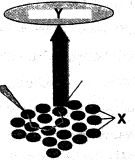
Identify $X$ and $Y$ from the figure.
$X$ $-$ $Y$
$X$ $-$ $Y$
A
Reaction centre $-$ pigment molecules
B
Pigment molecules $-$ primary acceptor
C
Reaction centre $-$ photon
D
Primary acceptor $-$ reaction center
Solution
(B) In the light-harvesting complex of photosynthesis,the antenna molecules (pigment molecules) absorb light energy and transfer it to the reaction centre.
In the provided figure,$X$ represents the light-harvesting pigment molecules that capture light energy.
The energy is then transferred to the reaction centre,which then passes an electron to the primary electron acceptor,represented by $Y$.
Therefore,$X$ refers to pigment molecules and $Y$ refers to the primary acceptor.
In the provided figure,$X$ represents the light-harvesting pigment molecules that capture light energy.
The energy is then transferred to the reaction centre,which then passes an electron to the primary electron acceptor,represented by $Y$.
Therefore,$X$ refers to pigment molecules and $Y$ refers to the primary acceptor.
0 likes
View Solution139
MediumMCQ
Which of the following is not an accessory pigment?
A
Chlorophyll-$b$
B
Carotenoids
C
Xanthophylls
D
Chlorophyll-$a$
Solution
(D) Photosynthetic pigments are classified into two categories: primary pigments and accessory pigments.
$1$. Primary Pigment: Chlorophyll-$a$ is the primary pigment because it is directly involved in the light reaction of photosynthesis by converting light energy into chemical energy.
$2$. Accessory Pigments: Chlorophyll-$b$,carotenoids,and xanthophylls are accessory pigments. They absorb light energy and transfer it to chlorophyll-$a$,and also protect chlorophyll-$a$ from photo-oxidation.
Therefore,chlorophyll-$a$ is not an accessory pigment.
$1$. Primary Pigment: Chlorophyll-$a$ is the primary pigment because it is directly involved in the light reaction of photosynthesis by converting light energy into chemical energy.
$2$. Accessory Pigments: Chlorophyll-$b$,carotenoids,and xanthophylls are accessory pigments. They absorb light energy and transfer it to chlorophyll-$a$,and also protect chlorophyll-$a$ from photo-oxidation.
Therefore,chlorophyll-$a$ is not an accessory pigment.
0 likes
View Solution140
MediumMCQ
Choose the incorrect sentence.
A
The pigments are organized into two discrete photochemical light harvesting complexes $(LHC)$ within the photosystem $II$ $(PS-II)$.
B
The $LHC$ are made up of hundreds of pigment molecules bound to carbohydrates.
C
The reaction center is different in both the photosystems.
D
In photosystem $II$,the reaction center absorbs $680 \ nm$ wavelength of red light.
Solution
(B) The incorrect statement is that $LHC$ are made up of pigment molecules bound to carbohydrates. In reality,the pigment molecules in the $LHC$ are bound to proteins,not carbohydrates. The $LHC$ consists of hundreds of pigment molecules bound to proteins. Each photosystem has all the pigments (except one molecule of chlorophyll $a$) forming a light-harvesting system also called antennae. These pigments help to make photosynthesis more efficient by absorbing different wavelengths of light.
0 likes
View Solution141
EasyMCQ
Where is the essential material present for photosynthesis?
A
Mitochondria
B
Ribosome
C
$DNA$
D
Chloroplast
Solution
(D) Photosynthesis is the process by which green plants and some other organisms use sunlight to synthesize foods with the help of chlorophyll.
Chlorophyll is the primary pigment required for photosynthesis.
This pigment is located within the thylakoid membranes of the chloroplast.
Therefore,the chloroplast is the organelle where the essential material for photosynthesis is present.
Chlorophyll is the primary pigment required for photosynthesis.
This pigment is located within the thylakoid membranes of the chloroplast.
Therefore,the chloroplast is the organelle where the essential material for photosynthesis is present.
0 likes
View Solution142
EasyMCQ
In a chloroplast,chlorophyll is present in the ............
A
Grana
B
Pyrenoid
C
Stroma
D
Both $(a)$ and $(b)$
Solution
(A) Chlorophyll is the primary photosynthetic pigment found in chloroplasts.
In higher plants,chloroplasts contain a system of thylakoids,which are flattened sac-like structures.
These thylakoids are stacked like coins to form structures called grana.
Chlorophyll molecules are embedded within the thylakoid membranes of the grana,where they capture light energy for the light-dependent reactions of photosynthesis.
Therefore,the correct location for chlorophyll is the grana.
In higher plants,chloroplasts contain a system of thylakoids,which are flattened sac-like structures.
These thylakoids are stacked like coins to form structures called grana.
Chlorophyll molecules are embedded within the thylakoid membranes of the grana,where they capture light energy for the light-dependent reactions of photosynthesis.
Therefore,the correct location for chlorophyll is the grana.
0 likes
View Solution143
EasyMCQ
The central metal ion of chlorophyll is .......
A
Iron
B
Magnesium
C
Nickel
D
Copper
Solution
(B) Chlorophyll is a green pigment found in the chloroplasts of plants,which is essential for photosynthesis.
Its molecular structure consists of a porphyrin ring with a central metal ion.
The central metal ion coordinated within the porphyrin ring of the chlorophyll molecule is $Mg^{2+}$ (Magnesium ion).
Therefore,the correct option is $B$.
Its molecular structure consists of a porphyrin ring with a central metal ion.
The central metal ion coordinated within the porphyrin ring of the chlorophyll molecule is $Mg^{2+}$ (Magnesium ion).
Therefore,the correct option is $B$.
0 likes
View Solution144
EasyMCQ
The size of the chlorophyll molecule is:
A
Head $15 \times 15 \mathring A$,Tail $25 \mathring A$
B
Head $20 \times 20 \mathring A$,Tail $25 \mathring A$
C
Head $15 \times 15 \mathring A$,Tail $20 \mathring A$
D
Head $10 \times 12 \mathring A$,Tail $25 \mathring A$
Solution
(C) The chlorophyll molecule consists of a porphyrin head and a phytol tail.
The porphyrin head is a square-shaped structure with dimensions of approximately $15 \times 15 \mathring A$.
The phytol tail is a long hydrocarbon chain attached to the head,which is approximately $20 \mathring A$ in length.
Therefore,the correct dimensions are Head $15 \times 15 \mathring A$ and Tail $20 \mathring A$.
The porphyrin head is a square-shaped structure with dimensions of approximately $15 \times 15 \mathring A$.
The phytol tail is a long hydrocarbon chain attached to the head,which is approximately $20 \mathring A$ in length.
Therefore,the correct dimensions are Head $15 \times 15 \mathring A$ and Tail $20 \mathring A$.
0 likes
View Solution145
MediumMCQ
Where are the photosynthetic pigments found in the chloroplast?
A
On the thylakoid membranes
B
In spherical organelles
C
In the matrix
D
On the chloroplast envelope
Solution
(A) Photosynthetic pigments such as chlorophyll $a$,chlorophyll $b$,xanthophylls,and carotenoids are embedded within the thylakoid membranes of the chloroplast.
These pigments are organized into photosystems ($PS-I$ and $PS-II$) which are essential for capturing light energy during the light-dependent reactions of photosynthesis.
These pigments are organized into photosystems ($PS-I$ and $PS-II$) which are essential for capturing light energy during the light-dependent reactions of photosynthesis.
0 likes
View Solution146
MediumMCQ
Chlorophyll $a$ is present in which of the following?
A
All autotrophic photosynthetic organisms
B
All higher plants
C
All oxygen-evolving photosynthetic organisms
D
All plants (except fungi)
Solution
(C) Chlorophyll $a$ is the primary photosynthetic pigment found in all oxygen-evolving photosynthetic organisms.
It acts as the reaction center in both Photosystem $I$ and Photosystem $II$.
While other pigments like chlorophyll $b$,carotenoids,and xanthophylls are accessory pigments,chlorophyll $a$ is essential for the conversion of light energy into chemical energy during the light-dependent reactions of photosynthesis.
It acts as the reaction center in both Photosystem $I$ and Photosystem $II$.
While other pigments like chlorophyll $b$,carotenoids,and xanthophylls are accessory pigments,chlorophyll $a$ is essential for the conversion of light energy into chemical energy during the light-dependent reactions of photosynthesis.
0 likes
View Solution147
MediumMCQ
In a chlorophyll $a$ molecule,which of the following groups is attached to carbon atom $3$ of pyrrole ring $II$?
A
Aldehyde group
B
Methyl group
C
Carboxyl group
D
Magnesium
Solution
(B) Chlorophyll $a$ $(C_{55}H_{72}O_5N_4Mg)$ is the primary photosynthetic pigment.
Its structure consists of a porphyrin head and a phytol tail.
The porphyrin head is composed of four pyrrole rings $(I, II, III, IV)$ linked by methine bridges.
In chlorophyll $a$,the carbon atom $3$ of pyrrole ring $II$ is attached to a methyl group $(-CH_3)$.
In contrast,chlorophyll $b$ has an aldehyde group $(-CHO)$ at the same position.
Its structure consists of a porphyrin head and a phytol tail.
The porphyrin head is composed of four pyrrole rings $(I, II, III, IV)$ linked by methine bridges.
In chlorophyll $a$,the carbon atom $3$ of pyrrole ring $II$ is attached to a methyl group $(-CH_3)$.
In contrast,chlorophyll $b$ has an aldehyde group $(-CHO)$ at the same position.
0 likes
View Solution148
MediumMCQ
How does protochlorophyll differ from chlorophyll due to the lack of which component?
A
Lack of $2$ hydrogen atoms in $1$ pyrrole ring.
B
Lack of $2$ hydrogen atoms in $2$ pyrrole rings.
C
Lack of $4$ hydrogen atoms in $1$ pyrrole ring.
D
Lack of $4$ hydrogen atoms in $2$ pyrrole rings.
Solution
(A) Protochlorophyll is the immediate precursor to chlorophyll $a$ in the biosynthetic pathway of chlorophyll.
The structural difference between protochlorophyll and chlorophyll $a$ is the presence of two additional hydrogen atoms in the $IV$ pyrrole ring of the chlorophyll molecule.
Therefore,protochlorophyll lacks these $2$ hydrogen atoms compared to chlorophyll $a$ in one of its pyrrole rings.
The structural difference between protochlorophyll and chlorophyll $a$ is the presence of two additional hydrogen atoms in the $IV$ pyrrole ring of the chlorophyll molecule.
Therefore,protochlorophyll lacks these $2$ hydrogen atoms compared to chlorophyll $a$ in one of its pyrrole rings.
0 likes
View Solution149
EasyMCQ
Which of the following absorbs light energy for photosynthesis?
A
Chlorophyll
B
Water molecule
C
$O_2$
D
$RuBP$
Solution
(A) Photosynthesis is the process by which green plants convert light energy into chemical energy.
Chlorophyll is the primary photosynthetic pigment located in the thylakoid membranes of chloroplasts.
It is responsible for absorbing light energy,primarily in the blue and red regions of the electromagnetic spectrum,which then drives the light-dependent reactions of photosynthesis.
Chlorophyll is the primary photosynthetic pigment located in the thylakoid membranes of chloroplasts.
It is responsible for absorbing light energy,primarily in the blue and red regions of the electromagnetic spectrum,which then drives the light-dependent reactions of photosynthesis.
0 likes
View Solution150
EasyMCQ
Which element is present at the center of the porphyrin ring of chlorophyll?
A
Manganese
B
Calcium
C
Magnesium
D
Potassium
Solution
(C) The chlorophyll molecule consists of a porphyrin head and a phytol tail.
The porphyrin head is a tetrapyrrole ring structure.
At the center of this porphyrin ring,a single $Mg^{2+}$ (magnesium) ion is coordinated.
This magnesium ion is essential for the light-harvesting function of chlorophyll.
The porphyrin head is a tetrapyrrole ring structure.
At the center of this porphyrin ring,a single $Mg^{2+}$ (magnesium) ion is coordinated.
This magnesium ion is essential for the light-harvesting function of chlorophyll.
0 likes
View SolutionPhotosynthesis in Higher Plants — Pigments involved in photo synthesis · Frequently Asked Questions
1Are these Photosynthesis in Higher Plants questions useful for JEE and NEET?
Yes. All questions in this section are mapped to JEE Main and NEET exam patterns. Previous year questions from JEE Main, NEET, GUJCET and state-level exams are included with full solutions.
2Can I switch to Hindi or Gujarati for these questions?
Yes. Use the language tabs in the hero section or the sidebar to view the same questions and solutions in English, Hindi or Gujarati.
3How do I generate a question paper from this subtopic?
Use the Vedclass Exam Paper Generator — select the chapter and subtopic, set difficulty, and generate Sets A, B, C, D automatically. First 3 chapters of every subject are free.
Vedclass Products
For Students
Vedclass Test Series
Mock tests in real JEE/NEET style with performance analysis. 5-day free trial.
Start Free TrialFor Teachers
Exam Paper Generator
Generate Set A/B/C/D papers from this chapter in 2 minutes. 3 chapters free.
Try FreeFor Institutes
Online Exam Module
Live online exams with unlimited students, 360° analytics & white-label branding.
See DemoFor Teachers & Institutes
Generate a Photosynthesis in Higher Plants Exam Paper in 2 Minutes
Select subtopic & difficulty — Sets A, B, C, D auto-generated with No Repeat logic.
First 3 chapters of every subject are free — no payment required.