
A English
Transmission of Impulses Questions in English
Class 11 Biology · Neural Control and Coordination · Transmission of Impulses
116+
Questions
English
Language
100%
With Solutions
Showing 16 of 116 questions in English
101
EasyMCQ
The synaptic knob contains $..........$.
A
Adrenaline
B
Acetylcholine
C
Nissl's granules
D
Noradrenaline
Solution
(B) The synaptic knob (also known as the synaptic terminal or bouton) is the bulbous end of an axon terminal.
It contains synaptic vesicles filled with neurotransmitters.
Among the given options,$Acetylcholine$ is a primary neurotransmitter stored in the synaptic vesicles of the synaptic knob.
While other substances like adrenaline or noradrenaline can act as neurotransmitters in specific neurons,$Acetylcholine$ is the most characteristic neurotransmitter associated with general synaptic transmission models in textbooks.
It contains synaptic vesicles filled with neurotransmitters.
Among the given options,$Acetylcholine$ is a primary neurotransmitter stored in the synaptic vesicles of the synaptic knob.
While other substances like adrenaline or noradrenaline can act as neurotransmitters in specific neurons,$Acetylcholine$ is the most characteristic neurotransmitter associated with general synaptic transmission models in textbooks.
0 likes
View Solution102
EasyMCQ
The junction between two neurons is called .......
A
Motor end plate
B
Neuromuscular junction
C
Synapse
D
Both $A$ and $B$
Solution
(C) synapse is the junction between two neurons,or between a neuron and a target cell (such as a muscle or gland). It allows the transmission of nerve impulses from one neuron to another or to an effector cell. The motor end plate is specifically the junction between a motor neuron and a muscle fiber,which is a type of neuromuscular junction. Therefore,the general term for the connection between two neurons is a synapse.
0 likes
View Solution103
EasyMCQ
In $P$,the membranes of pre-synaptic and post-synaptic neurons are in very close proximity,whereas in $Q$,there is a space between the membranes of pre-synaptic and post-synaptic neurons.
$\quad\quad\quad P\quad\quad\quad Q$
$\quad\quad\quad P\quad\quad\quad Q$
A
Chemical synapse $\quad$ Chemical synapse
B
Chemical synapse $\quad$ Electrical synapse
C
Electrical synapse $\quad$ Electrical synapse
D
Electrical synapse $\quad$ Chemical synapse
Solution
(D) In an electrical synapse $(P)$,the membranes of pre-synaptic and post-synaptic neurons are in very close proximity,allowing current to flow directly from one neuron to another.
In a chemical synapse $(Q)$,the membranes of pre-synaptic and post-synaptic neurons are separated by a fluid-filled space called the synaptic cleft.
Therefore,the correct sequence is $P$ = Electrical synapse and $Q$ = Chemical synapse.
In a chemical synapse $(Q)$,the membranes of pre-synaptic and post-synaptic neurons are separated by a fluid-filled space called the synaptic cleft.
Therefore,the correct sequence is $P$ = Electrical synapse and $Q$ = Chemical synapse.
0 likes
View Solution104
MediumMCQ
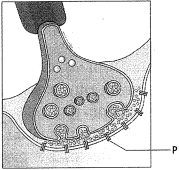
The following figure shows the axon terminal and synapse. What is the function of $P$?
A
Sodium ion channel
B
Potassium ion channel
C
Neurotransmitter receptor
D
Both $A$ and $C$
Solution
(C) In the provided diagram of a chemical synapse,the structure labeled $P$ represents the receptors located on the postsynaptic membrane. These receptors bind to the neurotransmitters released from the synaptic vesicles of the presynaptic neuron. This binding triggers the opening of ion channels,leading to the generation of a new action potential in the postsynaptic neuron. Therefore,$P$ is a neurotransmitter receptor.
0 likes
View Solution105
MediumMCQ
In a chemical synapse,the transmission of nerve impulses is mediated by:
A
Adrenaline
B
Noradrenaline
C
Acetylcholine
D
Both $A$ and $B$
Solution
(D) In a chemical synapse,the transmission of nerve impulses is mediated by chemical substances called neurotransmitters.
These neurotransmitters are stored in synaptic vesicles within the presynaptic neuron.
Common examples of neurotransmitters include $Acetylcholine$,$Adrenaline$,$Noradrenaline$,$Dopamine$,and $Serotonin$.
Since both $Adrenaline$ and $Noradrenaline$ act as neurotransmitters in various chemical synapses,the correct answer is $D$.
These neurotransmitters are stored in synaptic vesicles within the presynaptic neuron.
Common examples of neurotransmitters include $Acetylcholine$,$Adrenaline$,$Noradrenaline$,$Dopamine$,and $Serotonin$.
Since both $Adrenaline$ and $Noradrenaline$ act as neurotransmitters in various chemical synapses,the correct answer is $D$.
0 likes
View Solution106
MediumMCQ
Select the incorrect option for electrical synapses.
A
Impulse transmission across an electrical synapse is very similar to impulse conduction along a single axon.
B
Impulse transmission across an electrical synapse is always slower than that across a chemical synapse.
C
Electrical synapses are very rare in our system.
D
Neurotransmitters like acetylcholine are not required.
Solution
(B) In electrical synapses,the membranes of pre-synaptic and post-synaptic neurons are in very close proximity.
Impulse transmission across an electrical synapse is very similar to impulse conduction along a single axon.
Electrical synapses are very rare in our system.
Neurotransmitters are not involved in electrical synapses.
Impulse transmission across an electrical synapse is always faster than that across a chemical synapse.
Therefore,option $B$ is incorrect because it states that electrical synapses are slower,which is false.
Impulse transmission across an electrical synapse is very similar to impulse conduction along a single axon.
Electrical synapses are very rare in our system.
Neurotransmitters are not involved in electrical synapses.
Impulse transmission across an electrical synapse is always faster than that across a chemical synapse.
Therefore,option $B$ is incorrect because it states that electrical synapses are slower,which is false.
0 likes
View Solution107
MediumMCQ
Identify the sequential steps occurring in a chemical synapse.
A
Impulse in axon $\rightarrow$ Entry of $Ca^{+2}$ into synaptic knob $\rightarrow$ Release of neurotransmitters $\rightarrow$ Neurotransmitters bind to specific receptors $\rightarrow$ Ion channels open $\rightarrow$ Generation of new potential in post-synaptic neuron.
B
Impulse in axon $\rightarrow$ Entry of $Na^{+}$ into synaptic knob $\rightarrow$ Release of neurotransmitters $\rightarrow$ Neurotransmitters bind to specific receptors $\rightarrow$ Ion channels open $\rightarrow$ Generation of new potential in pre-synaptic neuron.
C
Impulse in axon $\rightarrow$ Entry of $Ca^{+2}$ into synaptic knob $\rightarrow$ Release of neurotransmitters $\rightarrow$ Neurotransmitters bind to specific receptors $\rightarrow$ Ion channels close $\rightarrow$ Generation of new potential in post-synaptic neuron.
D
Impulse in axon $\rightarrow$ Entry of $Na^{+}$ into synaptic knob $\rightarrow$ Release of neurotransmitters $\rightarrow$ Neurotransmitters bind to specific receptors $\rightarrow$ Ion channels close $\rightarrow$ Generation of new potential in pre-synaptic neuron.
Solution
(A) The transmission of an impulse across a chemical synapse follows these steps:
$1$. An action potential (impulse) reaches the axon terminal (synaptic knob).
$2$. This depolarization triggers the opening of voltage-gated $Ca^{+2}$ channels,allowing $Ca^{+2}$ to enter the synaptic knob.
$3$. The influx of $Ca^{+2}$ causes synaptic vesicles to fuse with the pre-synaptic membrane and release neurotransmitters into the synaptic cleft via exocytosis.
$4$. These neurotransmitters diffuse across the cleft and bind to specific receptors on the post-synaptic membrane.
$5$. This binding opens ion channels in the post-synaptic membrane,leading to the generation of a new action potential (or graded potential) in the post-synaptic neuron.
$1$. An action potential (impulse) reaches the axon terminal (synaptic knob).
$2$. This depolarization triggers the opening of voltage-gated $Ca^{+2}$ channels,allowing $Ca^{+2}$ to enter the synaptic knob.
$3$. The influx of $Ca^{+2}$ causes synaptic vesicles to fuse with the pre-synaptic membrane and release neurotransmitters into the synaptic cleft via exocytosis.
$4$. These neurotransmitters diffuse across the cleft and bind to specific receptors on the post-synaptic membrane.
$5$. This binding opens ion channels in the post-synaptic membrane,leading to the generation of a new action potential (or graded potential) in the post-synaptic neuron.
0 likes
View Solution108
MediumMCQ
Assertion $(A) :-$ Impulse transmission across an electrical synapse is always faster than that across a chemical synapse.
Reason $(R) :-$ Electrical current can flow directly from one neuron into the other across electrical synapses.
Reason $(R) :-$ Electrical current can flow directly from one neuron into the other across electrical synapses.
A
Both $(A)$ and $(R)$ are correct but $(R)$ is not the correct explanation of $(A)$
B
$(A)$ is correct but $(R)$ is not correct
C
$(A)$ is incorrect but $(R)$ is correct
D
Both $(A)$ and $(R)$ are correct and $(R)$ is the correct explanation of $(A)$
Solution
(D) In an electrical synapse,the membranes of pre- and post-synaptic neurons are in very close proximity.
Electrical current can flow directly from one neuron into the other across these synapses.
This direct flow of current allows for the transmission of impulses to be very fast,often faster than in a chemical synapse where neurotransmitters must be released,diffuse across the synaptic cleft,and bind to receptors.
Therefore,both the assertion and the reason are correct,and the reason provides the correct explanation for why electrical synapses are faster.
Electrical current can flow directly from one neuron into the other across these synapses.
This direct flow of current allows for the transmission of impulses to be very fast,often faster than in a chemical synapse where neurotransmitters must be released,diffuse across the synaptic cleft,and bind to receptors.
Therefore,both the assertion and the reason are correct,and the reason provides the correct explanation for why electrical synapses are faster.
0 likes
View Solution109
EasyMCQ
New potential generated in the post-synaptic neuron during transmission of impulse is:
A
always excitatory
B
never excitatory
C
either excitatory or inhibitory
D
always inhibitory
Solution
(C) During the transmission of a nerve impulse across a synapse,the neurotransmitters released from the pre-synaptic membrane bind to receptors on the post-synaptic membrane.
These neurotransmitters can cause either depolarization (excitatory post-synaptic potential,$EPSP$) or hyperpolarization (inhibitory post-synaptic potential,$IPSP$) of the post-synaptic neuron.
Therefore,the new potential generated in the post-synaptic neuron may be either excitatory or inhibitory,depending on the nature of the neurotransmitter and the receptor type.
These neurotransmitters can cause either depolarization (excitatory post-synaptic potential,$EPSP$) or hyperpolarization (inhibitory post-synaptic potential,$IPSP$) of the post-synaptic neuron.
Therefore,the new potential generated in the post-synaptic neuron may be either excitatory or inhibitory,depending on the nature of the neurotransmitter and the receptor type.
0 likes
View Solution110
EasyMCQ
Given below are two statements.
Statement $I$ - In chemical synapse,the rate of transmission of impulse is higher in homeotherms than poikilotherms.
Statement $II$ - In chemical synapse,the synaptic cleft has a width of about $3.8 \ nm$.
In the light of the above statements,select the correct option given below:
Statement $I$ - In chemical synapse,the rate of transmission of impulse is higher in homeotherms than poikilotherms.
Statement $II$ - In chemical synapse,the synaptic cleft has a width of about $3.8 \ nm$.
In the light of the above statements,select the correct option given below:
A
Both statement $I$ and statement $II$ are correct.
B
Both statement $I$ and statement $II$ are incorrect.
C
Statement $I$ is correct but statement $II$ is incorrect.
D
Statement $I$ is incorrect but statement $II$ is correct.
Solution
(C) $i$. The elevated and stable body temperature of homeotherms accelerates molecular,enzymatic,and ion channel processes,resulting in faster synaptic transmission compared to poikilotherms.
$ii$. In a chemical synapse,the synaptic cleft has a width of about $20 \ nm$ to $30 \ nm$,not $3.8 \ nm$.
$ii$. In a chemical synapse,the synaptic cleft has a width of about $20 \ nm$ to $30 \ nm$,not $3.8 \ nm$.
0 likes
View Solution111
EasyMCQ
Hyposecretion of which neurotransmitter can cause Parkinson's disease?
A
Adrenaline
B
Nor-epinephrine
C
Dopamine
D
Acetylcholine
Solution
(C) Parkinson's disease is a progressive neurodegenerative disorder that primarily affects movement.
It is caused by the death of dopamine-producing neurons in a specific area of the brain called the substantia nigra.
Dopamine is a neurotransmitter that plays a crucial role in coordinating smooth and controlled muscle movements.
When there is a hyposecretion (reduced production) of dopamine,the brain cannot effectively regulate motor signals,leading to symptoms such as tremors,rigidity,and bradykinesia (slowness of movement).
Therefore,the correct answer is $C$ (Dopamine).
It is caused by the death of dopamine-producing neurons in a specific area of the brain called the substantia nigra.
Dopamine is a neurotransmitter that plays a crucial role in coordinating smooth and controlled muscle movements.
When there is a hyposecretion (reduced production) of dopamine,the brain cannot effectively regulate motor signals,leading to symptoms such as tremors,rigidity,and bradykinesia (slowness of movement).
Therefore,the correct answer is $C$ (Dopamine).
0 likes
View Solution112
EasyMCQ
Electrical synapse shows following features $EXCEPT$ . . . . . . .
A
Usually found in defense reflexes.
B
Transmission across the gap is very fast
C
Gap between adjacent neurons is $20-30$ nm.
D
It is mechanical in nature.
Solution
(C) In an electrical synapse, the membranes of pre- and post-synaptic neurons are in very close proximity, typically less than $0.2 \ nm$ apart, allowing for direct flow of electrical current.
Conversely, in a chemical synapse, the gap between adjacent neurons, known as the synaptic cleft, is approximately $20-30 \ nm$ wide.
Therefore, the statement that the gap in an electrical synapse is $20-30 \ nm$ is incorrect, making it the exception.
Conversely, in a chemical synapse, the gap between adjacent neurons, known as the synaptic cleft, is approximately $20-30 \ nm$ wide.
Therefore, the statement that the gap in an electrical synapse is $20-30 \ nm$ is incorrect, making it the exception.
0 likes
View Solution113
EasyMCQ
Arrange the following events in proper sequence during impulse transmission across a chemical synapse:
$(a)$ Fusion of synaptic vesicles with the cell membrane of the presynaptic neuron.
$(b)$ $Ca^{++}$ channels open and $Ca^{++}$ diffuses into the synaptic knob from the extracellular fluid.
$(c)$ Neurotransmitter binds with receptors of the postsynaptic cell.
$(d)$ Release of neurotransmitter by exocytosis.
$(a)$ Fusion of synaptic vesicles with the cell membrane of the presynaptic neuron.
$(b)$ $Ca^{++}$ channels open and $Ca^{++}$ diffuses into the synaptic knob from the extracellular fluid.
$(c)$ Neurotransmitter binds with receptors of the postsynaptic cell.
$(d)$ Release of neurotransmitter by exocytosis.
A
$d \rightarrow c \rightarrow a \rightarrow b$
B
$a \rightarrow c \rightarrow b \rightarrow d$
C
$b \rightarrow a \rightarrow d \rightarrow c$
D
$c \rightarrow a \rightarrow d \rightarrow b$
Solution
(C) The transmission of an impulse across a chemical synapse occurs in the following sequence:
$1$. When an action potential reaches the synaptic knob,voltage-gated $Ca^{++}$ channels open,allowing $Ca^{++}$ to diffuse into the synaptic knob from the extracellular fluid $(b)$.
$2$. The influx of $Ca^{++}$ triggers the synaptic vesicles to move toward and fuse with the presynaptic membrane $(a)$.
$3$. The neurotransmitters are then released into the synaptic cleft via exocytosis $(d)$.
$4$. Finally,the neurotransmitters bind to the specific receptors present on the postsynaptic membrane,which may lead to the opening of ion channels $(c)$.
Therefore,the correct sequence is $b \rightarrow a \rightarrow d \rightarrow c$.
$1$. When an action potential reaches the synaptic knob,voltage-gated $Ca^{++}$ channels open,allowing $Ca^{++}$ to diffuse into the synaptic knob from the extracellular fluid $(b)$.
$2$. The influx of $Ca^{++}$ triggers the synaptic vesicles to move toward and fuse with the presynaptic membrane $(a)$.
$3$. The neurotransmitters are then released into the synaptic cleft via exocytosis $(d)$.
$4$. Finally,the neurotransmitters bind to the specific receptors present on the postsynaptic membrane,which may lead to the opening of ion channels $(c)$.
Therefore,the correct sequence is $b \rightarrow a \rightarrow d \rightarrow c$.
0 likes
View Solution114
EasyMCQ
In the neural system,a chemical synapse shows a synaptic gap of about . . . . . . .
A
$400 \ nm$ to $60 \ nm$
B
$80 \ nm$ to $100 \ nm$
C
$20 \ nm$ to $40 \ nm$
D
$60 \ nm$ to $80 \ nm$
Solution
(C) chemical synapse is a junction where information is transmitted from one neuron to another via chemical messengers called neurotransmitters.
In a chemical synapse,the membranes of the pre-synaptic and post-synaptic neurons are separated by a fluid-filled space called the synaptic cleft.
The width of this synaptic cleft in a typical chemical synapse ranges from approximately $20 \ nm$ to $40 \ nm$.
In a chemical synapse,the membranes of the pre-synaptic and post-synaptic neurons are separated by a fluid-filled space called the synaptic cleft.
The width of this synaptic cleft in a typical chemical synapse ranges from approximately $20 \ nm$ to $40 \ nm$.
0 likes
View Solution115
EasyMCQ
Identify the correct sequence of action potential transmission as it arrives at the axon terminal from the choices given below:
A
Axon terminal $\rightarrow$ Post-synaptic membrane $\rightarrow$ Synaptic cleft $\rightarrow$ Synaptic vesicles $\rightarrow$ Post-synaptic neuron
B
Axon terminal $\rightarrow$ Synaptic vesicles $\rightarrow$ Post-synaptic membrane $\rightarrow$ Synaptic cleft $\rightarrow$ Post-synaptic neuron
C
Axon terminal $\rightarrow$ Synaptic vesicles $\rightarrow$ Synaptic cleft $\rightarrow$ Post-synaptic membrane $\rightarrow$ Post-synaptic neuron
D
Axon terminal $\rightarrow$ Synaptic cleft $\rightarrow$ Synaptic vesicles $\rightarrow$ Post-synaptic neuron $\rightarrow$ Post-synaptic membrane
Solution
(C) When an action potential reaches the axon terminal,it triggers the following sequence of events:
$1$. The depolarization of the axon terminal membrane causes the opening of voltage-gated calcium channels.
$2$. Calcium ions enter the terminal,which stimulates the synaptic vesicles to move towards and fuse with the pre-synaptic membrane.
$3$. The neurotransmitters are released into the synaptic cleft via exocytosis.
$4$. These neurotransmitters diffuse across the synaptic cleft and bind to specific receptors on the post-synaptic membrane.
$5$. This binding leads to the generation of a new action potential in the post-synaptic neuron.
Therefore,the correct sequence is: Axon terminal $\rightarrow$ Synaptic vesicles $\rightarrow$ Synaptic cleft $\rightarrow$ Post-synaptic membrane $\rightarrow$ Post-synaptic neuron.
$1$. The depolarization of the axon terminal membrane causes the opening of voltage-gated calcium channels.
$2$. Calcium ions enter the terminal,which stimulates the synaptic vesicles to move towards and fuse with the pre-synaptic membrane.
$3$. The neurotransmitters are released into the synaptic cleft via exocytosis.
$4$. These neurotransmitters diffuse across the synaptic cleft and bind to specific receptors on the post-synaptic membrane.
$5$. This binding leads to the generation of a new action potential in the post-synaptic neuron.
Therefore,the correct sequence is: Axon terminal $\rightarrow$ Synaptic vesicles $\rightarrow$ Synaptic cleft $\rightarrow$ Post-synaptic membrane $\rightarrow$ Post-synaptic neuron.
0 likes
View Solution116
EasyMCQ
The specific receptors for neurotransmitters in a synapse are present on . . . . . .
A
$(1)$ Pre-synaptic membrane
B
$(2)$ Post-synaptic membrane
C
$(3)$ Myelin sheath
D
$(4)$ Schwann cell
Solution
(B) In a chemical synapse,the neurotransmitters are released from the synaptic vesicles of the pre-synaptic neuron into the synaptic cleft.
These neurotransmitters then bind to specific receptor proteins located on the membrane of the post-synaptic neuron (post-synaptic membrane) to generate an action potential.
These neurotransmitters then bind to specific receptor proteins located on the membrane of the post-synaptic neuron (post-synaptic membrane) to generate an action potential.
0 likes
View SolutionNeural Control and Coordination — Transmission of Impulses · Frequently Asked Questions
1Are these Neural Control and Coordination questions useful for JEE and NEET?
Yes. All questions in this section are mapped to JEE Main and NEET exam patterns. Previous year questions from JEE Main, NEET, GUJCET and state-level exams are included with full solutions.
2Can I switch to Hindi or Gujarati for these questions?
Yes. Use the language tabs in the hero section or the sidebar to view the same questions and solutions in English, Hindi or Gujarati.
3How do I generate a question paper from this subtopic?
Use the Vedclass Exam Paper Generator — select the chapter and subtopic, set difficulty, and generate Sets A, B, C, D automatically. First 3 chapters of every subject are free.
Vedclass Products
For Students
Vedclass Test Series
Mock tests in real JEE/NEET style with performance analysis. 5-day free trial.
Start Free TrialFor Teachers
Exam Paper Generator
Generate Set A/B/C/D papers from this chapter in 2 minutes. 3 chapters free.
Try FreeFor Institutes
Online Exam Module
Live online exams with unlimited students, 360° analytics & white-label branding.
See DemoFor Teachers & Institutes
Generate a Neural Control and Coordination Exam Paper in 2 Minutes
Select subtopic & difficulty — Sets A, B, C, D auto-generated with No Repeat logic.
First 3 chapters of every subject are free — no payment required.