
A English
Reflex Action and Reflex Arc Questions in English
Class 11 Biology · Neural Control and Coordination · Reflex Action and Reflex Arc
52+
Questions
English
Language
100%
With Solutions
Showing 50 of 52 questions in English
1
MediumMCQ
The delicious food generally makes mouth watery. It is due to:
A
Hormonal response
B
Neural response
C
Olfactory response
D
Optic response
Solution
(B) The secretion of saliva is a reflex action controlled by the nervous system.
When we see,smell,or even think about delicious food,the brain sends signals through the autonomic nervous system to the salivary glands.
This stimulation triggers the release of saliva,which is a neural response.
When we see,smell,or even think about delicious food,the brain sends signals through the autonomic nervous system to the salivary glands.
This stimulation triggers the release of saliva,which is a neural response.
0 likes
View Solution2
MediumMCQ
Which one of the following is responsible for the control of reflex action?
A
Sensory nerves
B
Motor nerves
C
Sympathetic nervous system
D
Central nervous system
Solution
(D) Reflex action is an immediate,involuntary response to a stimulus without the conscious intervention of the brain.
It is primarily controlled by the spinal cord,which is a key component of the $Central \ nervous \ system$ $(CNS)$.
It is primarily controlled by the spinal cord,which is a key component of the $Central \ nervous \ system$ $(CNS)$.
0 likes
View Solution3
EasyMCQ
Which one of the following occurs without the help of the brain?
A
Cranial reflex
B
Spinal reflex
C
Efferent reflex
D
Afferent reflex
Solution
(B) The correct answer is $B$.
Spinal reflexes are rapid,involuntary responses to stimuli that are processed entirely within the spinal cord.
Unlike cranial reflexes,which involve the brain,spinal reflexes do not require the brain's intervention to initiate a motor response,allowing for faster reaction times in emergency situations.
Spinal reflexes are rapid,involuntary responses to stimuli that are processed entirely within the spinal cord.
Unlike cranial reflexes,which involve the brain,spinal reflexes do not require the brain's intervention to initiate a motor response,allowing for faster reaction times in emergency situations.
0 likes
View Solution4
EasyMCQ
Reflex action immediately involves
A
Spinal cord
B
Cerebellum
C
Medulla oblongata
D
Optical lobe
Solution
(A) Reflexes are classified as spinal reflexes and cranial reflexes.
Spinal reflexes are so called because their basic neural pathway involves spinal nerves and the spinal cord.
Reflexes at the spinal level serve the purpose of protecting the body by removing it from harmful stimuli rapidly.
Spinal reflexes are so called because their basic neural pathway involves spinal nerves and the spinal cord.
Reflexes at the spinal level serve the purpose of protecting the body by removing it from harmful stimuli rapidly.
0 likes
View Solution5
MediumMCQ
Which of the following is an example of a reflex action?
A
To shoot the bird after aiming
B
Watering of the mouth on seeing good edibles
C
To obey the order
D
To read the story
Solution
(B) reflex action is an involuntary,rapid,and automatic response to a stimulus that does not involve conscious thought.
Watering of the mouth (salivation) upon seeing or smelling appetizing food is a classic example of a conditioned reflex action,where the nervous system triggers a physiological response without the need for voluntary decision-making.
Options $A$,$C$,and $D$ involve conscious processing,decision-making,and voluntary motor control,which are not reflex actions.
Watering of the mouth (salivation) upon seeing or smelling appetizing food is a classic example of a conditioned reflex action,where the nervous system triggers a physiological response without the need for voluntary decision-making.
Options $A$,$C$,and $D$ involve conscious processing,decision-making,and voluntary motor control,which are not reflex actions.
0 likes
View Solution6
MediumMCQ
$A$ boy learns typewriting and harmonium at the same time. He finds harmonium more easy to learn. This is:
A
Conditioned reflex
B
Short term homeostasis
C
Long term homeostasis
D
Residual learning
Solution
(A) Reflexes developed through training,practice,and learning are known as conditioned or acquired reflexes.
These reflexes are not innate but are acquired during the lifetime of an individual.
Examples include activities like dancing,cycling,swimming,singing,and playing musical instruments like the harmonium,which become automatic after proper learning and practice.
These reflexes are not innate but are acquired during the lifetime of an individual.
Examples include activities like dancing,cycling,swimming,singing,and playing musical instruments like the harmonium,which become automatic after proper learning and practice.
0 likes
View Solution7
MediumMCQ
Which of the following is an incorrect relationship?
A
Conditioned reflex - Hodgkins
B
Blood circulation - $W$. Harvey
C
$DNA$ double helix model - Watson and Crick
D
None of these
Solution
(A) The correct answer is $A$.
Conditioned reflexes were first demonstrated by the Russian scientist $I.P. Pavlov$ in dogs.
Hodgkins is known for his work on the ionic basis of nerve impulses (the Hodgkin-Huxley model),not for conditioned reflexes.
$W. Harvey$ discovered the mechanism of blood circulation.
$Watson$ and $Crick$ proposed the double helix model of $DNA$.
Conditioned reflexes were first demonstrated by the Russian scientist $I.P. Pavlov$ in dogs.
Hodgkins is known for his work on the ionic basis of nerve impulses (the Hodgkin-Huxley model),not for conditioned reflexes.
$W. Harvey$ discovered the mechanism of blood circulation.
$Watson$ and $Crick$ proposed the double helix model of $DNA$.
0 likes
View Solution8
EasyMCQ
One common example of a simple reflex is:
A
Tying your shoe laces while talking to another person and not looking at them
B
Watering of mouth at the sight of a favourite food
C
Climbing up a stairs in dark without stumbling
D
Closing of eyelids when an object suddenly approaches the eye
Solution
(D) simple reflex (or spinal reflex) is a rapid,involuntary,and stereotyped response to a specific sensory stimulus that does not require conscious thought.
Closing of eyelids when an object suddenly approaches the eye is a classic example of a protective reflex known as the corneal reflex or blink reflex.
This response is mediated by the brainstem and occurs automatically to protect the eye from potential injury.
Options $A$,$B$,and $C$ involve learned behaviors or complex conditioned responses that require higher-level processing in the brain.
Closing of eyelids when an object suddenly approaches the eye is a classic example of a protective reflex known as the corneal reflex or blink reflex.
This response is mediated by the brainstem and occurs automatically to protect the eye from potential injury.
Options $A$,$B$,and $C$ involve learned behaviors or complex conditioned responses that require higher-level processing in the brain.
0 likes
View Solution9
MediumMCQ
Reflex action in a vertebrate is an essential display exhibited by
A
Sympathetic nerve
B
Motor nerve
C
Sensory nerve
D
Autonomic response
Solution
(D) reflex action is an involuntary,rapid,and automatic response to a stimulus that does not involve conscious thought.
It is an autonomic response that occurs very quickly,often before we even consciously perceive the stimulus.
Thus,reflex actions serve as a protective mechanism to shield the body from the harmful effects of sudden or intense stimuli.
It is an autonomic response that occurs very quickly,often before we even consciously perceive the stimulus.
Thus,reflex actions serve as a protective mechanism to shield the body from the harmful effects of sudden or intense stimuli.
0 likes
View Solution10
EasyMCQ
When no intervention is done by the brain,the response is due to
A
$CNS$
B
Voluntary actions
C
Spinal reflex
D
Cerebral reflex
Solution
(C) reflex action is an involuntary,rapid,and automatic response to a stimulus that occurs without conscious thought or intervention by the brain.
These actions are primarily mediated by the spinal cord,which processes the sensory input and generates a motor output directly,bypassing the higher centers of the brain.
Therefore,when no intervention is done by the brain,the response is due to a spinal reflex.
These actions are primarily mediated by the spinal cord,which processes the sensory input and generates a motor output directly,bypassing the higher centers of the brain.
Therefore,when no intervention is done by the brain,the response is due to a spinal reflex.
0 likes
View Solution11
MediumMCQ
$A$ simple two-neuron reflex arc involves:
A
Sensory neuron
B
Spinal cord
C
Effector neuron
D
All the above
Solution
(D) reflex arc is the basic functional unit of the nervous system.
$A$ simple two-neuron reflex arc (monosynaptic reflex) consists of a sensory neuron that carries the impulse from the receptor to the central nervous system (spinal cord) and a motor neuron (effector neuron) that carries the response to the effector organ.
Since it involves a sensory neuron,the spinal cord (as the integration center),and an effector neuron,all the listed components are involved.
The pathway is: $Receptors \rightarrow \text{Sensory Neuron} \rightarrow \text{Spinal Cord} \rightarrow \text{Effector Neuron} \rightarrow \text{Effector Organ}$.
$A$ simple two-neuron reflex arc (monosynaptic reflex) consists of a sensory neuron that carries the impulse from the receptor to the central nervous system (spinal cord) and a motor neuron (effector neuron) that carries the response to the effector organ.
Since it involves a sensory neuron,the spinal cord (as the integration center),and an effector neuron,all the listed components are involved.
The pathway is: $Receptors \rightarrow \text{Sensory Neuron} \rightarrow \text{Spinal Cord} \rightarrow \text{Effector Neuron} \rightarrow \text{Effector Organ}$.
0 likes
View Solution12
MediumMCQ
Conditioned reflexes are different from unconditioned reflexes in that:
A
Conditioned reflexes are limited to the brain
B
Unconditioned reflexes are limited to the brain
C
Both $(a)$ and $(b)$
D
None of the above
Solution
(A) Unconditioned reflexes are inborn,inherited,species-specific,stable,and primarily controlled by the spinal cord.
Conditioned reflexes are acquired through learning and experience,and they are controlled by the cerebral cortex of the brain.
Conditioned reflexes are acquired through learning and experience,and they are controlled by the cerebral cortex of the brain.
0 likes
View Solution13
MediumMCQ
If a frog's brain is crushed,even then its leg moves upon pinpointing. This is called:
A
Simple reflex
B
Conditional reflex
C
Neurotransmitter function
D
Autonomic nerve condition
Solution
(A) reflex is a spontaneous,automatic,and mechanical response to a stimulus that occurs without the animal's conscious will. Even if the brain is destroyed,the spinal cord remains intact,which is responsible for mediating simple reflex actions. Therefore,the leg movement in response to a stimulus is an example of a simple reflex.
0 likes
View Solution14
MediumMCQ
If the dorsal root of a spinal nerve of a mammal is cut and an associated receptor in the skin is stimulated,what will happen to the animal?
A
Still be able to feel the stimulation
B
Show no response
C
Show a normal but slow response
D
Respond but only at a different level of spinal cord
Solution
(B) The dorsal root of a spinal nerve contains the axons of sensory neurons that carry impulses from receptors to the central nervous system $(CNS)$.
If the dorsal root is cut,the sensory pathway is interrupted.
Consequently,the nerve impulses generated by the stimulation of the skin receptors cannot reach the spinal cord or the brain.
Since the sensory input is blocked,the animal will not perceive the stimulation and will not exhibit any reflex or conscious response to it.
If the dorsal root is cut,the sensory pathway is interrupted.
Consequently,the nerve impulses generated by the stimulation of the skin receptors cannot reach the spinal cord or the brain.
Since the sensory input is blocked,the animal will not perceive the stimulation and will not exhibit any reflex or conscious response to it.
0 likes
View Solution15
EasyMCQ
Reflex action is controlled by
A
Sympathetic nervous system
B
Autonomic nervous system
C
Spinal cord
D
Peripheral nervous system
Solution
(C) reflex action is an involuntary,rapid,and automatic response to a stimulus.
It does not involve conscious thought or the brain's higher centers.
The neural pathway involved in a reflex action is called a reflex arc,which primarily consists of a receptor,a sensory neuron,an interneuron (in the spinal cord),a motor neuron,and an effector.
Therefore,the spinal cord is the primary center for controlling reflex actions.
It does not involve conscious thought or the brain's higher centers.
The neural pathway involved in a reflex action is called a reflex arc,which primarily consists of a receptor,a sensory neuron,an interneuron (in the spinal cord),a motor neuron,and an effector.
Therefore,the spinal cord is the primary center for controlling reflex actions.
0 likes
View Solution16
EasyMCQ
Which one of the following reflexes does not involve the innervation of the brain?
A
Spinal reflex
B
Cranial reflex
C
Afferent reflex
D
Efferent reflex
Solution
(A) spinal reflex is a type of reflex action that is mediated by the spinal cord without the direct involvement of the brain. In this process,the sensory impulse travels to the spinal cord via the dorsal root,and the motor response is generated immediately through the ventral root. Since the brain is not involved in the processing of the signal,the response is rapid and involuntary. In contrast,cranial reflexes involve the brain or brainstem.
0 likes
View Solution17
MediumMCQ
In reflex action, the reflex arc is formed by:
A
Brain - spinal cord - muscles
B
Receptor - spinal cord - muscles
C
Muscles - receptor - brain
D
Muscles - spinal cord - muscles
Solution
(B) The reflex arc is the neural pathway that controls a reflex action. In higher animals, most reflex arcs do not pass directly into the brain, but instead synapse in the spinal cord. The pathway typically involves:
$1$. Receptor: Detects the stimulus.
$2$. Sensory neuron: Transmits the impulse to the spinal cord.
$3$. Integration center: Located in the spinal cord (interneuron).
$4$. Motor neuron: Transmits the impulse from the spinal cord to the effector.
$5$. Effector (muscles/glands): Produces the response.
Therefore, the sequence is $Receptor - \text{spinal cord} - \text{muscles}$.
$1$. Receptor: Detects the stimulus.
$2$. Sensory neuron: Transmits the impulse to the spinal cord.
$3$. Integration center: Located in the spinal cord (interneuron).
$4$. Motor neuron: Transmits the impulse from the spinal cord to the effector.
$5$. Effector (muscles/glands): Produces the response.
Therefore, the sequence is $Receptor - \text{spinal cord} - \text{muscles}$.
0 likes
View Solution18
MediumMCQ
The effect of the reflex action due to the taste of food is the release of:
A
Vagal impulse
B
Appetite juice
C
Alkaline mucosa
D
Spasm of stomach
Solution
(B) The taste of food triggers a reflex action known as the cephalic phase of gastric secretion.
This reflex is mediated by the vagus nerve $(CN \ X)$.
When food is tasted,sensory signals are sent to the brain,which then sends a vagal impulse to the stomach.
This vagal impulse stimulates the gastric glands to secrete gastric juice,which is often referred to as 'appetite juice' or 'cephalic juice'.
This reflex is mediated by the vagus nerve $(CN \ X)$.
When food is tasted,sensory signals are sent to the brain,which then sends a vagal impulse to the stomach.
This vagal impulse stimulates the gastric glands to secrete gastric juice,which is often referred to as 'appetite juice' or 'cephalic juice'.
0 likes
View Solution19
MediumMCQ
The phenomenon where the mouth becomes watery upon looking at delicious food is due to:
A
Olfactory response
B
Hormonal response
C
Neural response
D
Optic response
Solution
(C) The sight of delicious food is perceived by the eyes,which send sensory signals to the brain (specifically the hypothalamus and salivary centers).
This triggers a reflex action through the autonomic nervous system,specifically the parasympathetic nervous system.
The parasympathetic nerves stimulate the salivary glands to secrete saliva,preparing the body for digestion.
Therefore,this is a classic example of a conditioned reflex mediated by the nervous system,known as a neural response.
This triggers a reflex action through the autonomic nervous system,specifically the parasympathetic nervous system.
The parasympathetic nerves stimulate the salivary glands to secrete saliva,preparing the body for digestion.
Therefore,this is a classic example of a conditioned reflex mediated by the nervous system,known as a neural response.
0 likes
View Solution20
MediumMCQ
If the light source in front of an eye becomes bright suddenly,what happens?
A
Focus of lens will change
B
Retinal blood supply will cut
C
Vitreous humour becomes fluid
D
Pupil will contract
Solution
(D) In response to sudden bright light,the pupil constricts due to the contraction of the $sphincter$ $pupillae$ muscles,which is mediated by the parasympathetic nervous system. This reflex action helps to protect the retina from potential damage caused by excessive light intensity.
0 likes
View Solution21
MediumMCQ
The various components of a reflex arc are given below:
$i.$ Effector organ
$ii.$ Interneuron
$iii.$ Motor neuron
$iv.$ Sensory neuron
$v.$ Sensory receptors
Choose the correct sequence of action potential transmission after the sensory receptors are stimulated.
$i.$ Effector organ
$ii.$ Interneuron
$iii.$ Motor neuron
$iv.$ Sensory neuron
$v.$ Sensory receptors
Choose the correct sequence of action potential transmission after the sensory receptors are stimulated.
A
$v, iv, iii, ii, i$
B
$v, iv, ii, iii, i$
C
$v, iii, iv, i, ii$
D
$v, ii, iv, iii, i$
Solution
(B) reflex arc is the neural pathway that controls a reflex action. The sequence of transmission of an action potential is as follows:
$1$. Sensory receptors $(v)$ detect the stimulus.
$2$. The impulse is carried by the sensory neuron $(iv)$ towards the central nervous system.
$3$. In the spinal cord,the impulse is transmitted to an interneuron $(ii)$.
$4$. The interneuron then transmits the signal to the motor neuron $(iii)$.
$5$. Finally,the motor neuron carries the impulse to the effector organ $(i)$,which produces the response.
Therefore,the correct sequence is $v, iv, ii, iii, i$.
$1$. Sensory receptors $(v)$ detect the stimulus.
$2$. The impulse is carried by the sensory neuron $(iv)$ towards the central nervous system.
$3$. In the spinal cord,the impulse is transmitted to an interneuron $(ii)$.
$4$. The interneuron then transmits the signal to the motor neuron $(iii)$.
$5$. Finally,the motor neuron carries the impulse to the effector organ $(i)$,which produces the response.
Therefore,the correct sequence is $v, iv, ii, iii, i$.
0 likes
View Solution22
MediumMCQ
Which of the following controls the reflex action?
A
Muscles
B
Limbs
C
Central Nervous System
D
Autonomic Nervous System
Solution
(C) Reflex action is an involuntary and rapid response to a stimulus.
It is primarily controlled by the $Central \ Nervous \ System$ $(CNS)$,specifically the spinal cord,which acts as the processing center for reflex arcs.
While the brain is involved in higher-level processing,the reflex arc itself is mediated by the spinal cord to ensure a quick reaction to potential danger.
It is primarily controlled by the $Central \ Nervous \ System$ $(CNS)$,specifically the spinal cord,which acts as the processing center for reflex arcs.
While the brain is involved in higher-level processing,the reflex arc itself is mediated by the spinal cord to ensure a quick reaction to potential danger.
0 likes
View Solution23
EasyMCQ
What does a reflex arc consist of?
A
Motor neuron
B
Sensory neuron
C
Both sensory and motor neurons
D
None of the above
Solution
(C) reflex arc is the neural pathway that controls a reflex action.
In its simplest form,it consists of at least one afferent (sensory) neuron and one efferent (motor) neuron.
The sensory neuron receives the stimulus and transmits the impulse to the central nervous system,while the motor neuron carries the response from the central nervous system to the effector organ (muscle or gland).
Therefore,a reflex arc involves both sensory and motor neurons.
In its simplest form,it consists of at least one afferent (sensory) neuron and one efferent (motor) neuron.
The sensory neuron receives the stimulus and transmits the impulse to the central nervous system,while the motor neuron carries the response from the central nervous system to the effector organ (muscle or gland).
Therefore,a reflex arc involves both sensory and motor neurons.
0 likes
View Solution24
MediumMCQ
What is the meaning of a reflex arc in the nervous system?
A
Inherited behavior that functions through a specific natural pathway.
B
$A$ functional unit consisting of receptors,a neural pathway,and effectors.
C
Peripheral nerves,spinal cord,and the brain.
D
$A$ homeostatic system of sensory nerves,synapses,and motor nerves.
Solution
(B) reflex arc is the neural pathway that mediates a reflex action.
It consists of at least one afferent neuron (receptor) and one efferent neuron (effector) appropriately arranged in a series.
The pathway typically involves:
$1$. $A$ receptor that detects the stimulus.
$2$. $A$ sensory (afferent) neuron that carries the impulse to the central nervous system.
$3$. An integration center (often in the spinal cord) where the signal is processed.
$4$. $A$ motor (efferent) neuron that carries the response to the effector.
$5$. An effector (muscle or gland) that performs the action.
Therefore,it is a functional unit that links receptors to effectors via a neural pathway.
It consists of at least one afferent neuron (receptor) and one efferent neuron (effector) appropriately arranged in a series.
The pathway typically involves:
$1$. $A$ receptor that detects the stimulus.
$2$. $A$ sensory (afferent) neuron that carries the impulse to the central nervous system.
$3$. An integration center (often in the spinal cord) where the signal is processed.
$4$. $A$ motor (efferent) neuron that carries the response to the effector.
$5$. An effector (muscle or gland) that performs the action.
Therefore,it is a functional unit that links receptors to effectors via a neural pathway.
0 likes
View Solution25
EasyMCQ
Identify the correct sequence of a typical reflex action.
A
Brain - Spinal cord - Nerve - Effector organ
B
Effector organ - $CNS$ - Sensory nerve - Receptor organ
C
Muscle - Spinal cord - Brain - Receptor organ
D
Receptor - Sensory nerve - $CNS$ - Effector organ
Solution
(D) reflex action is an involuntary and rapid response to a stimulus. The pathway followed by nerve impulses during a reflex action is called a reflex arc. The correct sequence is as follows:
$1$. Receptor: Detects the stimulus.
$2$. Sensory nerve (Afferent neuron): Transmits the signal to the $CNS$.
$3$. $CNS$ (Central Nervous System): Processes the information and generates a response.
$4$. Effector organ (Motor neuron): Carries the response to the muscle or gland to perform the action.
$1$. Receptor: Detects the stimulus.
$2$. Sensory nerve (Afferent neuron): Transmits the signal to the $CNS$.
$3$. $CNS$ (Central Nervous System): Processes the information and generates a response.
$4$. Effector organ (Motor neuron): Carries the response to the muscle or gland to perform the action.
0 likes
View Solution26
MediumMCQ
Which of the following is responsible for the control of reflex action?
A
Motor nerves
B
Sensory nerves
C
Central nervous system
D
Sympathetic nervous system
Solution
(C) Reflex action is an involuntary and rapid response to a stimulus.
It is primarily controlled by the $Central \text{ } Nervous \text{ } System$ $(CNS)$, specifically the spinal cord in most cases.
The reflex arc involves a sensory neuron, an interneuron (within the $CNS$), and a motor neuron.
Since the processing and integration of the signal occur within the $CNS$, it is the correct answer.
It is primarily controlled by the $Central \text{ } Nervous \text{ } System$ $(CNS)$, specifically the spinal cord in most cases.
The reflex arc involves a sensory neuron, an interneuron (within the $CNS$), and a motor neuron.
Since the processing and integration of the signal occur within the $CNS$, it is the correct answer.
0 likes
View Solution27
MediumMCQ
The watering of the mouth at the sight of delicious food is a result of:
A
Endocrine reflex
B
Neural reflex
C
Visual reflex
D
Olfactory reflex
Solution
(B) The watering of the mouth (salivation) in response to the sight or smell of food is a classic example of a $Neural$ $reflex$. This is a conditioned reflex mediated by the autonomic nervous system. When food is seen,sensory impulses travel to the brain,which then sends motor signals to the salivary glands to secrete saliva in anticipation of digestion. This process is coordinated by the nervous system,specifically involving the parasympathetic division.
0 likes
View Solution28
EasyMCQ
In reflex action, the reflex arc is formed by:
A
Receptor organ - spinal cord - muscles
B
Receptor organ - muscles - receptor organ
C
Muscles - receptor organ - muscles
D
Spinal cord - muscles - muscles
Solution
(A) reflex arc is the neural pathway that controls a reflex action.
In a typical reflex arc, the pathway follows this sequence:
$1$. A $Receptor$ organ detects a stimulus.
$2$. The sensory neuron carries the signal to the $Spinal$ $cord$ (the central nervous system).
$3$. The signal is processed, and a motor neuron carries the response to the effector organ, which is typically the $Muscles$.
Therefore, the correct sequence is $Receptor$ $organ$ - $Spinal$ $cord$ - $Muscles$.
In a typical reflex arc, the pathway follows this sequence:
$1$. A $Receptor$ organ detects a stimulus.
$2$. The sensory neuron carries the signal to the $Spinal$ $cord$ (the central nervous system).
$3$. The signal is processed, and a motor neuron carries the response to the effector organ, which is typically the $Muscles$.
Therefore, the correct sequence is $Receptor$ $organ$ - $Spinal$ $cord$ - $Muscles$.
0 likes
View Solution29
MediumMCQ
...... is not involved in the knee-jerk reflex.
A
Muscle spindle
B
Motor neuron
C
Brain
D
Interneurons
Solution
(C) The knee-jerk reflex is a classic example of a monosynaptic reflex arc.
$1$. It involves a sensory receptor (muscle spindle) that detects the stretch.
$2$. The sensory neuron carries the impulse to the spinal cord.
$3$. In the spinal cord,the sensory neuron synapses directly with a motor neuron (there are no interneurons involved in this specific monosynaptic pathway).
$4$. The motor neuron then carries the impulse to the effector muscle,causing contraction.
$5$. The brain is not involved in the processing of this reflex,as it is an involuntary response mediated entirely by the spinal cord.
$1$. It involves a sensory receptor (muscle spindle) that detects the stretch.
$2$. The sensory neuron carries the impulse to the spinal cord.
$3$. In the spinal cord,the sensory neuron synapses directly with a motor neuron (there are no interneurons involved in this specific monosynaptic pathway).
$4$. The motor neuron then carries the impulse to the effector muscle,causing contraction.
$5$. The brain is not involved in the processing of this reflex,as it is an involuntary response mediated entirely by the spinal cord.
0 likes
View Solution30
MediumMCQ
Which of the following is an example of a reflex action that occurs without our conscious awareness?
A
Running away when we see a lion
B
Evacuating houses due to an earthquake
C
Saliva secretion due to tasty food
D
Peristaltic movement of the digestive tract
Solution
(D) reflex action is an involuntary,rapid,and automatic response to a stimulus that does not require conscious thought.
$A$ and $B$ are conscious,voluntary responses involving higher brain centers.
$C$ (saliva secretion) is a reflex,but it is often consciously perceived.
$D$ (peristaltic movement) is an involuntary,autonomic reflex action that occurs continuously in the digestive tract without our conscious awareness or control.
$A$ and $B$ are conscious,voluntary responses involving higher brain centers.
$C$ (saliva secretion) is a reflex,but it is often consciously perceived.
$D$ (peristaltic movement) is an involuntary,autonomic reflex action that occurs continuously in the digestive tract without our conscious awareness or control.
0 likes
View Solution31
MediumMCQ
Identify $a, b,$ and $c$ from the figure.
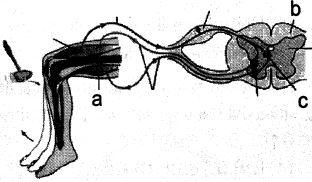
A
$a -$ Afferent pathway,$b -$ Grey matter,$c -$ Motor endplate
B
$a -$ Gray matter,$b -$ White matter,$c -$ Motor neuron
C
$a -$ Motor endplate,$b -$ White matter,$c -$ Interneuron
D
$a -$ Dorsal root ganglion,$b -$ Efferent pathway,$c -$ Interneuron
Solution
(A) The provided figure illustrates a knee-jerk reflex arc.
In this diagram:
$a$ points to the muscle spindle or the afferent pathway (sensory neuron) originating from the muscle.
$b$ points to the grey matter of the spinal cord,which is the central $H$-shaped region.
$c$ points to the motor endplate (or neuromuscular junction) where the motor neuron connects to the effector muscle.
Therefore,the correct identification is $a -$ Afferent pathway,$b -$ Grey matter,$c -$ Motor endplate.
In this diagram:
$a$ points to the muscle spindle or the afferent pathway (sensory neuron) originating from the muscle.
$b$ points to the grey matter of the spinal cord,which is the central $H$-shaped region.
$c$ points to the motor endplate (or neuromuscular junction) where the motor neuron connects to the effector muscle.
Therefore,the correct identification is $a -$ Afferent pathway,$b -$ Grey matter,$c -$ Motor endplate.
0 likes
View Solution32
EasyMCQ
Ivan Pavlov conducted experiments on ......... .
A
Simple reflex action
B
Conditioned reflex action
C
Threshold reflex action
D
Origin of life
Solution
(B) Ivan Pavlov was a Russian physiologist known primarily for his work in classical conditioning.
He conducted experiments on dogs to demonstrate the concept of $Conditioned \text{ } reflex \text{ } action$.
In his experiments, he paired a neutral stimulus (like a bell) with an unconditioned stimulus (food) to elicit a conditioned response (salivation) in dogs.
He conducted experiments on dogs to demonstrate the concept of $Conditioned \text{ } reflex \text{ } action$.
In his experiments, he paired a neutral stimulus (like a bell) with an unconditioned stimulus (food) to elicit a conditioned response (salivation) in dogs.
0 likes
View Solution33
MediumMCQ
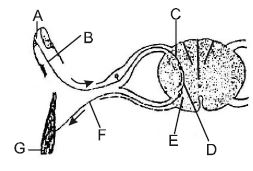
The following diagram indicates the reflex arc. Identify the parts labelled as $A, B, C, D, E, F$ and $G$. Choose the correct option.
A
$A =$ sense organ; $B =$ sensory nerve; $C =$ dorsal horn; $D =$ interneuron; $E =$ ventral horn; $F =$ motor nerve; $G =$ effector
B
$A =$ sense organ; $B =$ sensory nerve; $C =$ ventral horn; $D =$ interneuron; $E =$ dorsal horn; $F =$ motor nerve; $G =$ effector
C
$A =$ effector; $B =$ motor nerve; $C =$ dorsal horn; $D =$ interneuron; $E =$ ventral horn; $F =$ sensory nerve; $G =$ effector
D
$A =$ effector; $B =$ motor nerve; $C =$ ventral horn; $D =$ interneuron; $E =$ dorsal horn; $F =$ sensory nerve; $G =$ sense organ.
Solution
(A) In a reflex arc,the pathway of a nerve impulse is as follows:
$1$. $A$ represents the sense organ (receptor) which detects the stimulus.
$2$. $B$ represents the sensory nerve (afferent neuron) which carries the impulse towards the central nervous system.
$3$. $C$ represents the dorsal horn of the spinal cord grey matter,where sensory neurons enter.
$4$. $D$ represents the interneuron (relay neuron) which connects sensory and motor neurons.
$5$. $E$ represents the ventral horn of the spinal cord grey matter,where motor neurons exit.
$6$. $F$ represents the motor nerve (efferent neuron) which carries the impulse away from the central nervous system.
$7$. $G$ represents the effector (muscle or gland) which performs the response.
Therefore,the correct sequence is $A =$ sense organ,$B =$ sensory nerve,$C =$ dorsal horn,$D =$ interneuron,$E =$ ventral horn,$F =$ motor nerve,$G =$ effector.
$1$. $A$ represents the sense organ (receptor) which detects the stimulus.
$2$. $B$ represents the sensory nerve (afferent neuron) which carries the impulse towards the central nervous system.
$3$. $C$ represents the dorsal horn of the spinal cord grey matter,where sensory neurons enter.
$4$. $D$ represents the interneuron (relay neuron) which connects sensory and motor neurons.
$5$. $E$ represents the ventral horn of the spinal cord grey matter,where motor neurons exit.
$6$. $F$ represents the motor nerve (efferent neuron) which carries the impulse away from the central nervous system.
$7$. $G$ represents the effector (muscle or gland) which performs the response.
Therefore,the correct sequence is $A =$ sense organ,$B =$ sensory nerve,$C =$ dorsal horn,$D =$ interneuron,$E =$ ventral horn,$F =$ motor nerve,$G =$ effector.
0 likes
View Solution34
Medium
What is reflex action? How is reflex arc formed?
Solution
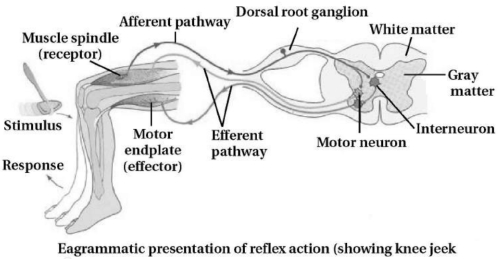
(N/A) Reflex action is the entire process of response to a peripheral nervous stimulation that occurs involuntarily,without conscious effort or thought,and requires the involvement of a part of the central nervous system $(CNS)$.
We experience sudden withdrawal of a body part when it comes in contact with objects that are extremely hot,cold,pointed,or animals that are scary or poisonous.
The reflex pathway,known as the reflex arc,comprises at least one afferent neuron (receptor) and one efferent (effector) neuron appropriately arranged in a series.
The afferent neuron receives a signal from a sensory organ and transmits the impulse via a dorsal nerve root into the $CNS$ at the level of the spinal cord.
The efferent neuron then carries signals from the $CNS$ to the effector (muscle or gland). The stimulus and response thus form a reflex arc,as shown in the knee-jerk reflex.
We experience sudden withdrawal of a body part when it comes in contact with objects that are extremely hot,cold,pointed,or animals that are scary or poisonous.
The reflex pathway,known as the reflex arc,comprises at least one afferent neuron (receptor) and one efferent (effector) neuron appropriately arranged in a series.
The afferent neuron receives a signal from a sensory organ and transmits the impulse via a dorsal nerve root into the $CNS$ at the level of the spinal cord.
The efferent neuron then carries signals from the $CNS$ to the effector (muscle or gland). The stimulus and response thus form a reflex arc,as shown in the knee-jerk reflex.
0 likes
View Solution35
Medium
What is a reflex action?
Solution
(N/A) reflex action is a rapid,involuntary response to a stimulus that occurs without conscious thought or effort.
When a part of our body comes into contact with extremely hot,cold,sharp,or dangerous objects,the body reacts immediately to withdraw from the stimulus.
This process involves the peripheral nervous system and the spinal cord (part of the Central Nervous System) to initiate a quick motor response,ensuring protection from potential harm.
When a part of our body comes into contact with extremely hot,cold,sharp,or dangerous objects,the body reacts immediately to withdraw from the stimulus.
This process involves the peripheral nervous system and the spinal cord (part of the Central Nervous System) to initiate a quick motor response,ensuring protection from potential harm.
0 likes
View Solution36
Medium
Give a scientific reason: Reflex action plays a significant role in animals.
Solution
(N/A) Reflex action occurs through reflex centers of the brain or spinal cord.
It is a very fast,involuntary response that occurs without conscious effort from the animal.
Such actions serve as a defense mechanism against harmful stimuli to protect the animal.
For example,when an animal touches a hot surface,the immediate withdrawal of the limb prevents tissue damage.
If reflex action did not occur,animals would be highly susceptible to injury; therefore,reflex action is protective in nature.
It is a very fast,involuntary response that occurs without conscious effort from the animal.
Such actions serve as a defense mechanism against harmful stimuli to protect the animal.
For example,when an animal touches a hot surface,the immediate withdrawal of the limb prevents tissue damage.
If reflex action did not occur,animals would be highly susceptible to injury; therefore,reflex action is protective in nature.
0 likes
View Solution37
Medium
Define/Explain:
$(1)$ Reflex action
$(1)$ Reflex action
Solution
(N/A) $(1)$ The sudden withdrawal of a body part that comes in contact with objects that are extremely cold,hot,pointed,or scary is known as a reflex action. The entire process of response to a peripheral nervous stimulation occurs involuntarily,without conscious effort or thought,and involves the central nervous system.
0 likes
View Solution38
EasyMCQ
The process of response to a peripheral nervous stimulation,that occurs involuntarily is called
A
Refractory potential
B
Action potential
C
Reflex action
D
Activation potential
Solution
(C) The entire process of response to a peripheral nervous stimulation that occurs involuntarily,i.e.,without conscious effort or thought,and requires the involvement of a part of the central nervous system is called a reflex action.
0 likes
View Solution39
EasyMCQ
Reflex action involves
A
Medulla oblongata
B
Spinal cord
C
Cerebellum
D
Optic fibre
Solution
(B) Reflex actions are involuntary and rapid responses to stimuli.
They are primarily classified into spinal reflexes and cranial reflexes.
Spinal reflexes are mediated through the spinal cord,which acts as the processing center for these quick,protective responses.
This allows the body to react to harmful stimuli without waiting for conscious input from the brain.
They are primarily classified into spinal reflexes and cranial reflexes.
Spinal reflexes are mediated through the spinal cord,which acts as the processing center for these quick,protective responses.
This allows the body to react to harmful stimuli without waiting for conscious input from the brain.
0 likes
View Solution40
MediumMCQ
$\ldots \ldots \ldots$ is not involved in knee-jerk reflex.
A
Muscle spindle
B
Motor neuron
C
Brain
D
Interneurons
Solution
(C) The knee-jerk reflex is a classic example of a monosynaptic spinal reflex.
It involves a sensory neuron (detecting the stretch via the muscle spindle),a motor neuron (causing muscle contraction),and the spinal cord.
The brain is not involved in the processing of this reflex arc,as it is an involuntary and rapid response to maintain posture and balance.
It involves a sensory neuron (detecting the stretch via the muscle spindle),a motor neuron (causing muscle contraction),and the spinal cord.
The brain is not involved in the processing of this reflex arc,as it is an involuntary and rapid response to maintain posture and balance.
0 likes
View Solution41
MediumMCQ
Which is not a reflex action?
A
Salivation
B
Eye opening and closing
C
Response to pinching pin in a frog leg
D
Sweating
Solution
(D) Sweating (maintenance of body temperature) is not a reflex action. It is a physiological process regulated by the autonomic nervous system to maintain homeostasis,whereas reflex actions are rapid,involuntary responses to a stimulus.
0 likes
View Solution42
MediumMCQ
The reflex pathway comprises of . . . . . . neurons.
A
One afferent neuron only
B
One efferent neuron only
C
One afferent and one efferent neuron
D
One afferent,one efferent and an interneuron
Solution
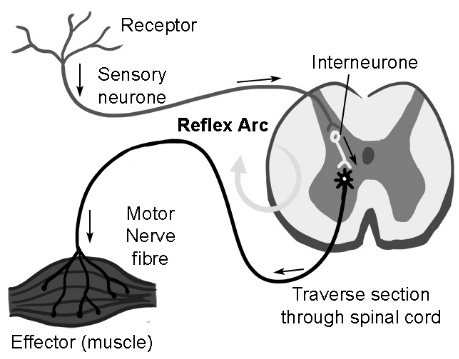
(D) The reflex pathway,also known as the reflex arc,consists of at least three components:
$1$. An afferent (sensory) neuron that carries the signal from the receptor to the central nervous system.
$2$. An interneuron (association neuron) located within the central nervous system (spinal cord) that processes the signal.
$3$. An efferent (motor) neuron that carries the response signal from the central nervous system to the effector organ (muscle or gland).
Therefore,the correct pathway involves one afferent,one efferent,and an interneuron.
$1$. An afferent (sensory) neuron that carries the signal from the receptor to the central nervous system.
$2$. An interneuron (association neuron) located within the central nervous system (spinal cord) that processes the signal.
$3$. An efferent (motor) neuron that carries the response signal from the central nervous system to the effector organ (muscle or gland).
Therefore,the correct pathway involves one afferent,one efferent,and an interneuron.
0 likes
View Solution43
EasyMCQ
The path of a reflex action is:
A
Receptor $\rightarrow$ Brain $\rightarrow$ Muscles
B
Receptor $\rightarrow$ Spinal cord $\rightarrow$ Muscles
C
Muscles $\rightarrow$ Receptor $\rightarrow$ Brain
D
Muscles $\rightarrow$ Spinal cord $\rightarrow$ Muscles
Solution
(B) reflex action is an immediate,involuntary response to a specific stimulus.
The pathway followed by the nerve impulses during a reflex action is known as the reflex arc.
The sequence is:
Receptor (detects stimulus) $\rightarrow$ Sensory neuron $\rightarrow$ Spinal cord (integration center) $\rightarrow$ Motor neuron $\rightarrow$ Muscles (effector organ).
Therefore,the correct path is: Receptor $\rightarrow$ Spinal cord $\rightarrow$ Muscles.
The pathway followed by the nerve impulses during a reflex action is known as the reflex arc.
The sequence is:
Receptor (detects stimulus) $\rightarrow$ Sensory neuron $\rightarrow$ Spinal cord (integration center) $\rightarrow$ Motor neuron $\rightarrow$ Muscles (effector organ).
Therefore,the correct path is: Receptor $\rightarrow$ Spinal cord $\rightarrow$ Muscles.
0 likes
View Solution44
MediumMCQ
Given below are different components of a reflex arc:
$I$. Effector organ
$II$. Interneuron
$III$. Motor neuron
$IV$. Sensory neuron
$V$. Sensory receptor
Arrange these in the correct order of the action potential that follows a sensory receptor stimulation.
$I$. Effector organ
$II$. Interneuron
$III$. Motor neuron
$IV$. Sensory neuron
$V$. Sensory receptor
Arrange these in the correct order of the action potential that follows a sensory receptor stimulation.
A
$V, IV, III, II, I$
B
$V, IV, II, III, I$
C
$V, III, IV, I, II$
D
$V, II, IV, III, I$
Solution
(B) reflex arc is the neural pathway that controls a reflex action. The sequence of events in a reflex arc is as follows:
$1$. The process begins at the $V$ (Sensory receptor),which detects the stimulus.
$2$. The signal is transmitted via the $IV$ (Sensory neuron) to the central nervous system.
$3$. In the spinal cord,the signal passes through the $II$ (Interneuron).
$4$. The signal is then transmitted to the $III$ (Motor neuron).
$5$. Finally,the $III$ (Motor neuron) carries the impulse to the $I$ (Effector organ) to produce a response.
Therefore,the correct sequence is $V, IV, II, III, I$.
$1$. The process begins at the $V$ (Sensory receptor),which detects the stimulus.
$2$. The signal is transmitted via the $IV$ (Sensory neuron) to the central nervous system.
$3$. In the spinal cord,the signal passes through the $II$ (Interneuron).
$4$. The signal is then transmitted to the $III$ (Motor neuron).
$5$. Finally,the $III$ (Motor neuron) carries the impulse to the $I$ (Effector organ) to produce a response.
Therefore,the correct sequence is $V, IV, II, III, I$.
0 likes
View Solution45
MediumMCQ
In a cross-section of the spinal cord,$A, B, C, D$ and $E$ represent:
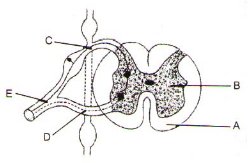
A
$A-$ White matter,$B-$ Grey matter,$C-$ Dorsal root,$D-$ Ventral root,$E-$ Spinal nerve
B
$A-$ White matter,$B-$ Grey matter,$C-$ Ventral root,$D-$ Dorsal root,$E-$ Spinal nerve
C
$A-$ Grey matter,$B-$ White matter,$C-$ Ventral root,$D-$ Dorsal root,$E-$ Spinal nerve
D
$A-$ Grey matter,$B-$ White matter,$C-$ Dorsal root,$D-$ Ventral root,$E-$ Spinal nerve
Solution
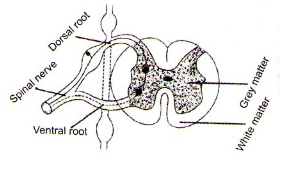
(A) The given diagram represents a reflex arc and its labeling is as follows:
$A$ represents the outer White matter of the spinal cord.
$B$ represents the inner butterfly-shaped Grey matter.
$C$ represents the Dorsal root,which carries sensory information into the spinal cord.
$D$ represents the Ventral root,which carries motor information out of the spinal cord.
$E$ represents the Spinal nerve,formed by the union of the dorsal and ventral roots.
Therefore,the correct sequence is $A-$ White matter,$B-$ Grey matter,$C-$ Dorsal root,$D-$ Ventral root,$E-$ Spinal nerve.
$A$ represents the outer White matter of the spinal cord.
$B$ represents the inner butterfly-shaped Grey matter.
$C$ represents the Dorsal root,which carries sensory information into the spinal cord.
$D$ represents the Ventral root,which carries motor information out of the spinal cord.
$E$ represents the Spinal nerve,formed by the union of the dorsal and ventral roots.
Therefore,the correct sequence is $A-$ White matter,$B-$ Grey matter,$C-$ Dorsal root,$D-$ Ventral root,$E-$ Spinal nerve.
0 likes
View Solution46
EasyMCQ
Reflex arc in the nervous system means
A
$A$ functional unit consisting of a receptor neural pathway and an effector neuron
B
Peripheral nerves,spinal cords and brain
C
$A$ homeostatic system of sensory nerves,synapses and motor nerves
D
An inherited behaviour pattern that functions through a certain neural pathway
Solution
(A) reflex arc is the neural pathway that mediates a reflex action.
It consists of a receptor,a sensory (afferent) neuron,an integration center (usually in the spinal cord),a motor (efferent) neuron,and an effector organ (muscle or gland).
Therefore,it is a functional unit consisting of a receptor neural pathway and an effector neuron.
It consists of a receptor,a sensory (afferent) neuron,an integration center (usually in the spinal cord),a motor (efferent) neuron,and an effector organ (muscle or gland).
Therefore,it is a functional unit consisting of a receptor neural pathway and an effector neuron.
0 likes
View Solution47
Easy
What is reflex action?
Solution
(N/A) The entire process of response to a peripheral nervous stimulation that occurs involuntarily,without conscious efforts or thought,and requires the involvement of a part of the central nervous system is called a reflex action.
0 likes
View Solution48
MediumMCQ
How is a reflex arc formed?
A
By the interaction of the brain and spinal cord.
B
By the pathway of nerve impulses during a reflex action.
C
By the voluntary control of skeletal muscles.
D
By the transmission of signals through the autonomic nervous system.
Solution
(B) reflex arc is formed by the pathway taken by nerve impulses in a reflex action.
- It consists of at least one afferent neuron (receptor) and one efferent (effector) neuron appropriately arranged in a series.
- The afferent neuron receives the signal from a sensory organ and transmits the impulse via a dorsal nerve root into the $CNS$ (at the level of the spinal cord).
- The efferent neuron then carries signals from the $CNS$ to the effector (muscle or gland).
- The stimulus and response,thus,form a reflex arc,as seen in the knee-jerk reflex.
- It consists of at least one afferent neuron (receptor) and one efferent (effector) neuron appropriately arranged in a series.
- The afferent neuron receives the signal from a sensory organ and transmits the impulse via a dorsal nerve root into the $CNS$ (at the level of the spinal cord).
- The efferent neuron then carries signals from the $CNS$ to the effector (muscle or gland).
- The stimulus and response,thus,form a reflex arc,as seen in the knee-jerk reflex.
0 likes
View Solution49
EasyMCQ
Select the correct option for the reflex arc.
A
Receptor $\rightarrow$ Motor neuron $\rightarrow$ Interneuron $\rightarrow$ Sensory neuron $\rightarrow$ Effector
B
Receptor $\rightarrow$ Sensory neuron $\rightarrow$ Interneuron $\rightarrow$ Motor neuron $\rightarrow$ Effector
C
Effector $\rightarrow$ Motor neuron $\rightarrow$ Interneuron $\rightarrow$ Sensory neuron $\rightarrow$ Receptor
D
Effector $\rightarrow$ Sensory neuron $\rightarrow$ Interneuron $\rightarrow$ Motor neuron $\rightarrow$ Receptor
Solution
(B) reflex arc is the neural pathway that controls a reflex action.
In a typical reflex arc,the signal travels in the following sequence:
$1$. Receptor: Detects the stimulus.
$2$. Sensory neuron: Transmits the impulse from the receptor to the central nervous system (spinal cord).
$3$. Interneuron: Processes the signal within the spinal cord.
$4$. Motor neuron: Carries the response impulse from the spinal cord to the effector.
$5$. Effector: The muscle or gland that performs the action.
Therefore,the correct sequence is Receptor $\rightarrow$ Sensory neuron $\rightarrow$ Interneuron $\rightarrow$ Motor neuron $\rightarrow$ Effector.
In a typical reflex arc,the signal travels in the following sequence:
$1$. Receptor: Detects the stimulus.
$2$. Sensory neuron: Transmits the impulse from the receptor to the central nervous system (spinal cord).
$3$. Interneuron: Processes the signal within the spinal cord.
$4$. Motor neuron: Carries the response impulse from the spinal cord to the effector.
$5$. Effector: The muscle or gland that performs the action.
Therefore,the correct sequence is Receptor $\rightarrow$ Sensory neuron $\rightarrow$ Interneuron $\rightarrow$ Motor neuron $\rightarrow$ Effector.
0 likes
View Solution50
EasyMCQ
Where is the cell body of the sensory neuron located in a reflex arc?
A
Receptor
B
Gray matter of the spinal cord
C
Dorsal root ganglion
D
Motor end plate
Solution
(C) In a reflex arc, the sensory neuron (afferent neuron) carries nerve impulses from the receptor to the central nervous system. The cell bodies of these sensory neurons are located in the $Dorsal \text{ } root \text{ } ganglion$ of the spinal nerve. The axon of this neuron then enters the spinal cord through the dorsal root to synapse with an interneuron or directly with a motor neuron.
0 likes
View SolutionNeural Control and Coordination — Reflex Action and Reflex Arc · Frequently Asked Questions
1Are these Neural Control and Coordination questions useful for JEE and NEET?
Yes. All questions in this section are mapped to JEE Main and NEET exam patterns. Previous year questions from JEE Main, NEET, GUJCET and state-level exams are included with full solutions.
2Can I switch to Hindi or Gujarati for these questions?
Yes. Use the language tabs in the hero section or the sidebar to view the same questions and solutions in English, Hindi or Gujarati.
3How do I generate a question paper from this subtopic?
Use the Vedclass Exam Paper Generator — select the chapter and subtopic, set difficulty, and generate Sets A, B, C, D automatically. First 3 chapters of every subject are free.
Vedclass Products
For Students
Vedclass Test Series
Mock tests in real JEE/NEET style with performance analysis. 5-day free trial.
Start Free TrialFor Teachers
Exam Paper Generator
Generate Set A/B/C/D papers from this chapter in 2 minutes. 3 chapters free.
Try FreeFor Institutes
Online Exam Module
Live online exams with unlimited students, 360° analytics & white-label branding.
See DemoFor Teachers & Institutes
Generate a Neural Control and Coordination Exam Paper in 2 Minutes
Select subtopic & difficulty — Sets A, B, C, D auto-generated with No Repeat logic.
First 3 chapters of every subject are free — no payment required.