
A English
Respiratory organs Questions in English
Class 11 Biology · Breathing and Exchange of Gases · Respiratory organs
73+
Questions
English
Language
100%
With Solutions
Showing 23 of 73 questions in English
51
MediumMCQ
Given below are four matchings of an animal and its kind of respiratory organ:
$I.$ Silver fish - Trachea
$II.$ Scorpion - Book lung
$III.$ Sea squirt - Pharyngeal gills
$IV.$ Dolphin - Skin
The correct matchings are:
$I.$ Silver fish - Trachea
$II.$ Scorpion - Book lung
$III.$ Sea squirt - Pharyngeal gills
$IV.$ Dolphin - Skin
The correct matchings are:
A
$I$ and $II$
B
$II$ and $III$
C
$I, II$ and $III$
D
$II, III$ and $IV$
Solution
(C) $1$. Silver fish $(Lepisma)$ is an insect, and insects respire through a tracheal system $(Trachea)$. Thus, $I$ is correct.
$2$. Scorpion is an arachnid, and it respires through book lungs. Thus, $II$ is correct.
$3$. Sea squirt $(Urochordata)$ respires through pharyngeal gill slits. Thus, $III$ is correct.
$4$. Dolphin is a mammal, and it respires through lungs, not skin. Thus, $IV$ is incorrect.
Therefore, the correct matchings are $I, II,$ and $III$.
$2$. Scorpion is an arachnid, and it respires through book lungs. Thus, $II$ is correct.
$3$. Sea squirt $(Urochordata)$ respires through pharyngeal gill slits. Thus, $III$ is correct.
$4$. Dolphin is a mammal, and it respires through lungs, not skin. Thus, $IV$ is incorrect.
Therefore, the correct matchings are $I, II,$ and $III$.
0 likes
View Solution52
MediumMCQ
The respiratory organs vary in different animals due to their
A
Nutrition
B
Habitat and level of organisation
C
Excretion
D
Reproduction
Solution
(B) The respiratory organs in animals are adapted to their specific environmental conditions. Because of different habitats (the place where an animal lives) and the complexity of their body structure (level of organisation),the breathing mechanisms vary significantly. Consequently,the respiratory organs also vary across different animal groups to ensure efficient gas exchange.
0 likes
View Solution53
MediumMCQ
Which of the following are the respiratory organs of insects?
A
Trachea
B
Gills
C
Cuticle
D
Lungs
Solution
(A) Insects (e.g.,Cockroach) respire through a network of tubes called the Tracheal system.
Gills are respiratory organs found in aquatic animals like fish and some amphibians.
Cuticle (moist skin) is the respiratory organ in earthworms.
Lungs are the respiratory organs in birds,reptiles,and mammals.
Gills are respiratory organs found in aquatic animals like fish and some amphibians.
Cuticle (moist skin) is the respiratory organ in earthworms.
Lungs are the respiratory organs in birds,reptiles,and mammals.
0 likes
View Solution54
MediumMCQ
Which animal among the following respires via buccal cavity,moist skin and lungs?
A
Hydra
B
Frog
C
Sycon
D
Earthworm
Solution
(B) Frogs can respire by their moist skin,buccal cavity,and lungs as they live on land. Their larval form,i.e.,tadpole,which lives in water,respires through gills.
$Hydra$ and $Sycon$ do not have a well-developed respiratory system; they perform the exchange of gases by simple diffusion.
Earthworms respire through their moist cuticle.
$Hydra$ and $Sycon$ do not have a well-developed respiratory system; they perform the exchange of gases by simple diffusion.
Earthworms respire through their moist cuticle.
0 likes
View Solution55
MediumMCQ
Respiratory organs in aquatic arthropods like crayfish,prawn and molluscs like $Unio$ are
A
Body wall
B
Lungs
C
Trachea
D
Gills
Solution
(D) Aquatic arthropods (such as crayfish and prawns) and aquatic molluscs (such as $Unio$) respire through specialized vascularized structures called gills (branchiae).
These organs are adapted for the exchange of dissolved oxygen from the water into the blood and the removal of carbon dioxide from the blood into the water.
These organs are adapted for the exchange of dissolved oxygen from the water into the blood and the removal of carbon dioxide from the blood into the water.
0 likes
View Solution56
MediumMCQ
Which group of animals respire through lungs?
A
Earthworm and insects
B
Sponges,coelenterates and flatworms
C
Fishes and aquatic arthropods
D
Reptiles,birds and mammals
Solution
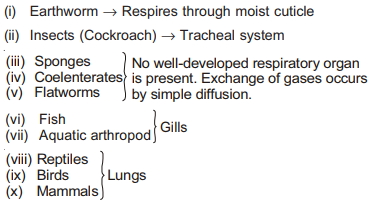
(D) The respiratory organs vary across different animal groups based on their habitat and level of organization:
$1$. Earthworms respire through their moist cuticle,while insects use a tracheal system.
$2$. Sponges,coelenterates,and flatworms do not have specialized respiratory organs; they exchange gases through simple diffusion across their body surface.
$3$. Fishes and aquatic arthropods typically use gills for respiration.
$4$. Reptiles,birds,and mammals possess well-developed lungs as their primary respiratory organs.
Therefore,the correct group of animals that respire through lungs is reptiles,birds,and mammals.
$1$. Earthworms respire through their moist cuticle,while insects use a tracheal system.
$2$. Sponges,coelenterates,and flatworms do not have specialized respiratory organs; they exchange gases through simple diffusion across their body surface.
$3$. Fishes and aquatic arthropods typically use gills for respiration.
$4$. Reptiles,birds,and mammals possess well-developed lungs as their primary respiratory organs.
Therefore,the correct group of animals that respire through lungs is reptiles,birds,and mammals.
0 likes
View Solution57
MediumMCQ
Which of the following is not a character of a respiratory surface?
A
Thin,permeable to gases
B
Extensive
C
Least vascular
D
Moist
Solution
(C) respiratory surface must possess specific characteristics to facilitate efficient gas exchange. These include being thin,moist,and having a large surface area (extensive). Furthermore,it must be highly vascular,meaning it is well-supplied with blood vessels,to ensure the rapid transport of oxygen and carbon dioxide between the respiratory surface and the blood. Therefore,'least vascular' is not a characteristic of a respiratory surface.
0 likes
View Solution58
MediumMCQ
Skin of man cannot act as a respiratory organ because
A
It is dry
B
It is not thin
C
It is not permeable to $O_2$ and $CO_2$
D
All of these
Solution
(D) Human skin cannot act as a respiratory organ for several reasons:
$1$. It is dry,which prevents the dissolution and diffusion of gases.
$2$. It is not thin enough to allow for efficient gas exchange.
$3$. It is impermeable to $O_2$ and $CO_2$,meaning these gases cannot pass through the skin layers effectively.
Therefore,all the given options are correct.
$1$. It is dry,which prevents the dissolution and diffusion of gases.
$2$. It is not thin enough to allow for efficient gas exchange.
$3$. It is impermeable to $O_2$ and $CO_2$,meaning these gases cannot pass through the skin layers effectively.
Therefore,all the given options are correct.
0 likes
View Solution59
MediumMCQ
$A$ : The lungs of birds are provided with air sacs.
$R$ : Air sacs supplement respiration.
$R$ : Air sacs supplement respiration.
A
Assertion and Reason both are correct and Reason is the correct explanation of Assertion.
B
Assertion and Reason both are correct but Reason is not the correct explanation of Assertion.
C
Assertion is correct,but Reason is incorrect.
D
Both Assertion and Reason are incorrect.
Solution
(B) Assertion is true: Birds possess air sacs connected to their lungs. These $8$ or $9$ air sacs are situated on either side of the lungs and help in maintaining a continuous flow of air.
Reason is true: Air sacs significantly increase the efficiency of respiration in birds. They ensure that air passes over the gas exchange surfaces in a unidirectional manner,preventing the mixing of oxygenated and deoxygenated air.
Conclusion: While both statements are scientifically accurate,the presence of air sacs (anatomical feature) is not the direct cause of them supplementing respiration (physiological function); rather,they are structural adaptations that facilitate the process. Therefore,the Reason is not the correct explanation of the Assertion.
Reason is true: Air sacs significantly increase the efficiency of respiration in birds. They ensure that air passes over the gas exchange surfaces in a unidirectional manner,preventing the mixing of oxygenated and deoxygenated air.
Conclusion: While both statements are scientifically accurate,the presence of air sacs (anatomical feature) is not the direct cause of them supplementing respiration (physiological function); rather,they are structural adaptations that facilitate the process. Therefore,the Reason is not the correct explanation of the Assertion.
0 likes
View Solution60
EasyMCQ
Amphibians respire through ........
A
Skin
B
Lungs
C
Gills
D
All of the above
Solution
(D) Amphibians exhibit a diverse range of respiratory mechanisms depending on their life stage and environment.
$1$. Cutaneous respiration: Many amphibians,such as frogs,can respire through their moist skin.
$2$. Pulmonary respiration: Adult amphibians possess lungs for breathing air.
$3$. Branchial respiration: Larval stages (tadpoles) of amphibians respire through gills.
Therefore,amphibians can respire through skin,lungs,and gills.
$1$. Cutaneous respiration: Many amphibians,such as frogs,can respire through their moist skin.
$2$. Pulmonary respiration: Adult amphibians possess lungs for breathing air.
$3$. Branchial respiration: Larval stages (tadpoles) of amphibians respire through gills.
Therefore,amphibians can respire through skin,lungs,and gills.
0 likes
View Solution61
MediumMCQ
Match the following columns:
| Column-$I$ (Plant Part) | Column-$II$ (Gas Exchange Structure) |
|---|---|
| $P$. Leaves and young stems | $I$. Lenticels |
| $Q$. Woody stems | $II$. Stomata |
| $R$. Roots | $III$. Root hairs |
A
$(P-III), (Q-II), (R-I)$
B
$(P-III), (Q-I), (R-II)$
C
$(P-I), (Q-II), (R-III)$
D
$(P-II), (Q-I), (R-III)$
Solution
(D) In plants,different parts have specialized structures for gas exchange:
$1$. Leaves and young stems contain stomata $(II)$ for the exchange of gases.
$2$. Woody stems have specialized openings called lenticels $(I)$ that allow for gas exchange.
$3$. Roots absorb oxygen from the soil through root hairs $(III)$.
Therefore,the correct matching is $P-II, Q-I, R-III$.
$1$. Leaves and young stems contain stomata $(II)$ for the exchange of gases.
$2$. Woody stems have specialized openings called lenticels $(I)$ that allow for gas exchange.
$3$. Roots absorb oxygen from the soil through root hairs $(III)$.
Therefore,the correct matching is $P-II, Q-I, R-III$.
0 likes
View Solution62
MediumMCQ
Match the following columns:
| Column-$I$ (Invertebrates) | Column-$II$ (Respiratory Organs) |
|---|---|
| $P$. Sponges,Coelenterates,Flatworms | $I$. Gills |
| $Q$. Earthworms | $II$. Simple diffusion through body surface |
| $R$. Insects | $III$. Vascularized bags (Lungs) |
| $S$. Aquatic arthropods and molluscs | $IV$. Tracheal tubes |
| $T$. Terrestrial arthropods and molluscs | $V$. Moist cuticle |
A
$(P-II), (Q-V), (R-IV), (S-I), (T-III)$
B
$(P-II), (Q-V), (R-I), (S-IV), (T-III)$
C
$(P-II), (Q-IV), (R-V), (S-I), (T-III)$
D
$(P-I), (Q-III), (R-IV), (S-II), (T-V)$
Solution
(A) The correct matching of invertebrates with their respiratory organs is as follows:
$P$. Sponges,Coelenterates,and Flatworms respire through simple diffusion across their entire body surface $(II)$.
$Q$. Earthworms use their moist skin (moist cuticle) for respiration $(V)$.
$R$. Insects possess a network of tubes called tracheal tubes for gas exchange $(IV)$.
$S$. Aquatic arthropods and molluscs use gills for respiration in water $(I)$.
$T$. Terrestrial arthropods and molluscs use vascularized structures like lungs or book lungs for respiration $(III)$.
Therefore,the correct sequence is $(P-II), (Q-V), (R-IV), (S-I), (T-III)$.
$P$. Sponges,Coelenterates,and Flatworms respire through simple diffusion across their entire body surface $(II)$.
$Q$. Earthworms use their moist skin (moist cuticle) for respiration $(V)$.
$R$. Insects possess a network of tubes called tracheal tubes for gas exchange $(IV)$.
$S$. Aquatic arthropods and molluscs use gills for respiration in water $(I)$.
$T$. Terrestrial arthropods and molluscs use vascularized structures like lungs or book lungs for respiration $(III)$.
Therefore,the correct sequence is $(P-II), (Q-V), (R-IV), (S-I), (T-III)$.
0 likes
View Solution63
MediumMCQ
Match the following columns:
| Column-$I$ (Organisms) | Column-$II$ (Respiratory Organs) |
| $P$. Fishes | $I$. Lungs |
| $Q$. Reptiles,Birds,Mammals | $II$. Gills |
| $R$. Amphibians like frogs | $III$. Lungs and moist skin |
A
$(P-I), (Q-II), (R-III)$
B
$(P-III), (Q-I), (R-II)$
C
$(P-II), (Q-III), (R-I)$
D
$(P-II), (Q-I), (R-III)$
Solution
(D) The respiratory organs in animals vary based on their habitat and level of organization:
$1$. Fishes $(P)$ respire through gills $(II)$ as they are aquatic.
$2$. Reptiles,birds,and mammals $(Q)$ are terrestrial vertebrates that primarily use lungs $(I)$ for respiration.
$3$. Amphibians like frogs $(R)$ use both lungs and moist skin $(III)$ for gas exchange.
Therefore,the correct matching is $(P-II), (Q-I), (R-III)$.
$1$. Fishes $(P)$ respire through gills $(II)$ as they are aquatic.
$2$. Reptiles,birds,and mammals $(Q)$ are terrestrial vertebrates that primarily use lungs $(I)$ for respiration.
$3$. Amphibians like frogs $(R)$ use both lungs and moist skin $(III)$ for gas exchange.
Therefore,the correct matching is $(P-II), (Q-I), (R-III)$.
0 likes
View Solution64
MediumMCQ
Which of the following statements is correct?
A
$O_2$ is utilized by organisms to directly break down simple molecules like glucose,amino acids,fatty acids,etc.
B
Earthworms use a network of tubes (tracheal tubes) to transport atmospheric air within the body.
C
Lungs are used by terrestrial organisms for the exchange of gases.
D
Insects use their moist cuticle to transport atmospheric air within the body.
Solution
(C) Statement $C$ is correct because terrestrial organisms,such as mammals,birds,and reptiles,primarily use lungs for the exchange of gases.
Statement $A$ is incorrect because $O_2$ is not used to 'directly' break down molecules; rather,it is the final electron acceptor in the electron transport chain during aerobic respiration to facilitate the complete oxidation of glucose.
Statement $B$ is incorrect because earthworms respire through their moist skin (cutaneous respiration),not through tracheal tubes.
Statement $D$ is incorrect because insects use a network of tracheal tubes for respiration,not their cuticle.
Statement $A$ is incorrect because $O_2$ is not used to 'directly' break down molecules; rather,it is the final electron acceptor in the electron transport chain during aerobic respiration to facilitate the complete oxidation of glucose.
Statement $B$ is incorrect because earthworms respire through their moist skin (cutaneous respiration),not through tracheal tubes.
Statement $D$ is incorrect because insects use a network of tracheal tubes for respiration,not their cuticle.
0 likes
View Solution65
MediumMCQ
What is the unique feature of the respiratory system of birds?
A
Gills
B
Lungs with alveoli
C
Tracheal tubes
D
Air sacs
Solution
(D) The respiratory system of birds is highly efficient and unique due to the presence of air sacs.
Birds possess lungs that are connected to a system of nine air sacs that extend into the bones and other parts of the body.
These air sacs do not participate in gas exchange directly but act as bellows to ensure a continuous,unidirectional flow of air through the lungs,allowing for efficient oxygen uptake even at high altitudes.
Birds possess lungs that are connected to a system of nine air sacs that extend into the bones and other parts of the body.
These air sacs do not participate in gas exchange directly but act as bellows to ensure a continuous,unidirectional flow of air through the lungs,allowing for efficient oxygen uptake even at high altitudes.
0 likes
View Solution66
MediumMCQ
Which of the following modes of respiration always continues in a frog?
A
Buccopharyngeal
B
Pulmonary
C
Cutaneous
D
Gills
Solution
(C) Frogs exhibit three types of respiration: cutaneous,pulmonary,and buccopharyngeal.
$1$. Cutaneous respiration occurs through the skin. This is the only mode of respiration that continues throughout the life of the frog,both on land and in water.
$2$. Pulmonary respiration occurs through the lungs,which is used primarily on land.
$3$. Buccopharyngeal respiration occurs through the lining of the mouth cavity.
$4$. Gills are typically present only in the larval stage (tadpole) and are not a mode of respiration in adult frogs.
Therefore,cutaneous respiration is the constant mode of respiration.
$1$. Cutaneous respiration occurs through the skin. This is the only mode of respiration that continues throughout the life of the frog,both on land and in water.
$2$. Pulmonary respiration occurs through the lungs,which is used primarily on land.
$3$. Buccopharyngeal respiration occurs through the lining of the mouth cavity.
$4$. Gills are typically present only in the larval stage (tadpole) and are not a mode of respiration in adult frogs.
Therefore,cutaneous respiration is the constant mode of respiration.
0 likes
View Solution67
EasyMCQ
Match the Column $I$ with Column $II$.
Choose the correct option.
| Column $I$ (Animals) | Column $II$ (Respiratory organs / surface) |
| $1$. Spider | $a$. Internal gills |
| $2$. Coelenterates | $b$. Book lungs |
| $3$. Frog | $c$. Plasma membrane |
| $4$. Fishes | $d$. Lungs |
| $e$. External gills |
A
$1-b, 2-c, 3-d, 4-e$
B
$1-b, 2-c, 3-d, 4-a$
C
$1-c, 2-e, 3-a, 4-b$
D
$1-e, 2-c, 3-d, 4-a$
Solution
(B) The correct matching is as follows:
$1$. Spider: Respires through $b$. Book lungs.
$2$. Coelenterates: Respire through $c$. Plasma membrane (general body surface).
$3$. Frog: Respires through $d$. Lungs (also skin and buccal cavity).
$4$. Fishes: Respire through $a$. Internal gills.
Therefore,the correct sequence is $1-b, 2-c, 3-d, 4-a$.
$1$. Spider: Respires through $b$. Book lungs.
$2$. Coelenterates: Respire through $c$. Plasma membrane (general body surface).
$3$. Frog: Respires through $d$. Lungs (also skin and buccal cavity).
$4$. Fishes: Respire through $a$. Internal gills.
Therefore,the correct sequence is $1-b, 2-c, 3-d, 4-a$.
0 likes
View Solution68
EasyMCQ
Match the Column $I$ with Column $II$ and select the correct option:
| Column $I$ (Animals) | Column $II$ (Respiratory organs) |
|---|---|
| $i$. Sponges | $a$. External gills |
| $ii$. Insects | $b$. Plasma membrane |
| $iii$. Limulus | $c$. Tracheae |
| $iv$. Amphibian tadpoles | $d$. Book gills |
A
$i-b, ii-c, iii-d, iv-a$
B
$i-b, ii-c, iii-a, iv-d$
C
$i-c, ii-b, iii-d, iv-a$
D
$i-c, ii-b, iii-a, iv-d$
Solution
(A) The correct matching is as follows:
$i$. Sponges: They respire through their body surface via the plasma membrane $(b)$.
$ii$. Insects: They possess a network of tubes called tracheae for respiration $(c)$.
$iii$. Limulus (King crab): They respire using book gills $(d)$.
$iv$. Amphibian tadpoles: They respire using external gills $(a)$.
Therefore,the correct match is $i-b, ii-c, iii-d, iv-a$.
$i$. Sponges: They respire through their body surface via the plasma membrane $(b)$.
$ii$. Insects: They possess a network of tubes called tracheae for respiration $(c)$.
$iii$. Limulus (King crab): They respire using book gills $(d)$.
$iv$. Amphibian tadpoles: They respire using external gills $(a)$.
Therefore,the correct match is $i-b, ii-c, iii-d, iv-a$.
0 likes
View Solution69
EasyMCQ
Match the organism in Column-$I$ with the respiratory surface in Column-$II$.
| Column-$I$ | Column-$II$ |
| $i$. Planaria | $a$. Book gills |
| $ii$. Limulus | $b$. External gills |
| $iii$. Turtles | $c$. Body surface |
| $iv$. Amphibian tadpoles | $d$. Cloaca |
A
$i-a, ii-c, iii-b, iv-d$
B
$i-b, ii-d, iii-c, iv-a$
C
$i-c, ii-a, iii-d, iv-b$
D
$i-d, ii-b, iii-a, iv-c$
Solution
(C) The correct matching is as follows:
$1$. Planaria: These are flatworms that respire through their $c$. Body surface via simple diffusion.
$2$. Limulus: Also known as the horseshoe crab,it respires using $a$. Book gills.
$3$. Turtles: These reptiles respire using $d$. Cloaca (in addition to lungs,they use the cloacal lining for gas exchange while submerged).
$4$. Amphibian tadpoles: These aquatic larval stages of amphibians respire using $b$. External gills.
Therefore,the correct sequence is $i-c, ii-a, iii-d, iv-b$.
$1$. Planaria: These are flatworms that respire through their $c$. Body surface via simple diffusion.
$2$. Limulus: Also known as the horseshoe crab,it respires using $a$. Book gills.
$3$. Turtles: These reptiles respire using $d$. Cloaca (in addition to lungs,they use the cloacal lining for gas exchange while submerged).
$4$. Amphibian tadpoles: These aquatic larval stages of amphibians respire using $b$. External gills.
Therefore,the correct sequence is $i-c, ii-a, iii-d, iv-b$.
0 likes
View Solution70
EasyMCQ
Match the animals in Column-$I$ with their respiratory surface / organs in Column-$II$ and select the correct option:
| Column-$I$ | Column-$II$ |
| $A$. Newts and tadpoles | $I$. Plasma membrane |
| $B$. Platyhelminthes | $II$. External gills |
| $C$. Reptiles | $III$. Body surface |
| $D$. Protists | $IV$. Lungs |
A
$A-III, B-I, C-II, D-IV$
B
$A-I, B-II, C-III, D-IV$
C
$A-II, B-III, C-IV, D-I$
D
$A-IV, B-II, C-III, D-I$
Solution
(C) The correct matching is as follows:
$A$. Newts and tadpoles respire through $II$. External gills.
$B$. Platyhelminthes (flatworms) respire through $III$. Body surface (diffusion).
$C$. Reptiles respire through $IV$. Lungs.
$D$. Protists respire through $I$. Plasma membrane (diffusion).
Thus,the correct sequence is $A-II, B-III, C-IV, D-I$.
$A$. Newts and tadpoles respire through $II$. External gills.
$B$. Platyhelminthes (flatworms) respire through $III$. Body surface (diffusion).
$C$. Reptiles respire through $IV$. Lungs.
$D$. Protists respire through $I$. Plasma membrane (diffusion).
Thus,the correct sequence is $A-II, B-III, C-IV, D-I$.
0 likes
View Solution71
EasyMCQ
Fishes have . . . . . . for respiration.
A
external gills
B
internal gills
C
book gills
D
book lungs
Solution
(B) Fishes are aquatic organisms that primarily use gills for respiration.
These gills are located internally within the branchial chambers,protected by an operculum in bony fishes or gill slits in cartilaginous fishes.
Therefore,fishes possess internal gills to facilitate the exchange of gases in an aquatic environment.
These gills are located internally within the branchial chambers,protected by an operculum in bony fishes or gill slits in cartilaginous fishes.
Therefore,fishes possess internal gills to facilitate the exchange of gases in an aquatic environment.
0 likes
View Solution72
EasyMCQ
Different types of respiratory organs like gills,book gills,book lungs and trachea are present in
A
arthropods
B
sponges
C
annelids
D
molluscs
Solution
(A) The correct answer is $A$ (arthropods).
Respiratory organs such as gills,book gills,book lungs,and trachea are characteristic features found in the phylum $Arthropoda$.
These diverse respiratory structures allow arthropods to adapt to various environments,including aquatic and terrestrial habitats.
Respiratory organs such as gills,book gills,book lungs,and trachea are characteristic features found in the phylum $Arthropoda$.
These diverse respiratory structures allow arthropods to adapt to various environments,including aquatic and terrestrial habitats.
0 likes
View Solution73
MediumMCQ
Match List-$I$ with List-$II$:
Choose the correct answer from the options given below:
| List-$I$ | List-$II$ |
| $A$. Molluscs | $I$. Pulmonary respiration only |
| $B$. Reptiles | $II$. Branchial respiration |
| $C$. Adult amphibians | $III$. Cellular respiration |
| $D$. Amoeba | $IV$. Pulmonary and Cutaneous respiration |
Choose the correct answer from the options given below:
A
$A-III, B-II, C-I, D-IV$
B
$A-II, B-III, C-III, D-IV$
C
$A-I, B-II, C-IV, D-III$
D
$A-III, B-I, C-IV, D-III$
Solution
(D) . Molluscs generally use gills (branchial) for respiration $(A-II)$.
$B$. Reptiles rely on pulmonary respiration $(B-I)$.
$C$. Adult amphibians use both lungs (pulmonary) and skin (cutaneous) $(C-IV)$.
$D$. Amoeba,being unicellular,relies on diffusion across the cell membrane,which is a form of cellular respiration $(D-III)$.
Therefore,the correct matching is $A-II, B-I, C-IV, D-III$. Note: Based on the provided options,option $(4)$ is the closest intended answer,though the scientific match for Molluscs is Branchial $(II)$.
$B$. Reptiles rely on pulmonary respiration $(B-I)$.
$C$. Adult amphibians use both lungs (pulmonary) and skin (cutaneous) $(C-IV)$.
$D$. Amoeba,being unicellular,relies on diffusion across the cell membrane,which is a form of cellular respiration $(D-III)$.
Therefore,the correct matching is $A-II, B-I, C-IV, D-III$. Note: Based on the provided options,option $(4)$ is the closest intended answer,though the scientific match for Molluscs is Branchial $(II)$.
0 likes
View SolutionBreathing and Exchange of Gases — Respiratory organs · Frequently Asked Questions
1Are these Breathing and Exchange of Gases questions useful for JEE and NEET?
Yes. All questions in this section are mapped to JEE Main and NEET exam patterns. Previous year questions from JEE Main, NEET, GUJCET and state-level exams are included with full solutions.
2Can I switch to Hindi or Gujarati for these questions?
Yes. Use the language tabs in the hero section or the sidebar to view the same questions and solutions in English, Hindi or Gujarati.
3How do I generate a question paper from this subtopic?
Use the Vedclass Exam Paper Generator — select the chapter and subtopic, set difficulty, and generate Sets A, B, C, D automatically. First 3 chapters of every subject are free.
Vedclass Products
For Students
Vedclass Test Series
Mock tests in real JEE/NEET style with performance analysis. 5-day free trial.
Start Free TrialFor Teachers
Exam Paper Generator
Generate Set A/B/C/D papers from this chapter in 2 minutes. 3 chapters free.
Try FreeFor Institutes
Online Exam Module
Live online exams with unlimited students, 360° analytics & white-label branding.
See DemoFor Teachers & Institutes
Generate a Breathing and Exchange of Gases Exam Paper in 2 Minutes
Select subtopic & difficulty — Sets A, B, C, D auto-generated with No Repeat logic.
First 3 chapters of every subject are free — no payment required.