
A English
Mix Examples - Sustainable Management of Natural Resources Questions in English
Class 10 Science · Sustainable Management of Natural Resources · Mix Examples - Sustainable Management of Natural Resources
174+
Questions
English
Language
100%
With Solutions
Showing 50 of 174 questions in English
1
EasyMCQ
From the list given below, pick the item that is not a natural resource.
A
Electricity
B
Water
C
Soil
D
Air
Solution
$(A)$ natural resource is something that is found in nature and can be used by humans without significant modification.
$Water$, $Soil$, and $Air$ are all naturally occurring substances essential for life and are classified as natural resources.
$Electricity$, on the other hand, is a form of energy that is generated by humans through various processes (such as burning fossil fuels, hydroelectric power, or solar panels). Therefore, it is not a natural resource but a man-made product of energy conversion.
$Water$, $Soil$, and $Air$ are all naturally occurring substances essential for life and are classified as natural resources.
$Electricity$, on the other hand, is a form of energy that is generated by humans through various processes (such as burning fossil fuels, hydroelectric power, or solar panels). Therefore, it is not a natural resource but a man-made product of energy conversion.
0 likes
View Solution2
EasyMCQ
The most rapidly dwindling natural resource in the world is
A
water
B
forests
C
wind
D
sunlight
Solution
(B) Forests are considered the most rapidly dwindling natural resource in the world due to large-scale deforestation for industrialization,urbanization,agriculture,and infrastructure development.
While water is a critical resource,forests are being cleared at an alarming rate,leading to a loss of biodiversity,soil erosion,and climate change,which makes them the most rapidly depleting resource among the given options.
While water is a critical resource,forests are being cleared at an alarming rate,leading to a loss of biodiversity,soil erosion,and climate change,which makes them the most rapidly depleting resource among the given options.
0 likes
View Solution3
MediumMCQ
The most appropriate definition of a natural resource is that it is a substance/commodity that is:
A
present only on land
B
a man-made substance placed in nature
C
a gift of nature which is very useful to mankind
D
available only in the forest
Solution
(C) natural resource is defined as any material or substance that occurs in nature and can be used for economic gain or to sustain life.
These resources are provided by the Earth and are not created by human activity.
Examples include air,water,soil,minerals,plants,and animals.
Therefore,the most appropriate definition is that it is a gift of nature which is very useful to mankind.
These resources are provided by the Earth and are not created by human activity.
Examples include air,water,soil,minerals,plants,and animals.
Therefore,the most appropriate definition is that it is a gift of nature which is very useful to mankind.
0 likes
View Solution4
MediumMCQ
The main cause for abundant coliform bacteria in the river Ganga is
A
immersion of ashes
B
discharge of effluents from electroplating industries
C
washing of clothes
D
disposal of unburnt corpses into water
Solution
(D) Coliform bacteria are a group of bacteria found in the human intestine. Their presence in water indicates contamination by disease-causing microorganisms.
In the case of the river Ganga,the disposal of unburnt corpses into the water is a major source of organic pollution,which leads to the proliferation of coliform bacteria.
While other activities like washing clothes or immersion of ashes contribute to pollution,the decomposition of organic matter from corpses provides a significant nutrient source for these bacteria.
In the case of the river Ganga,the disposal of unburnt corpses into the water is a major source of organic pollution,which leads to the proliferation of coliform bacteria.
While other activities like washing clothes or immersion of ashes contribute to pollution,the decomposition of organic matter from corpses provides a significant nutrient source for these bacteria.
0 likes
View Solution5
MediumMCQ
The $pH$ of a water sample collected from a river was found to be acidic in the range of $3.5 - 4.5$. On the banks of the river were several factories that were discharging effluents into the river. The effluents of which one of the following factories is the most likely cause for lowering the $pH$ of river water?
A
Lead battery manufacturing factory
B
Soap and detergent factory
C
Plastic cup manufacturing factory
D
Alcohol distillery
Solution
(A) The $pH$ range of $3.5 - 4.5$ indicates that the water is highly acidic.
Lead battery manufacturing factories typically use sulfuric acid $(H_2SO_4)$ in their production processes.
If the effluents from these factories are discharged into the river without proper treatment,the acidic waste significantly lowers the $pH$ of the water.
Soap and detergent factories usually produce alkaline effluents.
Plastic cup manufacturing and alcohol distilleries do not typically discharge strong mineral acids as their primary waste product compared to battery manufacturing.
Therefore,the lead battery manufacturing factory is the most likely cause for the acidic pollution.
Lead battery manufacturing factories typically use sulfuric acid $(H_2SO_4)$ in their production processes.
If the effluents from these factories are discharged into the river without proper treatment,the acidic waste significantly lowers the $pH$ of the water.
Soap and detergent factories usually produce alkaline effluents.
Plastic cup manufacturing and alcohol distilleries do not typically discharge strong mineral acids as their primary waste product compared to battery manufacturing.
Therefore,the lead battery manufacturing factory is the most likely cause for the acidic pollution.
0 likes
View Solution6
MediumMCQ
The $pH$ range most conducive for the life of freshwater plants and animals is:
A
$2.0 - 3.5$
B
$6.5 - 7.5$
C
$3.5 - 5.0$
D
$9.0 - 10.5$
Solution
(B) Most freshwater organisms,including plants and animals,thrive in a $pH$ range that is near neutral.
This range is typically between $6.5$ and $7.5$.
If the $pH$ drops below $5.5$ (acidic) or rises significantly above $8.5$ (alkaline),it can be harmful or fatal to many aquatic species.
Therefore,the optimal $pH$ range for the survival of freshwater life is $6.5 - 7.5$.
This range is typically between $6.5$ and $7.5$.
If the $pH$ drops below $5.5$ (acidic) or rises significantly above $8.5$ (alkaline),it can be harmful or fatal to many aquatic species.
Therefore,the optimal $pH$ range for the survival of freshwater life is $6.5 - 7.5$.
0 likes
View Solution7
MediumMCQ
The three $R$'s that will help us to conserve natural resources for long-term use are:
A
recycle,regenerate,reuse
B
reduce,regenerate,reuse
C
reduce,recycle,reuse
D
reduce,reuse,redistribute
Solution
(C) The three $R$'s that help in the conservation of natural resources are:
$1$. $Reduce$: This means using fewer resources,such as turning off lights and fans when not in use to save electricity,or repairing leaking taps to save water.
$2$. $Recycle$: This involves collecting waste materials like paper,plastic,glass,and metal,and processing them to create new products instead of extracting raw materials.
$3$. $Reuse$: This is a better strategy than recycling as it involves using an item again for the same or a different purpose,such as using empty glass jars for storing pickles or other items.
$1$. $Reduce$: This means using fewer resources,such as turning off lights and fans when not in use to save electricity,or repairing leaking taps to save water.
$2$. $Recycle$: This involves collecting waste materials like paper,plastic,glass,and metal,and processing them to create new products instead of extracting raw materials.
$3$. $Reuse$: This is a better strategy than recycling as it involves using an item again for the same or a different purpose,such as using empty glass jars for storing pickles or other items.
0 likes
View Solution8
MediumMCQ
Given below are a few statements related to biodiversity. Pick those that correctly describe the concept of biodiversity.
$(i)$ Biodiversity refers to the different species of flora and fauna present in an area.
$(ii)$ Biodiversity refers to only the flora of a given area.
$(iii)$ Biodiversity is greater in a forest.
$(iv)$ Biodiversity refers to the total number of individuals of a particular species living in an area.
$(i)$ Biodiversity refers to the different species of flora and fauna present in an area.
$(ii)$ Biodiversity refers to only the flora of a given area.
$(iii)$ Biodiversity is greater in a forest.
$(iv)$ Biodiversity refers to the total number of individuals of a particular species living in an area.
A
$(i)$ and $(ii)$
B
$(ii)$ and $(iv)$
C
$(ii)$ and $(iii)$
D
$(i)$ and $(iii)$
Solution
(D) Biodiversity is defined as the variety of all life forms,including plants (flora),animals (fauna),and microorganisms,present in a specific ecosystem or area.
Statement $(i)$ is correct because biodiversity encompasses the variety of both flora and fauna.
Statement $(ii)$ is incorrect because biodiversity is not limited to flora alone.
Statement $(iii)$ is correct because forests typically support a wide range of diverse species compared to other habitats,leading to higher biodiversity.
Statement $(iv)$ is incorrect because biodiversity refers to the variety of species,not just the population count of a single species.
Therefore,statements $(i)$ and $(iii)$ correctly describe the concept of biodiversity.
Statement $(i)$ is correct because biodiversity encompasses the variety of both flora and fauna.
Statement $(ii)$ is incorrect because biodiversity is not limited to flora alone.
Statement $(iii)$ is correct because forests typically support a wide range of diverse species compared to other habitats,leading to higher biodiversity.
Statement $(iv)$ is incorrect because biodiversity refers to the variety of species,not just the population count of a single species.
Therefore,statements $(i)$ and $(iii)$ correctly describe the concept of biodiversity.
0 likes
View Solution9
MediumMCQ
Among the statements given below,select the ones that correctly describe the concept of sustainable development:
$(i)$ Planned growth with minimum damage to the environment
$(ii)$ Growth irrespective of the extent of damage caused to the environment
$(iii)$ Stopping all developmental work to conserve the environment
$(iv)$ Growth that is acceptable to all the stakeholders
$(i)$ Planned growth with minimum damage to the environment
$(ii)$ Growth irrespective of the extent of damage caused to the environment
$(iii)$ Stopping all developmental work to conserve the environment
$(iv)$ Growth that is acceptable to all the stakeholders
A
$(i)$ and $(iv)$
B
$(ii)$ and $(iii)$
C
$(ii)$ and $(iv)$
D
$(iii)$ only
Solution
(A) Sustainable development is a pattern of resource use that aims to meet human needs while preserving the environment so that these needs can be met not only in the present but also for future generations.
Statement $(i)$ is correct because sustainable development emphasizes planned growth that minimizes environmental degradation.
Statement $(iv)$ is correct because it involves balancing the needs of various stakeholders,ensuring that development is socially equitable and environmentally responsible.
Statement $(ii)$ is incorrect because sustainable development specifically considers environmental impact.
Statement $(iii)$ is incorrect because sustainable development does not mean stopping all progress,but rather managing it responsibly.
Therefore,the correct statements are $(i)$ and $(iv)$.
Statement $(i)$ is correct because sustainable development emphasizes planned growth that minimizes environmental degradation.
Statement $(iv)$ is correct because it involves balancing the needs of various stakeholders,ensuring that development is socially equitable and environmentally responsible.
Statement $(ii)$ is incorrect because sustainable development specifically considers environmental impact.
Statement $(iii)$ is incorrect because sustainable development does not mean stopping all progress,but rather managing it responsibly.
Therefore,the correct statements are $(i)$ and $(iv)$.
0 likes
View Solution10
EasyMCQ
In our country,vast tracts of forests are cleared and a single species of plant is cultivated. This practice promotes
A
biodiversity in the area
B
monoculture in the area
C
growth of natural forest
D
preserves the natural ecosystem in the area
Solution
(B) The practice of clearing large areas of forest to cultivate a single species of plant is known as $monoculture$.
This practice is detrimental to the environment because it reduces the diversity of organisms in the area,making the ecosystem less stable and more susceptible to pests and diseases.
Therefore,the correct option is $B$.
This practice is detrimental to the environment because it reduces the diversity of organisms in the area,making the ecosystem less stable and more susceptible to pests and diseases.
Therefore,the correct option is $B$.
0 likes
View Solution11
EasyMCQ
$A$ successful forest conservation strategy should involve
A
protection of animals at the highest trophic level
B
protection of only herbivores
C
comprehensive programme to protect all the physical and biological components
D
protection of only carnivores
Solution
(C) successful forest conservation strategy must be holistic.
Forests are complex ecosystems consisting of both biotic (plants,animals,microorganisms) and abiotic (soil,water,air,climate) components.
Protecting only one group,such as herbivores or top predators,is insufficient because the survival of these species depends on the health of the entire ecosystem,including the physical environment.
Therefore,a comprehensive programme that protects all physical and biological components is essential for the long-term sustainability of the forest.
Forests are complex ecosystems consisting of both biotic (plants,animals,microorganisms) and abiotic (soil,water,air,climate) components.
Protecting only one group,such as herbivores or top predators,is insufficient because the survival of these species depends on the health of the entire ecosystem,including the physical environment.
Therefore,a comprehensive programme that protects all physical and biological components is essential for the long-term sustainability of the forest.
0 likes
View Solution12
EasyMCQ
The important message conveyed by the 'Chipko Movement' is
A
government agencies have the unquestionable right to order destruction of trees in forests
B
to ignore the community in forest conservation efforts
C
to cut down forest trees for developmental activities
D
to involve the community in forest conservation efforts
Solution
(D) The 'Chipko Movement' originated in the $1970s$ in the Reni village of Garhwal Himalayas.
It was a non-violent,grassroots movement where local villagers,particularly women,hugged trees to prevent them from being felled by contractors.
The movement highlighted the vital role of local communities in the protection and management of forest resources.
Therefore,the core message of the 'Chipko Movement' is the importance of involving the community in forest conservation efforts.
It was a non-violent,grassroots movement where local villagers,particularly women,hugged trees to prevent them from being felled by contractors.
The movement highlighted the vital role of local communities in the protection and management of forest resources.
Therefore,the core message of the 'Chipko Movement' is the importance of involving the community in forest conservation efforts.
0 likes
View Solution13
MediumMCQ
In our country,there are attempts to increase the height of several existing dams like Tehri and Almati,dams across Narmada. Choose the correct statements among the following that are a consequence of raising the height of dams:
$(i)$ Terrestrial flora and fauna of the area is destroyed completely.
$(ii)$ Dislocation of people and domestic animals living in the area.
$(iii)$ Valuable agricultural land may be permanently lost.
$(iv)$ It will generate permanent employment for people.
$(i)$ Terrestrial flora and fauna of the area is destroyed completely.
$(ii)$ Dislocation of people and domestic animals living in the area.
$(iii)$ Valuable agricultural land may be permanently lost.
$(iv)$ It will generate permanent employment for people.
A
$(i), (ii)$ and $(iii)$
B
$(i)$ and $(ii)$
C
$(ii)$ and $(iv)$
D
$(i), (iii)$ and $(iv)$
Solution
(A) Raising the height of dams leads to a larger reservoir area,which results in several negative environmental and social impacts:
$(i)$ The increased water level submerges vast areas of land,leading to the complete destruction of the local terrestrial flora and fauna.
$(ii)$ The submergence forces the displacement (dislocation) of human populations and their domestic animals from their homes and habitats.
$(iii)$ Large tracts of fertile agricultural land are submerged and permanently lost to the reservoir.
$(iv)$ While dam construction might provide temporary employment,it does not guarantee permanent employment for the displaced population,and the environmental/social costs far outweigh such claims. Therefore,$(i), (ii)$ and $(iii)$ are the correct consequences.
$(i)$ The increased water level submerges vast areas of land,leading to the complete destruction of the local terrestrial flora and fauna.
$(ii)$ The submergence forces the displacement (dislocation) of human populations and their domestic animals from their homes and habitats.
$(iii)$ Large tracts of fertile agricultural land are submerged and permanently lost to the reservoir.
$(iv)$ While dam construction might provide temporary employment,it does not guarantee permanent employment for the displaced population,and the environmental/social costs far outweigh such claims. Therefore,$(i), (ii)$ and $(iii)$ are the correct consequences.
0 likes
View Solution14
EasyMCQ
Expand the abbreviation $GAP$.
A
Governmental Agency for Pollution Control
B
Ganga Action Plan
C
Gross Assimilation by Photosynthesis
D
Governmental Agency for Animal Protection
Solution
(B) The abbreviation $GAP$ stands for $Ganga$ $Action$ $Plan$.
It was a major initiative launched by the Government of India in $1985$ to reduce the pollution load on the river $Ganga$ and to improve its water quality.
It was a major initiative launched by the Government of India in $1985$ to reduce the pollution load on the river $Ganga$ and to improve its water quality.
0 likes
View Solution15
MediumMCQ
Select the incorrect statement.
A
Economic development is linked to environmental conservation.
B
Sustainable development encourages development for current generation and conservation of resources for future generations.
C
Sustainable development does not consider the view points of stakeholders.
D
Sustainable development is a long planned and persistent development.
Solution
(C) Sustainable development is a process of development that meets the needs of the current generation without compromising the ability of future generations to meet their own needs.
It involves the judicious use of natural resources and requires the active participation and consideration of all stakeholders,including local communities,industries,and governments.
Therefore,the statement that 'Sustainable development does not consider the view points of stakeholders' is incorrect because stakeholder engagement is a fundamental pillar of sustainable development.
It involves the judicious use of natural resources and requires the active participation and consideration of all stakeholders,including local communities,industries,and governments.
Therefore,the statement that 'Sustainable development does not consider the view points of stakeholders' is incorrect because stakeholder engagement is a fundamental pillar of sustainable development.
0 likes
View Solution16
EasyMCQ
Which of the following is not a natural resource?
A
Mango tree
B
Snake
C
Wind
D
Wooden house
Solution
(D) natural resource is something that is found in nature and can be used by humans without significant modification.
$A$,$B$,and $C$ (Mango tree,Snake,and Wind) are all components of the natural environment.
$D$ (Wooden house) is a man-made structure constructed using wood,which is a processed material derived from trees. Therefore,a wooden house is not a natural resource.
$A$,$B$,and $C$ (Mango tree,Snake,and Wind) are all components of the natural environment.
$D$ (Wooden house) is a man-made structure constructed using wood,which is a processed material derived from trees. Therefore,a wooden house is not a natural resource.
0 likes
View Solution17
EasyMCQ
Select the wrong statement.
A
Forests do not conserve soil.
B
Forests have greater plant diversity.
C
Forests provide a variety of products.
D
Forests conserve water.
Solution
(A) Forests play a crucial role in maintaining the ecosystem.
$1$. Forests help in soil conservation by preventing soil erosion through the root systems of trees,which bind the soil particles together.
$2$. Forests are known for their high biodiversity,including a wide variety of plant species.
$3$. Forests provide numerous products such as timber,medicinal plants,fruits,and resins.
$4$. Forests act as sponges,absorbing rainwater and helping in groundwater recharge,thus conserving water.
Therefore,the statement 'Forests do not conserve soil' is incorrect.
$1$. Forests help in soil conservation by preventing soil erosion through the root systems of trees,which bind the soil particles together.
$2$. Forests are known for their high biodiversity,including a wide variety of plant species.
$3$. Forests provide numerous products such as timber,medicinal plants,fruits,and resins.
$4$. Forests act as sponges,absorbing rainwater and helping in groundwater recharge,thus conserving water.
Therefore,the statement 'Forests do not conserve soil' is incorrect.
0 likes
View Solution18
EasyMCQ
Arabari forests of Bengal are dominated by which tree species?
A
Teak
B
Sal
C
Bamboo
D
Mangrove
Solution
(B) The Arabari forest range in the Midnapore district of West Bengal is famous for its successful community-based forest management project.
In $1972$, the forest department realized that the degradation of the Arabari forest was due to the alienation of the local people.
Under the leadership of $A$.$K$. Banerjee, the local villagers were involved in the protection and management of $1,272$ hectares of badly degraded $Sal$ forests.
In return for their help in protecting the forest, the villagers were given employment in silviculture and harvesting operations and allowed to collect firewood and fodder at nominal rates.
Therefore, the Arabari forests are dominated by $Sal$ trees.
In $1972$, the forest department realized that the degradation of the Arabari forest was due to the alienation of the local people.
Under the leadership of $A$.$K$. Banerjee, the local villagers were involved in the protection and management of $1,272$ hectares of badly degraded $Sal$ forests.
In return for their help in protecting the forest, the villagers were given employment in silviculture and harvesting operations and allowed to collect firewood and fodder at nominal rates.
Therefore, the Arabari forests are dominated by $Sal$ trees.
0 likes
View Solution19
EasyMCQ
Ground water will not be depleted due to
A
loss of forest,and decreased rainfall
B
thermal power plants
C
afforestation
D
cropping of high water demanding crops
Solution
(C) Ground water depletion is primarily caused by excessive extraction and reduced recharge of aquifers.
$A$. Loss of forest cover reduces the ability of the soil to absorb rainwater,leading to surface runoff rather than infiltration,which depletes ground water.
$B$. Thermal power plants consume large quantities of water for cooling purposes,contributing to depletion.
$C$. Afforestation involves planting trees,which helps in soil conservation and increases the water-holding capacity of the soil,thereby promoting ground water recharge and preventing depletion.
$D$. Cropping of high water-demanding crops (like sugarcane or rice) requires excessive irrigation,which leads to the over-extraction of ground water.
Therefore,afforestation is the correct answer as it helps in maintaining the ground water level.
$A$. Loss of forest cover reduces the ability of the soil to absorb rainwater,leading to surface runoff rather than infiltration,which depletes ground water.
$B$. Thermal power plants consume large quantities of water for cooling purposes,contributing to depletion.
$C$. Afforestation involves planting trees,which helps in soil conservation and increases the water-holding capacity of the soil,thereby promoting ground water recharge and preventing depletion.
$D$. Cropping of high water-demanding crops (like sugarcane or rice) requires excessive irrigation,which leads to the over-extraction of ground water.
Therefore,afforestation is the correct answer as it helps in maintaining the ground water level.
0 likes
View Solution20
EasyMCQ
Opposition to the construction of large dams is due to
A
social reasons
B
economic reasons
C
environmental reasons
D
all the above
Solution
(D) The construction of large dams faces opposition due to several factors:
$1$. Social reasons: Large dams often lead to the displacement of a large number of peasants and tribals without adequate compensation or rehabilitation.
$2$. Economic reasons: They involve huge amounts of public money and often do not generate proportionate benefits for the local population.
$3$. Environmental reasons: They cause massive deforestation,loss of biodiversity,and ecological imbalance in the surrounding areas.
Therefore,all the mentioned factors contribute to the opposition.
$1$. Social reasons: Large dams often lead to the displacement of a large number of peasants and tribals without adequate compensation or rehabilitation.
$2$. Economic reasons: They involve huge amounts of public money and often do not generate proportionate benefits for the local population.
$3$. Environmental reasons: They cause massive deforestation,loss of biodiversity,and ecological imbalance in the surrounding areas.
Therefore,all the mentioned factors contribute to the opposition.
0 likes
View Solution21
EasyMCQ
Khadins,Bundhis,Ahars and Kattas are ancient structures that are examples for
A
water harvesting
B
wood storage
C
grain storage
D
soil conservation
Solution
(A) Khadins,Bundhis,Ahars,and Kattas are traditional,ancient methods used for water harvesting and management in various parts of India.
These structures were designed to collect and store rainwater or surface runoff,which helps in recharging groundwater and providing water for irrigation and domestic use.
Therefore,they are classic examples of ancient water harvesting systems.
These structures were designed to collect and store rainwater or surface runoff,which helps in recharging groundwater and providing water for irrigation and domestic use.
Therefore,they are classic examples of ancient water harvesting systems.
0 likes
View Solution22
MediumMCQ
Pick the right combination of terms which has no fossil fuel.
A
Wind,ocean and coal
B
Wind,wood,sun
C
Kerosene,wind and tide
D
Petroleum,wood,sun
Solution
(B) Fossil fuels are natural resources formed from the remains of ancient plants and animals over millions of years,such as coal,petroleum,and natural gas.
$A$. Wind and ocean are renewable,but coal is a fossil fuel.
$B$. Wind,wood,and sun are not fossil fuels. Wood is a biomass resource,while wind and sun are renewable energy sources.
$C$. Kerosene is a product derived from petroleum (a fossil fuel).
$D$. Petroleum is a fossil fuel.
Therefore,the correct combination containing no fossil fuel is wind,wood,and sun.
$A$. Wind and ocean are renewable,but coal is a fossil fuel.
$B$. Wind,wood,and sun are not fossil fuels. Wood is a biomass resource,while wind and sun are renewable energy sources.
$C$. Kerosene is a product derived from petroleum (a fossil fuel).
$D$. Petroleum is a fossil fuel.
Therefore,the correct combination containing no fossil fuel is wind,wood,and sun.
0 likes
View Solution23
EasyMCQ
Select the eco-friendly activity among the following.
A
Using car for transportation
B
Using polybags for shopping
C
Using windmills to generate power for irrigation
D
Using dyes for colouring clothes
Solution
(C) An eco-friendly activity is one that does not harm the environment or contributes to sustainable development.
$A$. Using a car for transportation increases carbon emissions,which contributes to global warming.
$B$. Using polybags (plastic bags) is harmful as they are non-biodegradable and cause pollution.
$C$. Using windmills to generate power for irrigation is an eco-friendly activity because it utilizes renewable energy (wind energy) and does not produce harmful emissions.
$D$. Using chemical dyes for coloring clothes often leads to water pollution due to the discharge of toxic effluents into water bodies.
Therefore,the correct option is $C$.
$A$. Using a car for transportation increases carbon emissions,which contributes to global warming.
$B$. Using polybags (plastic bags) is harmful as they are non-biodegradable and cause pollution.
$C$. Using windmills to generate power for irrigation is an eco-friendly activity because it utilizes renewable energy (wind energy) and does not produce harmful emissions.
$D$. Using chemical dyes for coloring clothes often leads to water pollution due to the discharge of toxic effluents into water bodies.
Therefore,the correct option is $C$.
0 likes
View Solution24
MediumMCQ
It is important to make small check dams across the flooded gullies because they
$(i)$ hold water for irrigation
$(ii)$ hold water and prevent soil erosion
$(iii)$ recharge ground water
$(iv)$ hold water permanently
$(i)$ hold water for irrigation
$(ii)$ hold water and prevent soil erosion
$(iii)$ recharge ground water
$(iv)$ hold water permanently
A
$(i)$ and $(iv)$
B
$(ii)$ and $(iv)$
C
$(iii)$ and $(iv)$
D
$(ii)$ and $(iii)$
Solution
(D) Small check dams are constructed across flooded gullies to manage water resources effectively.
$(i)$ While they may provide some water for irrigation,it is not their primary purpose.
$(ii)$ They hold water for a short period,which helps in reducing the flow velocity of water,thereby preventing soil erosion.
$(iii)$ By holding water,they allow it to percolate into the soil,which helps in recharging the groundwater levels.
$(iv)$ They do not hold water permanently; they are designed to hold water temporarily to facilitate infiltration.
Therefore,statements $(ii)$ and $(iii)$ are correct.
$(i)$ While they may provide some water for irrigation,it is not their primary purpose.
$(ii)$ They hold water for a short period,which helps in reducing the flow velocity of water,thereby preventing soil erosion.
$(iii)$ By holding water,they allow it to percolate into the soil,which helps in recharging the groundwater levels.
$(iv)$ They do not hold water permanently; they are designed to hold water temporarily to facilitate infiltration.
Therefore,statements $(ii)$ and $(iii)$ are correct.
0 likes
View Solution25
MediumMCQ
Prepare a list of five items that you use daily in school. Identify from the list which of these items can be recycled.
A
Paper,rexin bag,blade,pen,plastic box
B
Scale,eraser,compass,steel lunch box,steel spoon
C
All of the above
D
None of the above
Solution
(C) list of items used daily in school includes: Paper,rexin bag,blade,pen,plastic box,scale,eraser,metallic compass,steel lunch box,and steel spoon.
Among these,the items that can be recycled are: Paper,blade,plastic box,eraser,metallic compass,steel lunch box,and steel spoon.
Among these,the items that can be recycled are: Paper,blade,plastic box,eraser,metallic compass,steel lunch box,and steel spoon.
0 likes
View Solution26
Medium
List two advantages associated with water harvesting at the community level.
Solution
(N/A) The advantages of water harvesting at the community level include:
$(a)$ It leads to an increase in the groundwater level due to the recharging of wells and aquifers.
$(b)$ Stored groundwater keeps the soil layers above it moist,which supports vegetation and prevents water loss through evaporation.
$(c)$ It allows for the storage of water during the rainy season,which can be utilized during periods of scarcity or when required.
$(a)$ It leads to an increase in the groundwater level due to the recharging of wells and aquifers.
$(b)$ Stored groundwater keeps the soil layers above it moist,which supports vegetation and prevents water loss through evaporation.
$(c)$ It allows for the storage of water during the rainy season,which can be utilized during periods of scarcity or when required.
0 likes
View Solution27
Medium
In a village in Karnataka,people started cultivating crops all around a lake which was always filled with water. They added fertilisers to their fields in order to enhance the yield. Soon they discovered that the waterbody was completely covered with green floating plants and fishes started dying in large numbers. Analyse the situation and give reasons for the excessive growth of plants and the death of fish in the lake.
Solution
(N/A) The excessive use of fertilisers in the fields led to the runoff of nutrients into the lake during rains.
These fertilisers are rich in phosphates and nitrates,which act as nutrients for aquatic plants,leading to their rapid and excessive growth,a process known as $Eutrophication$.
As the surface of the water became completely covered with these plants,it blocked sunlight from reaching deeper layers.
Furthermore,the decomposition of these plants by microorganisms consumed a large amount of dissolved oxygen,leading to its depletion.
This lack of dissolved oxygen and the change in the ecosystem resulted in the mass death of fish.
These fertilisers are rich in phosphates and nitrates,which act as nutrients for aquatic plants,leading to their rapid and excessive growth,a process known as $Eutrophication$.
As the surface of the water became completely covered with these plants,it blocked sunlight from reaching deeper layers.
Furthermore,the decomposition of these plants by microorganisms consumed a large amount of dissolved oxygen,leading to its depletion.
This lack of dissolved oxygen and the change in the ecosystem resulted in the mass death of fish.
0 likes
View Solution28
Medium
What measures would you take to conserve electricity in your house?
Solution
(N/A) To conserve electricity in your house,the following measures can be taken:
$(a)$ Switch off fans,lights,and other electrical appliances when they are not in use.
$(b)$ Maximize the use of natural sunlight during the day to reduce the need for artificial lighting.
$(c)$ Use solar water heating systems,especially during winters,to reduce reliance on electric geysers.
$(d)$ Replace incandescent bulbs with energy-efficient alternatives like $CFL$s (Compact Fluorescent Lamps) or $LED$s (Light Emitting Diodes) to consume less power.
$(a)$ Switch off fans,lights,and other electrical appliances when they are not in use.
$(b)$ Maximize the use of natural sunlight during the day to reduce the need for artificial lighting.
$(c)$ Use solar water heating systems,especially during winters,to reduce reliance on electric geysers.
$(d)$ Replace incandescent bulbs with energy-efficient alternatives like $CFL$s (Compact Fluorescent Lamps) or $LED$s (Light Emitting Diodes) to consume less power.
0 likes
View Solution29
Medium
Although coal and petroleum are produced by the degradation of biomass,we still need to conserve them. Why?
Solution
(N/A) Both coal and petroleum are fossil fuels that take millions of years to form from the remains of ancient biomass. Because the rate at which we are consuming these resources is significantly faster than the rate at which they are being naturally replenished,they are non-renewable and will be exhausted in the near future. Therefore,it is essential to conserve them.
0 likes
View Solution30
Medium
Suggest a few measures for controlling carbon dioxide levels in the atmosphere.
Solution
(N/A) To control the levels of carbon dioxide $(CO_2)$ in the atmosphere,the following measures can be adopted:
$(a)$ Reduce the consumption of fossil fuels like petrol and diesel in automobiles to lower emissions.
$(b)$ Use cleaner fuels such as $CNG$ (Compressed Natural Gas) or electric vehicles to minimize carbon output.
$(c)$ Instead of burning organic waste or litter,convert it into manure through composting.
$(d)$ Implement industrial smoke treatment processes,such as scrubbers,to remove harmful gases before they are discharged into the atmosphere.
$(e)$ Increase forest cover by planting more trees,as they act as carbon sinks by absorbing $CO_2$ during photosynthesis.
$(a)$ Reduce the consumption of fossil fuels like petrol and diesel in automobiles to lower emissions.
$(b)$ Use cleaner fuels such as $CNG$ (Compressed Natural Gas) or electric vehicles to minimize carbon output.
$(c)$ Instead of burning organic waste or litter,convert it into manure through composting.
$(d)$ Implement industrial smoke treatment processes,such as scrubbers,to remove harmful gases before they are discharged into the atmosphere.
$(e)$ Increase forest cover by planting more trees,as they act as carbon sinks by absorbing $CO_2$ during photosynthesis.
0 likes
View Solution31
Medium
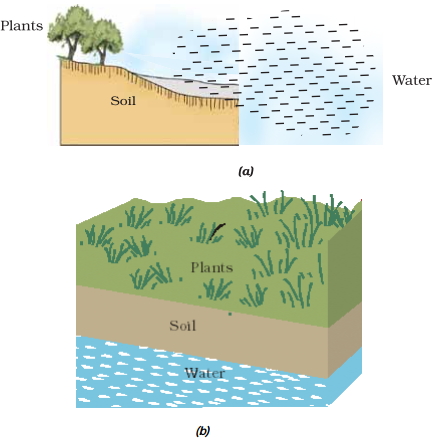
$(a)$ Locate and name the water reservoirs in Figures $(a)$ and $(b)$.
$(b)$ Which has an advantage over the other and why?
$(b)$ Which has an advantage over the other and why?
Solution
(N/A) The water reservoir in Figure $(a)$ is a surface water body (pond/lake),and in Figure $(b)$,it is an underground water body (aquifer).
$(b)$ Figure $(b)$ has an advantage over Figure $(a)$. The advantages of storing water underground are:
$1$. It does not evaporate.
$2$. It spreads out to recharge wells and provides moisture for vegetation over a wide area.
$3$. It is protected from contamination by human and animal wastes.
$4$. It prevents the breeding of insects like mosquitoes.
$(b)$ Figure $(b)$ has an advantage over Figure $(a)$. The advantages of storing water underground are:
$1$. It does not evaporate.
$2$. It spreads out to recharge wells and provides moisture for vegetation over a wide area.
$3$. It is protected from contamination by human and animal wastes.
$4$. It prevents the breeding of insects like mosquitoes.
0 likes
View Solution32
Medium
In the context of the conservation of natural resources,explain the terms reduce,recycle,and reuse. From among the materials that we use in daily life,identify two materials for each category.
Solution
(N/A) $Reduce$ means to use a material or commodity in a lesser quantity,for example,electricity and water.
$Recycle$ means collecting a material that has been used once and sending it back to a manufacturer so that they can make other useful materials from it,for example,plastic bottles and paper.
$Reuse$ means using an item over and over again instead of throwing it away. It does not involve the process of recycling on either a small or large scale,for example,used envelopes and glass jars.
$Recycle$ means collecting a material that has been used once and sending it back to a manufacturer so that they can make other useful materials from it,for example,plastic bottles and paper.
$Reuse$ means using an item over and over again instead of throwing it away. It does not involve the process of recycling on either a small or large scale,for example,used envelopes and glass jars.
0 likes
View Solution33
Medium
Prepare a list of five activities that you perform daily in which natural resources can be conserved or energy utilisation can be minimised.
Solution
(N/A) Here are five daily activities to conserve natural resources and minimize energy usage:
$(a)$ Use leftover water from your water bottle to water indoor plants instead of pouring it away.
$(b)$ Ensure all water taps are tightly closed before going to sleep to prevent water wastage.
$(c)$ Use a bucket and mug for watering plants or cleaning instead of a hose pipe to save water.
$(d)$ Wash vehicles only when necessary and use a bucket of water rather than a running hose.
$(e)$ Switch off fans and lights when leaving a room to minimize electricity consumption.
$(f)$ Utilize solar water heaters to reduce the demand for electricity or gas.
$(g)$ Replace conventional incandescent bulbs with energy-efficient $LED$ or $CFL$ lamps.
$(a)$ Use leftover water from your water bottle to water indoor plants instead of pouring it away.
$(b)$ Ensure all water taps are tightly closed before going to sleep to prevent water wastage.
$(c)$ Use a bucket and mug for watering plants or cleaning instead of a hose pipe to save water.
$(d)$ Wash vehicles only when necessary and use a bucket of water rather than a running hose.
$(e)$ Switch off fans and lights when leaving a room to minimize electricity consumption.
$(f)$ Utilize solar water heaters to reduce the demand for electricity or gas.
$(g)$ Replace conventional incandescent bulbs with energy-efficient $LED$ or $CFL$ lamps.
0 likes
View Solution34
Easy
Is water conservation necessary? Give reasons.
Solution
(N/A) Yes,water conservation is necessary. Although the total amount of fresh water on Earth is theoretically sufficient to meet human needs,it is not readily available for use due to several factors:
$1$. Uneven distribution of water resources across different geographical regions.
$2$. Significant seasonal and annual fluctuations in rainfall patterns,leading to droughts in some areas.
$3$. Excessive wastage,pollution,and mismanagement of water resources.
$4$. Increasing demand due to population growth,industrialization,and agricultural expansion.
Therefore,conservation is essential to ensure a sustainable supply for future generations.
$1$. Uneven distribution of water resources across different geographical regions.
$2$. Significant seasonal and annual fluctuations in rainfall patterns,leading to droughts in some areas.
$3$. Excessive wastage,pollution,and mismanagement of water resources.
$4$. Increasing demand due to population growth,industrialization,and agricultural expansion.
Therefore,conservation is essential to ensure a sustainable supply for future generations.
0 likes
View Solution35
Medium
Suggest a few useful ways of utilizing waste water.
Solution
(N/A) Waste water can be utilized in the following ways:
$(a)$ Recharging the groundwater table to prevent depletion.
$(b)$ Using treated waste water for irrigation in agriculture.
$(c)$ Using treated municipal waste water for non-potable purposes such as washing cars,cleaning roads,and watering gardens.
$(d)$ Utilizing organic pollutants present in sewage water as fertilizers for specific crops after proper treatment.
$(a)$ Recharging the groundwater table to prevent depletion.
$(b)$ Using treated waste water for irrigation in agriculture.
$(c)$ Using treated municipal waste water for non-potable purposes such as washing cars,cleaning roads,and watering gardens.
$(d)$ Utilizing organic pollutants present in sewage water as fertilizers for specific crops after proper treatment.
0 likes
View Solution36
Medium
What is the importance of forest as a resource?
Solution
(N/A) Forests are renewable resources that provide the following benefits:
$(a)$ Habitat,food,and protection to wildlife.
$(b)$ Help in balancing $CO_2$ and $O_2$ levels in the atmosphere.
$(c)$ Improve the water-holding capacity of the soil.
$(d)$ Regulate the water cycle.
$(e)$ For human beings,they are a source of essential commodities like fuel wood,timber,pulp,paper,etc.
$(f)$ They provide useful products such as fruits,resins,gums,essential oils,and bidi wrappers.
$(a)$ Habitat,food,and protection to wildlife.
$(b)$ Help in balancing $CO_2$ and $O_2$ levels in the atmosphere.
$(c)$ Improve the water-holding capacity of the soil.
$(d)$ Regulate the water cycle.
$(e)$ For human beings,they are a source of essential commodities like fuel wood,timber,pulp,paper,etc.
$(f)$ They provide useful products such as fruits,resins,gums,essential oils,and bidi wrappers.
0 likes
View Solution37
Medium
Why are the Arabari forests of Bengal known to be a good example of conserved forest?
Solution
(N/A) The forest department developed a strategy in which the villagers were involved in the protection of the forest. In return for their labour,the villagers were paid and also received benefits from harvesting operations. They were allowed to collect wood and fodder upon payment of a nominal fee. In this way,through the active and willing participation of the local people,the $Sal$ forests of Arabari were successfully conserved.
0 likes
View Solution38
Easy
Where are coliform bacteria found in human beings?
Solution
(N/A) Coliform bacteria are a group of bacteria that are primarily found in the intestines of humans and other warm-blooded animals. Their presence in water is often used as an indicator of fecal contamination.
0 likes
View Solution39
Easy
Name two ancient water harvesting structures in Maharashtra.
Solution
(N/A) The two ancient water harvesting structures in Maharashtra are $Bandharas$ and $Tals$. These are traditional methods used for water conservation and irrigation.
0 likes
View Solution40
EasyMCQ
Give one protective function of forest.
A
Provides timber for construction.
B
Acts as a habitat for biodiversity and maintains ecological balance.
C
Source of medicinal plants.
D
Provides raw materials for industries.
Solution
(B) Forests serve as the natural habitat for a vast array of wildlife species,including both plants and animals,many of which are endemic to these regions. By preserving these ecosystems,forests play a critical role in maintaining the balance of biodiversity and protecting the environment from degradation.
0 likes
View Solution41
Easy
Write two methods of waste disposal.
Solution
(N/A) Ideal methods:
$(i)$ Recycling the wastes.
$(ii)$ Reuse after repairing if required.
$(b)$ Traditional methods:
$(i)$ Throwing them in the dustbin and dumping in sanitary landfills.
$(ii)$ Burning or disposing of them in water bodies or rivers.
$(i)$ Recycling the wastes.
$(ii)$ Reuse after repairing if required.
$(b)$ Traditional methods:
$(i)$ Throwing them in the dustbin and dumping in sanitary landfills.
$(ii)$ Burning or disposing of them in water bodies or rivers.
0 likes
View Solution42
Easy
Mention any two reasons for the failure to sustain underground water.
Solution
(N/A) Loss of vegetation cover,which reduces the rate of water percolation into the soil.
$(b)$ Diversion of water towards high water-demanding crops,leading to over-extraction.
$(c)$ Pumping out excessive water for irrigation and industrial purposes,which exceeds the natural recharge rate.
$(b)$ Diversion of water towards high water-demanding crops,leading to over-extraction.
$(c)$ Pumping out excessive water for irrigation and industrial purposes,which exceeds the natural recharge rate.
0 likes
View Solution43
Easy
Name any two wastes which can be recycled and reused.
Solution
(N/A) Two examples of wastes that can be recycled and reused are:
$1$. Old newspapers (paper waste).
$2$. Plastic items (plastic waste).
Other examples include glass and metal scraps.
$1$. Old newspapers (paper waste).
$2$. Plastic items (plastic waste).
Other examples include glass and metal scraps.
0 likes
View Solution44
Easy
"We need to manage our resources." List two reasons to justify this statement.
Solution
(N/A) Due to the excessive use of natural resources, they are depleting at a faster rate and facing the danger of complete exhaustion.
$(b)$ Excessive use of natural resources has created a problem of environmental pollution and has threatened the life of humans.
$(b)$ Excessive use of natural resources has created a problem of environmental pollution and has threatened the life of humans.
0 likes
View Solution45
Easy
Why do we need alternative sources of energy?
Solution
(N/A) Our energy resources are finite and non-renewable. With the rapid increase in human population and industrialization,the demand for energy is growing at an exponential rate. To ensure long-term sustainability,reduce environmental pollution,and prevent the exhaustion of conventional fossil fuels,we need to shift towards alternative sources of energy.
0 likes
View Solution46
Easy
Why should the management of natural resources ensure the equitable distribution of resources?
Solution
(N/A) The management of natural resources should ensure the equitable distribution of resources so that all individuals,rather than just a handful of wealthy and powerful people,can benefit from the development and utilization of these resources. This approach promotes social justice and prevents the exploitation of resources by a privileged few.
0 likes
View Solution47
Easy
Name the group of bacteria whose presence confirms the contamination of river water.
Solution
(N/A) The group of bacteria whose presence confirms the contamination of river water is known as $Coliform$ bacteria. These bacteria are commonly found in the human intestine and their presence in water indicates contamination by sewage or fecal matter.
0 likes
View Solution48
Easy
Mention the action taken by the Government to save the river Ganga.
Solution
(N/A) The Government of India launched the $GAP$ ($Ganga$ $Action$ $Plan$) in $1985$. The primary objective of this multi-crore project was to improve the water quality of the river Ganga by intercepting,diverting,and treating domestic sewage and preventing toxic and industrial chemical wastes from entering the river.
0 likes
View Solution49
Easy
Write one negative effect of an affluent lifestyle of a few persons on the environment.
Solution
(N/A) An affluent lifestyle often leads to the excessive consumption of natural resources,which results in the generation of large amounts of waste and contributes significantly to environmental pollution.
0 likes
View Solution50
Easy
List two items which can easily be recycled, but we generally throw them in the dustbins.
Solution
(N/A) Two items that can be easily recycled but are commonly thrown in dustbins include:
$1$. $Paper$ (e.g., newspapers, notebooks, cardboard).
$2$. $Plastic$ (e.g., soft drink bottles, polythene bags).
These materials can be processed and reused to manufacture new products, thereby reducing waste and conserving natural resources.
$1$. $Paper$ (e.g., newspapers, notebooks, cardboard).
$2$. $Plastic$ (e.g., soft drink bottles, polythene bags).
These materials can be processed and reused to manufacture new products, thereby reducing waste and conserving natural resources.
0 likes
View SolutionSustainable Management of Natural Resources — Mix Examples - Sustainable Management of Natural Resources · Frequently Asked Questions
1Are these Sustainable Management of Natural Resources questions useful for JEE and NEET?
Yes. All questions in this section are mapped to JEE Main and NEET exam patterns. Previous year questions from JEE Main, NEET, GUJCET and state-level exams are included with full solutions.
2Can I switch to Hindi or Gujarati for these questions?
Yes. Use the language tabs in the hero section or the sidebar to view the same questions and solutions in English, Hindi or Gujarati.
3How do I generate a question paper from this subtopic?
Use the Vedclass Exam Paper Generator — select the chapter and subtopic, set difficulty, and generate Sets A, B, C, D automatically. First 3 chapters of every subject are free.
Vedclass Products
For Students
Vedclass Test Series
Mock tests in real JEE/NEET style with performance analysis. 5-day free trial.
Start Free TrialFor Teachers
Exam Paper Generator
Generate Set A/B/C/D papers from this chapter in 2 minutes. 3 chapters free.
Try FreeFor Institutes
Online Exam Module
Live online exams with unlimited students, 360° analytics & white-label branding.
See DemoFor Teachers & Institutes
Generate a Sustainable Management of Natural Resources Exam Paper in 2 Minutes
Select subtopic & difficulty — Sets A, B, C, D auto-generated with No Repeat logic.
First 3 chapters of every subject are free — no payment required.