
A English
Mix Examples - Sources of Energy Questions in English
Class 10 Science · Sources of Energy · Mix Examples - Sources of Energy
205+
Questions
English
Language
100%
With Solutions
Showing 50 of 205 questions in English
151
Medium
What is biogas? How can biogas be obtained? Why is the use of biogas obtained from cow dung advised in preference to burning cow dung cakes?
Solution
(N/A) Biogas is a mixture of gases,primarily methane,$CO_2$,hydrogen,and hydrogen sulphide,produced by the anaerobic decomposition of organic matter.
Biogas is obtained by the anaerobic decomposition of cow dung (or other organic waste) in a biogas plant,which is a dome-like structure built with bricks.
The use of biogas is preferred over burning cow dung cakes because:
$(i)$ Biogas burns without smoke and does not cause air pollution,whereas burning cow dung cakes releases harmful smoke and pollutants.
$(ii)$ Biogas leaves no residue (ash) after combustion,whereas burning cow dung cakes leaves behind a significant amount of ash as residue.
$(iii)$ Biogas has a higher calorific value and is a more efficient fuel compared to cow dung cakes.
Biogas is obtained by the anaerobic decomposition of cow dung (or other organic waste) in a biogas plant,which is a dome-like structure built with bricks.
The use of biogas is preferred over burning cow dung cakes because:
$(i)$ Biogas burns without smoke and does not cause air pollution,whereas burning cow dung cakes releases harmful smoke and pollutants.
$(ii)$ Biogas leaves no residue (ash) after combustion,whereas burning cow dung cakes leaves behind a significant amount of ash as residue.
$(iii)$ Biogas has a higher calorific value and is a more efficient fuel compared to cow dung cakes.
0 likes
View Solution152
Medium
List some advantages of solar cells.
Solution
(N/A) The principal advantages of solar cells are as follows:
$1$. They have no moving parts,which reduces wear and tear.
$2$. They require very little maintenance.
$3$. They work satisfactorily without the use of any focusing device.
$4$. They can be set up in remote,inaccessible,or sparsely populated areas where laying power transmission lines is expensive and not commercially viable.
$1$. They have no moving parts,which reduces wear and tear.
$2$. They require very little maintenance.
$3$. They work satisfactorily without the use of any focusing device.
$4$. They can be set up in remote,inaccessible,or sparsely populated areas where laying power transmission lines is expensive and not commercially viable.
0 likes
View Solution153
Easy
What are the drawbacks of using nuclear energy?
Solution
(N/A) The major hazard of nuclear power generation is the storage and disposal of spent or used fuel. Improper nuclear waste storage and disposal result in environmental contamination. Further,there is a risk of accidental leakage of nuclear radiation. The high cost of installation of a nuclear power plant,high risk of environmental contamination,and limited availability of uranium make the large-scale use of nuclear energy prohibitive.
0 likes
View Solution154
Medium
$(a)$ Why is the solar cooker box covered with a plane glass plate?
$(b)$ Why is energy of water flowing in a river considered to be an indirect form of solar energy?
$(c)$ How is the fission of ${}^{235}U$ nucleus brought about?
$(b)$ Why is energy of water flowing in a river considered to be an indirect form of solar energy?
$(c)$ How is the fission of ${}^{235}U$ nucleus brought about?
Solution
(N/A) The plane glass plate traps heat inside the box by preventing the escape of infrared radiation,which has a longer wavelength. This phenomenon is known as the greenhouse effect.
$(b)$ Solar energy causes the evaporation of water from oceans and other water bodies to form clouds. These clouds lead to precipitation (rain and snow) in mountainous regions. This water then flows into rivers,making the kinetic energy of river water an indirect form of solar energy.
$(c)$ The fission of ${}^{235}U$ is initiated by bombarding the nucleus with a slow-moving neutron. The ${}^{235}U$ nucleus absorbs this neutron to become ${}^{236}U$,which is highly unstable and immediately undergoes fission into smaller nuclei,releasing energy.
$(b)$ Solar energy causes the evaporation of water from oceans and other water bodies to form clouds. These clouds lead to precipitation (rain and snow) in mountainous regions. This water then flows into rivers,making the kinetic energy of river water an indirect form of solar energy.
$(c)$ The fission of ${}^{235}U$ is initiated by bombarding the nucleus with a slow-moving neutron. The ${}^{235}U$ nucleus absorbs this neutron to become ${}^{236}U$,which is highly unstable and immediately undergoes fission into smaller nuclei,releasing energy.
0 likes
View Solution155
Medium
$(a)$ Classify the two fuels, $CNG$ and hydrogen, as renewable and non-renewable.
$(b)$ Justify the statement, "Hydrogen is a cleaner and better fuel than $CNG$."
$(b)$ Justify the statement, "Hydrogen is a cleaner and better fuel than $CNG$."
Solution
(N/A) $CNG$ is a non-renewable source of energy because it is a fossil fuel that takes millions of years to form and is present in limited quantities.
Hydrogen is a renewable source of energy because it can be produced from water through electrolysis and is virtually inexhaustible.
$(b)$ Hydrogen is considered a cleaner and better fuel than $CNG$ because:
$1$. Hydrogen combustion produces only water $(H_2O)$ as a byproduct, which is environmentally harmless.
$2$. $CNG$ combustion produces carbon dioxide $(CO_2)$, which is a greenhouse gas contributing to global warming, although it produces less pollution than coal or petroleum.
Hydrogen is a renewable source of energy because it can be produced from water through electrolysis and is virtually inexhaustible.
$(b)$ Hydrogen is considered a cleaner and better fuel than $CNG$ because:
$1$. Hydrogen combustion produces only water $(H_2O)$ as a byproduct, which is environmentally harmless.
$2$. $CNG$ combustion produces carbon dioxide $(CO_2)$, which is a greenhouse gas contributing to global warming, although it produces less pollution than coal or petroleum.
0 likes
View Solution156
Medium
$(a)$ How does the construction of dams across rivers get linked with the production of greenhouse gases?
$(b)$ How do technological inputs improve the efficiency of biomass fuels?
$(b)$ How do technological inputs improve the efficiency of biomass fuels?
Solution
(N/A) When dams are constructed,large areas of vegetation are submerged. This submerged vegetation rots under anaerobic conditions,leading to the production of large amounts of methane,which is a potent greenhouse gas.
$(b)$ Technological inputs improve the efficiency of biomass fuels in the following ways:
$(i)$ Conversion of biomass into biogas in a biogas plant,which is a cleaner and more efficient fuel.
$(ii)$ Conversion of wood into charcoal by heating it in a limited supply of air (pyrolysis). Charcoal has a higher calorific value,burns without smoke,and is a more efficient fuel compared to raw wood.
$(b)$ Technological inputs improve the efficiency of biomass fuels in the following ways:
$(i)$ Conversion of biomass into biogas in a biogas plant,which is a cleaner and more efficient fuel.
$(ii)$ Conversion of wood into charcoal by heating it in a limited supply of air (pyrolysis). Charcoal has a higher calorific value,burns without smoke,and is a more efficient fuel compared to raw wood.
0 likes
View Solution157
Medium
Why is the use of biomass to generate heat:
$(i)$ discouraged by burning it directly in ovens (chulhas),and
$(ii)$ encouraged for obtaining biogas through a biogas plant?
$(i)$ discouraged by burning it directly in ovens (chulhas),and
$(ii)$ encouraged for obtaining biogas through a biogas plant?
Solution
(N/A) $(i)$ Burning biomass directly in traditional ovens (chulhas) is discouraged because it is less efficient,produces a lot of smoke,and causes significant air pollution.
$(ii)$ Using biomass to produce biogas is encouraged because it is a highly efficient fuel,burns without smoke,and the spent slurry left behind in the biogas plant serves as an excellent,nutrient-rich manure for crops.
$(ii)$ Using biomass to produce biogas is encouraged because it is a highly efficient fuel,burns without smoke,and the spent slurry left behind in the biogas plant serves as an excellent,nutrient-rich manure for crops.
0 likes
View Solution158
Medium
$A$ group of farmers teamed together to set-up a biogas plant close to their farms. List any six advantages that they would be able to derive from the plant.
Solution
(N/A) $(i)$ Efficient waste disposal from farms.
$(ii)$ Proper management and disposal of animal excreta.
$(iii)$ Production of biogas which can be used as a clean fuel in chulhas for cooking.
$(iv)$ The spent slurry acts as a nutrient-rich manure for the farms.
$(v)$ Biogas can be used for lighting in homes.
$(vi)$ It is an economical and sustainable source of energy.
$(ii)$ Proper management and disposal of animal excreta.
$(iii)$ Production of biogas which can be used as a clean fuel in chulhas for cooking.
$(iv)$ The spent slurry acts as a nutrient-rich manure for the farms.
$(v)$ Biogas can be used for lighting in homes.
$(vi)$ It is an economical and sustainable source of energy.
0 likes
View Solution159
Medium
Increasing demand for fossil fuels has caused harm to our environment. List its three ill-effects. Suggest three measures to reduce the consumption of fossil fuels.
Solution
(N/A) The ill-effects of burning fossil fuels are:
$(i)$ Air pollution,
$(ii)$ Global warming,and
$(iii)$ Acid rain.
The three measures to reduce the consumption of fossil fuels are:
$(i)$ Use of clean fuels like $CNG$,
$(ii)$ Use of public transport to reduce the number of private vehicles,
$(iii)$ Use of renewable energy sources like solar,wind,and hydroelectric power.
$(i)$ Air pollution,
$(ii)$ Global warming,and
$(iii)$ Acid rain.
The three measures to reduce the consumption of fossil fuels are:
$(i)$ Use of clean fuels like $CNG$,
$(ii)$ Use of public transport to reduce the number of private vehicles,
$(iii)$ Use of renewable energy sources like solar,wind,and hydroelectric power.
0 likes
View Solution160
Easy
Explain how electrical energy is generated from nuclear energy.
Solution
(N/A) In a process called nuclear fission,the nucleus of a heavy atom,such as $U^{235}$,is bombarded with low-energy neutrons,causing it to split into lighter nuclei.
During this process,a tremendous amount of energy is released due to the mass defect.
This released heat energy is used to boil water to produce high-pressure steam.
This steam is then used to drive a turbine,which is connected to an electrical generator (dynamo),thereby converting mechanical energy into electrical energy.
During this process,a tremendous amount of energy is released due to the mass defect.
This released heat energy is used to boil water to produce high-pressure steam.
This steam is then used to drive a turbine,which is connected to an electrical generator (dynamo),thereby converting mechanical energy into electrical energy.
0 likes
View Solution161
Medium
Aditya suggests his family to install a solar water heater at their residence. But some of the family members were in favour of installing an electric geyser.
$(a)$ Who,according to you,is taking a correct decision? Mention the value exhibited by Aditya.
$(b)$ Also,give reasons (at least $2$) for your answer.
$(a)$ Who,according to you,is taking a correct decision? Mention the value exhibited by Aditya.
$(b)$ Also,give reasons (at least $2$) for your answer.
Solution
(A) Aditya is taking the correct decision. The value exhibited by Aditya is environmental awareness and a sense of responsibility towards energy conservation.
$(b)$ Reasons for choosing a solar water heater:
$(i)$ $A$ solar water heater uses solar energy,which is a renewable and inexhaustible source of energy.
$(ii)$ It helps in saving electrical energy,which is often generated by burning fossil fuels. By reducing the consumption of electricity,it helps in lowering carbon emissions and mitigating global warming.
$(b)$ Reasons for choosing a solar water heater:
$(i)$ $A$ solar water heater uses solar energy,which is a renewable and inexhaustible source of energy.
$(ii)$ It helps in saving electrical energy,which is often generated by burning fossil fuels. By reducing the consumption of electricity,it helps in lowering carbon emissions and mitigating global warming.
0 likes
View Solution162
Medium
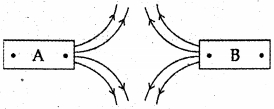
$(a)$ Magnetic field lines of two bar magnets $A$ and $B$ are as shown below. Name the poles of the magnets facing each other.
$(b)$ Two magnetic field lines never intersect each other. Why?
$(c)$ How does the strength of the magnetic field at the centre of a current-carrying circular coil depend on the
$(i)$ radius of the coil,
$(ii)$ number of turns in the coil, and
$(iii)$ strength of the current flowing in the coil?
$(b)$ Two magnetic field lines never intersect each other. Why?
$(c)$ How does the strength of the magnetic field at the centre of a current-carrying circular coil depend on the
$(i)$ radius of the coil,
$(ii)$ number of turns in the coil, and
$(iii)$ strength of the current flowing in the coil?
Solution
(N/A) The magnetic field lines are shown moving away from the poles of both magnets $A$ and $B$. Since magnetic field lines emerge from the North pole, the poles facing each other are both North poles.
$(b)$ Two magnetic field lines never intersect each other because if they did, the point of intersection would have two different directions for the magnetic field at the same time, which is physically impossible.
$(c)$ The strength of the magnetic field at the centre of a current-carrying circular coil depends on the following factors:
$(i)$ Radius of the coil: The magnetic field strength is inversely proportional to the radius of the coil $(B \propto 1/r)$. Thus, a larger radius results in a weaker magnetic field.
$(ii)$ Number of turns in the coil: The magnetic field strength is directly proportional to the number of turns $(B \propto n)$. Increasing the number of turns increases the magnetic field strength.
$(iii)$ Strength of the current: The magnetic field strength is directly proportional to the current flowing through the coil $(B \propto I)$. Increasing the current increases the magnetic field strength.
$(b)$ Two magnetic field lines never intersect each other because if they did, the point of intersection would have two different directions for the magnetic field at the same time, which is physically impossible.
$(c)$ The strength of the magnetic field at the centre of a current-carrying circular coil depends on the following factors:
$(i)$ Radius of the coil: The magnetic field strength is inversely proportional to the radius of the coil $(B \propto 1/r)$. Thus, a larger radius results in a weaker magnetic field.
$(ii)$ Number of turns in the coil: The magnetic field strength is directly proportional to the number of turns $(B \propto n)$. Increasing the number of turns increases the magnetic field strength.
$(iii)$ Strength of the current: The magnetic field strength is directly proportional to the current flowing through the coil $(B \propto I)$. Increasing the current increases the magnetic field strength.
0 likes
View Solution163
Medium
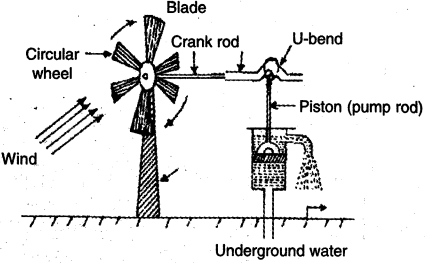
What is a windmill? With the help of a diagram,describe in brief the construction and working of a windmill. Give uses of wind energy.
Solution
(N/A) windmill is a machine that works using the energy of blowing wind. It can be used to run water pumps (to draw water from the ground) and also for grinding grains.
Construction: It consists of a circular wheel to which blades are attached radially to catch the wind. The center of this circular wheel is connected to one end of a crank rod. The $U$-bend of the crank is connected to the pump rod (piston rod).
Working: When the blowing wind strikes the blades of a windmill,the $KE$ (Kinetic Energy) of the wind rotates the blades continuously,which in turn rotates the attached crank. As the crank rotates,its $U$-bend lifts the pump rod up and down continuously. This pump rod operates the pump,which lifts the underground water.
Uses of wind energy:
$(i)$ Wind energy is used to propel sail boats to transport men and materials from one place to another.
$(ii)$ Wind energy is used to run water pumps to draw out underground water.
$(iii)$ Wind energy is used to run flour-mills to grind the grains.
$(iv)$ Wind energy is used to generate electricity.
Construction: It consists of a circular wheel to which blades are attached radially to catch the wind. The center of this circular wheel is connected to one end of a crank rod. The $U$-bend of the crank is connected to the pump rod (piston rod).
Working: When the blowing wind strikes the blades of a windmill,the $KE$ (Kinetic Energy) of the wind rotates the blades continuously,which in turn rotates the attached crank. As the crank rotates,its $U$-bend lifts the pump rod up and down continuously. This pump rod operates the pump,which lifts the underground water.
Uses of wind energy:
$(i)$ Wind energy is used to propel sail boats to transport men and materials from one place to another.
$(ii)$ Wind energy is used to run water pumps to draw out underground water.
$(iii)$ Wind energy is used to run flour-mills to grind the grains.
$(iv)$ Wind energy is used to generate electricity.
0 likes
View Solution164
Medium
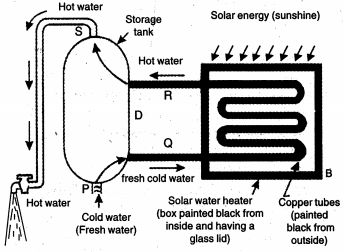
With the help of a labelled diagram,explain the construction and working of a solar water heater.
Solution
(N/A) Construction: $A$ solar water heater consists of an insulated metallic box painted black from both inside and outside. Inside this box,copper tubes,also painted black,are fitted in a zigzag pattern. The black color is used to absorb the maximum radiant heat energy from the sun. The box is covered with a glass sheet lid to trap sunrays by producing a greenhouse effect. The two ends of the copper tubes are connected to a water storage tank as shown in the diagram. The entire setup is placed on the roof of a building to ensure maximum exposure to sunlight.
Working: When sunlight falls on the solar heater,the radiant heat energy enters the metal box through the glass lid and is absorbed by the water flowing through the copper tubes. As the water gets heated,it expands and becomes less dense,causing it to rise and flow into the storage tank through the upper tube $(R)$. Simultaneously,fresh cold water from the bottom of the storage tank flows into the copper tubes through the lower tube $(Q)$ to replace the heated water. This continuous circulation of water between the solar heater box and the insulated storage tank continues as long as there is sunshine. The hot water stored in the tank can then be drawn out for use through the tap attached to the pipe.
Working: When sunlight falls on the solar heater,the radiant heat energy enters the metal box through the glass lid and is absorbed by the water flowing through the copper tubes. As the water gets heated,it expands and becomes less dense,causing it to rise and flow into the storage tank through the upper tube $(R)$. Simultaneously,fresh cold water from the bottom of the storage tank flows into the copper tubes through the lower tube $(Q)$ to replace the heated water. This continuous circulation of water between the solar heater box and the insulated storage tank continues as long as there is sunshine. The hot water stored in the tank can then be drawn out for use through the tap attached to the pipe.
0 likes
View Solution165
Medium
What is hydroelectricity? Explain the basic principle involved in the generation of this energy.
Solution
(N/A) The electricity generated by using the energy of flowing water is called hydroelectricity.
The basic principle of the generation of hydroelectricity is as follows:
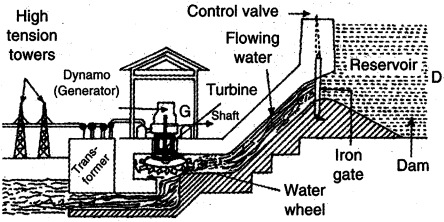
$1$. The water flowing in a river is collected by constructing a high-rise dam $D$ (See Fig.). This water,which has been stored at a high altitude,possesses a significant amount of potential energy.
$2$. The water stored in the high-rise dam is allowed to fall onto a water-turbine $G$ located near the base of the dam.
$3$. When the fast-moving water falls on the blades of the turbine,the kinetic energy of the water rotates the turbine rapidly.
$4$. The shaft of the turbine is connected to the coil of an electricity generator or dynamo. Consequently,when the water-turbine rotates rapidly,the generator coil fixed on its shaft also rotates rapidly,thereby producing electricity.
The basic principle of the generation of hydroelectricity is as follows:
$1$. The water flowing in a river is collected by constructing a high-rise dam $D$ (See Fig.). This water,which has been stored at a high altitude,possesses a significant amount of potential energy.
$2$. The water stored in the high-rise dam is allowed to fall onto a water-turbine $G$ located near the base of the dam.
$3$. When the fast-moving water falls on the blades of the turbine,the kinetic energy of the water rotates the turbine rapidly.
$4$. The shaft of the turbine is connected to the coil of an electricity generator or dynamo. Consequently,when the water-turbine rotates rapidly,the generator coil fixed on its shaft also rotates rapidly,thereby producing electricity.
0 likes
View Solution166
Difficult
Describe the construction and working of a box type solar cooker with the help of a labelled diagram. Give its advantages and limitations.
Solution
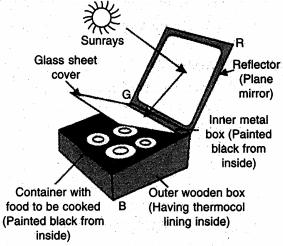
(N/A) solar cooker consists of an insulated metal box $B$ which is painted black from inside. $A$ metal container $C$,painted black from outside,is placed in the solar cooker box. The box and container are painted black because a black surface absorbs more heat rays than any other colour. In order to prevent the loss of absorbed heat in a solar heating device,the black painted metal box is placed inside an insulated (with thermocol or glass wool to prevent heat losses due to conduction,convection and radiation) wooden box $B$ and is covered with a transparent thick glass sheet cover $G$ over the top of the cooker box. $A$ plane mirror reflector $R$ is also attached to the box.
The food material to be cooked is placed in the metal container. The container is covered with a black lid and it is placed in the solar cooker box. The cooker box is then covered with a glass sheet lid. The solar cooker is kept in sunshine and its plane mirror reflector $R$ is adjusted in such a way that a strong beam of sunlight falls over the cooker top. The sunrays pass through the glass sheet cover and get absorbed inside the cooker box. This glass sheet cover does not allow the solar energy to flow out in the form of radiant heat. Thus,it traps more and more heat rays of the Sun thereby producing a greenhouse effect. Within half-an-hour or so the temperature within the solar cooker rises to about $100^{\circ} C$ to $140^{\circ} C$ which is sufficient to cook the food material (like rice or dal) kept inside the cooker container.
Advantages of box type solar cooker:
$(i)$ The cost of cooking food is zero as solar energy comes free of cost.
$(ii)$ It saves other costly fuels and does not cause any environmental pollution.
$(iii)$ It can cook one to four dishes simultaneously.
$(iv)$ It preserves all the nutrients in a food,as food gets cooked in it at a comparatively low temperature.
$(v)$ It has very low installation and maintenance cost.
Limitations (Disadvantages) of box type solar cooker:
$(i)$ It cannot cook food at night or when the sky is cloudy during daytime.
$(ii)$ It takes a long time to cook food.
$(iii)$ The direction of the reflector has to be changed frequently so that it always faces the sun.
$(iv)$ It cannot be used for making chapattis,frying or baking.
$(v)$ Its working is not as effective in winter as it is in the summer.
The food material to be cooked is placed in the metal container. The container is covered with a black lid and it is placed in the solar cooker box. The cooker box is then covered with a glass sheet lid. The solar cooker is kept in sunshine and its plane mirror reflector $R$ is adjusted in such a way that a strong beam of sunlight falls over the cooker top. The sunrays pass through the glass sheet cover and get absorbed inside the cooker box. This glass sheet cover does not allow the solar energy to flow out in the form of radiant heat. Thus,it traps more and more heat rays of the Sun thereby producing a greenhouse effect. Within half-an-hour or so the temperature within the solar cooker rises to about $100^{\circ} C$ to $140^{\circ} C$ which is sufficient to cook the food material (like rice or dal) kept inside the cooker container.
Advantages of box type solar cooker:
$(i)$ The cost of cooking food is zero as solar energy comes free of cost.
$(ii)$ It saves other costly fuels and does not cause any environmental pollution.
$(iii)$ It can cook one to four dishes simultaneously.
$(iv)$ It preserves all the nutrients in a food,as food gets cooked in it at a comparatively low temperature.
$(v)$ It has very low installation and maintenance cost.
Limitations (Disadvantages) of box type solar cooker:
$(i)$ It cannot cook food at night or when the sky is cloudy during daytime.
$(ii)$ It takes a long time to cook food.
$(iii)$ The direction of the reflector has to be changed frequently so that it always faces the sun.
$(iv)$ It cannot be used for making chapattis,frying or baking.
$(v)$ Its working is not as effective in winter as it is in the summer.
0 likes
View Solution167
Difficult
Draw a labelled diagram of a floating gas holder type biogas plant and describe its working. Mention any two advantages of using animal dung for making biogas over using it as a fuel in the form of dried dung cakes.
Solution
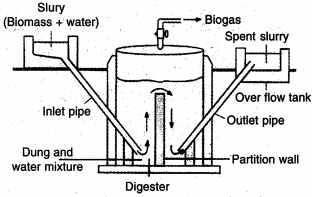
(N/A) Floating gas holder type biogas plant: This type of biogas plant consists of a well-shaped underground tank called a digester tank. The sides of the digester tank are made of bricks and the base is made of concrete. $A$ drum-shaped gas holder made of steel floats in the inverted position over the dung slurry in the digester tank.
The gas collects in the floating gas holder. The gas holder can move up or down,and its movement is controlled by a guide pipe. The biogas comes out from the outlet at the top of the gas holder tank. The digester tank has a partition wall,which divides it into two chambers and also helps in increasing gas pressure. On the left side of the digester tank is an inlet pipe made of cement which is connected to a mixing tank. This inlet pipe brings the fresh dung slurry into the digester tank. On the right side of the digester tank is an outlet pipe made of cement which is connected to an overflow tank. This outlet pipe is for removing the spent dung slurry after the extraction of biogas.
Working: Cattle dung and water are mixed in equal proportions in the mixing tank to prepare the slurry which is fed to the digester tank through an inlet pipe. The slurry is left in the digester tank for $50$ to $60$ days. This dung undergoes anaerobic fermentation and forms biogas which collects in the gas holder. As more and more biogas collects in the gas holder,the pressure of the gas in it increases and it raises the gas holder. Since the gas holder cannot rise up beyond a certain point,the increased gas pressure pushes the spent slurry from the digester tank into the overflow tank. This spent slurry is taken off and used as manure. More fresh slurry is added and thus biogas is produced continuously.
Advantages of using animal dung for making biogas over using it as fuel in the form of dried dung cakes:
$(i)$ Using animal dung in a biogas plant prevents both air and water pollution,whereas burning dung cakes releases smoke and harmful gases.
$(ii)$ The residue left in a biogas plant is excellent manure rich in nitrates and phosphates,which is not obtained when dung is burnt as fuel.
The gas collects in the floating gas holder. The gas holder can move up or down,and its movement is controlled by a guide pipe. The biogas comes out from the outlet at the top of the gas holder tank. The digester tank has a partition wall,which divides it into two chambers and also helps in increasing gas pressure. On the left side of the digester tank is an inlet pipe made of cement which is connected to a mixing tank. This inlet pipe brings the fresh dung slurry into the digester tank. On the right side of the digester tank is an outlet pipe made of cement which is connected to an overflow tank. This outlet pipe is for removing the spent dung slurry after the extraction of biogas.
Working: Cattle dung and water are mixed in equal proportions in the mixing tank to prepare the slurry which is fed to the digester tank through an inlet pipe. The slurry is left in the digester tank for $50$ to $60$ days. This dung undergoes anaerobic fermentation and forms biogas which collects in the gas holder. As more and more biogas collects in the gas holder,the pressure of the gas in it increases and it raises the gas holder. Since the gas holder cannot rise up beyond a certain point,the increased gas pressure pushes the spent slurry from the digester tank into the overflow tank. This spent slurry is taken off and used as manure. More fresh slurry is added and thus biogas is produced continuously.
Advantages of using animal dung for making biogas over using it as fuel in the form of dried dung cakes:
$(i)$ Using animal dung in a biogas plant prevents both air and water pollution,whereas burning dung cakes releases smoke and harmful gases.
$(ii)$ The residue left in a biogas plant is excellent manure rich in nitrates and phosphates,which is not obtained when dung is burnt as fuel.
0 likes
View Solution168
Medium
Why are fossil fuels classified as non-renewable sources of energy? What steps should be taken to conserve these sources?
Solution
(N/A) Fossil fuels are formed from the remains of prehistoric plants and animals buried deep under the earth millions of years ago.
They were covered by sediments like mud and sand in the absence of oxygen.
Under high pressure, high temperature, and the action of anaerobic bacteria, these remains were converted into coal, petroleum, and natural gas over millions of years.
Since these specific conditions are not currently prevailing, no new fossil fuels are being formed.
Therefore, they are classified as non-renewable sources of energy.
Steps to conserve these fuels include:
$1$. Use alternative energy sources such as solar energy, wind energy, tidal energy, geothermal energy, and biomass energy.
$2$. Follow the principle that "Energy saved is energy produced."
$3$. Use energy judiciously by switching off lights and fans when not in use.
$4$. Use energy-consuming appliances like geysers and electric irons carefully.
$5$. Reduce the use of private motor vehicles; instead, use public transport or carpool to save fuel.
They were covered by sediments like mud and sand in the absence of oxygen.
Under high pressure, high temperature, and the action of anaerobic bacteria, these remains were converted into coal, petroleum, and natural gas over millions of years.
Since these specific conditions are not currently prevailing, no new fossil fuels are being formed.
Therefore, they are classified as non-renewable sources of energy.
Steps to conserve these fuels include:
$1$. Use alternative energy sources such as solar energy, wind energy, tidal energy, geothermal energy, and biomass energy.
$2$. Follow the principle that "Energy saved is energy produced."
$3$. Use energy judiciously by switching off lights and fans when not in use.
$4$. Use energy-consuming appliances like geysers and electric irons carefully.
$5$. Reduce the use of private motor vehicles; instead, use public transport or carpool to save fuel.
0 likes
View Solution169
Difficult
What is the basic cause for winds to blow? Name a part of India where wind energy is commercially harnessed. Compare wind power and power of water flow in respect of generating mechanical and electrical energies. What is the hindrance in developing them?
Solution
(N/A) The basic cause for winds to blow is the uneven heating of the Earth's surface by the Sun's energy.
Kanyakumari in Tamil Nadu is a prominent part of India where wind energy is commercially harnessed.
Comparison:
$(i)$ Both wind power and flowing water power are renewable and pollution-free sources of energy.
$(ii)$ Both involve the conversion of kinetic energy into mechanical energy (e.g.,rotating turbines) and subsequently into electrical energy.
$(iii)$ The power of flowing water is generally more consistent and concentrated compared to wind power,making it more efficient for large-scale electricity generation.
Hindrances in development:
$(i)$ Wind energy: It is intermittent and not available everywhere. Wind farms require specific locations with high wind speeds for most of the year.
$(ii)$ Water energy: The construction of large dams causes significant ecological damage,displaces populations,and is limited to specific geographical locations with perennial rivers.
Kanyakumari in Tamil Nadu is a prominent part of India where wind energy is commercially harnessed.
Comparison:
$(i)$ Both wind power and flowing water power are renewable and pollution-free sources of energy.
$(ii)$ Both involve the conversion of kinetic energy into mechanical energy (e.g.,rotating turbines) and subsequently into electrical energy.
$(iii)$ The power of flowing water is generally more consistent and concentrated compared to wind power,making it more efficient for large-scale electricity generation.
Hindrances in development:
$(i)$ Wind energy: It is intermittent and not available everywhere. Wind farms require specific locations with high wind speeds for most of the year.
$(ii)$ Water energy: The construction of large dams causes significant ecological damage,displaces populations,and is limited to specific geographical locations with perennial rivers.
0 likes
View Solution170
Medium
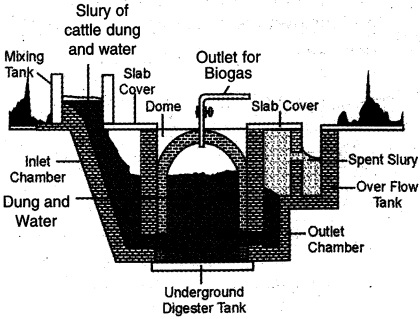
Name the major fuel component of biogas. What are its other combustible components? Draw a simple labelled diagram of a fixed dome type biogas plant. What is the use of the residual slurry and why?
Solution
(N/A) The major fuel component of biogas is Methane $(CH_{4})$.
Other combustible components include Hydrogen $(H_{2})$,Hydrogen Sulphide $(H_{2}S)$,and Carbon Monoxide $(CO)$.
Diagram: (Refer to the provided image of the fixed dome type biogas plant).
The residual slurry (spent slurry) is used as manure because it is rich in nitrogen and phosphorus,which are essential nutrients for plant growth.
Other combustible components include Hydrogen $(H_{2})$,Hydrogen Sulphide $(H_{2}S)$,and Carbon Monoxide $(CO)$.
Diagram: (Refer to the provided image of the fixed dome type biogas plant).
The residual slurry (spent slurry) is used as manure because it is rich in nitrogen and phosphorus,which are essential nutrients for plant growth.
0 likes
View Solution171
Easy
Why is hydrogen considered a cleaner fuel compared to $CNG$?
Solution
(N/A) Hydrogen is considered a cleaner fuel because,upon combustion,it produces only water vapour $(H_2O)$,which is non-polluting and environmentally friendly.
In contrast,$CNG$ (Compressed Natural Gas) is a hydrocarbon fuel that releases carbon dioxide $(CO_2)$ and other trace pollutants when burned.
Although hydrogen is cleaner,its widespread use is currently limited due to its highly explosive nature,as well as significant challenges related to its storage and transportation.
In contrast,$CNG$ (Compressed Natural Gas) is a hydrocarbon fuel that releases carbon dioxide $(CO_2)$ and other trace pollutants when burned.
Although hydrogen is cleaner,its widespread use is currently limited due to its highly explosive nature,as well as significant challenges related to its storage and transportation.
0 likes
View Solution172
Medium
State any two impacts on the environment caused due to the increase in energy demand. Suggest any two steps to reduce energy consumption.
Solution
(N/A) Modernisation and industrialisation have increased the demand for energy. This has resulted in the following:
Consequences:
$(i)$ The increase in the demand for energy has led to excessive exploitation of energy sources,which has disturbed the environmental balance.
$(ii)$ The increase in the demand for energy has led to the excessive use of conventional energy sources,which are limited in nature,causing a partial energy crisis.
Steps to reduce energy consumption:
$(i)$ Judicious use of energy and avoiding the misuse of energy can significantly reduce consumption.
$(ii)$ Alternative sources of energy,such as solar energy,wind energy,hydro energy,and tidal energy,should be used to reduce the burden on non-renewable energy sources.
Consequences:
$(i)$ The increase in the demand for energy has led to excessive exploitation of energy sources,which has disturbed the environmental balance.
$(ii)$ The increase in the demand for energy has led to the excessive use of conventional energy sources,which are limited in nature,causing a partial energy crisis.
Steps to reduce energy consumption:
$(i)$ Judicious use of energy and avoiding the misuse of energy can significantly reduce consumption.
$(ii)$ Alternative sources of energy,such as solar energy,wind energy,hydro energy,and tidal energy,should be used to reduce the burden on non-renewable energy sources.
0 likes
View Solution173
Medium
What do you suggest to overcome the problem of "limitation of sources of energy"? Mention any three suggestions for the effective use of energy.
Solution
(N/A) To overcome the problem of "limitation of sources of energy", we should prefer the use of alternative or non-conventional sources of energy such as solar energy, tidal energy, and wave energy.
$(b)$ Suggestions for the effective use of energy:
$1$. Switch off lights, fans, and other electrical appliances when not in use.
$2$. Use public transport or car-pooling to reduce fuel consumption.
$3$. Use energy-efficient appliances like $LED$ bulbs and $5$-star rated electrical devices.
$(b)$ Suggestions for the effective use of energy:
$1$. Switch off lights, fans, and other electrical appliances when not in use.
$2$. Use public transport or car-pooling to reduce fuel consumption.
$3$. Use energy-efficient appliances like $LED$ bulbs and $5$-star rated electrical devices.
0 likes
View Solution174
Medium
There are about $50$ teachers in a school and most of them come to school by their own cars. Many of the teachers come from the same place but everyone prefers to come to school by his/her own car.
Answer the following questions based on the above information:
$(a)$ Do you think that their practice of commuting to school is environmental-friendly? Give one suggestion. Justify your answer.
$(b)$ In what other two ways can we become environmental-friendly?
Answer the following questions based on the above information:
$(a)$ Do you think that their practice of commuting to school is environmental-friendly? Give one suggestion. Justify your answer.
$(b)$ In what other two ways can we become environmental-friendly?
Solution
(A) No,this practice is not environmental-friendly because it results in the wastage of fossil fuels and contributes to air pollution due to increased carbon emissions.
Suggestion: The teachers should adopt car-pooling or use public transport.
Justification: By sharing a vehicle,the total number of cars on the road decreases,which directly reduces fuel consumption and the amount of pollutants released into the atmosphere.
$(b)$ Two other ways to become environmental-friendly are:
$(i)$ Using public transport instead of private vehicles to reduce traffic and emissions.
$(ii)$ Using fuel-efficient modes of transport or switching to electric vehicles to minimize the carbon footprint.
Suggestion: The teachers should adopt car-pooling or use public transport.
Justification: By sharing a vehicle,the total number of cars on the road decreases,which directly reduces fuel consumption and the amount of pollutants released into the atmosphere.
$(b)$ Two other ways to become environmental-friendly are:
$(i)$ Using public transport instead of private vehicles to reduce traffic and emissions.
$(ii)$ Using fuel-efficient modes of transport or switching to electric vehicles to minimize the carbon footprint.
0 likes
View Solution175
Medium
Ram visited Manikaran Sahib in Himachal Pradesh where he saw an experimental geothermal plant. When he saw a hot spring,he wanted to know more about it. His father explained to him about geothermal energy and hot springs. Now answer the following questions:
$(a)$ What did Ram's father explain to him about hot springs?
$(b)$ Why is geothermal energy not generated on a large scale?
$(c)$ What is the main advantage of using geothermal energy?
$(a)$ What did Ram's father explain to him about hot springs?
$(b)$ Why is geothermal energy not generated on a large scale?
$(c)$ What is the main advantage of using geothermal energy?
Solution
(N/A) Ram's father explained that hot springs are formed when hot underground water finds an outlet at the surface and emerges from the earth.
$(b)$ Geothermal energy is not generated on a large scale because there are very few commercially viable sites where geothermal energy can be effectively exploited.
$(c)$ The main advantage of using geothermal energy is that it is a non-conventional,renewable source of energy that can be harnessed continuously for $24$ hours throughout the year.
$(b)$ Geothermal energy is not generated on a large scale because there are very few commercially viable sites where geothermal energy can be effectively exploited.
$(c)$ The main advantage of using geothermal energy is that it is a non-conventional,renewable source of energy that can be harnessed continuously for $24$ hours throughout the year.
0 likes
View Solution176
Medium
Vinod is a member of the school Eco-club. He knows about a school that is a zero-garbage zone. He expressed his willingness to his teachers to implement the same in his school. He decided to place different coloured dustbins for segregating biodegradable and non-biodegradable garbage as the first step. Now answer the following questions.
$(a)$ Why does Vinod want to segregate biodegradable and non-biodegradable waste?
$(b)$ What can Vinod do with the biodegradable waste?
$(a)$ Why does Vinod want to segregate biodegradable and non-biodegradable waste?
$(b)$ What can Vinod do with the biodegradable waste?
Solution
(N/A) Different disposal strategies are required to manage biodegradable and non-biodegradable wastes effectively. Segregation ensures that biodegradable waste can be processed naturally,while non-biodegradable waste can be recycled or disposed of safely.
$(b)$ Biodegradable waste can be processed in a biogas plant to produce energy or can be used to produce manure and compost through the process of composting.
$(b)$ Biodegradable waste can be processed in a biogas plant to produce energy or can be used to produce manure and compost through the process of composting.
0 likes
View Solution177
Medium
Ranvir lives in a village and uses wood as a fuel. He studied in his school that charcoal is a better fuel than wood. He decided to use charcoal instead of wood.
$(a)$ How can Ranvir obtain charcoal from wood?
$(b)$ Why is charcoal considered a better fuel than wood? (Give two reasons)
$(a)$ How can Ranvir obtain charcoal from wood?
$(b)$ Why is charcoal considered a better fuel than wood? (Give two reasons)
Solution
(N/A) Charcoal is obtained by burning wood in a limited supply of oxygen (a process known as destructive distillation).
$(b)$ Charcoal is considered a better fuel than wood because:
$(i)$ It burns without producing a flame.
$(ii)$ It produces very little or no smoke compared to wood.
$(iii)$ It has a higher calorific value (heat-generating efficiency) than wood.
$(b)$ Charcoal is considered a better fuel than wood because:
$(i)$ It burns without producing a flame.
$(ii)$ It produces very little or no smoke compared to wood.
$(iii)$ It has a higher calorific value (heat-generating efficiency) than wood.
0 likes
View Solution178
Medium
$A$ student constructed a box-type solar cooker. He found that it is not working efficiently. What could this be due to? Give any four possible mistakes in the construction and operation of the solar cooker. What maximum temperature can ordinarily be reached inside a solar cooker?
Solution
(N/A) The reasons for the inefficient working of the solar cooker could be as follows:
$(i)$ The inner surface of the box might not have been painted black to absorb maximum solar radiation.
$(ii)$ The box might not have been properly insulated,leading to heat loss.
$(iii)$ The reflector might not be positioned at the correct angle to direct sunlight into the box.
$(iv)$ The glass cover might be too thin or not airtight,allowing heat to escape.
Ordinarily,the maximum temperature that can be reached inside a box-type solar cooker ranges between $100^{\circ}C$ and $140^{\circ}C$.
$(i)$ The inner surface of the box might not have been painted black to absorb maximum solar radiation.
$(ii)$ The box might not have been properly insulated,leading to heat loss.
$(iii)$ The reflector might not be positioned at the correct angle to direct sunlight into the box.
$(iv)$ The glass cover might be too thin or not airtight,allowing heat to escape.
Ordinarily,the maximum temperature that can be reached inside a box-type solar cooker ranges between $100^{\circ}C$ and $140^{\circ}C$.
0 likes
View Solution179
Medium
Hydroelectricity generated at a dam may be considered to be another form of solar energy. Why?
Solution
(N/A) The heat energy from solar radiation causes the evaporation of surface water.
These vapours,after condensation,return to the Earth as rain or snowfall,which eventually forms running water in rivers.
Additionally,solar heat radiation causes the melting of ice on mountains,which also contributes to the flow of water.
The kinetic energy of this flowing water is harnessed to rotate turbines for generating electricity.
Therefore,hydroelectricity is considered an indirect form of solar energy.
These vapours,after condensation,return to the Earth as rain or snowfall,which eventually forms running water in rivers.
Additionally,solar heat radiation causes the melting of ice on mountains,which also contributes to the flow of water.
The kinetic energy of this flowing water is harnessed to rotate turbines for generating electricity.
Therefore,hydroelectricity is considered an indirect form of solar energy.
0 likes
View Solution180
Medium
Why are biogas plants considered to be a boon to farmers? Give reasons.
Solution
(N/A) Biogas plants are considered to be a boon to farmers for the following reasons:
$(i)$ Farmers obtain a clean fuel that produces no smoke or harmful emissions compared to traditional dried dung cakes.
$(ii)$ The spent slurry,which is the residue left after biogas extraction,serves as an excellent source of organic manure. This manure is produced quickly and can be applied directly to fields,unlike traditional composting methods.
$(iii)$ Biogas plants decompose various organic waste materials that would otherwise cause pollution. This process effectively helps in managing waste and controlling environmental pollution.
$(i)$ Farmers obtain a clean fuel that produces no smoke or harmful emissions compared to traditional dried dung cakes.
$(ii)$ The spent slurry,which is the residue left after biogas extraction,serves as an excellent source of organic manure. This manure is produced quickly and can be applied directly to fields,unlike traditional composting methods.
$(iii)$ Biogas plants decompose various organic waste materials that would otherwise cause pollution. This process effectively helps in managing waste and controlling environmental pollution.
0 likes
View Solution181
Medium
The waste materials collected from a market complex are scrap paper,thermocol,vegetable waste,tin cans,and glass bottles. Which of these can be used for producing biogas? Mention three advantages of converting these into biogas rather than burning them.
Solution
(N/A) Scrap paper and vegetable waste can be used to produce biogas through anaerobic decomposition.
Converting these into biogas has the following advantages:
$(i)$ It produces a clean,cheap,and valuable fuel that serves as a sustainable energy source.
$(ii)$ It effectively manages waste by utilizing substances that would otherwise require significant space for landfilling or dumping.
$(iii)$ If this organic waste is left to decompose naturally in open dumps,it releases harmful greenhouse gases like methane and carbon dioxide,contributing to environmental pollution. Converting it into biogas prevents these emissions.
Converting these into biogas has the following advantages:
$(i)$ It produces a clean,cheap,and valuable fuel that serves as a sustainable energy source.
$(ii)$ It effectively manages waste by utilizing substances that would otherwise require significant space for landfilling or dumping.
$(iii)$ If this organic waste is left to decompose naturally in open dumps,it releases harmful greenhouse gases like methane and carbon dioxide,contributing to environmental pollution. Converting it into biogas prevents these emissions.
0 likes
View Solution182
Medium
"$A$ biogas plant solves the fuel as well as environmental problems". Discuss.
Solution
(N/A) Biogas is considered an ideal fuel for the following reasons:
$(i)$ It has a high calorific value, providing efficient energy.
$(ii)$ It burns without producing smoke, ensuring clean combustion.
$(iii)$ It has a moderate ignition temperature, making it safe to handle.
$(iv)$ It does not produce harmful residues or toxic gases upon combustion.
$(v)$ It is cost-effective and easily accessible, especially in rural areas.
Due to these characteristics:
$(i)$ Biogas acts as an excellent fuel source, thereby addressing the fuel crisis.
$(ii)$ Since it does not cause air pollution, it helps solve environmental problems.
$(iii)$ The use of animal waste and organic matter in biogas plants prevents water pollution and promotes waste management.
$(i)$ It has a high calorific value, providing efficient energy.
$(ii)$ It burns without producing smoke, ensuring clean combustion.
$(iii)$ It has a moderate ignition temperature, making it safe to handle.
$(iv)$ It does not produce harmful residues or toxic gases upon combustion.
$(v)$ It is cost-effective and easily accessible, especially in rural areas.
Due to these characteristics:
$(i)$ Biogas acts as an excellent fuel source, thereby addressing the fuel crisis.
$(ii)$ Since it does not cause air pollution, it helps solve environmental problems.
$(iii)$ The use of animal waste and organic matter in biogas plants prevents water pollution and promotes waste management.
0 likes
View Solution183
EasyMCQ
Which of the following is not a non-renewable source of energy?
A
Coal
B
Petroleum
C
Wood
D
Natural gas
Solution
(C) non-renewable source of energy is a natural resource that cannot be readily replaced by natural means at a pace quick enough to keep up with consumption. Examples include fossil fuels like coal,petroleum,and natural gas.
Wood is considered a renewable source of energy because it can be replenished by planting new trees within a relatively short period of time compared to the geological timescales required for fossil fuel formation.
Therefore,wood is not a non-renewable source of energy.
Wood is considered a renewable source of energy because it can be replenished by planting new trees within a relatively short period of time compared to the geological timescales required for fossil fuel formation.
Therefore,wood is not a non-renewable source of energy.
0 likes
View Solution184
EasyMCQ
The fraction of the sun's energy received on the earth is about: (in $\%$)
A
$57$
B
$12$
C
$38$
D
$47$
Solution
(D) The Earth receives only a very small fraction of the total energy radiated by the Sun.
According to scientific estimates,the Earth intercepts approximately $47 \%$ of the solar energy that reaches the outer atmosphere,while the rest is either reflected back into space by clouds and dust or absorbed by the atmosphere.
Therefore,the correct fraction is approximately $47 \%$.
According to scientific estimates,the Earth intercepts approximately $47 \%$ of the solar energy that reaches the outer atmosphere,while the rest is either reflected back into space by clouds and dust or absorbed by the atmosphere.
Therefore,the correct fraction is approximately $47 \%$.
0 likes
View Solution185
EasyMCQ
Which of the following sources of energy is different from the other?
A
Plants
B
Coal
C
Petroleum
D
Lignite
Solution
(A) The correct answer is $A$.
$Coal$, $Petroleum$, and $Lignite$ are all examples of fossil fuels, which are non-renewable sources of energy formed from the remains of ancient organisms over millions of years.
$Plants$ are a renewable source of energy (biomass) and are living organisms, making them fundamentally different from the fossilized fuels listed in the other options.
$Coal$, $Petroleum$, and $Lignite$ are all examples of fossil fuels, which are non-renewable sources of energy formed from the remains of ancient organisms over millions of years.
$Plants$ are a renewable source of energy (biomass) and are living organisms, making them fundamentally different from the fossilized fuels listed in the other options.
0 likes
View Solution186
EasyMCQ
Which of the following sources of energy is different from the other?
A
Coke
B
Gobar gas
C
Bitumen
D
Anthracite
Solution
(B) The correct answer is $B$ (Gobar gas).
$1$. Coke,Bitumen,and Anthracite are all fossil fuel-based products or forms of coal.
$2$. Coke is a carbon-rich residue derived from coal.
$3$. Bitumen is a sticky,black,and highly viscous liquid or semi-solid form of petroleum.
$4$. Anthracite is a hard,compact variety of coal.
$5$. Gobar gas (biogas) is a renewable source of energy produced by the anaerobic decomposition of organic matter,whereas the others are non-renewable fossil fuel derivatives.
$1$. Coke,Bitumen,and Anthracite are all fossil fuel-based products or forms of coal.
$2$. Coke is a carbon-rich residue derived from coal.
$3$. Bitumen is a sticky,black,and highly viscous liquid or semi-solid form of petroleum.
$4$. Anthracite is a hard,compact variety of coal.
$5$. Gobar gas (biogas) is a renewable source of energy produced by the anaerobic decomposition of organic matter,whereas the others are non-renewable fossil fuel derivatives.
0 likes
View Solution187
EasyMCQ
Choose the only renewable source of energy from the following:
A
Coal
B
Uranium
C
Geothermal power
D
Natural gas
Solution
(C) Renewable sources of energy are those that are naturally replenished on a human timescale,such as sunlight,wind,and geothermal heat.
$A$. Coal is a fossil fuel and is non-renewable.
$B$. Uranium is a finite mineral resource used in nuclear energy and is non-renewable.
$C$. Geothermal power is derived from the internal heat of the Earth,which is continuously generated and thus considered a renewable source.
$D$. Natural gas is a fossil fuel and is non-renewable.
Therefore,the correct option is $C$.
$A$. Coal is a fossil fuel and is non-renewable.
$B$. Uranium is a finite mineral resource used in nuclear energy and is non-renewable.
$C$. Geothermal power is derived from the internal heat of the Earth,which is continuously generated and thus considered a renewable source.
$D$. Natural gas is a fossil fuel and is non-renewable.
Therefore,the correct option is $C$.
0 likes
View Solution188
EasyMCQ
The longest and the shortest wavelengths (in $\mu m$) for red and violet light are respectively:
A
$0.7, 0.4$
B
$0.4, 0.7$
C
$0.3, 0.6$
D
$0.7, 0.9$
Solution
(A) The visible spectrum of light ranges from approximately $0.4 \,\mu m$ to $0.7 \,\mu m$.
Violet light has the shortest wavelength, which is approximately $0.4 \,\mu m$.
Red light has the longest wavelength, which is approximately $0.7 \,\mu m$.
Therefore, the longest wavelength (red) is $0.7 \,\mu m$ and the shortest wavelength (violet) is $0.4 \,\mu m$.
Violet light has the shortest wavelength, which is approximately $0.4 \,\mu m$.
Red light has the longest wavelength, which is approximately $0.7 \,\mu m$.
Therefore, the longest wavelength (red) is $0.7 \,\mu m$ and the shortest wavelength (violet) is $0.4 \,\mu m$.
0 likes
View Solution189
EasyMCQ
The nuclear fuel in the sun is:
A
Hydrogen
B
Uranium
C
Helium
D
Radium
Solution
(A) The sun generates energy through the process of nuclear fusion.
In this process,light atomic nuclei,primarily $Hydrogen$ isotopes,fuse together to form heavier nuclei,such as $Helium$.
$Hydrogen$ acts as the primary nuclear fuel for the sun,providing the necessary mass to sustain the fusion reaction that releases immense amounts of energy.
In this process,light atomic nuclei,primarily $Hydrogen$ isotopes,fuse together to form heavier nuclei,such as $Helium$.
$Hydrogen$ acts as the primary nuclear fuel for the sun,providing the necessary mass to sustain the fusion reaction that releases immense amounts of energy.
0 likes
View Solution190
EasyMCQ
Minimum velocity of wind required for a functional windmill is about:
A
$15 \, m s^{-1}$
B
$15 \, km h^{-1}$
C
$30 \, m s^{-1}$
D
Any velocity will do
Solution
(B) functional windmill requires a minimum wind speed to overcome the inertia of the blades and generate useful mechanical or electrical energy.
According to standard scientific data and textbooks,the minimum wind velocity required for a functional windmill is approximately $15 \, km h^{-1}$.
Wind speeds below this threshold are generally insufficient to rotate the turbine blades effectively for power generation.
According to standard scientific data and textbooks,the minimum wind velocity required for a functional windmill is approximately $15 \, km h^{-1}$.
Wind speeds below this threshold are generally insufficient to rotate the turbine blades effectively for power generation.
0 likes
View Solution191
EasyMCQ
The temperature difference required up to a water level difference of $1000 \,m$ for operating an Ocean Thermal Energy Conversion $(OTEC)$ system is: (in $^{\circ} C$)
A
$25$
B
$15$
C
$20$
D
$10$
Solution
(C) Ocean Thermal Energy Conversion $(OTEC)$ systems utilize the temperature difference between the warm surface water of the ocean and the cold deep-sea water.
For the efficient operation of an $OTEC$ power plant,a temperature difference of at least $20^{\circ} C$ between the surface water and the water at depths up to $1000 \,m$ is required.
This temperature gradient allows the system to drive a heat engine to produce electricity.
For the efficient operation of an $OTEC$ power plant,a temperature difference of at least $20^{\circ} C$ between the surface water and the water at depths up to $1000 \,m$ is required.
This temperature gradient allows the system to drive a heat engine to produce electricity.
0 likes
View Solution192
MediumMCQ
The energy liberated by burning $1 \, g$ of wood is approximately: (in $, kJ/g$)
A
$33$
B
$15$
C
$20$
D
$17$
Solution
(D) The calorific value of a fuel is the amount of heat energy produced on complete combustion of $1 \, kg$ (or $1 \, g$) of a fuel.
For wood,the calorific value ranges from approximately $17 \, kJ/g$ to $22 \, kJ/g$.
Among the given options,$17 \, kJ/g$ is the standard value typically cited in textbooks for wood.
For wood,the calorific value ranges from approximately $17 \, kJ/g$ to $22 \, kJ/g$.
Among the given options,$17 \, kJ/g$ is the standard value typically cited in textbooks for wood.
0 likes
View Solution193
EasyMCQ
Which of the following is not obtained on the destructive distillation of wood?
A
Coal
B
Wood gas
C
Acetic acid
D
Tar
Solution
(A) Destructive distillation of wood is a process where wood is heated in the absence of air.
This process yields several products,including wood gas,pyroligneous acid (which contains acetic acid),wood tar,and charcoal.
Coal is a fossil fuel formed from the remains of plants buried deep underground over millions of years under high pressure and temperature.
Therefore,coal is not a product of the destructive distillation of wood.
This process yields several products,including wood gas,pyroligneous acid (which contains acetic acid),wood tar,and charcoal.
Coal is a fossil fuel formed from the remains of plants buried deep underground over millions of years under high pressure and temperature.
Therefore,coal is not a product of the destructive distillation of wood.
0 likes
View Solution194
EasyMCQ
The energy liberated by burning $1 \,g$ of charcoal is approximately: (in $,kJ$)
A
$17$
B
$33$
C
$20$
D
$15$
Solution
(B) Charcoal is a form of carbon. The combustion of carbon releases energy in the form of heat.
The calorific value of charcoal is approximately $33 \,kJ/g$.
Therefore,burning $1 \,g$ of charcoal liberates about $33 \,kJ$ of energy.
The calorific value of charcoal is approximately $33 \,kJ/g$.
Therefore,burning $1 \,g$ of charcoal liberates about $33 \,kJ$ of energy.
0 likes
View Solution195
EasyMCQ
Amount of charcoal produced on the destructive distillation of $1 \, kg$ of wood is about: (in $, kg$)
A
$0.50$
B
$0.75$
C
$0.25$
D
$1$
Solution
(C) Destructive distillation is the process of heating wood in the absence of air to produce charcoal,wood gas,and wood tar.
When $1 \, kg$ of wood undergoes destructive distillation,the yield of charcoal is approximately $25\%$ of the original mass of the wood.
Therefore,the amount of charcoal produced is $0.25 \, kg$.
When $1 \, kg$ of wood undergoes destructive distillation,the yield of charcoal is approximately $25\%$ of the original mass of the wood.
Therefore,the amount of charcoal produced is $0.25 \, kg$.
0 likes
View Solution196
EasyMCQ
Which of the following is not a fossil fuel?
A
Coal
B
Petroleum
C
Wood
D
Biogas
Solution
(C) Fossil fuels are natural fuels formed from the remains of living organisms buried under the Earth's surface over millions of years. Examples include $Coal$, $Petroleum$, and $Natural \ gas$.
$Wood$ is a biomass fuel obtained from trees and is not formed through the fossilization process.
$Biogas$ is a mixture of gases produced by the breakdown of organic matter in the absence of oxygen, which is also not a fossil fuel.
However, in the context of standard multiple-choice questions regarding non-fossil fuels, $Wood$ and $Biogas$ are both correct. Given the options, $Wood$ is the most traditional example of a non-fossil fuel (biomass) often contrasted with fossil fuels in textbooks.
$Wood$ is a biomass fuel obtained from trees and is not formed through the fossilization process.
$Biogas$ is a mixture of gases produced by the breakdown of organic matter in the absence of oxygen, which is also not a fossil fuel.
However, in the context of standard multiple-choice questions regarding non-fossil fuels, $Wood$ and $Biogas$ are both correct. Given the options, $Wood$ is the most traditional example of a non-fossil fuel (biomass) often contrasted with fossil fuels in textbooks.
0 likes
View Solution197
EasyMCQ
The average amount of energy released during the fission of a uranium atom is: (in $,MeV$)
A
$200$
B
$150$
C
$20$
D
$100$
Solution
(A) Nuclear fission is a process in which the nucleus of a heavy atom,such as uranium,is split into two or more smaller nuclei when bombarded with neutrons.
During the fission of a single uranium-$235$ $(^{235}U)$ atom,a significant amount of energy is released due to the mass defect between the reactants and the products.
This energy is approximately $200\,MeV$ (mega-electron volts) per fission event.
Therefore,the correct option is $A$.
During the fission of a single uranium-$235$ $(^{235}U)$ atom,a significant amount of energy is released due to the mass defect between the reactants and the products.
This energy is approximately $200\,MeV$ (mega-electron volts) per fission event.
Therefore,the correct option is $A$.
0 likes
View Solution198
Easy
State whether the following statement is true or false:
Solar energy has the greatest potential of all the renewable sources of energy.
Solar energy has the greatest potential of all the renewable sources of energy.
Solution
(TRUE) The statement is True.
Solar energy is considered to have the greatest potential among all renewable energy sources because the amount of solar energy reaching the Earth's surface in a single hour is more than the entire world's energy consumption for a whole year. It is abundant,inexhaustible,and widely available across the globe.
Solar energy is considered to have the greatest potential among all renewable energy sources because the amount of solar energy reaching the Earth's surface in a single hour is more than the entire world's energy consumption for a whole year. It is abundant,inexhaustible,and widely available across the globe.
0 likes
View Solution199
Easy
State whether the following statement is true or false:
Reflectors are used in solar heating devices to concentrate the sun's heat.
Reflectors are used in solar heating devices to concentrate the sun's heat.
Solution
(TRUE) True.
Solar heating devices,such as solar cookers and solar water heaters,often utilize concave mirrors or polished surfaces as reflectors. These reflectors concentrate the incoming solar radiation onto a specific point or area,thereby increasing the intensity of heat and improving the efficiency of the device.
Solar heating devices,such as solar cookers and solar water heaters,often utilize concave mirrors or polished surfaces as reflectors. These reflectors concentrate the incoming solar radiation onto a specific point or area,thereby increasing the intensity of heat and improving the efficiency of the device.
0 likes
View Solution200
Easy
State whether the following statement is true or false:
Black surfaces are poor absorbers of heat.
Black surfaces are poor absorbers of heat.
Solution
(FALSE) The statement is False.
Black surfaces are actually excellent absorbers of heat because they absorb most of the radiation that falls on them,rather than reflecting it. This is why dark-colored objects heat up faster than light-colored ones when exposed to sunlight.
Black surfaces are actually excellent absorbers of heat because they absorb most of the radiation that falls on them,rather than reflecting it. This is why dark-colored objects heat up faster than light-colored ones when exposed to sunlight.
0 likes
View SolutionSources of Energy — Mix Examples - Sources of Energy · Frequently Asked Questions
1Are these Sources of Energy questions useful for JEE and NEET?
Yes. All questions in this section are mapped to JEE Main and NEET exam patterns. Previous year questions from JEE Main, NEET, GUJCET and state-level exams are included with full solutions.
2Can I switch to Hindi or Gujarati for these questions?
Yes. Use the language tabs in the hero section or the sidebar to view the same questions and solutions in English, Hindi or Gujarati.
3How do I generate a question paper from this subtopic?
Use the Vedclass Exam Paper Generator — select the chapter and subtopic, set difficulty, and generate Sets A, B, C, D automatically. First 3 chapters of every subject are free.
Vedclass Products
For Students
Vedclass Test Series
Mock tests in real JEE/NEET style with performance analysis. 5-day free trial.
Start Free TrialFor Teachers
Exam Paper Generator
Generate Set A/B/C/D papers from this chapter in 2 minutes. 3 chapters free.
Try FreeFor Institutes
Online Exam Module
Live online exams with unlimited students, 360° analytics & white-label branding.
See DemoFor Teachers & Institutes
Generate a Sources of Energy Exam Paper in 2 Minutes
Select subtopic & difficulty — Sets A, B, C, D auto-generated with No Repeat logic.
First 3 chapters of every subject are free — no payment required.