
Which one of the following graphs correctly represents the variation of the gravitational field $(I)$ with the distance $(r)$ from the centre of a spherical shell of mass $M$ and radius $a$?
- A
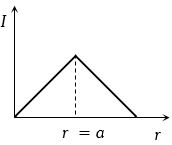
- B
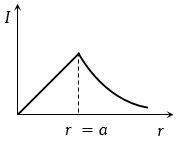
- C
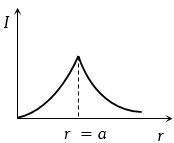
- D
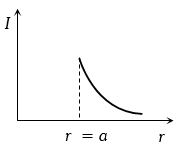
Explore More
Similar Questions
The mass density inside a solid sphere of radius $R$ varies as $\rho(r)=\rho_0\left(\frac{r}{R}\right)^\beta$,where $\rho_0$ and $\beta$ are constants and $r$ is the distance from the centre. Let $E_1$ and $E_2$ be gravitational fields due to the sphere at distances $\frac{R}{2}$ and $2R$ from the centre of the sphere,respectively. If $\frac{E_2}{E_1}=4$,the value of $\beta$ is
DifficultTS EAMCET 2018
View SolutionTwo point masses having mass $m$ and $2m$ are placed at a distance $d$. The point on the line joining the point masses,where the gravitational field intensity is zero,will be at a distance ............
Medium
View SolutionIf the gravitational potential is given by $V = (3x + 4y + 12z) \ J/kg$,then the gravitational intensity at the point $(x = 1, y = 0, z = 3)$ is ....... $N \ kg^{-1}$.
Medium
View Solution$A$ solid sphere of mass $M$ and radius $a$ is surrounded by a uniform concentric spherical shell of thickness $2a$ and mass $2M$. The gravitational field at distance $3a$ from the centre will be
If the distance between the centres of Earth and Moon is $D$ and the mass of Earth is $81$ times that of the Moon,at what distance from the centre of Earth will the gravitational field be zero?
Difficult
View SolutionVedclass Products
For Students
Vedclass Test Series
Mock tests in real JEE/NEET style with performance analysis. 5-day free trial.
Start Free TrialFor Teachers
Exam Paper Generator
Generate Set A/B/C/D exam papers from 7.5L+ questions in 2 minutes. 3 chapters free.
Try FreeFor Institutes
Online Exam Module
Live online exams with unlimited students, 360° analytics & white-label branding.
See Demo