
Medium
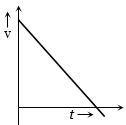
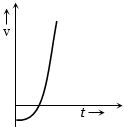
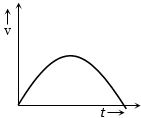
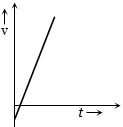
The graph of displacement $s$ versus time $t$ is given below. Its corresponding velocity-time graph will be:
- A
- B
- C
- D
Explore More
Similar Questions
The velocity-time graph of a particle in one-dimensional motion is shown in the figure. Which of the following formulae are correct for describing the motion of the particle over the time-interval $t_1$ to $t_2$?
$(a)$ $x(t_2) = x(t_1) + v(t_1)(t_2 - t_1) + (1/2)a(t_2 - t_1)^2$
$(b)$ $v(t_2) = v(t_1) + a(t_2 - t_1)$
$(c)$ $v_{\text{average}} = (x(t_2) - x(t_1)) / (t_2 - t_1)$
$(d)$ $a_{\text{average}} = (v(t_2) - v(t_1)) / (t_2 - t_1)$
$(e)$ $x(t_2) = x(t_1) + v_{\text{average}}(t_2 - t_1) + (1/2)a_{\text{average}}(t_2 - t_1)^2$
$(f)$ $x(t_2) - x(t_1) = \text{area under the } v-t \text{ curve bounded by the } t\text{-axis and the dotted lines shown.}$
$(a)$ $x(t_2) = x(t_1) + v(t_1)(t_2 - t_1) + (1/2)a(t_2 - t_1)^2$
$(b)$ $v(t_2) = v(t_1) + a(t_2 - t_1)$
$(c)$ $v_{\text{average}} = (x(t_2) - x(t_1)) / (t_2 - t_1)$
$(d)$ $a_{\text{average}} = (v(t_2) - v(t_1)) / (t_2 - t_1)$
$(e)$ $x(t_2) = x(t_1) + v_{\text{average}}(t_2 - t_1) + (1/2)a_{\text{average}}(t_2 - t_1)^2$
$(f)$ $x(t_2) - x(t_1) = \text{area under the } v-t \text{ curve bounded by the } t\text{-axis and the dotted lines shown.}$
Medium
View SolutionThe displacement $x$ of a particle varies with time $t$ as $x = a e^{-\alpha t} + b e^{\beta t}$,where $a, b, \alpha, \text{and } \beta$ are positive constants. The velocity of the particle will:
DifficultAIPMT 2005
View SolutionThe relation between velocity $v$ and displacement $x$ is $v = x^2$. Find the acceleration at $x = 3 \ m$.
Medium
View SolutionIn the following velocity-time graph,the distance travelled by the body in metres is ............. $m$.
Easy
View SolutionExplain instantaneous velocity.
Easy
View SolutionVedclass Products
For Students
Vedclass Test Series
Mock tests in real JEE/NEET style with performance analysis. 5-day free trial.
Start Free TrialFor Teachers
Exam Paper Generator
Generate Set A/B/C/D exam papers from 7.5L+ questions in 2 minutes. 3 chapters free.
Try FreeFor Institutes
Online Exam Module
Live online exams with unlimited students, 360° analytics & white-label branding.
See Demo