
Class 11PhysicsNewton's Laws of Motion and FrictionMix Examples-Newton's Laws of Motion and Friction
MediumIn which of the following graphs,the total change in momentum is zero?
- A
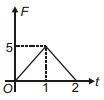
- B
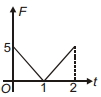
- C
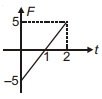
- D
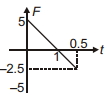
Explore More
Similar Questions
Masses of $10\, kg$ and $20\, kg$ are connected by a massless spring as shown in the figure. $A$ force of $200\, N$ acts on the $20\, kg$ mass. At the instant shown,the $10\, kg$ mass has an acceleration of $12\, m/s^2$. What is the acceleration of the $20\, kg$ mass in $m/s^2$?
Medium
View Solution$A$ ball is dropped on the floor from a height of $20 \ m$. It rebounds to a height of $5 \ m$. The ball remains in contact with the floor for $1 \ s$. The average acceleration during contact is (acceleration due to gravity $g = 10 \ m/s^2$): (in $m/s^2$)
Match Column-$I$ with Column-$II$ correctly.
Column-$I$ Column-$II$ $(1)$ Static friction $(a)$ Limiting friction $(2)$ Rolling friction $(b)$ Ball bearing $(c)$ Object moving on a road
| Column-$I$ | Column-$II$ |
|---|---|
| $(1)$ Static friction | $(a)$ Limiting friction |
| $(2)$ Rolling friction | $(b)$ Ball bearing |
| $(c)$ Object moving on a road |
Easy
View SolutionTwo blocks of mass $2 \ kg$ and $1 \ kg$ are connected by an ideal spring on a rough surface. The spring is unstretched. The spring constant is $8 \ N/m$. The coefficient of friction is $\mu = 0.8$. Now,the $2 \ kg$ block is imparted a velocity $u$ towards the $1 \ kg$ block. Find the maximum value of velocity $u$ of the $2 \ kg$ block such that the $1 \ kg$ block never moves.
Difficult
View Solution$A$ constant force $F$ is applied in the horizontal direction as shown. If the contact force between $M$ and $m$ is $N$ and the contact force between $m$ and $M'$ is $N'$,then:
Difficult
View SolutionVedclass Products
For Students
Vedclass Test Series
Mock tests in real JEE/NEET style with performance analysis. 5-day free trial.
Start Free TrialFor Teachers
Exam Paper Generator
Generate Set A/B/C/D exam papers from 7.5L+ questions in 2 minutes. 3 chapters free.
Try FreeFor Institutes
Online Exam Module
Live online exams with unlimited students, 360° analytics & white-label branding.
See Demo