
Difficult
In the given circuit,the charge $Q_2$ on the $2 \ \mu F$ capacitor changes as $C$ is varied from $1 \ \mu F$ to $3 \ \mu F$. $Q_2$ as a function of '$C$' is given properly by:
- A
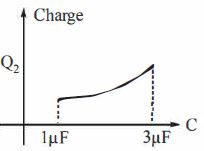
- B
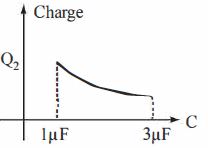
- C
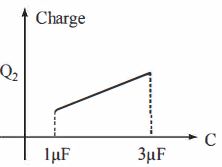
- D
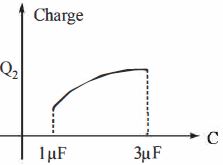
Explore More
Similar Questions
The charge on the $4\,\mu F$ capacitor in the given circuit is .... in $\mu C$.
Medium
View Solution$STATEMENT-1$: For practical purposes,the Earth is used as a reference at zero potential in electrical circuits.
$STATEMENT-2$: The electrical potential of a sphere of radius $R$ with charge $Q$ uniformly distributed on the surface is given by $\frac{Q}{4 \pi \varepsilon_0 R}$.
$STATEMENT-2$: The electrical potential of a sphere of radius $R$ with charge $Q$ uniformly distributed on the surface is given by $\frac{Q}{4 \pi \varepsilon_0 R}$.
MediumIIT 2008
View Solution$A$ particle of charge $Q$ and mass $M$ moves in a circular path of radius $R$ in a uniform magnetic field of magnitude $B$. The same particle now moves with the same speed in a circular path of same radius $R$ in the space between the cylindrical electrodes of a cylindrical capacitor. The radius of the inner electrode is $R/2$ while that of the outer electrode is $3R/2$. Then the potential difference between the capacitor electrodes must be
Difficult
View SolutionFrom a supply of identical capacitors rated $8 \mu F, 250 V$,the minimum number of capacitors required to form a composite $16 \mu F, 1000 V$ capacitor is:
Medium
View SolutionIn the adjoining figure,three capacitors $C_1$,$C_2$,and $C_3$ are connected to a battery of potential $V$. The correct condition is (Symbols have their usual meanings):
Medium
View SolutionVedclass Products
For Students
Vedclass Test Series
Mock tests in real JEE/NEET style with performance analysis. 5-day free trial.
Start Free TrialFor Teachers
Exam Paper Generator
Generate Set A/B/C/D exam papers from 7.5L+ questions in 2 minutes. 3 chapters free.
Try FreeFor Institutes
Online Exam Module
Live online exams with unlimited students, 360° analytics & white-label branding.
See Demo