
$A$ train is moving towards a stationary observer. Which of the following curves best represents the frequency $f$ received by the observer as a function of time $t$?
- A
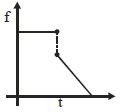
- B
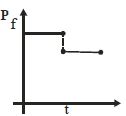
- C
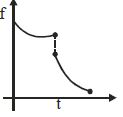
- D
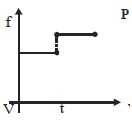
Explore More
Similar Questions
An observer standing at a station observes a frequency of $219 \, Hz$ when a train approaches and $184 \, Hz$ when the train goes away from him. If the velocity of sound in air is $340 \, m/s$,then the velocity of the train and the actual frequency of the whistle will be:
Difficult
View Solution$A$ musician using an open flute of length $50\,cm$ produces second harmonic sound waves. $A$ person runs towards the musician from another end of a hall at a speed of $10\,km/h.$ If the wave speed is $330\,m/s,$ the frequency heard by the running person shall be close to...... $Hz$
Two sources $A$ and $B$ are producing notes of frequency $680 \,Hz$. $A$ listener moves from $A$ to $B$ with a constant velocity $v$. If the speed of sound in air is $340 \,ms^{-1}$, the value of $v$ so that he hears $10$ beats per second is: (in $\,ms^{-1}$)
The driver of a bus approaching a big wall notices that the frequency of his bus's horn changes from $420\, Hz$ to $490\, Hz$,when he hears it after it gets reflected from the wall. Find the speed of the bus (in $kmh^{-1}$) if the speed of sound is $330\, ms^{-1}$.
DifficultJEE MAIN 2020
View Solution$A$ whistle of frequency $540 Hz$ rotates in a horizontal circle of radius $2 m$ at an angular speed of $15 rad/s$. What is the highest frequency heard by a listener at rest with respect to the center of the circle (in $Hz$)? (Velocity of sound in air $= 330 m/s$)
Vedclass Products
For Students
Vedclass Test Series
Mock tests in real JEE/NEET style with performance analysis. 5-day free trial.
Start Free TrialFor Teachers
Exam Paper Generator
Generate Set A/B/C/D exam papers from 7.5L+ questions in 2 minutes. 3 chapters free.
Try FreeFor Institutes
Online Exam Module
Live online exams with unlimited students, 360° analytics & white-label branding.
See Demo