
$A$ metallic shell has a point charge '$q$' kept inside its cavity. Which one of the following diagrams correctly represents the electric lines of force?
- A
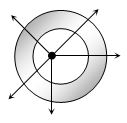
- B
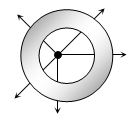
- C
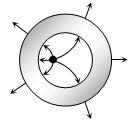
- D
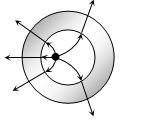
Explore More
Similar Questions
$A$ solid sphere of radius $R$ carries a charge $(Q+q)$ distributed uniformly over its volume. $A$ very small point-like piece of it of mass $m$ gets detached from the bottom of the sphere and falls down vertically under gravity. This piece carries charge $q$. If it acquires a speed $v$ when it has fallen through a vertical height $y$ (see figure),then: (assume the remaining portion to be spherical).
DifficultJEE MAIN 2020
View SolutionTwo identical metal spheres charged with $+12 \mu C$ and $-8 \mu C$ are kept at a certain distance in air. They are brought into contact and then kept at the same distance. The ratio of the magnitudes of electrostatic forces between them before and after contact is (in $: 1$)
MediumKCET 2008
View SolutionSix charges,three positive and three negative of equal magnitude,are to be placed at the vertices of a regular hexagon such that the electric field at $O$ is double the electric field when only one positive charge of the same magnitude is placed at $R$. Which of the following arrangements of charges is possible for $P, Q, R, S, T,$ and $U$ respectively?
MediumIIT 2004
View SolutionColumn $II$ corresponds to the graph of magnitude of electric field versus distance from the centre of the charge distribution in Column $I$. Match the items in Column $I$ with the corresponding graphs in Column $II$.
Column-$I$ Column-$II$ $(A)$ Ring along its axis $(P)$ Graph with a peak at a distance $r > 0$ $(B)$ Uniformly charged solid sphere $(Q)$ Graph increasing linearly for $r < R$ and decreasing as $1/r^2$ for $r > R$ $(C)$ Uniformly charged spherical shell $(R)$ Graph with zero field for $r < R$ and decreasing as $1/r^2$ for $r > R$ $(D)$ Combination of charge $+Q$ and $-Q$ at the perpendicular bisector $(S)$ Graph with a maximum at the center and decreasing as $r$ increases
| Column-$I$ | Column-$II$ |
|---|---|
| $(A)$ Ring along its axis | $(P)$ Graph with a peak at a distance $r > 0$ |
| $(B)$ Uniformly charged solid sphere | $(Q)$ Graph increasing linearly for $r < R$ and decreasing as $1/r^2$ for $r > R$ |
| $(C)$ Uniformly charged spherical shell | $(R)$ Graph with zero field for $r < R$ and decreasing as $1/r^2$ for $r > R$ |
| $(D)$ Combination of charge $+Q$ and $-Q$ at the perpendicular bisector | $(S)$ Graph with a maximum at the center and decreasing as $r$ increases |
Medium
View SolutionThe figure shows a nonconducting ring which has positive and negative charge non-uniformly distributed on it such that the total charge is zero. Which of the following statements is true?
Difficult
View SolutionVedclass Products
For Students
Vedclass Test Series
Mock tests in real JEE/NEET style with performance analysis. 5-day free trial.
Start Free TrialFor Teachers
Exam Paper Generator
Generate Set A/B/C/D exam papers from 7.5L+ questions in 2 minutes. 3 chapters free.
Try FreeFor Institutes
Online Exam Module
Live online exams with unlimited students, 360° analytics & white-label branding.
See Demo