
$A$ current is flowing through a thin cylindrical shell of radius $R$. If the energy density in the medium,due to the magnetic field,at a distance $r$ from the axis of the shell is equal to $U$,then which of the following graphs is correct?
- A
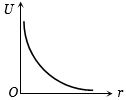
- B
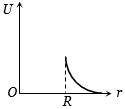
- C
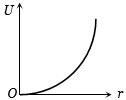
- D
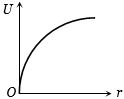
Explore More
Similar Questions
In the following hexagons,made up of two different materials $P$ and $Q$,current enters and leaves from points $X$ and $Y$ respectively. In which case is the magnetic field at its centre not zero?
$A$ thin,straight conductor lies along the axis of a hollow conductor of radius $R$. The two carry equal currents in the same direction. The magnetic field $B$ is plotted against the distance $r$ from the axis. Which of the following best represents the resulting curve?
Difficult
View SolutionAn electron moves straight inside a charged parallel plate capacitor of uniform charge density $\sigma$. The space between the plates is filled with a uniform magnetic field of intensity $B$,as shown in the figure. Neglecting the effect of gravity,the time taken for the straight-line motion of the electron in the capacitor is:
MediumNEET 2017
View Solution$A$ charged particle enters a uniform magnetic field perpendicular to its initial direction,travelling in air. The path of the particle is seen to follow the path in the figure. Which of the statements $1-3$ is/are correct?
$[1]$ The magnetic field strength may have been increased while the particle was travelling in air.
$[2]$ The particle lost energy by ionising the air.
$[3]$ The particle lost charge by ionising the air.
$[1]$ The magnetic field strength may have been increased while the particle was travelling in air.
$[2]$ The particle lost energy by ionising the air.
$[3]$ The particle lost charge by ionising the air.
Which of the following statements is correct?
Medium
View SolutionVedclass Products
For Students
Vedclass Test Series
Mock tests in real JEE/NEET style with performance analysis. 5-day free trial.
Start Free TrialFor Teachers
Exam Paper Generator
Generate Set A/B/C/D exam papers from 7.5L+ questions in 2 minutes. 3 chapters free.
Try FreeFor Institutes
Online Exam Module
Live online exams with unlimited students, 360° analytics & white-label branding.
See Demo