
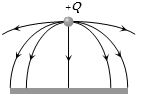
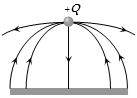
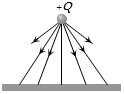
$A$ charge $Q$ is fixed at a distance $d$ in front of an infinite metal plate. The lines of force are represented by
- A
- B
- C
- D
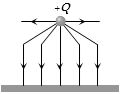
Explore More
Similar Questions
$A$ Van de Graaff generator produces:
Answer the following:
$(a)$ The top of the atmosphere is at about $400 \; kV$ with respect to the surface of the earth,corresponding to an electric field that decreases with altitude. Near the surface of the earth,the field is about $100 \; Vm^{-1}$. Why then do we not get an electric shock as we step out of our house into the open? (Assume the house to be a steel cage so there is no field inside!)
$(b)$ $A$ man fixes outside his house one evening a two-metre-high insulating slab carrying on its top a large aluminium sheet of area $1 \; m^2$. Will he get an electric shock if he touches the metal sheet next morning?
$(c)$ The discharging current in the atmosphere due to the small conductivity of air is known to be $1800 \; A$ on an average over the globe. Why then does the atmosphere not discharge itself completely in due course and become electrically neutral? In other words,what keeps the atmosphere charged?
$(d)$ What are the forms of energy into which the electrical energy of the atmosphere is dissipated during lightning?
$(a)$ The top of the atmosphere is at about $400 \; kV$ with respect to the surface of the earth,corresponding to an electric field that decreases with altitude. Near the surface of the earth,the field is about $100 \; Vm^{-1}$. Why then do we not get an electric shock as we step out of our house into the open? (Assume the house to be a steel cage so there is no field inside!)
$(b)$ $A$ man fixes outside his house one evening a two-metre-high insulating slab carrying on its top a large aluminium sheet of area $1 \; m^2$. Will he get an electric shock if he touches the metal sheet next morning?
$(c)$ The discharging current in the atmosphere due to the small conductivity of air is known to be $1800 \; A$ on an average over the globe. Why then does the atmosphere not discharge itself completely in due course and become electrically neutral? In other words,what keeps the atmosphere charged?
$(d)$ What are the forms of energy into which the electrical energy of the atmosphere is dissipated during lightning?
Medium
View SolutionConsider a uniformly charged hemispherical shell of radius $R$ and charge $Q$. If the electric field at point $A (0, 0, -z_0)$ is $\vec E$,then find the electric field at point $B (0, 0, z_0)$,where $z_0 < R$.
Medium
View SolutionAn infinitely long thin wire,having a uniform charge density per unit length of $5 \text{ nC/m}$,is passing through a spherical shell of radius $1 \text{ m}$,as shown in the figure. $A$ $10 \text{ nC}$ charge is distributed uniformly over the spherical shell. If the configuration of the charges remains static,the magnitude of the potential difference between points $P$ and $R$,in Volt,is. . . .
[Given: In $SI$ units $\frac{1}{4 \pi \epsilon_0}=9 \times 10^9, \ln 2=0.7$. Ignore the area pierced by the wire.]
[Given: In $SI$ units $\frac{1}{4 \pi \epsilon_0}=9 \times 10^9, \ln 2=0.7$. Ignore the area pierced by the wire.]
MediumIIT 2024
View SolutionTwo charges each of magnitude $Q$ are fixed at a distance of $2a$ apart. $A$ third charge ($-q$ of mass $m$) is placed at the midpoint of the two charges. If the $-q$ charge is slightly displaced perpendicular to the line joining the charges,find its time period.
Difficult
View SolutionVedclass Products
For Students
Vedclass Test Series
Mock tests in real JEE/NEET style with performance analysis. 5-day free trial.
Start Free TrialFor Teachers
Exam Paper Generator
Generate Set A/B/C/D exam papers from 7.5L+ questions in 2 minutes. 3 chapters free.
Try FreeFor Institutes
Online Exam Module
Live online exams with unlimited students, 360° analytics & white-label branding.
See Demo