
The energy spectrum of $\beta$-particles [number $N(E)$ as a function of $\beta$-energy $E$] emitted from a radioactive source is:
- A
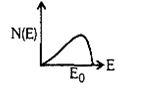
- B
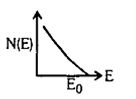
- C
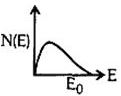
- D
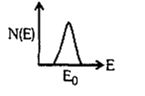
Explore More
Similar Questions
Consider the following reaction,
$C_2H_5Cl + AgCN \xrightarrow{EtOH / H_2O} \underline{X} \text{ (major)}$
Which one of the following statements is true for $\underline{X}$?
$(I)$ It gives propionic acid on hydrolysis
$(II)$ It has an ester functional group
$(III)$ It has a nitrogen linked to ethyl carbon
$(IV)$ It has a cyanide group
$C_2H_5Cl + AgCN \xrightarrow{EtOH / H_2O} \underline{X} \text{ (major)}$
Which one of the following statements is true for $\underline{X}$?
$(I)$ It gives propionic acid on hydrolysis
$(II)$ It has an ester functional group
$(III)$ It has a nitrogen linked to ethyl carbon
$(IV)$ It has a cyanide group
$A$ charged particle moves through a magnetic field in a direction perpendicular to it. Then the
$A$ solution of concentration $C \ g \ \text{equiv}/L$ has a specific resistance $R$. The equivalent conductance of the solution is
$A$ ball is projected from the ground with a velocity $V$ at an angle $\theta$ to the vertical. On its path,it makes an elastic collision with a vertical wall and returns to the ground. The total time of flight of the ball is:
$A$ parallel plate capacitor of capacity $C_0$ is charged to a potential $V_0$. $(i)$ The energy stored in the capacitor when the battery is disconnected and the plate separation is doubled is $E_1$. (ii) The energy stored in the capacitor when the charging battery is kept connected and the separation between the capacitor plates is doubled is $E_2$. Then,the value of $E_1 / E_2$ is:
Vedclass Products
For Students
Vedclass Test Series
Mock tests in real JEE/NEET style with performance analysis. 5-day free trial.
Start Free TrialFor Teachers
Exam Paper Generator
Generate Set A/B/C/D exam papers from 7.5L+ questions in 2 minutes. 3 chapters free.
Try FreeFor Institutes
Online Exam Module
Live online exams with unlimited students, 360° analytics & white-label branding.
See Demo