
Class 11PhysicsSystem of Particles and Rotational MotionConservation of angular momentum (combined translation and rotational motion)
Difficult$A$ circular platform rotates in a horizontal plane about a vertical axis passing through its center. $A$ tortoise sits on the edge of the platform. The platform is given an initial angular velocity $\omega_0$. The tortoise now moves along a chord of the platform with a constant velocity (relative to the platform). How does the angular velocity $\omega(t)$ of the platform change with time $t$?
- A
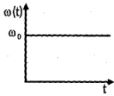
- B
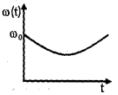
- C
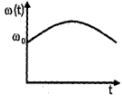
- D
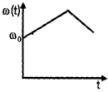
Explore More
Similar Questions
$A$ mouse of mass $m$ jumps on the outside edge of a rotating ceiling fan of moment of inertia $I$ and radius $R$. The fractional loss of angular velocity of the fan as a result is
MediumWBJEE 2023
View Solution$A$ child is standing with folded hands at the centre of a platform rotating about its central axis. The kinetic energy of the system is $K$. The child now stretches his arms so that the moment of inertia of the system becomes double. The kinetic energy of the system now is
$A$ hot solid sphere is rotating about a diameter at an angular velocity $\omega_0$. If it cools so that its radius reduces to $\frac{1}{\eta}$ of its original value,its angular velocity becomes .............
Easy
View SolutionThe angular momentum of a system of particles is not conserved:
Easy
View SolutionTwo discs with moments of inertia $I_1$ and $I_2$ and angular speeds $\omega_1$ and $\omega_2$ are rotating about collinear axes passing through their centers of mass and perpendicular to their planes. If they are joined together to rotate about the same axis,the rotational kinetic energy of the system will be:
Difficult
View SolutionVedclass Products
For Students
Vedclass Test Series
Mock tests in real JEE/NEET style with performance analysis. 5-day free trial.
Start Free TrialFor Teachers
Exam Paper Generator
Generate Set A/B/C/D exam papers from 7.5L+ questions in 2 minutes. 3 chapters free.
Try FreeFor Institutes
Online Exam Module
Live online exams with unlimited students, 360° analytics & white-label branding.
See Demo