
Medium
$A$ particle is released from a height $h$. The particle is given a constant horizontal velocity. Assuming $g$ remains constant everywhere, which graph correctly represents the kinetic energy $E$ of the particle with respect to time $t$?
- A
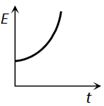
- B
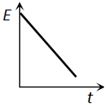
- C
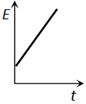
- D
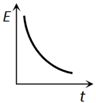
Explore More
Similar Questions
The linear momentum of a body of mass $8 \ kg$ is $24 \ kg \ m \ s^{-1}$. If a constant force of $24 \ N$ acts on the body in the direction of motion of the body for a time of $3 \ s$,then the increase in the kinetic energy of the body is (in $J$)
$A$ small disc of mass $m$ slides down with initial velocity zero from the top $(A)$ of a smooth hill of height $H$ having a horizontal portion $(BC)$ as shown in the figure. If the height of the horizontal portion of the hill is $h$,then the maximum horizontal distance covered by the disc from the point $D$ is
$A$ man throws a ball with a speed of $12 \ m/s$ at a height of $12 \ m$. If he throws the ball such that it just reaches this height,what is the percentage of energy saved?
Difficult
View Solution$A$ particle of unit mass is moving along the $x$-axis under the influence of a force and its total energy is conserved. Four possible forms of the potential energy of the particle are given in column $I$ ($a$ and $U_0$ are constants). Match the potential energies in column $I$ to the corresponding statement$(s)$ in column $II$.
Column $I$
Column $II$
$(A) U_1(x) = \frac{U_0}{2} \left[1 - \left(\frac{x}{a}\right)^2\right]^2$
$(P)$ The force acting on the particle is zero at $x = a$.
$(B) U_2(x) = \frac{U_0}{2} \left(\frac{x}{a}\right)^2$
$(Q)$ The force acting on the particle is zero at $x = 0$.
$(C) U_3(x) = \frac{U_0}{2} \left(\frac{x}{a}\right)^2 \exp \left[-\left(\frac{x}{a}\right)^2\right]$
$(R)$ The force acting on the particle is zero at $x = -a$.
$(D) U_4(x) = \frac{U_0}{2} \left[\frac{x}{a} - \frac{1}{3}\left(\frac{x}{a}\right)^3\right]$
$(S)$ The particle experiences an attractive force towards $x = 0$ in the region $|x| < a$.
$(T)$ The particle with total energy $\frac{U_0}{4}$ can oscillate about the point $x = -a$.
| Column $I$ | Column $II$ |
| $(A) U_1(x) = \frac{U_0}{2} \left[1 - \left(\frac{x}{a}\right)^2\right]^2$ | $(P)$ The force acting on the particle is zero at $x = a$. |
| $(B) U_2(x) = \frac{U_0}{2} \left(\frac{x}{a}\right)^2$ | $(Q)$ The force acting on the particle is zero at $x = 0$. |
| $(C) U_3(x) = \frac{U_0}{2} \left(\frac{x}{a}\right)^2 \exp \left[-\left(\frac{x}{a}\right)^2\right]$ | $(R)$ The force acting on the particle is zero at $x = -a$. |
| $(D) U_4(x) = \frac{U_0}{2} \left[\frac{x}{a} - \frac{1}{3}\left(\frac{x}{a}\right)^3\right]$ | $(S)$ The particle experiences an attractive force towards $x = 0$ in the region $|x| < a$. |
| $(T)$ The particle with total energy $\frac{U_0}{4}$ can oscillate about the point $x = -a$. |
DifficultIIT 2015
View Solution$A$ curved surface is shown in the figure. The portion $BCD$ is free of friction. There are three spherical balls of identical radii and masses. Balls are released from rest one by one from $A$,which is at a slightly greater height than $C$.
With the surface $AB$,ball $1$ has large enough friction to cause rolling down without slipping; ball $2$ has a small friction and ball $3$ has a negligible friction.
$(a)$ For which balls is total mechanical energy conserved?
$(b)$ Which ball$(s)$ can reach $D$?
$(c)$ For balls which do not reach $D$,which of the balls can reach back $A$?
With the surface $AB$,ball $1$ has large enough friction to cause rolling down without slipping; ball $2$ has a small friction and ball $3$ has a negligible friction.
$(a)$ For which balls is total mechanical energy conserved?
$(b)$ Which ball$(s)$ can reach $D$?
$(c)$ For balls which do not reach $D$,which of the balls can reach back $A$?
Difficult
View SolutionVedclass Products
For Students
Vedclass Test Series
Mock tests in real JEE/NEET style with performance analysis. 5-day free trial.
Start Free TrialFor Teachers
Exam Paper Generator
Generate Set A/B/C/D exam papers from 7.5L+ questions in 2 minutes. 3 chapters free.
Try FreeFor Institutes
Online Exam Module
Live online exams with unlimited students, 360° analytics & white-label branding.
See Demo