
A English
System of co-ordinates, Direction cosines and direction ratios, Projection Questions in English
Class 12 Mathematics · THREE DIMENSIONAL GEOMETRY · System of co-ordinates, Direction cosines and direction ratios, Projection
319+
Questions
English
Language
100%
With Solutions
Showing 50 of 319 questions in English
101
DifficultMCQ
If a line makes angles of $30^o$ and $45^o$ with $X-$ axis and $Y-$ axis,then the angle made by it with $Z-$ axis is
A
$45^o$
B
$60^o$
C
$120^o$
D
None of these
Solution
(D) Let the angles made by the line with $X, Y,$ and $Z-$ axes be $\alpha, \beta,$ and $\gamma$ respectively.
Given $\alpha = 30^o$ and $\beta = 45^o$.
The direction cosines of the line are $l = \cos \alpha, m = \cos \beta, n = \cos \gamma$.
We know that $l^2 + m^2 + n^2 = 1$.
Substituting the values: $\cos^2 30^o + \cos^2 45^o + \cos^2 \gamma = 1$.
$(\frac{\sqrt{3}}{2})^2 + (\frac{1}{\sqrt{2}})^2 + \cos^2 \gamma = 1$.
$\frac{3}{4} + \frac{1}{2} + \cos^2 \gamma = 1$.
$\frac{3+2}{4} + \cos^2 \gamma = 1 \implies \frac{5}{4} + \cos^2 \gamma = 1$.
$\cos^2 \gamma = 1 - \frac{5}{4} = -\frac{1}{4}$.
Since $\cos^2 \gamma$ cannot be negative,such a line does not exist in real space.
Therefore,the correct option is $D$.
Given $\alpha = 30^o$ and $\beta = 45^o$.
The direction cosines of the line are $l = \cos \alpha, m = \cos \beta, n = \cos \gamma$.
We know that $l^2 + m^2 + n^2 = 1$.
Substituting the values: $\cos^2 30^o + \cos^2 45^o + \cos^2 \gamma = 1$.
$(\frac{\sqrt{3}}{2})^2 + (\frac{1}{\sqrt{2}})^2 + \cos^2 \gamma = 1$.
$\frac{3}{4} + \frac{1}{2} + \cos^2 \gamma = 1$.
$\frac{3+2}{4} + \cos^2 \gamma = 1 \implies \frac{5}{4} + \cos^2 \gamma = 1$.
$\cos^2 \gamma = 1 - \frac{5}{4} = -\frac{1}{4}$.
Since $\cos^2 \gamma$ cannot be negative,such a line does not exist in real space.
Therefore,the correct option is $D$.
0 likes
View Solution102
AdvancedMCQ
If $\alpha, \beta, \gamma$ are the angles made by a line with $x, y,$ and $z$ axes respectively such that $2\left( \frac{\tan^2 \alpha}{1 + \tan^2 \alpha} + \frac{\tan^2 \beta}{1 + \tan^2 \beta} + \frac{\tan^2 \gamma}{1 + \tan^2 \gamma} \right) = 3 \sec^2 \frac{\theta}{2}$,then $\theta =$
A
$\frac{\pi}{12}$
B
$\frac{\pi}{10}$
C
$\frac{\pi}{6}$
D
$\frac{\pi}{3}$
Solution
(D) We know that for direction cosines,$\cos^2 \alpha + \cos^2 \beta + \cos^2 \gamma = 1$.
Since $\sin^2 \theta = 1 - \cos^2 \theta$,we have $\sin^2 \alpha + \sin^2 \beta + \sin^2 \gamma = 3 - (\cos^2 \alpha + \cos^2 \beta + \cos^2 \gamma) = 3 - 1 = 2$.
The given equation is $2(\sin^2 \alpha + \sin^2 \beta + \sin^2 \gamma) = 3 \sec^2 \frac{\theta}{2}$.
Substituting the value,$2(2) = 3 \sec^2 \frac{\theta}{2} \Rightarrow 4 = 3 \sec^2 \frac{\theta}{2}$.
$\sec^2 \frac{\theta}{2} = \frac{4}{3} \Rightarrow \cos^2 \frac{\theta}{2} = \frac{3}{4}$.
Using the identity $\cos \theta = 2 \cos^2 \frac{\theta}{2} - 1$,we get $\cos \theta = 2(\frac{3}{4}) - 1 = \frac{3}{2} - 1 = \frac{1}{2}$.
Thus,$\theta = \frac{\pi}{3}$.
Since $\sin^2 \theta = 1 - \cos^2 \theta$,we have $\sin^2 \alpha + \sin^2 \beta + \sin^2 \gamma = 3 - (\cos^2 \alpha + \cos^2 \beta + \cos^2 \gamma) = 3 - 1 = 2$.
The given equation is $2(\sin^2 \alpha + \sin^2 \beta + \sin^2 \gamma) = 3 \sec^2 \frac{\theta}{2}$.
Substituting the value,$2(2) = 3 \sec^2 \frac{\theta}{2} \Rightarrow 4 = 3 \sec^2 \frac{\theta}{2}$.
$\sec^2 \frac{\theta}{2} = \frac{4}{3} \Rightarrow \cos^2 \frac{\theta}{2} = \frac{3}{4}$.
Using the identity $\cos \theta = 2 \cos^2 \frac{\theta}{2} - 1$,we get $\cos \theta = 2(\frac{3}{4}) - 1 = \frac{3}{2} - 1 = \frac{1}{2}$.
Thus,$\theta = \frac{\pi}{3}$.
0 likes
View Solution103
DifficultMCQ
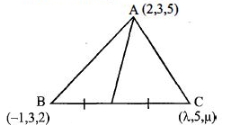
$ABC$ is a triangle in a plane with vertices $A(2, 3, 5)$,$B(-1, 3, 2)$,and $C(\lambda, 5, \mu)$. If the median through $A$ is equally inclined to the coordinate axes,then the value of $(\lambda^3 + \mu^3 + 5)$ is
A
$1130$
B
$1348$
C
$1077$
D
$676$
Solution
(B) Let $D$ be the midpoint of $BC$. The coordinates of $D$ are $\left( \frac{\lambda - 1}{2}, \frac{5 + 3}{2}, \frac{\mu + 2}{2} \right) = \left( \frac{\lambda - 1}{2}, 4, \frac{\mu + 2}{2} \right)$.
The direction ratios $(DRs)$ of the median $AD$ are $\left( \frac{\lambda - 1}{2} - 2, 4 - 3, \frac{\mu + 2}{2} - 5 \right) = \left( \frac{\lambda - 5}{2}, 1, \frac{\mu - 8}{2} \right)$.
Since the median $AD$ is equally inclined to the coordinate axes,its direction ratios must be equal. Thus,$\frac{\lambda - 5}{2} = 1 = \frac{\mu - 8}{2}$.
From $\frac{\lambda - 5}{2} = 1$,we get $\lambda - 5 = 2$,so $\lambda = 7$.
From $\frac{\mu - 8}{2} = 1$,we get $\mu - 8 = 2$,so $\mu = 10$.
Now,calculate the value of $(\lambda^3 + \mu^3 + 5) = 7^3 + 10^3 + 5 = 343 + 1000 + 5 = 1348$.
The direction ratios $(DRs)$ of the median $AD$ are $\left( \frac{\lambda - 1}{2} - 2, 4 - 3, \frac{\mu + 2}{2} - 5 \right) = \left( \frac{\lambda - 5}{2}, 1, \frac{\mu - 8}{2} \right)$.
Since the median $AD$ is equally inclined to the coordinate axes,its direction ratios must be equal. Thus,$\frac{\lambda - 5}{2} = 1 = \frac{\mu - 8}{2}$.
From $\frac{\lambda - 5}{2} = 1$,we get $\lambda - 5 = 2$,so $\lambda = 7$.
From $\frac{\mu - 8}{2} = 1$,we get $\mu - 8 = 2$,so $\mu = 10$.
Now,calculate the value of $(\lambda^3 + \mu^3 + 5) = 7^3 + 10^3 + 5 = 343 + 1000 + 5 = 1348$.
0 likes
View Solution104
DifficultMCQ
$A$ line in the $3-$dimensional space makes an angle $\theta \left( 0 < \theta \le \frac{\pi}{2} \right)$ with both the $x$ and $y$ axes. Then the set of all values of $\theta$ is the interval
A
$\left( 0, \frac{\pi}{4} \right]$
B
$\left[ \frac{\pi}{6}, \frac{\pi}{3} \right]$
C
$\left[ \frac{\pi}{4}, \frac{\pi}{2} \right]$
D
$\left( \frac{\pi}{3}, \frac{\pi}{2} \right]$
Solution
(C) Let the direction cosines of the line be $l, m, n$. Since the line makes an angle $\theta$ with the $x$ and $y$ axes,we have $l = \cos \theta$ and $m = \cos \theta$.
Let the angle with the $z$-axis be $\phi$. Then $n = \cos \phi$.
The condition for direction cosines is $l^2 + m^2 + n^2 = 1$.
Substituting the values,we get $\cos^2 \theta + \cos^2 \theta + \cos^2 \phi = 1$,which implies $2 \cos^2 \theta + \cos^2 \phi = 1$.
Thus,$\cos^2 \phi = 1 - 2 \cos^2 \theta = - \cos 2 \theta$.
Since $\cos^2 \phi \ge 0$,we must have $-\cos 2 \theta \ge 0$,which implies $\cos 2 \theta \le 0$.
Given $0 < \theta \le \frac{\pi}{2}$,we have $0 < 2 \theta \le \pi$.
For $\cos 2 \theta \le 0$ in the interval $(0, \pi]$,we have $\frac{\pi}{2} \le 2 \theta \le \pi$.
Dividing by $2$,we get $\frac{\pi}{4} \le \theta \le \frac{\pi}{2}$.
Therefore,the set of all values of $\theta$ is $\left[ \frac{\pi}{4}, \frac{\pi}{2} \right]$.
Let the angle with the $z$-axis be $\phi$. Then $n = \cos \phi$.
The condition for direction cosines is $l^2 + m^2 + n^2 = 1$.
Substituting the values,we get $\cos^2 \theta + \cos^2 \theta + \cos^2 \phi = 1$,which implies $2 \cos^2 \theta + \cos^2 \phi = 1$.
Thus,$\cos^2 \phi = 1 - 2 \cos^2 \theta = - \cos 2 \theta$.
Since $\cos^2 \phi \ge 0$,we must have $-\cos 2 \theta \ge 0$,which implies $\cos 2 \theta \le 0$.
Given $0 < \theta \le \frac{\pi}{2}$,we have $0 < 2 \theta \le \pi$.
For $\cos 2 \theta \le 0$ in the interval $(0, \pi]$,we have $\frac{\pi}{2} \le 2 \theta \le \pi$.
Dividing by $2$,we get $\frac{\pi}{4} \le \theta \le \frac{\pi}{2}$.
Therefore,the set of all values of $\theta$ is $\left[ \frac{\pi}{4}, \frac{\pi}{2} \right]$.
0 likes
View Solution105
DifficultMCQ
The acute angle between two lines such that the direction cosines $l, m, n$ of each of them satisfy the equations $l+m+n=0$ and $l^2+m^2-n^2=0$ is ............ $^o$
A
$15$
B
$30$
C
$60$
D
$45$
Solution
(C) Given the equations for direction cosines: $l+m+n=0$ and $l^2+m^2-n^2=0$.
From the first equation,$l+m = -n$. Squaring both sides,we get $l^2+m^2+2lm = n^2$.
Substituting $l^2+m^2 = n^2$ from the second equation into this,we get $n^2+2lm = n^2$,which implies $2lm = 0$,so $lm = 0$.
This means either $l=0$ or $m=0$.
Case $1$: If $l=0$,then $m+n=0 \Rightarrow m=-n$. Since $l^2+m^2+n^2=1$,we have $0^2+(-n)^2+n^2=1 \Rightarrow 2n^2=1 \Rightarrow n = \pm \frac{1}{\sqrt{2}}$. Thus,the direction ratios are $(0, -\frac{1}{\sqrt{2}}, \frac{1}{\sqrt{2}})$ or $(0, \frac{1}{\sqrt{2}}, -\frac{1}{\sqrt{2}})$.
Case $2$: If $m=0$,then $l+n=0 \Rightarrow l=-n$. Similarly,$l^2+0^2+n^2=1 \Rightarrow 2n^2=1 \Rightarrow n = \pm \frac{1}{\sqrt{2}}$. Thus,the direction ratios are $(-\frac{1}{\sqrt{2}}, 0, \frac{1}{\sqrt{2}})$ or $(\frac{1}{\sqrt{2}}, 0, -\frac{1}{\sqrt{2}})$.
Let the two lines have direction cosines $\vec{u_1} = (0, -\frac{1}{\sqrt{2}}, \frac{1}{\sqrt{2}})$ and $\vec{u_2} = (-\frac{1}{\sqrt{2}}, 0, \frac{1}{\sqrt{2}})$.
The cosine of the angle $\theta$ between them is $|\vec{u_1} \cdot \vec{u_2}| = |(0)(-\frac{1}{\sqrt{2}}) + (-\frac{1}{\sqrt{2}})(0) + (\frac{1}{\sqrt{2}})(\frac{1}{\sqrt{2}})| = |0 + 0 + \frac{1}{2}| = \frac{1}{2}$.
Since $\cos \theta = \frac{1}{2}$,the acute angle $\theta = 60^o$.
From the first equation,$l+m = -n$. Squaring both sides,we get $l^2+m^2+2lm = n^2$.
Substituting $l^2+m^2 = n^2$ from the second equation into this,we get $n^2+2lm = n^2$,which implies $2lm = 0$,so $lm = 0$.
This means either $l=0$ or $m=0$.
Case $1$: If $l=0$,then $m+n=0 \Rightarrow m=-n$. Since $l^2+m^2+n^2=1$,we have $0^2+(-n)^2+n^2=1 \Rightarrow 2n^2=1 \Rightarrow n = \pm \frac{1}{\sqrt{2}}$. Thus,the direction ratios are $(0, -\frac{1}{\sqrt{2}}, \frac{1}{\sqrt{2}})$ or $(0, \frac{1}{\sqrt{2}}, -\frac{1}{\sqrt{2}})$.
Case $2$: If $m=0$,then $l+n=0 \Rightarrow l=-n$. Similarly,$l^2+0^2+n^2=1 \Rightarrow 2n^2=1 \Rightarrow n = \pm \frac{1}{\sqrt{2}}$. Thus,the direction ratios are $(-\frac{1}{\sqrt{2}}, 0, \frac{1}{\sqrt{2}})$ or $(\frac{1}{\sqrt{2}}, 0, -\frac{1}{\sqrt{2}})$.
Let the two lines have direction cosines $\vec{u_1} = (0, -\frac{1}{\sqrt{2}}, \frac{1}{\sqrt{2}})$ and $\vec{u_2} = (-\frac{1}{\sqrt{2}}, 0, \frac{1}{\sqrt{2}})$.
The cosine of the angle $\theta$ between them is $|\vec{u_1} \cdot \vec{u_2}| = |(0)(-\frac{1}{\sqrt{2}}) + (-\frac{1}{\sqrt{2}})(0) + (\frac{1}{\sqrt{2}})(\frac{1}{\sqrt{2}})| = |0 + 0 + \frac{1}{2}| = \frac{1}{2}$.
Since $\cos \theta = \frac{1}{2}$,the acute angle $\theta = 60^o$.
0 likes
View Solution106
EasyMCQ
If the projections of a line segment on the $x, y$ and $z-$ axes in $3-$ dimensional space are $2, 3$ and $6$ respectively,then the length of the line segment is
A
$12$
B
$7$
C
$9$
D
$6$
Solution
(B) Let the projections of the line segment on the $x, y$ and $z-$ axes be $p_x = 2$,$p_y = 3$,and $p_z = 6$ respectively.
The length of the line segment $L$ in $3-$ dimensional space is given by the formula $L = \sqrt{p_x^2 + p_y^2 + p_z^2}$.
Substituting the given values,we get $L = \sqrt{2^2 + 3^2 + 6^2}$.
$L = \sqrt{4 + 9 + 36}$.
$L = \sqrt{49}$.
$L = 7$.
Therefore,the length of the line segment is $7$.
The length of the line segment $L$ in $3-$ dimensional space is given by the formula $L = \sqrt{p_x^2 + p_y^2 + p_z^2}$.
Substituting the given values,we get $L = \sqrt{2^2 + 3^2 + 6^2}$.
$L = \sqrt{4 + 9 + 36}$.
$L = \sqrt{49}$.
$L = 7$.
Therefore,the length of the line segment is $7$.
0 likes
View Solution107
DifficultMCQ
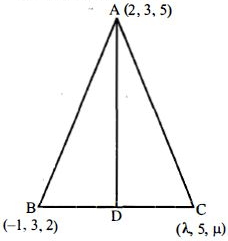
Let $ABC$ be a triangle with vertices at points $A(2, 3, 5)$,$B(-1, 3, 2)$ and $C(\lambda, 5, \mu)$ in three-dimensional space. If the median through $A$ is equally inclined with the axes,then $(\lambda, \mu)$ is equal to
A
$(10, 7)$
B
$(7, 5)$
C
$(7, 10)$
D
$(5, 7)$
Solution
(C) Let $D$ be the midpoint of $BC$. The coordinates of $D$ are given by:
$D = \left( \frac{\lambda - 1}{2}, \frac{5 + 3}{2}, \frac{\mu + 2}{2} \right) = \left( \frac{\lambda - 1}{2}, 4, \frac{\mu + 2}{2} \right)$
The direction ratios of the median $AD$ are:
$a = \frac{\lambda - 1}{2} - 2 = \frac{\lambda - 5}{2}$
$b = 4 - 3 = 1$
$c = \frac{\mu + 2}{2} - 5 = \frac{\mu - 8}{2}$
Since the median $AD$ is equally inclined with the axes,its direction cosines $l, m, n$ are equal,i.e.,$|l| = |m| = |n|$. Since $l^2 + m^2 + n^2 = 1$,we have $l = m = n = \pm \frac{1}{\sqrt{3}}$.
Thus,the direction ratios $a, b, c$ must be proportional to $1, 1, 1$. Since $b = 1$,we must have $a = 1$ and $c = 1$.
Setting $a = 1$:
$\frac{\lambda - 5}{2} = 1 \Rightarrow \lambda - 5 = 2 \Rightarrow \lambda = 7$
Setting $c = 1$:
$\frac{\mu - 8}{2} = 1 \Rightarrow \mu - 8 = 2 \Rightarrow \mu = 10$
Therefore,$(\lambda, \mu) = (7, 10)$.
$D = \left( \frac{\lambda - 1}{2}, \frac{5 + 3}{2}, \frac{\mu + 2}{2} \right) = \left( \frac{\lambda - 1}{2}, 4, \frac{\mu + 2}{2} \right)$
The direction ratios of the median $AD$ are:
$a = \frac{\lambda - 1}{2} - 2 = \frac{\lambda - 5}{2}$
$b = 4 - 3 = 1$
$c = \frac{\mu + 2}{2} - 5 = \frac{\mu - 8}{2}$
Since the median $AD$ is equally inclined with the axes,its direction cosines $l, m, n$ are equal,i.e.,$|l| = |m| = |n|$. Since $l^2 + m^2 + n^2 = 1$,we have $l = m = n = \pm \frac{1}{\sqrt{3}}$.
Thus,the direction ratios $a, b, c$ must be proportional to $1, 1, 1$. Since $b = 1$,we must have $a = 1$ and $c = 1$.
Setting $a = 1$:
$\frac{\lambda - 5}{2} = 1 \Rightarrow \lambda - 5 = 2 \Rightarrow \lambda = 7$
Setting $c = 1$:
$\frac{\mu - 8}{2} = 1 \Rightarrow \mu - 8 = 2 \Rightarrow \mu = 10$
Therefore,$(\lambda, \mu) = (7, 10)$.
0 likes
View Solution108
MediumMCQ
If a unit vector $\vec{r}$ makes angles $\frac{\pi}{3}$ with $\hat{i}$,$\frac{\pi}{4}$ with $\hat{j}$ and $\theta \in (0, \pi)$ with $\hat{k}$,then a value of $\theta$ is
A
$\frac{5\pi}{12}$
B
$\frac{5\pi}{6}$
C
$\frac{2\pi}{3}$
D
$\frac{\pi}{4}$
Solution
(C) Let the direction angles of the unit vector $\vec{r}$ be $\alpha = \frac{\pi}{3}$,$\beta = \frac{\pi}{4}$,and $\gamma = \theta$.
The sum of the squares of the direction cosines of a unit vector is always $1$,given by the relation $\cos^2 \alpha + \cos^2 \beta + \cos^2 \gamma = 1$.
Substituting the given values: $\cos^2(\frac{\pi}{3}) + \cos^2(\frac{\pi}{4}) + \cos^2 \theta = 1$.
Since $\cos(\frac{\pi}{3}) = \frac{1}{2}$ and $\cos(\frac{\pi}{4}) = \frac{1}{\sqrt{2}}$,we have $(\frac{1}{2})^2 + (\frac{1}{\sqrt{2}})^2 + \cos^2 \theta = 1$.
$\frac{1}{4} + \frac{1}{2} + \cos^2 \theta = 1$.
$\frac{3}{4} + \cos^2 \theta = 1$.
$\cos^2 \theta = 1 - \frac{3}{4} = \frac{1}{4}$.
Therefore,$\cos \theta = \pm \frac{1}{2}$.
Given $\theta \in (0, \pi)$,if $\cos \theta = \frac{1}{2}$,then $\theta = \frac{\pi}{3}$. If $\cos \theta = -\frac{1}{2}$,then $\theta = \frac{2\pi}{3}$.
Comparing with the options,$\frac{2\pi}{3}$ is the correct value.
The sum of the squares of the direction cosines of a unit vector is always $1$,given by the relation $\cos^2 \alpha + \cos^2 \beta + \cos^2 \gamma = 1$.
Substituting the given values: $\cos^2(\frac{\pi}{3}) + \cos^2(\frac{\pi}{4}) + \cos^2 \theta = 1$.
Since $\cos(\frac{\pi}{3}) = \frac{1}{2}$ and $\cos(\frac{\pi}{4}) = \frac{1}{\sqrt{2}}$,we have $(\frac{1}{2})^2 + (\frac{1}{\sqrt{2}})^2 + \cos^2 \theta = 1$.
$\frac{1}{4} + \frac{1}{2} + \cos^2 \theta = 1$.
$\frac{3}{4} + \cos^2 \theta = 1$.
$\cos^2 \theta = 1 - \frac{3}{4} = \frac{1}{4}$.
Therefore,$\cos \theta = \pm \frac{1}{2}$.
Given $\theta \in (0, \pi)$,if $\cos \theta = \frac{1}{2}$,then $\theta = \frac{\pi}{3}$. If $\cos \theta = -\frac{1}{2}$,then $\theta = \frac{2\pi}{3}$.
Comparing with the options,$\frac{2\pi}{3}$ is the correct value.
0 likes
View Solution109
EasyMCQ
Write the direction ratios of the vector $\vec{a} = \hat{i} + \hat{j} - 2\hat{k}$ and hence calculate its direction cosines.
A
$\left(\frac{1}{\sqrt{6}}, \frac{1}{\sqrt{6}}, -\frac{2}{\sqrt{6}}\right)$
B
$\left(\frac{1}{\sqrt{5}}, \frac{1}{\sqrt{5}}, -\frac{2}{\sqrt{5}}\right)$
C
$\left(\frac{1}{\sqrt{3}}, \frac{1}{\sqrt{3}}, -\frac{2}{\sqrt{3}}\right)$
D
$\left(\frac{1}{\sqrt{2}}, \frac{1}{\sqrt{2}}, -\frac{2}{\sqrt{2}}\right)$
Solution
(A) The direction ratios of a vector $\vec{r} = x\hat{i} + y\hat{j} + z\hat{k}$ are the components $(x, y, z)$.
For the given vector $\vec{a} = 1\hat{i} + 1\hat{j} - 2\hat{k}$,the direction ratios are $a = 1, b = 1, c = -2$.
Next,we calculate the magnitude of the vector: $|\vec{a}| = \sqrt{1^2 + 1^2 + (-2)^2} = \sqrt{1 + 1 + 4} = \sqrt{6}$.
The direction cosines $(l, m, n)$ are given by $l = \frac{a}{|\vec{a}|}, m = \frac{b}{|\vec{a}|}, n = \frac{c}{|\vec{a}|}$.
Substituting the values,we get $l = \frac{1}{\sqrt{6}}, m = \frac{1}{\sqrt{6}}, n = \frac{-2}{\sqrt{6}}$.
Thus,the direction cosines are $\left(\frac{1}{\sqrt{6}}, \frac{1}{\sqrt{6}}, -\frac{2}{\sqrt{6}}\right)$.
For the given vector $\vec{a} = 1\hat{i} + 1\hat{j} - 2\hat{k}$,the direction ratios are $a = 1, b = 1, c = -2$.
Next,we calculate the magnitude of the vector: $|\vec{a}| = \sqrt{1^2 + 1^2 + (-2)^2} = \sqrt{1 + 1 + 4} = \sqrt{6}$.
The direction cosines $(l, m, n)$ are given by $l = \frac{a}{|\vec{a}|}, m = \frac{b}{|\vec{a}|}, n = \frac{c}{|\vec{a}|}$.
Substituting the values,we get $l = \frac{1}{\sqrt{6}}, m = \frac{1}{\sqrt{6}}, n = \frac{-2}{\sqrt{6}}$.
Thus,the direction cosines are $\left(\frac{1}{\sqrt{6}}, \frac{1}{\sqrt{6}}, -\frac{2}{\sqrt{6}}\right)$.
0 likes
View Solution110
MediumMCQ
Find the direction cosines of the vector joining the points $A(1, 2, -3)$ and $B(-1, -2, 1)$,directed from $A$ to $B$.
A
$(-1/3, -2/3, 2/3)$
B
$(-1/3, 2/3, -2/3)$
C
$(1/3, 2/3, -2/3)$
D
$(-1/3, -2/3, -2/3)$
Solution
(A) The given points are $A(1, 2, -3)$ and $B(-1, -2, 1)$.
The vector $\overrightarrow{AB}$ is given by $(x_2 - x_1)\hat{i} + (y_2 - y_1)\hat{j} + (z_2 - z_1)\hat{k}$.
$\overrightarrow{AB} = (-1 - 1)\hat{i} + (-2 - 2)\hat{j} + (1 - (-3))\hat{k} = -2\hat{i} - 4\hat{j} + 4\hat{k}$.
The magnitude of $\overrightarrow{AB}$ is $|\overrightarrow{AB}| = \sqrt{(-2)^2 + (-4)^2 + 4^2} = \sqrt{4 + 16 + 16} = \sqrt{36} = 6$.
The direction cosines are given by $\left(\frac{a}{|\overrightarrow{AB}|}, \frac{b}{|\overrightarrow{AB}|}, \frac{c}{|\overrightarrow{AB}|}\right)$,where $\overrightarrow{AB} = a\hat{i} + b\hat{j} + c\hat{k}$.
Thus,the direction cosines are $\left(-\frac{2}{6}, -\frac{4}{6}, \frac{4}{6}\right) = \left(-\frac{1}{3}, -\frac{2}{3}, \frac{2}{3}\right)$.
The vector $\overrightarrow{AB}$ is given by $(x_2 - x_1)\hat{i} + (y_2 - y_1)\hat{j} + (z_2 - z_1)\hat{k}$.
$\overrightarrow{AB} = (-1 - 1)\hat{i} + (-2 - 2)\hat{j} + (1 - (-3))\hat{k} = -2\hat{i} - 4\hat{j} + 4\hat{k}$.
The magnitude of $\overrightarrow{AB}$ is $|\overrightarrow{AB}| = \sqrt{(-2)^2 + (-4)^2 + 4^2} = \sqrt{4 + 16 + 16} = \sqrt{36} = 6$.
The direction cosines are given by $\left(\frac{a}{|\overrightarrow{AB}|}, \frac{b}{|\overrightarrow{AB}|}, \frac{c}{|\overrightarrow{AB}|}\right)$,where $\overrightarrow{AB} = a\hat{i} + b\hat{j} + c\hat{k}$.
Thus,the direction cosines are $\left(-\frac{2}{6}, -\frac{4}{6}, \frac{4}{6}\right) = \left(-\frac{1}{3}, -\frac{2}{3}, \frac{2}{3}\right)$.
0 likes
View Solution111
EasyMCQ
If a line makes angles $90^{\circ}, 60^{\circ}$ and $30^{\circ}$ with the positive direction of $x, y$ and $z$-axes respectively,find its direction cosines.
A
$0, \frac{1}{2}, \frac{\sqrt{3}}{2}$
B
$1, \frac{1}{2}, \frac{\sqrt{3}}{2}$
C
$0, \frac{\sqrt{3}}{2}, \frac{1}{2}$
D
$1, 0, \frac{1}{2}$
Solution
(A) The direction cosines of a line are given by $l = \cos \alpha$,$m = \cos \beta$,and $n = \cos \gamma$,where $\alpha, \beta, \gamma$ are the angles made by the line with the positive directions of the $x, y,$ and $z$-axes respectively.
Given $\alpha = 90^{\circ}, \beta = 60^{\circ}, \gamma = 30^{\circ}$.
Therefore,$l = \cos 90^{\circ} = 0$.
$m = \cos 60^{\circ} = \frac{1}{2}$.
$n = \cos 30^{\circ} = \frac{\sqrt{3}}{2}$.
Thus,the direction cosines are $0, \frac{1}{2}, \frac{\sqrt{3}}{2}$.
Given $\alpha = 90^{\circ}, \beta = 60^{\circ}, \gamma = 30^{\circ}$.
Therefore,$l = \cos 90^{\circ} = 0$.
$m = \cos 60^{\circ} = \frac{1}{2}$.
$n = \cos 30^{\circ} = \frac{\sqrt{3}}{2}$.
Thus,the direction cosines are $0, \frac{1}{2}, \frac{\sqrt{3}}{2}$.
0 likes
View Solution112
EasyMCQ
If a line has direction ratios $2, -1, -2$,determine its direction cosines.
A
$\frac{2}{3}, -\frac{1}{3}, -\frac{2}{3}$
B
$\frac{2}{3}, \frac{1}{3}, \frac{2}{3}$
C
$\frac{1}{3}, -\frac{2}{3}, -\frac{2}{3}$
D
$\frac{2}{3}, -\frac{2}{3}, -\frac{1}{3}$
Solution
(A) Let the direction ratios be $a = 2, b = -1, c = -2$.
The magnitude of the vector is $\sqrt{a^2 + b^2 + c^2} = \sqrt{2^2 + (-1)^2 + (-2)^2} = \sqrt{4 + 1 + 4} = \sqrt{9} = 3$.
The direction cosines $(l, m, n)$ are given by $\frac{a}{\sqrt{a^2+b^2+c^2}}, \frac{b}{\sqrt{a^2+b^2+c^2}}, \frac{c}{\sqrt{a^2+b^2+c^2}}$.
Substituting the values,we get $l = \frac{2}{3}, m = -\frac{1}{3}, n = -\frac{2}{3}$.
Thus,the direction cosines are $\frac{2}{3}, -\frac{1}{3}, -\frac{2}{3}$.
The magnitude of the vector is $\sqrt{a^2 + b^2 + c^2} = \sqrt{2^2 + (-1)^2 + (-2)^2} = \sqrt{4 + 1 + 4} = \sqrt{9} = 3$.
The direction cosines $(l, m, n)$ are given by $\frac{a}{\sqrt{a^2+b^2+c^2}}, \frac{b}{\sqrt{a^2+b^2+c^2}}, \frac{c}{\sqrt{a^2+b^2+c^2}}$.
Substituting the values,we get $l = \frac{2}{3}, m = -\frac{1}{3}, n = -\frac{2}{3}$.
Thus,the direction cosines are $\frac{2}{3}, -\frac{1}{3}, -\frac{2}{3}$.
0 likes
View Solution113
MediumMCQ
Find the direction cosines of the line passing through the two points $(-2, 4, -5)$ and $(1, 2, 3)$.
A
$\frac{3}{\sqrt{77}}, \frac{-2}{\sqrt{77}}, \frac{8}{\sqrt{77}}$
B
$\frac{3}{\sqrt{77}}, \frac{2}{\sqrt{77}}, \frac{8}{\sqrt{77}}$
C
$\frac{-3}{\sqrt{77}}, \frac{-2}{\sqrt{77}}, \frac{8}{\sqrt{77}}$
D
$\frac{3}{\sqrt{77}}, \frac{-2}{\sqrt{77}}, \frac{-8}{\sqrt{77}}$
Solution
(A) The direction cosines of a line passing through two points $P(x_1, y_1, z_1)$ and $Q(x_2, y_2, z_2)$ are given by $\frac{x_2-x_1}{PQ}, \frac{y_2-y_1}{PQ}, \frac{z_2-z_1}{PQ}$,where $PQ = \sqrt{(x_2-x_1)^2 + (y_2-y_1)^2 + (z_2-z_1)^2}$.
Given points are $P(-2, 4, -5)$ and $Q(1, 2, 3)$.
First,calculate the distance $PQ$:
$PQ = \sqrt{(1 - (-2))^2 + (2 - 4)^2 + (3 - (-5))^2} = \sqrt{(3)^2 + (-2)^2 + (8)^2} = \sqrt{9 + 4 + 64} = \sqrt{77}$.
Now,the direction cosines are:
$l = \frac{1 - (-2)}{\sqrt{77}} = \frac{3}{\sqrt{77}}$
$m = \frac{2 - 4}{\sqrt{77}} = \frac{-2}{\sqrt{77}}$
$n = \frac{3 - (-5)}{\sqrt{77}} = \frac{8}{\sqrt{77}}$
Thus,the direction cosines are $\frac{3}{\sqrt{77}}, \frac{-2}{\sqrt{77}}, \frac{8}{\sqrt{77}}$.
Given points are $P(-2, 4, -5)$ and $Q(1, 2, 3)$.
First,calculate the distance $PQ$:
$PQ = \sqrt{(1 - (-2))^2 + (2 - 4)^2 + (3 - (-5))^2} = \sqrt{(3)^2 + (-2)^2 + (8)^2} = \sqrt{9 + 4 + 64} = \sqrt{77}$.
Now,the direction cosines are:
$l = \frac{1 - (-2)}{\sqrt{77}} = \frac{3}{\sqrt{77}}$
$m = \frac{2 - 4}{\sqrt{77}} = \frac{-2}{\sqrt{77}}$
$n = \frac{3 - (-5)}{\sqrt{77}} = \frac{8}{\sqrt{77}}$
Thus,the direction cosines are $\frac{3}{\sqrt{77}}, \frac{-2}{\sqrt{77}}, \frac{8}{\sqrt{77}}$.
0 likes
View Solution114
EasyMCQ
Find the direction cosines of $x$,$y$,and $z$-axis.
A
$(1, 0, 0), (0, 1, 0), (0, 0, 1)$
B
$(0, 1, 0), (1, 0, 0), (0, 0, 1)$
C
$(0, 0, 1), (0, 1, 0), (1, 0, 0)$
D
$(1, 1, 0), (0, 1, 1), (1, 0, 1)$
Solution
(A) The $x$-axis makes angles $0^{\circ}, 90^{\circ}$,and $90^{\circ}$ with the $x$,$y$,and $z$-axes respectively.
Therefore,the direction cosines of the $x$-axis are $\cos 0^{\circ}, \cos 90^{\circ}, \cos 90^{\circ}$,which are $(1, 0, 0)$.
Similarly,the $y$-axis makes angles $90^{\circ}, 0^{\circ}$,and $90^{\circ}$ with the $x$,$y$,and $z$-axes respectively.
Therefore,the direction cosines of the $y$-axis are $\cos 90^{\circ}, \cos 0^{\circ}, \cos 90^{\circ}$,which are $(0, 1, 0)$.
Finally,the $z$-axis makes angles $90^{\circ}, 90^{\circ}$,and $0^{\circ}$ with the $x$,$y$,and $z$-axes respectively.
Therefore,the direction cosines of the $z$-axis are $\cos 90^{\circ}, \cos 90^{\circ}, \cos 0^{\circ}$,which are $(0, 0, 1)$.
Therefore,the direction cosines of the $x$-axis are $\cos 0^{\circ}, \cos 90^{\circ}, \cos 90^{\circ}$,which are $(1, 0, 0)$.
Similarly,the $y$-axis makes angles $90^{\circ}, 0^{\circ}$,and $90^{\circ}$ with the $x$,$y$,and $z$-axes respectively.
Therefore,the direction cosines of the $y$-axis are $\cos 90^{\circ}, \cos 0^{\circ}, \cos 90^{\circ}$,which are $(0, 1, 0)$.
Finally,the $z$-axis makes angles $90^{\circ}, 90^{\circ}$,and $0^{\circ}$ with the $x$,$y$,and $z$-axes respectively.
Therefore,the direction cosines of the $z$-axis are $\cos 90^{\circ}, \cos 90^{\circ}, \cos 0^{\circ}$,which are $(0, 0, 1)$.
0 likes
View Solution115
EasyMCQ
If a line makes angles $90^{\circ}, 135^{\circ},$ and $45^{\circ}$ with the $x, y,$ and $z$-axes respectively,find its direction cosines.
A
$0, -\frac{1}{\sqrt{2}}, \frac{1}{\sqrt{2}}$
B
$1, -\frac{1}{\sqrt{2}}, \frac{1}{\sqrt{2}}$
C
$0, \frac{1}{\sqrt{2}}, \frac{1}{\sqrt{2}}$
D
$1, \frac{1}{\sqrt{2}}, -\frac{1}{\sqrt{2}}$
Solution
(A) Let the direction angles of the line be $\alpha = 90^{\circ}, \beta = 135^{\circ},$ and $\gamma = 45^{\circ}$.
The direction cosines $(l, m, n)$ of a line are given by $l = \cos \alpha, m = \cos \beta,$ and $n = \cos \gamma$.
Calculating each value:
$l = \cos 90^{\circ} = 0$
$m = \cos 135^{\circ} = \cos(180^{\circ} - 45^{\circ}) = -\cos 45^{\circ} = -\frac{1}{\sqrt{2}}$
$n = \cos 45^{\circ} = \frac{1}{\sqrt{2}}$
Therefore,the direction cosines of the line are $0, -\frac{1}{\sqrt{2}},$ and $\frac{1}{\sqrt{2}}$.
The direction cosines $(l, m, n)$ of a line are given by $l = \cos \alpha, m = \cos \beta,$ and $n = \cos \gamma$.
Calculating each value:
$l = \cos 90^{\circ} = 0$
$m = \cos 135^{\circ} = \cos(180^{\circ} - 45^{\circ}) = -\cos 45^{\circ} = -\frac{1}{\sqrt{2}}$
$n = \cos 45^{\circ} = \frac{1}{\sqrt{2}}$
Therefore,the direction cosines of the line are $0, -\frac{1}{\sqrt{2}},$ and $\frac{1}{\sqrt{2}}$.
0 likes
View Solution116
EasyMCQ
Find the direction cosines of a line which makes equal angles with the coordinate axes.
A
$\pm \frac{1}{\sqrt{3}}, \pm \frac{1}{\sqrt{3}}, \pm \frac{1}{\sqrt{3}}$
B
$\pm \frac{1}{2}, \pm \frac{1}{2}, \pm \frac{1}{2}$
C
$\pm \frac{1}{\sqrt{2}}, \pm \frac{1}{\sqrt{2}}, 0$
D
$\pm \frac{1}{3}, \pm \frac{1}{3}, \pm \frac{1}{3}$
Solution
(A) Let the direction cosines of the line be $l, m, n$. Since the line makes equal angles $\alpha$ with the coordinate axes,we have $l = \cos \alpha$,$m = \cos \alpha$,and $n = \cos \alpha$.
We know that $l^2 + m^2 + n^2 = 1$.
Substituting the values,we get $\cos^2 \alpha + \cos^2 \alpha + \cos^2 \alpha = 1$.
This simplifies to $3 \cos^2 \alpha = 1$,which implies $\cos^2 \alpha = \frac{1}{3}$.
Therefore,$\cos \alpha = \pm \frac{1}{\sqrt{3}}$.
Thus,the direction cosines are $\pm \frac{1}{\sqrt{3}}, \pm \frac{1}{\sqrt{3}}, \pm \frac{1}{\sqrt{3}}$.
We know that $l^2 + m^2 + n^2 = 1$.
Substituting the values,we get $\cos^2 \alpha + \cos^2 \alpha + \cos^2 \alpha = 1$.
This simplifies to $3 \cos^2 \alpha = 1$,which implies $\cos^2 \alpha = \frac{1}{3}$.
Therefore,$\cos \alpha = \pm \frac{1}{\sqrt{3}}$.
Thus,the direction cosines are $\pm \frac{1}{\sqrt{3}}, \pm \frac{1}{\sqrt{3}}, \pm \frac{1}{\sqrt{3}}$.
0 likes
View Solution117
EasyMCQ
If a line has the direction ratios $-18, 12, -4,$ then what are its direction cosines?
A
$\frac{-9}{11}, \frac{6}{11}, \frac{-2}{11}$
B
$\frac{9}{11}, \frac{-6}{11}, \frac{2}{11}$
C
$\frac{-9}{22}, \frac{6}{22}, \frac{-2}{22}$
D
$\frac{9}{22}, \frac{-6}{22}, \frac{2}{22}$
Solution
(A) Given direction ratios are $a = -18, b = 12, c = -4.$
The magnitude of the vector is $\sqrt{a^2 + b^2 + c^2} = \sqrt{(-18)^2 + (12)^2 + (-4)^2}.$
$= \sqrt{324 + 144 + 16} = \sqrt{484} = 22.$
The direction cosines $(l, m, n)$ are given by $\frac{a}{\sqrt{a^2+b^2+c^2}}, \frac{b}{\sqrt{a^2+b^2+c^2}}, \frac{c}{\sqrt{a^2+b^2+c^2}}.$
$l = \frac{-18}{22} = \frac{-9}{11},$
$m = \frac{12}{22} = \frac{6}{11},$
$n = \frac{-4}{22} = \frac{-2}{11}.$
Thus,the direction cosines are $\frac{-9}{11}, \frac{6}{11}, \frac{-2}{11}.$
The magnitude of the vector is $\sqrt{a^2 + b^2 + c^2} = \sqrt{(-18)^2 + (12)^2 + (-4)^2}.$
$= \sqrt{324 + 144 + 16} = \sqrt{484} = 22.$
The direction cosines $(l, m, n)$ are given by $\frac{a}{\sqrt{a^2+b^2+c^2}}, \frac{b}{\sqrt{a^2+b^2+c^2}}, \frac{c}{\sqrt{a^2+b^2+c^2}}.$
$l = \frac{-18}{22} = \frac{-9}{11},$
$m = \frac{12}{22} = \frac{6}{11},$
$n = \frac{-4}{22} = \frac{-2}{11}.$
Thus,the direction cosines are $\frac{-9}{11}, \frac{6}{11}, \frac{-2}{11}.$
0 likes
View Solution118
Medium
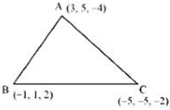
Find the direction cosines of the sides of the triangle whose vertices are $(3,5,-4), (-1,1,2)$ and $(-5,-5,-2)$.
Solution
Let the vertices of $\triangle ABC$ be $A(3,5,-4), B(-1,1,2),$ and $C(-5,-5,-2)$.
The direction ratios of side $AB$ are $(-1-3), (1-5), (2-(-4)),$ which are $-4, -4, 6$.
The magnitude of vector $\vec{AB}$ is $\sqrt{(-4)^2 + (-4)^2 + 6^2} = \sqrt{16+16+36} = \sqrt{68} = 2\sqrt{17}$.
Thus,the direction cosines of $AB$ are $\frac{-4}{2\sqrt{17}}, \frac{-4}{2\sqrt{17}}, \frac{6}{2\sqrt{17}},$ which simplify to $-\frac{2}{\sqrt{17}}, -\frac{2}{\sqrt{17}}, \frac{3}{\sqrt{17}}$.
The direction ratios of side $BC$ are $(-5-(-1)), (-5-1), (-2-2),$ which are $-4, -6, -4$.
The magnitude of vector $\vec{BC}$ is $\sqrt{(-4)^2 + (-6)^2 + (-4)^2} = \sqrt{16+36+16} = \sqrt{68} = 2\sqrt{17}$.
Thus,the direction cosines of $BC$ are $\frac{-4}{2\sqrt{17}}, \frac{-6}{2\sqrt{17}}, \frac{-4}{2\sqrt{17}},$ which simplify to $-\frac{2}{\sqrt{17}}, -\frac{3}{\sqrt{17}}, -\frac{2}{\sqrt{17}}$.
The direction ratios of side $CA$ are $(3-(-5)), (5-(-5)), (-4-(-2)),$ which are $8, 10, -2$.
The magnitude of vector $\vec{CA}$ is $\sqrt{8^2 + 10^2 + (-2)^2} = \sqrt{64+100+4} = \sqrt{168} = 2\sqrt{42}$.
Thus,the direction cosines of $CA$ are $\frac{8}{2\sqrt{42}}, \frac{10}{2\sqrt{42}}, \frac{-2}{2\sqrt{42}},$ which simplify to $\frac{4}{\sqrt{42}}, \frac{5}{\sqrt{42}}, -\frac{1}{\sqrt{42}}$.
The direction ratios of side $AB$ are $(-1-3), (1-5), (2-(-4)),$ which are $-4, -4, 6$.
The magnitude of vector $\vec{AB}$ is $\sqrt{(-4)^2 + (-4)^2 + 6^2} = \sqrt{16+16+36} = \sqrt{68} = 2\sqrt{17}$.
Thus,the direction cosines of $AB$ are $\frac{-4}{2\sqrt{17}}, \frac{-4}{2\sqrt{17}}, \frac{6}{2\sqrt{17}},$ which simplify to $-\frac{2}{\sqrt{17}}, -\frac{2}{\sqrt{17}}, \frac{3}{\sqrt{17}}$.
The direction ratios of side $BC$ are $(-5-(-1)), (-5-1), (-2-2),$ which are $-4, -6, -4$.
The magnitude of vector $\vec{BC}$ is $\sqrt{(-4)^2 + (-6)^2 + (-4)^2} = \sqrt{16+36+16} = \sqrt{68} = 2\sqrt{17}$.
Thus,the direction cosines of $BC$ are $\frac{-4}{2\sqrt{17}}, \frac{-6}{2\sqrt{17}}, \frac{-4}{2\sqrt{17}},$ which simplify to $-\frac{2}{\sqrt{17}}, -\frac{3}{\sqrt{17}}, -\frac{2}{\sqrt{17}}$.
The direction ratios of side $CA$ are $(3-(-5)), (5-(-5)), (-4-(-2)),$ which are $8, 10, -2$.
The magnitude of vector $\vec{CA}$ is $\sqrt{8^2 + 10^2 + (-2)^2} = \sqrt{64+100+4} = \sqrt{168} = 2\sqrt{42}$.
Thus,the direction cosines of $CA$ are $\frac{8}{2\sqrt{42}}, \frac{10}{2\sqrt{42}}, \frac{-2}{2\sqrt{42}},$ which simplify to $\frac{4}{\sqrt{42}}, \frac{5}{\sqrt{42}}, -\frac{1}{\sqrt{42}}$.
0 likes
View Solution119
Easy
Show that the three lines with direction cosines $\frac{12}{13}, \frac{-3}{13}, \frac{-4}{13} ; \frac{4}{13}, \frac{12}{13}, \frac{3}{13} ; \frac{3}{13}, \frac{-4}{13}, \frac{12}{13}$ are mutually perpendicular.
Solution
Two lines with direction cosines $l_{1}, m_{1}, n_{1}$ and $l_{2}, m_{2}, n_{2}$ are perpendicular to each other if $l_{1}l_{2} + m_{1}m_{2} + n_{1}n_{2} = 0$.
$(i)$ For the lines with direction cosines $\frac{12}{13}, \frac{-3}{13}, \frac{-4}{13}$ and $\frac{4}{13}, \frac{12}{13}, \frac{3}{13}$,we have:
$l_{1}l_{2} + m_{1}m_{2} + n_{1}n_{2} = \left(\frac{12}{13}\right)\left(\frac{4}{13}\right) + \left(\frac{-3}{13}\right)\left(\frac{12}{13}\right) + \left(\frac{-4}{13}\right)\left(\frac{3}{13}\right)$
$= \frac{48}{169} - \frac{36}{169} - \frac{12}{169} = 0$.
Thus,these two lines are perpendicular.
$(ii)$ For the lines with direction cosines $\frac{4}{13}, \frac{12}{13}, \frac{3}{13}$ and $\frac{3}{13}, \frac{-4}{13}, \frac{12}{13}$,we have:
$l_{1}l_{2} + m_{1}m_{2} + n_{1}n_{2} = \left(\frac{4}{13}\right)\left(\frac{3}{13}\right) + \left(\frac{12}{13}\right)\left(\frac{-4}{13}\right) + \left(\frac{3}{13}\right)\left(\frac{12}{13}\right)$
$= \frac{12}{169} - \frac{48}{169} + \frac{36}{169} = 0$.
Thus,these two lines are perpendicular.
$(iii)$ For the lines with direction cosines $\frac{3}{13}, \frac{-4}{13}, \frac{12}{13}$ and $\frac{12}{13}, \frac{-3}{13}, \frac{-4}{13}$,we have:
$l_{1}l_{2} + m_{1}m_{2} + n_{1}n_{2} = \left(\frac{3}{13}\right)\left(\frac{12}{13}\right) + \left(\frac{-4}{13}\right)\left(\frac{-3}{13}\right) + \left(\frac{12}{13}\right)\left(\frac{-4}{13}\right)$
$= \frac{36}{169} + \frac{12}{169} - \frac{48}{169} = 0$.
Thus,these two lines are perpendicular.
Since all pairs are perpendicular,the three lines are mutually perpendicular.
$(i)$ For the lines with direction cosines $\frac{12}{13}, \frac{-3}{13}, \frac{-4}{13}$ and $\frac{4}{13}, \frac{12}{13}, \frac{3}{13}$,we have:
$l_{1}l_{2} + m_{1}m_{2} + n_{1}n_{2} = \left(\frac{12}{13}\right)\left(\frac{4}{13}\right) + \left(\frac{-3}{13}\right)\left(\frac{12}{13}\right) + \left(\frac{-4}{13}\right)\left(\frac{3}{13}\right)$
$= \frac{48}{169} - \frac{36}{169} - \frac{12}{169} = 0$.
Thus,these two lines are perpendicular.
$(ii)$ For the lines with direction cosines $\frac{4}{13}, \frac{12}{13}, \frac{3}{13}$ and $\frac{3}{13}, \frac{-4}{13}, \frac{12}{13}$,we have:
$l_{1}l_{2} + m_{1}m_{2} + n_{1}n_{2} = \left(\frac{4}{13}\right)\left(\frac{3}{13}\right) + \left(\frac{12}{13}\right)\left(\frac{-4}{13}\right) + \left(\frac{3}{13}\right)\left(\frac{12}{13}\right)$
$= \frac{12}{169} - \frac{48}{169} + \frac{36}{169} = 0$.
Thus,these two lines are perpendicular.
$(iii)$ For the lines with direction cosines $\frac{3}{13}, \frac{-4}{13}, \frac{12}{13}$ and $\frac{12}{13}, \frac{-3}{13}, \frac{-4}{13}$,we have:
$l_{1}l_{2} + m_{1}m_{2} + n_{1}n_{2} = \left(\frac{3}{13}\right)\left(\frac{12}{13}\right) + \left(\frac{-4}{13}\right)\left(\frac{-3}{13}\right) + \left(\frac{12}{13}\right)\left(\frac{-4}{13}\right)$
$= \frac{36}{169} + \frac{12}{169} - \frac{48}{169} = 0$.
Thus,these two lines are perpendicular.
Since all pairs are perpendicular,the three lines are mutually perpendicular.
0 likes
View Solution120
Difficult
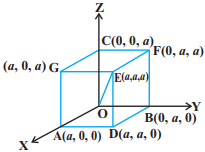
$A$ line makes angles $\alpha, \beta, \gamma$ and $\delta$ with the diagonals of a cube. Prove that $\cos^{2} \alpha + \cos^{2} \beta + \cos^{2} \gamma + \cos^{2} \delta = \frac{4}{3}$.
Solution
(N/A) cube is a rectangular parallelepiped having equal length,breadth,and height.
Let the vertices of the cube be defined such that the diagonals are $OE, AF, BG,$ and $CD$.
Let the side length of the cube be $a$.
The coordinates of the vertices are $O(0,0,0), A(a,0,0), B(0,a,0), C(0,0,a), D(a,a,0), E(a,a,a), F(0,a,a), G(a,0,a)$.
The direction vectors of the four diagonals are:
$d_1 = (a, a, a) \implies \text{unit vector } \hat{d}_1 = \frac{1}{\sqrt{3}}(1, 1, 1)$
$d_2 = (-a, a, a) \implies \text{unit vector } \hat{d}_2 = \frac{1}{\sqrt{3}}(-1, 1, 1)$
$d_3 = (a, -a, a) \implies \text{unit vector } \hat{d}_3 = \frac{1}{\sqrt{3}}(1, -1, 1)$
$d_4 = (a, a, -a) \implies \text{unit vector } \hat{d}_4 = \frac{1}{\sqrt{3}}(1, 1, -1)$
Let the direction cosines of the given line be $(l, m, n)$,where $l^2 + m^2 + n^2 = 1$.
The cosine of the angle between the line and a diagonal with unit vector $\hat{d}$ is given by the dot product: $\cos \theta = |l \cdot d_x + m \cdot d_y + n \cdot d_z|$.
Thus,$\cos \alpha = \frac{1}{\sqrt{3}}(l+m+n)$,$\cos \beta = \frac{1}{\sqrt{3}}(-l+m+n)$,$\cos \gamma = \frac{1}{\sqrt{3}}(l-m+n)$,and $\cos \delta = \frac{1}{\sqrt{3}}(l+m-n)$.
Squaring and adding these values:
$\cos^2 \alpha + \cos^2 \beta + \cos^2 \gamma + \cos^2 \delta = \frac{1}{3} [(l+m+n)^2 + (-l+m+n)^2 + (l-m+n)^2 + (l+m-n)^2]$
$= \frac{1}{3} [ (l^2+m^2+n^2 + 2lm + 2mn + 2nl) + (l^2+m^2+n^2 + 2lm - 2mn - 2nl) + (l^2+m^2+n^2 - 2lm - 2mn + 2nl) + (l^2+m^2+n^2 - 2lm + 2mn - 2nl) ]$
$= \frac{1}{3} [ 4(l^2+m^2+n^2) ]$
Since $l^2+m^2+n^2 = 1$,the sum is $\frac{4}{3}(1) = \frac{4}{3}$.
Let the vertices of the cube be defined such that the diagonals are $OE, AF, BG,$ and $CD$.
Let the side length of the cube be $a$.
The coordinates of the vertices are $O(0,0,0), A(a,0,0), B(0,a,0), C(0,0,a), D(a,a,0), E(a,a,a), F(0,a,a), G(a,0,a)$.
The direction vectors of the four diagonals are:
$d_1 = (a, a, a) \implies \text{unit vector } \hat{d}_1 = \frac{1}{\sqrt{3}}(1, 1, 1)$
$d_2 = (-a, a, a) \implies \text{unit vector } \hat{d}_2 = \frac{1}{\sqrt{3}}(-1, 1, 1)$
$d_3 = (a, -a, a) \implies \text{unit vector } \hat{d}_3 = \frac{1}{\sqrt{3}}(1, -1, 1)$
$d_4 = (a, a, -a) \implies \text{unit vector } \hat{d}_4 = \frac{1}{\sqrt{3}}(1, 1, -1)$
Let the direction cosines of the given line be $(l, m, n)$,where $l^2 + m^2 + n^2 = 1$.
The cosine of the angle between the line and a diagonal with unit vector $\hat{d}$ is given by the dot product: $\cos \theta = |l \cdot d_x + m \cdot d_y + n \cdot d_z|$.
Thus,$\cos \alpha = \frac{1}{\sqrt{3}}(l+m+n)$,$\cos \beta = \frac{1}{\sqrt{3}}(-l+m+n)$,$\cos \gamma = \frac{1}{\sqrt{3}}(l-m+n)$,and $\cos \delta = \frac{1}{\sqrt{3}}(l+m-n)$.
Squaring and adding these values:
$\cos^2 \alpha + \cos^2 \beta + \cos^2 \gamma + \cos^2 \delta = \frac{1}{3} [(l+m+n)^2 + (-l+m+n)^2 + (l-m+n)^2 + (l+m-n)^2]$
$= \frac{1}{3} [ (l^2+m^2+n^2 + 2lm + 2mn + 2nl) + (l^2+m^2+n^2 + 2lm - 2mn - 2nl) + (l^2+m^2+n^2 - 2lm - 2mn + 2nl) + (l^2+m^2+n^2 - 2lm + 2mn - 2nl) ]$
$= \frac{1}{3} [ 4(l^2+m^2+n^2) ]$
Since $l^2+m^2+n^2 = 1$,the sum is $\frac{4}{3}(1) = \frac{4}{3}$.
0 likes
View Solution121
Medium
If $l_{1}, m_{1}, n_{1}$ and $l_{2}, m_{2}, n_{2}$ are the direction cosines of two mutually perpendicular lines,show that the direction cosines of the line perpendicular to both of these are $m_{1} n_{2}-m_{2} n_{1}, n_{1} l_{2}-n_{2} l_{1}, l_{1} m_{2}-l_{2} m_{1}$.
Solution
(N/A) It is given that $l_{1}, m_{1}, n_{1}$ and $l_{2}, m_{2}, n_{2}$ are the direction cosines of two mutually perpendicular lines. Therefore,
$l_{1} l_{2}+m_{1} m_{2}+n_{1} n_{2}=0$ ........$(1)$
$l_{1}^{2}+m_{1}^{2}+n_{1}^{2}=1$ ..........$(2)$
$l_{2}^{2}+m_{2}^{2}+n_{2}^{2}=1$ ...........$(3)$
Let $l, m, n$ be the direction cosines of the line which is perpendicular to the line with direction cosines $l_{1}, m_{1}, n_{1}$ and $l_{2}, m_{2}, n_{2}$.
$\therefore l l_{1} + m m_{1} + n n_{1} = 0$
$l l_{2} + m m_{2} + n n_{2} = 0$
$\therefore \frac{l}{m_{1} n_{2} - m_{2} n_{1}} = \frac{m}{n_{1} l_{2} - n_{2} l_{1}} = \frac{n}{l_{1} m_{2} - l_{2} m_{1}}$
$\Rightarrow \frac{l^{2}}{(m_{1} n_{2} - m_{2} n_{1})^{2}} = \frac{m^{2}}{(n_{1} l_{2} - n_{2} l_{1})^{2}} = \frac{n^{2}}{(l_{1} m_{2} - l_{2} m_{1})^{2}}$
$= \frac{l^{2} + m^{2} + n^{2}}{(m_{1} n_{2} - m_{2} n_{1})^{2} + (n_{1} l_{2} - n_{2} l_{1})^{2} + (l_{1} m_{2} - l_{2} m_{1})^{2}}$ .........$(4)$
Since $l, m, n$ are the direction cosines of the line,$l^{2} + m^{2} + n^{2} = 1$ ........$(5)$
Using the Lagrange identity:
$(l_{1}^{2} + m_{1}^{2} + n_{1}^{2})(l_{2}^{2} + m_{2}^{2} + n_{2}^{2}) - (l_{1} l_{2} + m_{1} m_{2} + n_{1} n_{2})^{2} = (m_{1} n_{2} - m_{2} n_{1})^{2} + (n_{1} l_{2} - n_{2} l_{1})^{2} + (l_{1} m_{2} - l_{2} m_{1})^{2}$
From $(1), (2),$ and $(3),$ we obtain:
$1 \cdot 1 - 0^{2} = (m_{1} n_{2} - m_{2} n_{1})^{2} + (n_{1} l_{2} - n_{2} l_{1})^{2} + (l_{1} m_{2} - l_{2} m_{1})^{2} = 1$ .........$(6)$
Substituting $(5)$ and $(6)$ in $(4),$ we get:
$\frac{l^{2}}{(m_{1} n_{2} - m_{2} n_{1})^{2}} = \frac{m^{2}}{(n_{1} l_{2} - n_{2} l_{1})^{2}} = \frac{n^{2}}{(l_{1} m_{2} - l_{2} m_{1})^{2}} = 1$
Thus,$l = m_{1} n_{2} - m_{2} n_{1}, m = n_{1} l_{2} - n_{2} l_{1}, n = l_{1} m_{2} - l_{2} m_{1}$.
$l_{1} l_{2}+m_{1} m_{2}+n_{1} n_{2}=0$ ........$(1)$
$l_{1}^{2}+m_{1}^{2}+n_{1}^{2}=1$ ..........$(2)$
$l_{2}^{2}+m_{2}^{2}+n_{2}^{2}=1$ ...........$(3)$
Let $l, m, n$ be the direction cosines of the line which is perpendicular to the line with direction cosines $l_{1}, m_{1}, n_{1}$ and $l_{2}, m_{2}, n_{2}$.
$\therefore l l_{1} + m m_{1} + n n_{1} = 0$
$l l_{2} + m m_{2} + n n_{2} = 0$
$\therefore \frac{l}{m_{1} n_{2} - m_{2} n_{1}} = \frac{m}{n_{1} l_{2} - n_{2} l_{1}} = \frac{n}{l_{1} m_{2} - l_{2} m_{1}}$
$\Rightarrow \frac{l^{2}}{(m_{1} n_{2} - m_{2} n_{1})^{2}} = \frac{m^{2}}{(n_{1} l_{2} - n_{2} l_{1})^{2}} = \frac{n^{2}}{(l_{1} m_{2} - l_{2} m_{1})^{2}}$
$= \frac{l^{2} + m^{2} + n^{2}}{(m_{1} n_{2} - m_{2} n_{1})^{2} + (n_{1} l_{2} - n_{2} l_{1})^{2} + (l_{1} m_{2} - l_{2} m_{1})^{2}}$ .........$(4)$
Since $l, m, n$ are the direction cosines of the line,$l^{2} + m^{2} + n^{2} = 1$ ........$(5)$
Using the Lagrange identity:
$(l_{1}^{2} + m_{1}^{2} + n_{1}^{2})(l_{2}^{2} + m_{2}^{2} + n_{2}^{2}) - (l_{1} l_{2} + m_{1} m_{2} + n_{1} n_{2})^{2} = (m_{1} n_{2} - m_{2} n_{1})^{2} + (n_{1} l_{2} - n_{2} l_{1})^{2} + (l_{1} m_{2} - l_{2} m_{1})^{2}$
From $(1), (2),$ and $(3),$ we obtain:
$1 \cdot 1 - 0^{2} = (m_{1} n_{2} - m_{2} n_{1})^{2} + (n_{1} l_{2} - n_{2} l_{1})^{2} + (l_{1} m_{2} - l_{2} m_{1})^{2} = 1$ .........$(6)$
Substituting $(5)$ and $(6)$ in $(4),$ we get:
$\frac{l^{2}}{(m_{1} n_{2} - m_{2} n_{1})^{2}} = \frac{m^{2}}{(n_{1} l_{2} - n_{2} l_{1})^{2}} = \frac{n^{2}}{(l_{1} m_{2} - l_{2} m_{1})^{2}} = 1$
Thus,$l = m_{1} n_{2} - m_{2} n_{1}, m = n_{1} l_{2} - n_{2} l_{1}, n = l_{1} m_{2} - l_{2} m_{1}$.
0 likes
View Solution122
EasyMCQ
Find the octants in which the points $(-3, 1, 2)$ and $(-3, 1, -2)$ lie.
A
Second and Sixth
B
Third and Seventh
C
First and Fifth
D
Fourth and Eighth
Solution
(A) The octants are determined by the signs of the coordinates $(x, y, z)$.
For the point $(-3, 1, 2)$,the signs are $(-, +, +)$,which corresponds to the second octant.
For the point $(-3, 1, -2)$,the signs are $(-, +, -)$,which corresponds to the sixth octant.
Therefore,the points lie in the second and sixth octants respectively.
For the point $(-3, 1, 2)$,the signs are $(-, +, +)$,which corresponds to the second octant.
For the point $(-3, 1, -2)$,the signs are $(-, +, -)$,which corresponds to the sixth octant.
Therefore,the points lie in the second and sixth octants respectively.
0 likes
View Solution123
EasyMCQ
$A$ point is in the $XZ-$ plane. What can you say about its $y-$ coordinate?
A
$0$
B
$1$
C
$2$
D
None of these
Solution
(A) In a three-dimensional Cartesian coordinate system,any point lying in the $XZ-$ plane has its $y-$ coordinate equal to $0$.
Therefore,the $y-$ coordinate of the point is $0$.
Therefore,the $y-$ coordinate of the point is $0$.
0 likes
View Solution124
Easy
Name the octants in which the following points lie:
$(1, 2, 3), (4, -2, 3), (4, -2, -5), (4, 2, -5), (-4, 2, -5), (-4, 2, 5), (-3, -1, 6), (-2, -4, -7)$
$(1, 2, 3), (4, -2, 3), (4, -2, -5), (4, 2, -5), (-4, 2, -5), (-4, 2, 5), (-3, -1, 6), (-2, -4, -7)$
Solution
The octants are determined by the signs of the coordinates $(x, y, z)$:
$1$. $(1, 2, 3)$: All positive,so it lies in octant $I$.
$2$. $(4, -2, 3)$: $(+, -, +)$,so it lies in octant $IV$.
$3$. $(4, -2, -5)$: $(+, -, -)$,so it lies in octant $VIII$.
$4$. $(4, 2, -5)$: $(+, +, -)$,so it lies in octant $V$.
$5$. $(-4, 2, -5)$: $(-, +, -)$,so it lies in octant $VI$.
$6$. $(-4, 2, 5)$: $(-, +, +)$,so it lies in octant $II$.
$7$. $(-3, -1, 6)$: $(-, -, +)$,so it lies in octant $III$.
$8$. $(-2, -4, -7)$: $(-, -, -)$,so it lies in octant $VII$.
$1$. $(1, 2, 3)$: All positive,so it lies in octant $I$.
$2$. $(4, -2, 3)$: $(+, -, +)$,so it lies in octant $IV$.
$3$. $(4, -2, -5)$: $(+, -, -)$,so it lies in octant $VIII$.
$4$. $(4, 2, -5)$: $(+, +, -)$,so it lies in octant $V$.
$5$. $(-4, 2, -5)$: $(-, +, -)$,so it lies in octant $VI$.
$6$. $(-4, 2, 5)$: $(-, +, +)$,so it lies in octant $II$.
$7$. $(-3, -1, 6)$: $(-, -, +)$,so it lies in octant $III$.
$8$. $(-2, -4, -7)$: $(-, -, -)$,so it lies in octant $VII$.
0 likes
View Solution125
Easy
Fill in the blanks:
The coordinates of points in the $XY$-plane are of the form ...........
The coordinates of points in the $XY$-plane are of the form ...........
Solution
(N/A) In a three-dimensional coordinate system,any point in the $XY$-plane has its $z$-coordinate equal to $0$. Therefore,the coordinates of points in the $XY$-plane are of the form $(x, y, 0)$.
0 likes
View Solution126
EasyMCQ
Fill in the blanks:
Coordinate planes divide the space into ........ octants.
Coordinate planes divide the space into ........ octants.
A
$4$
B
$6$
C
$8$
D
$10$
Solution
(C) The three coordinate planes ($XY$,$YZ$,and $ZX$) divide the three-dimensional space into $8$ octants.
0 likes
View Solution127
EasyMCQ
If the direction ratios of a line are $1, 1, 2$,find the direction cosines of the line.
A
$\pm(\frac{1}{\sqrt{6}}, \frac{1}{\sqrt{6}}, \frac{2}{\sqrt{6}})$
B
$\pm(\frac{1}{\sqrt{3}}, \frac{1}{\sqrt{3}}, \frac{1}{\sqrt{3}})$
C
$\pm(\frac{1}{\sqrt{2}}, \frac{1}{\sqrt{2}}, \frac{2}{\sqrt{2}})$
D
$\pm(\frac{1}{6}, \frac{1}{6}, \frac{2}{6})$
Solution
(A) The direction cosines $(l, m, n)$ are given by the formulas:
$l = \frac{a}{\sqrt{a^2 + b^2 + c^2}}, m = \frac{b}{\sqrt{a^2 + b^2 + c^2}}, n = \frac{c}{\sqrt{a^2 + b^2 + c^2}}$
Here,the direction ratios are $a = 1, b = 1, c = 2$.
First,calculate the magnitude:
$\sqrt{a^2 + b^2 + c^2} = \sqrt{1^2 + 1^2 + 2^2} = \sqrt{1 + 1 + 4} = \sqrt{6}$.
Substituting these values,we get:
$l = \frac{1}{\sqrt{6}}, m = \frac{1}{\sqrt{6}}, n = \frac{2}{\sqrt{6}}$.
Since direction cosines can be positive or negative depending on the direction of the line,the direction cosines are $\pm(\frac{1}{\sqrt{6}}, \frac{1}{\sqrt{6}}, \frac{2}{\sqrt{6}})$.
$l = \frac{a}{\sqrt{a^2 + b^2 + c^2}}, m = \frac{b}{\sqrt{a^2 + b^2 + c^2}}, n = \frac{c}{\sqrt{a^2 + b^2 + c^2}}$
Here,the direction ratios are $a = 1, b = 1, c = 2$.
First,calculate the magnitude:
$\sqrt{a^2 + b^2 + c^2} = \sqrt{1^2 + 1^2 + 2^2} = \sqrt{1 + 1 + 4} = \sqrt{6}$.
Substituting these values,we get:
$l = \frac{1}{\sqrt{6}}, m = \frac{1}{\sqrt{6}}, n = \frac{2}{\sqrt{6}}$.
Since direction cosines can be positive or negative depending on the direction of the line,the direction cosines are $\pm(\frac{1}{\sqrt{6}}, \frac{1}{\sqrt{6}}, \frac{2}{\sqrt{6}})$.
0 likes
View Solution128
EasyMCQ
Find the direction cosines of the line passing through the points $P(2, 3, 5)$ and $Q(-1, 2, 4)$.
A
$\left(\frac{3}{\sqrt{11}}, \frac{1}{\sqrt{11}}, \frac{1}{\sqrt{11}}\right)$
B
$\left(\frac{-3}{\sqrt{11}}, \frac{-1}{\sqrt{11}}, \frac{-1}{\sqrt{11}}\right)$
C
Both $A$ and $B$
D
None of these
Solution
(C) The direction ratios of the line passing through $P(x_{1}, y_{1}, z_{1})$ and $Q(x_{2}, y_{2}, z_{2})$ are given by $(x_{2}-x_{1}, y_{2}-y_{1}, z_{2}-z_{1})$.
For points $P(2, 3, 5)$ and $Q(-1, 2, 4)$,the direction ratios are $(-1-2, 2-3, 4-5) = (-3, -1, -1)$.
The distance $PQ$ is $\sqrt{(-3)^{2} + (-1)^{2} + (-1)^{2}} = \sqrt{9 + 1 + 1} = \sqrt{11}$.
The direction cosines are obtained by dividing the direction ratios by the distance $PQ$.
Thus,the direction cosines are $\left(\frac{-3}{\sqrt{11}}, \frac{-1}{\sqrt{11}}, \frac{-1}{\sqrt{11}}\right)$ or $\left(\frac{3}{\sqrt{11}}, \frac{1}{\sqrt{11}}, \frac{1}{\sqrt{11}}\right)$.
For points $P(2, 3, 5)$ and $Q(-1, 2, 4)$,the direction ratios are $(-1-2, 2-3, 4-5) = (-3, -1, -1)$.
The distance $PQ$ is $\sqrt{(-3)^{2} + (-1)^{2} + (-1)^{2}} = \sqrt{9 + 1 + 1} = \sqrt{11}$.
The direction cosines are obtained by dividing the direction ratios by the distance $PQ$.
Thus,the direction cosines are $\left(\frac{-3}{\sqrt{11}}, \frac{-1}{\sqrt{11}}, \frac{-1}{\sqrt{11}}\right)$ or $\left(\frac{3}{\sqrt{11}}, \frac{1}{\sqrt{11}}, \frac{1}{\sqrt{11}}\right)$.
0 likes
View Solution129
EasyMCQ
If a line makes an angle of $30^{\circ}, 60^{\circ}, 90^{\circ}$ with the positive direction of $x, y, z$-axes,respectively,then find its direction cosines.
A
$\left(\frac{\sqrt{3}}{2}, \frac{1}{2}, 0\right)$
B
$\left(\frac{1}{2}, \frac{\sqrt{3}}{2}, 0\right)$
C
$\left(\frac{\sqrt{3}}{2}, 0, \frac{1}{2}\right)$
D
$\left(0, \frac{1}{2}, \frac{\sqrt{3}}{2}\right)$
Solution
(A) The direction cosines of a line that makes angles $\alpha, \beta, \gamma$ with the positive $x, y, z$-axes are given by $l = \cos \alpha$,$m = \cos \beta$,and $n = \cos \gamma$.
Given $\alpha = 30^{\circ}$,$\beta = 60^{\circ}$,and $\gamma = 90^{\circ}$.
Thus,the direction cosines are:
$l = \cos 30^{\circ} = \frac{\sqrt{3}}{2}$
$m = \cos 60^{\circ} = \frac{1}{2}$
$n = \cos 90^{\circ} = 0$
Therefore,the direction cosines are $\left(\frac{\sqrt{3}}{2}, \frac{1}{2}, 0\right)$.
Given $\alpha = 30^{\circ}$,$\beta = 60^{\circ}$,and $\gamma = 90^{\circ}$.
Thus,the direction cosines are:
$l = \cos 30^{\circ} = \frac{\sqrt{3}}{2}$
$m = \cos 60^{\circ} = \frac{1}{2}$
$n = \cos 90^{\circ} = 0$
Therefore,the direction cosines are $\left(\frac{\sqrt{3}}{2}, \frac{1}{2}, 0\right)$.
0 likes
View Solution130
DifficultMCQ
Find the position vector of a point $A$ in space such that $\overrightarrow{OA}$ is inclined at $60^{\circ}$ to $OX$ and at $45^{\circ}$ to $OY$ and $|\overrightarrow{OA}|=10$ units.
A
$5\hat{i} + 5\sqrt{2}\hat{j} + 5\hat{k}$
B
$5\hat{i} + 5\sqrt{2}\hat{j} - 5\hat{k}$
C
$5\hat{i} - 5\sqrt{2}\hat{j} + 5\hat{k}$
D
$5\hat{i} + 5\sqrt{2}\hat{j} + 10\hat{k}$
Solution
(A) Let the direction angles of $\overrightarrow{OA}$ be $\alpha = 60^{\circ}$,$\beta = 45^{\circ}$,and $\gamma$.
We know that $\cos^{2} \alpha + \cos^{2} \beta + \cos^{2} \gamma = 1$.
Substituting the values,we get $\cos^{2} 60^{\circ} + \cos^{2} 45^{\circ} + \cos^{2} \gamma = 1$.
$\Rightarrow (\frac{1}{2})^{2} + (\frac{1}{\sqrt{2}})^{2} + \cos^{2} \gamma = 1$.
$\Rightarrow \frac{1}{4} + \frac{1}{2} + \cos^{2} \gamma = 1$.
$\Rightarrow \frac{3}{4} + \cos^{2} \gamma = 1$.
$\Rightarrow \cos^{2} \gamma = 1 - \frac{3}{4} = \frac{1}{4}$.
$\Rightarrow \cos \gamma = \pm \frac{1}{2}$.
Assuming $\gamma$ is acute,$\cos \gamma = \frac{1}{2}$.
The direction cosines are $l = \cos 60^{\circ} = \frac{1}{2}$,$m = \cos 45^{\circ} = \frac{1}{\sqrt{2}}$,$n = \cos 60^{\circ} = \frac{1}{2}$.
The position vector $\overrightarrow{OA} = |\overrightarrow{OA}| (l\hat{i} + m\hat{j} + n\hat{k})$.
$\overrightarrow{OA} = 10 (\frac{1}{2}\hat{i} + \frac{1}{\sqrt{2}}\hat{j} + \frac{1}{2}\hat{k})$.
$\overrightarrow{OA} = 5\hat{i} + 5\sqrt{2}\hat{j} + 5\hat{k}$.
We know that $\cos^{2} \alpha + \cos^{2} \beta + \cos^{2} \gamma = 1$.
Substituting the values,we get $\cos^{2} 60^{\circ} + \cos^{2} 45^{\circ} + \cos^{2} \gamma = 1$.
$\Rightarrow (\frac{1}{2})^{2} + (\frac{1}{\sqrt{2}})^{2} + \cos^{2} \gamma = 1$.
$\Rightarrow \frac{1}{4} + \frac{1}{2} + \cos^{2} \gamma = 1$.
$\Rightarrow \frac{3}{4} + \cos^{2} \gamma = 1$.
$\Rightarrow \cos^{2} \gamma = 1 - \frac{3}{4} = \frac{1}{4}$.
$\Rightarrow \cos \gamma = \pm \frac{1}{2}$.
Assuming $\gamma$ is acute,$\cos \gamma = \frac{1}{2}$.
The direction cosines are $l = \cos 60^{\circ} = \frac{1}{2}$,$m = \cos 45^{\circ} = \frac{1}{\sqrt{2}}$,$n = \cos 60^{\circ} = \frac{1}{2}$.
The position vector $\overrightarrow{OA} = |\overrightarrow{OA}| (l\hat{i} + m\hat{j} + n\hat{k})$.
$\overrightarrow{OA} = 10 (\frac{1}{2}\hat{i} + \frac{1}{\sqrt{2}}\hat{j} + \frac{1}{2}\hat{k})$.
$\overrightarrow{OA} = 5\hat{i} + 5\sqrt{2}\hat{j} + 5\hat{k}$.
0 likes
View Solution131
DifficultMCQ
Find the angle between the lines whose direction cosines are given by the equations $l+m+n=0$ and $l^{2}+m^{2}-n^{2}=0$.
A
$\frac{\pi}{3}$
B
$\frac{\pi}{4}$
C
$\frac{\pi}{6}$
D
$\frac{\pi}{2}$
Solution
(A) Given equations are $l+m+n=0$ $(1)$ and $l^{2}+m^{2}-n^{2}=0$ $(2)$.
From $(1)$,$n = -(l+m)$. Substituting this into $(2)$:
$l^{2}+m^{2}-(-(l+m))^{2}=0$
$l^{2}+m^{2}-(l^{2}+m^{2}+2lm)=0$
$-2lm=0 \Rightarrow lm=0$.
Case $1$: $l=0$. From $(1)$,$m+n=0 \Rightarrow m=-n$. Direction ratios are $(0, -n, n)$ or $(0, -1, 1)$.
Case $2$: $m=0$. From $(1)$,$l+n=0 \Rightarrow l=-n$. Direction ratios are $(-n, 0, n)$ or $(-1, 0, 1)$.
Let $\vec{a} = 0\hat{i} - 1\hat{j} + 1\hat{k}$ and $\vec{b} = -1\hat{i} + 0\hat{j} + 1\hat{k}$.
$\cos \theta = \frac{|\vec{a} \cdot \vec{b}|}{|\vec{a}| |\vec{b}|} = \frac{|(0)(-1) + (-1)(0) + (1)(1)|}{\sqrt{0^2+(-1)^2+1^2} \sqrt{(-1)^2+0^2+1^2}} = \frac{1}{\sqrt{2} \cdot \sqrt{2}} = \frac{1}{2}$.
Therefore,$\theta = \cos^{-1}(\frac{1}{2}) = \frac{\pi}{3}$.
From $(1)$,$n = -(l+m)$. Substituting this into $(2)$:
$l^{2}+m^{2}-(-(l+m))^{2}=0$
$l^{2}+m^{2}-(l^{2}+m^{2}+2lm)=0$
$-2lm=0 \Rightarrow lm=0$.
Case $1$: $l=0$. From $(1)$,$m+n=0 \Rightarrow m=-n$. Direction ratios are $(0, -n, n)$ or $(0, -1, 1)$.
Case $2$: $m=0$. From $(1)$,$l+n=0 \Rightarrow l=-n$. Direction ratios are $(-n, 0, n)$ or $(-1, 0, 1)$.
Let $\vec{a} = 0\hat{i} - 1\hat{j} + 1\hat{k}$ and $\vec{b} = -1\hat{i} + 0\hat{j} + 1\hat{k}$.
$\cos \theta = \frac{|\vec{a} \cdot \vec{b}|}{|\vec{a}| |\vec{b}|} = \frac{|(0)(-1) + (-1)(0) + (1)(1)|}{\sqrt{0^2+(-1)^2+1^2} \sqrt{(-1)^2+0^2+1^2}} = \frac{1}{\sqrt{2} \cdot \sqrt{2}} = \frac{1}{2}$.
Therefore,$\theta = \cos^{-1}(\frac{1}{2}) = \frac{\pi}{3}$.
0 likes
View Solution132
Difficult
If a variable line in two adjacent positions has direction cosines $l, m, n$ and $l+\delta l, m+\delta m, n+\delta n,$ show that the small angle $\delta \theta$ between the two positions is given by $\delta \theta^{2}=\delta l^{2}+\delta m^{2}+\delta n^{2}$.
Solution
(A) We have $l, m, n$ and $l+\delta l, m+\delta m, n+\delta n$ as direction cosines of a variable line in two different positions.
$\therefore l^{2}+m^{2}+n^{2}=1 \dots (i)$
And $(l+\delta l)^{2}+(m+\delta m)^{2}+(n+\delta n)^{2}=1 \dots (ii)$
$\Rightarrow l^{2}+m^{2}+n^{2}+\delta l^{2}+\delta m^{2}+\delta n^{2}+2(l \delta l+m \delta m+n \delta n)=1$
$\Rightarrow \delta l^{2}+\delta m^{2}+\delta n^{2}=-2(l \delta l+m \delta m+n \delta n) \left[\because l^{2}+m^{2}+n^{2}=1\right]$
$\Rightarrow l \delta l+m \delta m+n \delta n=-\frac{1}{2}(\delta l^{2}+\delta m^{2}+\delta n^{2}) \dots (iii)$
Now,$\vec{a}$ and $\vec{b}$ are unit vectors along a line with direction cosines $l, m, n$ and $(l+\delta l), (m+\delta m), (n+\delta n)$ respectively.
$\therefore \vec{a}=l \hat{i}+m \hat{j}+n \hat{k}$ and $\vec{b}=(l+\delta l) \hat{i}+(m+\delta m) \hat{j}+(n+\delta n) \hat{k}$
$\Rightarrow \cos \delta \theta = \vec{a} \cdot \vec{b} = l(l+\delta l)+m(m+\delta m)+n(n+\delta n)$
$= (l^{2}+m^{2}+n^{2})+(l \delta l+m \delta m+n \delta n)$
$= 1-\frac{1}{2}(\delta l^{2}+\delta m^{2}+\delta n^{2}) \text{ [using Eq. } (iii)]$
$\Rightarrow 2(1-\cos \delta \theta) = \delta l^{2}+\delta m^{2}+\delta n^{2}$
$\Rightarrow 2(2 \sin^{2} \frac{\delta \theta}{2}) = \delta l^{2}+\delta m^{2}+\delta n^{2} \left[\because 1-\cos \theta = 2 \sin^{2} \frac{\theta}{2}\right]$
$\Rightarrow 4(\frac{\delta \theta}{2})^{2} = \delta l^{2}+\delta m^{2}+\delta n^{2} \left[\text{since } \delta \theta \text{ is small, } \sin \frac{\delta \theta}{2} \approx \frac{\delta \theta}{2}\right]$
$\therefore \delta \theta^{2} = \delta l^{2}+\delta m^{2}+\delta n^{2}$
$\therefore l^{2}+m^{2}+n^{2}=1 \dots (i)$
And $(l+\delta l)^{2}+(m+\delta m)^{2}+(n+\delta n)^{2}=1 \dots (ii)$
$\Rightarrow l^{2}+m^{2}+n^{2}+\delta l^{2}+\delta m^{2}+\delta n^{2}+2(l \delta l+m \delta m+n \delta n)=1$
$\Rightarrow \delta l^{2}+\delta m^{2}+\delta n^{2}=-2(l \delta l+m \delta m+n \delta n) \left[\because l^{2}+m^{2}+n^{2}=1\right]$
$\Rightarrow l \delta l+m \delta m+n \delta n=-\frac{1}{2}(\delta l^{2}+\delta m^{2}+\delta n^{2}) \dots (iii)$
Now,$\vec{a}$ and $\vec{b}$ are unit vectors along a line with direction cosines $l, m, n$ and $(l+\delta l), (m+\delta m), (n+\delta n)$ respectively.
$\therefore \vec{a}=l \hat{i}+m \hat{j}+n \hat{k}$ and $\vec{b}=(l+\delta l) \hat{i}+(m+\delta m) \hat{j}+(n+\delta n) \hat{k}$
$\Rightarrow \cos \delta \theta = \vec{a} \cdot \vec{b} = l(l+\delta l)+m(m+\delta m)+n(n+\delta n)$
$= (l^{2}+m^{2}+n^{2})+(l \delta l+m \delta m+n \delta n)$
$= 1-\frac{1}{2}(\delta l^{2}+\delta m^{2}+\delta n^{2}) \text{ [using Eq. } (iii)]$
$\Rightarrow 2(1-\cos \delta \theta) = \delta l^{2}+\delta m^{2}+\delta n^{2}$
$\Rightarrow 2(2 \sin^{2} \frac{\delta \theta}{2}) = \delta l^{2}+\delta m^{2}+\delta n^{2} \left[\because 1-\cos \theta = 2 \sin^{2} \frac{\theta}{2}\right]$
$\Rightarrow 4(\frac{\delta \theta}{2})^{2} = \delta l^{2}+\delta m^{2}+\delta n^{2} \left[\text{since } \delta \theta \text{ is small, } \sin \frac{\delta \theta}{2} \approx \frac{\delta \theta}{2}\right]$
$\therefore \delta \theta^{2} = \delta l^{2}+\delta m^{2}+\delta n^{2}$
0 likes
View Solution133
Easy
Show that the direction cosines of a vector equally inclined to the axes $OX, OY$ and $OZ$ are $\left(\frac{1}{\sqrt{3}}, \frac{1}{\sqrt{3}}, \frac{1}{\sqrt{3}}\right).$
Solution
Let a vector be equally inclined to the axes $OX, OY$,and $OZ$ at an angle $\alpha.$
Then,the direction cosines of the vector are $l = \cos \alpha, m = \cos \alpha,$ and $n = \cos \alpha.$
We know that for any vector,the sum of the squares of its direction cosines is $1.$
Therefore,$\cos^2 \alpha + \cos^2 \alpha + \cos^2 \alpha = 1.$
This simplifies to $3 \cos^2 \alpha = 1.$
Solving for $\cos \alpha,$ we get $\cos^2 \alpha = \frac{1}{3},$ which implies $\cos \alpha = \pm \frac{1}{\sqrt{3}}.$
Assuming the vector is in the first octant,the direction cosines are $\left(\frac{1}{\sqrt{3}}, \frac{1}{\sqrt{3}}, \frac{1}{\sqrt{3}}\right).$
Then,the direction cosines of the vector are $l = \cos \alpha, m = \cos \alpha,$ and $n = \cos \alpha.$
We know that for any vector,the sum of the squares of its direction cosines is $1.$
Therefore,$\cos^2 \alpha + \cos^2 \alpha + \cos^2 \alpha = 1.$
This simplifies to $3 \cos^2 \alpha = 1.$
Solving for $\cos \alpha,$ we get $\cos^2 \alpha = \frac{1}{3},$ which implies $\cos \alpha = \pm \frac{1}{\sqrt{3}}.$
Assuming the vector is in the first octant,the direction cosines are $\left(\frac{1}{\sqrt{3}}, \frac{1}{\sqrt{3}}, \frac{1}{\sqrt{3}}\right).$
0 likes
View Solution134
Medium
Find a vector $\vec{r}$ of magnitude $3 \sqrt{2}$ units which makes an angle of $\frac{\pi}{4}$ and $\frac{\pi}{2}$ with $y$ and $z$-axes,respectively.
Solution
(N/A) Let the direction cosines of the vector $\vec{r}$ be $l, m, n$.
Given that the vector makes an angle of $\frac{\pi}{4}$ with the $y$-axis and $\frac{\pi}{2}$ with the $z$-axis.
Thus,$m = \cos(\frac{\pi}{4}) = \frac{1}{\sqrt{2}}$ and $n = \cos(\frac{\pi}{2}) = 0$.
We know that for any vector,$l^2 + m^2 + n^2 = 1$.
Substituting the values,$l^2 + (\frac{1}{\sqrt{2}})^2 + 0^2 = 1$.
$l^2 + \frac{1}{2} = 1 \Rightarrow l^2 = \frac{1}{2} \Rightarrow l = \pm \frac{1}{\sqrt{2}}$.
The unit vector $\hat{r}$ is given by $l\hat{i} + m\hat{j} + n\hat{k} = \pm \frac{1}{\sqrt{2}}\hat{i} + \frac{1}{\sqrt{2}}\hat{j} + 0\hat{k}$.
The required vector $\vec{r}$ is given by $|\vec{r}| \hat{r} = 3\sqrt{2} (\pm \frac{1}{\sqrt{2}}\hat{i} + \frac{1}{\sqrt{2}}\hat{j} + 0\hat{k})$.
Therefore,$\vec{r} = \pm 3\hat{i} + 3\hat{j}$.
Given that the vector makes an angle of $\frac{\pi}{4}$ with the $y$-axis and $\frac{\pi}{2}$ with the $z$-axis.
Thus,$m = \cos(\frac{\pi}{4}) = \frac{1}{\sqrt{2}}$ and $n = \cos(\frac{\pi}{2}) = 0$.
We know that for any vector,$l^2 + m^2 + n^2 = 1$.
Substituting the values,$l^2 + (\frac{1}{\sqrt{2}})^2 + 0^2 = 1$.
$l^2 + \frac{1}{2} = 1 \Rightarrow l^2 = \frac{1}{2} \Rightarrow l = \pm \frac{1}{\sqrt{2}}$.
The unit vector $\hat{r}$ is given by $l\hat{i} + m\hat{j} + n\hat{k} = \pm \frac{1}{\sqrt{2}}\hat{i} + \frac{1}{\sqrt{2}}\hat{j} + 0\hat{k}$.
The required vector $\vec{r}$ is given by $|\vec{r}| \hat{r} = 3\sqrt{2} (\pm \frac{1}{\sqrt{2}}\hat{i} + \frac{1}{\sqrt{2}}\hat{j} + 0\hat{k})$.
Therefore,$\vec{r} = \pm 3\hat{i} + 3\hat{j}$.
0 likes
View Solution135
DifficultMCQ
Let $\alpha$ be the angle between the lines whose direction cosines satisfy the equations $l+m-n=0$ and $l^{2}+m^{2}-n^{2}=0$. Then the value of $\sin^{4} \alpha + \cos^{4} \alpha$ is
A
$\frac{3}{4}$
B
$\frac{3}{8}$
C
$\frac{5}{8}$
D
$\frac{1}{2}$
Solution
(NONE) Given equations are $l+m-n=0$ and $l^{2}+m^{2}-n^{2}=0$.
From the first equation,$n = l+m$.
Substituting this into the second equation: $l^{2}+m^{2}=(l+m)^{2} = l^{2}+m^{2}+2lm$.
This simplifies to $2lm = 0$,which means $l=0$ or $m=0$.
Case $1$: If $l=0$,then $n=m$. Since $l^{2}+m^{2}+n^{2}=1$,we have $0^{2}+m^{2}+m^{2}=1$,so $2m^{2}=1$,$m = \pm \frac{1}{\sqrt{2}}$. Thus,the direction cosines are $(0, \frac{1}{\sqrt{2}}, \frac{1}{\sqrt{2}})$.
Case $2$: If $m=0$,then $n=l$. Since $l^{2}+m^{2}+n^{2}=1$,we have $l^{2}+0^{2}+l^{2}=1$,so $2l^{2}=1$,$l = \pm \frac{1}{\sqrt{2}}$. Thus,the direction cosines are $(\frac{1}{\sqrt{2}}, 0, \frac{1}{\sqrt{2}})$.
Let the direction cosines be $\vec{u} = (0, \frac{1}{\sqrt{2}}, \frac{1}{\sqrt{2}})$ and $\vec{v} = (\frac{1}{\sqrt{2}}, 0, \frac{1}{\sqrt{2}})$.
The cosine of the angle $\alpha$ between them is $\cos \alpha = |\vec{u} \cdot \vec{v}| = |0 \cdot \frac{1}{\sqrt{2}} + \frac{1}{\sqrt{2}} \cdot 0 + \frac{1}{\sqrt{2}} \cdot \frac{1}{\sqrt{2}}| = \frac{1}{2}$.
We need to find $\sin^{4} \alpha + \cos^{4} \alpha$.
Since $\cos \alpha = \frac{1}{2}$,$\sin^{2} \alpha = 1 - \cos^{2} \alpha = 1 - \frac{1}{4} = \frac{3}{4}$.
Then $\sin^{4} \alpha + \cos^{4} \alpha = (\frac{3}{4})^{2} + (\frac{1}{2})^{2} = \frac{9}{16} + \frac{1}{4} = \frac{9+4}{16} = \frac{13}{16}$.
From the first equation,$n = l+m$.
Substituting this into the second equation: $l^{2}+m^{2}=(l+m)^{2} = l^{2}+m^{2}+2lm$.
This simplifies to $2lm = 0$,which means $l=0$ or $m=0$.
Case $1$: If $l=0$,then $n=m$. Since $l^{2}+m^{2}+n^{2}=1$,we have $0^{2}+m^{2}+m^{2}=1$,so $2m^{2}=1$,$m = \pm \frac{1}{\sqrt{2}}$. Thus,the direction cosines are $(0, \frac{1}{\sqrt{2}}, \frac{1}{\sqrt{2}})$.
Case $2$: If $m=0$,then $n=l$. Since $l^{2}+m^{2}+n^{2}=1$,we have $l^{2}+0^{2}+l^{2}=1$,so $2l^{2}=1$,$l = \pm \frac{1}{\sqrt{2}}$. Thus,the direction cosines are $(\frac{1}{\sqrt{2}}, 0, \frac{1}{\sqrt{2}})$.
Let the direction cosines be $\vec{u} = (0, \frac{1}{\sqrt{2}}, \frac{1}{\sqrt{2}})$ and $\vec{v} = (\frac{1}{\sqrt{2}}, 0, \frac{1}{\sqrt{2}})$.
The cosine of the angle $\alpha$ between them is $\cos \alpha = |\vec{u} \cdot \vec{v}| = |0 \cdot \frac{1}{\sqrt{2}} + \frac{1}{\sqrt{2}} \cdot 0 + \frac{1}{\sqrt{2}} \cdot \frac{1}{\sqrt{2}}| = \frac{1}{2}$.
We need to find $\sin^{4} \alpha + \cos^{4} \alpha$.
Since $\cos \alpha = \frac{1}{2}$,$\sin^{2} \alpha = 1 - \cos^{2} \alpha = 1 - \frac{1}{4} = \frac{3}{4}$.
Then $\sin^{4} \alpha + \cos^{4} \alpha = (\frac{3}{4})^{2} + (\frac{1}{2})^{2} = \frac{9}{16} + \frac{1}{4} = \frac{9+4}{16} = \frac{13}{16}$.
0 likes
View Solution136
DifficultMCQ
The angle between the straight lines,whose direction cosines are given by the equations $2l + 2m - n = 0$ and $mn + nl + lm = 0$,is:
A
$\frac{\pi}{2}$
B
$\pi - \cos^{-1}\left(\frac{4}{9}\right)$
C
$\cos^{-1}\left(\frac{8}{9}\right)$
D
$\frac{\pi}{3}$
Solution
(A) Given equations are $n = 2(l + m)$ and $mn + nl + lm = 0$.
Substituting $n = 2(l + m)$ into the second equation:
$m(2l + 2m) + 2l(l + m) + lm = 0$
$2lm + 2m^2 + 2l^2 + 2lm + lm = 0$
$2l^2 + 5lm + 2m^2 = 0$
Dividing by $m^2$,we get $2t^2 + 5t + 2 = 0$ where $t = \frac{l}{m}$.
Solving the quadratic equation: $(2t + 1)(t + 2) = 0$,so $t = -\frac{1}{2}$ or $t = -2$.
Case $1$: If $\frac{l}{m} = -2$,then $l = -2m$. Substituting into $n = 2(l + m)$,we get $n = 2(-2m + m) = -2m$.
The direction ratios are $(-2m, m, -2m)$,which simplifies to $(-2, 1, -2)$.
Case $2$: If $\frac{l}{m} = -\frac{1}{2}$,then $m = -2l$. Substituting into $n = 2(l + m)$,we get $n = 2(l - 2l) = -2l$.
The direction ratios are $(l, -2l, -2l)$,which simplifies to $(1, -2, -2)$.
Let the direction ratios be $\vec{a} = (-2, 1, -2)$ and $\vec{b} = (1, -2, -2)$.
The cosine of the angle $\theta$ is given by $\cos \theta = \frac{|a_1b_1 + a_2b_2 + a_3b_3|}{\sqrt{a_1^2 + a_2^2 + a_3^2} \sqrt{b_1^2 + b_2^2 + b_3^2}}$.
$\cos \theta = \frac{|(-2)(1) + (1)(-2) + (-2)(-2)|}{\sqrt{4+1+4} \sqrt{1+4+4}} = \frac{|-2 - 2 + 4|}{3 \times 3} = 0$.
Therefore,$\theta = \frac{\pi}{2}$.
Substituting $n = 2(l + m)$ into the second equation:
$m(2l + 2m) + 2l(l + m) + lm = 0$
$2lm + 2m^2 + 2l^2 + 2lm + lm = 0$
$2l^2 + 5lm + 2m^2 = 0$
Dividing by $m^2$,we get $2t^2 + 5t + 2 = 0$ where $t = \frac{l}{m}$.
Solving the quadratic equation: $(2t + 1)(t + 2) = 0$,so $t = -\frac{1}{2}$ or $t = -2$.
Case $1$: If $\frac{l}{m} = -2$,then $l = -2m$. Substituting into $n = 2(l + m)$,we get $n = 2(-2m + m) = -2m$.
The direction ratios are $(-2m, m, -2m)$,which simplifies to $(-2, 1, -2)$.
Case $2$: If $\frac{l}{m} = -\frac{1}{2}$,then $m = -2l$. Substituting into $n = 2(l + m)$,we get $n = 2(l - 2l) = -2l$.
The direction ratios are $(l, -2l, -2l)$,which simplifies to $(1, -2, -2)$.
Let the direction ratios be $\vec{a} = (-2, 1, -2)$ and $\vec{b} = (1, -2, -2)$.
The cosine of the angle $\theta$ is given by $\cos \theta = \frac{|a_1b_1 + a_2b_2 + a_3b_3|}{\sqrt{a_1^2 + a_2^2 + a_3^2} \sqrt{b_1^2 + b_2^2 + b_3^2}}$.
$\cos \theta = \frac{|(-2)(1) + (1)(-2) + (-2)(-2)|}{\sqrt{4+1+4} \sqrt{1+4+4}} = \frac{|-2 - 2 + 4|}{3 \times 3} = 0$.
Therefore,$\theta = \frac{\pi}{2}$.
0 likes
View Solution137
DifficultMCQ
If two straight lines whose direction cosines are given by the relations $l+m-n=0$ and $3l^{2}+m^{2}+cnl=0$ are parallel,then the positive value of $c$ is
A
$6$
B
$4$
C
$3$
D
$2$
Solution
(A) Given the relations for direction cosines $l, m, n$ are $l+m-n=0$ and $3l^{2}+m^{2}+cnl=0$.
From the first equation,we have $n = l+m$.
Substituting this into the second equation: $3l^{2}+m^{2}+cl(l+m)=0$.
Expanding this,we get $3l^{2}+m^{2}+cl^{2}+clm=0$.
Grouping the terms,we have $(3+c)l^{2}+clm+m^{2}=0$.
Dividing by $m^{2}$ (assuming $m \neq 0$),we get $(3+c)(\frac{l}{m})^{2}+c(\frac{l}{m})+1=0$.
Since the two lines are parallel,the roots of this quadratic equation in $(\frac{l}{m})$ must be equal.
Therefore,the discriminant $D = b^{2}-4ac = 0$.
$c^{2}-4(3+c)(1) = 0$.
$c^{2}-4c-12=0$.
Factoring the quadratic,we get $(c-6)(c+2)=0$.
This gives $c=6$ or $c=-2$.
Since we need the positive value of $c$,we have $c=6$.
From the first equation,we have $n = l+m$.
Substituting this into the second equation: $3l^{2}+m^{2}+cl(l+m)=0$.
Expanding this,we get $3l^{2}+m^{2}+cl^{2}+clm=0$.
Grouping the terms,we have $(3+c)l^{2}+clm+m^{2}=0$.
Dividing by $m^{2}$ (assuming $m \neq 0$),we get $(3+c)(\frac{l}{m})^{2}+c(\frac{l}{m})+1=0$.
Since the two lines are parallel,the roots of this quadratic equation in $(\frac{l}{m})$ must be equal.
Therefore,the discriminant $D = b^{2}-4ac = 0$.
$c^{2}-4(3+c)(1) = 0$.
$c^{2}-4c-12=0$.
Factoring the quadratic,we get $(c-6)(c+2)=0$.
This gives $c=6$ or $c=-2$.
Since we need the positive value of $c$,we have $c=6$.
0 likes
View Solution138
MediumMCQ
Let $P(x, y, z)$ be a point in the first octant,whose projection in the $xy$-plane is the point $Q$. Let $OP = \gamma$; the angle between $OQ$ and the positive $x$-axis be $\theta$; and the angle between $OP$ and the positive $z$-axis be $\phi$,where $O$ is the origin. Then the distance of $P$ from the $x$-axis is:
A
$\gamma \sqrt{1-\sin^2 \phi \cos^2 \theta}$
B
$\gamma \sqrt{1+\cos^2 \theta \sin^2 \phi}$
C
$\gamma \sqrt{1-\sin^2 \theta \sin^2 \phi}$
D
$\gamma \sqrt{1+\cos^2 \phi \sin^2 \theta}$
Solution
(A) Given $P(x, y, z)$ in the first octant,$OP = \gamma = \sqrt{x^2+y^2+z^2}$.
The projection of $P$ on the $xy$-plane is $Q(x, y, 0)$.
Let $OQ = r = \sqrt{x^2+y^2}$.
Given the angle between $OQ$ and the positive $x$-axis is $\theta$,we have $x = r \cos \theta$ and $y = r \sin \theta$.
Given the angle between $OP$ and the positive $z$-axis is $\phi$,we have $z = OP \cos \phi = \gamma \cos \phi$.
Also,$r = OP \sin \phi = \gamma \sin \phi$.
Thus,$x = \gamma \sin \phi \cos \theta$,$y = \gamma \sin \phi \sin \theta$,and $z = \gamma \cos \phi$.
The distance of $P(x, y, z)$ from the $x$-axis is $\sqrt{y^2+z^2}$.
Substituting the values: $\sqrt{(\gamma \sin \phi \sin \theta)^2 + (\gamma \cos \phi)^2} = \gamma \sqrt{\sin^2 \phi \sin^2 \theta + \cos^2 \phi}$.
Using $\cos^2 \phi = 1 - \sin^2 \phi$,we get $\gamma \sqrt{\sin^2 \phi \sin^2 \theta + 1 - \sin^2 \phi} = \gamma \sqrt{1 - \sin^2 \phi (1 - \sin^2 \theta)} = \gamma \sqrt{1 - \sin^2 \phi \cos^2 \theta}$.
The projection of $P$ on the $xy$-plane is $Q(x, y, 0)$.
Let $OQ = r = \sqrt{x^2+y^2}$.
Given the angle between $OQ$ and the positive $x$-axis is $\theta$,we have $x = r \cos \theta$ and $y = r \sin \theta$.
Given the angle between $OP$ and the positive $z$-axis is $\phi$,we have $z = OP \cos \phi = \gamma \cos \phi$.
Also,$r = OP \sin \phi = \gamma \sin \phi$.
Thus,$x = \gamma \sin \phi \cos \theta$,$y = \gamma \sin \phi \sin \theta$,and $z = \gamma \cos \phi$.
The distance of $P(x, y, z)$ from the $x$-axis is $\sqrt{y^2+z^2}$.
Substituting the values: $\sqrt{(\gamma \sin \phi \sin \theta)^2 + (\gamma \cos \phi)^2} = \gamma \sqrt{\sin^2 \phi \sin^2 \theta + \cos^2 \phi}$.
Using $\cos^2 \phi = 1 - \sin^2 \phi$,we get $\gamma \sqrt{\sin^2 \phi \sin^2 \theta + 1 - \sin^2 \phi} = \gamma \sqrt{1 - \sin^2 \phi (1 - \sin^2 \theta)} = \gamma \sqrt{1 - \sin^2 \phi \cos^2 \theta}$.
0 likes
View Solution139
DifficultMCQ
Each of the angles $\beta$ and $\gamma$ that a given line makes with the positive $y-$ and $z-$axes,respectively,is half of the angle that this line makes with the positive $x-$axis. Then the sum of all possible values of the angle $\beta$ is
A
$\frac{3 \pi}{4}$
B
$\pi$
C
$\frac{\pi}{2}$
D
$\frac{3 \pi}{2}$
Solution
(A) Let $\alpha, \beta, \gamma$ be the angles made by the line with the positive $x, y, z$-axes respectively.
Given $\beta = \frac{\alpha}{2}$ and $\gamma = \frac{\alpha}{2}$.
The direction cosines of the line satisfy the relation $\cos^2 \alpha + \cos^2 \beta + \cos^2 \gamma = 1$.
Substituting the given values: $\cos^2 \alpha + \cos^2(\frac{\alpha}{2}) + \cos^2(\frac{\alpha}{2}) = 1$.
$\cos^2 \alpha + 2 \cos^2(\frac{\alpha}{2}) = 1$.
Using the identity $\cos^2(\frac{\alpha}{2}) = \frac{1 + \cos \alpha}{2}$,we get $\cos^2 \alpha + 2(\frac{1 + \cos \alpha}{2}) = 1$.
$\cos^2 \alpha + 1 + \cos \alpha = 1$.
$\cos^2 \alpha + \cos \alpha = 0$.
$\cos \alpha(\cos \alpha + 1) = 0$.
This implies $\cos \alpha = 0$ or $\cos \alpha = -1$.
If $\cos \alpha = 0$,then $\alpha = \frac{\pi}{2}$,so $\beta = \frac{\pi}{4}$.
If $\cos \alpha = -1$,then $\alpha = \pi$,so $\beta = \frac{\pi}{2}$.
The possible values for $\beta$ are $\frac{\pi}{4}$ and $\frac{\pi}{2}$.
The sum of all possible values of $\beta$ is $\frac{\pi}{4} + \frac{\pi}{2} = \frac{3 \pi}{4}$.
Given $\beta = \frac{\alpha}{2}$ and $\gamma = \frac{\alpha}{2}$.
The direction cosines of the line satisfy the relation $\cos^2 \alpha + \cos^2 \beta + \cos^2 \gamma = 1$.
Substituting the given values: $\cos^2 \alpha + \cos^2(\frac{\alpha}{2}) + \cos^2(\frac{\alpha}{2}) = 1$.
$\cos^2 \alpha + 2 \cos^2(\frac{\alpha}{2}) = 1$.
Using the identity $\cos^2(\frac{\alpha}{2}) = \frac{1 + \cos \alpha}{2}$,we get $\cos^2 \alpha + 2(\frac{1 + \cos \alpha}{2}) = 1$.
$\cos^2 \alpha + 1 + \cos \alpha = 1$.
$\cos^2 \alpha + \cos \alpha = 0$.
$\cos \alpha(\cos \alpha + 1) = 0$.
This implies $\cos \alpha = 0$ or $\cos \alpha = -1$.
If $\cos \alpha = 0$,then $\alpha = \frac{\pi}{2}$,so $\beta = \frac{\pi}{4}$.
If $\cos \alpha = -1$,then $\alpha = \pi$,so $\beta = \frac{\pi}{2}$.
The possible values for $\beta$ are $\frac{\pi}{4}$ and $\frac{\pi}{2}$.
The sum of all possible values of $\beta$ is $\frac{\pi}{4} + \frac{\pi}{2} = \frac{3 \pi}{4}$.
0 likes
View Solution140
EasyMCQ
$A$ line makes a $45^{\circ}$ angle with the positive $X$-axis and makes equal angles with the positive $Y$-axis and $Z$-axis respectively. The sum of the three angles which the line makes with the positive $X$-axis,$Y$-axis,and $Z$-axis is: (in $^{\circ}$)
A
$135$
B
$150$
C
$165$
D
$180$
Solution
(C) Let the angles made by the line with the positive $X$,$Y$,and $Z$ axes be $\alpha$,$\beta$,and $\gamma$ respectively.
Given $\alpha = 45^{\circ}$ and $\beta = \gamma$.
Using the direction cosine property $\cos^2 \alpha + \cos^2 \beta + \cos^2 \gamma = 1$:
$\cos^2 45^{\circ} + \cos^2 \beta + \cos^2 \beta = 1$
$\left(\frac{1}{\sqrt{2}}\right)^2 + 2\cos^2 \beta = 1$
$\frac{1}{2} + 2\cos^2 \beta = 1$
$2\cos^2 \beta = \frac{1}{2}$
$\cos^2 \beta = \frac{1}{4}$
$\cos \beta = \frac{1}{2}$ (since angles are acute)
$\beta = 60^{\circ}$.
Thus,$\beta = 60^{\circ}$ and $\gamma = 60^{\circ}$.
The sum of the angles is $\alpha + \beta + \gamma = 45^{\circ} + 60^{\circ} + 60^{\circ} = 165^{\circ}$.
Given $\alpha = 45^{\circ}$ and $\beta = \gamma$.
Using the direction cosine property $\cos^2 \alpha + \cos^2 \beta + \cos^2 \gamma = 1$:
$\cos^2 45^{\circ} + \cos^2 \beta + \cos^2 \beta = 1$
$\left(\frac{1}{\sqrt{2}}\right)^2 + 2\cos^2 \beta = 1$
$\frac{1}{2} + 2\cos^2 \beta = 1$
$2\cos^2 \beta = \frac{1}{2}$
$\cos^2 \beta = \frac{1}{4}$
$\cos \beta = \frac{1}{2}$ (since angles are acute)
$\beta = 60^{\circ}$.
Thus,$\beta = 60^{\circ}$ and $\gamma = 60^{\circ}$.
The sum of the angles is $\alpha + \beta + \gamma = 45^{\circ} + 60^{\circ} + 60^{\circ} = 165^{\circ}$.
0 likes
View Solution141
EasyMCQ
If a line makes angles $120^{\circ}$ and $60^{\circ}$ with the positive directions of $X$ and $Z$ axes respectively,then the angle made by the line with the positive $Y$-axis is (in $^{\circ}$)
A
$150$
B
$60$
C
$135$
D
$120$
Solution
(C) Let the direction angles be $\alpha, \beta, \gamma$ with $X, Y, Z$ axes respectively.
Given $\alpha = 120^{\circ}$ and $\gamma = 60^{\circ}$.
We know that $\cos^2 \alpha + \cos^2 \beta + \cos^2 \gamma = 1$.
Substituting the values: $\cos^2(120^{\circ}) + \cos^2 \beta + \cos^2(60^{\circ}) = 1$.
$(-\frac{1}{2})^2 + \cos^2 \beta + (\frac{1}{2})^2 = 1$.
$\frac{1}{4} + \cos^2 \beta + \frac{1}{4} = 1$.
$\cos^2 \beta = 1 - \frac{1}{2} = \frac{1}{2}$.
$\cos \beta = \pm \frac{1}{\sqrt{2}}$.
Thus,$\beta = 45^{\circ}$ or $\beta = 135^{\circ}$.
Since $135^{\circ}$ is one of the options,the correct answer is $135^{\circ}$.
Given $\alpha = 120^{\circ}$ and $\gamma = 60^{\circ}$.
We know that $\cos^2 \alpha + \cos^2 \beta + \cos^2 \gamma = 1$.
Substituting the values: $\cos^2(120^{\circ}) + \cos^2 \beta + \cos^2(60^{\circ}) = 1$.
$(-\frac{1}{2})^2 + \cos^2 \beta + (\frac{1}{2})^2 = 1$.
$\frac{1}{4} + \cos^2 \beta + \frac{1}{4} = 1$.
$\cos^2 \beta = 1 - \frac{1}{2} = \frac{1}{2}$.
$\cos \beta = \pm \frac{1}{\sqrt{2}}$.
Thus,$\beta = 45^{\circ}$ or $\beta = 135^{\circ}$.
Since $135^{\circ}$ is one of the options,the correct answer is $135^{\circ}$.
0 likes
View Solution142
EasyMCQ
$A$ point on the $XOZ$-plane divides the line segment joining the points $(5, -3, -2)$ and $(1, 2, -2)$ at:
A
$\left(\frac{13}{5}, 0, -2\right)$
B
$\left(\frac{13}{5}, 0, 2\right)$
C
$(5, 0, 2)$
D
$(5, 0, -2)$
Solution
(A) Let point $P(x, y, z)$ divide the line segment joining the points $A(5, -3, -2)$ and $B(1, 2, -2)$ in the ratio $m:1$.
Since the point $P$ lies on the $XOZ$-plane,its $y$-coordinate must be $0$.
Using the section formula,the $y$-coordinate of $P$ is given by $\frac{m(2) + 1(-3)}{m + 1} = 0$.
$\Rightarrow 2m - 3 = 0 \Rightarrow m = \frac{3}{2}$.
Now,we find the $x$ and $z$ coordinates using $m = \frac{3}{2}$:
$x = \frac{m(1) + 1(5)}{m + 1} = \frac{\frac{3}{2}(1) + 5}{\frac{3}{2} + 1} = \frac{\frac{3+10}{2}}{\frac{5}{2}} = \frac{13}{5}$.
$z = \frac{m(-2) + 1(-2)}{m + 1} = \frac{\frac{3}{2}(-2) - 2}{\frac{3}{2} + 1} = \frac{-3 - 2}{\frac{5}{2}} = \frac{-5}{\frac{5}{2}} = -2$.
Therefore,the required point is $\left(\frac{13}{5}, 0, -2\right)$.
Since the point $P$ lies on the $XOZ$-plane,its $y$-coordinate must be $0$.
Using the section formula,the $y$-coordinate of $P$ is given by $\frac{m(2) + 1(-3)}{m + 1} = 0$.
$\Rightarrow 2m - 3 = 0 \Rightarrow m = \frac{3}{2}$.
Now,we find the $x$ and $z$ coordinates using $m = \frac{3}{2}$:
$x = \frac{m(1) + 1(5)}{m + 1} = \frac{\frac{3}{2}(1) + 5}{\frac{3}{2} + 1} = \frac{\frac{3+10}{2}}{\frac{5}{2}} = \frac{13}{5}$.
$z = \frac{m(-2) + 1(-2)}{m + 1} = \frac{\frac{3}{2}(-2) - 2}{\frac{3}{2} + 1} = \frac{-3 - 2}{\frac{5}{2}} = \frac{-5}{\frac{5}{2}} = -2$.
Therefore,the required point is $\left(\frac{13}{5}, 0, -2\right)$.
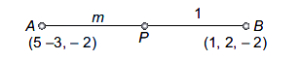
0 likes
View Solution143
MediumMCQ
If a directed line makes angles $45^{\circ}$ and $60^{\circ}$ with the $X$ and $Y$-axes respectively,then the obtuse angle $\theta$ made by the line with the $Z$-axis is (in $^{\circ}$)
A
$135$
B
$120$
C
$160$
D
$150$
Solution
(B) Let the direction angles of the line be $\alpha = 45^{\circ}$,$\beta = 60^{\circ}$,and $\gamma = \theta$.
We know that the sum of the squares of the direction cosines is $1$,i.e.,$\cos^{2}\alpha + \cos^{2}\beta + \cos^{2}\gamma = 1$.
Substituting the given values: $\cos^{2}(45^{\circ}) + \cos^{2}(60^{\circ}) + \cos^{2}\theta = 1$.
$(\frac{1}{\sqrt{2}})^{2} + (\frac{1}{2})^{2} + \cos^{2}\theta = 1$.
$\frac{1}{2} + \frac{1}{4} + \cos^{2}\theta = 1$.
$\frac{3}{4} + \cos^{2}\theta = 1$.
$\cos^{2}\theta = 1 - \frac{3}{4} = \frac{1}{4}$.
$\cos\theta = \pm \frac{1}{2}$.
Since the angle $\theta$ is obtuse,$\cos\theta$ must be negative,so $\cos\theta = -\frac{1}{2}$.
Therefore,$\theta = 120^{\circ}$.
We know that the sum of the squares of the direction cosines is $1$,i.e.,$\cos^{2}\alpha + \cos^{2}\beta + \cos^{2}\gamma = 1$.
Substituting the given values: $\cos^{2}(45^{\circ}) + \cos^{2}(60^{\circ}) + \cos^{2}\theta = 1$.
$(\frac{1}{\sqrt{2}})^{2} + (\frac{1}{2})^{2} + \cos^{2}\theta = 1$.
$\frac{1}{2} + \frac{1}{4} + \cos^{2}\theta = 1$.
$\frac{3}{4} + \cos^{2}\theta = 1$.
$\cos^{2}\theta = 1 - \frac{3}{4} = \frac{1}{4}$.
$\cos\theta = \pm \frac{1}{2}$.
Since the angle $\theta$ is obtuse,$\cos\theta$ must be negative,so $\cos\theta = -\frac{1}{2}$.
Therefore,$\theta = 120^{\circ}$.
0 likes
View Solution144
MediumMCQ
The projection of the line segment joining the points $(2,1,-3)$ and $(-1,0,2)$ on the line whose direction ratios are $3,2,6$ is
A
$\frac{19}{7}$ units
B
$\frac{17}{7}$ units
C
$\frac{11}{7}$ units
D
$\frac{15}{7}$ units
Solution
(A) Let the points be $P(2,1,-3)$ and $Q(-1,0,2)$.
The vector $\vec{PQ} = (-1-2)\hat{i} + (0-1)\hat{j} + (2-(-3))\hat{k} = -3\hat{i} - 1\hat{j} + 5\hat{k}$.
The direction ratios of the line are $3, 2, 6$. The direction vector of the line is $\vec{v} = 3\hat{i} + 2\hat{j} + 6\hat{k}$.
The magnitude of the direction vector is $|\vec{v}| = \sqrt{3^2 + 2^2 + 6^2} = \sqrt{9 + 4 + 36} = \sqrt{49} = 7$.
The unit vector along the line is $\hat{u} = \frac{3\hat{i} + 2\hat{j} + 6\hat{k}}{7}$.
The projection of the line segment $PQ$ on the line is given by the absolute value of the dot product of $\vec{PQ}$ and $\hat{u}$:
Projection $= |\vec{PQ} \cdot \hat{u}| = |(-3\hat{i} - 1\hat{j} + 5\hat{k}) \cdot \frac{(3\hat{i} + 2\hat{j} + 6\hat{k})}{7}|$
$= |\frac{(-3)(3) + (-1)(2) + (5)(6)}{7}| = |\frac{-9 - 2 + 30}{7}| = |\frac{19}{7}| = \frac{19}{7}$ units.
The vector $\vec{PQ} = (-1-2)\hat{i} + (0-1)\hat{j} + (2-(-3))\hat{k} = -3\hat{i} - 1\hat{j} + 5\hat{k}$.
The direction ratios of the line are $3, 2, 6$. The direction vector of the line is $\vec{v} = 3\hat{i} + 2\hat{j} + 6\hat{k}$.
The magnitude of the direction vector is $|\vec{v}| = \sqrt{3^2 + 2^2 + 6^2} = \sqrt{9 + 4 + 36} = \sqrt{49} = 7$.
The unit vector along the line is $\hat{u} = \frac{3\hat{i} + 2\hat{j} + 6\hat{k}}{7}$.
The projection of the line segment $PQ$ on the line is given by the absolute value of the dot product of $\vec{PQ}$ and $\hat{u}$:
Projection $= |\vec{PQ} \cdot \hat{u}| = |(-3\hat{i} - 1\hat{j} + 5\hat{k}) \cdot \frac{(3\hat{i} + 2\hat{j} + 6\hat{k})}{7}|$
$= |\frac{(-3)(3) + (-1)(2) + (5)(6)}{7}| = |\frac{-9 - 2 + 30}{7}| = |\frac{19}{7}| = \frac{19}{7}$ units.
0 likes
View Solution145
MediumMCQ
The angle $\theta$ between the lines whose direction cosines are $l_1 = \frac{-\sqrt{3}}{4}, m_1 = \frac{1}{4}, n_1 = \frac{-\sqrt{3}}{2}$ and $l_2 = \frac{-\sqrt{3}}{4}, m_2 = \frac{1}{4}, n_2 = \frac{\sqrt{3}}{2}$ is: (in $^{\circ}$)
A
$90$
B
$120$
C
$45$
D
$60$
Solution
(D) The angle $\theta$ between two lines with direction cosines $(l_1, m_1, n_1)$ and $(l_2, m_2, n_2)$ is given by $\cos \theta = |l_1 l_2 + m_1 m_2 + n_1 n_2|$.
Given direction cosines are:
Line $1: (\frac{-\sqrt{3}}{4}, \frac{1}{4}, \frac{-\sqrt{3}}{2})$
Line $2: (\frac{-\sqrt{3}}{4}, \frac{1}{4}, \frac{\sqrt{3}}{2})$
Calculating the dot product:
$\cos \theta = |(\frac{-\sqrt{3}}{4})(\frac{-\sqrt{3}}{4}) + (\frac{1}{4})(\frac{1}{4}) + (\frac{-\sqrt{3}}{2})(\frac{\sqrt{3}}{2})|$
$\cos \theta = |\frac{3}{16} + \frac{1}{16} - \frac{3}{4}|$
$\cos \theta = |\frac{4}{16} - \frac{12}{16}| = |\frac{-8}{16}| = |-\frac{1}{2}| = \frac{1}{2}$.
Since $\cos \theta = \frac{1}{2}$,the angle $\theta = 60^{\circ}$.
Thus,the correct option is $D$.
Given direction cosines are:
Line $1: (\frac{-\sqrt{3}}{4}, \frac{1}{4}, \frac{-\sqrt{3}}{2})$
Line $2: (\frac{-\sqrt{3}}{4}, \frac{1}{4}, \frac{\sqrt{3}}{2})$
Calculating the dot product:
$\cos \theta = |(\frac{-\sqrt{3}}{4})(\frac{-\sqrt{3}}{4}) + (\frac{1}{4})(\frac{1}{4}) + (\frac{-\sqrt{3}}{2})(\frac{\sqrt{3}}{2})|$
$\cos \theta = |\frac{3}{16} + \frac{1}{16} - \frac{3}{4}|$
$\cos \theta = |\frac{4}{16} - \frac{12}{16}| = |\frac{-8}{16}| = |-\frac{1}{2}| = \frac{1}{2}$.
Since $\cos \theta = \frac{1}{2}$,the angle $\theta = 60^{\circ}$.
Thus,the correct option is $D$.
0 likes
View Solution146
MediumMCQ
The projection of the line segment joining $P(2, -1, 0)$ and $Q(3, 2, -1)$ on the line whose direction ratios are $1, 2, 2$ is
A
$\frac{1}{3}$
B
$\frac{2}{3}$
C
$\frac{4}{3}$
D
$\frac{5}{3}$
Solution
(D) Let the points be $P(2, -1, 0)$ and $Q(3, 2, -1)$.
The vector $\vec{PQ}$ is given by $(3-2)\hat{i} + (2-(-1))\hat{j} + (-1-0)\hat{k} = 1\hat{i} + 3\hat{j} - 1\hat{k}$.
The direction ratios of the line are $1, 2, 2$. Thus,the direction vector $\vec{v}$ is $1\hat{i} + 2\hat{j} + 2\hat{k}$.
The unit vector $\hat{u}$ along the line is $\frac{1\hat{i} + 2\hat{j} + 2\hat{k}}{\sqrt{1^2 + 2^2 + 2^2}} = \frac{1\hat{i} + 2\hat{j} + 2\hat{k}}{\sqrt{9}} = \frac{1}{3}\hat{i} + \frac{2}{3}\hat{j} + \frac{2}{3}\hat{k}$.
The projection of $\vec{PQ}$ on the line is the dot product $\vec{PQ} \cdot \hat{u}$.
Projection $= (1\hat{i} + 3\hat{j} - 1\hat{k}) \cdot (\frac{1}{3}\hat{i} + \frac{2}{3}\hat{j} + \frac{2}{3}\hat{k})$.
Projection $= (1 \times \frac{1}{3}) + (3 \times \frac{2}{3}) + (-1 \times \frac{2}{3}) = \frac{1}{3} + 2 - \frac{2}{3} = \frac{1-2}{3} + 2 = -\frac{1}{3} + 2 = \frac{5}{3}$.
Thus,the correct option is $D$.
The vector $\vec{PQ}$ is given by $(3-2)\hat{i} + (2-(-1))\hat{j} + (-1-0)\hat{k} = 1\hat{i} + 3\hat{j} - 1\hat{k}$.
The direction ratios of the line are $1, 2, 2$. Thus,the direction vector $\vec{v}$ is $1\hat{i} + 2\hat{j} + 2\hat{k}$.
The unit vector $\hat{u}$ along the line is $\frac{1\hat{i} + 2\hat{j} + 2\hat{k}}{\sqrt{1^2 + 2^2 + 2^2}} = \frac{1\hat{i} + 2\hat{j} + 2\hat{k}}{\sqrt{9}} = \frac{1}{3}\hat{i} + \frac{2}{3}\hat{j} + \frac{2}{3}\hat{k}$.
The projection of $\vec{PQ}$ on the line is the dot product $\vec{PQ} \cdot \hat{u}$.
Projection $= (1\hat{i} + 3\hat{j} - 1\hat{k}) \cdot (\frac{1}{3}\hat{i} + \frac{2}{3}\hat{j} + \frac{2}{3}\hat{k})$.
Projection $= (1 \times \frac{1}{3}) + (3 \times \frac{2}{3}) + (-1 \times \frac{2}{3}) = \frac{1}{3} + 2 - \frac{2}{3} = \frac{1-2}{3} + 2 = -\frac{1}{3} + 2 = \frac{5}{3}$.
Thus,the correct option is $D$.
0 likes
View Solution147
DifficultMCQ
If $\theta$ is the angle between the lines whose direction cosines $(l, m, n)$ satisfy the equations $6mn - 2nl + 5lm = 0$ and $3l + m + 5n = 0$,then $\sin \theta = $
A
$\frac{\sqrt{35}}{6}$
B
$\frac{1}{6}$
C
$\frac{\sqrt{37}}{6}$
D
$\frac{5}{6}$
Solution
(A) Given the equations:
$6mn - 2nl + 5lm = 0$ $(1)$
$3l + m + 5n = 0 \implies m = -(3l + 5n)$ $(2)$
Substitute $(2)$ into $(1)$:
$6n(-(3l + 5n)) - 2nl + 5l(-(3l + 5n)) = 0$
$-18ln - 30n^2 - 2nl - 15l^2 - 25ln = 0$
$-15l^2 - 45ln - 30n^2 = 0$
Divide by $-15$:
$l^2 + 3ln + 2n^2 = 0$
$(l + n)(l + 2n) = 0$
Case $1$: $l = -n$. Then $m = -(3(-n) + 5n) = -2n$.
Direction ratios are $(-n, -2n, n)$,i.e.,$(1, 2, -1)$.
Case $2$: $l = -2n$. Then $m = -(3(-2n) + 5n) = n$.
Direction ratios are $(-2n, n, n)$,i.e.,$(-2, 1, 1)$.
Let $\vec{a} = \hat{i} + 2\hat{j} - \hat{k}$ and $\vec{b} = -2\hat{i} + \hat{j} + \hat{k}$.
$\cos \theta = \frac{|\vec{a} \cdot \vec{b}|}{|\vec{a}| |\vec{b}|} = \frac{|-2 + 2 - 1|}{\sqrt{1+4+1} \sqrt{4+1+1}} = \frac{1}{\sqrt{6} \sqrt{6}} = \frac{1}{6}$.
Since $\sin^2 \theta = 1 - \cos^2 \theta = 1 - (\frac{1}{6})^2 = 1 - \frac{1}{36} = \frac{35}{36}$.
Therefore,$\sin \theta = \frac{\sqrt{35}}{6}$.
$6mn - 2nl + 5lm = 0$ $(1)$
$3l + m + 5n = 0 \implies m = -(3l + 5n)$ $(2)$
Substitute $(2)$ into $(1)$:
$6n(-(3l + 5n)) - 2nl + 5l(-(3l + 5n)) = 0$
$-18ln - 30n^2 - 2nl - 15l^2 - 25ln = 0$
$-15l^2 - 45ln - 30n^2 = 0$
Divide by $-15$:
$l^2 + 3ln + 2n^2 = 0$
$(l + n)(l + 2n) = 0$
Case $1$: $l = -n$. Then $m = -(3(-n) + 5n) = -2n$.
Direction ratios are $(-n, -2n, n)$,i.e.,$(1, 2, -1)$.
Case $2$: $l = -2n$. Then $m = -(3(-2n) + 5n) = n$.
Direction ratios are $(-2n, n, n)$,i.e.,$(-2, 1, 1)$.
Let $\vec{a} = \hat{i} + 2\hat{j} - \hat{k}$ and $\vec{b} = -2\hat{i} + \hat{j} + \hat{k}$.
$\cos \theta = \frac{|\vec{a} \cdot \vec{b}|}{|\vec{a}| |\vec{b}|} = \frac{|-2 + 2 - 1|}{\sqrt{1+4+1} \sqrt{4+1+1}} = \frac{1}{\sqrt{6} \sqrt{6}} = \frac{1}{6}$.
Since $\sin^2 \theta = 1 - \cos^2 \theta = 1 - (\frac{1}{6})^2 = 1 - \frac{1}{36} = \frac{35}{36}$.
Therefore,$\sin \theta = \frac{\sqrt{35}}{6}$.
0 likes
View Solution148
MediumMCQ
The angle between the lines whose direction cosines $(\ell, m, n)$ satisfy the equations $\ell+m+n=0$ and $\ell^2+m^2-n^2=0$ is:
A
$\frac{\pi}{2}$
B
$\frac{\pi}{3}$
C
$\frac{\pi}{4}$
D
$\frac{\pi}{6}$
Solution
(B) Given equations are $\ell+m+n=0$ $(1)$ and $\ell^2+m^2-n^2=0$ $(2)$.
From $(1)$,$n = -(\ell+m)$.
Substituting this into $(2)$: $\ell^2+m^2-(-\ell-m)^2 = 0$.
$\ell^2+m^2-(\ell^2+m^2+2\ell m) = 0$.
$-2\ell m = 0$,which implies $\ell=0$ or $m=0$.
Case $1$: If $\ell=0$,then $n=-m$. The direction ratios are $(0, m, -m)$,which simplifies to $(0, 1, -1)$.
Case $2$: If $m=0$,then $n=-\ell$. The direction ratios are $(\ell, 0, -\ell)$,which simplifies to $(1, 0, -1)$.
Let the direction vectors be $\vec{a} = 0\hat{i} + 1\hat{j} - 1\hat{k}$ and $\vec{b} = 1\hat{i} + 0\hat{j} - 1\hat{k}$.
The angle $\theta$ between them is given by $\cos \theta = \frac{|\vec{a} \cdot \vec{b}|}{|\vec{a}| |\vec{b}|}$.
$\vec{a} \cdot \vec{b} = (0)(1) + (1)(0) + (-1)(-1) = 1$.
$|\vec{a}| = \sqrt{0^2+1^2+(-1)^2} = \sqrt{2}$.
$|\vec{b}| = \sqrt{1^2+0^2+(-1)^2} = \sqrt{2}$.
$\cos \theta = \frac{1}{\sqrt{2} \cdot \sqrt{2}} = \frac{1}{2}$.
Therefore,$\theta = \frac{\pi}{3}$.
From $(1)$,$n = -(\ell+m)$.
Substituting this into $(2)$: $\ell^2+m^2-(-\ell-m)^2 = 0$.
$\ell^2+m^2-(\ell^2+m^2+2\ell m) = 0$.
$-2\ell m = 0$,which implies $\ell=0$ or $m=0$.
Case $1$: If $\ell=0$,then $n=-m$. The direction ratios are $(0, m, -m)$,which simplifies to $(0, 1, -1)$.
Case $2$: If $m=0$,then $n=-\ell$. The direction ratios are $(\ell, 0, -\ell)$,which simplifies to $(1, 0, -1)$.
Let the direction vectors be $\vec{a} = 0\hat{i} + 1\hat{j} - 1\hat{k}$ and $\vec{b} = 1\hat{i} + 0\hat{j} - 1\hat{k}$.
The angle $\theta$ between them is given by $\cos \theta = \frac{|\vec{a} \cdot \vec{b}|}{|\vec{a}| |\vec{b}|}$.
$\vec{a} \cdot \vec{b} = (0)(1) + (1)(0) + (-1)(-1) = 1$.
$|\vec{a}| = \sqrt{0^2+1^2+(-1)^2} = \sqrt{2}$.
$|\vec{b}| = \sqrt{1^2+0^2+(-1)^2} = \sqrt{2}$.
$\cos \theta = \frac{1}{\sqrt{2} \cdot \sqrt{2}} = \frac{1}{2}$.
Therefore,$\theta = \frac{\pi}{3}$.
0 likes
View Solution149
DifficultMCQ
The direction cosines of two lines satisfy the equations $l+m+n=0$ and $2mn+3ln-5lm=0$. The angle between these lines is
A
$\frac{\pi}{2}$
B
$\frac{\pi}{6}$
C
$\frac{\pi}{3}$
D
$\frac{\pi}{4}$
Solution
(C) Given equations are $l+m+n=0$ $(1)$ and $2mn+3ln-5lm=0$ $(2)$.
From $(1)$,$n = -(l+m)$.
Substituting this in $(2)$: $2m(-(l+m)) + 3l(-(l+m)) - 5lm = 0$.
$-2ml - 2m^2 - 3l^2 - 3lm - 5lm = 0$.
$-3l^2 - 10lm - 2m^2 = 0$,which implies $3l^2 + 10lm + 2m^2 = 0$.
Dividing by $m^2$,we get $3(l/m)^2 + 10(l/m) + 2 = 0$.
Let the direction ratios of the two lines be $(l_1, m_1, n_1)$ and $(l_2, m_2, n_2)$.
From the quadratic equation,$l_1/m_1 \times l_2/m_2 = 2/3$,so $l_1l_2/m_1m_2 = 2/3$,which means $3l_1l_2 = 2m_1m_2$.
Similarly,by eliminating $l$ or $m$,we can find the relations between direction cosines.
The angle $\theta$ between the lines is given by $\cos \theta = |l_1l_2 + m_1m_2 + n_1n_2|$.
Using the property of lines satisfying these equations,the angle is $\frac{\pi}{3}$.
From $(1)$,$n = -(l+m)$.
Substituting this in $(2)$: $2m(-(l+m)) + 3l(-(l+m)) - 5lm = 0$.
$-2ml - 2m^2 - 3l^2 - 3lm - 5lm = 0$.
$-3l^2 - 10lm - 2m^2 = 0$,which implies $3l^2 + 10lm + 2m^2 = 0$.
Dividing by $m^2$,we get $3(l/m)^2 + 10(l/m) + 2 = 0$.
Let the direction ratios of the two lines be $(l_1, m_1, n_1)$ and $(l_2, m_2, n_2)$.
From the quadratic equation,$l_1/m_1 \times l_2/m_2 = 2/3$,so $l_1l_2/m_1m_2 = 2/3$,which means $3l_1l_2 = 2m_1m_2$.
Similarly,by eliminating $l$ or $m$,we can find the relations between direction cosines.
The angle $\theta$ between the lines is given by $\cos \theta = |l_1l_2 + m_1m_2 + n_1n_2|$.
Using the property of lines satisfying these equations,the angle is $\frac{\pi}{3}$.
0 likes
View Solution150
EasyMCQ
If the direction cosines $l, m, n$ of two lines are connected by relations $l-5m+3n=0$ and $7l^2+5m^2-3n^2=0$,then the value of $l+m+n$ is
A
$\frac{2}{\sqrt{6}}$ or $\frac{6}{\sqrt{14}}$
B
$\frac{1}{\sqrt{6}}$ or $\frac{5}{\sqrt{14}}$
C
$\frac{2}{\sqrt{6}}$ or $\frac{5}{\sqrt{14}}$
D
$\frac{1}{\sqrt{6}}$ or $\frac{6}{\sqrt{14}}$
Solution
(A) Given relations are $l-5m+3n=0$ and $7l^2+5m^2-3n^2=0$.
From the first equation,$l = 5m - 3n$.
Substituting this into the second equation: $7(5m-3n)^2 + 5m^2 - 3n^2 = 0$.
$7(25m^2 - 30mn + 9n^2) + 5m^2 - 3n^2 = 0$.
$175m^2 - 210mn + 63n^2 + 5m^2 - 3n^2 = 0$.
$180m^2 - 210mn + 60n^2 = 0$.
Dividing by $30$,we get $6m^2 - 7mn + 2n^2 = 0$.
Factoring the quadratic: $(3m - 2n)(2m - n) = 0$.
Case $1$: $3m = 2n \Rightarrow m = \frac{2n}{3}$. Then $l = 5(\frac{2n}{3}) - 3n = \frac{10n-9n}{3} = \frac{n}{3}$.
Using $l^2 + m^2 + n^2 = 1$: $(\frac{n}{3})^2 + (\frac{2n}{3})^2 + n^2 = 1 \Rightarrow \frac{n^2}{9} + \frac{4n^2}{9} + n^2 = 1 \Rightarrow \frac{14n^2}{9} = 1 \Rightarrow n = \frac{3}{\sqrt{14}}$.
Then $l = \frac{1}{\sqrt{14}}$ and $m = \frac{2}{\sqrt{14}}$.
$l+m+n = \frac{1+2+3}{\sqrt{14}} = \frac{6}{\sqrt{14}}$.
Case $2$: $2m = n \Rightarrow m = \frac{n}{2}$. Then $l = 5(\frac{n}{2}) - 3n = \frac{5n-6n}{2} = -\frac{n}{2}$.
Using $l^2 + m^2 + n^2 = 1$: $(-\frac{n}{2})^2 + (\frac{n}{2})^2 + n^2 = 1 \Rightarrow \frac{n^2}{4} + \frac{n^2}{4} + n^2 = 1 \Rightarrow \frac{6n^2}{4} = 1 \Rightarrow n^2 = \frac{2}{3} \Rightarrow n = \sqrt{\frac{2}{3}}$.
Then $l = -\frac{1}{\sqrt{6}}$ and $m = \frac{1}{\sqrt{6}}$.
$l+m+n = \frac{-1+1+\sqrt{4}}{\sqrt{6}} = \frac{2}{\sqrt{6}}$.
Thus,the possible values are $\frac{2}{\sqrt{6}}$ or $\frac{6}{\sqrt{14}}$.
From the first equation,$l = 5m - 3n$.
Substituting this into the second equation: $7(5m-3n)^2 + 5m^2 - 3n^2 = 0$.
$7(25m^2 - 30mn + 9n^2) + 5m^2 - 3n^2 = 0$.
$175m^2 - 210mn + 63n^2 + 5m^2 - 3n^2 = 0$.
$180m^2 - 210mn + 60n^2 = 0$.
Dividing by $30$,we get $6m^2 - 7mn + 2n^2 = 0$.
Factoring the quadratic: $(3m - 2n)(2m - n) = 0$.
Case $1$: $3m = 2n \Rightarrow m = \frac{2n}{3}$. Then $l = 5(\frac{2n}{3}) - 3n = \frac{10n-9n}{3} = \frac{n}{3}$.
Using $l^2 + m^2 + n^2 = 1$: $(\frac{n}{3})^2 + (\frac{2n}{3})^2 + n^2 = 1 \Rightarrow \frac{n^2}{9} + \frac{4n^2}{9} + n^2 = 1 \Rightarrow \frac{14n^2}{9} = 1 \Rightarrow n = \frac{3}{\sqrt{14}}$.
Then $l = \frac{1}{\sqrt{14}}$ and $m = \frac{2}{\sqrt{14}}$.
$l+m+n = \frac{1+2+3}{\sqrt{14}} = \frac{6}{\sqrt{14}}$.
Case $2$: $2m = n \Rightarrow m = \frac{n}{2}$. Then $l = 5(\frac{n}{2}) - 3n = \frac{5n-6n}{2} = -\frac{n}{2}$.
Using $l^2 + m^2 + n^2 = 1$: $(-\frac{n}{2})^2 + (\frac{n}{2})^2 + n^2 = 1 \Rightarrow \frac{n^2}{4} + \frac{n^2}{4} + n^2 = 1 \Rightarrow \frac{6n^2}{4} = 1 \Rightarrow n^2 = \frac{2}{3} \Rightarrow n = \sqrt{\frac{2}{3}}$.
Then $l = -\frac{1}{\sqrt{6}}$ and $m = \frac{1}{\sqrt{6}}$.
$l+m+n = \frac{-1+1+\sqrt{4}}{\sqrt{6}} = \frac{2}{\sqrt{6}}$.
Thus,the possible values are $\frac{2}{\sqrt{6}}$ or $\frac{6}{\sqrt{14}}$.
0 likes
View SolutionTHREE DIMENSIONAL GEOMETRY — System of co-ordinates, Direction cosines and direction ratios, Projection · Frequently Asked Questions
1Are these THREE DIMENSIONAL GEOMETRY questions useful for JEE and NEET?
Yes. All questions in this section are mapped to JEE Main and NEET exam patterns. Previous year questions from JEE Main, NEET, GUJCET and state-level exams are included with full solutions.
2Can I switch to Hindi or Gujarati for these questions?
Yes. Use the language tabs in the hero section or the sidebar to view the same questions and solutions in English, Hindi or Gujarati.
3How do I generate a question paper from this subtopic?
Use the Vedclass Exam Paper Generator — select the chapter and subtopic, set difficulty, and generate Sets A, B, C, D automatically. First 3 chapters of every subject are free.
Vedclass Products
For Students
Vedclass Test Series
Mock tests in real JEE/NEET style with performance analysis. 5-day free trial.
Start Free TrialFor Teachers
Exam Paper Generator
Generate Set A/B/C/D papers from this chapter in 2 minutes. 3 chapters free.
Try FreeFor Institutes
Online Exam Module
Live online exams with unlimited students, 360° analytics & white-label branding.
See DemoFor Teachers & Institutes
Generate a THREE DIMENSIONAL GEOMETRY Exam Paper in 2 Minutes
Select subtopic & difficulty — Sets A, B, C, D auto-generated with No Repeat logic.
First 3 chapters of every subject are free — no payment required.