
A English
Properties of definite integration Questions in English
Class 12 Mathematics · 7-2.Definite Integral · Properties of definite integration
722+
Questions
English
Language
100%
With Solutions
Showing 50 of 722 questions in English
351
DifficultMCQ
Let $f: R \rightarrow R$ be a function defined by $f(x)=\frac{4^x}{4^x+2}$ and $M=\int_{f(a)}^{f(1-a)} x \sin^4(x(1-x)) dx,$ $N=\int_{f(a)}^{f(1-a)} \sin^4(x(1-x)) dx;$ $a \neq \frac{1}{2}.$ If $\alpha M=\beta N,$ $\alpha, \beta \in N,$ then the least value of $\alpha^2+\beta^2$ is equal to $.....$
A
$4$
B
$5$
C
$6$
D
$7$
Solution
(B) First,observe that $f(x) + f(1-x) = \frac{4^x}{4^x+2} + \frac{4^{1-x}}{4^{1-x}+2} = \frac{4^x}{4^x+2} + \frac{4/4^x}{4/4^x+2} = \frac{4^x}{4^x+2} + \frac{4}{4+2 \cdot 4^x} = \frac{4^x}{4^x+2} + \frac{2}{2+4^x} = \frac{4^x+2}{4^x+2} = 1.$
Let $I = \int_{f(a)}^{f(1-a)} x \sin^4(x(1-x)) dx.$ Using the property $\int_A^B g(x) dx = \int_A^B g(A+B-x) dx,$ and noting that $A+B = f(a) + f(1-a) = 1,$ we have:
$M = \int_{f(a)}^{f(1-a)} (1-x) \sin^4((1-x)(1-(1-x))) dx = \int_{f(a)}^{f(1-a)} (1-x) \sin^4((1-x)x) dx.$
Thus,$M = \int_{f(a)}^{f(1-a)} \sin^4(x(1-x)) dx - \int_{f(a)}^{f(1-a)} x \sin^4(x(1-x)) dx.$
This implies $M = N - M,$ which simplifies to $2M = N.$
Given $\alpha M = \beta N,$ we have $\alpha M = \beta (2M),$ so $\alpha = 2\beta.$
Since $\alpha, \beta \in N,$ the smallest values are $\beta = 1$ and $\alpha = 2.$
The value of $\alpha^2 + \beta^2 = 2^2 + 1^2 = 4 + 1 = 5.$
Let $I = \int_{f(a)}^{f(1-a)} x \sin^4(x(1-x)) dx.$ Using the property $\int_A^B g(x) dx = \int_A^B g(A+B-x) dx,$ and noting that $A+B = f(a) + f(1-a) = 1,$ we have:
$M = \int_{f(a)}^{f(1-a)} (1-x) \sin^4((1-x)(1-(1-x))) dx = \int_{f(a)}^{f(1-a)} (1-x) \sin^4((1-x)x) dx.$
Thus,$M = \int_{f(a)}^{f(1-a)} \sin^4(x(1-x)) dx - \int_{f(a)}^{f(1-a)} x \sin^4(x(1-x)) dx.$
This implies $M = N - M,$ which simplifies to $2M = N.$
Given $\alpha M = \beta N,$ we have $\alpha M = \beta (2M),$ so $\alpha = 2\beta.$
Since $\alpha, \beta \in N,$ the smallest values are $\beta = 1$ and $\alpha = 2.$
The value of $\alpha^2 + \beta^2 = 2^2 + 1^2 = 4 + 1 = 5.$
0 likes
View Solution352
DifficultMCQ
$\left|\frac{120}{\pi^3} \int_0^\pi \frac{x^2 \sin x \cos x}{\sin^4 x + \cos^4 x} dx\right|$ is equal to:
A
$15$
B
$16$
C
$17$
D
$18$
Solution
(A) Let $I = \int_0^\pi \frac{x^2 \sin x \cos x}{\sin^4 x + \cos^4 x} dx$.
Using the property $\int_0^a f(x) dx = \int_0^a f(a-x) dx$,we have $I = \int_0^\pi \frac{(\pi-x)^2 \sin(\pi-x) \cos(\pi-x)}{\sin^4(\pi-x) + \cos^4(\pi-x)} dx = \int_0^\pi \frac{(\pi-x)^2 \sin x (-\cos x)}{\sin^4 x + \cos^4 x} dx = -\int_0^\pi \frac{(\pi^2 - 2\pi x + x^2) \sin x \cos x}{\sin^4 x + \cos^4 x} dx$.
Adding the two expressions for $I$: $2I = \int_0^\pi \frac{(x^2 - (\pi^2 - 2\pi x + x^2)) \sin x \cos x}{\sin^4 x + \cos^4 x} dx = \int_0^\pi \frac{(2\pi x - \pi^2) \sin x \cos x}{\sin^4 x + \cos^4 x} dx$.
$2I = 2\pi \int_0^\pi \frac{x \sin x \cos x}{\sin^4 x + \cos^4 x} dx - \pi^2 \int_0^\pi \frac{\sin x \cos x}{\sin^4 x + \cos^4 x} dx$.
Using the property $\int_0^{2a} f(x) dx = 2\int_0^a f(x) dx$ if $f(2a-x) = f(x)$,we find the second integral is $0$ because $\sin(\pi-x)\cos(\pi-x) = -\sin x \cos x$.
Thus,$2I = 2\pi \cdot \frac{\pi}{2} \int_0^\pi \frac{\sin x \cos x}{\sin^4 x + \cos^4 x} dx = 0$.
Wait,re-evaluating: $I = \int_0^{\pi/2} \frac{x^2 \sin x \cos x}{\sin^4 x + \cos^4 x} dx + \int_{\pi/2}^\pi \frac{x^2 \sin x \cos x}{\sin^4 x + \cos^4 x} dx$.
Let $x = \pi - t$ in the second integral: $\int_0^{\pi/2} \frac{(\pi-t)^2 \sin t (-\cos t)}{\sin^4 t + \cos^4 t} dt = -\int_0^{\pi/2} \frac{(\pi^2 - 2\pi t + t^2) \sin t \cos t}{\sin^4 t + \cos^4 t} dt$.
$I = \int_0^{\pi/2} \frac{(t^2 - \pi^2 + 2\pi t - t^2) \sin t \cos t}{\sin^4 t + \cos^4 t} dt = \int_0^{\pi/2} \frac{(2\pi t - \pi^2) \sin t \cos t}{\sin^4 t + \cos^4 t} dt$.
$= 2\pi \int_0^{\pi/2} \frac{t \sin t \cos t}{\sin^4 t + \cos^4 t} dt - \pi^2 \int_0^{\pi/2} \frac{\sin t \cos t}{\sin^4 t + \cos^4 t} dt$.
Using $\int_0^{\pi/2} f(\sin x, \cos x) dx = \int_0^{\pi/2} f(\cos x, \sin x) dx$,the first integral is $\frac{\pi}{4} \int_0^{\pi/2} \frac{\sin t \cos t}{\sin^4 t + \cos^4 t} dt$.
$I = (2\pi \cdot \frac{\pi}{4} - \pi^2) \int_0^{\pi/2} \frac{\sin t \cos t}{\sin^4 t + \cos^4 t} dt = -\frac{\pi^2}{2} \int_0^{\pi/2} \frac{\sin t \cos t}{\sin^4 t + \cos^4 t} dt$.
Let $u = \sin^2 t$,$du = 2 \sin t \cos t dt$. Integral becomes $-\frac{\pi^2}{4} \int_0^1 \frac{du}{u^2 + (1-u)^2} = -\frac{\pi^2}{4} \int_0^1 \frac{du}{2u^2 - 2u + 1} = -\frac{\pi^2}{8} \int_0^1 \frac{du}{(u-1/2)^2 + 1/4} = -\frac{\pi^2}{8} [2 \tan^{-1}(2u-1)]_0^1 = -\frac{\pi^2}{4} (\frac{\pi}{4} - (-\frac{\pi}{4})) = -\frac{\pi^3}{8}$.
Taking absolute value: $|-\frac{\pi^3}{8}| = \frac{\pi^3}{8}$.
Result: $\frac{120}{\pi^3} \cdot \frac{\pi^3}{8} = 15$.
Using the property $\int_0^a f(x) dx = \int_0^a f(a-x) dx$,we have $I = \int_0^\pi \frac{(\pi-x)^2 \sin(\pi-x) \cos(\pi-x)}{\sin^4(\pi-x) + \cos^4(\pi-x)} dx = \int_0^\pi \frac{(\pi-x)^2 \sin x (-\cos x)}{\sin^4 x + \cos^4 x} dx = -\int_0^\pi \frac{(\pi^2 - 2\pi x + x^2) \sin x \cos x}{\sin^4 x + \cos^4 x} dx$.
Adding the two expressions for $I$: $2I = \int_0^\pi \frac{(x^2 - (\pi^2 - 2\pi x + x^2)) \sin x \cos x}{\sin^4 x + \cos^4 x} dx = \int_0^\pi \frac{(2\pi x - \pi^2) \sin x \cos x}{\sin^4 x + \cos^4 x} dx$.
$2I = 2\pi \int_0^\pi \frac{x \sin x \cos x}{\sin^4 x + \cos^4 x} dx - \pi^2 \int_0^\pi \frac{\sin x \cos x}{\sin^4 x + \cos^4 x} dx$.
Using the property $\int_0^{2a} f(x) dx = 2\int_0^a f(x) dx$ if $f(2a-x) = f(x)$,we find the second integral is $0$ because $\sin(\pi-x)\cos(\pi-x) = -\sin x \cos x$.
Thus,$2I = 2\pi \cdot \frac{\pi}{2} \int_0^\pi \frac{\sin x \cos x}{\sin^4 x + \cos^4 x} dx = 0$.
Wait,re-evaluating: $I = \int_0^{\pi/2} \frac{x^2 \sin x \cos x}{\sin^4 x + \cos^4 x} dx + \int_{\pi/2}^\pi \frac{x^2 \sin x \cos x}{\sin^4 x + \cos^4 x} dx$.
Let $x = \pi - t$ in the second integral: $\int_0^{\pi/2} \frac{(\pi-t)^2 \sin t (-\cos t)}{\sin^4 t + \cos^4 t} dt = -\int_0^{\pi/2} \frac{(\pi^2 - 2\pi t + t^2) \sin t \cos t}{\sin^4 t + \cos^4 t} dt$.
$I = \int_0^{\pi/2} \frac{(t^2 - \pi^2 + 2\pi t - t^2) \sin t \cos t}{\sin^4 t + \cos^4 t} dt = \int_0^{\pi/2} \frac{(2\pi t - \pi^2) \sin t \cos t}{\sin^4 t + \cos^4 t} dt$.
$= 2\pi \int_0^{\pi/2} \frac{t \sin t \cos t}{\sin^4 t + \cos^4 t} dt - \pi^2 \int_0^{\pi/2} \frac{\sin t \cos t}{\sin^4 t + \cos^4 t} dt$.
Using $\int_0^{\pi/2} f(\sin x, \cos x) dx = \int_0^{\pi/2} f(\cos x, \sin x) dx$,the first integral is $\frac{\pi}{4} \int_0^{\pi/2} \frac{\sin t \cos t}{\sin^4 t + \cos^4 t} dt$.
$I = (2\pi \cdot \frac{\pi}{4} - \pi^2) \int_0^{\pi/2} \frac{\sin t \cos t}{\sin^4 t + \cos^4 t} dt = -\frac{\pi^2}{2} \int_0^{\pi/2} \frac{\sin t \cos t}{\sin^4 t + \cos^4 t} dt$.
Let $u = \sin^2 t$,$du = 2 \sin t \cos t dt$. Integral becomes $-\frac{\pi^2}{4} \int_0^1 \frac{du}{u^2 + (1-u)^2} = -\frac{\pi^2}{4} \int_0^1 \frac{du}{2u^2 - 2u + 1} = -\frac{\pi^2}{8} \int_0^1 \frac{du}{(u-1/2)^2 + 1/4} = -\frac{\pi^2}{8} [2 \tan^{-1}(2u-1)]_0^1 = -\frac{\pi^2}{4} (\frac{\pi}{4} - (-\frac{\pi}{4})) = -\frac{\pi^3}{8}$.
Taking absolute value: $|-\frac{\pi^3}{8}| = \frac{\pi^3}{8}$.
Result: $\frac{120}{\pi^3} \cdot \frac{\pi^3}{8} = 15$.
0 likes
View Solution353
DifficultMCQ
The value of the integral $\int_0^{\frac{\pi}{4}} \frac{x \, dx}{\sin^4(2x) + \cos^4(2x)}$ equals :
A
$\frac{\sqrt{2} \pi^2}{8}$
B
$\frac{\sqrt{2} \pi^2}{16}$
C
$\frac{\sqrt{2} \pi^2}{32}$
D
$\frac{\sqrt{2} \pi^2}{64}$
Solution
(C) Let $I = \int_0^{\frac{\pi}{4}} \frac{x \, dx}{\sin^4(2x) + \cos^4(2x)}$.
Substitute $2x = t$,so $dx = \frac{1}{2} dt$. When $x=0, t=0$ and when $x=\frac{\pi}{4}, t=\frac{\pi}{2}$.
$I = \int_0^{\frac{\pi}{2}} \frac{(t/2) \cdot (1/2) dt}{\sin^4 t + \cos^4 t} = \frac{1}{4} \int_0^{\frac{\pi}{2}} \frac{t \, dt}{\sin^4 t + \cos^4 t}$.
Using the property $\int_0^a f(t) dt = \int_0^a f(a-t) dt$,we get:
$I = \frac{1}{4} \int_0^{\frac{\pi}{2}} \frac{(\frac{\pi}{2} - t) dt}{\cos^4 t + \sin^4 t} = \frac{\pi}{8} \int_0^{\frac{\pi}{2}} \frac{dt}{\sin^4 t + \cos^4 t} - I$.
Thus,$2I = \frac{\pi}{8} \int_0^{\frac{\pi}{2}} \frac{dt}{\sin^4 t + \cos^4 t}$.
Divide numerator and denominator by $\cos^4 t$:
$2I = \frac{\pi}{8} \int_0^{\frac{\pi}{2}} \frac{\sec^4 t \, dt}{\tan^4 t + 1} = \frac{\pi}{8} \int_0^{\frac{\pi}{2}} \frac{(1 + \tan^2 t) \sec^2 t \, dt}{\tan^4 t + 1}$.
Let $\tan t = y$,then $\sec^2 t \, dt = dy$:
$2I = \frac{\pi}{8} \int_0^{\infty} \frac{1 + y^2}{y^4 + 1} dy = \frac{\pi}{8} \int_0^{\infty} \frac{1 + 1/y^2}{y^2 + 1/y^2} dy$.
Let $y - 1/y = p$,then $(1 + 1/y^2) dy = dp$. Limits change from $-\infty$ to $\infty$:
$2I = \frac{\pi}{8} \int_{-\infty}^{\infty} \frac{dp}{p^2 + 2} = \frac{\pi}{8} \left[ \frac{1}{\sqrt{2}} \tan^{-1} \left( \frac{p}{\sqrt{2}} \right) \right]_{-\infty}^{\infty} = \frac{\pi}{8\sqrt{2}} (\frac{\pi}{2} - (-\frac{\pi}{2})) = \frac{\pi^2}{8\sqrt{2}}$.
Therefore,$I = \frac{\pi^2}{16\sqrt{2}} = \frac{\sqrt{2}\pi^2}{32}$.
Substitute $2x = t$,so $dx = \frac{1}{2} dt$. When $x=0, t=0$ and when $x=\frac{\pi}{4}, t=\frac{\pi}{2}$.
$I = \int_0^{\frac{\pi}{2}} \frac{(t/2) \cdot (1/2) dt}{\sin^4 t + \cos^4 t} = \frac{1}{4} \int_0^{\frac{\pi}{2}} \frac{t \, dt}{\sin^4 t + \cos^4 t}$.
Using the property $\int_0^a f(t) dt = \int_0^a f(a-t) dt$,we get:
$I = \frac{1}{4} \int_0^{\frac{\pi}{2}} \frac{(\frac{\pi}{2} - t) dt}{\cos^4 t + \sin^4 t} = \frac{\pi}{8} \int_0^{\frac{\pi}{2}} \frac{dt}{\sin^4 t + \cos^4 t} - I$.
Thus,$2I = \frac{\pi}{8} \int_0^{\frac{\pi}{2}} \frac{dt}{\sin^4 t + \cos^4 t}$.
Divide numerator and denominator by $\cos^4 t$:
$2I = \frac{\pi}{8} \int_0^{\frac{\pi}{2}} \frac{\sec^4 t \, dt}{\tan^4 t + 1} = \frac{\pi}{8} \int_0^{\frac{\pi}{2}} \frac{(1 + \tan^2 t) \sec^2 t \, dt}{\tan^4 t + 1}$.
Let $\tan t = y$,then $\sec^2 t \, dt = dy$:
$2I = \frac{\pi}{8} \int_0^{\infty} \frac{1 + y^2}{y^4 + 1} dy = \frac{\pi}{8} \int_0^{\infty} \frac{1 + 1/y^2}{y^2 + 1/y^2} dy$.
Let $y - 1/y = p$,then $(1 + 1/y^2) dy = dp$. Limits change from $-\infty$ to $\infty$:
$2I = \frac{\pi}{8} \int_{-\infty}^{\infty} \frac{dp}{p^2 + 2} = \frac{\pi}{8} \left[ \frac{1}{\sqrt{2}} \tan^{-1} \left( \frac{p}{\sqrt{2}} \right) \right]_{-\infty}^{\infty} = \frac{\pi}{8\sqrt{2}} (\frac{\pi}{2} - (-\frac{\pi}{2})) = \frac{\pi^2}{8\sqrt{2}}$.
Therefore,$I = \frac{\pi^2}{16\sqrt{2}} = \frac{\sqrt{2}\pi^2}{32}$.
0 likes
View Solution354
DifficultMCQ
If $\int_{-\pi / 2}^{\pi / 2} \frac{8 \sqrt{2} \cos x \, dx}{(1+e^{\sin x})(1+\sin ^4 x)} = \alpha \pi + \beta \log _e(3+2 \sqrt{2})$,where $\alpha, \beta$ are integers,then $\alpha^2+\beta^2$ equals.....................
A
$4$
B
$3$
C
$2$
D
$8$
Solution
(D) Let $I = \int_{-\frac{\pi}{2}}^{\frac{\pi}{2}} \frac{8 \sqrt{2} \cos x}{(1+e^{\sin x})(1+\sin ^4 x)} \, dx$ $(1)$
Using the property $\int_a^b f(x) \, dx = \int_a^b f(a+b-x) \, dx$,we get:
$I = \int_{-\frac{\pi}{2}}^{\frac{\pi}{2}} \frac{8 \sqrt{2} \cos x}{(1+e^{-\sin x})(1+\sin ^4 x)} \, dx = \int_{-\frac{\pi}{2}}^{\frac{\pi}{2}} \frac{8 \sqrt{2} \cos x \cdot e^{\sin x}}{(1+e^{\sin x})(1+\sin ^4 x)} \, dx$ $(2)$
Adding $(1)$ and $(2)$:
$2I = \int_{-\frac{\pi}{2}}^{\frac{\pi}{2}} \frac{8 \sqrt{2} \cos x}{1+\sin ^4 x} \, dx = 2 \int_{0}^{\frac{\pi}{2}} \frac{8 \sqrt{2} \cos x}{1+\sin ^4 x} \, dx$
$I = \int_{0}^{\frac{\pi}{2}} \frac{8 \sqrt{2} \cos x}{1+\sin ^4 x} \, dx$
Let $\sin x = t$,then $\cos x \, dx = dt$. Limits change from $0$ to $1$:
$I = \int_{0}^{1} \frac{8 \sqrt{2}}{1+t^4} \, dt = 4 \sqrt{2} \int_{0}^{1} \frac{2}{1+t^4} \, dt = 4 \sqrt{2} \int_{0}^{1} \frac{(t^2+1) - (t^2-1)}{1+t^4} \, dt$
$I = 4 \sqrt{2} \left[ \int_{0}^{1} \frac{1+1/t^2}{t^2+1/t^2} \, dt - \int_{0}^{1} \frac{1-1/t^2}{t^2+1/t^2} \, dt \right]$
$I = 4 \sqrt{2} \left[ \int_{0}^{1} \frac{d(t-1/t)}{(t-1/t)^2+2} - \int_{0}^{1} \frac{d(t+1/t)}{(t+1/t)^2-2} \right]$
Evaluating the integrals:
$I = 4 \sqrt{2} \left[ \frac{1}{\sqrt{2}} \tan^{-1} \left( \frac{t-1/t}{\sqrt{2}} \right) \Big|_0^1 - \frac{1}{2\sqrt{2}} \ln \left| \frac{t+1/t-\sqrt{2}}{t+1/t+\sqrt{2}} \right| \Big|_0^1 \right]$
$I = 4 \sqrt{2} \left[ \frac{1}{\sqrt{2}} (\frac{\pi}{2} - (-\frac{\pi}{2})) - \frac{1}{2\sqrt{2}} (\ln \frac{2-\sqrt{2}}{2+\sqrt{2}} - \ln 1) \right]$
$I = 2\pi - 2 \ln \left( \frac{2-\sqrt{2}}{2+\sqrt{2}} \cdot \frac{2-\sqrt{2}}{2-\sqrt{2}} \right) = 2\pi - 2 \ln \left( \frac{6-4\sqrt{2}}{2} \right) = 2\pi - 2 \ln (3-2\sqrt{2}) = 2\pi + 2 \ln (3+2\sqrt{2})$
Thus,$\alpha = 2, \beta = 2$. Therefore,$\alpha^2 + \beta^2 = 2^2 + 2^2 = 8$.
Using the property $\int_a^b f(x) \, dx = \int_a^b f(a+b-x) \, dx$,we get:
$I = \int_{-\frac{\pi}{2}}^{\frac{\pi}{2}} \frac{8 \sqrt{2} \cos x}{(1+e^{-\sin x})(1+\sin ^4 x)} \, dx = \int_{-\frac{\pi}{2}}^{\frac{\pi}{2}} \frac{8 \sqrt{2} \cos x \cdot e^{\sin x}}{(1+e^{\sin x})(1+\sin ^4 x)} \, dx$ $(2)$
Adding $(1)$ and $(2)$:
$2I = \int_{-\frac{\pi}{2}}^{\frac{\pi}{2}} \frac{8 \sqrt{2} \cos x}{1+\sin ^4 x} \, dx = 2 \int_{0}^{\frac{\pi}{2}} \frac{8 \sqrt{2} \cos x}{1+\sin ^4 x} \, dx$
$I = \int_{0}^{\frac{\pi}{2}} \frac{8 \sqrt{2} \cos x}{1+\sin ^4 x} \, dx$
Let $\sin x = t$,then $\cos x \, dx = dt$. Limits change from $0$ to $1$:
$I = \int_{0}^{1} \frac{8 \sqrt{2}}{1+t^4} \, dt = 4 \sqrt{2} \int_{0}^{1} \frac{2}{1+t^4} \, dt = 4 \sqrt{2} \int_{0}^{1} \frac{(t^2+1) - (t^2-1)}{1+t^4} \, dt$
$I = 4 \sqrt{2} \left[ \int_{0}^{1} \frac{1+1/t^2}{t^2+1/t^2} \, dt - \int_{0}^{1} \frac{1-1/t^2}{t^2+1/t^2} \, dt \right]$
$I = 4 \sqrt{2} \left[ \int_{0}^{1} \frac{d(t-1/t)}{(t-1/t)^2+2} - \int_{0}^{1} \frac{d(t+1/t)}{(t+1/t)^2-2} \right]$
Evaluating the integrals:
$I = 4 \sqrt{2} \left[ \frac{1}{\sqrt{2}} \tan^{-1} \left( \frac{t-1/t}{\sqrt{2}} \right) \Big|_0^1 - \frac{1}{2\sqrt{2}} \ln \left| \frac{t+1/t-\sqrt{2}}{t+1/t+\sqrt{2}} \right| \Big|_0^1 \right]$
$I = 4 \sqrt{2} \left[ \frac{1}{\sqrt{2}} (\frac{\pi}{2} - (-\frac{\pi}{2})) - \frac{1}{2\sqrt{2}} (\ln \frac{2-\sqrt{2}}{2+\sqrt{2}} - \ln 1) \right]$
$I = 2\pi - 2 \ln \left( \frac{2-\sqrt{2}}{2+\sqrt{2}} \cdot \frac{2-\sqrt{2}}{2-\sqrt{2}} \right) = 2\pi - 2 \ln \left( \frac{6-4\sqrt{2}}{2} \right) = 2\pi - 2 \ln (3-2\sqrt{2}) = 2\pi + 2 \ln (3+2\sqrt{2})$
Thus,$\alpha = 2, \beta = 2$. Therefore,$\alpha^2 + \beta^2 = 2^2 + 2^2 = 8$.
0 likes
View Solution355
MediumMCQ
The value of $\int_0^1 (2x^3 - 3x^2 - x + 1)^{\frac{1}{3}} dx$ is equal to:
A
$0$
B
$1$
C
$2$
D
$-1$
Solution
(A) Let $I = \int_0^1 (2x^3 - 3x^2 - x + 1)^{\frac{1}{3}} dx$.
Consider the property $\int_0^a f(x) dx = \int_0^a f(a-x) dx$.
Let $f(x) = (2x^3 - 3x^2 - x + 1)^{\frac{1}{3}}$.
Then $f(1-x) = (2(1-x)^3 - 3(1-x)^2 - (1-x) + 1)^{\frac{1}{3}}$.
Expanding the terms: $f(1-x) = (2(1 - 3x + 3x^2 - x^3) - 3(1 - 2x + x^2) - 1 + x + 1)^{\frac{1}{3}}$.
$f(1-x) = (2 - 6x + 6x^2 - 2x^3 - 3 + 6x - 3x^2 - 1 + x + 1)^{\frac{1}{3}}$.
$f(1-x) = (-2x^3 + 3x^2 + x - 1)^{\frac{1}{3}} = -(2x^3 - 3x^2 - x + 1)^{\frac{1}{3}} = -f(x)$.
Since $f(1-x) = -f(x)$,the integral $I = \int_0^1 f(x) dx$ satisfies $I = -I$,which implies $2I = 0$,so $I = 0$.
Consider the property $\int_0^a f(x) dx = \int_0^a f(a-x) dx$.
Let $f(x) = (2x^3 - 3x^2 - x + 1)^{\frac{1}{3}}$.
Then $f(1-x) = (2(1-x)^3 - 3(1-x)^2 - (1-x) + 1)^{\frac{1}{3}}$.
Expanding the terms: $f(1-x) = (2(1 - 3x + 3x^2 - x^3) - 3(1 - 2x + x^2) - 1 + x + 1)^{\frac{1}{3}}$.
$f(1-x) = (2 - 6x + 6x^2 - 2x^3 - 3 + 6x - 3x^2 - 1 + x + 1)^{\frac{1}{3}}$.
$f(1-x) = (-2x^3 + 3x^2 + x - 1)^{\frac{1}{3}} = -(2x^3 - 3x^2 - x + 1)^{\frac{1}{3}} = -f(x)$.
Since $f(1-x) = -f(x)$,the integral $I = \int_0^1 f(x) dx$ satisfies $I = -I$,which implies $2I = 0$,so $I = 0$.
0 likes
View Solution356
DifficultMCQ
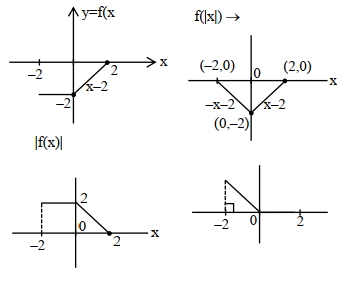
Let $f(x) = \begin{cases} -2, & -2 \leq x \leq 0 \\ x-2, & 0 < x \leq 2 \end{cases}$ and $h(x) = f(|x|) + |f(x)|$. Then $\int_{-2}^2 h(x) dx$ is equal to:
A
$2$
B
$4$
C
$1$
D
$6$
Solution
(A) Given $f(x) = \begin{cases} -2, & -2 \leq x \leq 0 \\ x-2, & 0 < x \leq 2 \end{cases}$.
We need to find $h(x) = f(|x|) + |f(x)|$.
For $x \in [0, 2]$,$f(|x|) = f(x) = x-2$ and $|f(x)| = |x-2| = 2-x$. Thus,$h(x) = (x-2) + (2-x) = 0$.
For $x \in [-2, 0)$,$f(|x|) = f(-x) = -2$ (since $-x \in (0, 2]$ is not true,actually for $x \in [-2, 0)$,$|x| \in (0, 2]$,so $f(|x|) = |x|-2 = -x-2$).
Wait,let's re-evaluate: $f(|x|) = \begin{cases} -2, & |x| \leq 0 \text{ (only } x=0) \\ |x|-2, & 0 < |x| \leq 2 \end{cases} = |x|-2$.
So $f(|x|) = |x|-2$.
$|f(x)| = \begin{cases} |-2| = 2, & -2 \leq x \leq 0 \\ |x-2| = 2-x, & 0 < x \leq 2 \end{cases}$.
Thus,$h(x) = f(|x|) + |f(x)| = \begin{cases} (-x-2) + 2 = -x, & -2 \leq x < 0 \\ (x-2) + (2-x) = 0, & 0 \leq x \leq 2 \end{cases}$.
Now,$\int_{-2}^2 h(x) dx = \int_{-2}^0 (-x) dx + \int_0^2 0 dx = \left[ -\frac{x^2}{2} \right]_{-2}^0 = 0 - (-\frac{(-2)^2}{2}) = 0 - (-2) = 2$.
We need to find $h(x) = f(|x|) + |f(x)|$.
For $x \in [0, 2]$,$f(|x|) = f(x) = x-2$ and $|f(x)| = |x-2| = 2-x$. Thus,$h(x) = (x-2) + (2-x) = 0$.
For $x \in [-2, 0)$,$f(|x|) = f(-x) = -2$ (since $-x \in (0, 2]$ is not true,actually for $x \in [-2, 0)$,$|x| \in (0, 2]$,so $f(|x|) = |x|-2 = -x-2$).
Wait,let's re-evaluate: $f(|x|) = \begin{cases} -2, & |x| \leq 0 \text{ (only } x=0) \\ |x|-2, & 0 < |x| \leq 2 \end{cases} = |x|-2$.
So $f(|x|) = |x|-2$.
$|f(x)| = \begin{cases} |-2| = 2, & -2 \leq x \leq 0 \\ |x-2| = 2-x, & 0 < x \leq 2 \end{cases}$.
Thus,$h(x) = f(|x|) + |f(x)| = \begin{cases} (-x-2) + 2 = -x, & -2 \leq x < 0 \\ (x-2) + (2-x) = 0, & 0 \leq x \leq 2 \end{cases}$.
Now,$\int_{-2}^2 h(x) dx = \int_{-2}^0 (-x) dx + \int_0^2 0 dx = \left[ -\frac{x^2}{2} \right]_{-2}^0 = 0 - (-\frac{(-2)^2}{2}) = 0 - (-2) = 2$.
0 likes
View Solution357
DifficultMCQ
If $\int_0^{\frac{\pi}{4}} \frac{\sin^2 x}{1+\sin x \cos x} dx = \frac{1}{a} \log_e\left(\frac{a}{3}\right) + \frac{\pi}{b \sqrt{3}}$,where $a, b \in N$,then $a+b$ is equal to ....................
A
$6$
B
$8$
C
$4$
D
$1$
Solution
(B) Let $I = \int_0^{\frac{\pi}{4}} \frac{\sin^2 x}{1+\sin x \cos x} dx$. Multiply numerator and denominator by $2$ to get $I = \int_0^{\frac{\pi}{4}} \frac{2\sin^2 x}{2+2\sin x \cos x} dx = \int_0^{\frac{\pi}{4}} \frac{1-\cos 2x}{2+\sin 2x} dx$.
This splits into $I = \int_0^{\frac{\pi}{4}} \frac{1}{2+\sin 2x} dx - \int_0^{\frac{\pi}{4}} \frac{\cos 2x}{2+\sin 2x} dx = I_1 - I_2$.
For $I_1 = \int_0^{\frac{\pi}{4}} \frac{\sec^2 x}{2\tan^2 x + 2\tan x + 2} dx$. Let $t = \tan x$,$dt = \sec^2 x dx$. Limits change from $0$ to $1$.
$I_1 = \frac{1}{2} \int_0^1 \frac{dt}{t^2+t+1} = \frac{1}{2} \int_0^1 \frac{dt}{(t+1/2)^2 + 3/4} = \frac{1}{2} \cdot \frac{2}{\sqrt{3}} [\tan^{-1}(\frac{2t+1}{\sqrt{3}})]_0^1 = \frac{1}{\sqrt{3}} (\frac{\pi}{3} - \frac{\pi}{6}) = \frac{\pi}{6\sqrt{3}}$.
For $I_2 = \int_0^{\frac{\pi}{4}} \frac{\cos 2x}{2+\sin 2x} dx$. Let $u = 2+\sin 2x$,$du = 2\cos 2x dx$.
$I_2 = \frac{1}{2} \int_2^3 \frac{du}{u} = \frac{1}{2} \ln(\frac{3}{2}) = \frac{1}{2} \ln(3) - \frac{1}{2} \ln(2)$.
Comparing $I = I_1 - I_2 = \frac{\pi}{6\sqrt{3}} - \frac{1}{2} \ln(3) + \frac{1}{2} \ln(2) = \frac{\pi}{6\sqrt{3}} + \frac{1}{2} \ln(2/3)$.
Given form is $\frac{1}{a} \ln(a/3) + \frac{\pi}{b\sqrt{3}}$. With $a=2, b=6$,we get $\frac{1}{2} \ln(2/3) + \frac{\pi}{6\sqrt{3}}$.
Thus $a=2, b=6$,so $a+b = 8$.
This splits into $I = \int_0^{\frac{\pi}{4}} \frac{1}{2+\sin 2x} dx - \int_0^{\frac{\pi}{4}} \frac{\cos 2x}{2+\sin 2x} dx = I_1 - I_2$.
For $I_1 = \int_0^{\frac{\pi}{4}} \frac{\sec^2 x}{2\tan^2 x + 2\tan x + 2} dx$. Let $t = \tan x$,$dt = \sec^2 x dx$. Limits change from $0$ to $1$.
$I_1 = \frac{1}{2} \int_0^1 \frac{dt}{t^2+t+1} = \frac{1}{2} \int_0^1 \frac{dt}{(t+1/2)^2 + 3/4} = \frac{1}{2} \cdot \frac{2}{\sqrt{3}} [\tan^{-1}(\frac{2t+1}{\sqrt{3}})]_0^1 = \frac{1}{\sqrt{3}} (\frac{\pi}{3} - \frac{\pi}{6}) = \frac{\pi}{6\sqrt{3}}$.
For $I_2 = \int_0^{\frac{\pi}{4}} \frac{\cos 2x}{2+\sin 2x} dx$. Let $u = 2+\sin 2x$,$du = 2\cos 2x dx$.
$I_2 = \frac{1}{2} \int_2^3 \frac{du}{u} = \frac{1}{2} \ln(\frac{3}{2}) = \frac{1}{2} \ln(3) - \frac{1}{2} \ln(2)$.
Comparing $I = I_1 - I_2 = \frac{\pi}{6\sqrt{3}} - \frac{1}{2} \ln(3) + \frac{1}{2} \ln(2) = \frac{\pi}{6\sqrt{3}} + \frac{1}{2} \ln(2/3)$.
Given form is $\frac{1}{a} \ln(a/3) + \frac{\pi}{b\sqrt{3}}$. With $a=2, b=6$,we get $\frac{1}{2} \ln(2/3) + \frac{\pi}{6\sqrt{3}}$.
Thus $a=2, b=6$,so $a+b = 8$.
0 likes
View Solution358
DifficultMCQ
If the value of the integral $\int_{-1}^1 \frac{\cos \alpha x}{1+3^x} d x$ is $\frac{2}{\pi}$,then a value of $\alpha$ is
A
$\frac{\pi}{6}$
B
$\frac{\pi}{2}$
C
$\frac{\pi}{3}$
D
$\frac{\pi}{4}$
Solution
(B) Let $I = \int_{-1}^{1} \frac{\cos \alpha x}{1+3^x} dx$ $(1)$
Using the property $\int_{a}^{b} f(x) dx = \int_{a}^{b} f(a+b-x) dx$,we get:
$I = \int_{-1}^{1} \frac{\cos \alpha (-x)}{1+3^{-x}} dx = \int_{-1}^{1} \frac{\cos \alpha x}{1+\frac{1}{3^x}} dx = \int_{-1}^{1} \frac{3^x \cos \alpha x}{3^x+1} dx$ $(2)$
Adding $(1)$ and $(2)$:
$2I = \int_{-1}^{1} \frac{\cos \alpha x}{1+3^x} dx + \int_{-1}^{1} \frac{3^x \cos \alpha x}{1+3^x} dx$
$2I = \int_{-1}^{1} \frac{(1+3^x) \cos \alpha x}{1+3^x} dx = \int_{-1}^{1} \cos \alpha x dx$
Since $\cos \alpha x$ is an even function:
$2I = 2 \int_{0}^{1} \cos \alpha x dx = 2 \left[ \frac{\sin \alpha x}{\alpha} \right]_{0}^{1} = \frac{2 \sin \alpha}{\alpha}$
$I = \frac{\sin \alpha}{\alpha}$
Given $I = \frac{2}{\pi}$,so $\frac{\sin \alpha}{\alpha} = \frac{2}{\pi}$.
By inspection,$\alpha = \frac{\pi}{2}$ satisfies the equation since $\frac{\sin(\pi/2)}{\pi/2} = \frac{1}{\pi/2} = \frac{2}{\pi}$.
Using the property $\int_{a}^{b} f(x) dx = \int_{a}^{b} f(a+b-x) dx$,we get:
$I = \int_{-1}^{1} \frac{\cos \alpha (-x)}{1+3^{-x}} dx = \int_{-1}^{1} \frac{\cos \alpha x}{1+\frac{1}{3^x}} dx = \int_{-1}^{1} \frac{3^x \cos \alpha x}{3^x+1} dx$ $(2)$
Adding $(1)$ and $(2)$:
$2I = \int_{-1}^{1} \frac{\cos \alpha x}{1+3^x} dx + \int_{-1}^{1} \frac{3^x \cos \alpha x}{1+3^x} dx$
$2I = \int_{-1}^{1} \frac{(1+3^x) \cos \alpha x}{1+3^x} dx = \int_{-1}^{1} \cos \alpha x dx$
Since $\cos \alpha x$ is an even function:
$2I = 2 \int_{0}^{1} \cos \alpha x dx = 2 \left[ \frac{\sin \alpha x}{\alpha} \right]_{0}^{1} = \frac{2 \sin \alpha}{\alpha}$
$I = \frac{\sin \alpha}{\alpha}$
Given $I = \frac{2}{\pi}$,so $\frac{\sin \alpha}{\alpha} = \frac{2}{\pi}$.
By inspection,$\alpha = \frac{\pi}{2}$ satisfies the equation since $\frac{\sin(\pi/2)}{\pi/2} = \frac{1}{\pi/2} = \frac{2}{\pi}$.
0 likes
View Solution359
DifficultMCQ
The value of $\int_{-\pi}^\pi \frac{2 y(1+\sin y)}{1+\cos ^2 y} d y$ is :
A
$\pi^2$
B
$\frac{\pi^2}{2}$
C
$\frac{\pi}{2}$
D
$2 \pi^2$
Solution
(A) Let $I = \int_{-\pi}^\pi \frac{2 y(1+\sin y)}{1+\cos ^2 y} d y$.
Split the integral into two parts:
$I = \int_{-\pi}^\pi \frac{2 y}{1+\cos ^2 y} d y + \int_{-\pi}^\pi \frac{2 y \sin y}{1+\cos ^2 y} d y$.
The first part $\int_{-\pi}^\pi \frac{2 y}{1+\cos ^2 y} d y = 0$ because the integrand is an odd function.
For the second part,since $y \sin y$ is an even function,we have:
$I = 2 \int_0^\pi \frac{2 y \sin y}{1+\cos ^2 y} d y = 4 \int_0^\pi \frac{y \sin y}{1+\cos ^2 y} d y$.
Using the property $\int_0^a f(y) dy = \int_0^a f(a-y) dy$:
$I = 4 \int_0^\pi \frac{(\pi-y) \sin y}{1+\cos ^2 y} d y = 4\pi \int_0^\pi \frac{\sin y}{1+\cos ^2 y} d y - 4 \int_0^\pi \frac{y \sin y}{1+\cos ^2 y} d y$.
$I = 4\pi \int_0^\pi \frac{\sin y}{1+\cos ^2 y} d y - I
\implies 2I = 4\pi \int_0^\pi \frac{\sin y}{1+\cos ^2 y} d y
\implies I = 2\pi \int_0^\pi \frac{\sin y}{1+\cos ^2 y} d y$.
Let $t = \cos y$,then $dt = -\sin y dy$. When $y=0, t=1$; when $y=\pi, t=-1$.
$I = 2\pi \int_1^{-1} \frac{-dt}{1+t^2} = 2\pi \int_{-1}^1 \frac{dt}{1+t^2} = 2\pi [\tan^{-1} t]_{-1}^1$.
$I = 2\pi [\tan^{-1}(1) - \tan^{-1}(-1)] = 2\pi [\frac{\pi}{4} - (-\frac{\pi}{4})] = 2\pi [\frac{\pi}{2}] = \pi^2$.
Split the integral into two parts:
$I = \int_{-\pi}^\pi \frac{2 y}{1+\cos ^2 y} d y + \int_{-\pi}^\pi \frac{2 y \sin y}{1+\cos ^2 y} d y$.
The first part $\int_{-\pi}^\pi \frac{2 y}{1+\cos ^2 y} d y = 0$ because the integrand is an odd function.
For the second part,since $y \sin y$ is an even function,we have:
$I = 2 \int_0^\pi \frac{2 y \sin y}{1+\cos ^2 y} d y = 4 \int_0^\pi \frac{y \sin y}{1+\cos ^2 y} d y$.
Using the property $\int_0^a f(y) dy = \int_0^a f(a-y) dy$:
$I = 4 \int_0^\pi \frac{(\pi-y) \sin y}{1+\cos ^2 y} d y = 4\pi \int_0^\pi \frac{\sin y}{1+\cos ^2 y} d y - 4 \int_0^\pi \frac{y \sin y}{1+\cos ^2 y} d y$.
$I = 4\pi \int_0^\pi \frac{\sin y}{1+\cos ^2 y} d y - I
\implies 2I = 4\pi \int_0^\pi \frac{\sin y}{1+\cos ^2 y} d y
\implies I = 2\pi \int_0^\pi \frac{\sin y}{1+\cos ^2 y} d y$.
Let $t = \cos y$,then $dt = -\sin y dy$. When $y=0, t=1$; when $y=\pi, t=-1$.
$I = 2\pi \int_1^{-1} \frac{-dt}{1+t^2} = 2\pi \int_{-1}^1 \frac{dt}{1+t^2} = 2\pi [\tan^{-1} t]_{-1}^1$.
$I = 2\pi [\tan^{-1}(1) - \tan^{-1}(-1)] = 2\pi [\frac{\pi}{4} - (-\frac{\pi}{4})] = 2\pi [\frac{\pi}{2}] = \pi^2$.
0 likes
View Solution360
DifficultMCQ
If $f(t) = \int_0^\pi \frac{2x \, dx}{1 - \cos^2 t \sin^2 x}$,where $0 < t < \pi$,then the value of $\int_0^{\frac{\pi}{2}} \frac{\pi^2 \, dt}{f(t)}$ equals..........
A
$3$
B
$9$
C
$1$
D
$7$
Solution
(C) Given $f(t) = \int_0^\pi \frac{2x \, dx}{1 - \cos^2 t \sin^2 x}$.
Using the property $\int_0^a g(x) \, dx = \int_0^a g(a-x) \, dx$,we have:
$f(t) = \int_0^\pi \frac{2(\pi - x) \, dx}{1 - \cos^2 t \sin^2 x}$.
Adding the two expressions for $f(t)$:
$2f(t) = \int_0^\pi \frac{2x + 2\pi - 2x}{1 - \cos^2 t \sin^2 x} \, dx = \int_0^\pi \frac{2\pi \, dx}{1 - \cos^2 t \sin^2 x}$.
Thus,$f(t) = \pi \int_0^\pi \frac{dx}{1 - \cos^2 t \sin^2 x}$.
Since the integrand is symmetric about $x = \frac{\pi}{2}$,$f(t) = 2\pi \int_0^{\frac{\pi}{2}} \frac{dx}{1 - \cos^2 t \sin^2 x}$.
Dividing numerator and denominator by $\cos^2 x$:
$f(t) = 2\pi \int_0^{\frac{\pi}{2}} \frac{\sec^2 x \, dx}{\sec^2 x - \cos^2 t \tan^2 x} = 2\pi \int_0^{\frac{\pi}{2}} \frac{\sec^2 x \, dx}{1 + \tan^2 x - \cos^2 t \tan^2 x} = 2\pi \int_0^{\frac{\pi}{2}} \frac{\sec^2 x \, dx}{1 + \sin^2 t \tan^2 x}$.
Let $\tan x = z$,then $\sec^2 x \, dx = dz$. As $x \to 0, z \to 0$ and as $x \to \frac{\pi}{2}, z \to \infty$:
$f(t) = 2\pi \int_0^{\infty} \frac{dz}{1 + (\sin t \cdot z)^2} = 2\pi \left[ \frac{1}{\sin t} \tan^{-1}(\sin t \cdot z) \right]_0^{\infty} = 2\pi \cdot \frac{1}{\sin t} \cdot \frac{\pi}{2} = \frac{\pi^2}{\sin t}$.
Now,calculate the integral $\int_0^{\frac{\pi}{2}} \frac{\pi^2}{f(t)} \, dt = \int_0^{\frac{\pi}{2}} \frac{\pi^2}{\pi^2 / \sin t} \, dt = \int_0^{\frac{\pi}{2}} \sin t \, dt$.
$= [-\cos t]_0^{\frac{\pi}{2}} = -(0 - 1) = 1$.
Using the property $\int_0^a g(x) \, dx = \int_0^a g(a-x) \, dx$,we have:
$f(t) = \int_0^\pi \frac{2(\pi - x) \, dx}{1 - \cos^2 t \sin^2 x}$.
Adding the two expressions for $f(t)$:
$2f(t) = \int_0^\pi \frac{2x + 2\pi - 2x}{1 - \cos^2 t \sin^2 x} \, dx = \int_0^\pi \frac{2\pi \, dx}{1 - \cos^2 t \sin^2 x}$.
Thus,$f(t) = \pi \int_0^\pi \frac{dx}{1 - \cos^2 t \sin^2 x}$.
Since the integrand is symmetric about $x = \frac{\pi}{2}$,$f(t) = 2\pi \int_0^{\frac{\pi}{2}} \frac{dx}{1 - \cos^2 t \sin^2 x}$.
Dividing numerator and denominator by $\cos^2 x$:
$f(t) = 2\pi \int_0^{\frac{\pi}{2}} \frac{\sec^2 x \, dx}{\sec^2 x - \cos^2 t \tan^2 x} = 2\pi \int_0^{\frac{\pi}{2}} \frac{\sec^2 x \, dx}{1 + \tan^2 x - \cos^2 t \tan^2 x} = 2\pi \int_0^{\frac{\pi}{2}} \frac{\sec^2 x \, dx}{1 + \sin^2 t \tan^2 x}$.
Let $\tan x = z$,then $\sec^2 x \, dx = dz$. As $x \to 0, z \to 0$ and as $x \to \frac{\pi}{2}, z \to \infty$:
$f(t) = 2\pi \int_0^{\infty} \frac{dz}{1 + (\sin t \cdot z)^2} = 2\pi \left[ \frac{1}{\sin t} \tan^{-1}(\sin t \cdot z) \right]_0^{\infty} = 2\pi \cdot \frac{1}{\sin t} \cdot \frac{\pi}{2} = \frac{\pi^2}{\sin t}$.
Now,calculate the integral $\int_0^{\frac{\pi}{2}} \frac{\pi^2}{f(t)} \, dt = \int_0^{\frac{\pi}{2}} \frac{\pi^2}{\pi^2 / \sin t} \, dt = \int_0^{\frac{\pi}{2}} \sin t \, dt$.
$= [-\cos t]_0^{\frac{\pi}{2}} = -(0 - 1) = 1$.
0 likes
View Solution361
MediumMCQ
The value of $\int_{-\frac{\pi}{2}}^{\frac{\pi}{2}} \frac{x^2 \cos x}{1+e^x} d x$ is equal to
A
$\frac{\pi^2}{4}-2$
B
$\frac{\pi^2}{4}+2$
C
$\pi^2-e^{\frac{\pi}{2}}$
D
$\pi^2+e^{\frac{\pi}{2}}$
Solution
(A) Let $I = \int_{-\frac{\pi}{2}}^{\frac{\pi}{2}} \frac{x^2 \cos x}{1+e^x} dx$ ... $(i)$
Using the property $\int_{a}^{b} f(x) dx = \int_{a}^{b} f(a+b-x) dx$,we have $a+b = -\frac{\pi}{2} + \frac{\pi}{2} = 0$,so $f(x) \to f(-x)$.
$I = \int_{-\frac{\pi}{2}}^{\frac{\pi}{2}} \frac{(-x)^2 \cos(-x)}{1+e^{-x}} dx = \int_{-\frac{\pi}{2}}^{\frac{\pi}{2}} \frac{x^2 \cos x}{1+e^{-x}} dx = \int_{-\frac{\pi}{2}}^{\frac{\pi}{2}} \frac{x^2 \cos x \cdot e^x}{e^x+1} dx$ ... (ii)
Adding $(i)$ and (ii):
$2I = \int_{-\frac{\pi}{2}}^{\frac{\pi}{2}} \frac{x^2 \cos x (1+e^x)}{1+e^x} dx = \int_{-\frac{\pi}{2}}^{\frac{\pi}{2}} x^2 \cos x dx$
Since $x^2 \cos x$ is an even function,$2I = 2 \int_{0}^{\frac{\pi}{2}} x^2 \cos x dx$.
$I = \int_{0}^{\frac{\pi}{2}} x^2 \cos x dx$.
Using integration by parts $\int u dv = uv - \int v du$ with $u=x^2, dv=\cos x dx$:
$I = [x^2 \sin x]_{0}^{\frac{\pi}{2}} - \int_{0}^{\frac{\pi}{2}} 2x \sin x dx$
$I = (\frac{\pi^2}{4} \cdot 1 - 0) - 2 \int_{0}^{\frac{\pi}{2}} x \sin x dx$
$I = \frac{\pi^2}{4} - 2 [x(-\cos x) - \int 1(-\cos x) dx]_{0}^{\frac{\pi}{2}}$
$I = \frac{\pi^2}{4} - 2 [-x \cos x + \sin x]_{0}^{\frac{\pi}{2}}$
$I = \frac{\pi^2}{4} - 2 [(-0 + 1) - (0 + 0)] = \frac{\pi^2}{4} - 2$.
Using the property $\int_{a}^{b} f(x) dx = \int_{a}^{b} f(a+b-x) dx$,we have $a+b = -\frac{\pi}{2} + \frac{\pi}{2} = 0$,so $f(x) \to f(-x)$.
$I = \int_{-\frac{\pi}{2}}^{\frac{\pi}{2}} \frac{(-x)^2 \cos(-x)}{1+e^{-x}} dx = \int_{-\frac{\pi}{2}}^{\frac{\pi}{2}} \frac{x^2 \cos x}{1+e^{-x}} dx = \int_{-\frac{\pi}{2}}^{\frac{\pi}{2}} \frac{x^2 \cos x \cdot e^x}{e^x+1} dx$ ... (ii)
Adding $(i)$ and (ii):
$2I = \int_{-\frac{\pi}{2}}^{\frac{\pi}{2}} \frac{x^2 \cos x (1+e^x)}{1+e^x} dx = \int_{-\frac{\pi}{2}}^{\frac{\pi}{2}} x^2 \cos x dx$
Since $x^2 \cos x$ is an even function,$2I = 2 \int_{0}^{\frac{\pi}{2}} x^2 \cos x dx$.
$I = \int_{0}^{\frac{\pi}{2}} x^2 \cos x dx$.
Using integration by parts $\int u dv = uv - \int v du$ with $u=x^2, dv=\cos x dx$:
$I = [x^2 \sin x]_{0}^{\frac{\pi}{2}} - \int_{0}^{\frac{\pi}{2}} 2x \sin x dx$
$I = (\frac{\pi^2}{4} \cdot 1 - 0) - 2 \int_{0}^{\frac{\pi}{2}} x \sin x dx$
$I = \frac{\pi^2}{4} - 2 [x(-\cos x) - \int 1(-\cos x) dx]_{0}^{\frac{\pi}{2}}$
$I = \frac{\pi^2}{4} - 2 [-x \cos x + \sin x]_{0}^{\frac{\pi}{2}}$
$I = \frac{\pi^2}{4} - 2 [(-0 + 1) - (0 + 0)] = \frac{\pi^2}{4} - 2$.
0 likes
View Solution362
DifficultMCQ
If $I_n = \int_{-\pi}^{\pi} \frac{\sin(nx)}{(1+\pi^x) \sin x} dx$,$n=0, 1, 2, \ldots$,then
$(A)$ $I_n = I_{n+2}$
$(B)$ $\sum_{m=1}^{10} I_{2m+1} = 10\pi$
$(C)$ $\sum_{m=1}^{10} I_{2m} = 0$
$(D)$ $I_n = I_{n+1}$
$(A)$ $I_n = I_{n+2}$
$(B)$ $\sum_{m=1}^{10} I_{2m+1} = 10\pi$
$(C)$ $\sum_{m=1}^{10} I_{2m} = 0$
$(D)$ $I_n = I_{n+1}$
A
$(A, B, C)$
B
$(A, B, D)$
C
$(A, C, D)$
D
$(B, C, D)$
Solution
(A) Given $I_n = \int_{-\pi}^{\pi} \frac{\sin(nx)}{(1+\pi^x) \sin x} dx \quad \ldots (i)$
Using the property $\int_a^b f(x) dx = \int_a^b f(a+b-x) dx$,we get
$I_n = \int_{-\pi}^{\pi} \frac{\pi^x \sin(nx)}{(1+\pi^x) \sin x} dx \quad \ldots (ii)$
Adding $(i)$ and $(ii)$:
$2I_n = \int_{-\pi}^{\pi} \frac{\sin(nx)}{\sin x} dx = 2 \int_0^{\pi} \frac{\sin(nx)}{\sin x} dx$ (since the integrand is an even function).
Thus,$I_n = \int_0^{\pi} \frac{\sin(nx)}{\sin x} dx$.
Now,$I_{n+2} - I_n = \int_0^{\pi} \frac{\sin((n+2)x) - \sin(nx)}{\sin x} dx = \int_0^{\pi} \frac{2 \cos((n+1)x) \sin x}{\sin x} dx = 2 \int_0^{\pi} \cos((n+1)x) dx = 0$.
So,$I_{n+2} = I_n$.
For $n=1$,$I_1 = \int_0^{\pi} \frac{\sin x}{\sin x} dx = \pi$.
For $n=2$,$I_2 = \int_0^{\pi} \frac{\sin(2x)}{\sin x} dx = \int_0^{\pi} 2 \cos x dx = 0$.
Since $I_{n+2} = I_n$,all odd terms $I_{2m+1} = \pi$ and all even terms $I_{2m} = 0$.
Therefore,$\sum_{m=1}^{10} I_{2m+1} = 10\pi$ and $\sum_{m=1}^{10} I_{2m} = 0$.
Thus,options $(A)$,$(B)$,and $(C)$ are correct.
Using the property $\int_a^b f(x) dx = \int_a^b f(a+b-x) dx$,we get
$I_n = \int_{-\pi}^{\pi} \frac{\pi^x \sin(nx)}{(1+\pi^x) \sin x} dx \quad \ldots (ii)$
Adding $(i)$ and $(ii)$:
$2I_n = \int_{-\pi}^{\pi} \frac{\sin(nx)}{\sin x} dx = 2 \int_0^{\pi} \frac{\sin(nx)}{\sin x} dx$ (since the integrand is an even function).
Thus,$I_n = \int_0^{\pi} \frac{\sin(nx)}{\sin x} dx$.
Now,$I_{n+2} - I_n = \int_0^{\pi} \frac{\sin((n+2)x) - \sin(nx)}{\sin x} dx = \int_0^{\pi} \frac{2 \cos((n+1)x) \sin x}{\sin x} dx = 2 \int_0^{\pi} \cos((n+1)x) dx = 0$.
So,$I_{n+2} = I_n$.
For $n=1$,$I_1 = \int_0^{\pi} \frac{\sin x}{\sin x} dx = \pi$.
For $n=2$,$I_2 = \int_0^{\pi} \frac{\sin(2x)}{\sin x} dx = \int_0^{\pi} 2 \cos x dx = 0$.
Since $I_{n+2} = I_n$,all odd terms $I_{2m+1} = \pi$ and all even terms $I_{2m} = 0$.
Therefore,$\sum_{m=1}^{10} I_{2m+1} = 10\pi$ and $\sum_{m=1}^{10} I_{2m} = 0$.
Thus,options $(A)$,$(B)$,and $(C)$ are correct.
0 likes
View Solution363
AdvancedMCQ
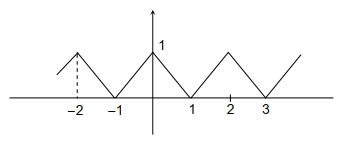
For any real number $x$,let $[x]$ denote the greatest integer less than or equal to $x$. Let $f$ be a real-valued function defined on the interval $[-10, 10]$ by
$f(x) = \begin{cases} x - [x] & \text{if } [x] \text{ is odd} \\ 1 + [x] - x & \text{if } [x] \text{ is even} \end{cases}$
Then the value of $\frac{\pi^2}{10} \int_{-10}^{10} f(x) \cos(\pi x) \, dx$ is
$f(x) = \begin{cases} x - [x] & \text{if } [x] \text{ is odd} \\ 1 + [x] - x & \text{if } [x] \text{ is even} \end{cases}$
Then the value of $\frac{\pi^2}{10} \int_{-10}^{10} f(x) \cos(\pi x) \, dx$ is
A
$4$
B
$5$
C
$6$
D
$8$
Solution
(A) The function $f(x)$ is defined as:
$f(x) = x - [x]$ if $[x]$ is odd,and $f(x) = 1 + [x] - x$ if $[x]$ is even.
For $x \in [0, 1)$,$[x] = 0$ (even),so $f(x) = 1 + 0 - x = 1 - x$.
For $x \in [1, 2)$,$[x] = 1$ (odd),so $f(x) = x - 1$.
This function is periodic with period $T = 2$.
Let $I = \int_{-10}^{10} f(x) \cos(\pi x) \, dx$.
Since $f(x)$ is an even function $(f(-x) = f(x))$ and $\cos(\pi x)$ is an even function,their product is even.
$I = 2 \int_{0}^{10} f(x) \cos(\pi x) \, dx = 2 \times 5 \int_{0}^{2} f(x) \cos(\pi x) \, dx = 10 \left[ \int_{0}^{1} (1-x) \cos(\pi x) \, dx + \int_{1}^{2} (x-1) \cos(\pi x) \, dx \right]$.
Let $I_1 = \int_{0}^{1} (1-x) \cos(\pi x) \, dx$. Using integration by parts:
$I_1 = \left[ (1-x) \frac{\sin(\pi x)}{\pi} \right]_0^1 - \int_{0}^{1} (-1) \frac{\sin(\pi x)}{\pi} \, dx = 0 + \left[ -\frac{\cos(\pi x)}{\pi^2} \right]_0^1 = -\frac{1}{\pi^2} (-1 - 1) = \frac{2}{\pi^2}$.
Let $I_2 = \int_{1}^{2} (x-1) \cos(\pi x) \, dx$. Let $t = x-1$,then $dt = dx$:
$I_2 = \int_{0}^{1} t \cos(\pi(t+1)) \, dt = \int_{0}^{1} t \cos(\pi t + \pi) \, dt = -\int_{0}^{1} t \cos(\pi t) \, dt$.
Using integration by parts for $\int t \cos(\pi t) \, dt = \frac{t \sin(\pi t)}{\pi} + \frac{\cos(\pi t)}{\pi^2}$:
$I_2 = -\left[ \frac{t \sin(\pi t)}{\pi} + \frac{\cos(\pi t)}{\pi^2} \right]_0^1 = -\left( 0 + \frac{-1}{\pi^2} - (0 + \frac{1}{\pi^2}) \right) = \frac{2}{\pi^2}$.
Thus,$I = 10 \left( \frac{2}{\pi^2} + \frac{2}{\pi^2} \right) = \frac{40}{\pi^2}$.
Finally,$\frac{\pi^2}{10} I = \frac{\pi^2}{10} \times \frac{40}{\pi^2} = 4$.
$f(x) = x - [x]$ if $[x]$ is odd,and $f(x) = 1 + [x] - x$ if $[x]$ is even.
For $x \in [0, 1)$,$[x] = 0$ (even),so $f(x) = 1 + 0 - x = 1 - x$.
For $x \in [1, 2)$,$[x] = 1$ (odd),so $f(x) = x - 1$.
This function is periodic with period $T = 2$.
Let $I = \int_{-10}^{10} f(x) \cos(\pi x) \, dx$.
Since $f(x)$ is an even function $(f(-x) = f(x))$ and $\cos(\pi x)$ is an even function,their product is even.
$I = 2 \int_{0}^{10} f(x) \cos(\pi x) \, dx = 2 \times 5 \int_{0}^{2} f(x) \cos(\pi x) \, dx = 10 \left[ \int_{0}^{1} (1-x) \cos(\pi x) \, dx + \int_{1}^{2} (x-1) \cos(\pi x) \, dx \right]$.
Let $I_1 = \int_{0}^{1} (1-x) \cos(\pi x) \, dx$. Using integration by parts:
$I_1 = \left[ (1-x) \frac{\sin(\pi x)}{\pi} \right]_0^1 - \int_{0}^{1} (-1) \frac{\sin(\pi x)}{\pi} \, dx = 0 + \left[ -\frac{\cos(\pi x)}{\pi^2} \right]_0^1 = -\frac{1}{\pi^2} (-1 - 1) = \frac{2}{\pi^2}$.
Let $I_2 = \int_{1}^{2} (x-1) \cos(\pi x) \, dx$. Let $t = x-1$,then $dt = dx$:
$I_2 = \int_{0}^{1} t \cos(\pi(t+1)) \, dt = \int_{0}^{1} t \cos(\pi t + \pi) \, dt = -\int_{0}^{1} t \cos(\pi t) \, dt$.
Using integration by parts for $\int t \cos(\pi t) \, dt = \frac{t \sin(\pi t)}{\pi} + \frac{\cos(\pi t)}{\pi^2}$:
$I_2 = -\left[ \frac{t \sin(\pi t)}{\pi} + \frac{\cos(\pi t)}{\pi^2} \right]_0^1 = -\left( 0 + \frac{-1}{\pi^2} - (0 + \frac{1}{\pi^2}) \right) = \frac{2}{\pi^2}$.
Thus,$I = 10 \left( \frac{2}{\pi^2} + \frac{2}{\pi^2} \right) = \frac{40}{\pi^2}$.
Finally,$\frac{\pi^2}{10} I = \frac{\pi^2}{10} \times \frac{40}{\pi^2} = 4$.
0 likes
View Solution364
AdvancedMCQ
The value of $\int_{\sqrt{\ln 2}}^{\sqrt{\ln 3}} \frac{x \sin x^2}{\sin x^2 + \sin (\ln 6 - x^2)} dx$ is
A
$\frac{1}{4} \ln \frac{3}{2}$
B
$\frac{1}{2} \ln \frac{3}{2}$
C
$\ln \frac{3}{2}$
D
$\frac{1}{6} \ln \frac{3}{2}$
Solution
(A) Let $I = \int_{\sqrt{\ln 2}}^{\sqrt{\ln 3}} \frac{x \sin x^2}{\sin x^2 + \sin (\ln 6 - x^2)} dx$.
Substitute $x^2 = t$,so $2x dx = dt$ or $x dx = \frac{1}{2} dt$.
When $x = \sqrt{\ln 2}$,$t = \ln 2$. When $x = \sqrt{\ln 3}$,$t = \ln 3$.
The integral becomes $I = \frac{1}{2} \int_{\ln 2}^{\ln 3} \frac{\sin t}{\sin t + \sin (\ln 6 - t)} dt$.
Using the property $\int_{a}^{b} f(t) dt = \int_{a}^{b} f(a+b-t) dt$,we have $I = \frac{1}{2} \int_{\ln 2}^{\ln 3} \frac{\sin (\ln 2 + \ln 3 - t)}{\sin (\ln 2 + \ln 3 - t) + \sin (\ln 6 - (\ln 2 + \ln 3 - t))} dt$.
Since $\ln 2 + \ln 3 = \ln 6$,this simplifies to $I = \frac{1}{2} \int_{\ln 2}^{\ln 3} \frac{\sin (\ln 6 - t)}{\sin (\ln 6 - t) + \sin t} dt$.
Adding the two expressions for $I$:
$2I = \frac{1}{2} \int_{\ln 2}^{\ln 3} \frac{\sin t + \sin (\ln 6 - t)}{\sin t + \sin (\ln 6 - t)} dt = \frac{1}{2} \int_{\ln 2}^{\ln 3} 1 dt$.
$2I = \frac{1}{2} [t]_{\ln 2}^{\ln 3} = \frac{1}{2} (\ln 3 - \ln 2) = \frac{1}{2} \ln \frac{3}{2}$.
Therefore,$I = \frac{1}{4} \ln \frac{3}{2}$.
Substitute $x^2 = t$,so $2x dx = dt$ or $x dx = \frac{1}{2} dt$.
When $x = \sqrt{\ln 2}$,$t = \ln 2$. When $x = \sqrt{\ln 3}$,$t = \ln 3$.
The integral becomes $I = \frac{1}{2} \int_{\ln 2}^{\ln 3} \frac{\sin t}{\sin t + \sin (\ln 6 - t)} dt$.
Using the property $\int_{a}^{b} f(t) dt = \int_{a}^{b} f(a+b-t) dt$,we have $I = \frac{1}{2} \int_{\ln 2}^{\ln 3} \frac{\sin (\ln 2 + \ln 3 - t)}{\sin (\ln 2 + \ln 3 - t) + \sin (\ln 6 - (\ln 2 + \ln 3 - t))} dt$.
Since $\ln 2 + \ln 3 = \ln 6$,this simplifies to $I = \frac{1}{2} \int_{\ln 2}^{\ln 3} \frac{\sin (\ln 6 - t)}{\sin (\ln 6 - t) + \sin t} dt$.
Adding the two expressions for $I$:
$2I = \frac{1}{2} \int_{\ln 2}^{\ln 3} \frac{\sin t + \sin (\ln 6 - t)}{\sin t + \sin (\ln 6 - t)} dt = \frac{1}{2} \int_{\ln 2}^{\ln 3} 1 dt$.
$2I = \frac{1}{2} [t]_{\ln 2}^{\ln 3} = \frac{1}{2} (\ln 3 - \ln 2) = \frac{1}{2} \ln \frac{3}{2}$.
Therefore,$I = \frac{1}{4} \ln \frac{3}{2}$.
0 likes
View Solution365
DifficultMCQ
Let $f:[-1, 2] \rightarrow [0, \infty)$ be a continuous function such that $f(x) = f(1-x)$ for all $x \in [-1, 2]$. Let $R_1 = \int_{-1}^2 x f(x) dx$,and $R_2$ be the area of the region bounded by $y = f(x)$,$x = -1$,$x = 2$,and the $x$-axis. Then
A
$R_1 = 2 R_2$
B
$R_1 = 3 R_2$
C
$2 R_1 = R_2$
D
$3 R_1 = R_2$
Solution
(C) Given $R_1 = \int_{-1}^2 x f(x) dx$.
Using the property $\int_a^b g(x) dx = \int_a^b g(a+b-x) dx$,we have:
$R_1 = \int_{-1}^2 ((-1) + 2 - x) f((-1) + 2 - x) dx$
$R_1 = \int_{-1}^2 (1 - x) f(1 - x) dx$.
Since $f(x) = f(1 - x)$,we substitute this into the integral:
$R_1 = \int_{-1}^2 (1 - x) f(x) dx = \int_{-1}^2 f(x) dx - \int_{-1}^2 x f(x) dx$.
$R_1 = \int_{-1}^2 f(x) dx - R_1$.
$2 R_1 = \int_{-1}^2 f(x) dx$.
Since $R_2$ is the area bounded by $y = f(x)$ from $x = -1$ to $x = 2$,$R_2 = \int_{-1}^2 f(x) dx$.
Therefore,$2 R_1 = R_2$.
Using the property $\int_a^b g(x) dx = \int_a^b g(a+b-x) dx$,we have:
$R_1 = \int_{-1}^2 ((-1) + 2 - x) f((-1) + 2 - x) dx$
$R_1 = \int_{-1}^2 (1 - x) f(1 - x) dx$.
Since $f(x) = f(1 - x)$,we substitute this into the integral:
$R_1 = \int_{-1}^2 (1 - x) f(x) dx = \int_{-1}^2 f(x) dx - \int_{-1}^2 x f(x) dx$.
$R_1 = \int_{-1}^2 f(x) dx - R_1$.
$2 R_1 = \int_{-1}^2 f(x) dx$.
Since $R_2$ is the area bounded by $y = f(x)$ from $x = -1$ to $x = 2$,$R_2 = \int_{-1}^2 f(x) dx$.
Therefore,$2 R_1 = R_2$.
0 likes
View Solution366
EasyMCQ
If $I = \frac{2}{\pi} \int_{-\pi / 4}^{\pi / 4} \frac{dx}{(1 + e^{\sin x})(2 - \cos 2x)}$,then $27 I^2$ equals . . . . . . . .
A
$3$
B
$4$
C
$7$
D
$8$
Solution
(B) Let $I = \frac{2}{\pi} \int_{-\pi / 4}^{\pi / 4} \frac{dx}{(1 + e^{\sin x})(2 - \cos 2x)}$.
Using the property $\int_a^b f(x) dx = \int_a^b f(a+b-x) dx$,we have:
$I = \frac{2}{\pi} \int_{-\pi / 4}^{\pi / 4} \frac{dx}{(1 + e^{-\sin x})(2 - \cos 2x)}$.
Adding the two expressions for $I$:
$2I = \frac{2}{\pi} \int_{-\pi / 4}^{\pi / 4} \frac{1}{2 - \cos 2x} \left( \frac{1}{1 + e^{\sin x}} + \frac{e^{\sin x}}{1 + e^{\sin x}} \right) dx = \frac{2}{\pi} \int_{-\pi / 4}^{\pi / 4} \frac{dx}{2 - \cos 2x}$.
Since the integrand is even,$I = \frac{2}{\pi} \int_0^{\pi / 4} \frac{dx}{2 - \cos 2x} = \frac{2}{\pi} \int_0^{\pi / 4} \frac{\sec^2 x dx}{2(1 + \tan^2 x) - (1 - \tan^2 x)} = \frac{2}{\pi} \int_0^{\pi / 4} \frac{\sec^2 x dx}{1 + 3 \tan^2 x}$.
Let $u = \sqrt{3} \tan x$,then $du = \sqrt{3} \sec^2 x dx$.
$I = \frac{2}{\pi \sqrt{3}} \int_0^{\sqrt{3}} \frac{du}{1 + u^2} = \frac{2}{\pi \sqrt{3}} [\tan^{-1} u]_0^{\sqrt{3}} = \frac{2}{\pi \sqrt{3}} \cdot \frac{\pi}{3} = \frac{2}{3\sqrt{3}}$.
Thus,$27 I^2 = 27 \cdot \frac{4}{27} = 4$.
Using the property $\int_a^b f(x) dx = \int_a^b f(a+b-x) dx$,we have:
$I = \frac{2}{\pi} \int_{-\pi / 4}^{\pi / 4} \frac{dx}{(1 + e^{-\sin x})(2 - \cos 2x)}$.
Adding the two expressions for $I$:
$2I = \frac{2}{\pi} \int_{-\pi / 4}^{\pi / 4} \frac{1}{2 - \cos 2x} \left( \frac{1}{1 + e^{\sin x}} + \frac{e^{\sin x}}{1 + e^{\sin x}} \right) dx = \frac{2}{\pi} \int_{-\pi / 4}^{\pi / 4} \frac{dx}{2 - \cos 2x}$.
Since the integrand is even,$I = \frac{2}{\pi} \int_0^{\pi / 4} \frac{dx}{2 - \cos 2x} = \frac{2}{\pi} \int_0^{\pi / 4} \frac{\sec^2 x dx}{2(1 + \tan^2 x) - (1 - \tan^2 x)} = \frac{2}{\pi} \int_0^{\pi / 4} \frac{\sec^2 x dx}{1 + 3 \tan^2 x}$.
Let $u = \sqrt{3} \tan x$,then $du = \sqrt{3} \sec^2 x dx$.
$I = \frac{2}{\pi \sqrt{3}} \int_0^{\sqrt{3}} \frac{du}{1 + u^2} = \frac{2}{\pi \sqrt{3}} [\tan^{-1} u]_0^{\sqrt{3}} = \frac{2}{\pi \sqrt{3}} \cdot \frac{\pi}{3} = \frac{2}{3\sqrt{3}}$.
Thus,$27 I^2 = 27 \cdot \frac{4}{27} = 4$.
0 likes
View Solution367
AdvancedMCQ
The value of the integral $\int_0^{\pi / 2} \frac{3 \sqrt{\cos \theta}}{(\sqrt{\cos \theta}+\sqrt{\sin \theta})^5} d \theta$ equals
A
$0.20$
B
$0.30$
C
$0.40$
D
$0.50$
Solution
(D) Let $I = \int_0^{\pi / 2} \frac{3 \sqrt{\cos \theta}}{(\sqrt{\cos \theta}+\sqrt{\sin \theta})^5} d \theta$.
Using the property $\int_0^a f(x) dx = \int_0^a f(a-x) dx$,we get:
$I = \int_0^{\pi / 2} \frac{3 \sqrt{\sin \theta}}{(\sqrt{\sin \theta}+\sqrt{\cos \theta})^5} d \theta$.
Adding the two expressions for $I$:
$2I = \int_0^{\pi / 2} \frac{3(\sqrt{\cos \theta} + \sqrt{\sin \theta})}{(\sqrt{\cos \theta}+\sqrt{\sin \theta})^5} d \theta = \int_0^{\pi / 2} \frac{3}{(\sqrt{\cos \theta}+\sqrt{\sin \theta})^4} d \theta$.
Divide numerator and denominator by $\cos^2 \theta$:
$2I = 3 \int_0^{\pi / 2} \frac{\sec^2 \theta}{(1+\sqrt{\tan \theta})^4} d \theta$.
Let $1+\sqrt{\tan \theta} = t$,then $\frac{1}{2\sqrt{\tan \theta}} \cdot \sec^2 \theta d \theta = dt$,so $\sec^2 \theta d \theta = 2(t-1) dt$.
Substituting these:
$2I = 3 \int_1^{\infty} \frac{2(t-1)}{t^4} dt = 6 \int_1^{\infty} (t^{-3} - t^{-4}) dt$.
$2I = 6 \left[ \frac{t^{-2}}{-2} - \frac{t^{-3}}{-3} \right]_1^{\infty} = 6 \left[ 0 - (-\frac{1}{2} + \frac{1}{3}) \right] = 6 \left( \frac{1}{6} \right) = 1$.
Thus,$I = 0.50$.
Using the property $\int_0^a f(x) dx = \int_0^a f(a-x) dx$,we get:
$I = \int_0^{\pi / 2} \frac{3 \sqrt{\sin \theta}}{(\sqrt{\sin \theta}+\sqrt{\cos \theta})^5} d \theta$.
Adding the two expressions for $I$:
$2I = \int_0^{\pi / 2} \frac{3(\sqrt{\cos \theta} + \sqrt{\sin \theta})}{(\sqrt{\cos \theta}+\sqrt{\sin \theta})^5} d \theta = \int_0^{\pi / 2} \frac{3}{(\sqrt{\cos \theta}+\sqrt{\sin \theta})^4} d \theta$.
Divide numerator and denominator by $\cos^2 \theta$:
$2I = 3 \int_0^{\pi / 2} \frac{\sec^2 \theta}{(1+\sqrt{\tan \theta})^4} d \theta$.
Let $1+\sqrt{\tan \theta} = t$,then $\frac{1}{2\sqrt{\tan \theta}} \cdot \sec^2 \theta d \theta = dt$,so $\sec^2 \theta d \theta = 2(t-1) dt$.
Substituting these:
$2I = 3 \int_1^{\infty} \frac{2(t-1)}{t^4} dt = 6 \int_1^{\infty} (t^{-3} - t^{-4}) dt$.
$2I = 6 \left[ \frac{t^{-2}}{-2} - \frac{t^{-3}}{-3} \right]_1^{\infty} = 6 \left[ 0 - (-\frac{1}{2} + \frac{1}{3}) \right] = 6 \left( \frac{1}{6} \right) = 1$.
Thus,$I = 0.50$.
0 likes
View Solution368
MediumMCQ
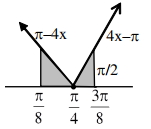
Let $g_i: \left[\frac{\pi}{8}, \frac{3\pi}{8}\right] \rightarrow \mathbb{R}, i=1, 2$,and $f: \left[\frac{\pi}{8}, \frac{3\pi}{8}\right] \rightarrow \mathbb{R}$ be functions such that $g_1(x)=1, g_2(x)=|4x-\pi|$ and $f(x)=\sin^2 x$,for all $x \in \left[\frac{\pi}{8}, \frac{3\pi}{8}\right]$.
Define $S_i = \int_{\frac{\pi}{8}}^{\frac{3\pi}{8}} f(x) \cdot g_i(x) dx, i=1, 2$.
$(1)$ The value of $\frac{16S_1}{\pi}$ is.
$(2)$ The value of $\frac{48S_2}{\pi^2}$ is.
Define $S_i = \int_{\frac{\pi}{8}}^{\frac{3\pi}{8}} f(x) \cdot g_i(x) dx, i=1, 2$.
$(1)$ The value of $\frac{16S_1}{\pi}$ is.
$(2)$ The value of $\frac{48S_2}{\pi^2}$ is.
A
$2, 1.20$
B
$2, 1.30$
C
$2, 1.50$
D
$2, 1.80$
Solution
(C) For $S_1$,we have $S_1 = \int_{\pi/8}^{3\pi/8} \sin^2 x dx$. Using the property $\int_a^b f(x) dx = \int_a^b f(a+b-x) dx$,we get $S_1 = \int_{\pi/8}^{3\pi/8} \sin^2(\frac{\pi}{8} + \frac{3\pi}{8} - x) dx = \int_{\pi/8}^{3\pi/8} \cos^2 x dx$.
Adding these,$2S_1 = \int_{\pi/8}^{3\pi/8} (\sin^2 x + \cos^2 x) dx = \int_{\pi/8}^{3\pi/8} 1 dx = \frac{3\pi}{8} - \frac{\pi}{8} = \frac{\pi}{4}$.
Thus,$S_1 = \frac{\pi}{8}$,so $\frac{16S_1}{\pi} = \frac{16}{\pi} \cdot \frac{\pi}{8} = 2$.
For $S_2$,$S_2 = \int_{\pi/8}^{3\pi/8} \sin^2 x |4x - \pi| dx$. Using the same property,$S_2 = \int_{\pi/8}^{3\pi/8} \sin^2(\frac{\pi}{2}-x) |4(\frac{\pi}{2}-x) - \pi| dx = \int_{\pi/8}^{3\pi/8} \cos^2 x |\pi - 4x| dx = \int_{\pi/8}^{3\pi/8} \cos^2 x |4x - \pi| dx$.
Adding these,$2S_2 = \int_{\pi/8}^{3\pi/8} |4x - \pi| (\sin^2 x + \cos^2 x) dx = \int_{\pi/8}^{3\pi/8} |4x - \pi| dx$.
The integral represents the area of two triangles with base $\frac{\pi}{8}$ and height $\frac{\pi}{2}$,so $2S_2 = 2 \cdot (\frac{1}{2} \cdot \frac{\pi}{8} \cdot \frac{\pi}{2}) = \frac{\pi^2}{16}$.
Thus,$S_2 = \frac{\pi^2}{32}$,so $\frac{48S_2}{\pi^2} = \frac{48}{\pi^2} \cdot \frac{\pi^2}{32} = \frac{48}{32} = 1.5$.
Adding these,$2S_1 = \int_{\pi/8}^{3\pi/8} (\sin^2 x + \cos^2 x) dx = \int_{\pi/8}^{3\pi/8} 1 dx = \frac{3\pi}{8} - \frac{\pi}{8} = \frac{\pi}{4}$.
Thus,$S_1 = \frac{\pi}{8}$,so $\frac{16S_1}{\pi} = \frac{16}{\pi} \cdot \frac{\pi}{8} = 2$.
For $S_2$,$S_2 = \int_{\pi/8}^{3\pi/8} \sin^2 x |4x - \pi| dx$. Using the same property,$S_2 = \int_{\pi/8}^{3\pi/8} \sin^2(\frac{\pi}{2}-x) |4(\frac{\pi}{2}-x) - \pi| dx = \int_{\pi/8}^{3\pi/8} \cos^2 x |\pi - 4x| dx = \int_{\pi/8}^{3\pi/8} \cos^2 x |4x - \pi| dx$.
Adding these,$2S_2 = \int_{\pi/8}^{3\pi/8} |4x - \pi| (\sin^2 x + \cos^2 x) dx = \int_{\pi/8}^{3\pi/8} |4x - \pi| dx$.
The integral represents the area of two triangles with base $\frac{\pi}{8}$ and height $\frac{\pi}{2}$,so $2S_2 = 2 \cdot (\frac{1}{2} \cdot \frac{\pi}{8} \cdot \frac{\pi}{2}) = \frac{\pi^2}{16}$.
Thus,$S_2 = \frac{\pi^2}{32}$,so $\frac{48S_2}{\pi^2} = \frac{48}{\pi^2} \cdot \frac{\pi^2}{32} = \frac{48}{32} = 1.5$.
0 likes
View Solution369
AdvancedMCQ
The value of the integral $\int_{-\pi / 2}^{\pi / 2}\left(x^2+\ln \frac{\pi+x}{\pi-x}\right) \cos x \, dx$ is
A
$0$
B
$\frac{\pi^2}{2}-4$
C
$\frac{\pi^2}{2}+4$
D
$\frac{\pi^2}{2}$
Solution
(B) Let $I = \int_{-\pi / 2}^{\pi / 2} \left(x^2 + \ln \frac{\pi+x}{\pi-x}\right) \cos x \, dx$.
We can split this into two integrals: $I = \int_{-\pi / 2}^{\pi / 2} x^2 \cos x \, dx + \int_{-\pi / 2}^{\pi / 2} \ln \left(\frac{\pi+x}{\pi-x}\right) \cos x \, dx$.
Let $f(x) = \ln \left(\frac{\pi+x}{\pi-x}\right) \cos x$. Since $\ln \left(\frac{\pi+x}{\pi-x}\right)$ is an odd function and $\cos x$ is an even function,their product is an odd function. Thus,$\int_{-\pi / 2}^{\pi / 2} f(x) \, dx = 0$.
Now,$I = \int_{-\pi / 2}^{\pi / 2} x^2 \cos x \, dx$. Since $x^2 \cos x$ is an even function,$I = 2 \int_0^{\pi / 2} x^2 \cos x \, dx$.
Using integration by parts: $\int x^2 \cos x \, dx = x^2 \sin x - \int 2x \sin x \, dx = x^2 \sin x - 2 \left( -x \cos x + \int \cos x \, dx \right) = x^2 \sin x + 2x \cos x - 2 \sin x$.
Evaluating from $0$ to $\pi / 2$: $2 \left[ (x^2 \sin x + 2x \cos x - 2 \sin x) \right]_0^{\pi / 2} = 2 \left[ ((\pi/2)^2 \cdot 1 + 0 - 2(1)) - (0 + 0 - 0) \right] = 2 \left( \frac{\pi^2}{4} - 2 \right) = \frac{\pi^2}{2} - 4$.
We can split this into two integrals: $I = \int_{-\pi / 2}^{\pi / 2} x^2 \cos x \, dx + \int_{-\pi / 2}^{\pi / 2} \ln \left(\frac{\pi+x}{\pi-x}\right) \cos x \, dx$.
Let $f(x) = \ln \left(\frac{\pi+x}{\pi-x}\right) \cos x$. Since $\ln \left(\frac{\pi+x}{\pi-x}\right)$ is an odd function and $\cos x$ is an even function,their product is an odd function. Thus,$\int_{-\pi / 2}^{\pi / 2} f(x) \, dx = 0$.
Now,$I = \int_{-\pi / 2}^{\pi / 2} x^2 \cos x \, dx$. Since $x^2 \cos x$ is an even function,$I = 2 \int_0^{\pi / 2} x^2 \cos x \, dx$.
Using integration by parts: $\int x^2 \cos x \, dx = x^2 \sin x - \int 2x \sin x \, dx = x^2 \sin x - 2 \left( -x \cos x + \int \cos x \, dx \right) = x^2 \sin x + 2x \cos x - 2 \sin x$.
Evaluating from $0$ to $\pi / 2$: $2 \left[ (x^2 \sin x + 2x \cos x - 2 \sin x) \right]_0^{\pi / 2} = 2 \left[ ((\pi/2)^2 \cdot 1 + 0 - 2(1)) - (0 + 0 - 0) \right] = 2 \left( \frac{\pi^2}{4} - 2 \right) = \frac{\pi^2}{2} - 4$.
0 likes
View Solution370
DifficultMCQ
The option$(s)$ with the values of $a$ and $L$ that satisfy the following equation is(are) $\frac{\int_0^{4 \pi} e^t(\sin^6 at + \cos^4 at) dt}{\int_0^{\pi} e^t(\sin^6 at + \cos^4 at) dt} = L$.
A
$(A, C)$
B
$(A, B)$
C
$(B, D)$
D
$(B, C)$
Solution
(A) Let $f(t) = e^t(\sin^6 at + \cos^4 at)$. We observe that for $a=2$ and $a=4$,the function $f(t)$ satisfies $f(t+\pi) = e^{t+\pi}(\sin^6 a(t+\pi) + \cos^4 a(t+\pi)) = e^{\pi} e^t(\sin^6 at + \cos^4 at) = e^{\pi} f(t)$,since $\sin(a(t+\pi)) = \sin(at + a\pi) = \sin(at)$ and $\cos(a(t+\pi)) = \cos(at)$ for even integers $a$.
Let $I_k = \int_{(k-1)\pi}^{k\pi} f(t) dt$. Then $I_{k+1} = \int_{k\pi}^{(k+1)\pi} f(t) dt$. Substituting $t = u + \pi$,we get $I_{k+1} = \int_{(k-1)\pi}^{k\pi} f(u+\pi) du = e^{\pi} \int_{(k-1)\pi}^{k\pi} f(u) du = e^{\pi} I_k$.
Thus,$I_1 = A$,$I_2 = e^{\pi} A$,$I_3 = e^{2\pi} A$,and $I_4 = e^{3\pi} A$,where $A = \int_0^{\pi} f(t) dt$.
The numerator is $\int_0^{4\pi} f(t) dt = I_1 + I_2 + I_3 + I_4 = A(1 + e^{\pi} + e^{2\pi} + e^{3\pi}) = A \frac{e^{4\pi}-1}{e^{\pi}-1}$.
Therefore,$L = \frac{A \frac{e^{4\pi}-1}{e^{\pi}-1}}{A} = \frac{e^{4\pi}-1}{e^{\pi}-1}$.
This holds for both $a=2$ and $a=4$. Thus,options $(A)$ and $(C)$ are correct.
Let $I_k = \int_{(k-1)\pi}^{k\pi} f(t) dt$. Then $I_{k+1} = \int_{k\pi}^{(k+1)\pi} f(t) dt$. Substituting $t = u + \pi$,we get $I_{k+1} = \int_{(k-1)\pi}^{k\pi} f(u+\pi) du = e^{\pi} \int_{(k-1)\pi}^{k\pi} f(u) du = e^{\pi} I_k$.
Thus,$I_1 = A$,$I_2 = e^{\pi} A$,$I_3 = e^{2\pi} A$,and $I_4 = e^{3\pi} A$,where $A = \int_0^{\pi} f(t) dt$.
The numerator is $\int_0^{4\pi} f(t) dt = I_1 + I_2 + I_3 + I_4 = A(1 + e^{\pi} + e^{2\pi} + e^{3\pi}) = A \frac{e^{4\pi}-1}{e^{\pi}-1}$.
Therefore,$L = \frac{A \frac{e^{4\pi}-1}{e^{\pi}-1}}{A} = \frac{e^{4\pi}-1}{e^{\pi}-1}$.
This holds for both $a=2$ and $a=4$. Thus,options $(A)$ and $(C)$ are correct.
0 likes
View Solution371
AdvancedMCQ
Let $f(x) = 7 \tan^8 x + 7 \tan^6 x - 3 \tan^4 x - 3 \tan^2 x$ for all $x \in \left(-\frac{\pi}{2}, \frac{\pi}{2}\right)$. Then the correct expression$(s)$ is(are):
$(A) \int_0^{\pi/4} x f(x) dx = \frac{1}{12}$
$(B) \int_0^{\pi/4} f(x) dx = 0$
$(C) \int_0^{\pi/4} x f(x) dx = \frac{1}{6}$
$(D) \int_0^{\pi/4} f(x) dx = 1$
$(A) \int_0^{\pi/4} x f(x) dx = \frac{1}{12}$
$(B) \int_0^{\pi/4} f(x) dx = 0$
$(C) \int_0^{\pi/4} x f(x) dx = \frac{1}{6}$
$(D) \int_0^{\pi/4} f(x) dx = 1$
A
$(A, B)$
B
$(B, D)$
C
$(B, C)$
D
$(A, C)$
Solution
(A) Given $f(x) = 7 \tan^6 x (\tan^2 x + 1) - 3 \tan^2 x (\tan^2 x + 1) = (7 \tan^6 x - 3 \tan^2 x) \sec^2 x$.
First,evaluate $\int_0^{\pi/4} f(x) dx$:
$\int_0^{\pi/4} (7 \tan^6 x - 3 \tan^2 x) \sec^2 x dx$. Let $u = \tan x$,then $du = \sec^2 x dx$. When $x=0, u=0$; when $x=\pi/4, u=1$.
$= \int_0^1 (7u^6 - 3u^2) du = [u^7 - u^3]_0^1 = (1 - 1) - (0 - 0) = 0$. Thus,$(B)$ is correct.
Next,evaluate $\int_0^{\pi/4} x f(x) dx$ using integration by parts:
Let $I = \int_0^{\pi/4} x f(x) dx$. Let $g(x) = \int f(x) dx = \tan^7 x - \tan^3 x$.
Using integration by parts: $\int_0^{\pi/4} x f(x) dx = [x g(x)]_0^{\pi/4} - \int_0^{\pi/4} g(x) dx$.
$[x(\tan^7 x - \tan^3 x)]_0^{\pi/4} = \frac{\pi}{4}(1 - 1) - 0 = 0$.
So,$I = - \int_0^{\pi/4} (\tan^7 x - \tan^3 x) dx = \int_0^{\pi/4} (\tan^3 x - \tan^7 x) dx$.
$= \int_0^{\pi/4} \tan^3 x (1 - \tan^4 x) dx = \int_0^{\pi/4} \tan^3 x (1 - \tan^2 x)(1 + \tan^2 x) dx$.
$= \int_0^{\pi/4} (\tan^3 x - \tan^5 x) \sec^2 x dx$. Let $u = \tan x$,$du = \sec^2 x dx$.
$= \int_0^1 (u^3 - u^5) du = [\frac{u^4}{4} - \frac{u^6}{6}]_0^1 = \frac{1}{4} - \frac{1}{6} = \frac{3-2}{12} = \frac{1}{12}$. Thus,$(A)$ is correct.
First,evaluate $\int_0^{\pi/4} f(x) dx$:
$\int_0^{\pi/4} (7 \tan^6 x - 3 \tan^2 x) \sec^2 x dx$. Let $u = \tan x$,then $du = \sec^2 x dx$. When $x=0, u=0$; when $x=\pi/4, u=1$.
$= \int_0^1 (7u^6 - 3u^2) du = [u^7 - u^3]_0^1 = (1 - 1) - (0 - 0) = 0$. Thus,$(B)$ is correct.
Next,evaluate $\int_0^{\pi/4} x f(x) dx$ using integration by parts:
Let $I = \int_0^{\pi/4} x f(x) dx$. Let $g(x) = \int f(x) dx = \tan^7 x - \tan^3 x$.
Using integration by parts: $\int_0^{\pi/4} x f(x) dx = [x g(x)]_0^{\pi/4} - \int_0^{\pi/4} g(x) dx$.
$[x(\tan^7 x - \tan^3 x)]_0^{\pi/4} = \frac{\pi}{4}(1 - 1) - 0 = 0$.
So,$I = - \int_0^{\pi/4} (\tan^7 x - \tan^3 x) dx = \int_0^{\pi/4} (\tan^3 x - \tan^7 x) dx$.
$= \int_0^{\pi/4} \tan^3 x (1 - \tan^4 x) dx = \int_0^{\pi/4} \tan^3 x (1 - \tan^2 x)(1 + \tan^2 x) dx$.
$= \int_0^{\pi/4} (\tan^3 x - \tan^5 x) \sec^2 x dx$. Let $u = \tan x$,$du = \sec^2 x dx$.
$= \int_0^1 (u^3 - u^5) du = [\frac{u^4}{4} - \frac{u^6}{6}]_0^1 = \frac{1}{4} - \frac{1}{6} = \frac{3-2}{12} = \frac{1}{12}$. Thus,$(A)$ is correct.
0 likes
View Solution372
AdvancedMCQ
Let $f: [0, \frac{\pi}{2}] \rightarrow [0, 1]$ be the function defined by $f(x) = \sin^2 x$ and let $g: [0, \frac{\pi}{2}] \rightarrow [0, \infty)$ be the function defined by $g(x) = \sqrt{\frac{\pi x}{2} - x^2}$.
(There are two questions based on this paragraph. The questions given below are those two.)
$(1)$ The value of $2 \int_0^{\frac{\pi}{2}} f(x) g(x) dx - \int_0^{\frac{\pi}{2}} g(x) dx$ is
$(2)$ The value of $\frac{16}{\pi^3} \int_0^{\frac{\pi}{2}} f(x) g(x) dx$ is
(There are two questions based on this paragraph. The questions given below are those two.)
$(1)$ The value of $2 \int_0^{\frac{\pi}{2}} f(x) g(x) dx - \int_0^{\frac{\pi}{2}} g(x) dx$ is
$(2)$ The value of $\frac{16}{\pi^3} \int_0^{\frac{\pi}{2}} f(x) g(x) dx$ is
A
$0, 0.20$
B
$0, 0.25$
C
$0, 0.30$
D
$0, 0.35$
Solution
(B) $(1)$ Let $I = 2 \int_0^{\frac{\pi}{2}} \sin^2 x \sqrt{\frac{\pi x}{2} - x^2} dx - \int_0^{\frac{\pi}{2}} \sqrt{\frac{\pi x}{2} - x^2} dx$.
Let $I_1 = \int_0^{\frac{\pi}{2}} \sin^2 x \sqrt{(\frac{\pi}{4})^2 - (x - \frac{\pi}{4})^2} dx$.
Using the property $\int_0^a h(x) dx = \int_0^a h(a-x) dx$,we get:
$I_1 = \int_0^{\frac{\pi}{2}} \cos^2 x \sqrt{(\frac{\pi}{4})^2 - (\frac{\pi}{2} - x - \frac{\pi}{4})^2} dx = \int_0^{\frac{\pi}{2}} \cos^2 x \sqrt{(\frac{\pi}{4})^2 - (x - \frac{\pi}{4})^2} dx$.
Adding the two expressions for $I_1$:
$2I_1 = \int_0^{\frac{\pi}{2}} (\sin^2 x + \cos^2 x) \sqrt{(\frac{\pi}{4})^2 - (x - \frac{\pi}{4})^2} dx = \int_0^{\frac{\pi}{2}} g(x) dx$.
Thus,$I = 2I_1 - \int_0^{\frac{\pi}{2}} g(x) dx = \int_0^{\frac{\pi}{2}} g(x) dx - \int_0^{\frac{\pi}{2}} g(x) dx = 0$.
$(2)$ From above,$I_1 = \frac{1}{2} \int_0^{\frac{\pi}{2}} g(x) dx = \frac{1}{2} \int_0^{\frac{\pi}{2}} \sqrt{(\frac{\pi}{4})^2 - (x - \frac{\pi}{4})^2} dx$.
Using $\int \sqrt{a^2 - u^2} du = \frac{u}{2} \sqrt{a^2 - u^2} + \frac{a^2}{2} \sin^{-1}(\frac{u}{a}) + C$:
$I_1 = \frac{1}{2} [\frac{x - \frac{\pi}{4}}{2} \sqrt{\frac{\pi x}{2} - x^2} + \frac{\pi^2}{32} \sin^{-1}(\frac{x - \frac{\pi}{4}}{\pi/4})]_0^{\frac{\pi}{2}} = \frac{1}{2} [(\frac{\pi^2}{32} \cdot \frac{\pi}{2}) - (\frac{\pi^2}{32} \cdot -\frac{\pi}{2})] = \frac{1}{2} [\frac{\pi^3}{64} + \frac{\pi^3}{64}] = \frac{\pi^3}{64}$.
Therefore,$\frac{16}{\pi^3} I_1 = \frac{16}{\pi^3} \cdot \frac{\pi^3}{64} = \frac{1}{4} = 0.25$.
Let $I_1 = \int_0^{\frac{\pi}{2}} \sin^2 x \sqrt{(\frac{\pi}{4})^2 - (x - \frac{\pi}{4})^2} dx$.
Using the property $\int_0^a h(x) dx = \int_0^a h(a-x) dx$,we get:
$I_1 = \int_0^{\frac{\pi}{2}} \cos^2 x \sqrt{(\frac{\pi}{4})^2 - (\frac{\pi}{2} - x - \frac{\pi}{4})^2} dx = \int_0^{\frac{\pi}{2}} \cos^2 x \sqrt{(\frac{\pi}{4})^2 - (x - \frac{\pi}{4})^2} dx$.
Adding the two expressions for $I_1$:
$2I_1 = \int_0^{\frac{\pi}{2}} (\sin^2 x + \cos^2 x) \sqrt{(\frac{\pi}{4})^2 - (x - \frac{\pi}{4})^2} dx = \int_0^{\frac{\pi}{2}} g(x) dx$.
Thus,$I = 2I_1 - \int_0^{\frac{\pi}{2}} g(x) dx = \int_0^{\frac{\pi}{2}} g(x) dx - \int_0^{\frac{\pi}{2}} g(x) dx = 0$.
$(2)$ From above,$I_1 = \frac{1}{2} \int_0^{\frac{\pi}{2}} g(x) dx = \frac{1}{2} \int_0^{\frac{\pi}{2}} \sqrt{(\frac{\pi}{4})^2 - (x - \frac{\pi}{4})^2} dx$.
Using $\int \sqrt{a^2 - u^2} du = \frac{u}{2} \sqrt{a^2 - u^2} + \frac{a^2}{2} \sin^{-1}(\frac{u}{a}) + C$:
$I_1 = \frac{1}{2} [\frac{x - \frac{\pi}{4}}{2} \sqrt{\frac{\pi x}{2} - x^2} + \frac{\pi^2}{32} \sin^{-1}(\frac{x - \frac{\pi}{4}}{\pi/4})]_0^{\frac{\pi}{2}} = \frac{1}{2} [(\frac{\pi^2}{32} \cdot \frac{\pi}{2}) - (\frac{\pi^2}{32} \cdot -\frac{\pi}{2})] = \frac{1}{2} [\frac{\pi^3}{64} + \frac{\pi^3}{64}] = \frac{\pi^3}{64}$.
Therefore,$\frac{16}{\pi^3} I_1 = \frac{16}{\pi^3} \cdot \frac{\pi^3}{64} = \frac{1}{4} = 0.25$.
0 likes
View Solution373
DifficultMCQ
The value of $\int_{e^2}^{e^4} \frac{1}{x} \left( \frac{e^{((\ln x)^2+1)^{-1}}}{e^{((\ln x)^2+1)^{-1}} + e^{((6-\ln x)^2+1)^{-1}}} \right) dx$ is
A
$\ln 2$
B
$2$
C
$1$
D
$e^2$
Solution
(C) Let $I = \int_{e^2}^{e^4} \frac{1}{x} \left( \frac{e^{((\ln x)^2+1)^{-1}}}{e^{((\ln x)^2+1)^{-1}} + e^{((6-\ln x)^2+1)^{-1}}} \right) dx$.
Substitute $\ln x = t$,then $\frac{1}{x} dx = dt$.
When $x = e^2$,$t = 2$. When $x = e^4$,$t = 4$.
So,$I = \int_{2}^{4} \frac{e^{(t^2+1)^{-1}}}{e^{(t^2+1)^{-1}} + e^{((6-t)^2+1)^{-1}}} dt$.
Using the property $\int_{a}^{b} f(t) dt = \int_{a}^{b} f(a+b-t) dt$,we get:
$I = \int_{2}^{4} \frac{e^{((6-t)^2+1)^{-1}}}{e^{((6-t)^2+1)^{-1}} + e^{(t^2+1)^{-1}}} dt$.
Adding the two expressions for $I$:
$2I = \int_{2}^{4} \frac{e^{(t^2+1)^{-1}} + e^{((6-t)^2+1)^{-1}}}{e^{(t^2+1)^{-1}} + e^{((6-t)^2+1)^{-1}}} dt = \int_{2}^{4} 1 dt = [t]_{2}^{4} = 4 - 2 = 2$.
Therefore,$I = 1$.
Substitute $\ln x = t$,then $\frac{1}{x} dx = dt$.
When $x = e^2$,$t = 2$. When $x = e^4$,$t = 4$.
So,$I = \int_{2}^{4} \frac{e^{(t^2+1)^{-1}}}{e^{(t^2+1)^{-1}} + e^{((6-t)^2+1)^{-1}}} dt$.
Using the property $\int_{a}^{b} f(t) dt = \int_{a}^{b} f(a+b-t) dt$,we get:
$I = \int_{2}^{4} \frac{e^{((6-t)^2+1)^{-1}}}{e^{((6-t)^2+1)^{-1}} + e^{(t^2+1)^{-1}}} dt$.
Adding the two expressions for $I$:
$2I = \int_{2}^{4} \frac{e^{(t^2+1)^{-1}} + e^{((6-t)^2+1)^{-1}}}{e^{(t^2+1)^{-1}} + e^{((6-t)^2+1)^{-1}}} dt = \int_{2}^{4} 1 dt = [t]_{2}^{4} = 4 - 2 = 2$.
Therefore,$I = 1$.
0 likes
View Solution374
DifficultMCQ
If $I=\int_0^{\frac{\pi}{2}} \frac{\sin ^{\frac{3}{2}} x}{\sin ^{\frac{3}{2}} x+\cos ^{\frac{3}{2}} x} d x$,then the value of $\int_0^{\frac{\pi}{2}} \frac{x \sin x \cos x}{\sin ^4 x+\cos ^4 x} d x$ is:
A
$\frac{\pi^2}{16}$
B
$\frac{\pi^2}{4}$
C
$\frac{\pi^2}{8}$
D
$\frac{\pi^2}{12}$
Solution
(A) Let $I_2 = \int_0^{\frac{\pi}{2}} \frac{x \sin x \cos x}{\sin ^4 x+\cos ^4 x} dx$.
Using the property $\int_0^a f(x) dx = \int_0^a f(a-x) dx$,we have:
$I_2 = \int_0^{\frac{\pi}{2}} \frac{(\frac{\pi}{2}-x) \sin(\frac{\pi}{2}-x) \cos(\frac{\pi}{2}-x)}{\sin ^4(\frac{\pi}{2}-x)+\cos ^4(\frac{\pi}{2}-x)} dx = \int_0^{\frac{\pi}{2}} \frac{(\frac{\pi}{2}-x) \cos x \sin x}{\cos ^4 x+\sin ^4 x} dx$.
Adding the two expressions for $I_2$:
$2I_2 = \int_0^{\frac{\pi}{2}} \frac{\frac{\pi}{2} \sin x \cos x}{\sin ^4 x+\cos ^4 x} dx = \frac{\pi}{2} \int_0^{\frac{\pi}{2}} \frac{\sin x \cos x}{\sin ^4 x+\cos ^4 x} dx$.
Divide numerator and denominator by $\cos^4 x$:
$I_2 = \frac{\pi}{4} \int_0^{\frac{\pi}{2}} \frac{\tan x \sec^2 x}{\tan^4 x + 1} dx$.
Let $t = \tan^2 x$,then $dt = 2 \tan x \sec^2 x dx$,so $\tan x \sec^2 x dx = \frac{dt}{2}$.
As $x \to 0, t \to 0$ and as $x \to \frac{\pi}{2}, t \to \infty$.
$I_2 = \frac{\pi}{4} \int_0^{\infty} \frac{dt/2}{t^2+1} = \frac{\pi}{8} [\tan^{-1} t]_0^{\infty} = \frac{\pi}{8} \cdot \frac{\pi}{2} = \frac{\pi^2}{16}$.
Using the property $\int_0^a f(x) dx = \int_0^a f(a-x) dx$,we have:
$I_2 = \int_0^{\frac{\pi}{2}} \frac{(\frac{\pi}{2}-x) \sin(\frac{\pi}{2}-x) \cos(\frac{\pi}{2}-x)}{\sin ^4(\frac{\pi}{2}-x)+\cos ^4(\frac{\pi}{2}-x)} dx = \int_0^{\frac{\pi}{2}} \frac{(\frac{\pi}{2}-x) \cos x \sin x}{\cos ^4 x+\sin ^4 x} dx$.
Adding the two expressions for $I_2$:
$2I_2 = \int_0^{\frac{\pi}{2}} \frac{\frac{\pi}{2} \sin x \cos x}{\sin ^4 x+\cos ^4 x} dx = \frac{\pi}{2} \int_0^{\frac{\pi}{2}} \frac{\sin x \cos x}{\sin ^4 x+\cos ^4 x} dx$.
Divide numerator and denominator by $\cos^4 x$:
$I_2 = \frac{\pi}{4} \int_0^{\frac{\pi}{2}} \frac{\tan x \sec^2 x}{\tan^4 x + 1} dx$.
Let $t = \tan^2 x$,then $dt = 2 \tan x \sec^2 x dx$,so $\tan x \sec^2 x dx = \frac{dt}{2}$.
As $x \to 0, t \to 0$ and as $x \to \frac{\pi}{2}, t \to \infty$.
$I_2 = \frac{\pi}{4} \int_0^{\infty} \frac{dt/2}{t^2+1} = \frac{\pi}{8} [\tan^{-1} t]_0^{\infty} = \frac{\pi}{8} \cdot \frac{\pi}{2} = \frac{\pi^2}{16}$.
0 likes
View Solution375
DifficultMCQ
If $\int_{-\frac{\pi}{2}}^{\frac{\pi}{2}} \frac{96 x^2 \cos^2 x}{1+e^x} dx = \pi(\alpha \pi^2 + \beta)$,where $\alpha, \beta \in \mathbb{Z}$,then $(\alpha + \beta)^2$ equals:
A
$144$
B
$196$
C
$100$
D
$64$
Solution
(C) Let $I = \int_{-\frac{\pi}{2}}^{\frac{\pi}{2}} \frac{96 x^2 \cos^2 x}{1+e^x} dx$.
Using the property $\int_a^b f(x) dx = \int_a^b f(a+b-x) dx$,we have $I = \int_{-\frac{\pi}{2}}^{\frac{\pi}{2}} \frac{96 x^2 \cos^2 x}{1+e^{-x}} dx$.
Adding the two expressions for $I$: $2I = \int_{-\frac{\pi}{2}}^{\frac{\pi}{2}} 96 x^2 \cos^2 x \left( \frac{1}{1+e^x} + \frac{1}{1+e^{-x}} \right) dx = \int_{-\frac{\pi}{2}}^{\frac{\pi}{2}} 96 x^2 \cos^2 x dx$.
Since $x^2 \cos^2 x$ is an even function,$I = \int_0^{\frac{\pi}{2}} 96 x^2 \cos^2 x dx = 48 \int_0^{\frac{\pi}{2}} x^2 (1 + \cos 2x) dx$.
$I = 48 \left[ \frac{x^3}{3} \right]_0^{\frac{\pi}{2}} + 48 \int_0^{\frac{\pi}{2}} x^2 \cos 2x dx$.
$I = 48 \left( \frac{\pi^3}{24} \right) + 48 \left[ x^2 \frac{\sin 2x}{2} - \int 2x \frac{\sin 2x}{2} dx \right]_0^{\frac{\pi}{2}}$.
$I = 2\pi^3 + 48 \left[ 0 - \int_0^{\frac{\pi}{2}} x \sin 2x dx \right] = 2\pi^3 - 48 \left[ x \left( -\frac{\cos 2x}{2} \right) - \int -\frac{\cos 2x}{2} dx \right]_0^{\frac{\pi}{2}}$.
$I = 2\pi^3 - 48 \left[ -\frac{x \cos 2x}{2} + \frac{\sin 2x}{4} \right]_0^{\frac{\pi}{2}} = 2\pi^3 - 48 \left[ -\frac{\pi}{2} \cdot \frac{(-1)}{2} - 0 \right] = 2\pi^3 - 12\pi = \pi(2\pi^2 - 12)$.
Comparing with $\pi(\alpha \pi^2 + \beta)$,we get $\alpha = 2, \beta = -12$.
Thus,$(\alpha + \beta)^2 = (2 - 12)^2 = (-10)^2 = 100$.
Using the property $\int_a^b f(x) dx = \int_a^b f(a+b-x) dx$,we have $I = \int_{-\frac{\pi}{2}}^{\frac{\pi}{2}} \frac{96 x^2 \cos^2 x}{1+e^{-x}} dx$.
Adding the two expressions for $I$: $2I = \int_{-\frac{\pi}{2}}^{\frac{\pi}{2}} 96 x^2 \cos^2 x \left( \frac{1}{1+e^x} + \frac{1}{1+e^{-x}} \right) dx = \int_{-\frac{\pi}{2}}^{\frac{\pi}{2}} 96 x^2 \cos^2 x dx$.
Since $x^2 \cos^2 x$ is an even function,$I = \int_0^{\frac{\pi}{2}} 96 x^2 \cos^2 x dx = 48 \int_0^{\frac{\pi}{2}} x^2 (1 + \cos 2x) dx$.
$I = 48 \left[ \frac{x^3}{3} \right]_0^{\frac{\pi}{2}} + 48 \int_0^{\frac{\pi}{2}} x^2 \cos 2x dx$.
$I = 48 \left( \frac{\pi^3}{24} \right) + 48 \left[ x^2 \frac{\sin 2x}{2} - \int 2x \frac{\sin 2x}{2} dx \right]_0^{\frac{\pi}{2}}$.
$I = 2\pi^3 + 48 \left[ 0 - \int_0^{\frac{\pi}{2}} x \sin 2x dx \right] = 2\pi^3 - 48 \left[ x \left( -\frac{\cos 2x}{2} \right) - \int -\frac{\cos 2x}{2} dx \right]_0^{\frac{\pi}{2}}$.
$I = 2\pi^3 - 48 \left[ -\frac{x \cos 2x}{2} + \frac{\sin 2x}{4} \right]_0^{\frac{\pi}{2}} = 2\pi^3 - 48 \left[ -\frac{\pi}{2} \cdot \frac{(-1)}{2} - 0 \right] = 2\pi^3 - 12\pi = \pi(2\pi^2 - 12)$.
Comparing with $\pi(\alpha \pi^2 + \beta)$,we get $\alpha = 2, \beta = -12$.
Thus,$(\alpha + \beta)^2 = (2 - 12)^2 = (-10)^2 = 100$.
0 likes
View Solution376
DifficultMCQ
Let $(a, b)$ be the point of intersection of the curve $x^2=2y$ and the straight line $y-2x-6=0$ in the second quadrant. Then the integral $I=\int_a^b \frac{9x^2}{1+5^x} dx$ is equal to:
A
$24$
B
$27$
C
$18$
D
$21$
Solution
(A) Given the curve $x^2=2y$ and the line $y=2x+6$. Substituting $y$ from the line equation into the curve equation:
$x^2=2(2x+6) \Rightarrow x^2=4x+12$
$x^2-4x-12=0 \Rightarrow (x-6)(x+2)=0$
So,$x=6$ or $x=-2$.
For $x=6$,$y=2(6)+6=18$. For $x=-2$,$y=2(-2)+6=2$.
The points of intersection are $(6, 18)$ and $(-2, 2)$.
Since the point $(a, b)$ lies in the second quadrant,we have $a=-2$ and $b=2$.
We need to evaluate $I=\int_{-2}^2 \frac{9x^2}{1+5^x} dx$.
Using the property $\int_{-k}^k f(x) dx = \int_0^k (f(x)+f(-x)) dx$:
$I = \int_{-2}^2 \frac{9x^2}{1+5^x} dx$.
Note that $\frac{9x^2}{1+5^x} + \frac{9(-x)^2}{1+5^{-x}} = \frac{9x^2}{1+5^x} + \frac{9x^2 \cdot 5^x}{5^x+1} = \frac{9x^2(1+5^x)}{1+5^x} = 9x^2$.
Thus,$I = \int_0^2 9x^2 dx = [3x^3]_0^2 = 3(8) - 3(0) = 24$.
$x^2=2(2x+6) \Rightarrow x^2=4x+12$
$x^2-4x-12=0 \Rightarrow (x-6)(x+2)=0$
So,$x=6$ or $x=-2$.
For $x=6$,$y=2(6)+6=18$. For $x=-2$,$y=2(-2)+6=2$.
The points of intersection are $(6, 18)$ and $(-2, 2)$.
Since the point $(a, b)$ lies in the second quadrant,we have $a=-2$ and $b=2$.
We need to evaluate $I=\int_{-2}^2 \frac{9x^2}{1+5^x} dx$.
Using the property $\int_{-k}^k f(x) dx = \int_0^k (f(x)+f(-x)) dx$:
$I = \int_{-2}^2 \frac{9x^2}{1+5^x} dx$.
Note that $\frac{9x^2}{1+5^x} + \frac{9(-x)^2}{1+5^{-x}} = \frac{9x^2}{1+5^x} + \frac{9x^2 \cdot 5^x}{5^x+1} = \frac{9x^2(1+5^x)}{1+5^x} = 9x^2$.
Thus,$I = \int_0^2 9x^2 dx = [3x^3]_0^2 = 3(8) - 3(0) = 24$.
0 likes
View Solution377
MediumMCQ
The integral $\int_0^\pi \frac{8 x \, dx}{4 \cos^2 x + \sin^2 x}$ is equal to
A
$2 \pi^2$
B
$4 \pi^2$
C
$\pi^2$
D
$\frac{3 \pi^2}{2}$
Solution
(A) Let $I = \int_0^\pi \frac{8 x \, dx}{4 \cos^2 x + \sin^2 x}$.
Using the property $\int_0^a f(x) \, dx = \int_0^a f(a-x) \, dx$,we get:
$I = \int_0^\pi \frac{8(\pi - x) \, dx}{4 \cos^2(\pi - x) + \sin^2(\pi - x)} = \int_0^\pi \frac{8(\pi - x) \, dx}{4 \cos^2 x + \sin^2 x}$.
Adding the two expressions for $I$:
$2I = \int_0^\pi \frac{8x + 8\pi - 8x}{4 \cos^2 x + \sin^2 x} \, dx = 8\pi \int_0^\pi \frac{dx}{4 \cos^2 x + \sin^2 x}$.
Since the integrand is symmetric about $\pi/2$,$2I = 8\pi \times 2 \int_0^{\pi/2} \frac{dx}{4 \cos^2 x + \sin^2 x}$.
Divide numerator and denominator by $\cos^2 x$:
$I = 8\pi \int_0^{\pi/2} \frac{\sec^2 x \, dx}{4 + \tan^2 x}$.
Let $t = \tan x$,then $dt = \sec^2 x \, dx$. As $x \to 0, t \to 0$ and as $x \to \pi/2, t \to \infty$.
$I = 8\pi \int_0^\infty \frac{dt}{4 + t^2} = 8\pi \left[ \frac{1}{2} \tan^{-1}\left(\frac{t}{2}\right) \right]_0^\infty$.
$I = 4\pi \left( \frac{\pi}{2} - 0 \right) = 2\pi^2$.
Using the property $\int_0^a f(x) \, dx = \int_0^a f(a-x) \, dx$,we get:
$I = \int_0^\pi \frac{8(\pi - x) \, dx}{4 \cos^2(\pi - x) + \sin^2(\pi - x)} = \int_0^\pi \frac{8(\pi - x) \, dx}{4 \cos^2 x + \sin^2 x}$.
Adding the two expressions for $I$:
$2I = \int_0^\pi \frac{8x + 8\pi - 8x}{4 \cos^2 x + \sin^2 x} \, dx = 8\pi \int_0^\pi \frac{dx}{4 \cos^2 x + \sin^2 x}$.
Since the integrand is symmetric about $\pi/2$,$2I = 8\pi \times 2 \int_0^{\pi/2} \frac{dx}{4 \cos^2 x + \sin^2 x}$.
Divide numerator and denominator by $\cos^2 x$:
$I = 8\pi \int_0^{\pi/2} \frac{\sec^2 x \, dx}{4 + \tan^2 x}$.
Let $t = \tan x$,then $dt = \sec^2 x \, dx$. As $x \to 0, t \to 0$ and as $x \to \pi/2, t \to \infty$.
$I = 8\pi \int_0^\infty \frac{dt}{4 + t^2} = 8\pi \left[ \frac{1}{2} \tan^{-1}\left(\frac{t}{2}\right) \right]_0^\infty$.
$I = 4\pi \left( \frac{\pi}{2} - 0 \right) = 2\pi^2$.
0 likes
View Solution378
DifficultMCQ
The value of $\int_{-1}^1 \frac{(1+\sqrt{|x|-x}) e^x+(\sqrt{|x|-x}) e^{-x}}{e^x+e^{-x}} d x$ is equal to
A
$3-\frac{2 \sqrt{2}}{3}$
B
$2+\frac{2 \sqrt{2}}{3}$
C
$1-\frac{2 \sqrt{2}}{3}$
D
$1+\frac{2 \sqrt{2}}{3}$
Solution
(D) Let $I = \int_{-1}^1 \frac{(1+\sqrt{|x|-x}) e^x+(\sqrt{|x|-x}) e^{-x}}{e^x+e^{-x}} dx$.
Using the property $\int_a^b f(x) dx = \int_a^b f(a+b-x) dx$,we replace $x$ with $-x$:
$I = \int_{-1}^1 \frac{(1+\sqrt{|-x|-(-x)}) e^{-x}+(\sqrt{|-x|-(-x)}) e^{-(-x)}}{e^{-x}+e^{-(-x)}} dx$
$I = \int_{-1}^1 \frac{(1+\sqrt{|x|+x}) e^{-x}+(\sqrt{|x|+x}) e^x}{e^{-x}+e^x} dx$.
Adding the two expressions for $I$:
$2I = \int_{-1}^1 \frac{(1+\sqrt{|x|-x}) e^x + (\sqrt{|x|-x}) e^{-x} + (1+\sqrt{|x|+x}) e^{-x} + (\sqrt{|x|+x}) e^x}{e^x+e^{-x}} dx$
$2I = \int_{-1}^1 \frac{(1+\sqrt{|x|-x}+\sqrt{|x|+x})(e^x+e^{-x})}{e^x+e^{-x}} dx$
$2I = \int_{-1}^1 (1+\sqrt{|x|-x}+\sqrt{|x|+x}) dx$.
Since the integrand is an even function,$2I = 2 \int_0^1 (1+\sqrt{x-x}+\sqrt{x+x}) dx = 2 \int_0^1 (1+0+\sqrt{2x}) dx$.
$I = \int_0^1 (1+\sqrt{2}x^{1/2}) dx = [x + \sqrt{2} \cdot \frac{2}{3} x^{3/2}]_0^1$
$I = 1 + \frac{2\sqrt{2}}{3}$.
Using the property $\int_a^b f(x) dx = \int_a^b f(a+b-x) dx$,we replace $x$ with $-x$:
$I = \int_{-1}^1 \frac{(1+\sqrt{|-x|-(-x)}) e^{-x}+(\sqrt{|-x|-(-x)}) e^{-(-x)}}{e^{-x}+e^{-(-x)}} dx$
$I = \int_{-1}^1 \frac{(1+\sqrt{|x|+x}) e^{-x}+(\sqrt{|x|+x}) e^x}{e^{-x}+e^x} dx$.
Adding the two expressions for $I$:
$2I = \int_{-1}^1 \frac{(1+\sqrt{|x|-x}) e^x + (\sqrt{|x|-x}) e^{-x} + (1+\sqrt{|x|+x}) e^{-x} + (\sqrt{|x|+x}) e^x}{e^x+e^{-x}} dx$
$2I = \int_{-1}^1 \frac{(1+\sqrt{|x|-x}+\sqrt{|x|+x})(e^x+e^{-x})}{e^x+e^{-x}} dx$
$2I = \int_{-1}^1 (1+\sqrt{|x|-x}+\sqrt{|x|+x}) dx$.
Since the integrand is an even function,$2I = 2 \int_0^1 (1+\sqrt{x-x}+\sqrt{x+x}) dx = 2 \int_0^1 (1+0+\sqrt{2x}) dx$.
$I = \int_0^1 (1+\sqrt{2}x^{1/2}) dx = [x + \sqrt{2} \cdot \frac{2}{3} x^{3/2}]_0^1$
$I = 1 + \frac{2\sqrt{2}}{3}$.
0 likes
View Solution379
MediumMCQ
The integral $\int_0^\pi \frac{(x+3) \sin x}{1+3 \cos ^2 x} d x$ is equal to :
A
$\frac{\pi}{\sqrt{3}}(\pi+1)$
B
$\frac{\pi}{\sqrt{3}}(\pi+2)$
C
$\frac{\pi}{3 \sqrt{3}}(\pi+6)$
D
$\frac{\pi}{2 \sqrt{3}}(\pi+4)$
Solution
(C) Let $I = \int_0^\pi \frac{(x+3) \sin x}{1+3 \cos^2 x} dx$.
Using the property $\int_0^a f(x) dx = \int_0^a f(a-x) dx$,we get:
$I = \int_0^\pi \frac{(\pi-x+3) \sin(\pi-x)}{1+3 \cos^2(\pi-x)} dx = \int_0^\pi \frac{(\pi-x+3) \sin x}{1+3 \cos^2 x} dx$.
Adding the two expressions for $I$:
$2I = \int_0^\pi \frac{(x+3+\pi-x+3) \sin x}{1+3 \cos^2 x} dx = \int_0^\pi \frac{(\pi+6) \sin x}{1+3 \cos^2 x} dx$.
Since $\sin(\pi-x) = \sin x$ and $\cos^2(\pi-x) = \cos^2 x$,we use the property $\int_0^{2a} f(x) dx = 2 \int_0^a f(x) dx$ if $f(2a-x) = f(x)$:
$2I = 2(\pi+6) \int_0^{\pi/2} \frac{\sin x}{1+3 \cos^2 x} dx$.
$I = (\pi+6) \int_0^{\pi/2} \frac{\sin x}{1+3 \cos^2 x} dx$.
Let $\sqrt{3} \cos x = t$,then $-\sqrt{3} \sin x dx = dt$,so $\sin x dx = -\frac{dt}{\sqrt{3}}$.
When $x=0, t=\sqrt{3}$. When $x=\pi/2, t=0$.
$I = (\pi+6) \int_{\sqrt{3}}^0 \frac{-dt/\sqrt{3}}{1+t^2} = \frac{\pi+6}{\sqrt{3}} \int_0^{\sqrt{3}} \frac{dt}{1+t^2}$.
$I = \frac{\pi+6}{\sqrt{3}} [\tan^{-1} t]_0^{\sqrt{3}} = \frac{\pi+6}{\sqrt{3}} (\tan^{-1} \sqrt{3} - \tan^{-1} 0) = \frac{\pi+6}{\sqrt{3}} \cdot \frac{\pi}{3} = \frac{\pi(\pi+6)}{3\sqrt{3}}$.
Using the property $\int_0^a f(x) dx = \int_0^a f(a-x) dx$,we get:
$I = \int_0^\pi \frac{(\pi-x+3) \sin(\pi-x)}{1+3 \cos^2(\pi-x)} dx = \int_0^\pi \frac{(\pi-x+3) \sin x}{1+3 \cos^2 x} dx$.
Adding the two expressions for $I$:
$2I = \int_0^\pi \frac{(x+3+\pi-x+3) \sin x}{1+3 \cos^2 x} dx = \int_0^\pi \frac{(\pi+6) \sin x}{1+3 \cos^2 x} dx$.
Since $\sin(\pi-x) = \sin x$ and $\cos^2(\pi-x) = \cos^2 x$,we use the property $\int_0^{2a} f(x) dx = 2 \int_0^a f(x) dx$ if $f(2a-x) = f(x)$:
$2I = 2(\pi+6) \int_0^{\pi/2} \frac{\sin x}{1+3 \cos^2 x} dx$.
$I = (\pi+6) \int_0^{\pi/2} \frac{\sin x}{1+3 \cos^2 x} dx$.
Let $\sqrt{3} \cos x = t$,then $-\sqrt{3} \sin x dx = dt$,so $\sin x dx = -\frac{dt}{\sqrt{3}}$.
When $x=0, t=\sqrt{3}$. When $x=\pi/2, t=0$.
$I = (\pi+6) \int_{\sqrt{3}}^0 \frac{-dt/\sqrt{3}}{1+t^2} = \frac{\pi+6}{\sqrt{3}} \int_0^{\sqrt{3}} \frac{dt}{1+t^2}$.
$I = \frac{\pi+6}{\sqrt{3}} [\tan^{-1} t]_0^{\sqrt{3}} = \frac{\pi+6}{\sqrt{3}} (\tan^{-1} \sqrt{3} - \tan^{-1} 0) = \frac{\pi+6}{\sqrt{3}} \cdot \frac{\pi}{3} = \frac{\pi(\pi+6)}{3\sqrt{3}}$.
0 likes
View Solution380
DifficultMCQ
Let $f(x)$ be a positive function,$I_1 = \int_{-\frac{1}{2}}^1 2x f(2x(1-2x)) dx$,and $I_2 = \int_{-1}^2 f(x(1-x)) dx$. Then the value of $\frac{I_2}{I_1}$ is equal to:
A
$9$
B
$6$
C
$12$
D
$4$
Solution
(D) Given $I_1 = \int_{-\frac{1}{2}}^1 2x f(2x(1-2x)) dx$. Let $2x = t$,then $2dx = dt$,so $dx = \frac{1}{2} dt$. When $x = -\frac{1}{2}$,$t = -1$. When $x = 1$,$t = 2$. Substituting these,$I_1 = \int_{-1}^2 t f(t(1-t)) \frac{1}{2} dt = \frac{1}{2} \int_{-1}^2 t f(t(1-t)) dt$. Thus,$2I_1 = \int_{-1}^2 t f(t(1-t)) dt$.
Using the property $\int_a^b g(t) dt = \int_a^b g(a+b-t) dt$,we have $2I_1 = \int_{-1}^2 (1-t) f((1-t)(1-(1-t))) dt = \int_{-1}^2 (1-t) f((1-t)t) dt$.
Expanding this,$2I_1 = \int_{-1}^2 f(t(1-t)) dt - \int_{-1}^2 t f(t(1-t)) dt$.
Substituting $I_2 = \int_{-1}^2 f(t(1-t)) dt$ and $2I_1 = \int_{-1}^2 t f(t(1-t)) dt$,we get $2I_1 = I_2 - 2I_1$.
Therefore,$4I_1 = I_2$,which implies $\frac{I_2}{I_1} = 4$.
Using the property $\int_a^b g(t) dt = \int_a^b g(a+b-t) dt$,we have $2I_1 = \int_{-1}^2 (1-t) f((1-t)(1-(1-t))) dt = \int_{-1}^2 (1-t) f((1-t)t) dt$.
Expanding this,$2I_1 = \int_{-1}^2 f(t(1-t)) dt - \int_{-1}^2 t f(t(1-t)) dt$.
Substituting $I_2 = \int_{-1}^2 f(t(1-t)) dt$ and $2I_1 = \int_{-1}^2 t f(t(1-t)) dt$,we get $2I_1 = I_2 - 2I_1$.
Therefore,$4I_1 = I_2$,which implies $\frac{I_2}{I_1} = 4$.
0 likes
View Solution381
AdvancedMCQ
If $\alpha=\int_{\frac{1}{2}}^2 \frac{\tan ^{-1} x}{2 x^2-3 x+2} d x$,then the value of $\sqrt{7} \tan \left(\frac{2 \alpha \sqrt{7}}{\pi}\right)$ is $....$. (Here,the inverse trigonometric function $\tan ^{-1} x$ assumes values in $\left(-\frac{\pi}{2}, \frac{\pi}{2}\right)$.)
A
$21$
B
$22$
C
$23$
D
$24$
Solution
(A) Let $\alpha=\int_{\frac{1}{2}}^2 \frac{\tan ^{-1} x}{2 x^2-3 x+2} d x \quad ...(i)$
Using the property $\int_a^b f(x) dx = \int_a^b f(a+b-x) dx$,we note that $a+b = \frac{1}{2} + 2 = \frac{5}{2}$. However,a simpler substitution $x = \frac{1}{t}$ is more effective here.
Let $x = \frac{1}{t}$,then $dx = -\frac{1}{t^2} dt$.
When $x = \frac{1}{2}, t = 2$ and when $x = 2, t = \frac{1}{2}$.
$\alpha = \int_2^{\frac{1}{2}} \frac{\tan ^{-1}(1/t)}{2/t^2 - 3/t + 2} \left(-\frac{1}{t^2}\right) dt = \int_{\frac{1}{2}}^2 \frac{\cot ^{-1} t}{2 - 3t + 2t^2} dt = \int_{\frac{1}{2}}^2 \frac{\cot ^{-1} x}{2x^2 - 3x + 2} dx \quad ...(ii)$
Adding $(i)$ and $(ii)$:
$2\alpha = \int_{\frac{1}{2}}^2 \frac{\tan ^{-1} x + \cot ^{-1} x}{2x^2 - 3x + 2} dx = \int_{\frac{1}{2}}^2 \frac{\pi/2}{2x^2 - 3x + 2} dx$
$2\alpha = \frac{\pi}{4} \int_{\frac{1}{2}}^2 \frac{dx}{x^2 - \frac{3}{2}x + 1} = \frac{\pi}{4} \int_{\frac{1}{2}}^2 \frac{dx}{(x - 3/4)^2 + 7/16}$
$2\alpha = \frac{\pi}{4} \cdot \frac{4}{\sqrt{7}} \left[ \tan^{-1} \left( \frac{x - 3/4}{\sqrt{7}/4} \right) \right]_{\frac{1}{2}}^2 = \frac{\pi}{\sqrt{7}} \left[ \tan^{-1} \left( \frac{4x - 3}{\sqrt{7}} \right) \right]_{\frac{1}{2}}^2$
$2\alpha = \frac{\pi}{\sqrt{7}} \left[ \tan^{-1} \left( \frac{5}{\sqrt{7}} \right) - \tan^{-1} \left( \frac{-1}{\sqrt{7}} \right) \right] = \frac{\pi}{\sqrt{7}} \tan^{-1} \left( \frac{5/\sqrt{7} + 1/\sqrt{7}}{1 - (5/\sqrt{7})(-1/\sqrt{7})} \right)$
$2\alpha = \frac{\pi}{\sqrt{7}} \tan^{-1} \left( \frac{6/\sqrt{7}}{1 + 5/7} \right) = \frac{\pi}{\sqrt{7}} \tan^{-1} \left( \frac{6/\sqrt{7}}{12/7} \right) = \frac{\pi}{\sqrt{7}} \tan^{-1} \left( \frac{6}{\sqrt{7}} \cdot \frac{7}{12} \right) = \frac{\pi}{\sqrt{7}} \tan^{-1} \left( \frac{\sqrt{7}}{2} \right)$
Wait,re-evaluating the integral: $\alpha = \frac{\pi}{2\sqrt{7}} \tan^{-1}(3\sqrt{7})$.
Thus,$\sqrt{7} \tan \left( \frac{2\alpha\sqrt{7}}{\pi} \right) = \sqrt{7} \tan \left( \tan^{-1}(3\sqrt{7}) \right) = \sqrt{7} \cdot 3\sqrt{7} = 21$.
Using the property $\int_a^b f(x) dx = \int_a^b f(a+b-x) dx$,we note that $a+b = \frac{1}{2} + 2 = \frac{5}{2}$. However,a simpler substitution $x = \frac{1}{t}$ is more effective here.
Let $x = \frac{1}{t}$,then $dx = -\frac{1}{t^2} dt$.
When $x = \frac{1}{2}, t = 2$ and when $x = 2, t = \frac{1}{2}$.
$\alpha = \int_2^{\frac{1}{2}} \frac{\tan ^{-1}(1/t)}{2/t^2 - 3/t + 2} \left(-\frac{1}{t^2}\right) dt = \int_{\frac{1}{2}}^2 \frac{\cot ^{-1} t}{2 - 3t + 2t^2} dt = \int_{\frac{1}{2}}^2 \frac{\cot ^{-1} x}{2x^2 - 3x + 2} dx \quad ...(ii)$
Adding $(i)$ and $(ii)$:
$2\alpha = \int_{\frac{1}{2}}^2 \frac{\tan ^{-1} x + \cot ^{-1} x}{2x^2 - 3x + 2} dx = \int_{\frac{1}{2}}^2 \frac{\pi/2}{2x^2 - 3x + 2} dx$
$2\alpha = \frac{\pi}{4} \int_{\frac{1}{2}}^2 \frac{dx}{x^2 - \frac{3}{2}x + 1} = \frac{\pi}{4} \int_{\frac{1}{2}}^2 \frac{dx}{(x - 3/4)^2 + 7/16}$
$2\alpha = \frac{\pi}{4} \cdot \frac{4}{\sqrt{7}} \left[ \tan^{-1} \left( \frac{x - 3/4}{\sqrt{7}/4} \right) \right]_{\frac{1}{2}}^2 = \frac{\pi}{\sqrt{7}} \left[ \tan^{-1} \left( \frac{4x - 3}{\sqrt{7}} \right) \right]_{\frac{1}{2}}^2$
$2\alpha = \frac{\pi}{\sqrt{7}} \left[ \tan^{-1} \left( \frac{5}{\sqrt{7}} \right) - \tan^{-1} \left( \frac{-1}{\sqrt{7}} \right) \right] = \frac{\pi}{\sqrt{7}} \tan^{-1} \left( \frac{5/\sqrt{7} + 1/\sqrt{7}}{1 - (5/\sqrt{7})(-1/\sqrt{7})} \right)$
$2\alpha = \frac{\pi}{\sqrt{7}} \tan^{-1} \left( \frac{6/\sqrt{7}}{1 + 5/7} \right) = \frac{\pi}{\sqrt{7}} \tan^{-1} \left( \frac{6/\sqrt{7}}{12/7} \right) = \frac{\pi}{\sqrt{7}} \tan^{-1} \left( \frac{6}{\sqrt{7}} \cdot \frac{7}{12} \right) = \frac{\pi}{\sqrt{7}} \tan^{-1} \left( \frac{\sqrt{7}}{2} \right)$
Wait,re-evaluating the integral: $\alpha = \frac{\pi}{2\sqrt{7}} \tan^{-1}(3\sqrt{7})$.
Thus,$\sqrt{7} \tan \left( \frac{2\alpha\sqrt{7}}{\pi} \right) = \sqrt{7} \tan \left( \tan^{-1}(3\sqrt{7}) \right) = \sqrt{7} \cdot 3\sqrt{7} = 21$.
0 likes
View Solution382
MediumMCQ
Let $f:[-1, 2] \rightarrow [0, \infty)$ be a continuous function such that $f(x) = f(1-x)$ for all $x \in [-1, 2]$. Let $R_1 = \int_{-1}^2 x f(x) dx$ and $R_2$ be the area of the region bounded by $y = f(x)$,$x = -1$,$x = 2$,and the $X$-axis. Then $R_2$ is:
A
$\frac{1}{2} R_1$
B
$2 R_1$
C
$3 R_1$
D
$\frac{1}{3} R_1$
Solution
(B) Given $f(x) = f(1-x)$ and $R_1 = \int_{-1}^2 x f(x) dx$.
Using the property $\int_{a}^b g(x) dx = \int_{a}^b g(a+b-x) dx$,where $a = -1$ and $b = 2$,we have $a+b = 1$.
Thus,$R_1 = \int_{-1}^2 (1-x) f(1-x) dx$.
Since $f(1-x) = f(x)$,we get $R_1 = \int_{-1}^2 (1-x) f(x) dx$.
$R_1 = \int_{-1}^2 f(x) dx - \int_{-1}^2 x f(x) dx$.
$R_1 = \int_{-1}^2 f(x) dx - R_1$.
$2 R_1 = \int_{-1}^2 f(x) dx$.
Since $R_2$ is the area bounded by $y = f(x)$ from $x = -1$ to $x = 2$,$R_2 = \int_{-1}^2 f(x) dx$.
Therefore,$R_2 = 2 R_1$.
Using the property $\int_{a}^b g(x) dx = \int_{a}^b g(a+b-x) dx$,where $a = -1$ and $b = 2$,we have $a+b = 1$.
Thus,$R_1 = \int_{-1}^2 (1-x) f(1-x) dx$.
Since $f(1-x) = f(x)$,we get $R_1 = \int_{-1}^2 (1-x) f(x) dx$.
$R_1 = \int_{-1}^2 f(x) dx - \int_{-1}^2 x f(x) dx$.
$R_1 = \int_{-1}^2 f(x) dx - R_1$.
$2 R_1 = \int_{-1}^2 f(x) dx$.
Since $R_2$ is the area bounded by $y = f(x)$ from $x = -1$ to $x = 2$,$R_2 = \int_{-1}^2 f(x) dx$.
Therefore,$R_2 = 2 R_1$.
0 likes
View Solution383
MediumMCQ
The value of the integral $\int_{-\frac{\pi}{2}}^{\frac{\pi}{2}} \left(x^2 + \log \frac{\pi-x}{\pi+x}\right) \cos x \, dx$ is equal to
A
$0$
B
$\frac{\pi^2}{2} - 4$
C
$\frac{\pi^2}{2}$
D
$\frac{\pi^2}{2} + 4$
Solution
(B) Let $I = \int_{-\frac{\pi}{2}}^{\frac{\pi}{2}} \left[x^2 + \log \left(\frac{\pi-x}{\pi+x}\right)\right] \cos x \, dx$.
We can split the integral as $I = I_1 + I_2$,where $I_1 = \int_{-\frac{\pi}{2}}^{\frac{\pi}{2}} x^2 \cos x \, dx$ and $I_2 = \int_{-\frac{\pi}{2}}^{\frac{\pi}{2}} \log \left(\frac{\pi-x}{\pi+x}\right) \cos x \, dx$.
Since $f(x) = \log \left(\frac{\pi-x}{\pi+x}\right) \cos x$ is an odd function because $f(-x) = \log \left(\frac{\pi+x}{\pi-x}\right) \cos(-x) = -\log \left(\frac{\pi-x}{\pi+x}\right) \cos x = -f(x)$,we have $I_2 = 0$.
Now,$I_1 = \int_{-\frac{\pi}{2}}^{\frac{\pi}{2}} x^2 \cos x \, dx = 2 \int_{0}^{\frac{\pi}{2}} x^2 \cos x \, dx$ (since $x^2 \cos x$ is an even function).
Using integration by parts: $\int x^2 \cos x \, dx = x^2 \sin x - \int 2x \sin x \, dx = x^2 \sin x - 2 \left[x(-\cos x) - \int 1(-\cos x) \, dx\right] = x^2 \sin x + 2x \cos x - 2 \sin x$.
Evaluating from $0$ to $\frac{\pi}{2}$: $2 \left[x^2 \sin x + 2x \cos x - 2 \sin x\right]_{0}^{\frac{\pi}{2}} = 2 \left[\left(\frac{\pi^2}{4} \cdot 1 + 2 \cdot \frac{\pi}{2} \cdot 0 - 2 \cdot 1\right) - (0 + 0 - 0)\right] = 2 \left(\frac{\pi^2}{4} - 2\right) = \frac{\pi^2}{2} - 4$.
Thus,$I = \frac{\pi^2}{2} - 4$.
We can split the integral as $I = I_1 + I_2$,where $I_1 = \int_{-\frac{\pi}{2}}^{\frac{\pi}{2}} x^2 \cos x \, dx$ and $I_2 = \int_{-\frac{\pi}{2}}^{\frac{\pi}{2}} \log \left(\frac{\pi-x}{\pi+x}\right) \cos x \, dx$.
Since $f(x) = \log \left(\frac{\pi-x}{\pi+x}\right) \cos x$ is an odd function because $f(-x) = \log \left(\frac{\pi+x}{\pi-x}\right) \cos(-x) = -\log \left(\frac{\pi-x}{\pi+x}\right) \cos x = -f(x)$,we have $I_2 = 0$.
Now,$I_1 = \int_{-\frac{\pi}{2}}^{\frac{\pi}{2}} x^2 \cos x \, dx = 2 \int_{0}^{\frac{\pi}{2}} x^2 \cos x \, dx$ (since $x^2 \cos x$ is an even function).
Using integration by parts: $\int x^2 \cos x \, dx = x^2 \sin x - \int 2x \sin x \, dx = x^2 \sin x - 2 \left[x(-\cos x) - \int 1(-\cos x) \, dx\right] = x^2 \sin x + 2x \cos x - 2 \sin x$.
Evaluating from $0$ to $\frac{\pi}{2}$: $2 \left[x^2 \sin x + 2x \cos x - 2 \sin x\right]_{0}^{\frac{\pi}{2}} = 2 \left[\left(\frac{\pi^2}{4} \cdot 1 + 2 \cdot \frac{\pi}{2} \cdot 0 - 2 \cdot 1\right) - (0 + 0 - 0)\right] = 2 \left(\frac{\pi^2}{4} - 2\right) = \frac{\pi^2}{2} - 4$.
Thus,$I = \frac{\pi^2}{2} - 4$.
0 likes
View Solution384
MediumMCQ
$\int_{0}^{\frac{\pi}{2}} \log \left[\sqrt{\frac{1-\cos 2x}{1+\cos 2x}}\right] dx =$
A
$1$
B
$\frac{\pi}{4}$
C
$0$
D
$\frac{\pi}{8}$
Solution
(C) Let $I = \int_{0}^{\frac{\pi}{2}} \log \left[\sqrt{\frac{1-\cos 2x}{1+\cos 2x}}\right] dx$.
Using the trigonometric identities $1-\cos 2x = 2\sin^2 x$ and $1+\cos 2x = 2\cos^2 x$,we get:
$I = \int_{0}^{\frac{\pi}{2}} \log \sqrt{\frac{2\sin^2 x}{2\cos^2 x}} dx = \int_{0}^{\frac{\pi}{2}} \log \left(\frac{\sin x}{\cos x}\right) dx = \int_{0}^{\frac{\pi}{2}} \log (\tan x) dx$ ... $(1)$
Using the property $\int_{0}^{a} f(x) dx = \int_{0}^{a} f(a-x) dx$:
$I = \int_{0}^{\frac{\pi}{2}} \log \left(\tan \left(\frac{\pi}{2}-x\right)\right) dx = \int_{0}^{\frac{\pi}{2}} \log (\cot x) dx$ ... $(2)$
Adding equations $(1)$ and $(2)$:
$2I = \int_{0}^{\frac{\pi}{2}} [\log (\tan x) + \log (\cot x)] dx = \int_{0}^{\frac{\pi}{2}} \log (\tan x \cdot \cot x) dx$
Since $\tan x \cdot \cot x = 1$,we have:
$2I = \int_{0}^{\frac{\pi}{2}} \log (1) dx = \int_{0}^{\frac{\pi}{2}} 0 dx = 0$
Therefore,$I = 0$.
Using the trigonometric identities $1-\cos 2x = 2\sin^2 x$ and $1+\cos 2x = 2\cos^2 x$,we get:
$I = \int_{0}^{\frac{\pi}{2}} \log \sqrt{\frac{2\sin^2 x}{2\cos^2 x}} dx = \int_{0}^{\frac{\pi}{2}} \log \left(\frac{\sin x}{\cos x}\right) dx = \int_{0}^{\frac{\pi}{2}} \log (\tan x) dx$ ... $(1)$
Using the property $\int_{0}^{a} f(x) dx = \int_{0}^{a} f(a-x) dx$:
$I = \int_{0}^{\frac{\pi}{2}} \log \left(\tan \left(\frac{\pi}{2}-x\right)\right) dx = \int_{0}^{\frac{\pi}{2}} \log (\cot x) dx$ ... $(2)$
Adding equations $(1)$ and $(2)$:
$2I = \int_{0}^{\frac{\pi}{2}} [\log (\tan x) + \log (\cot x)] dx = \int_{0}^{\frac{\pi}{2}} \log (\tan x \cdot \cot x) dx$
Since $\tan x \cdot \cot x = 1$,we have:
$2I = \int_{0}^{\frac{\pi}{2}} \log (1) dx = \int_{0}^{\frac{\pi}{2}} 0 dx = 0$
Therefore,$I = 0$.
0 likes
View Solution385
MediumMCQ
The value of the integral $\int_{-2}^0 (x^3 + 3x^2 + 3x + 5 + (x + 1) \cos(x + 1)) \, dx$ is equal to:
A
$0$
B
$6$
C
$4$
D
$8$
Solution
(D) Let $I = \int_{-2}^0 (x^3 + 3x^2 + 3x + 5 + (x + 1) \cos(x + 1)) \, dx$.
We can rewrite the expression as:
$I = \int_{-2}^0 ((x + 1)^3 + 4 + (x + 1) \cos(x + 1)) \, dx$.
Substitute $t = x + 1$,then $dt = dx$.
When $x = -2$,$t = -1$. When $x = 0$,$t = 1$.
So,$I = \int_{-1}^1 (t^3 + 4 + t \cos t) \, dt$.
We know that $t^3$ and $t \cos t$ are odd functions,and the integral of an odd function over a symmetric interval $[-a, a]$ is $0$.
Therefore,$I = \int_{-1}^1 t^3 \, dt + \int_{-1}^1 4 \, dt + \int_{-1}^1 t \cos t \, dt$.
$I = 0 + \int_{-1}^1 4 \, dt + 0$.
$I = 4 [t]_{-1}^1 = 4(1 - (-1)) = 4(2) = 8$.
The correct value is $8$.
We can rewrite the expression as:
$I = \int_{-2}^0 ((x + 1)^3 + 4 + (x + 1) \cos(x + 1)) \, dx$.
Substitute $t = x + 1$,then $dt = dx$.
When $x = -2$,$t = -1$. When $x = 0$,$t = 1$.
So,$I = \int_{-1}^1 (t^3 + 4 + t \cos t) \, dt$.
We know that $t^3$ and $t \cos t$ are odd functions,and the integral of an odd function over a symmetric interval $[-a, a]$ is $0$.
Therefore,$I = \int_{-1}^1 t^3 \, dt + \int_{-1}^1 4 \, dt + \int_{-1}^1 t \cos t \, dt$.
$I = 0 + \int_{-1}^1 4 \, dt + 0$.
$I = 4 [t]_{-1}^1 = 4(1 - (-1)) = 4(2) = 8$.
The correct value is $8$.
0 likes
View Solution386
MediumMCQ
$\int_0^\pi \frac{x \tan x}{\sec x+\cos x} \,d x=$
A
$\frac{\pi}{8}$
B
$-\frac{\pi^2}{8}$
C
$\frac{\pi^2}{4}$
D
$-\frac{\pi^2}{4}$
Solution
(C) Let $I = \int_0^\pi \frac{x \tan x}{\sec x + \cos x} \,dx$ $\quad \dots (i)$
Using the property $\int_0^a f(x) \,dx = \int_0^a f(a-x) \,dx$, we have:
$I = \int_0^\pi \frac{(\pi - x) \tan(\pi - x)}{\sec(\pi - x) + \cos(\pi - x)} \,dx$
Since $\tan(\pi - x) = -\tan x$, $\sec(\pi - x) = -\sec x$, and $\cos(\pi - x) = -\cos x$:
$I = \int_0^\pi \frac{(\pi - x)(-\tan x)}{-(\sec x + \cos x)} \,dx = \int_0^\pi \frac{(\pi - x) \tan x}{\sec x + \cos x} \,dx$ $\quad \dots (ii)$
Adding $(i)$ and $(ii)$:
$2I = \int_0^\pi \frac{\pi \tan x}{\sec x + \cos x} \,dx = \pi \int_0^\pi \frac{\sin x / \cos x}{1/\cos x + \cos x} \,dx = \pi \int_0^\pi \frac{\sin x}{1 + \cos^2 x} \,dx$
Let $t = \cos x$, then $dt = -\sin x \,dx$. When $x=0, t=1$; when $x=\pi, t=-1$.
$2I = \pi \int_1^{-1} \frac{-dt}{1 + t^2} = \pi \int_{-1}^1 \frac{dt}{1 + t^2} = \pi [\tan^{-1} t]_{-1}^1$
$2I = \pi (\tan^{-1}(1) - \tan^{-1}(-1)) = \pi (\frac{\pi}{4} - (-\frac{\pi}{4})) = \pi (\frac{\pi}{2}) = \frac{\pi^2}{2}$
Therefore, $I = \frac{\pi^2}{4}$.
Using the property $\int_0^a f(x) \,dx = \int_0^a f(a-x) \,dx$, we have:
$I = \int_0^\pi \frac{(\pi - x) \tan(\pi - x)}{\sec(\pi - x) + \cos(\pi - x)} \,dx$
Since $\tan(\pi - x) = -\tan x$, $\sec(\pi - x) = -\sec x$, and $\cos(\pi - x) = -\cos x$:
$I = \int_0^\pi \frac{(\pi - x)(-\tan x)}{-(\sec x + \cos x)} \,dx = \int_0^\pi \frac{(\pi - x) \tan x}{\sec x + \cos x} \,dx$ $\quad \dots (ii)$
Adding $(i)$ and $(ii)$:
$2I = \int_0^\pi \frac{\pi \tan x}{\sec x + \cos x} \,dx = \pi \int_0^\pi \frac{\sin x / \cos x}{1/\cos x + \cos x} \,dx = \pi \int_0^\pi \frac{\sin x}{1 + \cos^2 x} \,dx$
Let $t = \cos x$, then $dt = -\sin x \,dx$. When $x=0, t=1$; when $x=\pi, t=-1$.
$2I = \pi \int_1^{-1} \frac{-dt}{1 + t^2} = \pi \int_{-1}^1 \frac{dt}{1 + t^2} = \pi [\tan^{-1} t]_{-1}^1$
$2I = \pi (\tan^{-1}(1) - \tan^{-1}(-1)) = \pi (\frac{\pi}{4} - (-\frac{\pi}{4})) = \pi (\frac{\pi}{2}) = \frac{\pi^2}{2}$
Therefore, $I = \frac{\pi^2}{4}$.
0 likes
View Solution387
MediumMCQ
If $\int_0^{\frac{\pi}{2}} \log \cos x \, dx = \frac{\pi}{2} \log \left(\frac{1}{2}\right)$,then $\int_0^{\frac{\pi}{2}} \log \sec x \, dx = $
A
$\frac{\pi}{2} \log \left(\frac{1}{2}\right)$
B
$1 - \frac{\pi}{2} \log \left(\frac{1}{2}\right)$
C
$1 + \frac{\pi}{2} \log \left(\frac{1}{2}\right)$
D
$\frac{\pi}{2} \log 2$
Solution
(D) We are given that $\int_0^{\frac{\pi}{2}} \log \cos x \, dx = \frac{\pi}{2} \log \left(\frac{1}{2}\right)$.
We need to evaluate $I = \int_0^{\frac{\pi}{2}} \log \sec x \, dx$.
Since $\sec x = \frac{1}{\cos x}$,we have $\log \sec x = \log \left(\frac{1}{\cos x}\right) = \log 1 - \log \cos x = -\log \cos x$.
Therefore,$I = \int_0^{\frac{\pi}{2}} -\log \cos x \, dx$.
$I = -\int_0^{\frac{\pi}{2}} \log \cos x \, dx$.
Substituting the given value,$I = -\left[\frac{\pi}{2} \log \left(\frac{1}{2}\right)\right]$.
Since $\log \left(\frac{1}{2}\right) = \log (2^{-1}) = -\log 2$,we get $I = -\left[\frac{\pi}{2} (-\log 2)\right] = \frac{\pi}{2} \log 2$.
We need to evaluate $I = \int_0^{\frac{\pi}{2}} \log \sec x \, dx$.
Since $\sec x = \frac{1}{\cos x}$,we have $\log \sec x = \log \left(\frac{1}{\cos x}\right) = \log 1 - \log \cos x = -\log \cos x$.
Therefore,$I = \int_0^{\frac{\pi}{2}} -\log \cos x \, dx$.
$I = -\int_0^{\frac{\pi}{2}} \log \cos x \, dx$.
Substituting the given value,$I = -\left[\frac{\pi}{2} \log \left(\frac{1}{2}\right)\right]$.
Since $\log \left(\frac{1}{2}\right) = \log (2^{-1}) = -\log 2$,we get $I = -\left[\frac{\pi}{2} (-\log 2)\right] = \frac{\pi}{2} \log 2$.
0 likes
View Solution388
EasyMCQ
$\int_0^{\frac{\pi}{2}} \left( \frac{\sqrt[n]{\sec x}}{\sqrt[n]{\sec x} + \sqrt[n]{\operatorname{cosec} x}} \right) dx = $
A
$\frac{\pi}{2}$
B
$\frac{\pi}{3}$
C
$\frac{\pi}{4}$
D
$\frac{\pi}{6}$
Solution
(C) Let $I = \int_0^{\frac{\pi}{2}} \frac{(\sec x)^{1/n}}{(\sec x)^{1/n} + (\operatorname{cosec} x)^{1/n}} dx \dots (i)$
Using the property $\int_0^a f(x) dx = \int_0^a f(a-x) dx$:
$I = \int_0^{\frac{\pi}{2}} \frac{(\sec(\frac{\pi}{2}-x))^{1/n}}{(\sec(\frac{\pi}{2}-x))^{1/n} + (\operatorname{cosec}(\frac{\pi}{2}-x))^{1/n}} dx$
$I = \int_0^{\frac{\pi}{2}} \frac{(\operatorname{cosec} x)^{1/n}}{(\operatorname{cosec} x)^{1/n} + (\sec x)^{1/n}} dx \dots (ii)$
Adding $(i)$ and $(ii)$:
$2I = \int_0^{\frac{\pi}{2}} \frac{(\sec x)^{1/n} + (\operatorname{cosec} x)^{1/n}}{(\sec x)^{1/n} + (\operatorname{cosec} x)^{1/n}} dx$
$2I = \int_0^{\frac{\pi}{2}} 1 dx$
$2I = [x]_0^{\frac{\pi}{2}} = \frac{\pi}{2}$
$I = \frac{\pi}{4}$
Using the property $\int_0^a f(x) dx = \int_0^a f(a-x) dx$:
$I = \int_0^{\frac{\pi}{2}} \frac{(\sec(\frac{\pi}{2}-x))^{1/n}}{(\sec(\frac{\pi}{2}-x))^{1/n} + (\operatorname{cosec}(\frac{\pi}{2}-x))^{1/n}} dx$
$I = \int_0^{\frac{\pi}{2}} \frac{(\operatorname{cosec} x)^{1/n}}{(\operatorname{cosec} x)^{1/n} + (\sec x)^{1/n}} dx \dots (ii)$
Adding $(i)$ and $(ii)$:
$2I = \int_0^{\frac{\pi}{2}} \frac{(\sec x)^{1/n} + (\operatorname{cosec} x)^{1/n}}{(\sec x)^{1/n} + (\operatorname{cosec} x)^{1/n}} dx$
$2I = \int_0^{\frac{\pi}{2}} 1 dx$
$2I = [x]_0^{\frac{\pi}{2}} = \frac{\pi}{2}$
$I = \frac{\pi}{4}$
0 likes
View Solution389
EasyMCQ
$\int_{-\frac{\pi}{2}}^{\frac{\pi}{2}} \log \left(\frac{2-\sin x}{2+\sin x}\right) d x=$
A
$1$
B
$3$
C
$2$
D
$0$
Solution
(D) Let $I = \int_{-\frac{\pi}{2}}^{\frac{\pi}{2}} \log \left(\frac{2-\sin x}{2+\sin x}\right) d x$.
Consider the function $f(x) = \log \left(\frac{2-\sin x}{2+\sin x}\right)$.
Now,check if the function is even or odd by evaluating $f(-x)$:
$f(-x) = \log \left(\frac{2-\sin(-x)}{2+\sin(-x)}\right) = \log \left(\frac{2+\sin x}{2-\sin x}\right)$.
Since $\log \left(\frac{a}{b}\right) = -\log \left(\frac{b}{a}\right)$,we have:
$f(-x) = -\log \left(\frac{2-\sin x}{2+\sin x}\right) = -f(x)$.
Since $f(-x) = -f(x)$,the function $f(x)$ is an odd function.
According to the property of definite integrals,if $f(x)$ is an odd function,then $\int_{-a}^{a} f(x) d x = 0$.
Therefore,$I = 0$.
Consider the function $f(x) = \log \left(\frac{2-\sin x}{2+\sin x}\right)$.
Now,check if the function is even or odd by evaluating $f(-x)$:
$f(-x) = \log \left(\frac{2-\sin(-x)}{2+\sin(-x)}\right) = \log \left(\frac{2+\sin x}{2-\sin x}\right)$.
Since $\log \left(\frac{a}{b}\right) = -\log \left(\frac{b}{a}\right)$,we have:
$f(-x) = -\log \left(\frac{2-\sin x}{2+\sin x}\right) = -f(x)$.
Since $f(-x) = -f(x)$,the function $f(x)$ is an odd function.
According to the property of definite integrals,if $f(x)$ is an odd function,then $\int_{-a}^{a} f(x) d x = 0$.
Therefore,$I = 0$.
0 likes
View Solution390
EasyMCQ
The value of $\int_{-3}^3 \sin ^7 x \cos ^{16} x \,dx$ is
A
$1$
B
$2$
C
$0$
D
$-1$
Solution
(C) Let $f(x) = \sin^7 x \cos^{16} x$.
We check if the function is even or odd by evaluating $f(-x)$.
$f(-x) = \sin^7(-x) \cos^{16}(-x)$.
Since $\sin(-x) = -\sin x$ and $\cos(-x) = \cos x$,we have:
$f(-x) = (-\sin x)^7 (\cos x)^{16} = -\sin^7 x \cos^{16} x = -f(x)$.
Since $f(-x) = -f(x)$,the function $f(x)$ is an odd function.
According to the property of definite integrals,if $f(x)$ is an odd function,then $\int_{-a}^a f(x) \,dx = 0$.
Therefore,$\int_{-3}^3 \sin^7 x \cos^{16} x \,dx = 0$.
We check if the function is even or odd by evaluating $f(-x)$.
$f(-x) = \sin^7(-x) \cos^{16}(-x)$.
Since $\sin(-x) = -\sin x$ and $\cos(-x) = \cos x$,we have:
$f(-x) = (-\sin x)^7 (\cos x)^{16} = -\sin^7 x \cos^{16} x = -f(x)$.
Since $f(-x) = -f(x)$,the function $f(x)$ is an odd function.
According to the property of definite integrals,if $f(x)$ is an odd function,then $\int_{-a}^a f(x) \,dx = 0$.
Therefore,$\int_{-3}^3 \sin^7 x \cos^{16} x \,dx = 0$.
0 likes
View Solution391
EasyMCQ
The value of $\int_{-1}^1 \left(\sqrt{1+x+x^2} - \sqrt{1-x+x^2}\right) dx$ is
A
$-1$
B
$0$
C
$1$
D
$2$
Solution
(B) Let $I = \int_{-1}^1 \left(\sqrt{1+x+x^2} - \sqrt{1-x+x^2}\right) dx$.
Using the property $\int_a^b f(x) dx = \int_a^b f(a+b-x) dx$,we have $a+b = -1+1 = 0$.
So,$I = \int_{-1}^1 \left(\sqrt{1+(-x)+(-x)^2} - \sqrt{1-(-x)+(-x)^2}\right) dx$.
$I = \int_{-1}^1 \left(\sqrt{1-x+x^2} - \sqrt{1+x+x^2}\right) dx$.
$I = - \int_{-1}^1 \left(\sqrt{1+x+x^2} - \sqrt{1-x+x^2}\right) dx$.
$I = -I$.
$2I = 0$,which implies $I = 0$.
Using the property $\int_a^b f(x) dx = \int_a^b f(a+b-x) dx$,we have $a+b = -1+1 = 0$.
So,$I = \int_{-1}^1 \left(\sqrt{1+(-x)+(-x)^2} - \sqrt{1-(-x)+(-x)^2}\right) dx$.
$I = \int_{-1}^1 \left(\sqrt{1-x+x^2} - \sqrt{1+x+x^2}\right) dx$.
$I = - \int_{-1}^1 \left(\sqrt{1+x+x^2} - \sqrt{1-x+x^2}\right) dx$.
$I = -I$.
$2I = 0$,which implies $I = 0$.
0 likes
View Solution392
EasyMCQ
$\int_0^{\frac{\pi}{2}} \frac{dx}{1+(\cot x)^{101}} = $
A
$\frac{\pi}{2}$
B
$\frac{\pi}{4}$
C
$\frac{\pi}{8}$
D
$\pi$
Solution
(B) Let $I = \int_0^{\frac{\pi}{2}} \frac{dx}{1+(\cot x)^{101}}$.
Using the property $\int_0^a f(x) dx = \int_0^a f(a-x) dx$,we get:
$I = \int_0^{\frac{\pi}{2}} \frac{dx}{1+(\cot(\frac{\pi}{2}-x))^{101}}$
Since $\cot(\frac{\pi}{2}-x) = \tan x$,we have:
$I = \int_0^{\frac{\pi}{2}} \frac{dx}{1+(\tan x)^{101}} = \int_0^{\frac{\pi}{2}} \frac{dx}{1+\frac{1}{(\cot x)^{101}}} = \int_0^{\frac{\pi}{2}} \frac{(\cot x)^{101}}{1+(\cot x)^{101}} dx$.
Adding the two expressions for $I$:
$2I = \int_0^{\frac{\pi}{2}} \frac{1+(\cot x)^{101}}{1+(\cot x)^{101}} dx = \int_0^{\frac{\pi}{2}} 1 dx = [x]_0^{\frac{\pi}{2}} = \frac{\pi}{2}$.
Therefore,$I = \frac{\pi}{4}$.
Using the property $\int_0^a f(x) dx = \int_0^a f(a-x) dx$,we get:
$I = \int_0^{\frac{\pi}{2}} \frac{dx}{1+(\cot(\frac{\pi}{2}-x))^{101}}$
Since $\cot(\frac{\pi}{2}-x) = \tan x$,we have:
$I = \int_0^{\frac{\pi}{2}} \frac{dx}{1+(\tan x)^{101}} = \int_0^{\frac{\pi}{2}} \frac{dx}{1+\frac{1}{(\cot x)^{101}}} = \int_0^{\frac{\pi}{2}} \frac{(\cot x)^{101}}{1+(\cot x)^{101}} dx$.
Adding the two expressions for $I$:
$2I = \int_0^{\frac{\pi}{2}} \frac{1+(\cot x)^{101}}{1+(\cot x)^{101}} dx = \int_0^{\frac{\pi}{2}} 1 dx = [x]_0^{\frac{\pi}{2}} = \frac{\pi}{2}$.
Therefore,$I = \frac{\pi}{4}$.
0 likes
View Solution393
MediumMCQ
$\int_2^4 \frac{\log x^2}{\log x^2+\log (36-12x+x^2)} dx$ is equal to
A
$1$
B
$2$
C
$4$
D
$6$
Solution
(A) Let $I = \int_2^4 \frac{\log x^2}{\log x^2 + \log (36-12x+x^2)} dx$.
Note that $36-12x+x^2 = (6-x)^2$.
So,$I = \int_2^4 \frac{\log x^2}{\log x^2 + \log (6-x)^2} dx$.
Using the property $\int_a^b f(x) dx = \int_a^b f(a+b-x) dx$,we have $a+b = 2+4 = 6$.
Replacing $x$ with $6-x$:
$I = \int_2^4 \frac{\log (6-x)^2}{\log (6-x)^2 + \log (6-(6-x))^2} dx = \int_2^4 \frac{\log (6-x)^2}{\log (6-x)^2 + \log x^2} dx$.
Adding the two expressions for $I$:
$2I = \int_2^4 \frac{\log x^2 + \log (6-x)^2}{\log x^2 + \log (6-x)^2} dx = \int_2^4 1 dx$.
$2I = [x]_2^4 = 4-2 = 2$.
Therefore,$I = 1$.
Note that $36-12x+x^2 = (6-x)^2$.
So,$I = \int_2^4 \frac{\log x^2}{\log x^2 + \log (6-x)^2} dx$.
Using the property $\int_a^b f(x) dx = \int_a^b f(a+b-x) dx$,we have $a+b = 2+4 = 6$.
Replacing $x$ with $6-x$:
$I = \int_2^4 \frac{\log (6-x)^2}{\log (6-x)^2 + \log (6-(6-x))^2} dx = \int_2^4 \frac{\log (6-x)^2}{\log (6-x)^2 + \log x^2} dx$.
Adding the two expressions for $I$:
$2I = \int_2^4 \frac{\log x^2 + \log (6-x)^2}{\log x^2 + \log (6-x)^2} dx = \int_2^4 1 dx$.
$2I = [x]_2^4 = 4-2 = 2$.
Therefore,$I = 1$.
0 likes
View Solution394
MediumMCQ
$\int_{-1}^3 \left(\tan^{-1}\left(\frac{x}{x^2+1}\right) + \tan^{-1}\left(\frac{x^2+1}{x}\right)\right) dx =$
A
$\frac{\pi}{2}$
B
$\pi$
C
$\frac{2\pi}{3}$
D
$2\pi$
Solution
(B) Let $I = \int_{-1}^3 \left(\tan^{-1}\left(\frac{x}{x^2+1}\right) + \tan^{-1}\left(\frac{x^2+1}{x}\right)\right) dx$.
Using the property $\tan^{-1}(u) + \tan^{-1}(1/u) = \frac{\pi}{2}$ for $u > 0$,we observe that the expression inside the integral is $\frac{\pi}{2}$ whenever $x > 0$.
However,for $x < 0$,let $u = x/(x^2+1)$. Since $x < 0$,$u < 0$.
Using $\tan^{-1}(u) + \tan^{-1}(1/u) = -\frac{\pi}{2}$ for $u < 0$,the integral becomes:
$I = \int_{-1}^0 (-\frac{\pi}{2}) dx + \int_0^3 (\frac{\pi}{2}) dx$.
$I = -\frac{\pi}{2} [x]_{-1}^0 + \frac{\pi}{2} [x]_0^3$.
$I = -\frac{\pi}{2} (0 - (-1)) + \frac{\pi}{2} (3 - 0)$.
$I = -\frac{\pi}{2} (1) + \frac{\pi}{2} (3) = -\frac{\pi}{2} + \frac{3\pi}{2} = \frac{2\pi}{2} = \pi$.
Using the property $\tan^{-1}(u) + \tan^{-1}(1/u) = \frac{\pi}{2}$ for $u > 0$,we observe that the expression inside the integral is $\frac{\pi}{2}$ whenever $x > 0$.
However,for $x < 0$,let $u = x/(x^2+1)$. Since $x < 0$,$u < 0$.
Using $\tan^{-1}(u) + \tan^{-1}(1/u) = -\frac{\pi}{2}$ for $u < 0$,the integral becomes:
$I = \int_{-1}^0 (-\frac{\pi}{2}) dx + \int_0^3 (\frac{\pi}{2}) dx$.
$I = -\frac{\pi}{2} [x]_{-1}^0 + \frac{\pi}{2} [x]_0^3$.
$I = -\frac{\pi}{2} (0 - (-1)) + \frac{\pi}{2} (3 - 0)$.
$I = -\frac{\pi}{2} (1) + \frac{\pi}{2} (3) = -\frac{\pi}{2} + \frac{3\pi}{2} = \frac{2\pi}{2} = \pi$.
0 likes
View Solution395
MediumMCQ
$\int_{\frac{\pi}{3}}^{\frac{2 \pi}{3}} \frac{x}{1+\sin x} \,d x=$
A
$\pi(\sqrt{3}-2)$
B
$\pi(2-\sqrt{3})$
C
$\pi(\sqrt{3}+2)$
D
$\frac{\pi}{2}(2-\sqrt{3})$
Solution
(B) Let $I = \int_{\frac{\pi}{3}}^{\frac{2 \pi}{3}} \frac{x}{1+\sin x} dx$.
Using the property $\int_{a}^{b} f(x) dx = \int_{a}^{b} f(a+b-x) dx$,where $a+b = \frac{\pi}{3} + \frac{2\pi}{3} = \pi$:
$I = \int_{\frac{\pi}{3}}^{\frac{2 \pi}{3}} \frac{\pi-x}{1+\sin(\pi-x)} dx = \int_{\frac{\pi}{3}}^{\frac{2 \pi}{3}} \frac{\pi-x}{1+\sin x} dx$.
Adding the two expressions for $I$:
$2I = \int_{\frac{\pi}{3}}^{\frac{2 \pi}{3}} \frac{x + \pi - x}{1+\sin x} dx = \pi \int_{\frac{\pi}{3}}^{\frac{2 \pi}{3}} \frac{1}{1+\sin x} dx$.
Multiply numerator and denominator by $(1-\sin x)$:
$2I = \pi \int_{\frac{\pi}{3}}^{\frac{2 \pi}{3}} \frac{1-\sin x}{\cos^2 x} dx = \pi \int_{\frac{\pi}{3}}^{\frac{2 \pi}{3}} (\sec^2 x - \sec x \tan x) dx$.
Integrating:
$2I = \pi [\tan x - \sec x]_{\frac{\pi}{3}}^{\frac{2 \pi}{3}}$.
Evaluating at limits:
$2I = \pi [(\tan \frac{2\pi}{3} - \sec \frac{2\pi}{3}) - (\tan \frac{\pi}{3} - \sec \frac{\pi}{3})]$.
$2I = \pi [(-\sqrt{3} - (-2)) - (\sqrt{3} - 2)] = \pi [2 - \sqrt{3} - \sqrt{3} + 2] = \pi [4 - 2\sqrt{3}]$.
$I = \pi (2 - \sqrt{3})$.
Using the property $\int_{a}^{b} f(x) dx = \int_{a}^{b} f(a+b-x) dx$,where $a+b = \frac{\pi}{3} + \frac{2\pi}{3} = \pi$:
$I = \int_{\frac{\pi}{3}}^{\frac{2 \pi}{3}} \frac{\pi-x}{1+\sin(\pi-x)} dx = \int_{\frac{\pi}{3}}^{\frac{2 \pi}{3}} \frac{\pi-x}{1+\sin x} dx$.
Adding the two expressions for $I$:
$2I = \int_{\frac{\pi}{3}}^{\frac{2 \pi}{3}} \frac{x + \pi - x}{1+\sin x} dx = \pi \int_{\frac{\pi}{3}}^{\frac{2 \pi}{3}} \frac{1}{1+\sin x} dx$.
Multiply numerator and denominator by $(1-\sin x)$:
$2I = \pi \int_{\frac{\pi}{3}}^{\frac{2 \pi}{3}} \frac{1-\sin x}{\cos^2 x} dx = \pi \int_{\frac{\pi}{3}}^{\frac{2 \pi}{3}} (\sec^2 x - \sec x \tan x) dx$.
Integrating:
$2I = \pi [\tan x - \sec x]_{\frac{\pi}{3}}^{\frac{2 \pi}{3}}$.
Evaluating at limits:
$2I = \pi [(\tan \frac{2\pi}{3} - \sec \frac{2\pi}{3}) - (\tan \frac{\pi}{3} - \sec \frac{\pi}{3})]$.
$2I = \pi [(-\sqrt{3} - (-2)) - (\sqrt{3} - 2)] = \pi [2 - \sqrt{3} - \sqrt{3} + 2] = \pi [4 - 2\sqrt{3}]$.
$I = \pi (2 - \sqrt{3})$.
0 likes
View Solution396
MediumMCQ
$\int_{3}^{5} \frac{\sqrt{x}}{\sqrt{8-x}+\sqrt{x}} \, dx =$
A
$0$
B
$1$
C
$2$
D
$3$
Solution
(B) Let $I = \int_{3}^{5} \frac{\sqrt{x}}{\sqrt{8-x}+\sqrt{x}} \, dx$
Using the property $\int_{a}^{b} f(x) \, dx = \int_{a}^{b} f(a+b-x) \, dx$,we get:
$I = \int_{3}^{5} \frac{\sqrt{3+5-x}}{\sqrt{8-(3+5-x)}+\sqrt{3+5-x}} \, dx$
$I = \int_{3}^{5} \frac{\sqrt{8-x}}{\sqrt{x}+\sqrt{8-x}} \, dx$
Adding the two expressions for $I$:
$2I = \int_{3}^{5} \frac{\sqrt{x}+\sqrt{8-x}}{\sqrt{x}+\sqrt{8-x}} \, dx$
$2I = \int_{3}^{5} 1 \, dx$
$2I = [x]_{3}^{5} = 5 - 3 = 2$
$I = 1$
Using the property $\int_{a}^{b} f(x) \, dx = \int_{a}^{b} f(a+b-x) \, dx$,we get:
$I = \int_{3}^{5} \frac{\sqrt{3+5-x}}{\sqrt{8-(3+5-x)}+\sqrt{3+5-x}} \, dx$
$I = \int_{3}^{5} \frac{\sqrt{8-x}}{\sqrt{x}+\sqrt{8-x}} \, dx$
Adding the two expressions for $I$:
$2I = \int_{3}^{5} \frac{\sqrt{x}+\sqrt{8-x}}{\sqrt{x}+\sqrt{8-x}} \, dx$
$2I = \int_{3}^{5} 1 \, dx$
$2I = [x]_{3}^{5} = 5 - 3 = 2$
$I = 1$
0 likes
View Solution397
MediumMCQ
The value of $\int_0^1 \tan^{-1}(1-x+x^2) dx$ is
A
$\frac{\pi}{2}-\log 2$
B
$\frac{\pi}{2}+\log 2$
C
$\log 2$
D
$0$
Solution
(A) Let $I = \int_0^1 \tan^{-1}(1-x+x^2) dx$.
Using the property $\int_0^a f(x) dx = \int_0^a f(a-x) dx$,we have:
$I = \int_0^1 \tan^{-1}(1-(1-x)+(1-x)^2) dx$
$I = \int_0^1 \tan^{-1}(1-1+x+1-2x+x^2) dx$
$I = \int_0^1 \tan^{-1}(x^2-x+1) dx$.
This shows the integral remains the same.
We know that $\tan^{-1}(1-x+x^2) = \tan^{-1}(1+x(x-1))$.
Using $\tan^{-1} A - \tan^{-1} B = \tan^{-1}(\frac{A-B}{1+AB})$,we can write:
$1-x+x^2 = 1 + x(x-1)$.
Thus,$\tan^{-1}(1-x+x^2) = \tan^{-1}(1) + \tan^{-1}(x^2-x)$ is not directly applicable.
Instead,note that $1-x+x^2 = 1 + x(x-1)$.
Actually,$\tan^{-1}(1-x+x^2) = \tan^{-1}(x) + \tan^{-1}(1-x)$.
Integrating both sides:
$I = \int_0^1 \tan^{-1}(x) dx + \int_0^1 \tan^{-1}(1-x) dx$.
Since $\int_0^1 \tan^{-1}(x) dx = \int_0^1 \tan^{-1}(1-x) dx$,we have:
$I = 2 \int_0^1 \tan^{-1}(x) dx$.
Using integration by parts: $\int \tan^{-1}(x) dx = x \tan^{-1}(x) - \frac{1}{2} \log(1+x^2)$.
Evaluating from $0$ to $1$:
$I = 2 [x \tan^{-1}(x) - \frac{1}{2} \log(1+x^2)]_0^1$
$I = 2 [ (1 \cdot \frac{\pi}{4} - \frac{1}{2} \log 2) - (0 - 0) ]$
$I = 2 [ \frac{\pi}{4} - \frac{1}{2} \log 2 ] = \frac{\pi}{2} - \log 2$.
Using the property $\int_0^a f(x) dx = \int_0^a f(a-x) dx$,we have:
$I = \int_0^1 \tan^{-1}(1-(1-x)+(1-x)^2) dx$
$I = \int_0^1 \tan^{-1}(1-1+x+1-2x+x^2) dx$
$I = \int_0^1 \tan^{-1}(x^2-x+1) dx$.
This shows the integral remains the same.
We know that $\tan^{-1}(1-x+x^2) = \tan^{-1}(1+x(x-1))$.
Using $\tan^{-1} A - \tan^{-1} B = \tan^{-1}(\frac{A-B}{1+AB})$,we can write:
$1-x+x^2 = 1 + x(x-1)$.
Thus,$\tan^{-1}(1-x+x^2) = \tan^{-1}(1) + \tan^{-1}(x^2-x)$ is not directly applicable.
Instead,note that $1-x+x^2 = 1 + x(x-1)$.
Actually,$\tan^{-1}(1-x+x^2) = \tan^{-1}(x) + \tan^{-1}(1-x)$.
Integrating both sides:
$I = \int_0^1 \tan^{-1}(x) dx + \int_0^1 \tan^{-1}(1-x) dx$.
Since $\int_0^1 \tan^{-1}(x) dx = \int_0^1 \tan^{-1}(1-x) dx$,we have:
$I = 2 \int_0^1 \tan^{-1}(x) dx$.
Using integration by parts: $\int \tan^{-1}(x) dx = x \tan^{-1}(x) - \frac{1}{2} \log(1+x^2)$.
Evaluating from $0$ to $1$:
$I = 2 [x \tan^{-1}(x) - \frac{1}{2} \log(1+x^2)]_0^1$
$I = 2 [ (1 \cdot \frac{\pi}{4} - \frac{1}{2} \log 2) - (0 - 0) ]$
$I = 2 [ \frac{\pi}{4} - \frac{1}{2} \log 2 ] = \frac{\pi}{2} - \log 2$.
0 likes
View Solution398
MediumMCQ
$\int_0^1 \log \left(\frac{1}{x}-1\right) d x=$
A
$1/2$
B
$1$
C
$2$
D
$0$
Solution
(D) Let $I = \int_0^1 \log \left(\frac{1-x}{x}\right) dx$.
Using the property $\int_0^a f(x) dx = \int_0^a f(a-x) dx$,we get:
$I = \int_0^1 \log \left(\frac{1-(1-x)}{1-x}\right) dx = \int_0^1 \log \left(\frac{x}{1-x}\right) dx$.
$I = \int_0^1 \log \left(\left(\frac{1-x}{x}\right)^{-1}\right) dx = -\int_0^1 \log \left(\frac{1-x}{x}\right) dx$.
$I = -I$.
$2I = 0$,which implies $I = 0$.
Using the property $\int_0^a f(x) dx = \int_0^a f(a-x) dx$,we get:
$I = \int_0^1 \log \left(\frac{1-(1-x)}{1-x}\right) dx = \int_0^1 \log \left(\frac{x}{1-x}\right) dx$.
$I = \int_0^1 \log \left(\left(\frac{1-x}{x}\right)^{-1}\right) dx = -\int_0^1 \log \left(\frac{1-x}{x}\right) dx$.
$I = -I$.
$2I = 0$,which implies $I = 0$.
0 likes
View Solution399
MediumMCQ
$\int_{-\frac{\pi}{2}}^{\frac{\pi}{2}} \left(x^2 + \log \left(\frac{\pi-x}{\pi+x}\right) \cdot \cos x\right) dx =$
A
$0$
B
$\frac{\pi^3}{48}$
C
$\frac{\pi^3}{12}$
D
$\frac{\pi^3}{24}$
Solution
(C) Let $I = \int_{-\frac{\pi}{2}}^{\frac{\pi}{2}} \left(x^2 + \log \left(\frac{\pi-x}{\pi+x}\right) \cdot \cos x\right) dx$.
Split the integral into two parts: $I = \int_{-\frac{\pi}{2}}^{\frac{\pi}{2}} x^2 dx + \int_{-\frac{\pi}{2}}^{\frac{\pi}{2}} \log \left(\frac{\pi-x}{\pi+x}\right) \cdot \cos x dx$.
Let $f(x) = \log \left(\frac{\pi-x}{\pi+x}\right) \cdot \cos x$.
Then $f(-x) = \log \left(\frac{\pi-(-x)}{\pi+(-x)}\right) \cdot \cos(-x) = \log \left(\frac{\pi+x}{\pi-x}\right) \cdot \cos x = \log \left(\left(\frac{\pi-x}{\pi+x}\right)^{-1}\right) \cdot \cos x = -\log \left(\frac{\pi-x}{\pi+x}\right) \cdot \cos x = -f(x)$.
Since $f(x)$ is an odd function,$\int_{-\frac{\pi}{2}}^{\frac{\pi}{2}} f(x) dx = 0$.
Thus,$I = \int_{-\frac{\pi}{2}}^{\frac{\pi}{2}} x^2 dx = 2 \int_{0}^{\frac{\pi}{2}} x^2 dx = 2 \left[ \frac{x^3}{3} \right]_{0}^{\frac{\pi}{2}} = 2 \cdot \frac{(\pi/2)^3}{3} = 2 \cdot \frac{\pi^3}{8 \cdot 3} = \frac{\pi^3}{12}$.
Split the integral into two parts: $I = \int_{-\frac{\pi}{2}}^{\frac{\pi}{2}} x^2 dx + \int_{-\frac{\pi}{2}}^{\frac{\pi}{2}} \log \left(\frac{\pi-x}{\pi+x}\right) \cdot \cos x dx$.
Let $f(x) = \log \left(\frac{\pi-x}{\pi+x}\right) \cdot \cos x$.
Then $f(-x) = \log \left(\frac{\pi-(-x)}{\pi+(-x)}\right) \cdot \cos(-x) = \log \left(\frac{\pi+x}{\pi-x}\right) \cdot \cos x = \log \left(\left(\frac{\pi-x}{\pi+x}\right)^{-1}\right) \cdot \cos x = -\log \left(\frac{\pi-x}{\pi+x}\right) \cdot \cos x = -f(x)$.
Since $f(x)$ is an odd function,$\int_{-\frac{\pi}{2}}^{\frac{\pi}{2}} f(x) dx = 0$.
Thus,$I = \int_{-\frac{\pi}{2}}^{\frac{\pi}{2}} x^2 dx = 2 \int_{0}^{\frac{\pi}{2}} x^2 dx = 2 \left[ \frac{x^3}{3} \right]_{0}^{\frac{\pi}{2}} = 2 \cdot \frac{(\pi/2)^3}{3} = 2 \cdot \frac{\pi^3}{8 \cdot 3} = \frac{\pi^3}{12}$.
0 likes
View Solution400
MediumMCQ
$\int_1^3 \frac{\log x^2}{\log \left(16 x^2-8 x^3+x^4\right)} d x=\ldots$
A
$1$
B
$3$
C
$\log 2$
D
$\frac{1}{2}$
Solution
(A) Let $I = \int_1^3 \frac{\log x^2}{\log \left(16 x^2-8 x^3+x^4\right)} dx$.
Note that $16x^2 - 8x^3 + x^4 = x^2(16 - 8x + x^2) = x^2(4-x)^2$.
Thus,the denominator is $\log(x^2(4-x)^2) = \log x^2 + \log(4-x)^2$.
So,$I = \int_1^3 \frac{\log x^2}{\log x^2 + \log(4-x)^2} dx$.
Using the property $\int_a^b f(x) dx = \int_a^b f(a+b-x) dx$,we have $a+b = 1+3 = 4$.
Replacing $x$ with $(4-x)$,we get $I = \int_1^3 \frac{\log(4-x)^2}{\log(4-x)^2 + \log x^2} dx$.
Adding the two expressions for $I$:
$2I = \int_1^3 \frac{\log x^2 + \log(4-x)^2}{\log x^2 + \log(4-x)^2} dx = \int_1^3 1 dx = [x]_1^3 = 3-1 = 2$.
Therefore,$I = 1$.
Note that $16x^2 - 8x^3 + x^4 = x^2(16 - 8x + x^2) = x^2(4-x)^2$.
Thus,the denominator is $\log(x^2(4-x)^2) = \log x^2 + \log(4-x)^2$.
So,$I = \int_1^3 \frac{\log x^2}{\log x^2 + \log(4-x)^2} dx$.
Using the property $\int_a^b f(x) dx = \int_a^b f(a+b-x) dx$,we have $a+b = 1+3 = 4$.
Replacing $x$ with $(4-x)$,we get $I = \int_1^3 \frac{\log(4-x)^2}{\log(4-x)^2 + \log x^2} dx$.
Adding the two expressions for $I$:
$2I = \int_1^3 \frac{\log x^2 + \log(4-x)^2}{\log x^2 + \log(4-x)^2} dx = \int_1^3 1 dx = [x]_1^3 = 3-1 = 2$.
Therefore,$I = 1$.
0 likes
View Solution7-2.Definite Integral — Properties of definite integration · Frequently Asked Questions
1Are these 7-2.Definite Integral questions useful for JEE and NEET?
Yes. All questions in this section are mapped to JEE Main and NEET exam patterns. Previous year questions from JEE Main, NEET, GUJCET and state-level exams are included with full solutions.
2Can I switch to Hindi or Gujarati for these questions?
Yes. Use the language tabs in the hero section or the sidebar to view the same questions and solutions in English, Hindi or Gujarati.
3How do I generate a question paper from this subtopic?
Use the Vedclass Exam Paper Generator — select the chapter and subtopic, set difficulty, and generate Sets A, B, C, D automatically. First 3 chapters of every subject are free.
Vedclass Products
For Students
Vedclass Test Series
Mock tests in real JEE/NEET style with performance analysis. 5-day free trial.
Start Free TrialFor Teachers
Exam Paper Generator
Generate Set A/B/C/D papers from this chapter in 2 minutes. 3 chapters free.
Try FreeFor Institutes
Online Exam Module
Live online exams with unlimited students, 360° analytics & white-label branding.
See DemoFor Teachers & Institutes
Generate a 7-2.Definite Integral Exam Paper in 2 Minutes
Select subtopic & difficulty — Sets A, B, C, D auto-generated with No Repeat logic.
First 3 chapters of every subject are free — no payment required.