
A English
Concentration Questions in English
Class 12 Chemistry · General Principles and Processes of Isolation of Elements · Concentration
167+
Questions
English
Language
100%
With Solutions
Showing 50 of 167 questions in English
101
MediumMCQ
Which of the following metals is extracted by the cyanide process (leaching)?
A
$Ag$
B
$Na$
C
$Al$
D
$Cu$
Solution
(A) The cyanide process,also known as the MacArthur-Forrest process,is primarily used for the extraction of precious metals like gold $(Au)$ and silver $(Ag)$ from their ores.
In this process,the crushed ore is treated with a dilute solution of sodium cyanide $(NaCN)$ in the presence of air (as a source of oxygen).
For silver $(Ag)$,the chemical reaction is: $4Ag(s) + 8CN^-(aq) + 2H_2O(aq) + O_2(g) \rightarrow 4[Ag(CN)_2]^-(aq) + 4OH^-(aq)$.
Thus,$Ag$ is extracted using the cyanide process.
In this process,the crushed ore is treated with a dilute solution of sodium cyanide $(NaCN)$ in the presence of air (as a source of oxygen).
For silver $(Ag)$,the chemical reaction is: $4Ag(s) + 8CN^-(aq) + 2H_2O(aq) + O_2(g) \rightarrow 4[Ag(CN)_2]^-(aq) + 4OH^-(aq)$.
Thus,$Ag$ is extracted using the cyanide process.
0 likes
View Solution102
MediumMCQ
$PbS$ can be separated from $ZnS$ by electrostatic separation. Which property is involved in this method?
A
$PbS$ is a conductor of electricity and $ZnS$ is an insulator.
B
$PbS$ is an insulator and $ZnS$ is a conductor of electricity.
C
Both $PbS$ and $ZnS$ are conductors of electricity.
D
Both $PbS$ and $ZnS$ are insulators.
Solution
(A) Electrostatic separation is based on the difference in the electrical properties of the ore components.
$PbS$ (Galena) is a good conductor of electricity,whereas $ZnS$ (Zinc blende) is a poor conductor (insulator).
When the powdered ore is passed over a charged roller,the conducting particles $(PbS)$ get attracted to the roller and fall separately,while the non-conducting particles $(ZnS)$ fall away from the roller.
$PbS$ (Galena) is a good conductor of electricity,whereas $ZnS$ (Zinc blende) is a poor conductor (insulator).
When the powdered ore is passed over a charged roller,the conducting particles $(PbS)$ get attracted to the roller and fall separately,while the non-conducting particles $(ZnS)$ fall away from the roller.
0 likes
View Solution103
MediumMCQ
Which of the following ores is concentrated by the froth flotation process?
A
Horn silver
B
Bauxite
C
Cinnabar
D
Hematite
Solution
(C) The froth flotation process is primarily used for the concentration of sulfide ores.
Among the given options,$HgS$ (Cinnabar) is a sulfide ore.
Therefore,it is concentrated using the froth flotation process.
$Horn \ silver$ is $AgCl$,$Bauxite$ is $Al_2O_3 \cdot 2H_2O$,and $Hematite$ is $Fe_2O_3$.
Among the given options,$HgS$ (Cinnabar) is a sulfide ore.
Therefore,it is concentrated using the froth flotation process.
$Horn \ silver$ is $AgCl$,$Bauxite$ is $Al_2O_3 \cdot 2H_2O$,and $Hematite$ is $Fe_2O_3$.
0 likes
View Solution104
EasyMCQ
Which method of concentration of ore is known as gravity separation?
A
Leaching
B
Hydraulic washing
C
Magnetic separation
D
Froth flotation process
Solution
(B) Gravity separation is based on the difference in the densities of the ore and the gangue particles.
This method is also known as hydraulic washing or levigation.
In this process,an upward stream of running water is used to wash away the lighter gangue particles,while the heavier ore particles settle down.
This method is also known as hydraulic washing or levigation.
In this process,an upward stream of running water is used to wash away the lighter gangue particles,while the heavier ore particles settle down.
0 likes
View Solution105
EasyMCQ
Which substances are used as stabilizers in the froth flotation process?
A
Cresol,Aniline
B
Cresol,Quinoline
C
Aniline,Quinoline
D
Pine oil,Turpentine
Solution
(A) In the froth flotation process,stabilizers are added to stabilize the froth. $Cresol$ and $Aniline$ are commonly used as stabilizers to enhance the stability of the froth formed during the concentration of sulfide ores.
0 likes
View Solution106
EasyMCQ
During the extraction of sodium aluminate from bauxite,the compounds of ....... are insoluble and precipitate out.
A
$Fe, Al$
B
$Ti, Si$
C
$Fe, Ti$
D
$Ti, Ca$
Solution
(C) In the Bayer's process for the extraction of aluminum from bauxite,the ore is treated with a concentrated solution of $NaOH$ at $473-523 \ K$ and $35-36 \ bar$ pressure.
$Al_2O_3 \cdot 2H_2O + 2NaOH + H_2O \rightarrow 2Na[Al(OH)_4]$.
During this process,impurities like $Fe_2O_3$ (ferric oxide),$TiO_2$ (titanium dioxide),and $SiO_2$ (silica) remain insoluble and are removed as 'red mud'.
Among the given options,$Fe$ and $Ti$ compounds ($Fe_2O_3$ and $TiO_2$) are the primary insoluble impurities that precipitate out.
$Al_2O_3 \cdot 2H_2O + 2NaOH + H_2O \rightarrow 2Na[Al(OH)_4]$.
During this process,impurities like $Fe_2O_3$ (ferric oxide),$TiO_2$ (titanium dioxide),and $SiO_2$ (silica) remain insoluble and are removed as 'red mud'.
Among the given options,$Fe$ and $Ti$ compounds ($Fe_2O_3$ and $TiO_2$) are the primary insoluble impurities that precipitate out.
0 likes
View Solution107
EasyMCQ
Select the correct option regarding the method of separating two sulfide ores by the froth flotation process.
$(1)$ The ratio of water and oil is chosen appropriately.
$(2)$ Some depressants are used for this process.
$(3)$ $HCN$ is a depressant for a mixture of $ZnS$ and $PbS$.
$(4)$ By using a suitable depressant for a mixture of $ZnS$ and $PbS$,only $PbS$ comes up with the froth.
$(1)$ The ratio of water and oil is chosen appropriately.
$(2)$ Some depressants are used for this process.
$(3)$ $HCN$ is a depressant for a mixture of $ZnS$ and $PbS$.
$(4)$ By using a suitable depressant for a mixture of $ZnS$ and $PbS$,only $PbS$ comes up with the froth.
A
$T, T, T, F$
B
$T, T, T, T$
C
$F, F, T, T$
D
$T, T, F, F$
Solution
(B) The froth flotation process is used for sulfide ores.
$(1)$ The ratio of water and oil is adjusted to ensure proper wetting and frothing,which is true.
$(2)$ Depressants are used to selectively prevent one sulfide ore from forming froth,which is true.
$(3)$ $HCN$ is used as a depressant to prevent $ZnS$ from floating while allowing $PbS$ to float,which is true.
$(4)$ Since $HCN$ prevents $ZnS$ from floating,only $PbS$ comes up with the froth,which is true.
Therefore,all statements $(1), (2), (3),$ and $(4)$ are true.
$(1)$ The ratio of water and oil is adjusted to ensure proper wetting and frothing,which is true.
$(2)$ Depressants are used to selectively prevent one sulfide ore from forming froth,which is true.
$(3)$ $HCN$ is used as a depressant to prevent $ZnS$ from floating while allowing $PbS$ to float,which is true.
$(4)$ Since $HCN$ prevents $ZnS$ from floating,only $PbS$ comes up with the froth,which is true.
Therefore,all statements $(1), (2), (3),$ and $(4)$ are true.
0 likes
View Solution108
MediumMCQ
Observe the following statements regarding the purification of bauxite and select the correct answer.
$I$ : During the Hall's process,silicon is removed in the form of vapor.
$II$ : Bauxite containing $Fe_2O_3$ impurities is purified by the Bayer's process.
$III$ : During the Serpek's process,$AlN$ is formed.
$I$ : During the Hall's process,silicon is removed in the form of vapor.
$II$ : Bauxite containing $Fe_2O_3$ impurities is purified by the Bayer's process.
$III$ : During the Serpek's process,$AlN$ is formed.
A
$I, II$ and $III$ are correct.
B
Only $I$ and $II$ are correct.
C
Only $I$ and $III$ are correct.
D
Only $II$ and $III$ are correct.
Solution
(D) Statement $I$ is incorrect because Hall's process involves the conversion of $Al_2O_3$ into $NaAlO_2$ using $Na_2CO_3$. Silicon is removed as $Na_2SiO_3$ in the Bayer's process,not Hall's process.
Statement $II$ is correct because Bayer's process is specifically used for bauxite ores containing $Fe_2O_3$ as the main impurity.
Statement $III$ is correct because Serpek's process involves heating bauxite with coke and nitrogen at high temperatures to form aluminum nitride $(AlN)$.
Statement $II$ is correct because Bayer's process is specifically used for bauxite ores containing $Fe_2O_3$ as the main impurity.
Statement $III$ is correct because Serpek's process involves heating bauxite with coke and nitrogen at high temperatures to form aluminum nitride $(AlN)$.
0 likes
View Solution109
Difficult
Which of the ores mentioned in the table can be concentrated by the magnetic separation method?
| Metal | Ores and Composition |
|---|---|
| $Aluminium$ | $Bauxite: AlO_{x}(OH)_{3-2x} (0 < x < 1)$; $Kaolinite: [Al_{2}(OH)_{4}Si_{2}O_{5}]$ |
| $Iron$ | $Haematite: Fe_{2}O_{3}$; $Magnetite: Fe_{3}O_{4}$; $Siderite: FeCO_{3}$; $Iron pyrites: FeS_{2}$ |
| $Copper$ | $Copper pyrites: CuFeS_{2}$; $Malachite: CuCO_{3} \cdot Cu(OH)_{2}$; $Cuprite: Cu_{2}O$; $Copper glance: Cu_{2}S$ |
| $Zinc$ | $Zinc blende or Sphalerite: ZnS$; $Calamine: ZnCO_{3}$; $Zincite: ZnO$ |
Solution
(IRON ORES) The magnetic separation method is used when either the ore or the gangue particles are magnetic in nature.
Among the ores listed,the iron ores are magnetic.
Specifically,$Haematite (Fe_{2}O_{3})$,$Magnetite (Fe_{3}O_{4})$,$Siderite (FeCO_{3})$,and $Iron pyrites (FeS_{2})$ are iron-containing ores that exhibit magnetic properties and can be concentrated using this method.
Among the ores listed,the iron ores are magnetic.
Specifically,$Haematite (Fe_{2}O_{3})$,$Magnetite (Fe_{3}O_{4})$,$Siderite (FeCO_{3})$,and $Iron pyrites (FeS_{2})$ are iron-containing ores that exhibit magnetic properties and can be concentrated using this method.
0 likes
View Solution110
Medium
What is the significance of leaching in the extraction of aluminium?
Solution
In the extraction of aluminium,the significance of leaching is to concentrate pure alumina $(Al_2O_3)$ from bauxite ore.
Bauxite usually contains silica,iron oxide,and titanium oxide as impurities. In the process of leaching,alumina is concentrated by digesting the powdered ore with a concentrated solution of $NaOH$ at $473-523 \, K$ and $35-36 \, bar$. Under these conditions,alumina $(Al_2O_3)$ dissolves as sodium meta-aluminate and silica $(SiO_2)$ dissolves as sodium silicate,leaving the impurities like iron oxide and titanium oxide behind.
$Al_2O_{3(s)} + 2NaOH_{(aq)} + 3H_2O_{(l)} \xrightarrow[35-36 \, bar]{473-523 \, K} 2Na[Al(OH)_4]_{(aq)}$
$SiO_{2(s)} + 2NaOH_{(aq)} \xrightarrow[35-36 \, bar]{473-523 \, K} Na_2SiO_{3(aq)} + H_2O_{(l)}$
The impurities are then filtered and the solution is neutralized by passing $CO_2$ gas. In this process,hydrated $Al_2O_3$ gets precipitated and sodium silicate remains in the solution. Precipitation is induced by seeding the solution with freshly prepared samples of hydrated $Al_2O_3$.
$2Na[Al(OH)_4]_{(aq)} + CO_{2(g)} \to Al_2O_3 \cdot xH_2O_{(s)} + 2NaHCO_{3(aq)}$
Hydrated alumina thus obtained is filtered,dried,and heated to give back pure alumina $(Al_2O_3)$.
$Al_2O_3 \cdot xH_2O_{(s)} \xrightarrow{1470 \, K} Al_2O_{3(s)} + xH_2O_{(g)}$
Bauxite usually contains silica,iron oxide,and titanium oxide as impurities. In the process of leaching,alumina is concentrated by digesting the powdered ore with a concentrated solution of $NaOH$ at $473-523 \, K$ and $35-36 \, bar$. Under these conditions,alumina $(Al_2O_3)$ dissolves as sodium meta-aluminate and silica $(SiO_2)$ dissolves as sodium silicate,leaving the impurities like iron oxide and titanium oxide behind.
$Al_2O_{3(s)} + 2NaOH_{(aq)} + 3H_2O_{(l)} \xrightarrow[35-36 \, bar]{473-523 \, K} 2Na[Al(OH)_4]_{(aq)}$
$SiO_{2(s)} + 2NaOH_{(aq)} \xrightarrow[35-36 \, bar]{473-523 \, K} Na_2SiO_{3(aq)} + H_2O_{(l)}$
The impurities are then filtered and the solution is neutralized by passing $CO_2$ gas. In this process,hydrated $Al_2O_3$ gets precipitated and sodium silicate remains in the solution. Precipitation is induced by seeding the solution with freshly prepared samples of hydrated $Al_2O_3$.
$2Na[Al(OH)_4]_{(aq)} + CO_{2(g)} \to Al_2O_3 \cdot xH_2O_{(s)} + 2NaHCO_{3(aq)}$
Hydrated alumina thus obtained is filtered,dried,and heated to give back pure alumina $(Al_2O_3)$.
$Al_2O_3 \cdot xH_2O_{(s)} \xrightarrow{1470 \, K} Al_2O_{3(s)} + xH_2O_{(g)}$
0 likes
View Solution111
EasyMCQ
What is the role of a depressant in the froth flotation process?
A
To increase the froth formation.
B
To selectively prevent one sulphide ore from forming froth.
C
To act as a collector for the ore.
D
To act as a frother in the process.
Solution
(B) In the froth flotation process,the role of the depressants is to separate two sulphide ores by selectively preventing one ore from forming froth.
For example,to separate two sulphide ores ($ZnS$ and $PbS$),$NaCN$ is used as a depressant which selectively allows $PbS$ to come with the froth,but prevents $ZnS$ from coming to the froth.
This happens because $NaCN$ reacts with $ZnS$ to form the soluble complex $Na_2[Zn(CN)_4]$.
$4NaCN + ZnS \longrightarrow Na_2[Zn(CN)_4] + Na_2S$
For example,to separate two sulphide ores ($ZnS$ and $PbS$),$NaCN$ is used as a depressant which selectively allows $PbS$ to come with the froth,but prevents $ZnS$ from coming to the froth.
This happens because $NaCN$ reacts with $ZnS$ to form the soluble complex $Na_2[Zn(CN)_4]$.
$4NaCN + ZnS \longrightarrow Na_2[Zn(CN)_4] + Na_2S$
0 likes
View Solution112
Medium
How can you separate alumina from silica in bauxite ore associated with silica? Give equations,if any.
Solution
(N/A) To separate alumina from silica in bauxite ore,the powdered ore is digested with a concentrated $NaOH$ solution at $473-523 \ K$ and $35-36 \ bar$ pressure.
This process leaches out alumina $(Al_2O_3)$ as sodium aluminate and silica $(SiO_2)$ as sodium silicate,leaving behind other impurities.
$Al_2O_{3(s)} + 2NaOH_{(aq)} + 3H_2O_{(l)} \to 2Na[Al(OH)_4]_{(aq)}$
$SiO_2 + 2NaOH_{(aq)} \to Na_2SiO_{3(aq)} + H_2O_{(l)}$
Next,$CO_2$ gas is passed through the resulting solution to neutralize the aluminate,which causes the precipitation of hydrated alumina. The solution is seeded with freshly prepared samples of hydrated alumina to induce precipitation.
$2Na[Al(OH)_4]_{(aq)} + 2CO_{2(g)} \to Al_2O_3 \cdot xH_2O_{(s)} + 2NaHCO_{3(aq)}$
During this step,sodium silicate remains in the solution. The hydrated alumina is filtered,washed,dried,and heated to obtain pure alumina.
$Al_2O_3 \cdot xH_2O_{(s)} \xrightarrow{1470 \ K} Al_2O_{3(s)} + xH_2O_{(g)}$
This process leaches out alumina $(Al_2O_3)$ as sodium aluminate and silica $(SiO_2)$ as sodium silicate,leaving behind other impurities.
$Al_2O_{3(s)} + 2NaOH_{(aq)} + 3H_2O_{(l)} \to 2Na[Al(OH)_4]_{(aq)}$
$SiO_2 + 2NaOH_{(aq)} \to Na_2SiO_{3(aq)} + H_2O_{(l)}$
Next,$CO_2$ gas is passed through the resulting solution to neutralize the aluminate,which causes the precipitation of hydrated alumina. The solution is seeded with freshly prepared samples of hydrated alumina to induce precipitation.
$2Na[Al(OH)_4]_{(aq)} + 2CO_{2(g)} \to Al_2O_3 \cdot xH_2O_{(s)} + 2NaHCO_{3(aq)}$
During this step,sodium silicate remains in the solution. The hydrated alumina is filtered,washed,dried,and heated to obtain pure alumina.
$Al_2O_3 \cdot xH_2O_{(s)} \xrightarrow{1470 \ K} Al_2O_{3(s)} + xH_2O_{(g)}$
0 likes
View Solution113
Medium
How is leaching carried out in case of low grade copper ores?
Solution
(N/A) In the case of low-grade copper ores,leaching is carried out using acid or bacteria in the presence of air. In this process,copper dissolves into the solution as $Cu^{2+}$ ions.
$Cu_{(s)} + 2H^{+}_{(aq)} + \frac{1}{2}O_{2(g)} \to Cu^{2+}_{(aq)} + H_2O_{(l)}$
The resulting solution is then treated with scrap iron or $H_2$ gas to recover metallic copper.
$Cu^{2+}_{(aq)} + H_{2(g)} \to Cu_{(s)} + 2H^{+}_{(aq)}$
$Cu_{(s)} + 2H^{+}_{(aq)} + \frac{1}{2}O_{2(g)} \to Cu^{2+}_{(aq)} + H_2O_{(l)}$
The resulting solution is then treated with scrap iron or $H_2$ gas to recover metallic copper.
$Cu^{2+}_{(aq)} + H_{2(g)} \to Cu_{(s)} + 2H^{+}_{(aq)}$
0 likes
View Solution114
Medium
Explain the concentration of ore by Hydraulic Washing.
Solution
(N/A) $(i)$ Hydraulic Washing :
Principle : The method is based on the difference between the specific gravities of the ore and the gangue particles.
In hydraulic washing,an upward stream of running water is used to wash the powdered ore. The lighter gangue particles are washed away by the water current,while the heavier ore particles are left behind. This method is also referred to as Gravity Separation.
Principle : The method is based on the difference between the specific gravities of the ore and the gangue particles.
In hydraulic washing,an upward stream of running water is used to wash the powdered ore. The lighter gangue particles are washed away by the water current,while the heavier ore particles are left behind. This method is also referred to as Gravity Separation.
0 likes
View Solution115
Medium
Explain the concentration of ore by Magnetic Separation.
Solution
(N/A) Principle: This method is based on the difference in magnetic properties of the ore components (ore or gangue).
Procedure: The powdered ore is dropped over a conveyor belt which moves over a magnetic roller.
Mechanism: If either the ore or the gangue particles are magnetic,they are attracted towards the magnetic roller and fall closer to it,while the non-magnetic particles fall further away,forming a separate heap.
Example: This method is used for the concentration of iron ores like magnetite $(Fe_3O_4)$ and hematite $(Fe_2O_3)$.
Procedure: The powdered ore is dropped over a conveyor belt which moves over a magnetic roller.
Mechanism: If either the ore or the gangue particles are magnetic,they are attracted towards the magnetic roller and fall closer to it,while the non-magnetic particles fall further away,forming a separate heap.
Example: This method is used for the concentration of iron ores like magnetite $(Fe_3O_4)$ and hematite $(Fe_2O_3)$.
0 likes
View Solution116
Difficult
Explain the froth flotation process.
Solution
(N/A) Principle: The process is based on the difference in wetting properties of ore and impurities in the presence of water and a frothing agent. The following components are used in the process:
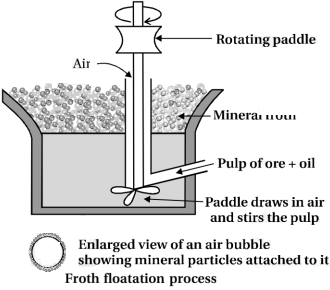
$(i)$ Frothers: These substances create froth. Examples: Pine oil,turpentine oil,etc.
$(ii)$ Collectors: Collectors help in the adhesion of ore particles to air bubbles in the froth. Example: Sodium ethyl xanthate.
$(iii)$ Froth stabilizers: These substances stabilize the froth. Examples: Aniline,cresol,etc.
$(iv)$ Depressants: These substances prevent the formation of froth with air bubbles for specific minerals. Example: $NaCN$ (sodium cyanide).
Process: In this process,a suspension of the powdered ore is made with water. The mineral particles become wet by oils,while gangue particles are wetted by water. $A$ rotating paddle agitates the mixture and draws air into it. As a result,froth is formed which carries the mineral particles. The froth is light and is skimmed off. It is then dried for the recovery of ore particles.
Role of depressants: Sometimes,it is possible to separate two sulphide ores by adjusting the proportion of oil to water or by adding depressants. For example,in the case of an ore containing $ZnS$ and $PbS$,the depressant used is $NaCN$. $NaCN$ forms a layer of zinc complex $Na_2[Zn(CN)_4]$ on the surface of $ZnS$,thereby preventing it from froth formation and allowing $PbS$ to come with the froth.
Conclusion: The sulphide ores,being lighter and easily wetted by oils,come to the surface,leaving behind the gangue. Hence,this method is used for the concentration of sulphide ores.
$(i)$ Frothers: These substances create froth. Examples: Pine oil,turpentine oil,etc.
$(ii)$ Collectors: Collectors help in the adhesion of ore particles to air bubbles in the froth. Example: Sodium ethyl xanthate.
$(iii)$ Froth stabilizers: These substances stabilize the froth. Examples: Aniline,cresol,etc.
$(iv)$ Depressants: These substances prevent the formation of froth with air bubbles for specific minerals. Example: $NaCN$ (sodium cyanide).
Process: In this process,a suspension of the powdered ore is made with water. The mineral particles become wet by oils,while gangue particles are wetted by water. $A$ rotating paddle agitates the mixture and draws air into it. As a result,froth is formed which carries the mineral particles. The froth is light and is skimmed off. It is then dried for the recovery of ore particles.
Role of depressants: Sometimes,it is possible to separate two sulphide ores by adjusting the proportion of oil to water or by adding depressants. For example,in the case of an ore containing $ZnS$ and $PbS$,the depressant used is $NaCN$. $NaCN$ forms a layer of zinc complex $Na_2[Zn(CN)_4]$ on the surface of $ZnS$,thereby preventing it from froth formation and allowing $PbS$ to come with the froth.
Conclusion: The sulphide ores,being lighter and easily wetted by oils,come to the surface,leaving behind the gangue. Hence,this method is used for the concentration of sulphide ores.
0 likes
View Solution117
Difficult
What is leaching? Explain with an example.
Solution
(N/A) Leaching is a process of concentration of ore,which is used when the ore is soluble in a suitable solvent.
Principle: The powdered ore is treated with a suitable solvent in which the ore is soluble,but the impurities are not. The ore is then recovered from the solution by suitable chemical methods.
Example-$1$: Leaching of Alumina from Bauxite.
Bauxite,the principal ore of aluminium,usually contains $SiO_2$,iron oxides,and titanium oxide $(TiO_2)$ as impurities.
Concentrated $NaOH$ solution is used to digest the powdered ore at $473-523 \ K$ and $35-36 \ bar$ pressure. This process extracts $Al_2O_3$ as sodium aluminate.
$Al_2O_{3(s)} + 2NaOH_{(aq)} + 3H_2O_{(l)} \rightarrow 2Na[Al(OH)_4]_{(aq)}$
The impurities like $SiO_2$ also dissolve in $NaOH$ to form sodium silicate,while other impurities remain insoluble.
The aluminate in solution is neutralised by passing $CO_2$ gas,which results in the precipitation of hydrated $Al_2O_3$. The solution is seeded with freshly prepared $Al_2O_3$ samples to induce precipitation.
$2Na[Al(OH)_4]_{(aq)} + 2CO_{2(g)} \rightarrow Al_2O_3 \cdot xH_2O_{(s)} + 2NaHCO_{3(aq)}$
The sodium silicate remains in the solution,and the hydrated alumina is filtered,dried,and heated to get pure $Al_2O_3$.
$Al_2O_3 \cdot xH_2O_{(s)} \xrightarrow{1470 \ K} Al_2O_{3(s)} + xH_2O_{(g)}$
Example-$2$: Leaching of Silver and Gold.
In the metallurgy of silver and gold,the respective metal is leached with a dilute solution of $NaCN$ or $KCN$ in the presence of air $(O_2)$,which supplies the necessary oxygen.
$4M_{(s)} + 8CN^-_{(aq)} + 2H_2O_{(aq)} + O_2(g) \rightarrow 4[M(CN)_2]^-_{(aq)} + 4OH^-_{(aq)}$ (where $M = Ag$ or $Au$)
The metal is then recovered by displacement using zinc.
$2[M(CN)_2]^-_{(aq)} + Zn_{(s)} \rightarrow [Zn(CN)_4]^{2-}_{(aq)} + 2M_{(s)}$
Principle: The powdered ore is treated with a suitable solvent in which the ore is soluble,but the impurities are not. The ore is then recovered from the solution by suitable chemical methods.
Example-$1$: Leaching of Alumina from Bauxite.
Bauxite,the principal ore of aluminium,usually contains $SiO_2$,iron oxides,and titanium oxide $(TiO_2)$ as impurities.
Concentrated $NaOH$ solution is used to digest the powdered ore at $473-523 \ K$ and $35-36 \ bar$ pressure. This process extracts $Al_2O_3$ as sodium aluminate.
$Al_2O_{3(s)} + 2NaOH_{(aq)} + 3H_2O_{(l)} \rightarrow 2Na[Al(OH)_4]_{(aq)}$
The impurities like $SiO_2$ also dissolve in $NaOH$ to form sodium silicate,while other impurities remain insoluble.
The aluminate in solution is neutralised by passing $CO_2$ gas,which results in the precipitation of hydrated $Al_2O_3$. The solution is seeded with freshly prepared $Al_2O_3$ samples to induce precipitation.
$2Na[Al(OH)_4]_{(aq)} + 2CO_{2(g)} \rightarrow Al_2O_3 \cdot xH_2O_{(s)} + 2NaHCO_{3(aq)}$
The sodium silicate remains in the solution,and the hydrated alumina is filtered,dried,and heated to get pure $Al_2O_3$.
$Al_2O_3 \cdot xH_2O_{(s)} \xrightarrow{1470 \ K} Al_2O_{3(s)} + xH_2O_{(g)}$
Example-$2$: Leaching of Silver and Gold.
In the metallurgy of silver and gold,the respective metal is leached with a dilute solution of $NaCN$ or $KCN$ in the presence of air $(O_2)$,which supplies the necessary oxygen.
$4M_{(s)} + 8CN^-_{(aq)} + 2H_2O_{(aq)} + O_2(g) \rightarrow 4[M(CN)_2]^-_{(aq)} + 4OH^-_{(aq)}$ (where $M = Ag$ or $Au$)
The metal is then recovered by displacement using zinc.
$2[M(CN)_2]^-_{(aq)} + Zn_{(s)} \rightarrow [Zn(CN)_4]^{2-}_{(aq)} + 2M_{(s)}$
0 likes
View Solution118
EasyMCQ
What are the various methods used for the concentration of an ore?
A
Hydraulic washing
B
Magnetic separation
C
Froth flotation process
D
All of the above
Solution
(D) The concentration of an ore is the process of removing gangue from the ore. The common methods used are:
$1$. Hydraulic washing (gravity separation): Based on the difference in densities of the ore and gangue.
$2$. Magnetic separation: Used when either the ore or the gangue is magnetic.
$3$. Froth flotation process: Used for sulphide ores based on the difference in wetting properties of the ore and gangue with oil and water.
$4$. Leaching: Chemical method used when the ore is soluble in a suitable solvent.
$1$. Hydraulic washing (gravity separation): Based on the difference in densities of the ore and gangue.
$2$. Magnetic separation: Used when either the ore or the gangue is magnetic.
$3$. Froth flotation process: Used for sulphide ores based on the difference in wetting properties of the ore and gangue with oil and water.
$4$. Leaching: Chemical method used when the ore is soluble in a suitable solvent.
0 likes
View Solution119
EasyMCQ
Which principle is involved in froth flotation?
A
Magnetic separation
B
Preferential wetting of ore by oil
C
Preferential wetting of ore by water
D
Gravity separation
Solution
(B) The froth flotation process is based on the principle of the difference in the wetting properties of the ore and the gangue particles with water and oil.
In this process,the ore particles are preferentially wetted by oil,while the gangue particles are preferentially wetted by water.
In this process,the ore particles are preferentially wetted by oil,while the gangue particles are preferentially wetted by water.
0 likes
View Solution120
EasyMCQ
Froth flotation method is used for the concentration of which type of ores?
A
Oxide ores
B
Sulphide ores
C
Carbonate ores
D
Halide ores
Solution
(B) The froth flotation method is primarily used for the concentration of $Sulphide$ ores.
In this process,the ore particles are wetted by oil (pine oil) and rise to the surface with the froth,while the gangue particles are wetted by water and settle at the bottom.
In this process,the ore particles are wetted by oil (pine oil) and rise to the surface with the froth,while the gangue particles are wetted by water and settle at the bottom.
0 likes
View Solution121
EasyMCQ
Which principle is involved in magnetic separation?
A
Difference in densities of ore and gangue
B
Difference in magnetic properties of ore and gangue
C
Difference in solubility of ore and gangue
D
Difference in chemical reactivity of ore and gangue
Solution
(B) Magnetic separation is based on the difference in magnetic properties of the ore and the gangue particles.
If either the ore or the gangue is attracted by a magnetic field,this method can be used for separation.
For example,magnetic ores like magnetite $(Fe_3O_4)$ or chromite $(FeCr_2O_4)$ can be separated from non-magnetic impurities using this technique.
If either the ore or the gangue is attracted by a magnetic field,this method can be used for separation.
For example,magnetic ores like magnetite $(Fe_3O_4)$ or chromite $(FeCr_2O_4)$ can be separated from non-magnetic impurities using this technique.
0 likes
View Solution122
Medium
How do we separate two sulphide ores by the Froth Flotation Method? Explain with an example.
Solution
(N/A) In the Froth Flotation Method,two sulphide ores can be separated by using substances called depressants.
Depressants selectively prevent one sulphide ore from forming froth while allowing the other to come to the froth.
For example,in an ore containing both $ZnS$ (zinc blende) and $PbS$ (galena),$NaCN$ is used as a depressant.
$NaCN$ reacts with $ZnS$ to form a soluble complex,$Na_2[Zn(CN)_4]$,which prevents $ZnS$ from forming froth,whereas $PbS$ is allowed to come with the froth.
Depressants selectively prevent one sulphide ore from forming froth while allowing the other to come to the froth.
For example,in an ore containing both $ZnS$ (zinc blende) and $PbS$ (galena),$NaCN$ is used as a depressant.
$NaCN$ reacts with $ZnS$ to form a soluble complex,$Na_2[Zn(CN)_4]$,which prevents $ZnS$ from forming froth,whereas $PbS$ is allowed to come with the froth.
0 likes
View Solution123
Difficult
Explain the leaching of:
$(i)$ Alumina from Bauxite (Bayer's Process)
$(ii)$ Gold and Silver (Cyanide Process)
$(i)$ Alumina from Bauxite (Bayer's Process)
$(ii)$ Gold and Silver (Cyanide Process)
Solution
(N/A) Principle: It works on the difference in the solubilities of ore and impurities in a suitable solvent.
$(i)$ Leaching of Alumina from Bauxite (Bayer's process): Bauxite is the principal ore of aluminium. It contains impurities of ferric oxide $(Fe_{2}O_{3})$,silica $(SiO_{2})$,and titanium oxide $(TiO_{2})$. The powdered ore is digested with concentrated $NaOH$ solution at $473-523 \ K$ temperature and $35-36 \ bar$ pressure. The alumina dissolves as sodium aluminate,while $Fe_{2}O_{3}$ and $TiO_{2}$ remain as solid residue. $SiO_{2}$ dissolves as sodium silicate.
$Al_{2}O_{3(s)} + 2NaOH_{(aq)} + 3H_{2}O_{(l)} \xrightarrow[473-523 \ K]{35 \ bar} 2Na[Al(OH)_{4}]_{(aq)}$
$SiO_{2(s)} + 2NaOH_{(aq)} \rightarrow Na_{2}SiO_{3(aq)} + H_{2}O_{(l)}$
The sodium aluminate solution is neutralized by passing $CO_{2}$ gas,causing hydrated $Al_{2}O_{3}$ to precipitate. $A$ small amount of freshly prepared hydrated $Al_{2}O_{3}$ is added to induce precipitation,a process called seeding.
$2Na[Al(OH)_{4}]_{(aq)} + 2CO_{2(g)} \rightarrow Al_{2}O_{3} \cdot xH_{2}O_{(s)} + 2NaHCO_{3(aq)}$
Sodium silicate remains in the solution,and the hydrated alumina is filtered and heated to obtain pure $Al_{2}O_{3}$.
$Al_{2}O_{3} \cdot xH_{2}O_{(s)} \xrightarrow{1470 \ K} Al_{2}O_{3(s)} + xH_{2}O_{(g)}$
$(ii)$ Cyanide Process (Leaching of Gold and Silver): In the metallurgy of gold and silver,the metal is leached with a dilute solution of $KCN$ or $NaCN$ in the presence of air (which supplies $O_{2}$). The metal is later recovered by a displacement reaction.
$4M_{(s)} + 8CN^{-}_{(aq)} + 2H_{2}O_{(l)} + O_{2(g)} \rightarrow 4[M(CN)_{2}]^{-}_{(aq)} + 4OH^{-}_{(aq)}$
$(M = Ag \text{ or } Au)$
$(i)$ Leaching of Alumina from Bauxite (Bayer's process): Bauxite is the principal ore of aluminium. It contains impurities of ferric oxide $(Fe_{2}O_{3})$,silica $(SiO_{2})$,and titanium oxide $(TiO_{2})$. The powdered ore is digested with concentrated $NaOH$ solution at $473-523 \ K$ temperature and $35-36 \ bar$ pressure. The alumina dissolves as sodium aluminate,while $Fe_{2}O_{3}$ and $TiO_{2}$ remain as solid residue. $SiO_{2}$ dissolves as sodium silicate.
$Al_{2}O_{3(s)} + 2NaOH_{(aq)} + 3H_{2}O_{(l)} \xrightarrow[473-523 \ K]{35 \ bar} 2Na[Al(OH)_{4}]_{(aq)}$
$SiO_{2(s)} + 2NaOH_{(aq)} \rightarrow Na_{2}SiO_{3(aq)} + H_{2}O_{(l)}$
The sodium aluminate solution is neutralized by passing $CO_{2}$ gas,causing hydrated $Al_{2}O_{3}$ to precipitate. $A$ small amount of freshly prepared hydrated $Al_{2}O_{3}$ is added to induce precipitation,a process called seeding.
$2Na[Al(OH)_{4}]_{(aq)} + 2CO_{2(g)} \rightarrow Al_{2}O_{3} \cdot xH_{2}O_{(s)} + 2NaHCO_{3(aq)}$
Sodium silicate remains in the solution,and the hydrated alumina is filtered and heated to obtain pure $Al_{2}O_{3}$.
$Al_{2}O_{3} \cdot xH_{2}O_{(s)} \xrightarrow{1470 \ K} Al_{2}O_{3(s)} + xH_{2}O_{(g)}$
$(ii)$ Cyanide Process (Leaching of Gold and Silver): In the metallurgy of gold and silver,the metal is leached with a dilute solution of $KCN$ or $NaCN$ in the presence of air (which supplies $O_{2}$). The metal is later recovered by a displacement reaction.
$4M_{(s)} + 8CN^{-}_{(aq)} + 2H_{2}O_{(l)} + O_{2(g)} \rightarrow 4[M(CN)_{2}]^{-}_{(aq)} + 4OH^{-}_{(aq)}$
$(M = Ag \text{ or } Au)$
0 likes
View Solution124
MediumMCQ
What is concentration of ore?
A
The process of adding impurities to the ore.
B
The process of removing gangue from the ore.
C
The process of melting the ore.
D
The process of converting ore into metal oxide.
Solution
(B) The removal of unwanted materials such as sand,clay,and rocks from the ore is known as ore benefaction or concentration (dressing) of ore.
Before concentration,the ores are crushed and pulverized into fine particles.
The selection of the concentration method depends on the differences in physical properties between the metal compound and the gangue.
Factors like the type of metal,available facilities,and environmental impact are also considered.
Before concentration,the ores are crushed and pulverized into fine particles.
The selection of the concentration method depends on the differences in physical properties between the metal compound and the gangue.
Factors like the type of metal,available facilities,and environmental impact are also considered.
0 likes
View Solution125
MediumMCQ
The method of concentrating the ore which makes use of the difference in density between ore and impurities is called:
A
Levigation
B
Leaching
C
Magnetic separation
D
Liquation
Solution
(A) The method of concentrating ore based on the difference in densities of the ore and the gangue (impurities) is known as $Levigation$ or $Gravity$ $Separation$ or $Hydraulic$ $Washing$. In this process,the powdered ore is washed with a stream of water,where lighter gangue particles are carried away,leaving behind the heavier ore particles.
0 likes
View Solution126
MediumMCQ
Which of the following ores is concentrated using a group $1$ cyanide salt?
A
Sphalerite
B
Calamine
C
Siderite
D
Malachite
Solution
(A) The concentration of sulphide ores is often carried out by the froth flotation process.
In this process,depressants are used to selectively prevent one sulphide ore from forming froth.
For an ore containing $ZnS$ (Sphalerite) and $PbS$ (Galena),sodium cyanide $(NaCN)$,which is a group $1$ cyanide salt,is used as a depressant.
$NaCN$ selectively prevents $ZnS$ from coming to the froth by forming a complex,$Na_{2}[Zn(CN)_{4}]$,while $PbS$ forms froth.
Therefore,$ZnS$ (Sphalerite) is the ore associated with this process.
In this process,depressants are used to selectively prevent one sulphide ore from forming froth.
For an ore containing $ZnS$ (Sphalerite) and $PbS$ (Galena),sodium cyanide $(NaCN)$,which is a group $1$ cyanide salt,is used as a depressant.
$NaCN$ selectively prevents $ZnS$ from coming to the froth by forming a complex,$Na_{2}[Zn(CN)_{4}]$,while $PbS$ forms froth.
Therefore,$ZnS$ (Sphalerite) is the ore associated with this process.
0 likes
View Solution127
MediumMCQ
Given below are two statements :
Statement $I :$ Sphalerite is a sulphide ore of zinc and copper glance is a sulphide ore of copper.
Statement $II :$ It is possible to separate two sulphide ores by adjusting proportion of oil to water or by using 'depressants' in a froth flotation method.
Choose the most appropriate answer from the options given below :
Statement $I :$ Sphalerite is a sulphide ore of zinc and copper glance is a sulphide ore of copper.
Statement $II :$ It is possible to separate two sulphide ores by adjusting proportion of oil to water or by using 'depressants' in a froth flotation method.
Choose the most appropriate answer from the options given below :
A
Statement $I$ is true but Statement $II$ is false.
B
Both Statement $I$ and Statement $II$ are true.
C
Statement $I$ is false but Statement $II$ is true.
D
Both Statement $I$ and Statement $II$ are false.
Solution
(B) Statement $I$ is true: Sphalerite is $ZnS$ (zinc sulphide) and copper glance is $Cu_2S$ (copper sulphide).
Statement $II$ is true: In the froth flotation process,the separation of two sulphide ores can be achieved by adjusting the ratio of oil to water or by using 'depressants' (e.g.,$NaCN$ is used to separate $ZnS$ from $PbS$).
Statement $II$ is true: In the froth flotation process,the separation of two sulphide ores can be achieved by adjusting the ratio of oil to water or by using 'depressants' (e.g.,$NaCN$ is used to separate $ZnS$ from $PbS$).
0 likes
View Solution128
MediumMCQ
In the leaching of alumina from bauxite,the ore impurity expected to leach out in the process by reacting with $NaOH$ is:
A
$TiO_{2}$
B
$SiO_{2}$
C
$Fe_{2}O_{3}$
D
$ZnO$
Solution
(B) In bauxite,impurities of $Fe_{2}O_{3}$,$TiO_{2}$,and $SiO_{2}$ are present.
$Fe_{2}O_{3}$ and $TiO_{2}$ are basic oxides,therefore they do not react with or dissolve in $NaOH$.
$SiO_{2}$ is an acidic oxide; it reacts with $NaOH$ to form soluble sodium silicate,hence it leaches out.
The chemical reaction is: $SiO_{2} + 2NaOH \rightarrow Na_{2}SiO_{3} (aq.) + H_{2}O$.
$Fe_{2}O_{3}$ and $TiO_{2}$ are basic oxides,therefore they do not react with or dissolve in $NaOH$.
$SiO_{2}$ is an acidic oxide; it reacts with $NaOH$ to form soluble sodium silicate,hence it leaches out.
The chemical reaction is: $SiO_{2} + 2NaOH \rightarrow Na_{2}SiO_{3} (aq.) + H_{2}O$.
0 likes
View Solution129
EasyMCQ
Depressant used in the concentration of an ore containing $ZnS$ and $PbS$ is
A
$Na_2CO_3$
B
$NaCl$
C
$NaCN$
D
$Na_2SO_4$
Solution
(C) In the froth flotation process,$NaCN$ is used as a depressant to separate $ZnS$ from $PbS$.
$NaCN$ selectively prevents $ZnS$ from forming froth by forming a soluble complex $Na_2[Zn(CN)_4]$,while $PbS$ forms froth and is collected.
$NaCN$ selectively prevents $ZnS$ from forming froth by forming a soluble complex $Na_2[Zn(CN)_4]$,while $PbS$ forms froth and is collected.
0 likes
View Solution130
EasyMCQ
The role of depressants in the Froth Flotation method is to $.....$.
A
selectively prevent one component of the ore from coming to the froth.
B
reduce the consumption of oil for froth formation.
C
stabilize the froth.
D
enhance non-wettability of the mineral particles.
Solution
(A) In the Froth Flotation process,depressants are used to selectively prevent one component of the ore from forming froth.
For example,in the separation of $PbS$ (Galena) from $ZnS$ (Zinc blende),$NaCN$ is used as a depressant.
$NaCN$ reacts with $ZnS$ to form a soluble complex $Na_2[Zn(CN)_4]$,thereby preventing $ZnS$ from coming to the froth,while $PbS$ forms the froth.
For example,in the separation of $PbS$ (Galena) from $ZnS$ (Zinc blende),$NaCN$ is used as a depressant.
$NaCN$ reacts with $ZnS$ to form a soluble complex $Na_2[Zn(CN)_4]$,thereby preventing $ZnS$ from coming to the froth,while $PbS$ forms the froth.
0 likes
View Solution131
MediumMCQ
Which of the following reactions is suitable for concentrating ore by the leaching process?
A
$2Cu_2S + 3O_2 \rightarrow 2Cu_2O + 2SO_2$
B
$Fe_3O_4 + CO \rightarrow 3FeO + CO_2$
C
$Al_2O_3 + 2NaOH + 3H_2O \rightarrow 2Na[Al(OH)_4]$
D
$Al_2O_3 + 6Mg \rightarrow 6MgO + 4Al$
Solution
(C) Leaching is a process of concentrating ore by dissolving it in a suitable solvent in which the ore is soluble but the impurities are not.
The reaction $Al_2O_3 + 2NaOH + 3H_2O \rightarrow 2Na[Al(OH)_4]$ represents the Bayer's process,which is a classic example of leaching bauxite ore $(Al_2O_3)$ using a sodium hydroxide solution.
The reaction $Al_2O_3 + 2NaOH + 3H_2O \rightarrow 2Na[Al(OH)_4]$ represents the Bayer's process,which is a classic example of leaching bauxite ore $(Al_2O_3)$ using a sodium hydroxide solution.
0 likes
View Solution132
MediumMCQ
In metallurgy,the term "gangue" is used for:
A
Contamination of undesired earthy materials.
B
Contamination of metals,other than the desired metal.
C
Minerals which are naturally occurring in pure form.
D
Magnetic impurities in an ore.
Solution
(A) Earthy and undesired materials present in the ore,other than the desired metal,are known as gangue.
0 likes
View Solution133
MediumMCQ
Given below are two statements :-
Statement $I$: In froth floatation method,a rotating paddle agitates the mixture to draw air into it.
Statement $II$: Iron pyrites are generally avoided for the extraction of iron due to environmental reasons.
In the light of the above statements,choose the correct answer from the options given below :-
Statement $I$: In froth floatation method,a rotating paddle agitates the mixture to draw air into it.
Statement $II$: Iron pyrites are generally avoided for the extraction of iron due to environmental reasons.
In the light of the above statements,choose the correct answer from the options given below :-
A
Both Statement $I$ and Statement $II$ are true
B
Statement $I$ is false but Statement $II$ is true
C
Statement $I$ is true but Statement $II$ is false
D
Both Statement $I$ and Statement $II$ are false
Solution
(B) Statement $I$ is false because in the froth floatation method,the rotating paddle agitates the mixture to draw air into it,not to drive air out of it.
Statement $II$ is true because iron pyrites $(FeS_2)$ contain a high percentage of sulfur,which leads to the release of $SO_2$ gas upon roasting,causing severe environmental pollution and acid rain. Therefore,it is generally avoided for the extraction of iron.
Statement $II$ is true because iron pyrites $(FeS_2)$ contain a high percentage of sulfur,which leads to the release of $SO_2$ gas upon roasting,causing severe environmental pollution and acid rain. Therefore,it is generally avoided for the extraction of iron.
0 likes
View Solution134
MediumMCQ
The methods $NOT$ involved in the concentration of ore are:
$A$. Liquation
$B$. Leaching
$C$. Electrolysis
$D$. Hydraulic washing
$E$. Froth flotation
Choose the correct answer from the options given below:
$A$. Liquation
$B$. Leaching
$C$. Electrolysis
$D$. Hydraulic washing
$E$. Froth flotation
Choose the correct answer from the options given below:
A
$B, D$ and $C$ only
B
$C, D$ and $E$ only
C
$A$ and $C$ only
D
$B, D$ and $E$ only
Solution
(C) The concentration of ore (also known as beneficiation or dressing) involves removing gangue from the ore. The common methods are:
$(i)$ Hydraulic Washing (Gravity separation)
$(ii)$ Froth Flotation
$(iii)$ Magnetic Separation
$(iv)$ Leaching
Liquation $(A)$ is a method used for the refining of metals with low melting points.
Electrolysis $(C)$ is a method used for the refining of metals.
Therefore,the methods $NOT$ involved in the concentration of ore are $A$ (Liquation) and $C$ (Electrolysis).
$(i)$ Hydraulic Washing (Gravity separation)
$(ii)$ Froth Flotation
$(iii)$ Magnetic Separation
$(iv)$ Leaching
Liquation $(A)$ is a method used for the refining of metals with low melting points.
Electrolysis $(C)$ is a method used for the refining of metals.
Therefore,the methods $NOT$ involved in the concentration of ore are $A$ (Liquation) and $C$ (Electrolysis).
0 likes
View Solution135
EasyMCQ
Which of the following metals can be extracted through alkali leaching technique?
A
$Cu$
B
$Sn$
C
$Pb$
D
$Au$
Solution
(D) The alkali leaching process is commonly used for the extraction of $Al$ (from bauxite ore) and $Au$ or $Ag$ (from their respective ores).
In the case of gold $(Au)$,the ore is treated with a dilute solution of sodium cyanide $(NaCN)$ in the presence of air $(O_2)$,which acts as a source of oxygen.
The chemical reaction is: $4Au(s) + 8CN^-(aq) + 2H_2O(aq) + O_2(g) \rightarrow 4[Au(CN)_2]^-(aq) + 4OH^-(aq)$.
Thus,$Au$ is extracted using this leaching technique.
In the case of gold $(Au)$,the ore is treated with a dilute solution of sodium cyanide $(NaCN)$ in the presence of air $(O_2)$,which acts as a source of oxygen.
The chemical reaction is: $4Au(s) + 8CN^-(aq) + 2H_2O(aq) + O_2(g) \rightarrow 4[Au(CN)_2]^-(aq) + 4OH^-(aq)$.
Thus,$Au$ is extracted using this leaching technique.
0 likes
View Solution136
MediumMCQ
Which of the following is used as a stabilizer during the concentration of sulphide ores?
A
Pine oils
B
Xanthates
C
Fatty acids
D
Cresols
Solution
(D) In the froth flotation process,stabilizers are added to stabilize the froth. $Cresols$ or $Aniline$ are commonly used as stabilizers.
0 likes
View Solution137
EasyMCQ
Which of the following magnetic impurity is present in Cassiterite ore?
A
$Fe_2O_3$
B
$FeWO_4$
C
$FeO$
D
$Fe_3O_4$
Solution
(B) Cassiterite $(SnO_2)$ is the principal ore of tin.
It often contains magnetic impurities of wolframite,which is a mixture of iron tungstate $(FeWO_4)$ and manganese tungstate $(MnWO_4)$.
These magnetic impurities are separated from the non-magnetic $SnO_2$ ore using electromagnetic separation.
It often contains magnetic impurities of wolframite,which is a mixture of iron tungstate $(FeWO_4)$ and manganese tungstate $(MnWO_4)$.
These magnetic impurities are separated from the non-magnetic $SnO_2$ ore using electromagnetic separation.
0 likes
View Solution138
EasyMCQ
Which among the following ores is concentrated by the froth flotation process?
A
Diaspore
B
Bauxite
C
Dolomite
D
Galena
Solution
(D) The correct answer is $Galena$.
$Galena$ $(PbS)$ is a sulphide ore.
The froth flotation process is specifically used for the concentration of sulphide ores because sulphide ores are preferentially wetted by oil,while gangue particles are wetted by water.
Since $Galena$ is lead$(II)$ sulphide,it is concentrated using this method.
$Galena$ $(PbS)$ is a sulphide ore.
The froth flotation process is specifically used for the concentration of sulphide ores because sulphide ores are preferentially wetted by oil,while gangue particles are wetted by water.
Since $Galena$ is lead$(II)$ sulphide,it is concentrated using this method.
0 likes
View Solution139
MediumMCQ
In leaching of alumina from bauxite by Bayer's process,the ore is treated with
A
$NaOH_{(aq)}$
B
$NaCl_{(aq)}$
C
$KCN_{(aq)}$
D
$Na_2CO_{3(aq)}$
Solution
(A) In leaching of alumina from bauxite by Bayer's process,the ore is treated with $NaOH_{(aq)}$.
Concentration is carried out by heating the powdered ore with a concentrated solution of $NaOH$ at $473-523 \ K$ and $35-36 \ bar$ pressure.
$Al_2O_3$ is extracted out as sodium aluminate.
$Al_2O_{3(s)} + 2NaOH_{(aq)} + 3H_2O_{(l)} \rightarrow 2Na[Al(OH)_4]_{(aq)}$
The sodium aluminate formed is neutralised by passing $CO_2$ gas and hydrated $Al_2O_3$ is precipitated.
$2Na[Al(OH)_4]_{(aq)} + 2CO_{2(g)} \rightarrow Al_2O_3 \cdot xH_2O_{(s)} + 2NaHCO_{3(aq)}$
Concentration is carried out by heating the powdered ore with a concentrated solution of $NaOH$ at $473-523 \ K$ and $35-36 \ bar$ pressure.
$Al_2O_3$ is extracted out as sodium aluminate.
$Al_2O_{3(s)} + 2NaOH_{(aq)} + 3H_2O_{(l)} \rightarrow 2Na[Al(OH)_4]_{(aq)}$
The sodium aluminate formed is neutralised by passing $CO_2$ gas and hydrated $Al_2O_3$ is precipitated.
$2Na[Al(OH)_4]_{(aq)} + 2CO_{2(g)} \rightarrow Al_2O_3 \cdot xH_2O_{(s)} + 2NaHCO_{3(aq)}$
0 likes
View Solution140
MediumMCQ
Which of the following methods is used to separate wolframite and stannic oxide present in cassiterite?
A
Hydraulic washing using Wilfley table
B
Froth flotation
C
Hydraulic classifier
D
Magnetic separation
Solution
(D) Cassiterite $(SnO_2)$ is a non-magnetic ore.
Wolframite $(FeWO_4)$ is a magnetic impurity.
These can be separated by the magnetic separation method,where the ore is passed over a magnetic belt that attracts the magnetic wolframite while the non-magnetic $SnO_2$ falls off.
Wolframite $(FeWO_4)$ is a magnetic impurity.
These can be separated by the magnetic separation method,where the ore is passed over a magnetic belt that attracts the magnetic wolframite while the non-magnetic $SnO_2$ falls off.
0 likes
View Solution141
EasyMCQ
Name the reagent that is used in leaching of gold.
A
Carbon
B
Sodium cyanide
C
Carbon monoxide
D
Iodine
Solution
(B) In the process of leaching gold,the ore is treated with a dilute solution of sodium cyanide $(NaCN)$ in the presence of air or oxygen $(O_2)$.
This results in the formation of a soluble complex,sodium dicyanoaurate$(I)$,represented by the equation: $4Au(s) + 8CN^-(aq) + 2H_2O(aq) + O_2(g) \rightarrow 4[Au(CN)_2]^-(aq) + 4OH^-(aq)$.
This results in the formation of a soluble complex,sodium dicyanoaurate$(I)$,represented by the equation: $4Au(s) + 8CN^-(aq) + 2H_2O(aq) + O_2(g) \rightarrow 4[Au(CN)_2]^-(aq) + 4OH^-(aq)$.
0 likes
View Solution142
EasyMCQ
What is the product formed when bauxite ore is treated with sodium hydroxide?
A
Sodium meta-aluminate
B
Aluminium hydroxide
C
Sodium aluminate
D
Sodium hydrogen carbonate
Solution
(A) Bauxite ore is finely divided and heated under pressure with a concentrated solution of sodium hydroxide $(NaOH)$ at $150^{\circ} C$ to obtain sodium meta-aluminate.
The chemical reaction is as follows:
$Al_{2}O_{3} \cdot 2H_{2}O + 2NaOH \xrightarrow{150^{\circ} C} 2NaAlO_{2} + 3H_{2}O$
Thus,the product formed is sodium meta-aluminate.
The chemical reaction is as follows:
$Al_{2}O_{3} \cdot 2H_{2}O + 2NaOH \xrightarrow{150^{\circ} C} 2NaAlO_{2} + 3H_{2}O$
Thus,the product formed is sodium meta-aluminate.
0 likes
View Solution143
EasyMCQ
Identify the product formed when bauxite ore is treated with sodium hydroxide?
A
Sodium hydrogen carbonate
B
Aluminium hydroxide
C
Sodium meta aluminate
D
Aluminium chloride
Solution
(C) Bauxite ore $(Al_2O_3 \cdot 2H_2O)$ is treated with a concentrated solution of sodium hydroxide $(NaOH)$ at $473-523 \ K$ and $35-36 \ bar$ pressure.
This process dissolves the aluminium oxide to form soluble sodium meta aluminate $(NaAlO_2)$:
$Al_2O_3(s) + 2NaOH(aq) + 3H_2O(l) \rightarrow 2Na[Al(OH)_4](aq)$ or $2NaAlO_2(aq) + 3H_2O(l)$.
This process dissolves the aluminium oxide to form soluble sodium meta aluminate $(NaAlO_2)$:
$Al_2O_3(s) + 2NaOH(aq) + 3H_2O(l) \rightarrow 2Na[Al(OH)_4](aq)$ or $2NaAlO_2(aq) + 3H_2O(l)$.
0 likes
View Solution144
EasyMCQ
Bauxite,an ore of aluminium,is purified by which process?
A
Hoope's process
B
Hall's process
C
Mond's process
D
Liquation process
Solution
(B) Bauxite $(Al_2O_3 \cdot 2H_2O)$,an ore of aluminium,is purified by the leaching process known as Hall's process (or Bayer's process) to remove impurities like $Fe_2O_3$,$SiO_2$,and $TiO_2$.
0 likes
View Solution145
EasyMCQ
Which one of the following is true?
A
$NaOH$ is used in the concentration of bauxite ore
B
$NaOH$ is a primary standard in volumetric analysis
C
Manganous hydroxide is soluble in excess of $NaOH$ solution
D
$NaOH$ solution does not react with $Cl_2$
Solution
(A) In the Bayer's process,$NaOH$ is used to leach bauxite ore $(Al_2O_3 \cdot 2H_2O)$ to separate it from impurities like $Fe_2O_3$ and $SiO_2$.
$NaOH$ is not a primary standard because it is hygroscopic and absorbs $CO_2$ from the air.
Manganous hydroxide,$Mn(OH)_2$,is insoluble in excess $NaOH$.
$NaOH$ reacts with $Cl_2$ to form sodium chloride and sodium hypochlorite or chlorate depending on the temperature.
$NaOH$ is not a primary standard because it is hygroscopic and absorbs $CO_2$ from the air.
Manganous hydroxide,$Mn(OH)_2$,is insoluble in excess $NaOH$.
$NaOH$ reacts with $Cl_2$ to form sodium chloride and sodium hypochlorite or chlorate depending on the temperature.
0 likes
View Solution146
EasyMCQ
The function of potassium ethyl xanthate in the froth floatation process is to make the ore
A
lighter
B
hydrophobic
C
hydrophilic
D
heavier
Solution
(B) In the froth floatation process,collectors like potassium ethyl xanthate are added to the suspension.
These molecules adsorb onto the surface of the mineral particles,making them water-repellent or $hydrophobic$.
This allows the mineral particles to attach to air bubbles and rise to the surface with the froth,effectively separating them from the gangue.
These molecules adsorb onto the surface of the mineral particles,making them water-repellent or $hydrophobic$.
This allows the mineral particles to attach to air bubbles and rise to the surface with the froth,effectively separating them from the gangue.
0 likes
View Solution147
EasyMCQ
The function of potassium ethyl xanthate in the froth floatation process is to make the ore
A
water repellant
B
lighter
C
heavier
D
attracted towards water
Solution
(A) In the froth floatation process,potassium ethyl xanthate acts as a collector.
It attaches itself by its polar group to the grains of minerals,making the mineral surface hydrophobic.
This increases the non-wettability of the mineral particles,effectively making the ore water repellant.
It attaches itself by its polar group to the grains of minerals,making the mineral surface hydrophobic.
This increases the non-wettability of the mineral particles,effectively making the ore water repellant.
0 likes
View Solution148
EasyMCQ
The ore that is concentrated by the froth floatation process is
A
cryolite
B
cuprite
C
calamine
D
chalcopyrites
Solution
(D) The froth floatation process is primarily used for the concentration of sulphide ores.
Among the given options,chalcopyrites $(CuFeS_{2})$ is a sulphide ore,whereas cryolite $(Na_{3}AlF_{6})$,cuprite $(Cu_{2}O)$,and calamine $(ZnCO_{3})$ are not.
Therefore,chalcopyrites is concentrated by the froth floatation process.
Among the given options,chalcopyrites $(CuFeS_{2})$ is a sulphide ore,whereas cryolite $(Na_{3}AlF_{6})$,cuprite $(Cu_{2}O)$,and calamine $(ZnCO_{3})$ are not.
Therefore,chalcopyrites is concentrated by the froth floatation process.
0 likes
View Solution149
MediumMCQ
The ore that is concentrated by froth floatation process is
A
zincite
B
cinnabar
C
bauxite
D
malachite
Solution
(B) Cinnabar $(HgS)$ is a sulphide ore.
Froth floatation process is specifically used for the concentration of sulphide ores.
Therefore,cinnabar is concentrated by this process.
Froth floatation process is specifically used for the concentration of sulphide ores.
Therefore,cinnabar is concentrated by this process.
0 likes
View Solution150
EasyMCQ
The complex formed when $Al_2O_3$ is leached from Bauxite using concentrated $NaOH$ solution is,
A
$Na[Al(OH)_4]$
B
$NaAl_2O_4$
C
$Na_2[Al(OH)_3]$
D
$Na_2AlO_2$
Solution
(A) When $Al_2O_3$ is leached from bauxite using concentrated $NaOH$ solution,the complex formed is $Na[Al(OH)_4]$.
The chemical reaction involved in the leaching process of bauxite ore is:
$Al_2O_3 \cdot 2H_2O + 2NaOH + 3H_2O \xrightarrow{473-523 \ K} 2Na[Al(OH)_4]$
The chemical reaction involved in the leaching process of bauxite ore is:
$Al_2O_3 \cdot 2H_2O + 2NaOH + 3H_2O \xrightarrow{473-523 \ K} 2Na[Al(OH)_4]$
0 likes
View SolutionGeneral Principles and Processes of Isolation of Elements — Concentration · Frequently Asked Questions
1Are these General Principles and Processes of Isolation of Elements questions useful for JEE and NEET?
Yes. All questions in this section are mapped to JEE Main and NEET exam patterns. Previous year questions from JEE Main, NEET, GUJCET and state-level exams are included with full solutions.
2Can I switch to Hindi or Gujarati for these questions?
Yes. Use the language tabs in the hero section or the sidebar to view the same questions and solutions in English, Hindi or Gujarati.
3How do I generate a question paper from this subtopic?
Use the Vedclass Exam Paper Generator — select the chapter and subtopic, set difficulty, and generate Sets A, B, C, D automatically. First 3 chapters of every subject are free.
Vedclass Products
For Students
Vedclass Test Series
Mock tests in real JEE/NEET style with performance analysis. 5-day free trial.
Start Free TrialFor Teachers
Exam Paper Generator
Generate Set A/B/C/D papers from this chapter in 2 minutes. 3 chapters free.
Try FreeFor Institutes
Online Exam Module
Live online exams with unlimited students, 360° analytics & white-label branding.
See DemoFor Teachers & Institutes
Generate a General Principles and Processes of Isolation of Elements Exam Paper in 2 Minutes
Select subtopic & difficulty — Sets A, B, C, D auto-generated with No Repeat logic.
First 3 chapters of every subject are free — no payment required.