
A English
Decomposition Questions in English
Class 12 Biology · Ecosystem · Decomposition
122+
Questions
English
Language
100%
With Solutions
Showing 50 of 122 questions in English
51
Easy
Mention the various steps included in the process of decomposition.
Solution
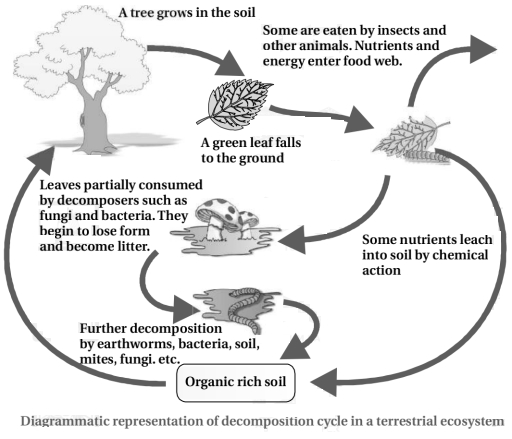
(N/A) The important steps in the process of decomposition are fragmentation,leaching,catabolism,humification,and mineralization.
$(i)$ Fragmentation: Detritivores (e.g.,earthworm) break down detritus into smaller particles. This process is called fragmentation.
$(ii)$ Leaching: By the process of leaching,water-soluble inorganic nutrients go down into the soil horizon and get precipitated as unavailable salts.
$(iii)$ Catabolism: Bacterial and fungal enzymes degrade detritus into simpler inorganic substances. This process is called catabolism.
$(iv)$ Humification: Humification leads to the accumulation of a dark-colored amorphous substance called humus that is highly resistant to microbial action and undergoes decomposition at an extremely slow rate. Being colloidal in nature,it serves as a reservoir of nutrients.
$(v)$ Mineralization: The humus is further degraded by some microbes and release of inorganic nutrients occurs by the process known as mineralization.
$(i)$ Fragmentation: Detritivores (e.g.,earthworm) break down detritus into smaller particles. This process is called fragmentation.
$(ii)$ Leaching: By the process of leaching,water-soluble inorganic nutrients go down into the soil horizon and get precipitated as unavailable salts.
$(iii)$ Catabolism: Bacterial and fungal enzymes degrade detritus into simpler inorganic substances. This process is called catabolism.
$(iv)$ Humification: Humification leads to the accumulation of a dark-colored amorphous substance called humus that is highly resistant to microbial action and undergoes decomposition at an extremely slow rate. Being colloidal in nature,it serves as a reservoir of nutrients.
$(v)$ Mineralization: The humus is further degraded by some microbes and release of inorganic nutrients occurs by the process known as mineralization.
0 likes
View Solution52
Medium
Define decomposition and describe the processes and products of decomposition.
Solution
(N/A) Decomposition is the process that involves the breakdown of complex organic matter or biomass from the body of dead plants and animals with the help of decomposers into inorganic raw materials such as $CO_{2}$,water,and other nutrients.
The various processes involved in decomposition are as follows:
$1$. Fragmentation: It is the first step in the process of decomposition. It involves the breakdown of detritus into smaller pieces by the action of detritivores such as earthworms.
$2$. Leaching: It is a process where the water-soluble nutrients go down into the soil layers and get locked as unavailable salts.
$3$. Catabolism: It is a process in which bacteria and fungi degrade detritus through various enzymes into simpler inorganic substances.
$4$. Humification: This step leads to the formation of a dark-colored,amorphous,colloidal substance called humus,which acts as a reservoir of nutrients for plants.
$5$. Mineralization: The humus is further degraded by the action of microbes,which leads to the release of inorganic nutrients into the soil. This process of releasing inorganic nutrients from the humus is known as mineralization.
The final products of decomposition include humus (a nutrient-rich substance) and inorganic raw materials such as $CO_{2}$,water,and various mineral nutrients.
The various processes involved in decomposition are as follows:
$1$. Fragmentation: It is the first step in the process of decomposition. It involves the breakdown of detritus into smaller pieces by the action of detritivores such as earthworms.
$2$. Leaching: It is a process where the water-soluble nutrients go down into the soil layers and get locked as unavailable salts.
$3$. Catabolism: It is a process in which bacteria and fungi degrade detritus through various enzymes into simpler inorganic substances.
$4$. Humification: This step leads to the formation of a dark-colored,amorphous,colloidal substance called humus,which acts as a reservoir of nutrients for plants.
$5$. Mineralization: The humus is further degraded by the action of microbes,which leads to the release of inorganic nutrients into the soil. This process of releasing inorganic nutrients from the humus is known as mineralization.
The final products of decomposition include humus (a nutrient-rich substance) and inorganic raw materials such as $CO_{2}$,water,and various mineral nutrients.
0 likes
View Solution53
EasyMCQ
What is common to earthworm,mushroom,soil mites,and dung beetle in an ecosystem?
A
They are primary producers.
B
They are detritivores.
C
They are secondary consumers.
D
They are top carnivores.
Solution
(B) Earthworms,mushrooms,soil mites,and dung beetles are all organisms that feed on dead and decaying organic matter (detritus).
In an ecosystem,these organisms are collectively known as detritivores.
They play a crucial role in the decomposition process by breaking down complex organic matter into simpler substances,thereby facilitating nutrient cycling.
In an ecosystem,these organisms are collectively known as detritivores.
They play a crucial role in the decomposition process by breaking down complex organic matter into simpler substances,thereby facilitating nutrient cycling.
0 likes
View Solution54
EasyMCQ
What could be the reason for the faster rate of decomposition in the tropics?
A
High temperature and moisture
B
Low temperature and moisture
C
High temperature and low moisture
D
Low temperature and high moisture
Solution
(A) Decomposition is an oxygen-requiring process. The rate of decomposition is controlled by chemical composition of detritus and climatic factors.
In the tropics,the climate is characterized by high temperature and high humidity (moisture).
These conditions favor the activity of decomposers (bacteria and fungi),which leads to a faster rate of decomposition compared to temperate regions.
In the tropics,the climate is characterized by high temperature and high humidity (moisture).
These conditions favor the activity of decomposers (bacteria and fungi),which leads to a faster rate of decomposition compared to temperate regions.
0 likes
View Solution55
Medium
Apart from plants and animals, microbes form a permanent biotic component in an ecosystem. While plants are referred to as autotrophs and animals as heterotrophs, what are microbes referred to as? How do microbes fulfill their energy requirements?
Solution
(N/A) Microbes, specifically bacteria and fungi, are primarily referred to as $saprotrophs$ or $decomposers$ in an ecosystem.
They fulfill their energy requirements by breaking down complex organic matter from dead and decaying plants and animals into simpler substances.
This process is known as $extracellular$ $digestion$, where microbes secrete digestive enzymes onto the organic matter, absorb the resulting nutrients, and release inorganic minerals back into the soil, thereby playing a crucial role in nutrient cycling.
They fulfill their energy requirements by breaking down complex organic matter from dead and decaying plants and animals into simpler substances.
This process is known as $extracellular$ $digestion$, where microbes secrete digestive enzymes onto the organic matter, absorb the resulting nutrients, and release inorganic minerals back into the soil, thereby playing a crucial role in nutrient cycling.
0 likes
View Solution56
DifficultMCQ
How do you distinguish between humification and mineralization?
A
Humification is the breakdown of humus,while mineralization is the formation of humus.
B
Humification is the formation of humus,while mineralization is the release of inorganic nutrients from humus.
C
Humification occurs in water,while mineralization occurs in soil.
D
There is no difference between the two processes.
Solution
(B) Humification leads to the accumulation of a dark-colored amorphous substance called humus,which is highly resistant to microbial action and undergoes decomposition at an extremely slow rate. Being colloidal in nature,it serves as a reservoir of nutrients.
Mineralization: The humus is further degraded by some microbes,and the release of inorganic nutrients occurs through the process known as mineralization.
Mineralization: The humus is further degraded by some microbes,and the release of inorganic nutrients occurs through the process known as mineralization.
0 likes
View Solution57
Medium
The rate of decomposition of detritus is affected by abiotic factors like the availability of oxygen, $pH$ of the soil substratum, temperature, etc. Discuss.
Solution
(N/A) Decomposition is the process of breakdown of complex organic matter into inorganic substances like $CO_2$, water, and nutrients by decomposers.
$1$. $Oxygen$ $availability$: Decomposition is an oxygen-requiring process. The rate of decomposition is higher in aerobic conditions (presence of oxygen) and slower in anaerobic conditions (absence of oxygen).
$2$. $pH$ $of$ $the$ $soil$ $substratum$: The $pH$ of the soil influences the activity of decomposers like bacteria and fungi. Most decomposers prefer a neutral to slightly acidic $pH$. Extreme $pH$ levels can inhibit microbial activity.
$3$. $Temperature$: Temperature is a critical factor. Warm and moist environments favor decomposition because they promote the activity of soil microbes. Low temperatures inhibit microbial activity, leading to the accumulation of detritus, while very high temperatures may also limit the growth of certain decomposers.
$1$. $Oxygen$ $availability$: Decomposition is an oxygen-requiring process. The rate of decomposition is higher in aerobic conditions (presence of oxygen) and slower in anaerobic conditions (absence of oxygen).
$2$. $pH$ $of$ $the$ $soil$ $substratum$: The $pH$ of the soil influences the activity of decomposers like bacteria and fungi. Most decomposers prefer a neutral to slightly acidic $pH$. Extreme $pH$ levels can inhibit microbial activity.
$3$. $Temperature$: Temperature is a critical factor. Warm and moist environments favor decomposition because they promote the activity of soil microbes. Low temperatures inhibit microbial activity, leading to the accumulation of detritus, while very high temperatures may also limit the growth of certain decomposers.
0 likes
View Solution58
MediumMCQ
Which of the following can decompose complex organic matter into simpler forms?
A
Earthworms
B
Mosquitoes
C
Cockroaches
D
Leeches
Solution
(A) Decomposition is the process by which decomposers and detritivores break down complex organic matter into inorganic substances like $CO_2$,$H_2O$,and nutrients.
Earthworms are known as 'detritivores' or 'farmer's friends' because they break down detritus (dead plant and animal remains) into smaller particles,facilitating the action of microbial decomposers.
Among the given options,earthworms play a significant role in the decomposition process by fragmenting organic matter.
Earthworms are known as 'detritivores' or 'farmer's friends' because they break down detritus (dead plant and animal remains) into smaller particles,facilitating the action of microbial decomposers.
Among the given options,earthworms play a significant role in the decomposition process by fragmenting organic matter.
0 likes
View Solution59
MediumMCQ
Decomposition is defined as .....
A
Conversion of complex inorganic substances into simple organic substances
B
Fragmentation,leaching,catabolism,humification,and mineralization of detritus
C
Formation of organic substances by decomposers from $CO_2$,water,and inorganic nutrients
D
All of the above
Solution
(B) Decomposition is the process by which decomposers break down complex organic matter into simpler inorganic substances.
It involves several key steps:
$1$. Fragmentation: Breakdown of detritus into smaller particles.
$2$. Leaching: Water-soluble inorganic nutrients go down into the soil horizon.
$3$. Catabolism: Bacterial and fungal enzymes degrade detritus into simpler inorganic substances.
$4$. Humification: Formation of dark-colored amorphous substance called humus.
$5$. Mineralization: Degradation of humus by microbes to release inorganic nutrients.
Therefore,option $B$ correctly describes the process of decomposition.
It involves several key steps:
$1$. Fragmentation: Breakdown of detritus into smaller particles.
$2$. Leaching: Water-soluble inorganic nutrients go down into the soil horizon.
$3$. Catabolism: Bacterial and fungal enzymes degrade detritus into simpler inorganic substances.
$4$. Humification: Formation of dark-colored amorphous substance called humus.
$5$. Mineralization: Degradation of humus by microbes to release inorganic nutrients.
Therefore,option $B$ correctly describes the process of decomposition.
0 likes
View Solution60
MediumMCQ
Identify the correct sequence of the process of decomposition.
A
Leaching $\rightarrow$ Catabolism $\rightarrow$ Fragmentation $\rightarrow$ Mineralization
B
Mineralization $\rightarrow$ Fragmentation $\rightarrow$ Catabolism $\rightarrow$ Leaching
C
Fragmentation $\rightarrow$ Leaching $\rightarrow$ Catabolism $\rightarrow$ Mineralization
D
Catabolism $\rightarrow$ Fragmentation $\rightarrow$ Leaching $\rightarrow$ Humification
Solution
(C) The process of decomposition involves several steps that occur in a specific order:
$1$. Fragmentation: Detritivores (e.g., earthworms) break down detritus into smaller particles.
$2$. Leaching: Water-soluble inorganic nutrients go down into the soil horizon and get precipitated as unavailable salts.
$3$. Catabolism: Bacterial and fungal enzymes degrade detritus into simpler inorganic substances.
$4$. Humification and Mineralization: These processes lead to the formation of humus and the release of inorganic nutrients back into the soil.
Therefore, the correct sequence is $Fragmentation \rightarrow Leaching \rightarrow Catabolism \rightarrow Mineralization$.
$1$. Fragmentation: Detritivores (e.g., earthworms) break down detritus into smaller particles.
$2$. Leaching: Water-soluble inorganic nutrients go down into the soil horizon and get precipitated as unavailable salts.
$3$. Catabolism: Bacterial and fungal enzymes degrade detritus into simpler inorganic substances.
$4$. Humification and Mineralization: These processes lead to the formation of humus and the release of inorganic nutrients back into the soil.
Therefore, the correct sequence is $Fragmentation \rightarrow Leaching \rightarrow Catabolism \rightarrow Mineralization$.
0 likes
View Solution61
MediumMCQ
Which of the following are included as decomposers?
A
Earthworms
B
Fungi
C
Bacteria
D
All of the above
Solution
(D) Decomposers are organisms that break down dead or decaying organic matter.
$1$. Bacteria and fungi are the primary decomposers in an ecosystem as they secrete digestive enzymes to break down complex organic substances into simpler inorganic forms.
$2$. Earthworms are often referred to as 'detritivores' or 'nature's ploughmen' because they break down detritus into smaller particles,facilitating the decomposition process by microbes.
$3$. Therefore,all the listed organisms play a significant role in the decomposition process.
$1$. Bacteria and fungi are the primary decomposers in an ecosystem as they secrete digestive enzymes to break down complex organic substances into simpler inorganic forms.
$2$. Earthworms are often referred to as 'detritivores' or 'nature's ploughmen' because they break down detritus into smaller particles,facilitating the decomposition process by microbes.
$3$. Therefore,all the listed organisms play a significant role in the decomposition process.
0 likes
View Solution62
MediumMCQ
In which step of the decomposition process do water-soluble inorganic nutrients enter the soil?
A
Fragmentation
B
Catabolism
C
Leaching
D
Humification
Solution
(C) The process of decomposition consists of five main steps: fragmentation,leaching,catabolism,humification,and mineralization.
$1$. Fragmentation: Detritivores break down detritus into smaller particles.
$2$. Leaching: In this process,water-soluble inorganic nutrients go down into the soil horizon and get precipitated as unavailable salts.
$3$. Catabolism: Bacterial and fungal enzymes degrade detritus into simpler inorganic substances.
$4$. Humification: Leads to the accumulation of a dark-colored amorphous substance called humus.
$5$. Mineralization: Further degradation of humus by microbes releases inorganic nutrients.
Therefore,the correct step is leaching.
$1$. Fragmentation: Detritivores break down detritus into smaller particles.
$2$. Leaching: In this process,water-soluble inorganic nutrients go down into the soil horizon and get precipitated as unavailable salts.
$3$. Catabolism: Bacterial and fungal enzymes degrade detritus into simpler inorganic substances.
$4$. Humification: Leads to the accumulation of a dark-colored amorphous substance called humus.
$5$. Mineralization: Further degradation of humus by microbes releases inorganic nutrients.
Therefore,the correct step is leaching.
0 likes
View Solution63
MediumMCQ
Decomposition is possible through which of the following?
A
By enzymes
B
Fragmentation of large detritus
C
Entry of inorganic nutrients into the soil
D
All of the above
Solution
(D) Decomposition is the process by which complex organic matter is broken down into inorganic substances such as $CO_2$,water,and nutrients.
This process involves several steps:
$1$. Fragmentation: The breakdown of detritus into smaller particles.
$2$. Leaching: The process where water-soluble inorganic nutrients go down into the soil horizons.
$3$. Catabolism: The process where fungal and bacterial enzymes degrade detritus into simpler inorganic substances.
Since all these processes (enzymatic action,fragmentation,and nutrient release into the soil) are integral parts of decomposition,the correct option is $D$.
This process involves several steps:
$1$. Fragmentation: The breakdown of detritus into smaller particles.
$2$. Leaching: The process where water-soluble inorganic nutrients go down into the soil horizons.
$3$. Catabolism: The process where fungal and bacterial enzymes degrade detritus into simpler inorganic substances.
Since all these processes (enzymatic action,fragmentation,and nutrient release into the soil) are integral parts of decomposition,the correct option is $D$.
0 likes
View Solution64
MediumMCQ
The process of conversion of humified components into manure (mineralization) is carried out by which of the following processes?
A
Fragmentation
B
Catabolism
C
Decomposition
D
Leaching
Solution
(C) The process of decomposition involves several steps: fragmentation,leaching,catabolism,humification,and mineralization.
$1$. Fragmentation: Detritivores break down detritus into smaller particles.
$2$. Leaching: Water-soluble inorganic nutrients go down into the soil horizon.
$3$. Catabolism: Bacterial and fungal enzymes degrade detritus into simpler inorganic substances.
$4$. Humification: Leads to the accumulation of a dark-colored amorphous substance called humus.
$5$. Mineralization: The process by which microbes further degrade humus to release inorganic nutrients is known as mineralization.
$1$. Fragmentation: Detritivores break down detritus into smaller particles.
$2$. Leaching: Water-soluble inorganic nutrients go down into the soil horizon.
$3$. Catabolism: Bacterial and fungal enzymes degrade detritus into simpler inorganic substances.
$4$. Humification: Leads to the accumulation of a dark-colored amorphous substance called humus.
$5$. Mineralization: The process by which microbes further degrade humus to release inorganic nutrients is known as mineralization.
0 likes
View Solution65
MediumMCQ
The process of decomposition is .........
A
Occurs in the absence of oxygen
B
Occurs in the presence of oxygen
C
Occurs only by anaerobic organisms
D
Cannot be determined
Solution
(B) Decomposition is primarily an aerobic process. It requires oxygen for the breakdown of complex organic matter into inorganic substances by decomposers like bacteria and fungi. Therefore,the presence of oxygen is essential for the efficient decomposition of organic matter.
0 likes
View Solution66
MediumMCQ
The rate of decomposition is controlled by .........
A
Chemical composition of detritus
B
Climatic factors
C
Temperature and soil moisture
D
All of the above
Solution
(D) Decomposition is a complex process influenced by several factors.
$1$. Chemical composition of detritus: Decomposition is slower if detritus is rich in lignin and chitin, and quicker if detritus is rich in nitrogen and water-soluble substances like sugars.
$2$. Climatic factors: These are the most important climatic factors that regulate decomposition through their effects on the activities of soil microbes.
$3$. Temperature and soil moisture: Warm and moist environments favor decomposition, whereas low temperature and anaerobiosis inhibit it.
Since all these factors play a significant role, the correct answer is $All of the above$.
$1$. Chemical composition of detritus: Decomposition is slower if detritus is rich in lignin and chitin, and quicker if detritus is rich in nitrogen and water-soluble substances like sugars.
$2$. Climatic factors: These are the most important climatic factors that regulate decomposition through their effects on the activities of soil microbes.
$3$. Temperature and soil moisture: Warm and moist environments favor decomposition, whereas low temperature and anaerobiosis inhibit it.
Since all these factors play a significant role, the correct answer is $All of the above$.
0 likes
View Solution67
MediumMCQ
Identify the factors that decrease the rate of decomposition.
A
High content of lignin-rich detritus
B
High content of chitin-rich detritus
C
Low population of detritivores like earthworms,fungi,and bacteria
D
All of the above
Solution
(D) The rate of decomposition is controlled by chemical composition of detritus and climatic factors.
$1$. Chemical composition: Decomposition is slower if detritus is rich in lignin and chitin.
$2$. Biological factors: The presence of detritivores (like earthworms) and decomposers (like fungi and bacteria) is essential for the process. $A$ low population of these organisms significantly reduces the rate of decomposition.
Therefore,all the given factors contribute to a decrease in the rate of decomposition.
$1$. Chemical composition: Decomposition is slower if detritus is rich in lignin and chitin.
$2$. Biological factors: The presence of detritivores (like earthworms) and decomposers (like fungi and bacteria) is essential for the process. $A$ low population of these organisms significantly reduces the rate of decomposition.
Therefore,all the given factors contribute to a decrease in the rate of decomposition.
0 likes
View Solution68
MediumMCQ
The rate of decomposition is $........$ in anaerobic and low-moisture conditions,and $........$ in warm and moist conditions,respectively.
A
Slow,Fast
B
Fast,Slow
C
Fast,Fast
D
Slow,Slow
Solution
(A) Decomposition is the process of breakdown of complex organic matter into inorganic substances like $CO_2$,$H_2O$,and nutrients.
Factors affecting decomposition include chemical composition of detritus and climatic factors.
Warm and moist environments favor the activity of decomposers (bacteria and fungi),leading to a fast rate of decomposition.
Conversely,anaerobic conditions (lack of $O_2$) and low moisture (dry conditions) inhibit the activity of decomposers,resulting in a slow rate of decomposition.
Therefore,the rate is slow in anaerobic/low-moisture conditions and fast in warm/moist conditions.
Factors affecting decomposition include chemical composition of detritus and climatic factors.
Warm and moist environments favor the activity of decomposers (bacteria and fungi),leading to a fast rate of decomposition.
Conversely,anaerobic conditions (lack of $O_2$) and low moisture (dry conditions) inhibit the activity of decomposers,resulting in a slow rate of decomposition.
Therefore,the rate is slow in anaerobic/low-moisture conditions and fast in warm/moist conditions.
0 likes
View Solution69
MediumMCQ
Identify the organisms that initiate the detritus food chain or food web.
A
Producers
B
Decomposers
C
Herbivores
D
Carnivores
Solution
(B) The detritus food chain $(DFC)$ begins with dead organic matter,which is also known as detritus.
Decomposers,such as fungi and bacteria,are the organisms that initiate the $DFC$ by breaking down this dead organic matter into simpler inorganic substances.
Unlike the grazing food chain,which starts with producers,the $DFC$ relies on the decomposition of organic waste.
Therefore,the correct option is $B$.
Decomposers,such as fungi and bacteria,are the organisms that initiate the $DFC$ by breaking down this dead organic matter into simpler inorganic substances.
Unlike the grazing food chain,which starts with producers,the $DFC$ relies on the decomposition of organic waste.
Therefore,the correct option is $B$.
0 likes
View Solution70
MediumMCQ
Decomposers (bacteria,fungi) perform the process of decomposition through which of the following actions?
A
Extracellular digestion
B
Intracellular digestion
C
Digestion via vacuoles
D
Both $A$ and $B$
Solution
(A) Decomposers like bacteria and fungi are saprotrophs. They secrete digestive enzymes into the environment (outside their body) to break down complex organic matter into simpler inorganic substances. This process is known as extracellular digestion. Once the organic matter is broken down into simpler soluble forms,they absorb these nutrients through their cell walls or membranes. Therefore,the primary mechanism for decomposition is extracellular digestion.
0 likes
View Solution71
MediumMCQ
The cycling of nutrients in an ecosystem will stop if which of the following are removed?
A
Producers
B
Primary consumers
C
Heterotrophs (Lion)
D
Bacteria and Fungi
Solution
(D) The cycling of nutrients in an ecosystem is primarily driven by the process of decomposition.
Decomposers,such as $Bacteria$ and $Fungi$,break down complex organic matter from dead plants and animals into simpler inorganic substances.
These inorganic nutrients are then released back into the soil,making them available for uptake by producers (plants).
If $Bacteria$ and $Fungi$ are removed,the decomposition process will cease,organic matter will accumulate,and the recycling of essential nutrients back into the ecosystem will stop.
Decomposers,such as $Bacteria$ and $Fungi$,break down complex organic matter from dead plants and animals into simpler inorganic substances.
These inorganic nutrients are then released back into the soil,making them available for uptake by producers (plants).
If $Bacteria$ and $Fungi$ are removed,the decomposition process will cease,organic matter will accumulate,and the recycling of essential nutrients back into the ecosystem will stop.
0 likes
View Solution72
MediumMCQ
Which of the following plays a role in mineralization or humification?
A
Bacteria
B
Fungi
C
Detritivores (Worms)
D
All of the above
Solution
(D) Decomposition is the process of breaking down complex organic matter into inorganic substances.
$1$. Detritivores (like earthworms) break down detritus into smaller particles.
$2$. Bacteria and fungi secrete extracellular enzymes to degrade organic matter,leading to humification (formation of humus) and mineralization (release of inorganic nutrients like $CO_2$,$H_2O$,and nutrients).
Therefore,all these organisms contribute to the process of decomposition.
$1$. Detritivores (like earthworms) break down detritus into smaller particles.
$2$. Bacteria and fungi secrete extracellular enzymes to degrade organic matter,leading to humification (formation of humus) and mineralization (release of inorganic nutrients like $CO_2$,$H_2O$,and nutrients).
Therefore,all these organisms contribute to the process of decomposition.
0 likes
View Solution73
EasyMCQ
The rate of decomposition is faster in the ecosystem due to the following factors $EXCEPT$:
A
Detritus richer in lignin and chitin
B
Detritus rich in sugars
C
Warm and moist environment
D
Presence of aerobic soil microbes
Solution
(A) Decomposition is the process of breakdown of complex organic matter into inorganic substances.
Factors that promote faster decomposition include a warm and moist environment,the presence of oxygen (aerobic conditions),and detritus rich in nitrogen and water-soluble substances like sugars.
Conversely,the rate of decomposition is significantly slower if the detritus contains high amounts of lignin,chitin,tannins,and cellulose,as these are complex polymers that are difficult for microbes to break down.
Factors that promote faster decomposition include a warm and moist environment,the presence of oxygen (aerobic conditions),and detritus rich in nitrogen and water-soluble substances like sugars.
Conversely,the rate of decomposition is significantly slower if the detritus contains high amounts of lignin,chitin,tannins,and cellulose,as these are complex polymers that are difficult for microbes to break down.
0 likes
View Solution74
MediumMCQ
The word $detritus$ includes:
A
Dead plant parts
B
Remains of animals
C
Animal excretions
D
All of these
Solution
(D) $Detritus$ refers to non-living particulate organic material.
It typically includes the bodies or fragments of dead organisms,such as dead plant parts and animal remains,as well as faecal material (animal excretions).
$Detritus$ is typically colonized by communities of microorganisms,which act to decompose the material.
In terrestrial ecosystems,it is encountered as leaf litter and other organic matter intermixed with soil.
Therefore,all the given options are components of $detritus$.
It typically includes the bodies or fragments of dead organisms,such as dead plant parts and animal remains,as well as faecal material (animal excretions).
$Detritus$ is typically colonized by communities of microorganisms,which act to decompose the material.
In terrestrial ecosystems,it is encountered as leaf litter and other organic matter intermixed with soil.
Therefore,all the given options are components of $detritus$.
0 likes
View Solution75
MediumMCQ
Fungi in a forest ecosystem is
A
Producer
B
Decomposer
C
Top consumer
D
Autotroph
Solution
(B) An ecosystem is composed of biotic components and abiotic (non-living) components.
The biotic components of a forest ecosystem are primary consumers (e.g.,rabbit,moles,deer,squirrels,grasshoppers,etc.),secondary consumers (e.g.,carnivores,birds,snakes,lizards,etc.),and decomposers (fungi and bacteria).
Fungi are heterotrophic organisms that obtain nutrients by breaking down dead organic matter,thus playing the role of decomposers in the ecosystem.
Therefore,the correct option is $B$.
The biotic components of a forest ecosystem are primary consumers (e.g.,rabbit,moles,deer,squirrels,grasshoppers,etc.),secondary consumers (e.g.,carnivores,birds,snakes,lizards,etc.),and decomposers (fungi and bacteria).
Fungi are heterotrophic organisms that obtain nutrients by breaking down dead organic matter,thus playing the role of decomposers in the ecosystem.
Therefore,the correct option is $B$.
0 likes
View Solution76
MediumMCQ
In which layer of soil does decomposition occur at the maximum rate?
A
Upper layer of soil
B
Middle layer of soil
C
Lower layer of soil
D
None of these
Solution
(A) The correct answer is the upper layer of soil.
Decomposition is the process of breaking down complex organic substances into simpler inorganic substances.
In a terrestrial ecosystem,the upper layer of soil (topsoil) is the primary site for decomposition.
This is because the upper layer is rich in organic matter (detritus),has optimal moisture levels,and contains a high concentration of decomposers like bacteria,fungi,and detritivores (e.g.,earthworms) that require oxygen and nutrients present in the surface layers.
Decomposition is the process of breaking down complex organic substances into simpler inorganic substances.
In a terrestrial ecosystem,the upper layer of soil (topsoil) is the primary site for decomposition.
This is because the upper layer is rich in organic matter (detritus),has optimal moisture levels,and contains a high concentration of decomposers like bacteria,fungi,and detritivores (e.g.,earthworms) that require oxygen and nutrients present in the surface layers.
0 likes
View Solution77
MediumMCQ
The products of the decomposition process are:
A
Humus
B
Inorganic nutrients
C
Organic nutrients
D
Both $(a)$ and $(b)$
Solution
(D) Decomposition is the process of breakdown of complex organic matter into simpler inorganic substances by decomposers. The end products of this process include humus,which is a dark-colored,amorphous substance,and inorganic nutrients such as carbon dioxide $(CO_2)$,water $(H_2O)$,and various minerals that are released back into the soil.
0 likes
View Solution78
MediumMCQ
The organisms which physically and chemically break down complex dead organic remains are known as:
A
Scavengers
B
Decomposers
C
Both $(A)$ and $(B)$
D
Parasites
Solution
(B) Decomposers (also known as saprotrophs) are organisms that break down complex organic matter into simpler inorganic substances. Through this process,they carry out the natural cycle of decomposition,which is essential for nutrient recycling in an ecosystem.
0 likes
View Solution79
MediumMCQ
What will happen if all the bacteria and fungi are destroyed?
A
There will be no disease and death
B
No antibiotics would become available
C
Dead bodies and excretions will pile up
D
Soil will become rich of all nutrients
Solution
(C) Bacteria and fungi act as primary decomposers in an ecosystem. They break down complex organic matter from dead plants and animals into simpler inorganic substances,which are then recycled back into the soil.
If all bacteria and fungi were destroyed,the process of decomposition would stop completely.
As a result,dead bodies of organisms and organic waste (excretions) would accumulate in the environment because they would not be broken down.
Furthermore,the soil would not receive essential nutrients that are typically released during the decomposition process,leading to a loss of soil fertility.
If all bacteria and fungi were destroyed,the process of decomposition would stop completely.
As a result,dead bodies of organisms and organic waste (excretions) would accumulate in the environment because they would not be broken down.
Furthermore,the soil would not receive essential nutrients that are typically released during the decomposition process,leading to a loss of soil fertility.
0 likes
View Solution80
MediumMCQ
Humus is
A
Dark coloured amorphous organic matter rich in lignin
B
Dark coloured organic matter rich in cellulose
C
Both $(a)$ and $(b)$
D
Red coloured substances rich in iron
Solution
(C) Humus is a dark-coloured,amorphous substance that is highly resistant to microbial action. It is formed during the process of decomposition and is rich in complex organic compounds like lignin and cellulose.
0 likes
View Solution81
MediumMCQ
What is common in earthworm,soil mites and dung beetle in an ecosystem?
A
They all are detritivores
B
Primary consumer
C
Secondary consumer
D
Tertiary consumer
Solution
(A) In an ecosystem,organisms are categorized based on their feeding habits.
Earthworms,soil mites,and dung beetles are classified as detritivores.
Detritivores are organisms that feed on detritus,which consists of dead plant and animal matter,including fecal matter.
They play a crucial role in the ecosystem by breaking down organic matter,which facilitates the process of decomposition and nutrient cycling.
Earthworms,soil mites,and dung beetles are classified as detritivores.
Detritivores are organisms that feed on detritus,which consists of dead plant and animal matter,including fecal matter.
They play a crucial role in the ecosystem by breaking down organic matter,which facilitates the process of decomposition and nutrient cycling.
0 likes
View Solution82
MediumMCQ
The decomposition rate is higher when detritus is rich in:
A
Nitrogen and sugar
B
Phosphorus and sugar
C
Calcium and sugar
D
Both $(b)$ and $(c)$
Solution
(A) Decomposition is the process of breakdown of complex organic matter into inorganic substances by decomposers. The rate of decomposition is controlled by chemical composition of detritus and climatic factors. Decomposition is faster when detritus is rich in nitrogen and water-soluble substances like sugars. Conversely,decomposition is slower if detritus is rich in lignin and chitin.
0 likes
View Solution83
MediumMCQ
The process by which humus is degraded by some microbes to release inorganic nutrients is known as
A
Mineralization
B
Humification
C
Photophosphorylation
D
Pollination
Solution
(A) The process by which humus is further degraded by some microbes and releases inorganic nutrients such as $CO_2$,$H_2O$,and nutrients like $Ca^{2+}$,$Mg^{2+}$,$K^+$,etc.,is called mineralization.
Humification is the process of formation of humus from detritus.
Photophosphorylation is the synthesis of $ATP$ from $ADP$ and inorganic phosphate in the presence of light.
Pollination is the transfer of pollen grains from the anther to the stigma of a flower.
Humification is the process of formation of humus from detritus.
Photophosphorylation is the synthesis of $ATP$ from $ADP$ and inorganic phosphate in the presence of light.
Pollination is the transfer of pollen grains from the anther to the stigma of a flower.
0 likes
View Solution84
EasyMCQ
Breakdown of detritus into smaller particles by earthworm is a process called
A
Humification
B
Fragmentation
C
Mineralisation
D
Catabolism
Solution
(B) The process of breaking down detritus into smaller particles is known as fragmentation. Earthworms act as detritivores and facilitate this process by consuming detritus and breaking it into smaller fragments,which increases the surface area for microbial action.
0 likes
View Solution85
MediumMCQ
Osmotrophs belong to
A
Primary consumers
B
Secondary consumers
C
Top carnivores
D
Decomposers
Solution
(D) Osmotrophs are organisms that obtain nutrients through the absorption of dissolved organic compounds across their cell membranes.
In an ecosystem,these organisms play a crucial role in breaking down complex organic matter into simpler substances.
Therefore,they are classified as decomposers,as they facilitate the recycling of nutrients back into the environment.
In an ecosystem,these organisms play a crucial role in breaking down complex organic matter into simpler substances.
Therefore,they are classified as decomposers,as they facilitate the recycling of nutrients back into the environment.
0 likes
View Solution86
MediumMCQ
If decomposers are removed,what will happen to the ecosystem?
A
Energy cycle is stopped
B
Mineral cycle is stopped
C
Consumers cannot absorb solar energy
D
Rate of decomposition of mineral increases
Solution
(B) Decomposers,such as bacteria and fungi,play a crucial role in the ecosystem by breaking down complex organic matter into simpler inorganic substances.
This process,known as decomposition,releases nutrients back into the soil,making them available for producers (plants) to reuse.
If decomposers are removed,the recycling of these essential minerals and nutrients will cease,leading to a depletion of soil fertility and the eventual collapse of the ecosystem.
Therefore,the mineral cycle is stopped.
This process,known as decomposition,releases nutrients back into the soil,making them available for producers (plants) to reuse.
If decomposers are removed,the recycling of these essential minerals and nutrients will cease,leading to a depletion of soil fertility and the eventual collapse of the ecosystem.
Therefore,the mineral cycle is stopped.
0 likes
View Solution87
MediumMCQ
The factors influencing the rate of decomposition are
A
Temperature
B
Moisture
C
Both $(a)$ and $(b)$
D
Catabolism
Solution
(C) Decomposition is a biological process that is significantly influenced by climatic factors.
Specifically,temperature and soil moisture are the primary environmental factors that regulate the activity of decomposers.
Warm and moist environments favor rapid decomposition,whereas low temperatures and anaerobic conditions inhibit it.
Therefore,both temperature and moisture are critical factors influencing the rate of decomposition.
Specifically,temperature and soil moisture are the primary environmental factors that regulate the activity of decomposers.
Warm and moist environments favor rapid decomposition,whereas low temperatures and anaerobic conditions inhibit it.
Therefore,both temperature and moisture are critical factors influencing the rate of decomposition.
0 likes
View Solution88
MediumMCQ
Most diverse organisms of an ecosystem are
A
Producers
B
Consumers
C
Carnivores
D
Decomposers
Solution
(D) Decomposers are saprotrophic microorganisms that feed on the dead bodies of organisms and the organic wastes of living organisms.
They play a crucial role in nutrient cycling by breaking down complex organic matter into simpler inorganic substances.
Due to their wide variety of metabolic capabilities and their ability to inhabit diverse environments,they are considered the most diverse organisms within an ecosystem.
They play a crucial role in nutrient cycling by breaking down complex organic matter into simpler inorganic substances.
Due to their wide variety of metabolic capabilities and their ability to inhabit diverse environments,they are considered the most diverse organisms within an ecosystem.
0 likes
View Solution89
MediumMCQ
Build up of organic material in soil occurs under which of the following conditions?
A
$< 10^{\circ}C$ temperature,Absence of oxygen
B
Warm temperature,Humid environment
C
Aerobic conditions,$> 25^{\circ}C$ temperature
D
Nitrogen-rich detritus,Optimum moisture
Solution
(A) The decomposition process is significantly slowed down by low temperatures and anaerobic conditions. When the temperature is $< 10^{\circ}C$ and oxygen is absent (anaerobic conditions),the microbial activity responsible for breaking down organic matter is inhibited. This leads to the accumulation or build-up of organic material in the soil.
0 likes
View Solution90
MediumMCQ
Humification results in the formation of . . . . . . substance.
A
Colloidal,Basic
B
Acidic,Dark coloured
C
Amorphous,Light coloured
D
Light coloured,Colloidal
Solution
(B) Humification is the process of decomposition of organic matter that leads to the accumulation of a dark-coloured,amorphous substance called humus.
Humus is highly resistant to microbial action and undergoes decomposition at an extremely slow rate.
It is colloidal in nature and serves as a reservoir of nutrients.
Therefore,humification results in the formation of an acidic,dark-coloured substance.
Humus is highly resistant to microbial action and undergoes decomposition at an extremely slow rate.
It is colloidal in nature and serves as a reservoir of nutrients.
Therefore,humification results in the formation of an acidic,dark-coloured substance.
0 likes
View Solution91
MediumMCQ
Mineralisation is performed by
A
Small carnivores
B
Detritivores
C
Saprophytic bacteria and fungi
D
Earthworm,termites
Solution
(C) Mineralisation is the process by which inorganic nutrients are released from organic matter during decomposition. This process is primarily performed by saprophytic bacteria and fungi,which break down complex organic compounds into simpler inorganic substances.
0 likes
View Solution92
MediumMCQ
The major site of decomposition in soil and water bodies,respectively,is:
A
Bottom and upper layer
B
Upper and bottom layer
C
Middle and upper layer
D
Bottom and top layer
Solution
(B) In the soil,decomposition primarily occurs in the upper layer (topsoil) where organic matter is abundant and microbial activity is high.
In water bodies,decomposition primarily occurs at the bottom layer (benthic zone) where dead organic matter (detritus) settles and accumulates.
In water bodies,decomposition primarily occurs at the bottom layer (benthic zone) where dead organic matter (detritus) settles and accumulates.
0 likes
View Solution93
MediumMCQ
Raw material for decomposition represented by dead organic matter is
A
Detritus
B
Only roots
C
Minerals
D
Humus
Solution
(A) The raw material for the process of decomposition is known as detritus.
Detritus consists of dead plant remains such as leaves,bark,flowers,and dead remains of animals,including fecal matter.
These organic materials serve as the primary substrate for decomposers like bacteria and fungi to initiate the decomposition cycle.
Detritus consists of dead plant remains such as leaves,bark,flowers,and dead remains of animals,including fecal matter.
These organic materials serve as the primary substrate for decomposers like bacteria and fungi to initiate the decomposition cycle.
0 likes
View Solution94
MediumMCQ
Which of the following is not true for humus?
A
Dark coloured amorphous substance
B
Highly resistant to microbial action
C
Acts as a reservoir of nutrients and increases the water-holding capacity of the soil
D
They are degradation products of proteins and fats and are produced by the process of mineralisation
Solution
(D) Humus is a dark-coloured,amorphous substance that is highly resistant to microbial action and undergoes decomposition at an extremely slow rate. It acts as a reservoir of nutrients. Humus is formed through the process of humification,not mineralisation. Mineralisation is the process by which microbes further degrade humus to release inorganic nutrients. Therefore,option $D$ is incorrect as it misidentifies the process of formation.
0 likes
View Solution95
MediumMCQ
$A$: Warm and moist environment can enhance the rate of decomposition.
$R$: Warm and moist climate leads to create anaerobic conditions which promote decomposition.
$R$: Warm and moist climate leads to create anaerobic conditions which promote decomposition.
A
Assertion and Reason both are correct and Reason is the correct explanation of Assertion.
B
Assertion and Reason both are correct but Reason is not the correct explanation of Assertion.
C
Assertion is correct,but Reason is incorrect.
D
Both Assertion and Reason are incorrect.
Solution
(C) Decomposition is an oxygen-requiring process,meaning it occurs most efficiently under aerobic conditions.
Warm and moist environments favor the activity of decomposers (bacteria and fungi),thereby increasing the rate of decomposition.
However,the Reason statement claims that warm and moist climates create anaerobic conditions,which is incorrect. Anaerobic conditions generally slow down the rate of decomposition compared to aerobic conditions.
Therefore,the Assertion is correct,but the Reason is incorrect.
Warm and moist environments favor the activity of decomposers (bacteria and fungi),thereby increasing the rate of decomposition.
However,the Reason statement claims that warm and moist climates create anaerobic conditions,which is incorrect. Anaerobic conditions generally slow down the rate of decomposition compared to aerobic conditions.
Therefore,the Assertion is correct,but the Reason is incorrect.
0 likes
View Solution96
MediumMCQ
$A$: Detritus food chain begins with detritus.
$R$: Detritivores like fungi and bacteria are major decomposers in such food chains.
$R$: Detritivores like fungi and bacteria are major decomposers in such food chains.
A
Assertion and Reason both are correct and Reason is the correct explanation of Assertion.
B
Assertion and Reason both are correct but Reason is not the correct explanation of Assertion.
C
Assertion is correct,but Reason is incorrect.
D
Both Assertion and Reason are incorrect.
Solution
(A) The detritus food chain $(DFC)$ begins with dead organic matter,known as detritus.
Detritivores,such as fungi and bacteria,break down this dead organic matter into simpler inorganic substances.
These organisms are known as decomposers or saprotrophs.
Since the breakdown of detritus by these decomposers is the fundamental process that initiates and sustains the $DFC$,the Reason correctly explains the Assertion.
Detritivores,such as fungi and bacteria,break down this dead organic matter into simpler inorganic substances.
These organisms are known as decomposers or saprotrophs.
Since the breakdown of detritus by these decomposers is the fundamental process that initiates and sustains the $DFC$,the Reason correctly explains the Assertion.
0 likes
View Solution97
MediumMCQ
$A$: Detritivores and decomposers hold up a part of nutrients contained in detritus.
$R$: Immobilised nutrients cannot be available for solubilisation after the death of saprotrophs.
$R$: Immobilised nutrients cannot be available for solubilisation after the death of saprotrophs.
A
Assertion and Reason both are correct and Reason is the correct explanation of Assertion.
B
Assertion and Reason both are correct but Reason is not the correct explanation of Assertion.
C
Assertion is correct,but Reason is incorrect.
D
Both Assertion and Reason are incorrect.
Solution
(C) The Assertion is correct because detritivores and decomposers consume detritus and incorporate some nutrients into their own biomass,thereby temporarily immobilizing them.
The Reason is incorrect because,upon the death of these saprotrophs (decomposers),their bodies decay,and the previously immobilized nutrients are released back into the environment,becoming available for solubilisation and uptake by other organisms.
The Reason is incorrect because,upon the death of these saprotrophs (decomposers),their bodies decay,and the previously immobilized nutrients are released back into the environment,becoming available for solubilisation and uptake by other organisms.
0 likes
View Solution98
Medium
Give scientific reasons: Decomposers are essential in nature.
Solution
(N/A) Decomposers,such as $Bacteria$,$Fungi$,and $Actinomycetes$,play a crucial role in the ecosystem by breaking down the dead organic matter of plants and animals,as well as their waste products.
This decomposition process releases locked-in inorganic nutrients back into the soil,water,and atmosphere.
These nutrients are then recycled and made available for uptake by producers (plants),thereby maintaining the continuous flow of energy and the cycling of nutrients in the environment.
This decomposition process releases locked-in inorganic nutrients back into the soil,water,and atmosphere.
These nutrients are then recycled and made available for uptake by producers (plants),thereby maintaining the continuous flow of energy and the cycling of nutrients in the environment.
0 likes
View Solution99
DifficultMCQ
Given below are two statements:
Statement $I:$
Decomposition is a process in which the detritus is degraded into simpler substances by microbes.
Statement $II:$
Decomposition is faster if the detritus is rich in lignin and chitin.
In the light of the above statements,choose the correct answer from the options given below:
Statement $I:$
Decomposition is a process in which the detritus is degraded into simpler substances by microbes.
Statement $II:$
Decomposition is faster if the detritus is rich in lignin and chitin.
In the light of the above statements,choose the correct answer from the options given below:
A
Both Statement $I$ and Statement $II$ are incorrect
B
Statement $I$ is correct but Statement $II$ is incorrect
C
Statement $I$ is incorrect but Statement $II$ is correct
D
Both Statement $I$ and Statement $II$ are correct
Solution
(B) Statement $I$ is correct because decomposition is the process of breakdown of complex organic matter (detritus) into simpler inorganic substances by decomposers like bacteria and fungi.
Statement $II$ is incorrect because decomposition is slower if the detritus is rich in lignin and chitin. These substances are complex and resistant to microbial degradation,thus inhibiting the rate of decomposition. Conversely,decomposition is faster when detritus is rich in nitrogen and water-soluble substances like sugars.
Statement $II$ is incorrect because decomposition is slower if the detritus is rich in lignin and chitin. These substances are complex and resistant to microbial degradation,thus inhibiting the rate of decomposition. Conversely,decomposition is faster when detritus is rich in nitrogen and water-soluble substances like sugars.
0 likes
View Solution100
MediumMCQ
Detritivores breakdown detritus into smaller particles. This process is called:
A
Fragmentation
B
Humification
C
Decomposition
D
Catabolism
Solution
(A) The process of decomposition involves several steps: fragmentation,leaching,catabolism,humification,and mineralization.
$1$. Fragmentation: Detritivores (e.g.,earthworms) break down detritus into smaller particles.
$2$. Leaching: Water-soluble inorganic nutrients go down into the soil horizon and get precipitated as unavailable salts.
$3$. Catabolism: Bacterial and fungal enzymes degrade detritus into simpler inorganic substances.
$4$. Humification: Leads to the accumulation of a dark-colored amorphous substance called humus.
$5$. Mineralization: Further degradation of humus by some microbes releases inorganic nutrients.
Therefore,the breakdown of detritus into smaller particles by detritivores is known as fragmentation.
$1$. Fragmentation: Detritivores (e.g.,earthworms) break down detritus into smaller particles.
$2$. Leaching: Water-soluble inorganic nutrients go down into the soil horizon and get precipitated as unavailable salts.
$3$. Catabolism: Bacterial and fungal enzymes degrade detritus into simpler inorganic substances.
$4$. Humification: Leads to the accumulation of a dark-colored amorphous substance called humus.
$5$. Mineralization: Further degradation of humus by some microbes releases inorganic nutrients.
Therefore,the breakdown of detritus into smaller particles by detritivores is known as fragmentation.
0 likes
View SolutionEcosystem — Decomposition · Frequently Asked Questions
1Are these Ecosystem questions useful for JEE and NEET?
Yes. All questions in this section are mapped to JEE Main and NEET exam patterns. Previous year questions from JEE Main, NEET, GUJCET and state-level exams are included with full solutions.
2Can I switch to Hindi or Gujarati for these questions?
Yes. Use the language tabs in the hero section or the sidebar to view the same questions and solutions in English, Hindi or Gujarati.
3How do I generate a question paper from this subtopic?
Use the Vedclass Exam Paper Generator — select the chapter and subtopic, set difficulty, and generate Sets A, B, C, D automatically. First 3 chapters of every subject are free.
Vedclass Products
For Students
Vedclass Test Series
Mock tests in real JEE/NEET style with performance analysis. 5-day free trial.
Start Free TrialFor Teachers
Exam Paper Generator
Generate Set A/B/C/D papers from this chapter in 2 minutes. 3 chapters free.
Try FreeFor Institutes
Online Exam Module
Live online exams with unlimited students, 360° analytics & white-label branding.
See DemoFor Teachers & Institutes
Generate a Ecosystem Exam Paper in 2 Minutes
Select subtopic & difficulty — Sets A, B, C, D auto-generated with No Repeat logic.
First 3 chapters of every subject are free — no payment required.