
A English
Concept of limits, Evaluation of algebric limits Questions in English
Class 11 Mathematics · Limits · Concept of limits, Evaluation of algebric limits
508+
Questions
English
Language
100%
With Solutions
Showing 46 of 508 questions in English
401
DifficultMCQ
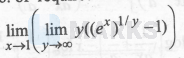
$\lim _{x \rightarrow 1} \left( \lim _{y \rightarrow \infty} y \left( (e^x)^{1/y} - 1 \right) \right) = $
A
$e$
B
$0$
C
$1$
D
$-1$
Solution
(C) We need to evaluate the limit: $\lim _{x \rightarrow 1} \left( \lim _{y \rightarrow \infty} y \left( e^{x/y} - 1 \right) \right)$.
First,consider the inner limit: $L_{inner} = \lim _{y \rightarrow \infty} y \left( e^{x/y} - 1 \right)$.
Using the Taylor series expansion for $e^u = 1 + u + \frac{u^2}{2!} + \dots$,where $u = x/y$:
$L_{inner} = \lim _{y \rightarrow \infty} y \left( (1 + \frac{x}{y} + \frac{x^2}{2y^2} + \dots) - 1 \right)$
$L_{inner} = \lim _{y \rightarrow \infty} y \left( \frac{x}{y} + \frac{x^2}{2y^2} + \dots \right)$
$L_{inner} = \lim _{y \rightarrow \infty} \left( x + \frac{x^2}{2y} + \dots \right) = x$.
Now,evaluate the outer limit: $\lim _{x \rightarrow 1} (x) = 1$.
First,consider the inner limit: $L_{inner} = \lim _{y \rightarrow \infty} y \left( e^{x/y} - 1 \right)$.
Using the Taylor series expansion for $e^u = 1 + u + \frac{u^2}{2!} + \dots$,where $u = x/y$:
$L_{inner} = \lim _{y \rightarrow \infty} y \left( (1 + \frac{x}{y} + \frac{x^2}{2y^2} + \dots) - 1 \right)$
$L_{inner} = \lim _{y \rightarrow \infty} y \left( \frac{x}{y} + \frac{x^2}{2y^2} + \dots \right)$
$L_{inner} = \lim _{y \rightarrow \infty} \left( x + \frac{x^2}{2y} + \dots \right) = x$.
Now,evaluate the outer limit: $\lim _{x \rightarrow 1} (x) = 1$.
0 likes
View Solution402
MediumMCQ
If $\lim _{n \rightarrow \infty} x^n \log _e x=0$,then $\log _x 12=$
A
Negative
B
Positive
C
Zero
D
Any value between $-1$ and $1$
Solution
(A) Given,$\lim _{n \rightarrow \infty} x^n \log _e x=0$.
We know that as $n \rightarrow \infty$,$x^n \rightarrow 0$ only when $x \in (0, 1)$.
If $x > 1$,then $x^n \rightarrow \infty$,and if $x = 1$,$\log _e 1 = 0$,but the limit behavior for $x^n$ is generally considered for $x \in (0, 1)$ to ensure the product vanishes.
Thus,for the limit to be $0$,we must have $x \in (0, 1)$.
Since the base of the logarithm $\log _x 12$ is $x \in (0, 1)$ and the argument $12 > 1$,the value of $\log _x 12$ must be negative.
We know that as $n \rightarrow \infty$,$x^n \rightarrow 0$ only when $x \in (0, 1)$.
If $x > 1$,then $x^n \rightarrow \infty$,and if $x = 1$,$\log _e 1 = 0$,but the limit behavior for $x^n$ is generally considered for $x \in (0, 1)$ to ensure the product vanishes.
Thus,for the limit to be $0$,we must have $x \in (0, 1)$.
Since the base of the logarithm $\log _x 12$ is $x \in (0, 1)$ and the argument $12 > 1$,the value of $\log _x 12$ must be negative.
0 likes
View Solution403
MediumMCQ
$\lim _{n}$ ${\rightarrow \infty} \sqrt{2} \left[ \frac{(2+\sqrt{2})^n + (2-\sqrt{2})^n}{(2+\sqrt{2})^n - (2-\sqrt{2})^n} \right] =$
A
$2-\sqrt{2}$
B
$2+\sqrt{2}$
C
$1$
D
$\sqrt{2}$
Solution
(D) Given the limit as $n \rightarrow \infty$:
Since $2-\sqrt{2} \approx 0.586 < 1$,we have $\lim _{n \rightarrow \infty} (2-\sqrt{2})^n = 0$.
Dividing the numerator and denominator by $(2+\sqrt{2})^n$:
$= \lim _{n}$ ${\rightarrow \infty} \sqrt{2} \left[ \frac{1 + \left( \frac{2-\sqrt{2}}{2+\sqrt{2}} \right)^n}{1 - \left( \frac{2-\sqrt{2}}{2+\sqrt{2}} \right)^n} \right] = \sqrt{2} \left[ \frac{1+0}{1-0} \right] = \sqrt{2}$.
Since $2-\sqrt{2} \approx 0.586 < 1$,we have $\lim _{n \rightarrow \infty} (2-\sqrt{2})^n = 0$.
Dividing the numerator and denominator by $(2+\sqrt{2})^n$:
$= \lim _{n}$ ${\rightarrow \infty} \sqrt{2} \left[ \frac{1 + \left( \frac{2-\sqrt{2}}{2+\sqrt{2}} \right)^n}{1 - \left( \frac{2-\sqrt{2}}{2+\sqrt{2}} \right)^n} \right] = \sqrt{2} \left[ \frac{1+0}{1-0} \right] = \sqrt{2}$.
0 likes
View Solution404
MediumMCQ
Evaluate the limit: $\lim _{n \rightarrow \infty} \frac{A+e^{n x}}{x+A e^{n x}}$
A
$\frac{A}{x}$,when $x < 0$
B
$1$,when $x > 0$
C
$0$,when $\forall x \in \mathbb{R}$
D
$A$,when $x = 0$
Solution
(A) Case $1$: When $x < 0$,as $n \rightarrow \infty$,$nx \rightarrow -\infty$. Thus,$e^{nx} \rightarrow 0$. The limit becomes $\lim _{n \rightarrow \infty} \frac{A+0}{x+A(0)} = \frac{A}{x}$.
Case $2$: When $x > 0$,as $n \rightarrow \infty$,$nx \rightarrow \infty$. Thus,$e^{nx} \rightarrow \infty$. Dividing numerator and denominator by $e^{nx}$,we get $\lim _{n \rightarrow \infty} \frac{A/e^{nx} + 1}{x/e^{nx} + A} = \frac{0+1}{0+A} = \frac{1}{A}$ (assuming $A \neq 0$).
Case $2$: When $x > 0$,as $n \rightarrow \infty$,$nx \rightarrow \infty$. Thus,$e^{nx} \rightarrow \infty$. Dividing numerator and denominator by $e^{nx}$,we get $\lim _{n \rightarrow \infty} \frac{A/e^{nx} + 1}{x/e^{nx} + A} = \frac{0+1}{0+A} = \frac{1}{A}$ (assuming $A \neq 0$).
0 likes
View Solution405
MediumMCQ
If $\lim _{x \rightarrow 0^{+}} x^2\left(\frac{e^{1 / x}-e^{-1 / x}}{e^{1 / x}+e^{-1 / x}}\right)=k$ and $\lim _{x \rightarrow 0^{-}} x^2\left(\frac{e^{1 / x}-e^{-1 / x}}{e^{1 / x}+e^{-1 / x}}\right)=l$,then which of the following is true?
A
$k=l=0$
B
$k=1, l=-1$
C
$k=-1, l=1$
D
$k \neq l \neq \pm 1$
Solution
(A) For $k = \lim _{x \rightarrow 0^{+}} x^2 \left( \frac{e^{1/x} - e^{-1/x}}{e^{1/x} + e^{-1/x}} \right)$,let $t = 1/x$. As $x \rightarrow 0^{+}$,$t \rightarrow \infty$.
$k = \lim _{t \rightarrow \infty} \frac{1}{t^2} \left( \frac{e^t - e^{-t}}{e^t + e^{-t}} \right) = \lim _{t \rightarrow \infty} \frac{1}{t^2} \left( \frac{1 - e^{-2t}}{1 + e^{-2t}} \right) = 0 \times 1 = 0$.
For $l = \lim _{x \rightarrow 0^{-}} x^2 \left( \frac{e^{1/x} - e^{-1/x}}{e^{1/x} + e^{-1/x}} \right)$,let $y = 1/x$. As $x \rightarrow 0^{-}$,$y \rightarrow -\infty$.
$l = \lim _{y \rightarrow -\infty} \frac{1}{y^2} \left( \frac{e^y - e^{-y}}{e^y + e^{-y}} \right) = \lim _{y \rightarrow -\infty} \frac{1}{y^2} \left( \frac{e^{2y} - 1}{e^{2y} + 1} \right) = 0 \times (-1) = 0$.
Therefore,$k = l = 0$.
$k = \lim _{t \rightarrow \infty} \frac{1}{t^2} \left( \frac{e^t - e^{-t}}{e^t + e^{-t}} \right) = \lim _{t \rightarrow \infty} \frac{1}{t^2} \left( \frac{1 - e^{-2t}}{1 + e^{-2t}} \right) = 0 \times 1 = 0$.
For $l = \lim _{x \rightarrow 0^{-}} x^2 \left( \frac{e^{1/x} - e^{-1/x}}{e^{1/x} + e^{-1/x}} \right)$,let $y = 1/x$. As $x \rightarrow 0^{-}$,$y \rightarrow -\infty$.
$l = \lim _{y \rightarrow -\infty} \frac{1}{y^2} \left( \frac{e^y - e^{-y}}{e^y + e^{-y}} \right) = \lim _{y \rightarrow -\infty} \frac{1}{y^2} \left( \frac{e^{2y} - 1}{e^{2y} + 1} \right) = 0 \times (-1) = 0$.
Therefore,$k = l = 0$.
0 likes
View Solution406
EasyMCQ
If $f(x) = \frac{e^{1/x} - 1}{e^{1/x} + 1}$,then
A
$\lim_{x \rightarrow 0^+} f(x) = 1$
B
$\lim_{x \rightarrow 0^-} f(x) = -1$
C
$\lim_{x \rightarrow 0} f(x) = 0$
D
$\lim_{x \rightarrow \infty} f(x) = 0$
Solution
(D) To find $\lim_{x \rightarrow 0^+} f(x)$,let $x \rightarrow 0^+$,then $\frac{1}{x} \rightarrow \infty$.
Thus,$\lim_{x \rightarrow 0^+} \frac{e^{1/x} - 1}{e^{1/x} + 1} = \lim_{x \rightarrow 0^+} \frac{1 - e^{-1/x}}{1 + e^{-1/x}} = \frac{1 - 0}{1 + 0} = 1$.
To find $\lim_{x \rightarrow 0^-} f(x)$,let $x \rightarrow 0^-$,then $\frac{1}{x} \rightarrow -\infty$.
Thus,$\lim_{x \rightarrow 0^-} \frac{e^{1/x} - 1}{e^{1/x} + 1} = \frac{0 - 1}{0 + 1} = -1$.
Since the left-hand limit and right-hand limit are not equal,$\lim_{x \rightarrow 0} f(x)$ does not exist.
For $\lim_{x \rightarrow \infty} f(x)$,$\frac{1}{x} \rightarrow 0$,so $\lim_{x \rightarrow \infty} f(x) = \frac{e^0 - 1}{e^0 + 1} = \frac{1 - 1}{1 + 1} = 0$.
Therefore,option $D$ is correct.
Thus,$\lim_{x \rightarrow 0^+} \frac{e^{1/x} - 1}{e^{1/x} + 1} = \lim_{x \rightarrow 0^+} \frac{1 - e^{-1/x}}{1 + e^{-1/x}} = \frac{1 - 0}{1 + 0} = 1$.
To find $\lim_{x \rightarrow 0^-} f(x)$,let $x \rightarrow 0^-$,then $\frac{1}{x} \rightarrow -\infty$.
Thus,$\lim_{x \rightarrow 0^-} \frac{e^{1/x} - 1}{e^{1/x} + 1} = \frac{0 - 1}{0 + 1} = -1$.
Since the left-hand limit and right-hand limit are not equal,$\lim_{x \rightarrow 0} f(x)$ does not exist.
For $\lim_{x \rightarrow \infty} f(x)$,$\frac{1}{x} \rightarrow 0$,so $\lim_{x \rightarrow \infty} f(x) = \frac{e^0 - 1}{e^0 + 1} = \frac{1 - 1}{1 + 1} = 0$.
Therefore,option $D$ is correct.
0 likes
View Solution407
MediumMCQ
If $\lim _{n \rightarrow \infty} \frac{1-(10)^n}{1+(10)^{n+1}}=\frac{-\alpha}{10}$,then $\alpha$ is equal to
A
$0$
B
$-1$
C
$1$
D
$2$
Solution
(C) Given the limit: $\lim _{n \rightarrow \infty} \frac{1-10^n}{1+10^{n+1}}=-\frac{\alpha}{10}$
Divide the numerator and denominator by $10^n$:
$\lim _{n \rightarrow \infty} \frac{\frac{1}{10^n}-1}{\frac{1}{10^n}+10}=-\frac{\alpha}{10}$
As $n \rightarrow \infty$,$\frac{1}{10^n} \rightarrow 0$.
Substituting this value,we get:
$\frac{0-1}{0+10} = -\frac{\alpha}{10}$
$-\frac{1}{10} = -\frac{\alpha}{10}$
Therefore,$\alpha = 1$.
Divide the numerator and denominator by $10^n$:
$\lim _{n \rightarrow \infty} \frac{\frac{1}{10^n}-1}{\frac{1}{10^n}+10}=-\frac{\alpha}{10}$
As $n \rightarrow \infty$,$\frac{1}{10^n} \rightarrow 0$.
Substituting this value,we get:
$\frac{0-1}{0+10} = -\frac{\alpha}{10}$
$-\frac{1}{10} = -\frac{\alpha}{10}$
Therefore,$\alpha = 1$.
0 likes
View Solution408
MediumMCQ
If $\lim _{x \rightarrow \infty}\left(1+\frac{p}{x}\right)^{q x}=e^9$ where $p, q \in \mathbb{N}$,then $p+q=$
A
$6$
B
$9$
C
$81$
D
$18$
Solution
(A) Given,$\lim _{x \rightarrow \infty}\left(1+\frac{p}{x}\right)^{q x}=e^9$.
Using the standard limit formula $\lim _{x \rightarrow \infty}(1+\frac{a}{x})^x = e^a$,we have:
$\lim _{x \rightarrow \infty}\left(1+\frac{p}{x}\right)^{q x} = \left[ \lim _{x \rightarrow \infty} \left(1+\frac{p}{x}\right)^{x} \right]^{q} = (e^p)^q = e^{pq}$.
Comparing this with the given expression $e^9$,we get $pq = 9$.
Since $p, q \in \mathbb{N}$ (natural numbers),the possible pairs $(p, q)$ are $(1, 9), (3, 3), (9, 1)$.
In these cases,$p+q$ can be $1+9=10$ or $3+3=6$.
Given the options,the correct value is $6$.
Using the standard limit formula $\lim _{x \rightarrow \infty}(1+\frac{a}{x})^x = e^a$,we have:
$\lim _{x \rightarrow \infty}\left(1+\frac{p}{x}\right)^{q x} = \left[ \lim _{x \rightarrow \infty} \left(1+\frac{p}{x}\right)^{x} \right]^{q} = (e^p)^q = e^{pq}$.
Comparing this with the given expression $e^9$,we get $pq = 9$.
Since $p, q \in \mathbb{N}$ (natural numbers),the possible pairs $(p, q)$ are $(1, 9), (3, 3), (9, 1)$.
In these cases,$p+q$ can be $1+9=10$ or $3+3=6$.
Given the options,the correct value is $6$.
0 likes
View Solution409
MediumMCQ
$\lim _{x \rightarrow 0}(1+3x)^{\frac{2}{x}} = $
A
$6$
B
$e^6$
C
$e^{-6}$
D
$e^{\frac{1}{6}}$
Solution
(B) We know that the standard limit formula is $\lim _{x \rightarrow 0}(1+ax)^{\frac{1}{ax}} = e$ for $a \neq 0$.
Given expression is $\lim _{x \rightarrow 0}(1+3x)^{\frac{2}{x}}$.
We can rewrite the exponent as $\frac{2}{x} = 6 \times \frac{1}{3x}$.
Substituting this into the limit,we get $\lim _{x \rightarrow 0}(1+3x)^{\frac{2}{x}} = \lim _{x \rightarrow 0} \left((1+3x)^{\frac{1}{3x}}\right)^6$.
Using the standard limit property,this expression evaluates to $e^6$.
Given expression is $\lim _{x \rightarrow 0}(1+3x)^{\frac{2}{x}}$.
We can rewrite the exponent as $\frac{2}{x} = 6 \times \frac{1}{3x}$.
Substituting this into the limit,we get $\lim _{x \rightarrow 0}(1+3x)^{\frac{2}{x}} = \lim _{x \rightarrow 0} \left((1+3x)^{\frac{1}{3x}}\right)^6$.
Using the standard limit property,this expression evaluates to $e^6$.
0 likes
View Solution410
MediumMCQ
For $A \neq 0$ and $x < 0$,evaluate $\lim _{n \rightarrow \infty} \frac{\sin x - e^{n x}}{1 + A e^{n x}}$.
A
$\frac{1}{A}$
B
$\sin x$
C
$-\frac{1}{A}$
D
$-\sin x$
Solution
(B) Given the limit: $\lim _{n \rightarrow \infty} \frac{\sin x - e^{n x}}{1 + A e^{n x}}$.
Since $x < 0$,as $n \rightarrow \infty$,$e^{n x} \rightarrow 0$.
Dividing the numerator and denominator by $e^{n x}$ (or simply evaluating the limit as $e^{n x} \rightarrow 0$):
$\lim _{n}$ ${\rightarrow \infty} \frac{\sin x - e^{n x}}{1 + A e^{n x}} = \frac{\sin x - 0}{1 + A(0)} = \frac{\sin x}{1} = \sin x$.
Wait,let us re-evaluate the limit expression: $\lim _{n \rightarrow \infty} \frac{\sin x - e^{n x}}{1 + A e^{n x}}$.
If $x < 0$,then $e^{n x} \rightarrow 0$ as $n \rightarrow \infty$.
Thus,$\frac{\sin x - 0}{1 + A(0)} = \sin x$.
Since $x < 0$,as $n \rightarrow \infty$,$e^{n x} \rightarrow 0$.
Dividing the numerator and denominator by $e^{n x}$ (or simply evaluating the limit as $e^{n x} \rightarrow 0$):
$\lim _{n}$ ${\rightarrow \infty} \frac{\sin x - e^{n x}}{1 + A e^{n x}} = \frac{\sin x - 0}{1 + A(0)} = \frac{\sin x}{1} = \sin x$.
Wait,let us re-evaluate the limit expression: $\lim _{n \rightarrow \infty} \frac{\sin x - e^{n x}}{1 + A e^{n x}}$.
If $x < 0$,then $e^{n x} \rightarrow 0$ as $n \rightarrow \infty$.
Thus,$\frac{\sin x - 0}{1 + A(0)} = \sin x$.
0 likes
View Solution411
MediumMCQ
$\lim _{n}$ ${\rightarrow \infty} n^{-n k} \left\{(n+1)\left(n+\frac{1}{2}\right)\left(n+\frac{1}{2^2}\right) \ldots\left(n+\frac{1}{2^{k-1}}\right)\right\}^n=$
A
$2$
B
$e^{2\left(1-\frac{1}{2^k}\right)}$
C
$2\left(1-\frac{1}{2^k}\right)$
D
$e^2$
Solution
(B) Let $P = \lim _{n}$ ${\rightarrow \infty} n^{-n k} \left\{(n+1)\left(n+\frac{1}{2}\right)\left(n+\frac{1}{2^2}\right) \ldots\left(n+\frac{1}{2^{k-1}}\right)\right\}^n$.
Taking the natural logarithm on both sides:
$\log P = \lim _{n \rightarrow \infty} n \left[ \sum_{j=0}^{k-1} \log \left(1 + \frac{1}{2^j n}\right) \right]$.
Using the standard limit $\lim _{x \rightarrow 0} \frac{\log(1+ax)}{x} = a$,we have:
$\log P = \sum_{j=0}^{k-1} \lim _{n}$ ${\rightarrow \infty} \frac{\log \left(1 + \frac{1}{2^j n}\right)}{1/n} = \sum_{j=0}^{k-1} \frac{1}{2^j}$.
This is a geometric series with $k$ terms,first term $a=1$ and common ratio $r=1/2$:
$\sum_{j=0}^{k-1} \left(\frac{1}{2}\right)^j = \frac{1(1-(1/2)^k)}{1-1/2} = 2 \left(1 - \frac{1}{2^k}\right)$.
Therefore,$P = e^{2 \left(1 - \frac{1}{2^k}\right)}$.
Taking the natural logarithm on both sides:
$\log P = \lim _{n \rightarrow \infty} n \left[ \sum_{j=0}^{k-1} \log \left(1 + \frac{1}{2^j n}\right) \right]$.
Using the standard limit $\lim _{x \rightarrow 0} \frac{\log(1+ax)}{x} = a$,we have:
$\log P = \sum_{j=0}^{k-1} \lim _{n}$ ${\rightarrow \infty} \frac{\log \left(1 + \frac{1}{2^j n}\right)}{1/n} = \sum_{j=0}^{k-1} \frac{1}{2^j}$.
This is a geometric series with $k$ terms,first term $a=1$ and common ratio $r=1/2$:
$\sum_{j=0}^{k-1} \left(\frac{1}{2}\right)^j = \frac{1(1-(1/2)^k)}{1-1/2} = 2 \left(1 - \frac{1}{2^k}\right)$.
Therefore,$P = e^{2 \left(1 - \frac{1}{2^k}\right)}$.
0 likes
View Solution412
EasyMCQ
$\lim _{x \rightarrow 0} \frac{6^x-3^x-2^x+1}{x^2}$ is equal to
A
$(\log _e 2)(\log _e 3)$
B
$\log _{e} 5$
C
$\log _{e} 6$
D
$0$
Solution
(A) Let $l = \lim _{x \rightarrow 0} \frac{6^x-3^x-2^x+1}{x^2}$.
We can factor the numerator as follows:
$6^x - 3^x - 2^x + 1 = 3^x(2^x - 1) - 1(2^x - 1) = (2^x - 1)(3^x - 1)$.
Substituting this back into the limit:
$l = \lim _{x \rightarrow 0} \frac{(2^x - 1)(3^x - 1)}{x^2} = \lim _{x \rightarrow 0} \left( \frac{2^x - 1}{x} \right) \times \left( \frac{3^x - 1}{x} \right)$.
Using the standard limit formula $\lim _{x \rightarrow 0} \frac{a^x - 1}{x} = \log _e a$,we get:
$l = (\log _e 2) \times (\log _e 3)$.
We can factor the numerator as follows:
$6^x - 3^x - 2^x + 1 = 3^x(2^x - 1) - 1(2^x - 1) = (2^x - 1)(3^x - 1)$.
Substituting this back into the limit:
$l = \lim _{x \rightarrow 0} \frac{(2^x - 1)(3^x - 1)}{x^2} = \lim _{x \rightarrow 0} \left( \frac{2^x - 1}{x} \right) \times \left( \frac{3^x - 1}{x} \right)$.
Using the standard limit formula $\lim _{x \rightarrow 0} \frac{a^x - 1}{x} = \log _e a$,we get:
$l = (\log _e 2) \times (\log _e 3)$.
0 likes
View Solution413
EasyMCQ
$\lim _{x \rightarrow \infty}\left(\frac{3 x^2-2 x+3}{3 x^2+x-2}\right)^{3 x-2} = $
A
$e^3$
B
$e^{-1}$
C
$e^{-3}$
D
$e^1$
Solution
(C) The given limit is of the form $1^\infty$.
We use the formula $\lim _{x \rightarrow \infty} (f(x))^{g(x)} = e^{\lim _{x \rightarrow \infty} (f(x)-1)g(x)}$.
Here,$f(x) = \frac{3x^2-2x+3}{3x^2+x-2}$ and $g(x) = 3x-2$.
$(f(x)-1) = \frac{3x^2-2x+3 - (3x^2+x-2)}{3x^2+x-2} = \frac{-3x+5}{3x^2+x-2}$.
Now,$\lim _{x \rightarrow \infty} (f(x)-1)g(x) = \lim _{x \rightarrow \infty} \left(\frac{-3x+5}{3x^2+x-2}\right)(3x-2)$.
$= \lim _{x \rightarrow \infty} \frac{-9x^2+6x+15x-10}{3x^2+x-2} = \lim _{x \rightarrow \infty} \frac{-9x^2+21x-10}{3x^2+x-2}$.
Dividing the numerator and denominator by $x^2$,we get $\frac{-9}{3} = -3$.
Therefore,the limit is $e^{-3}$.
We use the formula $\lim _{x \rightarrow \infty} (f(x))^{g(x)} = e^{\lim _{x \rightarrow \infty} (f(x)-1)g(x)}$.
Here,$f(x) = \frac{3x^2-2x+3}{3x^2+x-2}$ and $g(x) = 3x-2$.
$(f(x)-1) = \frac{3x^2-2x+3 - (3x^2+x-2)}{3x^2+x-2} = \frac{-3x+5}{3x^2+x-2}$.
Now,$\lim _{x \rightarrow \infty} (f(x)-1)g(x) = \lim _{x \rightarrow \infty} \left(\frac{-3x+5}{3x^2+x-2}\right)(3x-2)$.
$= \lim _{x \rightarrow \infty} \frac{-9x^2+6x+15x-10}{3x^2+x-2} = \lim _{x \rightarrow \infty} \frac{-9x^2+21x-10}{3x^2+x-2}$.
Dividing the numerator and denominator by $x^2$,we get $\frac{-9}{3} = -3$.
Therefore,the limit is $e^{-3}$.
0 likes
View Solution414
MediumMCQ
If $a > 0, b > 0$,then $\lim _{n \rightarrow \infty}\left(\frac{a + b^{1 / n} - 1}{a}\right)^n =$
A
$a^b$
B
$b^a$
C
$b^{1 / a}$
D
$a^{1 / b}$
Solution
(C) Let $L = \lim _{n \rightarrow \infty}\left(\frac{a + b^{1 / n} - 1}{a}\right)^n$.
Taking the natural logarithm on both sides:
$\ln L = \lim _{n \rightarrow \infty} n \ln \left(1 + \frac{b^{1 / n} - 1}{a}\right)$.
Using the limit formula $\lim _{x \rightarrow 0} \frac{\ln(1 + x)}{x} = 1$,let $x = \frac{b^{1 / n} - 1}{a}$. As $n \rightarrow \infty$,$x \rightarrow 0$.
$\ln L = \lim _{n \rightarrow \infty} n \cdot \left(\frac{b^{1 / n} - 1}{a}\right) \cdot \frac{\ln(1 + x)}{x} = \lim _{n \rightarrow \infty} \frac{n}{a} (b^{1 / n} - 1)$.
Let $t = 1/n$. As $n \rightarrow \infty$,$t \rightarrow 0$.
$\ln L = \frac{1}{a} \lim _{t \rightarrow 0} \frac{b^t - 1}{t}$.
Since $\lim _{t \rightarrow 0} \frac{b^t - 1}{t} = \ln b$,we have:
$\ln L = \frac{1}{a} \ln b = \ln(b^{1 / a})$.
Therefore,$L = b^{1 / a}$.
Taking the natural logarithm on both sides:
$\ln L = \lim _{n \rightarrow \infty} n \ln \left(1 + \frac{b^{1 / n} - 1}{a}\right)$.
Using the limit formula $\lim _{x \rightarrow 0} \frac{\ln(1 + x)}{x} = 1$,let $x = \frac{b^{1 / n} - 1}{a}$. As $n \rightarrow \infty$,$x \rightarrow 0$.
$\ln L = \lim _{n \rightarrow \infty} n \cdot \left(\frac{b^{1 / n} - 1}{a}\right) \cdot \frac{\ln(1 + x)}{x} = \lim _{n \rightarrow \infty} \frac{n}{a} (b^{1 / n} - 1)$.
Let $t = 1/n$. As $n \rightarrow \infty$,$t \rightarrow 0$.
$\ln L = \frac{1}{a} \lim _{t \rightarrow 0} \frac{b^t - 1}{t}$.
Since $\lim _{t \rightarrow 0} \frac{b^t - 1}{t} = \ln b$,we have:
$\ln L = \frac{1}{a} \ln b = \ln(b^{1 / a})$.
Therefore,$L = b^{1 / a}$.
0 likes
View Solution415
DifficultMCQ
Let $f(x) = \lim_{y \rightarrow \infty} y(x^{1/y} - 1)$,and $2022 f(\frac{1}{x}) + P f(x) = f(x^2)$,then $P =$
A
$2020$
B
$2021$
C
$2023$
D
$2024$
Solution
(D) Given,$f(x) = \lim_{y \rightarrow \infty} y(x^{1/y} - 1)$.
First,we simplify $f(x)$:
$f(x) = \lim_{y \rightarrow \infty} \frac{x^{1/y} - 1}{1/y}$.
Let $t = 1/y$. As $y \rightarrow \infty$,$t \rightarrow 0^+$.
$f(x) = \lim_{t \rightarrow 0} \frac{x^t - 1}{t}$.
Using the standard limit $\lim_{t \rightarrow 0} \frac{a^t - 1}{t} = \ln(a)$,we get $f(x) = \ln(x)$.
Now,substitute $f(x) = \ln(x)$ into the given equation $2022 f(\frac{1}{x}) + P f(x) = f(x^2)$:
$2022 \ln(\frac{1}{x}) + P \ln(x) = \ln(x^2)$.
Since $\ln(\frac{1}{x}) = -\ln(x)$ and $\ln(x^2) = 2 \ln(x)$:
$2022(-\ln(x)) + P \ln(x) = 2 \ln(x)$.
$-2022 \ln(x) + P \ln(x) = 2 \ln(x)$.
Dividing by $\ln(x)$ (for $x \neq 1$):
$-2022 + P = 2$.
$P = 2024$.
First,we simplify $f(x)$:
$f(x) = \lim_{y \rightarrow \infty} \frac{x^{1/y} - 1}{1/y}$.
Let $t = 1/y$. As $y \rightarrow \infty$,$t \rightarrow 0^+$.
$f(x) = \lim_{t \rightarrow 0} \frac{x^t - 1}{t}$.
Using the standard limit $\lim_{t \rightarrow 0} \frac{a^t - 1}{t} = \ln(a)$,we get $f(x) = \ln(x)$.
Now,substitute $f(x) = \ln(x)$ into the given equation $2022 f(\frac{1}{x}) + P f(x) = f(x^2)$:
$2022 \ln(\frac{1}{x}) + P \ln(x) = \ln(x^2)$.
Since $\ln(\frac{1}{x}) = -\ln(x)$ and $\ln(x^2) = 2 \ln(x)$:
$2022(-\ln(x)) + P \ln(x) = 2 \ln(x)$.
$-2022 \ln(x) + P \ln(x) = 2 \ln(x)$.
Dividing by $\ln(x)$ (for $x \neq 1$):
$-2022 + P = 2$.
$P = 2024$.
0 likes
View Solution416
EasyMCQ
$\lim _{x \rightarrow \infty}\left(1+\frac{2}{x}\right)^{3 x}=$
A
$e^6$
B
$e^3$
C
$e^2$
D
$e$
Solution
(A) We use the standard limit formula: $\lim _{x \rightarrow \infty} (1 + \frac{a}{x})^{bx} = e^{ab}$.
Given expression: $\lim _{x \rightarrow \infty} (1 + \frac{2}{x})^{3x}$.
Here,$a = 2$ and $b = 3$.
Applying the formula: $e^{2 \times 3} = e^6$.
Given expression: $\lim _{x \rightarrow \infty} (1 + \frac{2}{x})^{3x}$.
Here,$a = 2$ and $b = 3$.
Applying the formula: $e^{2 \times 3} = e^6$.
0 likes
View Solution417
MediumMCQ
$\lim _{y \rightarrow 0} \frac{\sqrt{1+\sqrt{1+y^4}}-\sqrt{2}}{y^4} = $
A
$\frac{1}{4 \sqrt{2}}$
B
$\frac{1}{2 \sqrt{2}(1+\sqrt{2})}$
C
$\frac{1}{2 \sqrt{2}}$
D
$\frac{1}{4 \sqrt{2}(1+\sqrt{2})}$
Solution
(A) Let $L = \lim _{y \rightarrow 0} \frac{\sqrt{1+\sqrt{1+y^4}}-\sqrt{2}}{y^4}$.
Rationalizing the numerator,we multiply by $\frac{\sqrt{1+\sqrt{1+y^4}}+\sqrt{2}}{\sqrt{1+\sqrt{1+y^4}}+\sqrt{2}}$:
$L = \lim _{y \rightarrow 0} \frac{(1+\sqrt{1+y^4})-2}{y^4(\sqrt{1+\sqrt{1+y^4}}+\sqrt{2})} = \lim _{y \rightarrow 0} \frac{\sqrt{1+y^4}-1}{y^4(\sqrt{1+\sqrt{1+y^4}}+\sqrt{2})}$.
Rationalizing the numerator again,we multiply by $\frac{\sqrt{1+y^4}+1}{\sqrt{1+y^4}+1}$:
$L = \lim _{y \rightarrow 0} \frac{(1+y^4)-1}{y^4(\sqrt{1+\sqrt{1+y^4}}+\sqrt{2})(\sqrt{1+y^4}+1)} = \lim _{y \rightarrow 0} \frac{y^4}{y^4(\sqrt{1+\sqrt{1+y^4}}+\sqrt{2})(\sqrt{1+y^4}+1)}$.
Canceling $y^4$ and evaluating the limit as $y \rightarrow 0$:
$L = \frac{1}{(\sqrt{1+1}+\sqrt{2})(\sqrt{1}+1)} = \frac{1}{(\sqrt{2}+\sqrt{2})(1+1)} = \frac{1}{2\sqrt{2} \times 2} = \frac{1}{4\sqrt{2}}$.
Rationalizing the numerator,we multiply by $\frac{\sqrt{1+\sqrt{1+y^4}}+\sqrt{2}}{\sqrt{1+\sqrt{1+y^4}}+\sqrt{2}}$:
$L = \lim _{y \rightarrow 0} \frac{(1+\sqrt{1+y^4})-2}{y^4(\sqrt{1+\sqrt{1+y^4}}+\sqrt{2})} = \lim _{y \rightarrow 0} \frac{\sqrt{1+y^4}-1}{y^4(\sqrt{1+\sqrt{1+y^4}}+\sqrt{2})}$.
Rationalizing the numerator again,we multiply by $\frac{\sqrt{1+y^4}+1}{\sqrt{1+y^4}+1}$:
$L = \lim _{y \rightarrow 0} \frac{(1+y^4)-1}{y^4(\sqrt{1+\sqrt{1+y^4}}+\sqrt{2})(\sqrt{1+y^4}+1)} = \lim _{y \rightarrow 0} \frac{y^4}{y^4(\sqrt{1+\sqrt{1+y^4}}+\sqrt{2})(\sqrt{1+y^4}+1)}$.
Canceling $y^4$ and evaluating the limit as $y \rightarrow 0$:
$L = \frac{1}{(\sqrt{1+1}+\sqrt{2})(\sqrt{1}+1)} = \frac{1}{(\sqrt{2}+\sqrt{2})(1+1)} = \frac{1}{2\sqrt{2} \times 2} = \frac{1}{4\sqrt{2}}$.
0 likes
View Solution418
DifficultMCQ
If $[x]$ is the greatest integer function,then $\lim _{x \rightarrow 3^{-}} \frac{(3-|x|+\sin |3-x|) \cos [9-3 x]}{|3-x|[3 x-9]} = $
A
$0$
B
$1$
C
$2$
D
$-2$
Solution
(D) Let $x = 3 - h$,where $h \rightarrow 0^{+}$.
As $x \rightarrow 3^{-}$,$|x| = x = 3 - h$ and $|3-x| = |3-(3-h)| = |h| = h$.
Also,$[3x-9] = [3(3-h)-9] = [9-3h-9] = [-3h]$. Since $h > 0$,$-3h$ is a small negative number,so $[-3h] = -1$.
And $[9-3x] = [9-3(3-h)] = [9-9+3h] = [3h]$. Since $h > 0$,$3h$ is a small positive number,so $[3h] = 0$.
Substituting these into the limit expression:
$\lim _{h \rightarrow 0^{+}} \frac{(3-(3-h)+\sin h) \cos(0)}{h(-1)} = \lim _{h \rightarrow 0^{+}} \frac{(h+\sin h)(1)}{-h} = \lim _{h \rightarrow 0^{+}} -\left(1 + \frac{\sin h}{h}\right) = -(1+1) = -2$.
As $x \rightarrow 3^{-}$,$|x| = x = 3 - h$ and $|3-x| = |3-(3-h)| = |h| = h$.
Also,$[3x-9] = [3(3-h)-9] = [9-3h-9] = [-3h]$. Since $h > 0$,$-3h$ is a small negative number,so $[-3h] = -1$.
And $[9-3x] = [9-3(3-h)] = [9-9+3h] = [3h]$. Since $h > 0$,$3h$ is a small positive number,so $[3h] = 0$.
Substituting these into the limit expression:
$\lim _{h \rightarrow 0^{+}} \frac{(3-(3-h)+\sin h) \cos(0)}{h(-1)} = \lim _{h \rightarrow 0^{+}} \frac{(h+\sin h)(1)}{-h} = \lim _{h \rightarrow 0^{+}} -\left(1 + \frac{\sin h}{h}\right) = -(1+1) = -2$.
0 likes
View Solution419
EasyMCQ
If $0 \leq x \leq \pi / 2$,then $\lim _{x \rightarrow a} \frac{|2 \cos x-1|}{2 \cos x-1}$
A
does not exist at all points in $[0, \pi/2]$
B
$=1$ when $a=\pi/3$
C
$-1$,when $a=\pi/3$
D
$=1$,when $0 \leq a < \pi/3$
Solution
(D) Let $f(x) = \frac{|2 \cos x - 1|}{2 \cos x - 1}$ for $0 \leq x \leq \pi/2$.
We know that $2 \cos x - 1 > 0$ when $\cos x > 1/2$,i.e.,$0 \leq x < \pi/3$,and $2 \cos x - 1 < 0$ when $\pi/3 < x \leq \pi/2$.
Thus,$f(x) = 1$ for $0 \leq x < \pi/3$ and $f(x) = -1$ for $\pi/3 < x \leq \pi/2$.
For the limit to exist at $x=a$,the left-hand limit and right-hand limit must be equal.
For $0 \leq a < \pi/3$,the function is constant $1$,so the limit is $1$.
For $\pi/3 < a \leq \pi/2$,the function is constant $-1$,so the limit is $-1$.
At $a = \pi/3$,the left-hand limit is $1$ and the right-hand limit is $-1$,so the limit does not exist.
Therefore,the correct statement is that the limit is $1$ when $0 \leq a < \pi/3$.
We know that $2 \cos x - 1 > 0$ when $\cos x > 1/2$,i.e.,$0 \leq x < \pi/3$,and $2 \cos x - 1 < 0$ when $\pi/3 < x \leq \pi/2$.
Thus,$f(x) = 1$ for $0 \leq x < \pi/3$ and $f(x) = -1$ for $\pi/3 < x \leq \pi/2$.
For the limit to exist at $x=a$,the left-hand limit and right-hand limit must be equal.
For $0 \leq a < \pi/3$,the function is constant $1$,so the limit is $1$.
For $\pi/3 < a \leq \pi/2$,the function is constant $-1$,so the limit is $-1$.
At $a = \pi/3$,the left-hand limit is $1$ and the right-hand limit is $-1$,so the limit does not exist.
Therefore,the correct statement is that the limit is $1$ when $0 \leq a < \pi/3$.
0 likes
View Solution420
MediumMCQ
$\lim _{x \rightarrow 3 / 2} \frac{\left(4 x^2-6 x\right)\left(4 x^2+6 x+9\right)}{\sqrt[3]{2 x}-\sqrt[3]{3}}=$
A
$\sqrt[3]{3^{17}}$
B
$\sqrt[3]{3^{16}}$
C
$\sqrt[3]{3^{15}}$
D
$\sqrt[3]{3^{14}}$
Solution
(A) $\text{Given limit: } L = \lim _{x \rightarrow \frac{3}{2}} \frac{2x(2x-3)(4x^2+6x+9)}{(2x)^{1/3} - 3^{1/3}}$
$\text{Rationalizing the denominator using } a^3 - b^3 = (a-b)(a^2+ab+b^2) \text{ where } a=(2x)^{1/3}, b=3^{1/3}:$
$L = \lim _{x \rightarrow \frac{3}{2}} \frac{2x(2x-3)(4x^2+6x+9)((2x)^{2/3} + (6x)^{1/3} + 3^{2/3})}{2x-3}$
$L = \lim _{x \rightarrow \frac{3}{2}} 2x(4x^2+6x+9)((2x)^{2/3} + (6x)^{1/3} + 3^{2/3})$
$\text{Substituting } x = \frac{3}{2}:$
$L = 2(\frac{3}{2})(4(\frac{9}{4}) + 6(\frac{3}{2}) + 9)(3^{2/3} + 9^{1/3} + 3^{2/3})$
$L = 3(9 + 9 + 9)(3 \times 3^{2/3})$
$L = 3(27)(3^{5/3}) = 3^1 \times 3^3 \times 3^{5/3} = 3^{1+3+5/3} = 3^{17/3} = \sqrt[3]{3^{17}}$
$\text{Rationalizing the denominator using } a^3 - b^3 = (a-b)(a^2+ab+b^2) \text{ where } a=(2x)^{1/3}, b=3^{1/3}:$
$L = \lim _{x \rightarrow \frac{3}{2}} \frac{2x(2x-3)(4x^2+6x+9)((2x)^{2/3} + (6x)^{1/3} + 3^{2/3})}{2x-3}$
$L = \lim _{x \rightarrow \frac{3}{2}} 2x(4x^2+6x+9)((2x)^{2/3} + (6x)^{1/3} + 3^{2/3})$
$\text{Substituting } x = \frac{3}{2}:$
$L = 2(\frac{3}{2})(4(\frac{9}{4}) + 6(\frac{3}{2}) + 9)(3^{2/3} + 9^{1/3} + 3^{2/3})$
$L = 3(9 + 9 + 9)(3 \times 3^{2/3})$
$L = 3(27)(3^{5/3}) = 3^1 \times 3^3 \times 3^{5/3} = 3^{1+3+5/3} = 3^{17/3} = \sqrt[3]{3^{17}}$
0 likes
View Solution421
EasyMCQ
$\lim _{x \rightarrow 0} \frac{(3^{2x}-\sqrt{x+1}) \sin 5x}{1-\cos 4x} =$
A
$\frac{3}{5}(\log 18-1)$
B
$\frac{5}{16} \log \left(\frac{81}{e}\right)$
C
$\frac{4}{15}(\log 81-1)$
D
$\frac{16}{5}[\log (27)-1]$
Solution
(B) Let $L = \lim _{x \rightarrow 0} \frac{(3^{2x} - \sqrt{x+1}) \sin 5x}{1 - \cos 4x}$.
Using the identity $1 - \cos 4x = 2 \sin^2 2x$,we have $L = \lim _{x \rightarrow 0} \frac{(3^{2x} - \sqrt{x+1}) \sin 5x}{2 \sin^2 2x}$.
Divide numerator and denominator by $x^2$ and use standard limits $\lim_{x \to 0} \frac{\sin ax}{ax} = 1$:
$L = \lim _{x \rightarrow 0} \left( \frac{3^{2x} - \sqrt{x+1}}{x} \right) \cdot \left( \frac{\sin 5x}{x} \right) \cdot \left( \frac{x^2}{2 \sin^2 2x} \right) = \lim _{x \rightarrow 0} \left( \frac{3^{2x} - 1 - (\sqrt{x+1} - 1)}{x} \right) \cdot 5 \cdot \frac{1}{2(2)^2}$.
$L = \frac{5}{8} \lim _{x \rightarrow 0} \left( \frac{3^{2x} - 1}{x} - \frac{\sqrt{x+1} - 1}{x} \right)$.
Using $\lim_{x \to 0} \frac{a^x - 1}{x} = \ln a$ and $\lim_{x \to 0} \frac{\sqrt{x+1} - 1}{x} = \frac{1}{2}$:
$L = \frac{5}{8} \left( 2 \ln 3 - \frac{1}{2} \right) = \frac{5}{16} (4 \ln 3 - 1) = \frac{5}{16} (\ln 81 - \ln e) = \frac{5}{16} \ln \left( \frac{81}{e} \right)$.
Using the identity $1 - \cos 4x = 2 \sin^2 2x$,we have $L = \lim _{x \rightarrow 0} \frac{(3^{2x} - \sqrt{x+1}) \sin 5x}{2 \sin^2 2x}$.
Divide numerator and denominator by $x^2$ and use standard limits $\lim_{x \to 0} \frac{\sin ax}{ax} = 1$:
$L = \lim _{x \rightarrow 0} \left( \frac{3^{2x} - \sqrt{x+1}}{x} \right) \cdot \left( \frac{\sin 5x}{x} \right) \cdot \left( \frac{x^2}{2 \sin^2 2x} \right) = \lim _{x \rightarrow 0} \left( \frac{3^{2x} - 1 - (\sqrt{x+1} - 1)}{x} \right) \cdot 5 \cdot \frac{1}{2(2)^2}$.
$L = \frac{5}{8} \lim _{x \rightarrow 0} \left( \frac{3^{2x} - 1}{x} - \frac{\sqrt{x+1} - 1}{x} \right)$.
Using $\lim_{x \to 0} \frac{a^x - 1}{x} = \ln a$ and $\lim_{x \to 0} \frac{\sqrt{x+1} - 1}{x} = \frac{1}{2}$:
$L = \frac{5}{8} \left( 2 \ln 3 - \frac{1}{2} \right) = \frac{5}{16} (4 \ln 3 - 1) = \frac{5}{16} (\ln 81 - \ln e) = \frac{5}{16} \ln \left( \frac{81}{e} \right)$.
0 likes
View Solution422
EasyMCQ
$\lim_{x \rightarrow -2^{+}} ([x]^2 - [x] - 2) + \lim_{x \rightarrow -3^{-}} ([x]^2 - 4[x] + 3) =$
A
$39$
B
$33$
C
$28$
D
$44$
Solution
(A) For the first limit: $\lim_{x \rightarrow -2^{+}} [x] = -2$.
Thus,$\lim_{x \rightarrow -2^{+}} ([x]^2 - [x] - 2) = (-2)^2 - (-2) - 2 = 4 + 2 - 2 = 4$.
For the second limit: $\lim_{x \rightarrow -3^{-}} [x] = -4$.
Thus,$\lim_{x \rightarrow -3^{-}} ([x]^2 - 4[x] + 3) = (-4)^2 - 4(-4) + 3 = 16 + 16 + 3 = 35$.
Adding both results: $4 + 35 = 39$.
Thus,$\lim_{x \rightarrow -2^{+}} ([x]^2 - [x] - 2) = (-2)^2 - (-2) - 2 = 4 + 2 - 2 = 4$.
For the second limit: $\lim_{x \rightarrow -3^{-}} [x] = -4$.
Thus,$\lim_{x \rightarrow -3^{-}} ([x]^2 - 4[x] + 3) = (-4)^2 - 4(-4) + 3 = 16 + 16 + 3 = 35$.
Adding both results: $4 + 35 = 39$.
0 likes
View Solution423
EasyMCQ
$\lim _{x \rightarrow 0} \frac{\tan 2x - 2\tan x}{(1 - \cos x)(2^x - 1)} = $
A
$\frac{2}{\ln 2}$
B
$\frac{1}{\ln 4}$
C
$4 \ln 2$
D
$\frac{4}{\ln 2}$
Solution
(D) Let $L = \lim _{x \rightarrow 0} \frac{\tan 2x - 2\tan x}{(1 - \cos x)(2^x - 1)}$.
Using the expansion $\tan x = x + \frac{x^3}{3} + O(x^5)$:
$\tan 2x = 2x + \frac{(2x)^3}{3} + O(x^5) = 2x + \frac{8x^3}{3} + O(x^5)$.
$2\tan x = 2(x + \frac{x^3}{3} + O(x^5)) = 2x + \frac{2x^3}{3} + O(x^5)$.
Numerator: $\tan 2x - 2\tan x = (2x + \frac{8x^3}{3}) - (2x + \frac{2x^3}{3}) = \frac{6x^3}{3} = 2x^3$.
Denominator: $(1 - \cos x)(2^x - 1) \approx (\frac{x^2}{2})(x \ln 2) = \frac{x^3 \ln 2}{2}$.
$L = \lim _{x \rightarrow 0} \frac{2x^3}{\frac{x^3 \ln 2}{2}} = \frac{2 \times 2}{\ln 2} = \frac{4}{\ln 2}$.
Using the expansion $\tan x = x + \frac{x^3}{3} + O(x^5)$:
$\tan 2x = 2x + \frac{(2x)^3}{3} + O(x^5) = 2x + \frac{8x^3}{3} + O(x^5)$.
$2\tan x = 2(x + \frac{x^3}{3} + O(x^5)) = 2x + \frac{2x^3}{3} + O(x^5)$.
Numerator: $\tan 2x - 2\tan x = (2x + \frac{8x^3}{3}) - (2x + \frac{2x^3}{3}) = \frac{6x^3}{3} = 2x^3$.
Denominator: $(1 - \cos x)(2^x - 1) \approx (\frac{x^2}{2})(x \ln 2) = \frac{x^3 \ln 2}{2}$.
$L = \lim _{x \rightarrow 0} \frac{2x^3}{\frac{x^3 \ln 2}{2}} = \frac{2 \times 2}{\ln 2} = \frac{4}{\ln 2}$.
0 likes
View Solution424
MediumMCQ
Let $[x]$ denote the greatest integer less than or equal to $x$ and $f(x) = 2x - [2x]$. If $\lim_{x \rightarrow 2^{-}} f(x) = l_1$ and $\lim_{x \rightarrow 2^{+}} f(x) = l_2$,then $l_1 + l_2 =$
A
$1$
B
$2$
C
$0$
D
$4$
Solution
(A) Given $f(x) = 2x - [2x]$.
To find $l_1 = \lim_{x \rightarrow 2^{-}} f(x)$:
Let $x = 2 - h$,where $h \rightarrow 0$ and $h > 0$.
$l_1 = \lim_{h \rightarrow 0} (2(2 - h) - [2(2 - h)]) = \lim_{h \rightarrow 0} (4 - 2h - [4 - 2h])$.
Since $h$ is a very small positive number,$4 - 2h$ is slightly less than $4$,so $[4 - 2h] = 3$.
Thus,$l_1 = 4 - 3 = 1$.
To find $l_2 = \lim_{x \rightarrow 2^{+}} f(x)$:
Let $x = 2 + h$,where $h \rightarrow 0$ and $h > 0$.
$l_2 = \lim_{h \rightarrow 0} (2(2 + h) - [2(2 + h)]) = \lim_{h \rightarrow 0} (4 + 2h - [4 + 2h])$.
Since $h$ is a very small positive number,$4 + 2h$ is slightly greater than $4$,so $[4 + 2h] = 4$.
Thus,$l_2 = 4 - 4 = 0$.
Therefore,$l_1 + l_2 = 1 + 0 = 1$.
To find $l_1 = \lim_{x \rightarrow 2^{-}} f(x)$:
Let $x = 2 - h$,where $h \rightarrow 0$ and $h > 0$.
$l_1 = \lim_{h \rightarrow 0} (2(2 - h) - [2(2 - h)]) = \lim_{h \rightarrow 0} (4 - 2h - [4 - 2h])$.
Since $h$ is a very small positive number,$4 - 2h$ is slightly less than $4$,so $[4 - 2h] = 3$.
Thus,$l_1 = 4 - 3 = 1$.
To find $l_2 = \lim_{x \rightarrow 2^{+}} f(x)$:
Let $x = 2 + h$,where $h \rightarrow 0$ and $h > 0$.
$l_2 = \lim_{h \rightarrow 0} (2(2 + h) - [2(2 + h)]) = \lim_{h \rightarrow 0} (4 + 2h - [4 + 2h])$.
Since $h$ is a very small positive number,$4 + 2h$ is slightly greater than $4$,so $[4 + 2h] = 4$.
Thus,$l_2 = 4 - 4 = 0$.
Therefore,$l_1 + l_2 = 1 + 0 = 1$.
0 likes
View Solution425
DifficultMCQ
If $f(x) = \begin{cases} \frac{\sin(1+[x])}{[x]}, & \text{for } [x] \neq 0 \\ 0, & \text{for } [x] = 0 \end{cases}$ where $[x]$ denotes the greatest integer function,then $\lim_{x \rightarrow 0^{-}} f(x)$ is equal to
A
$-1$
B
$0$
C
$\sin(1)$
D
$1$
Solution
(B) We are given the function $f(x) = \frac{\sin(1+[x])}{[x]}$ for $[x] \neq 0$.
To find $\lim_{x \rightarrow 0^{-}} f(x)$,we consider the values of $x$ slightly less than $0$.
For $x \in (-1, 0)$,the greatest integer function $[x] = -1$.
Substituting this into the limit:
$\lim_{x \rightarrow 0^{-}} f(x) = \lim_{x \rightarrow 0^{-}} \frac{\sin(1+[x])}{[x]} = \frac{\sin(1+(-1))}{-1} = \frac{\sin(0)}{-1} = \frac{0}{-1} = 0$.
To find $\lim_{x \rightarrow 0^{-}} f(x)$,we consider the values of $x$ slightly less than $0$.
For $x \in (-1, 0)$,the greatest integer function $[x] = -1$.
Substituting this into the limit:
$\lim_{x \rightarrow 0^{-}} f(x) = \lim_{x \rightarrow 0^{-}} \frac{\sin(1+[x])}{[x]} = \frac{\sin(1+(-1))}{-1} = \frac{\sin(0)}{-1} = \frac{0}{-1} = 0$.
0 likes
View Solution426
DifficultMCQ
If $f(x) = \frac{x(a^x - 1)}{1 - \cos x}$ and $g(x) = \frac{x(1 - a^x)}{a^x(\sqrt{1 - x^2} - \sqrt{1 + x^2})}$,then $\lim_{x \to 0} (f(x) - g(x)) = $
A
$3 \log a$
B
$e^a$
C
$2 \log a$
D
$\log a$
Solution
(D) First,evaluate $\lim_{x \to 0} f(x) = \lim_{x \to 0} \frac{x(a^x - 1)}{1 - \cos x}$.
Using the standard limits $\lim_{x \to 0} \frac{a^x - 1}{x} = \log a$ and $\lim_{x \to 0} \frac{1 - \cos x}{x^2} = \frac{1}{2}$,we rewrite $f(x)$ as $\frac{(a^x - 1)/x}{(1 - \cos x)/x^2} = \frac{\log a}{1/2} = 2 \log a$.
Next,evaluate $\lim_{x \to 0} g(x) = \lim_{x \to 0} \frac{x(1 - a^x)}{a^x(\sqrt{1 - x^2} - \sqrt{1 + x^2})}$.
Rationalize the denominator: $\sqrt{1 - x^2} - \sqrt{1 + x^2} = \frac{(1 - x^2) - (1 + x^2)}{\sqrt{1 - x^2} + \sqrt{1 + x^2}} = \frac{-2x^2}{\sqrt{1 - x^2} + \sqrt{1 + x^2}}$.
So,$g(x) = \frac{x(1 - a^x)}{a^x \cdot \frac{-2x^2}{\sqrt{1 - x^2} + \sqrt{1 + x^2}}} = \frac{-(a^x - 1)}{x} \cdot \frac{\sqrt{1 - x^2} + \sqrt{1 + x^2}}{-2 a^x} = \frac{a^x - 1}{x} \cdot \frac{\sqrt{1 - x^2} + \sqrt{1 + x^2}}{2 a^x}$.
Taking the limit as $x \to 0$: $\lim_{x \to 0} g(x) = (\log a) \cdot \frac{1 + 1}{2(1)} = \log a$.
Finally,$\lim_{x \to 0} (f(x) - g(x)) = 2 \log a - \log a = \log a$.
Using the standard limits $\lim_{x \to 0} \frac{a^x - 1}{x} = \log a$ and $\lim_{x \to 0} \frac{1 - \cos x}{x^2} = \frac{1}{2}$,we rewrite $f(x)$ as $\frac{(a^x - 1)/x}{(1 - \cos x)/x^2} = \frac{\log a}{1/2} = 2 \log a$.
Next,evaluate $\lim_{x \to 0} g(x) = \lim_{x \to 0} \frac{x(1 - a^x)}{a^x(\sqrt{1 - x^2} - \sqrt{1 + x^2})}$.
Rationalize the denominator: $\sqrt{1 - x^2} - \sqrt{1 + x^2} = \frac{(1 - x^2) - (1 + x^2)}{\sqrt{1 - x^2} + \sqrt{1 + x^2}} = \frac{-2x^2}{\sqrt{1 - x^2} + \sqrt{1 + x^2}}$.
So,$g(x) = \frac{x(1 - a^x)}{a^x \cdot \frac{-2x^2}{\sqrt{1 - x^2} + \sqrt{1 + x^2}}} = \frac{-(a^x - 1)}{x} \cdot \frac{\sqrt{1 - x^2} + \sqrt{1 + x^2}}{-2 a^x} = \frac{a^x - 1}{x} \cdot \frac{\sqrt{1 - x^2} + \sqrt{1 + x^2}}{2 a^x}$.
Taking the limit as $x \to 0$: $\lim_{x \to 0} g(x) = (\log a) \cdot \frac{1 + 1}{2(1)} = \log a$.
Finally,$\lim_{x \to 0} (f(x) - g(x)) = 2 \log a - \log a = \log a$.
0 likes
View Solution427
DifficultMCQ
If $\lim _{x \rightarrow 0} \frac{3^{x^3}-\left(1-x^3\right)^{2 / 3}}{x^2 \sin x}=p+\log q$, then $pq=$
A
$\frac{2}{3}$
B
$2$
C
$3$
D
$-2$
Solution
(B) Given the limit $L = \lim _{x \rightarrow 0} \frac{3^{x^3}-\left(1-x^3\right)^{2 / 3}}{x^2 \sin x}$.
Since $\sin x \approx x$ as $x \rightarrow 0$, the expression becomes $\lim _{x \rightarrow 0} \frac{3^{x^3}-\left(1-x^3\right)^{2 / 3}}{x^3}$.
Using the series expansions $a^u = 1 + u \ln a + O(u^2)$ and $(1+u)^n = 1 + nu + O(u^2)$, we have:
$3^{x^3} = 1 + x^3 \ln 3 + O(x^6)$
$(1-x^3)^{2/3} = 1 - \frac{2}{3}x^3 + O(x^6)$
Substituting these into the limit:
$L = \lim _{x \rightarrow 0} \frac{(1 + x^3 \ln 3) - (1 - \frac{2}{3}x^3)}{x^3} = \lim _{x \rightarrow 0} \frac{x^3(\ln 3 + \frac{2}{3})}{x^3} = \ln 3 + \frac{2}{3} = \frac{2}{3} + \log_e 3$.
Comparing this with $p + \log q$, we get $p = \frac{2}{3}$ and $q = 3$.
Therefore, $pq = \frac{2}{3} \times 3 = 2$.
Since $\sin x \approx x$ as $x \rightarrow 0$, the expression becomes $\lim _{x \rightarrow 0} \frac{3^{x^3}-\left(1-x^3\right)^{2 / 3}}{x^3}$.
Using the series expansions $a^u = 1 + u \ln a + O(u^2)$ and $(1+u)^n = 1 + nu + O(u^2)$, we have:
$3^{x^3} = 1 + x^3 \ln 3 + O(x^6)$
$(1-x^3)^{2/3} = 1 - \frac{2}{3}x^3 + O(x^6)$
Substituting these into the limit:
$L = \lim _{x \rightarrow 0} \frac{(1 + x^3 \ln 3) - (1 - \frac{2}{3}x^3)}{x^3} = \lim _{x \rightarrow 0} \frac{x^3(\ln 3 + \frac{2}{3})}{x^3} = \ln 3 + \frac{2}{3} = \frac{2}{3} + \log_e 3$.
Comparing this with $p + \log q$, we get $p = \frac{2}{3}$ and $q = 3$.
Therefore, $pq = \frac{2}{3} \times 3 = 2$.
0 likes
View Solution428
MediumMCQ
$\lim _{x \rightarrow 0} \frac{\sqrt{\cos x} - \sqrt[3]{\cos x}}{\sin ^2 x} = $
A
$1/2$
B
$-1/12$
C
$-1/6$
D
$2/3$
Solution
(B) Let $L = \lim _{x \rightarrow 0} \frac{(\cos x)^{1/2} - (\cos x)^{1/3}}{\sin ^2 x}$.
Using the Taylor series expansion for $\cos x \approx 1 - \frac{x^2}{2}$ and $\sin x \approx x$ as $x \rightarrow 0$:
$L = \lim _{x \rightarrow 0} \frac{(1 - \frac{x^2}{2})^{1/2} - (1 - \frac{x^2}{2})^{1/3}}{x^2}$.
Using the binomial expansion $(1+u)^n \approx 1 + nu$ for small $u$:
$(1 - \frac{x^2}{2})^{1/2} \approx 1 - \frac{1}{2}(\frac{x^2}{2}) = 1 - \frac{x^2}{4}$.
$(1 - \frac{x^2}{2})^{1/3} \approx 1 - \frac{1}{3}(\frac{x^2}{2}) = 1 - \frac{x^2}{6}$.
Substituting these into the limit:
$L = \lim _{x \rightarrow 0} \frac{(1 - \frac{x^2}{4}) - (1 - \frac{x^2}{6})}{x^2} = \lim _{x \rightarrow 0} \frac{-\frac{x^2}{4} + \frac{x^2}{6}}{x^2} = -\frac{1}{4} + \frac{1}{6} = \frac{-3 + 2}{12} = -\frac{1}{12}$.
Using the Taylor series expansion for $\cos x \approx 1 - \frac{x^2}{2}$ and $\sin x \approx x$ as $x \rightarrow 0$:
$L = \lim _{x \rightarrow 0} \frac{(1 - \frac{x^2}{2})^{1/2} - (1 - \frac{x^2}{2})^{1/3}}{x^2}$.
Using the binomial expansion $(1+u)^n \approx 1 + nu$ for small $u$:
$(1 - \frac{x^2}{2})^{1/2} \approx 1 - \frac{1}{2}(\frac{x^2}{2}) = 1 - \frac{x^2}{4}$.
$(1 - \frac{x^2}{2})^{1/3} \approx 1 - \frac{1}{3}(\frac{x^2}{2}) = 1 - \frac{x^2}{6}$.
Substituting these into the limit:
$L = \lim _{x \rightarrow 0} \frac{(1 - \frac{x^2}{4}) - (1 - \frac{x^2}{6})}{x^2} = \lim _{x \rightarrow 0} \frac{-\frac{x^2}{4} + \frac{x^2}{6}}{x^2} = -\frac{1}{4} + \frac{1}{6} = \frac{-3 + 2}{12} = -\frac{1}{12}$.
0 likes
View Solution429
MediumMCQ
$\lim _{\theta \rightarrow \frac{\pi}{2}^{-}} \frac{8 \tan ^4 \theta+4 \tan ^2 \theta+5}{(3-2 \tan \theta)^4} = $
A
$-\frac{1}{2}$
B
$\frac{1}{2}$
C
$-4$
D
$1$
Solution
(B) Let $x = \tan \theta$. As $\theta \rightarrow \frac{\pi}{2}^{-}$,$x \rightarrow \infty$.
The expression becomes $\lim _{x \rightarrow \infty} \frac{8x^4 + 4x^2 + 5}{(3-2x)^4}$.
Dividing the numerator and denominator by $x^4$:
$\lim _{x \rightarrow \infty} \frac{8 + \frac{4}{x^2} + \frac{5}{x^4}}{(\frac{3}{x} - 2)^4}$.
As $x \rightarrow \infty$,$\frac{4}{x^2} \rightarrow 0$,$\frac{5}{x^4} \rightarrow 0$,and $\frac{3}{x} \rightarrow 0$.
Thus,the limit is $\frac{8 + 0 + 0}{(0 - 2)^4} = \frac{8}{(-2)^4} = \frac{8}{16} = \frac{1}{2}$.
The expression becomes $\lim _{x \rightarrow \infty} \frac{8x^4 + 4x^2 + 5}{(3-2x)^4}$.
Dividing the numerator and denominator by $x^4$:
$\lim _{x \rightarrow \infty} \frac{8 + \frac{4}{x^2} + \frac{5}{x^4}}{(\frac{3}{x} - 2)^4}$.
As $x \rightarrow \infty$,$\frac{4}{x^2} \rightarrow 0$,$\frac{5}{x^4} \rightarrow 0$,and $\frac{3}{x} \rightarrow 0$.
Thus,the limit is $\frac{8 + 0 + 0}{(0 - 2)^4} = \frac{8}{(-2)^4} = \frac{8}{16} = \frac{1}{2}$.
0 likes
View Solution430
EasyMCQ
$\lim _{x \rightarrow 1} \frac{(2 x-3)(\sqrt{x}-1)}{2 x^2+x-3} = $
A
$\frac{1}{10}$
B
$-\frac{1}{10}$
C
$\frac{2}{5}$
D
$-\frac{2}{5}$
Solution
(B) Given limit: $\lim _{x \rightarrow 1} \frac{(2 x-3)(\sqrt{x}-1)}{2 x^2+x-3}$
Factorize the denominator: $2x^2+x-3 = (2x+3)(x-1)$
Substitute this into the limit: $\lim _{x \rightarrow 1} \frac{(2 x-3)(\sqrt{x}-1)}{(2 x+3)(x-1)}$
Multiply the numerator and denominator by $(\sqrt{x}+1)$: $\lim _{x \rightarrow 1} \frac{(2 x-3)(\sqrt{x}-1)(\sqrt{x}+1)}{(2 x+3)(x-1)(\sqrt{x}+1)}$
Simplify using $(\sqrt{x}-1)(\sqrt{x}+1) = (x-1)$: $\lim _{x \rightarrow 1} \frac{(2 x-3)(x-1)}{(2 x+3)(x-1)(\sqrt{x}+1)}$
Cancel $(x-1)$ from numerator and denominator: $\lim _{x \rightarrow 1} \frac{2 x-3}{(2 x+3)(\sqrt{x}+1)}$
Evaluate the limit by substituting $x=1$: $\frac{2(1)-3}{(2(1)+3)(\sqrt{1}+1)} = \frac{-1}{5(2)} = -\frac{1}{10}$
Factorize the denominator: $2x^2+x-3 = (2x+3)(x-1)$
Substitute this into the limit: $\lim _{x \rightarrow 1} \frac{(2 x-3)(\sqrt{x}-1)}{(2 x+3)(x-1)}$
Multiply the numerator and denominator by $(\sqrt{x}+1)$: $\lim _{x \rightarrow 1} \frac{(2 x-3)(\sqrt{x}-1)(\sqrt{x}+1)}{(2 x+3)(x-1)(\sqrt{x}+1)}$
Simplify using $(\sqrt{x}-1)(\sqrt{x}+1) = (x-1)$: $\lim _{x \rightarrow 1} \frac{(2 x-3)(x-1)}{(2 x+3)(x-1)(\sqrt{x}+1)}$
Cancel $(x-1)$ from numerator and denominator: $\lim _{x \rightarrow 1} \frac{2 x-3}{(2 x+3)(\sqrt{x}+1)}$
Evaluate the limit by substituting $x=1$: $\frac{2(1)-3}{(2(1)+3)(\sqrt{1}+1)} = \frac{-1}{5(2)} = -\frac{1}{10}$
0 likes
View Solution431
EasyMCQ
$\lim _{x \rightarrow 2} \frac{\sqrt[3]{6+x}-\sqrt[3]{10-x}}{x-2} = $
A
$\frac{1}{6}$
B
$\frac{1}{4}$
C
$\frac{1}{2}$
D
$\frac{1}{12}$
Solution
(A) Let $L = \lim _{x \rightarrow 2} \frac{\sqrt[3]{6+x}-\sqrt[3]{10-x}}{x-2}$.
Using the identity $a^3 - b^3 = (a-b)(a^2 + ab + b^2)$,where $a = \sqrt[3]{6+x}$ and $b = \sqrt[3]{10-x}$:
$L = \lim _{x \rightarrow 2} \frac{(6+x) - (10-x)}{(x-2)((6+x)^{2/3} + (6+x)^{1/3}(10-x)^{1/3} + (10-x)^{2/3})}$
$L = \lim _{x \rightarrow 2} \frac{2x - 4}{(x-2)((6+x)^{2/3} + (6+x)^{1/3}(10-x)^{1/3} + (10-x)^{2/3})}$
$L = \lim _{x \rightarrow 2} \frac{2(x-2)}{(x-2)((6+x)^{2/3} + (6+x)^{1/3}(10-x)^{1/3} + (10-x)^{2/3})}$
$L = \frac{2}{8^{2/3} + (8 \times 8)^{1/3} + 8^{2/3}} = \frac{2}{4 + 4 + 4} = \frac{2}{12} = \frac{1}{6}$.
Using the identity $a^3 - b^3 = (a-b)(a^2 + ab + b^2)$,where $a = \sqrt[3]{6+x}$ and $b = \sqrt[3]{10-x}$:
$L = \lim _{x \rightarrow 2} \frac{(6+x) - (10-x)}{(x-2)((6+x)^{2/3} + (6+x)^{1/3}(10-x)^{1/3} + (10-x)^{2/3})}$
$L = \lim _{x \rightarrow 2} \frac{2x - 4}{(x-2)((6+x)^{2/3} + (6+x)^{1/3}(10-x)^{1/3} + (10-x)^{2/3})}$
$L = \lim _{x \rightarrow 2} \frac{2(x-2)}{(x-2)((6+x)^{2/3} + (6+x)^{1/3}(10-x)^{1/3} + (10-x)^{2/3})}$
$L = \frac{2}{8^{2/3} + (8 \times 8)^{1/3} + 8^{2/3}} = \frac{2}{4 + 4 + 4} = \frac{2}{12} = \frac{1}{6}$.
0 likes
View Solution432
EasyMCQ
$\lim _{x \rightarrow 0} \frac{2^{2 x}-2^{x+1}+2-\cos 2 x}{x^2} = $
A
$2+(\log _e 2)$
B
$2+(\log _e 2)^2$
C
$2+(\log _e 4)^2$
D
$2+\log _e 4$
Solution
(B) Given,$\lim _{x \rightarrow 0} \frac{2^{2 x}-2^{x+1}+2-\cos 2 x}{x^2}$
$= \lim _{x \rightarrow 0} \frac{(2^x)^2 - 2 \cdot 2^x + 1 + 1 - \cos 2x}{x^2}$
$= \lim _{x \rightarrow 0} \frac{(2^x - 1)^2 + (1 - \cos 2x)}{x^2}$
$= \lim _{x \rightarrow 0} \left( \frac{2^x - 1}{x} \right)^2 + \lim _{x \rightarrow 0} \frac{1 - \cos 2x}{x^2}$
Using the standard limits $\lim _{x \rightarrow 0} \frac{a^x - 1}{x} = \log _e a$ and $\lim _{x \rightarrow 0} \frac{1 - \cos kx}{x^2} = \frac{k^2}{2}$:
$= (\log _e 2)^2 + \frac{2^2}{2}$
$= (\log _e 2)^2 + 2$
$= \lim _{x \rightarrow 0} \frac{(2^x)^2 - 2 \cdot 2^x + 1 + 1 - \cos 2x}{x^2}$
$= \lim _{x \rightarrow 0} \frac{(2^x - 1)^2 + (1 - \cos 2x)}{x^2}$
$= \lim _{x \rightarrow 0} \left( \frac{2^x - 1}{x} \right)^2 + \lim _{x \rightarrow 0} \frac{1 - \cos 2x}{x^2}$
Using the standard limits $\lim _{x \rightarrow 0} \frac{a^x - 1}{x} = \log _e a$ and $\lim _{x \rightarrow 0} \frac{1 - \cos kx}{x^2} = \frac{k^2}{2}$:
$= (\log _e 2)^2 + \frac{2^2}{2}$
$= (\log _e 2)^2 + 2$
0 likes
View Solution433
EasyMCQ
$\lim _{x \rightarrow \infty} x^3 \left[ \sqrt{x^2 + \sqrt{x^4 + 1}} - \sqrt{2} x \right] = $
A
$0$
B
$1$
C
$\frac{1}{4 \sqrt{2}}$
D
$\frac{3}{2 \sqrt{2}}$
Solution
(C) Let $L = \lim _{x \rightarrow \infty} x^3 \left[ \sqrt{x^2 + \sqrt{x^4 + 1}} - \sqrt{2} x \right]$.
Rationalizing the expression:
$L = \lim _{x \rightarrow \infty} x^3 \left[ \sqrt{x^2 + \sqrt{x^4 + 1}} - \sqrt{2} x \right] \times \frac{\sqrt{x^2 + \sqrt{x^4 + 1}} + \sqrt{2} x}{\sqrt{x^2 + \sqrt{x^4 + 1}} + \sqrt{2} x}$
$= \lim _{x \rightarrow \infty} x^3 \frac{x^2 + \sqrt{x^4 + 1} - 2x^2}{\sqrt{x^2 + \sqrt{x^4 + 1}} + \sqrt{2} x} = \lim _{x \rightarrow \infty} x^3 \frac{\sqrt{x^4 + 1} - x^2}{\sqrt{x^2 + \sqrt{x^4 + 1}} + \sqrt{2} x}$.
Rationalizing again:
$= \lim _{x \rightarrow \infty} x^3 \frac{(\sqrt{x^4 + 1} - x^2)(\sqrt{x^4 + 1} + x^2)}{(\sqrt{x^2 + \sqrt{x^4 + 1}} + \sqrt{2} x)(\sqrt{x^4 + 1} + x^2)} = \lim _{x \rightarrow \infty} x^3 \frac{x^4 + 1 - x^4}{(\sqrt{x^2 + \sqrt{x^4 + 1}} + \sqrt{2} x)(\sqrt{x^4 + 1} + x^2)}$
$= \lim _{x \rightarrow \infty} \frac{x^3}{(\sqrt{x^2 + \sqrt{x^4 + 1}} + \sqrt{2} x)(\sqrt{x^4 + 1} + x^2)}$.
Dividing numerator and denominator by $x^3$ (specifically $x$ in the first bracket and $x^2$ in the second):
$= \lim _{x \rightarrow \infty} \frac{1}{(\sqrt{1 + \sqrt{1 + \frac{1}{x^4}}} + \sqrt{2})(\sqrt{1 + \frac{1}{x^4}} + 1)} = \frac{1}{(\sqrt{1 + 1} + \sqrt{2})(1 + 1)} = \frac{1}{(2\sqrt{2})(2)} = \frac{1}{4\sqrt{2}}$.
Rationalizing the expression:
$L = \lim _{x \rightarrow \infty} x^3 \left[ \sqrt{x^2 + \sqrt{x^4 + 1}} - \sqrt{2} x \right] \times \frac{\sqrt{x^2 + \sqrt{x^4 + 1}} + \sqrt{2} x}{\sqrt{x^2 + \sqrt{x^4 + 1}} + \sqrt{2} x}$
$= \lim _{x \rightarrow \infty} x^3 \frac{x^2 + \sqrt{x^4 + 1} - 2x^2}{\sqrt{x^2 + \sqrt{x^4 + 1}} + \sqrt{2} x} = \lim _{x \rightarrow \infty} x^3 \frac{\sqrt{x^4 + 1} - x^2}{\sqrt{x^2 + \sqrt{x^4 + 1}} + \sqrt{2} x}$.
Rationalizing again:
$= \lim _{x \rightarrow \infty} x^3 \frac{(\sqrt{x^4 + 1} - x^2)(\sqrt{x^4 + 1} + x^2)}{(\sqrt{x^2 + \sqrt{x^4 + 1}} + \sqrt{2} x)(\sqrt{x^4 + 1} + x^2)} = \lim _{x \rightarrow \infty} x^3 \frac{x^4 + 1 - x^4}{(\sqrt{x^2 + \sqrt{x^4 + 1}} + \sqrt{2} x)(\sqrt{x^4 + 1} + x^2)}$
$= \lim _{x \rightarrow \infty} \frac{x^3}{(\sqrt{x^2 + \sqrt{x^4 + 1}} + \sqrt{2} x)(\sqrt{x^4 + 1} + x^2)}$.
Dividing numerator and denominator by $x^3$ (specifically $x$ in the first bracket and $x^2$ in the second):
$= \lim _{x \rightarrow \infty} \frac{1}{(\sqrt{1 + \sqrt{1 + \frac{1}{x^4}}} + \sqrt{2})(\sqrt{1 + \frac{1}{x^4}} + 1)} = \frac{1}{(\sqrt{1 + 1} + \sqrt{2})(1 + 1)} = \frac{1}{(2\sqrt{2})(2)} = \frac{1}{4\sqrt{2}}$.
0 likes
View Solution434
MediumMCQ
Let $f(x)$ be a differentiable function such that $f(0)=0$ and $f^{\prime}(0)=20$. For $x \in \left(0, \frac{\pi}{2}\right]$,if $A(x)=2 f(x) \operatorname{cosec} 4 x+4 f(x)\left(\cos ^2 x+1\right)-4 \cos ^2 x$,then $\lim _{x \rightarrow 0} A(x)=$
A
$0$
B
$4$
C
$6$
D
$8$
Solution
(C) Given that $f(x)$ is a differentiable function with $f(0)=0$ and $f^{\prime}(0)=20$.
We need to find $\lim _{x \rightarrow 0} A(x) = \lim _{x \rightarrow 0} [2 f(x) \operatorname{cosec} 4 x + 4 f(x)(\cos ^2 x + 1) - 4 \cos ^2 x]$.
Rewrite the expression as:
$\lim _{x \rightarrow 0} A(x) = \lim _{x \rightarrow 0} \left[ \frac{2 f(x)}{\sin 4x} + 4 f(x)(\cos ^2 x + 1) - 4 \cos ^2 x \right]$.
Since $f(0)=0$,the first term is an indeterminate form of type $\frac{0}{0}$.
Using the limit $\lim _{x \rightarrow 0} \frac{f(x)}{\sin 4x} = \lim _{x \rightarrow 0} \frac{f(x)}{x} \cdot \frac{4x}{\sin 4x} \cdot \frac{1}{4} = f^{\prime}(0) \cdot 1 \cdot \frac{1}{4} = \frac{20}{4} = 5$.
Now,evaluate the limit:
$\lim _{x \rightarrow 0} A(x) = 2 \left( \lim _{x \rightarrow 0} \frac{f(x)}{\sin 4x} \right) + 4 \lim _{x \rightarrow 0} f(x)(\cos ^2 x + 1) - 4 \lim _{x \rightarrow 0} \cos ^2 x$.
$= 2(5) + 4(0)(1+1) - 4(1)^2$.
$= 10 + 0 - 4 = 6$.
Therefore,the correct option is $C$.
We need to find $\lim _{x \rightarrow 0} A(x) = \lim _{x \rightarrow 0} [2 f(x) \operatorname{cosec} 4 x + 4 f(x)(\cos ^2 x + 1) - 4 \cos ^2 x]$.
Rewrite the expression as:
$\lim _{x \rightarrow 0} A(x) = \lim _{x \rightarrow 0} \left[ \frac{2 f(x)}{\sin 4x} + 4 f(x)(\cos ^2 x + 1) - 4 \cos ^2 x \right]$.
Since $f(0)=0$,the first term is an indeterminate form of type $\frac{0}{0}$.
Using the limit $\lim _{x \rightarrow 0} \frac{f(x)}{\sin 4x} = \lim _{x \rightarrow 0} \frac{f(x)}{x} \cdot \frac{4x}{\sin 4x} \cdot \frac{1}{4} = f^{\prime}(0) \cdot 1 \cdot \frac{1}{4} = \frac{20}{4} = 5$.
Now,evaluate the limit:
$\lim _{x \rightarrow 0} A(x) = 2 \left( \lim _{x \rightarrow 0} \frac{f(x)}{\sin 4x} \right) + 4 \lim _{x \rightarrow 0} f(x)(\cos ^2 x + 1) - 4 \lim _{x \rightarrow 0} \cos ^2 x$.
$= 2(5) + 4(0)(1+1) - 4(1)^2$.
$= 10 + 0 - 4 = 6$.
Therefore,the correct option is $C$.
0 likes
View Solution435
MediumMCQ
$\lim _{x \rightarrow 0} \frac{\left(2^x-1\right)(1+\sin x)^{\frac{2}{\sin x}}}{\log (1+2 x)} = $
A
$e^2 \log 4$
B
$e \log \sqrt{2}$
C
$e^2 \log 2$
D
$e^2 \log \sqrt{2}$
Solution
(D) We need to evaluate the limit $L = \lim _{x \rightarrow 0} \frac{\left(2^x-1\right)(1+\sin x)^{\frac{2}{\sin x}}}{\log (1+2 x)}$.
First,consider the term $(1+\sin x)^{\frac{2}{\sin x}}$. As $x \rightarrow 0$,$\sin x \rightarrow 0$,so this is of the form $(1+u)^{2/u}$ where $u = \sin x$. We know that $\lim _{u \rightarrow 0} (1+u)^{1/u} = e$,so $\lim _{x \rightarrow 0} (1+\sin x)^{\frac{2}{\sin x}} = e^2$.
Now,rewrite the limit as:
$L = \lim _{x \rightarrow 0} \left( \frac{2^x-1}{\log(1+2x)} \right) \times \lim _{x \rightarrow 0} (1+\sin x)^{\frac{2}{\sin x}}$.
Using the standard limits $\lim _{x \rightarrow 0} \frac{a^x-1}{x} = \log a$ and $\lim _{x \rightarrow 0} \frac{\log(1+x)}{x} = 1$:
$\lim _{x \rightarrow 0} \frac{2^x-1}{\log(1+2x)} = \lim _{x \rightarrow 0} \left( \frac{2^x-1}{x} \cdot \frac{2x}{\log(1+2x)} \cdot \frac{1}{2} \right) = \log 2 \cdot 1 \cdot \frac{1}{2} = \frac{\log 2}{2} = \log \sqrt{2}$.
Thus,$L = \log \sqrt{2} \cdot e^2 = e^2 \log \sqrt{2}$.
Therefore,option $(D)$ is correct.
First,consider the term $(1+\sin x)^{\frac{2}{\sin x}}$. As $x \rightarrow 0$,$\sin x \rightarrow 0$,so this is of the form $(1+u)^{2/u}$ where $u = \sin x$. We know that $\lim _{u \rightarrow 0} (1+u)^{1/u} = e$,so $\lim _{x \rightarrow 0} (1+\sin x)^{\frac{2}{\sin x}} = e^2$.
Now,rewrite the limit as:
$L = \lim _{x \rightarrow 0} \left( \frac{2^x-1}{\log(1+2x)} \right) \times \lim _{x \rightarrow 0} (1+\sin x)^{\frac{2}{\sin x}}$.
Using the standard limits $\lim _{x \rightarrow 0} \frac{a^x-1}{x} = \log a$ and $\lim _{x \rightarrow 0} \frac{\log(1+x)}{x} = 1$:
$\lim _{x \rightarrow 0} \frac{2^x-1}{\log(1+2x)} = \lim _{x \rightarrow 0} \left( \frac{2^x-1}{x} \cdot \frac{2x}{\log(1+2x)} \cdot \frac{1}{2} \right) = \log 2 \cdot 1 \cdot \frac{1}{2} = \frac{\log 2}{2} = \log \sqrt{2}$.
Thus,$L = \log \sqrt{2} \cdot e^2 = e^2 \log \sqrt{2}$.
Therefore,option $(D)$ is correct.
0 likes
View Solution436
EasyMCQ
$\lim _{x \rightarrow-\infty} \frac{3|x|^3-x^2+2|x|-5}{-5|x|^3+3 x^2-2|x|+7} = $
A
$\frac{3}{5}$
B
$\frac{-5}{7}$
C
$\frac{5}{7}$
D
$\frac{-3}{5}$
Solution
(D) Given the limit: $\lim _{x \rightarrow-\infty} \frac{3|x|^3-x^2+2|x|-5}{-5|x|^3+3 x^2-2|x|+7}$
Since $x \rightarrow -\infty$,we have $|x| = -x$. Let $x = -t$,where $t \rightarrow \infty$. Then $|x| = t$.
Substituting these into the expression:
$= \lim _{t \rightarrow \infty} \frac{3t^3 - (-t)^2 + 2t - 5}{-5t^3 + 3(-t)^2 - 2t + 7}$
$= \lim _{t \rightarrow \infty} \frac{3t^3 - t^2 + 2t - 5}{-5t^3 + 3t^2 - 2t + 7}$
Divide the numerator and denominator by $t^3$:
$= \lim _{t}$ ${\rightarrow \infty} \frac{3 - \frac{1}{t} + \frac{2}{t^2} - \frac{5}{t^3}}{-5 + \frac{3}{t} - \frac{2}{t^2} + \frac{7}{t^3}}$
As $t \rightarrow \infty$,all terms with $t$ in the denominator approach $0$.
$= \frac{3 - 0 + 0 - 0}{-5 + 0 - 0 + 0} = -\frac{3}{5}$
Since $x \rightarrow -\infty$,we have $|x| = -x$. Let $x = -t$,where $t \rightarrow \infty$. Then $|x| = t$.
Substituting these into the expression:
$= \lim _{t \rightarrow \infty} \frac{3t^3 - (-t)^2 + 2t - 5}{-5t^3 + 3(-t)^2 - 2t + 7}$
$= \lim _{t \rightarrow \infty} \frac{3t^3 - t^2 + 2t - 5}{-5t^3 + 3t^2 - 2t + 7}$
Divide the numerator and denominator by $t^3$:
$= \lim _{t}$ ${\rightarrow \infty} \frac{3 - \frac{1}{t} + \frac{2}{t^2} - \frac{5}{t^3}}{-5 + \frac{3}{t} - \frac{2}{t^2} + \frac{7}{t^3}}$
As $t \rightarrow \infty$,all terms with $t$ in the denominator approach $0$.
$= \frac{3 - 0 + 0 - 0}{-5 + 0 - 0 + 0} = -\frac{3}{5}$
0 likes
View Solution437
EasyMCQ
$\lim _{x \rightarrow 0} \frac{1-\cos \left(x^2+\pi(x+2)\right)}{x^2} = $
A
$\frac{\pi}{2}$
B
$\frac{\pi^2}{4}$
C
$\frac{\pi^2}{2}$
D
$\frac{\pi}{4}$
Solution
(C) We have,$\lim _{x \rightarrow 0} \frac{1-\cos \left(x^2+\pi x+2\pi\right)}{x^2}$
Since $\cos(2\pi + \theta) = \cos \theta$,the expression becomes $\lim _{x \rightarrow 0} \frac{1-\cos \left(x^2+\pi x\right)}{x^2}$
Using the identity $1 - \cos \theta = 2 \sin^2 \left(\frac{\theta}{2}\right)$,we get:
$\lim _{x \rightarrow 0} \frac{2 \sin^2 \left(\frac{x^2+\pi x}{2}\right)}{x^2}$
$= 2 \lim _{x}$ ${\rightarrow 0} \left[ \frac{\sin \left(\frac{x^2+\pi x}{2}\right)}{\frac{x^2+\pi x}{2}} \right]^2 \times \left( \frac{x^2+\pi x}{2} \right)^2 \times \frac{1}{x^2}$
$= 2 \times 1^2 \times \lim _{x \rightarrow 0} \frac{x^2(x+\pi)^2}{4x^2}$
$= 2 \times \frac{1}{4} \times \pi^2 = \frac{\pi^2}{2}$
Since $\cos(2\pi + \theta) = \cos \theta$,the expression becomes $\lim _{x \rightarrow 0} \frac{1-\cos \left(x^2+\pi x\right)}{x^2}$
Using the identity $1 - \cos \theta = 2 \sin^2 \left(\frac{\theta}{2}\right)$,we get:
$\lim _{x \rightarrow 0} \frac{2 \sin^2 \left(\frac{x^2+\pi x}{2}\right)}{x^2}$
$= 2 \lim _{x}$ ${\rightarrow 0} \left[ \frac{\sin \left(\frac{x^2+\pi x}{2}\right)}{\frac{x^2+\pi x}{2}} \right]^2 \times \left( \frac{x^2+\pi x}{2} \right)^2 \times \frac{1}{x^2}$
$= 2 \times 1^2 \times \lim _{x \rightarrow 0} \frac{x^2(x+\pi)^2}{4x^2}$
$= 2 \times \frac{1}{4} \times \pi^2 = \frac{\pi^2}{2}$
0 likes
View Solution438
EasyMCQ
If $[x]$ is the greatest integer function,then $\lim _{x \rightarrow 2^{+}}\left(\frac{[x]^3}{3}-\left[\frac{x}{3}\right]^3\right)=$
A
$0$
B
$\frac{64}{27}$
C
$\frac{8}{3}$
D
$\frac{7}{3}$
Solution
(C) Given that $[x]$ is the greatest integer function.
We need to evaluate the limit: $\lim _{x \rightarrow 2^{+}}\left(\frac{[x]^3}{3}-\left[\frac{x}{3}\right]^3\right)$.
Let $x = 2 + h$,where $h \rightarrow 0^{+}$.
As $x \rightarrow 2^{+}$,we have $2 < x < 3$,which implies $[x] = 2$.
Also,for $2 < x < 3$,we have $\frac{2}{3} < \frac{x}{3} < 1$.
Since $\frac{2}{3} < \frac{x}{3} < 1$,the greatest integer value $\left[\frac{x}{3}\right] = 0$.
Substituting these values into the limit:
$L = \lim _{h}$ ${\rightarrow 0^{+}}\left(\frac{[2+h]^3}{3}-\left[\frac{2+h}{3}\right]^3\right) = \frac{2^3}{3} - 0^3 = \frac{8}{3}$.
We need to evaluate the limit: $\lim _{x \rightarrow 2^{+}}\left(\frac{[x]^3}{3}-\left[\frac{x}{3}\right]^3\right)$.
Let $x = 2 + h$,where $h \rightarrow 0^{+}$.
As $x \rightarrow 2^{+}$,we have $2 < x < 3$,which implies $[x] = 2$.
Also,for $2 < x < 3$,we have $\frac{2}{3} < \frac{x}{3} < 1$.
Since $\frac{2}{3} < \frac{x}{3} < 1$,the greatest integer value $\left[\frac{x}{3}\right] = 0$.
Substituting these values into the limit:
$L = \lim _{h}$ ${\rightarrow 0^{+}}\left(\frac{[2+h]^3}{3}-\left[\frac{2+h}{3}\right]^3\right) = \frac{2^3}{3} - 0^3 = \frac{8}{3}$.
0 likes
View Solution439
EasyMCQ
$\lim _{x \rightarrow 0} \frac{\sqrt{x^2+100}-10}{x^2} = $
A
$0$
B
$0.1$
C
$0.05$
D
$-0.05$
Solution
(C) To evaluate the limit $\lim _{x \rightarrow 0} \frac{\sqrt{x^2+100}-10}{x^2}$,we rationalize the numerator:
$\lim _{x \rightarrow 0} \frac{\sqrt{x^2+100}-10}{x^2} \times \frac{\sqrt{x^2+100}+10}{\sqrt{x^2+100}+10}$
$= \lim _{x \rightarrow 0} \frac{(x^2+100)-100}{x^2(\sqrt{x^2+100}+10)}$
$= \lim _{x \rightarrow 0} \frac{x^2}{x^2(\sqrt{x^2+100}+10)}$
$= \lim _{x \rightarrow 0} \frac{1}{\sqrt{x^2+100}+10}$
Substituting $x = 0$:
$= \frac{1}{\sqrt{0+100}+10} = \frac{1}{10+10} = \frac{1}{20} = 0.05$
Thus,the correct option is $C$.
$\lim _{x \rightarrow 0} \frac{\sqrt{x^2+100}-10}{x^2} \times \frac{\sqrt{x^2+100}+10}{\sqrt{x^2+100}+10}$
$= \lim _{x \rightarrow 0} \frac{(x^2+100)-100}{x^2(\sqrt{x^2+100}+10)}$
$= \lim _{x \rightarrow 0} \frac{x^2}{x^2(\sqrt{x^2+100}+10)}$
$= \lim _{x \rightarrow 0} \frac{1}{\sqrt{x^2+100}+10}$
Substituting $x = 0$:
$= \frac{1}{\sqrt{0+100}+10} = \frac{1}{10+10} = \frac{1}{20} = 0.05$
Thus,the correct option is $C$.
0 likes
View Solution440
EasyMCQ
$\lim _{x \rightarrow a} \frac{\sqrt{a+2 x}-\sqrt{3 a}}{\sqrt{x}-\sqrt{a}} = $
A
$-\frac{5}{\sqrt{3}}$
B
$-\frac{1}{\sqrt{3}}$
C
$\frac{1}{\sqrt{3}}$
D
$\frac{2}{\sqrt{3}}$
Solution
(D) To evaluate the limit $\lim _{x \rightarrow a} \frac{\sqrt{a+2 x}-\sqrt{3 a}}{\sqrt{x}-\sqrt{a}}$,we rationalize the numerator and the denominator:
$\lim _{x}$ ${\rightarrow a} \frac{\sqrt{a+2 x}-\sqrt{3 a}}{\sqrt{x}-\sqrt{a}} \times \frac{\sqrt{x}+\sqrt{a}}{\sqrt{x}+\sqrt{a}} \times \frac{\sqrt{a+2 x}+\sqrt{3 a}}{\sqrt{a+2 x}+\sqrt{3 a}}$
$= \lim _{x \rightarrow a} \frac{(a+2x) - 3a}{x-a} \times \frac{\sqrt{x}+\sqrt{a}}{\sqrt{a+2x}+\sqrt{3a}}$
$= \lim _{x \rightarrow a} \frac{2x - 2a}{x-a} \times \frac{\sqrt{x}+\sqrt{a}}{\sqrt{a+2x}+\sqrt{3a}}$
$= \lim _{x \rightarrow a} \frac{2(x-a)}{x-a} \times \frac{\sqrt{x}+\sqrt{a}}{\sqrt{a+2x}+\sqrt{3a}}$
$= 2 \times \frac{\sqrt{a}+\sqrt{a}}{\sqrt{a+2a}+\sqrt{3a}} = 2 \times \frac{2\sqrt{a}}{\sqrt{3a}+\sqrt{3a}} = 2 \times \frac{2\sqrt{a}}{2\sqrt{3a}} = \frac{2}{\sqrt{3}}$
$\lim _{x}$ ${\rightarrow a} \frac{\sqrt{a+2 x}-\sqrt{3 a}}{\sqrt{x}-\sqrt{a}} \times \frac{\sqrt{x}+\sqrt{a}}{\sqrt{x}+\sqrt{a}} \times \frac{\sqrt{a+2 x}+\sqrt{3 a}}{\sqrt{a+2 x}+\sqrt{3 a}}$
$= \lim _{x \rightarrow a} \frac{(a+2x) - 3a}{x-a} \times \frac{\sqrt{x}+\sqrt{a}}{\sqrt{a+2x}+\sqrt{3a}}$
$= \lim _{x \rightarrow a} \frac{2x - 2a}{x-a} \times \frac{\sqrt{x}+\sqrt{a}}{\sqrt{a+2x}+\sqrt{3a}}$
$= \lim _{x \rightarrow a} \frac{2(x-a)}{x-a} \times \frac{\sqrt{x}+\sqrt{a}}{\sqrt{a+2x}+\sqrt{3a}}$
$= 2 \times \frac{\sqrt{a}+\sqrt{a}}{\sqrt{a+2a}+\sqrt{3a}} = 2 \times \frac{2\sqrt{a}}{\sqrt{3a}+\sqrt{3a}} = 2 \times \frac{2\sqrt{a}}{2\sqrt{3a}} = \frac{2}{\sqrt{3}}$
0 likes
View Solution441
EasyMCQ
$\lim _{x \rightarrow 0} \frac{\cos 4 x-4 \cos 2 x+3}{x^4} = $
A
$4$
B
$8$
C
$\frac{1}{4}$
D
$\frac{1}{8}$
Solution
(B) Given the limit: $\lim _{x \rightarrow 0} \frac{\cos 4 x-4 \cos 2 x+3}{x^4}$ which is in the $\frac{0}{0}$ indeterminate form.
Using Taylor series expansion for $\cos \theta \approx 1 - \frac{\theta^2}{2!} + \frac{\theta^4}{4!}$:
$\cos 4x \approx 1 - \frac{(4x)^2}{2} + \frac{(4x)^4}{24} = 1 - 8x^2 + \frac{256x^4}{24} = 1 - 8x^2 + \frac{32x^4}{3}$.
$\cos 2x \approx 1 - \frac{(2x)^2}{2} + \frac{(2x)^4}{24} = 1 - 2x^2 + \frac{16x^4}{24} = 1 - 2x^2 + \frac{2x^4}{3}$.
Substituting these into the numerator:
$(1 - 8x^2 + \frac{32x^4}{3}) - 4(1 - 2x^2 + \frac{2x^4}{3}) + 3$
$= 1 - 8x^2 + \frac{32x^4}{3} - 4 + 8x^2 - \frac{8x^4}{3} + 3$
$= (1 - 4 + 3) + (-8x^2 + 8x^2) + (\frac{32x^4}{3} - \frac{8x^4}{3})$
$= 0 + 0 + \frac{24x^4}{3} = 8x^4$.
Thus,$\lim _{x \rightarrow 0} \frac{8x^4}{x^4} = 8$.
Using Taylor series expansion for $\cos \theta \approx 1 - \frac{\theta^2}{2!} + \frac{\theta^4}{4!}$:
$\cos 4x \approx 1 - \frac{(4x)^2}{2} + \frac{(4x)^4}{24} = 1 - 8x^2 + \frac{256x^4}{24} = 1 - 8x^2 + \frac{32x^4}{3}$.
$\cos 2x \approx 1 - \frac{(2x)^2}{2} + \frac{(2x)^4}{24} = 1 - 2x^2 + \frac{16x^4}{24} = 1 - 2x^2 + \frac{2x^4}{3}$.
Substituting these into the numerator:
$(1 - 8x^2 + \frac{32x^4}{3}) - 4(1 - 2x^2 + \frac{2x^4}{3}) + 3$
$= 1 - 8x^2 + \frac{32x^4}{3} - 4 + 8x^2 - \frac{8x^4}{3} + 3$
$= (1 - 4 + 3) + (-8x^2 + 8x^2) + (\frac{32x^4}{3} - \frac{8x^4}{3})$
$= 0 + 0 + \frac{24x^4}{3} = 8x^4$.
Thus,$\lim _{x \rightarrow 0} \frac{8x^4}{x^4} = 8$.
0 likes
View Solution442
EasyMCQ
$\lim _{y \rightarrow 1}\left(\frac{1}{y^2-1}-\frac{2}{y^4-1}\right)=$
A
$\frac{1}{2}$
B
$\frac{1}{3}$
C
$\frac{1}{4}$
D
$0$
Solution
(A) We have,$\lim _{y \rightarrow 1}\left(\frac{1}{y^2-1}-\frac{2}{y^4-1}\right)$
$= \lim _{y \rightarrow 1}\left(\frac{y^2+1-2}{y^4-1}\right)$
$= \lim _{y \rightarrow 1}\left(\frac{y^2-1}{(y^2-1)(y^2+1)}\right)$
$= \lim _{y \rightarrow 1} \frac{1}{y^2+1}$
$= \frac{1}{1^2+1} = \frac{1}{2}$
$= \lim _{y \rightarrow 1}\left(\frac{y^2+1-2}{y^4-1}\right)$
$= \lim _{y \rightarrow 1}\left(\frac{y^2-1}{(y^2-1)(y^2+1)}\right)$
$= \lim _{y \rightarrow 1} \frac{1}{y^2+1}$
$= \frac{1}{1^2+1} = \frac{1}{2}$
0 likes
View Solution443
MediumMCQ
$\lim _{x \rightarrow 0} \frac{\sqrt{1+x^2}-\sqrt{1-x+x^2}}{3^x-1}$ is equal to
A
$\frac{1}{\log _e 3}$
B
$\log _e 9$
C
$\frac{1}{\log _e 9}$
D
$\log _e 3$
Solution
(C) We evaluate the limit: $\lim _{x \rightarrow 0} \frac{\sqrt{1+x^2}-\sqrt{1-x+x^2}}{3^x-1}$.
Rationalizing the numerator,we multiply by $\frac{\sqrt{1+x^2}+\sqrt{1-x+x^2}}{\sqrt{1+x^2}+\sqrt{1-x+x^2}}$:
$= \lim _{x \rightarrow 0} \frac{(1+x^2)-(1-x+x^2)}{(3^x-1)(\sqrt{1+x^2}+\sqrt{1-x+x^2})}$
$= \lim _{x \rightarrow 0} \frac{x}{(3^x-1)(\sqrt{1+x^2}+\sqrt{1-x+x^2})}$
$= \lim _{x}$ ${\rightarrow 0} \left( \frac{1}{\frac{3^x-1}{x}} \right) \times \left( \frac{1}{\sqrt{1+x^2}+\sqrt{1-x+x^2}} \right)$
Using the standard limit $\lim _{x \rightarrow 0} \frac{a^x-1}{x} = \log _e a$,we get:
$= \frac{1}{\log _e 3} \times \frac{1}{\sqrt{1+0}+\sqrt{1-0+0}}$
$= \frac{1}{\log _e 3} \times \frac{1}{1+1}$
$= \frac{1}{2 \log _e 3} = \frac{1}{\log _e 3^2} = \frac{1}{\log _e 9}$.
Rationalizing the numerator,we multiply by $\frac{\sqrt{1+x^2}+\sqrt{1-x+x^2}}{\sqrt{1+x^2}+\sqrt{1-x+x^2}}$:
$= \lim _{x \rightarrow 0} \frac{(1+x^2)-(1-x+x^2)}{(3^x-1)(\sqrt{1+x^2}+\sqrt{1-x+x^2})}$
$= \lim _{x \rightarrow 0} \frac{x}{(3^x-1)(\sqrt{1+x^2}+\sqrt{1-x+x^2})}$
$= \lim _{x}$ ${\rightarrow 0} \left( \frac{1}{\frac{3^x-1}{x}} \right) \times \left( \frac{1}{\sqrt{1+x^2}+\sqrt{1-x+x^2}} \right)$
Using the standard limit $\lim _{x \rightarrow 0} \frac{a^x-1}{x} = \log _e a$,we get:
$= \frac{1}{\log _e 3} \times \frac{1}{\sqrt{1+0}+\sqrt{1-0+0}}$
$= \frac{1}{\log _e 3} \times \frac{1}{1+1}$
$= \frac{1}{2 \log _e 3} = \frac{1}{\log _e 3^2} = \frac{1}{\log _e 9}$.
0 likes
View Solution444
DifficultMCQ
$\lim _{x \rightarrow 8} \frac{\sqrt{1+\sqrt{1+x}}-2}{x-8}$ is equal to
A
$\frac{3}{2}$
B
$\frac{1}{4}$
C
$\frac{1}{24}$
D
$\frac{1}{12}$
Solution
(C) To evaluate the limit $\lim _{x \rightarrow 8} \frac{\sqrt{1+\sqrt{1+x}}-2}{x-8}$,we rationalize the numerator:
$\lim _{x \rightarrow 8} \frac{\sqrt{1+\sqrt{1+x}}-2}{x-8} \times \frac{\sqrt{1+\sqrt{1+x}}+2}{\sqrt{1+\sqrt{1+x}}+2}$
$= \lim _{x \rightarrow 8} \frac{1+\sqrt{1+x}-4}{(x-8)(\sqrt{1+\sqrt{1+x}}+2)}$
$= \lim _{x \rightarrow 8} \frac{\sqrt{1+x}-3}{(x-8)(\sqrt{1+\sqrt{1+x}}+2)}$
Now,rationalize the remaining radical in the numerator:
$= \lim _{x \rightarrow 8} \frac{\sqrt{1+x}-3}{(x-8)(\sqrt{1+\sqrt{1+x}}+2)} \times \frac{\sqrt{1+x}+3}{\sqrt{1+x}+3}$
$= \lim _{x \rightarrow 8} \frac{1+x-9}{(x-8)(\sqrt{1+\sqrt{1+x}}+2)(\sqrt{1+x}+3)}$
$= \lim _{x \rightarrow 8} \frac{x-8}{(x-8)(\sqrt{1+\sqrt{1+x}}+2)(\sqrt{1+x}+3)}$
$= \lim _{x \rightarrow 8} \frac{1}{(\sqrt{1+\sqrt{1+x}}+2)(\sqrt{1+x}+3)}$
Substitute $x = 8$:
$= \frac{1}{(\sqrt{1+\sqrt{9}}+2)(\sqrt{9}+3)}$
$= \frac{1}{(\sqrt{1+3}+2)(3+3)}$
$= \frac{1}{(2+2)(6)} = \frac{1}{4 \times 6} = \frac{1}{24}$
$\lim _{x \rightarrow 8} \frac{\sqrt{1+\sqrt{1+x}}-2}{x-8} \times \frac{\sqrt{1+\sqrt{1+x}}+2}{\sqrt{1+\sqrt{1+x}}+2}$
$= \lim _{x \rightarrow 8} \frac{1+\sqrt{1+x}-4}{(x-8)(\sqrt{1+\sqrt{1+x}}+2)}$
$= \lim _{x \rightarrow 8} \frac{\sqrt{1+x}-3}{(x-8)(\sqrt{1+\sqrt{1+x}}+2)}$
Now,rationalize the remaining radical in the numerator:
$= \lim _{x \rightarrow 8} \frac{\sqrt{1+x}-3}{(x-8)(\sqrt{1+\sqrt{1+x}}+2)} \times \frac{\sqrt{1+x}+3}{\sqrt{1+x}+3}$
$= \lim _{x \rightarrow 8} \frac{1+x-9}{(x-8)(\sqrt{1+\sqrt{1+x}}+2)(\sqrt{1+x}+3)}$
$= \lim _{x \rightarrow 8} \frac{x-8}{(x-8)(\sqrt{1+\sqrt{1+x}}+2)(\sqrt{1+x}+3)}$
$= \lim _{x \rightarrow 8} \frac{1}{(\sqrt{1+\sqrt{1+x}}+2)(\sqrt{1+x}+3)}$
Substitute $x = 8$:
$= \frac{1}{(\sqrt{1+\sqrt{9}}+2)(\sqrt{9}+3)}$
$= \frac{1}{(\sqrt{1+3}+2)(3+3)}$
$= \frac{1}{(2+2)(6)} = \frac{1}{4 \times 6} = \frac{1}{24}$
0 likes
View Solution445
EasyMCQ
$\lim _{x \rightarrow \infty}\left[\sqrt{x^2+2 x-1}-x\right]$ is equal to :
A
$\infty$
B
$\frac{1}{2}$
C
$4$
D
$1$
Solution
(D) To evaluate the limit $\lim _{x \rightarrow \infty}\left[\sqrt{x^2+2 x-1}-x\right]$,we rationalize the expression by multiplying and dividing by the conjugate $\sqrt{x^2+2 x-1}+x$:
$\lim _{x \rightarrow \infty}\left[\frac{(\sqrt{x^2+2 x-1}-x)(\sqrt{x^2+2 x-1}+x)}{\sqrt{x^2+2 x-1}+x}\right]$
$= \lim _{x \rightarrow \infty}\left[\frac{x^2+2 x-1-x^2}{\sqrt{x^2+2 x-1}+x}\right]$
$= \lim _{x \rightarrow \infty}\left[\frac{2x-1}{\sqrt{x^2(1+\frac{2}{x}-\frac{1}{x^2})}+x}\right]$
$= \lim _{x \rightarrow \infty}\left[\frac{x(2-\frac{1}{x})}{x(\sqrt{1+\frac{2}{x}-\frac{1}{x^2}}+1)}\right]$
$= \frac{2-0}{\sqrt{1+0-0}+1} = \frac{2}{2} = 1$
$\lim _{x \rightarrow \infty}\left[\frac{(\sqrt{x^2+2 x-1}-x)(\sqrt{x^2+2 x-1}+x)}{\sqrt{x^2+2 x-1}+x}\right]$
$= \lim _{x \rightarrow \infty}\left[\frac{x^2+2 x-1-x^2}{\sqrt{x^2+2 x-1}+x}\right]$
$= \lim _{x \rightarrow \infty}\left[\frac{2x-1}{\sqrt{x^2(1+\frac{2}{x}-\frac{1}{x^2})}+x}\right]$
$= \lim _{x \rightarrow \infty}\left[\frac{x(2-\frac{1}{x})}{x(\sqrt{1+\frac{2}{x}-\frac{1}{x^2}}+1)}\right]$
$= \frac{2-0}{\sqrt{1+0-0}+1} = \frac{2}{2} = 1$
0 likes
View Solution446
MediumMCQ
The quadratic equation whose roots are $\ell = \lim_{\theta \rightarrow 0} \left( \frac{3 \sin \theta - 4 \sin^3 \theta}{\theta} \right)$ and $m = \lim_{\theta \rightarrow 0} \left( \frac{2 \tan \theta}{\theta(1 - \tan^2 \theta)} \right)$ is
A
$x^2 - 5x + 6 = 0$
B
$x^2 + 5x + 6 = 0$
C
$x^2 - 5x - 6 = 0$
D
$x^2 + 5x - 6 = 0$
Solution
(A) First,we evaluate $\ell$:
$\ell = \lim_{\theta \rightarrow 0} \frac{3 \sin \theta - 4 \sin^3 \theta}{\theta} = \lim_{\theta \rightarrow 0} \frac{\sin(3\theta)}{\theta} = \lim_{\theta \rightarrow 0} 3 \left( \frac{\sin(3\theta)}{3\theta} \right) = 3(1) = 3$.
Next,we evaluate $m$:
$m = \lim_{\theta \rightarrow 0} \frac{2 \tan \theta}{\theta(1 - \tan^2 \theta)} = \lim_{\theta \rightarrow 0} \frac{\tan(2\theta)}{\theta} = \lim_{\theta \rightarrow 0} 2 \left( \frac{\tan(2\theta)}{2\theta} \right) = 2(1) = 2$.
The quadratic equation with roots $\ell = 3$ and $m = 2$ is given by $x^2 - (\ell + m)x + \ell m = 0$.
$x^2 - (3 + 2)x + (3 \times 2) = 0$
$x^2 - 5x + 6 = 0$.
$\ell = \lim_{\theta \rightarrow 0} \frac{3 \sin \theta - 4 \sin^3 \theta}{\theta} = \lim_{\theta \rightarrow 0} \frac{\sin(3\theta)}{\theta} = \lim_{\theta \rightarrow 0} 3 \left( \frac{\sin(3\theta)}{3\theta} \right) = 3(1) = 3$.
Next,we evaluate $m$:
$m = \lim_{\theta \rightarrow 0} \frac{2 \tan \theta}{\theta(1 - \tan^2 \theta)} = \lim_{\theta \rightarrow 0} \frac{\tan(2\theta)}{\theta} = \lim_{\theta \rightarrow 0} 2 \left( \frac{\tan(2\theta)}{2\theta} \right) = 2(1) = 2$.
The quadratic equation with roots $\ell = 3$ and $m = 2$ is given by $x^2 - (\ell + m)x + \ell m = 0$.
$x^2 - (3 + 2)x + (3 \times 2) = 0$
$x^2 - 5x + 6 = 0$.
0 likes
View SolutionLimits — Concept of limits, Evaluation of algebric limits · Frequently Asked Questions
1Are these Limits questions useful for JEE and NEET?
Yes. All questions in this section are mapped to JEE Main and NEET exam patterns. Previous year questions from JEE Main, NEET, GUJCET and state-level exams are included with full solutions.
2Can I switch to Hindi or Gujarati for these questions?
Yes. Use the language tabs in the hero section or the sidebar to view the same questions and solutions in English, Hindi or Gujarati.
3How do I generate a question paper from this subtopic?
Use the Vedclass Exam Paper Generator — select the chapter and subtopic, set difficulty, and generate Sets A, B, C, D automatically. First 3 chapters of every subject are free.
Vedclass Products
For Students
Vedclass Test Series
Mock tests in real JEE/NEET style with performance analysis. 5-day free trial.
Start Free TrialFor Teachers
Exam Paper Generator
Generate Set A/B/C/D papers from this chapter in 2 minutes. 3 chapters free.
Try FreeFor Institutes
Online Exam Module
Live online exams with unlimited students, 360° analytics & white-label branding.
See DemoFor Teachers & Institutes
Generate a Limits Exam Paper in 2 Minutes
Select subtopic & difficulty — Sets A, B, C, D auto-generated with No Repeat logic.
First 3 chapters of every subject are free — no payment required.