
A English
Concept of limits, Evaluation of algebric limits Questions in English
Class 11 Mathematics · Limits · Concept of limits, Evaluation of algebric limits
508+
Questions
English
Language
100%
With Solutions
Showing 49 of 508 questions in English
101
EasyMCQ
If $f(x) = \begin{cases} \frac{\sin([x])}{[x]}, & \text{when } [x] \neq 0 \\ 0, & \text{when } [x] = 0 \end{cases}$ where $[x]$ is the greatest integer function,then $\lim_{x \to 0} f(x) = $
A
$-1$
B
$1$
C
$0$
D
Does not exist
Solution
(D) To find $\lim_{x \to 0} f(x)$,we evaluate the left-hand limit $(LHL)$ and the right-hand limit $(RHL)$ at $x = 0$.
For the $LHL$: $\lim_{x \to 0^-} f(x)$. As $x \to 0^-$,$x$ is slightly less than $0$,so $[x] = -1$.
Thus,$f(x) = \frac{\sin(-1)}{-1} = \frac{-\sin(1)}{-1} = \sin(1)$.
So,$\lim_{x \to 0^-} f(x) = \sin(1)$.
For the $RHL$: $\lim_{x \to 0^+} f(x)$. As $x \to 0^+$,$x$ is in the interval $[0, 1)$,so $[x] = 0$.
According to the definition of $f(x)$,when $[x] = 0$,$f(x) = 0$.
So,$\lim_{x \to 0^+} f(x) = 0$.
Since $\lim_{x \to 0^-} f(x) = \sin(1)$ and $\lim_{x \to 0^+} f(x) = 0$,the left-hand limit is not equal to the right-hand limit.
Therefore,$\lim_{x \to 0} f(x)$ does not exist.
For the $LHL$: $\lim_{x \to 0^-} f(x)$. As $x \to 0^-$,$x$ is slightly less than $0$,so $[x] = -1$.
Thus,$f(x) = \frac{\sin(-1)}{-1} = \frac{-\sin(1)}{-1} = \sin(1)$.
So,$\lim_{x \to 0^-} f(x) = \sin(1)$.
For the $RHL$: $\lim_{x \to 0^+} f(x)$. As $x \to 0^+$,$x$ is in the interval $[0, 1)$,so $[x] = 0$.
According to the definition of $f(x)$,when $[x] = 0$,$f(x) = 0$.
So,$\lim_{x \to 0^+} f(x) = 0$.
Since $\lim_{x \to 0^-} f(x) = \sin(1)$ and $\lim_{x \to 0^+} f(x) = 0$,the left-hand limit is not equal to the right-hand limit.
Therefore,$\lim_{x \to 0} f(x)$ does not exist.
0 likes
View Solution102
MediumMCQ
If $\mathop {\lim }\limits_{n \to \infty } \frac{1 - 10^n}{1 + 10^{n+1}} = \frac{-\alpha}{10}$,then find the value of $\alpha$.
A
$0$
B
$-1$
C
$1$
D
$2$
Solution
(C) Given the limit: $\mathop {\lim }\limits_{n \to \infty } \frac{1 - 10^n}{1 + 10^{n+1}}$
Divide the numerator and denominator by $10^n$:
$= \mathop {\lim }\limits_{n \to \infty } \frac{\frac{1}{10^n} - 1}{\frac{1}{10^n} + 10}$
As $n \to \infty$,$\frac{1}{10^n} \to 0$:
$= \frac{0 - 1}{0 + 10} = -\frac{1}{10}$
Comparing this with the given expression $\frac{-\alpha}{10}$,we get:
$-\frac{1}{10} = -\frac{\alpha}{10}$
Therefore,$\alpha = 1$.
Divide the numerator and denominator by $10^n$:
$= \mathop {\lim }\limits_{n \to \infty } \frac{\frac{1}{10^n} - 1}{\frac{1}{10^n} + 10}$
As $n \to \infty$,$\frac{1}{10^n} \to 0$:
$= \frac{0 - 1}{0 + 10} = -\frac{1}{10}$
Comparing this with the given expression $\frac{-\alpha}{10}$,we get:
$-\frac{1}{10} = -\frac{\alpha}{10}$
Therefore,$\alpha = 1$.
0 likes
View Solution103
MediumMCQ
The value of $\mathop {\lim }\limits_{x \to 0} \frac{{\log (1 + {x^3})}}{{{{\sin }^3}x}} = $
A
$0$
B
$1$
C
$3$
D
None of these
Solution
(B) We need to evaluate the limit: $\mathop {\lim }\limits_{x \to 0} \frac{{\log (1 + {x^3})}}{{{{\sin }^3}x}}$.
Since the form is $\frac{0}{0}$ as $x \to 0$,we can use the standard limit $\mathop {\lim }\limits_{x \to 0} \frac{{\log (1 + u)}}{u} = 1$ where $u = x^3$.
$\mathop {\lim }\limits_{x \to 0} \frac{{\log (1 + {x^3})}}{{{{\sin }^3}x}} = \mathop {\lim }\limits_{x \to 0} \left( \frac{{\log (1 + {x^3})}}{{{x^3}}} \times \frac{{{x^3}}}{{{{\sin }^3}x}} \right)$
$= \mathop {\lim }\limits_{x \to 0} \left( \frac{{\log (1 + {x^3})}}{{{x^3}}} \right) \times \mathop {\lim }\limits_{x \to 0} \left( \frac{x}{{\sin x}} \right)^3$
$= 1 \times (1)^3 = 1$.
Since the form is $\frac{0}{0}$ as $x \to 0$,we can use the standard limit $\mathop {\lim }\limits_{x \to 0} \frac{{\log (1 + u)}}{u} = 1$ where $u = x^3$.
$\mathop {\lim }\limits_{x \to 0} \frac{{\log (1 + {x^3})}}{{{{\sin }^3}x}} = \mathop {\lim }\limits_{x \to 0} \left( \frac{{\log (1 + {x^3})}}{{{x^3}}} \times \frac{{{x^3}}}{{{{\sin }^3}x}} \right)$
$= \mathop {\lim }\limits_{x \to 0} \left( \frac{{\log (1 + {x^3})}}{{{x^3}}} \right) \times \mathop {\lim }\limits_{x \to 0} \left( \frac{x}{{\sin x}} \right)^3$
$= 1 \times (1)^3 = 1$.
0 likes
View Solution104
EasyMCQ
The value of $\mathop {\lim }\limits_{n \to \infty } \frac{{{x^n}}}{{{x^n} + 1}}$ where $x < -1$ is
A
$1/2$
B
$-1/2$
C
$1$
D
None of these
Solution
(C) Given the limit $\mathop {\lim }\limits_{n \to \infty } \frac{{{x^n}}}{{{x^n} + 1}}$.
Since $x < -1$,we have $|x| > 1$,which implies that $\mathop {\lim }\limits_{n \to \infty } x^n$ does not exist in the finite sense,but we can divide the numerator and denominator by $x^n$:
$\mathop {\lim }\limits_{n \to \infty } \frac{{{x^n}}}{{{x^n}(1 + \frac{1}{x^n})}} = \mathop {\lim }\limits_{n \to \infty } \frac{1}{1 + \frac{1}{x^n}}$.
As $n \to \infty$ and $|x| > 1$,$\frac{1}{x^n} \to 0$.
Therefore,the limit is $\frac{1}{1 + 0} = 1$.
Since $x < -1$,we have $|x| > 1$,which implies that $\mathop {\lim }\limits_{n \to \infty } x^n$ does not exist in the finite sense,but we can divide the numerator and denominator by $x^n$:
$\mathop {\lim }\limits_{n \to \infty } \frac{{{x^n}}}{{{x^n}(1 + \frac{1}{x^n})}} = \mathop {\lim }\limits_{n \to \infty } \frac{1}{1 + \frac{1}{x^n}}$.
As $n \to \infty$ and $|x| > 1$,$\frac{1}{x^n} \to 0$.
Therefore,the limit is $\frac{1}{1 + 0} = 1$.
0 likes
View Solution105
MediumMCQ
$\mathop {\lim }\limits_{n \to \infty } \left[ {\frac{1}{{1 - {n^2}}} + \frac{2}{{1 - {n^2}}} + \frac{3}{{1 - {n^2}}} + \dots + \frac{n}{{1 - {n^2}}}} \right] =$
A
$0$
B
$-\frac{1}{2}$
C
$1/2$
D
None of these
Solution
(B) The given expression is $\mathop {\lim }\limits_{n \to \infty } \left[ {\frac{1 + 2 + 3 + \dots + n}{1 - {n^2}}} \right]$.
Using the formula for the sum of the first $n$ natural numbers,$\sum_{k=1}^{n} k = \frac{n(n+1)}{2}$,the expression becomes:
$\mathop {\lim }\limits_{n \to \infty } \frac{n(n+1)}{2(1 - {n^2})}$
$= \mathop {\lim }\limits_{n \to \infty } \frac{n^2 + n}{2 - 2n^2}$
Dividing the numerator and denominator by $n^2$:
$= \mathop {\lim }\limits_{n \to \infty } \frac{1 + \frac{1}{n}}{\frac{2}{n^2} - 2} = \frac{1 + 0}{0 - 2} = -\frac{1}{2}$.
Using the formula for the sum of the first $n$ natural numbers,$\sum_{k=1}^{n} k = \frac{n(n+1)}{2}$,the expression becomes:
$\mathop {\lim }\limits_{n \to \infty } \frac{n(n+1)}{2(1 - {n^2})}$
$= \mathop {\lim }\limits_{n \to \infty } \frac{n^2 + n}{2 - 2n^2}$
Dividing the numerator and denominator by $n^2$:
$= \mathop {\lim }\limits_{n \to \infty } \frac{1 + \frac{1}{n}}{\frac{2}{n^2} - 2} = \frac{1 + 0}{0 - 2} = -\frac{1}{2}$.
0 likes
View Solution106
MediumMCQ
$\mathop {\lim }\limits_{n \to \infty } \left[ {\frac{1}{{{n^3} + 1}} + \frac{4}{{{n^3} + 1}} + \frac{9}{{{n^3} + 1}} + \dots + \frac{{{n^2}}}{{{n^3} + 1}}} \right] = $
A
$1$
B
$2/3$
C
$1/3$
D
$0$
Solution
(C) Given limit $L = \mathop {\lim }\limits_{n \to \infty } \frac{{{1^2} + {2^2} + {3^2} + \dots + {n^2}}}{{{n^3} + 1}} = \mathop {\lim }\limits_{n \to \infty } \frac{{\sum_{k=1}^{n} k^2}}{{{n^3} + 1}}$
Using the formula $\sum_{k=1}^{n} k^2 = \frac{n(n+1)(2n+1)}{6}$,we get:
$L = \mathop {\lim }\limits_{n \to \infty } \frac{n(n+1)(2n+1)}{6(n^3+1)}$
$L = \mathop {\lim }\limits_{n \to \infty } \frac{1}{6} \cdot \frac{n^3(1 + \frac{1}{n})(2 + \frac{1}{n})}{n^3(1 + \frac{1}{n^3})}$
$L = \frac{1}{6} \cdot \frac{(1+0)(2+0)}{(1+0)} = \frac{2}{6} = \frac{1}{3}$
Using the formula $\sum_{k=1}^{n} k^2 = \frac{n(n+1)(2n+1)}{6}$,we get:
$L = \mathop {\lim }\limits_{n \to \infty } \frac{n(n+1)(2n+1)}{6(n^3+1)}$
$L = \mathop {\lim }\limits_{n \to \infty } \frac{1}{6} \cdot \frac{n^3(1 + \frac{1}{n})(2 + \frac{1}{n})}{n^3(1 + \frac{1}{n^3})}$
$L = \frac{1}{6} \cdot \frac{(1+0)(2+0)}{(1+0)} = \frac{2}{6} = \frac{1}{3}$
0 likes
View Solution107
DifficultMCQ
If ${S_n} = \sum\limits_{k = 1}^n {{a_k}} $ and $\mathop {\lim }\limits_{n \to \infty } {a_n} = a,$ then $\mathop {\lim }\limits_{n \to \infty } \frac{{{S_{n + 1}} - {S_n}}}{{\sqrt {\sum\limits_{k = 1}^n k } }}$ is equal to
A
$0$
B
$a$
C
$\sqrt{2} a$
D
$2a$
Solution
(A) We are given that ${S_n} = \sum\limits_{k = 1}^n {{a_k}}$.
Therefore,${S_{n + 1}} - {S_n} = {a_{n + 1}}$.
We know that $\sum\limits_{k = 1}^n k = \frac{n(n + 1)}{2}$.
Thus,the limit becomes $\mathop {\lim }\limits_{n \to \infty } \frac{{{a_{n + 1}}}}{{\sqrt{\frac{n(n + 1)}{2}}}} = \mathop {\lim }\limits_{n \to \infty } \frac{{{a_{n + 1}} \cdot \sqrt{2}}}{{\sqrt{n(n + 1)}}}$.
Since $\mathop {\lim }\limits_{n \to \infty } {a_n} = a$,we have $\mathop {\lim }\limits_{n \to \infty } {a_{n + 1}} = a$.
As $n \to \infty$,the numerator approaches $a \cdot \sqrt{2}$ (a finite value) and the denominator $\sqrt{n(n + 1)} \to \infty$.
Therefore,the limit is $\frac{a \cdot \sqrt{2}}{\infty} = 0$.
Therefore,${S_{n + 1}} - {S_n} = {a_{n + 1}}$.
We know that $\sum\limits_{k = 1}^n k = \frac{n(n + 1)}{2}$.
Thus,the limit becomes $\mathop {\lim }\limits_{n \to \infty } \frac{{{a_{n + 1}}}}{{\sqrt{\frac{n(n + 1)}{2}}}} = \mathop {\lim }\limits_{n \to \infty } \frac{{{a_{n + 1}} \cdot \sqrt{2}}}{{\sqrt{n(n + 1)}}}$.
Since $\mathop {\lim }\limits_{n \to \infty } {a_n} = a$,we have $\mathop {\lim }\limits_{n \to \infty } {a_{n + 1}} = a$.
As $n \to \infty$,the numerator approaches $a \cdot \sqrt{2}$ (a finite value) and the denominator $\sqrt{n(n + 1)} \to \infty$.
Therefore,the limit is $\frac{a \cdot \sqrt{2}}{\infty} = 0$.
0 likes
View Solution108
DifficultMCQ
The value of $\mathop {\lim }\limits_{n \to \infty } \cos \left( {\frac{x}{2}} \right)\cos \left( {\frac{x}{4}} \right)\cos \left( {\frac{x}{8}} \right) \dots \cos \left( {\frac{x}{{{2^n}}}} \right)$ is
A
$1$
B
$\frac{{\sin x}}{x}$
C
$\frac{x}{{\sin x}}$
D
None of these
Solution
(B) We know the identity: $\cos A \cos 2A \cos 4A \dots \cos (2^{n-1}A) = \frac{\sin (2^n A)}{2^n \sin A}$.
Let $A = \frac{x}{2^n}$. Then the product becomes:
$\cos \left( \frac{x}{2^n} \right) \cos \left( \frac{x}{2^{n-1}} \right) \dots \cos \left( \frac{x}{2} \right) = \frac{\sin (2^n \cdot \frac{x}{2^n})}{2^n \sin (\frac{x}{2^n})} = \frac{\sin x}{2^n \sin (\frac{x}{2^n})}$.
Taking the limit as $n \to \infty$:
$\mathop {\lim }\limits_{n \to \infty } \frac{\sin x}{2^n \sin (\frac{x}{2^n})} = \sin x \cdot \mathop {\lim }\limits_{n \to \infty } \frac{1}{2^n \sin (\frac{x}{2^n})}$.
Since $\mathop {\lim }\limits_{\theta \to 0} \frac{\sin \theta}{\theta} = 1$,let $\theta = \frac{x}{2^n}$. As $n \to \infty$,$\theta \to 0$:
$\mathop {\lim }\limits_{n \to \infty } \frac{x/2^n}{\sin (x/2^n)} = 1$.
Thus,the expression becomes $\frac{\sin x}{x} \cdot 1 = \frac{\sin x}{x}$.
Let $A = \frac{x}{2^n}$. Then the product becomes:
$\cos \left( \frac{x}{2^n} \right) \cos \left( \frac{x}{2^{n-1}} \right) \dots \cos \left( \frac{x}{2} \right) = \frac{\sin (2^n \cdot \frac{x}{2^n})}{2^n \sin (\frac{x}{2^n})} = \frac{\sin x}{2^n \sin (\frac{x}{2^n})}$.
Taking the limit as $n \to \infty$:
$\mathop {\lim }\limits_{n \to \infty } \frac{\sin x}{2^n \sin (\frac{x}{2^n})} = \sin x \cdot \mathop {\lim }\limits_{n \to \infty } \frac{1}{2^n \sin (\frac{x}{2^n})}$.
Since $\mathop {\lim }\limits_{\theta \to 0} \frac{\sin \theta}{\theta} = 1$,let $\theta = \frac{x}{2^n}$. As $n \to \infty$,$\theta \to 0$:
$\mathop {\lim }\limits_{n \to \infty } \frac{x/2^n}{\sin (x/2^n)} = 1$.
Thus,the expression becomes $\frac{\sin x}{x} \cdot 1 = \frac{\sin x}{x}$.
0 likes
View Solution109
EasyMCQ
$\mathop {\lim }\limits_{n \to \infty } \left( \frac{1}{2} + \frac{1}{{{2^2}}} + \frac{1}{{{2^3}}} + ... + \frac{1}{{{2^n}}} \right)$ equals
A
$2$
B
$-1$
C
$1$
D
$3$
Solution
(C) The given expression is a geometric series with first term $a = \frac{1}{2}$ and common ratio $r = \frac{1}{2}$.
The sum of the first $n$ terms of a geometric series is given by $S_n = \frac{a(1 - r^n)}{1 - r}$.
Substituting the values,we get $S_n = \frac{\frac{1}{2}(1 - (\frac{1}{2})^n)}{1 - \frac{1}{2}} = \frac{\frac{1}{2}(1 - \frac{1}{2^n})}{\frac{1}{2}} = 1 - \frac{1}{2^n}$.
Now,taking the limit as $n \to \infty$:
$\mathop {\lim }\limits_{n \to \infty } (1 - \frac{1}{2^n}) = 1 - 0 = 1$.
The sum of the first $n$ terms of a geometric series is given by $S_n = \frac{a(1 - r^n)}{1 - r}$.
Substituting the values,we get $S_n = \frac{\frac{1}{2}(1 - (\frac{1}{2})^n)}{1 - \frac{1}{2}} = \frac{\frac{1}{2}(1 - \frac{1}{2^n})}{\frac{1}{2}} = 1 - \frac{1}{2^n}$.
Now,taking the limit as $n \to \infty$:
$\mathop {\lim }\limits_{n \to \infty } (1 - \frac{1}{2^n}) = 1 - 0 = 1$.
0 likes
View Solution110
EasyMCQ
$\mathop {\lim }\limits_{n \to \infty } \left\{ {\frac{1}{{{n^2}}} + \frac{2}{{{n^2}}} + \frac{3}{{{n^2}}} + \dots + \frac{n}{{{n^2}}}} \right\}$ is
A
$1/2$
B
$0$
C
$1$
D
$\infty $
Solution
(A) The given limit is $\mathop {\lim }\limits_{n \to \infty } \left( {\frac{1}{{{n^2}}} + \frac{2}{{{n^2}}} + \frac{3}{{{n^2}}} + \dots + \frac{n}{{{n^2}}}} \right)$.
We can factor out $\frac{1}{{{n^2}}}$ from the sum:
$= \mathop {\lim }\limits_{n \to \infty } \frac{1}{{{n^2}}} (1 + 2 + 3 + \dots + n)$.
Using the formula for the sum of the first $n$ natural numbers,$\sum_{k=1}^{n} k = \frac{n(n+1)}{2}$:
$= \mathop {\lim }\limits_{n \to \infty } \frac{n(n+1)}{2{n^2}}$.
Simplify the expression:
$= \mathop {\lim }\limits_{n \to \infty } \frac{n^2 + n}{2n^2} = \mathop {\lim }\limits_{n \to \infty } \left( \frac{1}{2} + \frac{1}{2n} \right)$.
As $n \to \infty$,$\frac{1}{n} \to 0$:
$= \frac{1}{2} + 0 = \frac{1}{2}$.
We can factor out $\frac{1}{{{n^2}}}$ from the sum:
$= \mathop {\lim }\limits_{n \to \infty } \frac{1}{{{n^2}}} (1 + 2 + 3 + \dots + n)$.
Using the formula for the sum of the first $n$ natural numbers,$\sum_{k=1}^{n} k = \frac{n(n+1)}{2}$:
$= \mathop {\lim }\limits_{n \to \infty } \frac{n(n+1)}{2{n^2}}$.
Simplify the expression:
$= \mathop {\lim }\limits_{n \to \infty } \frac{n^2 + n}{2n^2} = \mathop {\lim }\limits_{n \to \infty } \left( \frac{1}{2} + \frac{1}{2n} \right)$.
As $n \to \infty$,$\frac{1}{n} \to 0$:
$= \frac{1}{2} + 0 = \frac{1}{2}$.
0 likes
View Solution111
MediumMCQ
The value of $\mathop {\lim }\limits_{n \to \infty } \frac{1 - n^2}{\sum n}$ is
A
$-2$
B
$-1$
C
$2$
D
$1$
Solution
(A) We know that the sum of the first $n$ natural numbers is given by $\sum n = \frac{n(n + 1)}{2}$.
Substituting this into the limit expression:
$\mathop {\lim }\limits_{n \to \infty } \frac{1 - n^2}{\frac{n(n + 1)}{2}}$
$= \mathop {\lim }\limits_{n \to \infty } \frac{2(1 - n)(1 + n)}{n(n + 1)}$
$= \mathop {\lim }\limits_{n \to \infty } \frac{2(1 - n)}{n}$
$= \mathop {\lim }\limits_{n \to \infty } 2 \left( \frac{1}{n} - 1 \right)$
As $n \to \infty$,$\frac{1}{n} \to 0$.
Therefore,the limit is $2(0 - 1) = -2$.
Substituting this into the limit expression:
$\mathop {\lim }\limits_{n \to \infty } \frac{1 - n^2}{\frac{n(n + 1)}{2}}$
$= \mathop {\lim }\limits_{n \to \infty } \frac{2(1 - n)(1 + n)}{n(n + 1)}$
$= \mathop {\lim }\limits_{n \to \infty } \frac{2(1 - n)}{n}$
$= \mathop {\lim }\limits_{n \to \infty } 2 \left( \frac{1}{n} - 1 \right)$
As $n \to \infty$,$\frac{1}{n} \to 0$.
Therefore,the limit is $2(0 - 1) = -2$.
0 likes
View Solution112
DifficultMCQ
If ${x_n} = \frac{{1 - 2 + 3 - 4 + 5 - 6 + \dots - 2n}}{{\sqrt {{n^2} + 1} + \sqrt {4{n^2} - 1} }},$ then $\mathop {\lim }\limits_{n \to \infty } {x_n}$ is equal to
A
$\frac{1}{3}$
B
$-\frac{1}{3}$
C
$\frac{2}{3}$
D
$1$
Solution
(B) The numerator is the sum of the series $1 - 2 + 3 - 4 + \dots - 2n$.
This can be grouped as $(1 - 2) + (3 - 4) + \dots + ((2n-1) - 2n)$.
There are $n$ such pairs,each summing to $-1$.
Thus,the numerator is $n \times (-1) = -n$.
Now,$\mathop {\lim }\limits_{n \to \infty } {x_n} = \mathop {\lim }\limits_{n \to \infty } \frac{-n}{\sqrt {n^2 + 1} + \sqrt {4n^2 - 1}}$.
Dividing the numerator and denominator by $n$:
$\mathop {\lim }\limits_{n \to \infty } \frac{-1}{\sqrt {1 + \frac{1}{n^2}} + \sqrt {4 - \frac{1}{n^2}}} = \frac{-1}{\sqrt{1+0} + \sqrt{4-0}} = \frac{-1}{1+2} = -\frac{1}{3}$.
This can be grouped as $(1 - 2) + (3 - 4) + \dots + ((2n-1) - 2n)$.
There are $n$ such pairs,each summing to $-1$.
Thus,the numerator is $n \times (-1) = -n$.
Now,$\mathop {\lim }\limits_{n \to \infty } {x_n} = \mathop {\lim }\limits_{n \to \infty } \frac{-n}{\sqrt {n^2 + 1} + \sqrt {4n^2 - 1}}$.
Dividing the numerator and denominator by $n$:
$\mathop {\lim }\limits_{n \to \infty } \frac{-1}{\sqrt {1 + \frac{1}{n^2}} + \sqrt {4 - \frac{1}{n^2}}} = \frac{-1}{\sqrt{1+0} + \sqrt{4-0}} = \frac{-1}{1+2} = -\frac{1}{3}$.
0 likes
View Solution113
MediumMCQ
$\mathop {\lim }\limits_{x \to \infty } \frac{{{{(x + 1)}^{10}} + {{(x + 2)}^{10}} + \dots + {{(x + 100)}^{10}}}}{{{x^{10}} + {{10}^{10}}}}$ is equal to
A
$0$
B
$1$
C
$10$
D
$100$
Solution
(D) We are given the limit: $\mathop {\lim }\limits_{x \to \infty } \frac{{{{(x + 1)}^{10}} + {{(x + 2)}^{10}} + \dots + {{(x + 100)}^{10}}}}{{{x^{10}} + {{10}^{10}}}}$
Divide the numerator and denominator by $x^{10}$:
$= \mathop {\lim }\limits_{x \to \infty } \frac{{{{\left( {1 + \frac{1}{x}} \right)}^{10}} + {{\left( {1 + \frac{2}{x}} \right)}^{10}} + \dots + {{\left( {1 + \frac{{100}}{x}} \right)}^{10}}}}{{1 + \frac{{{{10}^{10}}}}{{{x^{10}}}}}}$
As $x \to \infty$,the terms $\frac{k}{x} \to 0$ for any constant $k$,and $\frac{10^{10}}{x^{10}} \to 0$.
Therefore,the expression becomes:
$= \frac{{{{(1 + 0)}^{10}} + {{(1 + 0)}^{10}} + \dots + {{(1 + 0)}^{10}}}}{{1 + 0}}$
Since there are $100$ terms in the numerator,each equal to $1^{10} = 1$:
$= \frac{1 + 1 + \dots + 1 \text{ (100 times)}}{1} = 100$.
Divide the numerator and denominator by $x^{10}$:
$= \mathop {\lim }\limits_{x \to \infty } \frac{{{{\left( {1 + \frac{1}{x}} \right)}^{10}} + {{\left( {1 + \frac{2}{x}} \right)}^{10}} + \dots + {{\left( {1 + \frac{{100}}{x}} \right)}^{10}}}}{{1 + \frac{{{{10}^{10}}}}{{{x^{10}}}}}}$
As $x \to \infty$,the terms $\frac{k}{x} \to 0$ for any constant $k$,and $\frac{10^{10}}{x^{10}} \to 0$.
Therefore,the expression becomes:
$= \frac{{{{(1 + 0)}^{10}} + {{(1 + 0)}^{10}} + \dots + {{(1 + 0)}^{10}}}}{{1 + 0}}$
Since there are $100$ terms in the numerator,each equal to $1^{10} = 1$:
$= \frac{1 + 1 + \dots + 1 \text{ (100 times)}}{1} = 100$.
0 likes
View Solution114
MediumMCQ
The value of $\mathop {\lim }\limits_{n \to \infty } \frac{{1 + 2 + 3 + .... + n}}{{{n^2} + 100}}$ is equal to:
A
$\infty $
B
$\frac{1}{2}$
C
$2$
D
$0$
Solution
(B) We know that the sum of the first $n$ natural numbers is given by $\frac{n(n+1)}{2}$.
Substituting this into the limit,we get:
$\mathop {\lim }\limits_{n \to \infty } \frac{n(n + 1)}{2({n^2} + 100)}$
$= \mathop {\lim }\limits_{n \to \infty } \frac{{n^2} + n}{2{n^2} + 200}$
Dividing the numerator and the denominator by ${n^2}$:
$= \mathop {\lim }\limits_{n \to \infty } \frac{1 + \frac{1}{n}}{2 + \frac{200}{n^2}}$
As $n \to \infty$,$\frac{1}{n} \to 0$ and $\frac{200}{n^2} \to 0$.
Therefore,the limit is $\frac{1 + 0}{2 + 0} = \frac{1}{2}$.
Substituting this into the limit,we get:
$\mathop {\lim }\limits_{n \to \infty } \frac{n(n + 1)}{2({n^2} + 100)}$
$= \mathop {\lim }\limits_{n \to \infty } \frac{{n^2} + n}{2{n^2} + 200}$
Dividing the numerator and the denominator by ${n^2}$:
$= \mathop {\lim }\limits_{n \to \infty } \frac{1 + \frac{1}{n}}{2 + \frac{200}{n^2}}$
As $n \to \infty$,$\frac{1}{n} \to 0$ and $\frac{200}{n^2} \to 0$.
Therefore,the limit is $\frac{1 + 0}{2 + 0} = \frac{1}{2}$.
0 likes
View Solution115
MediumMCQ
The true statement for $\mathop {\lim }\limits_{x \to 0} \frac{{\sqrt {1 + x} - \sqrt {1 - x} }}{{\sqrt {2 + 3x} - \sqrt {2 - 3x} }}$ is
A
Does not exist
B
Lies between $0$ and $\frac{1}{2}$
C
Lies between $\frac{1}{2}$ and $1$
D
Greater than $1$
Solution
(B) Let $L = \mathop {\lim }\limits_{x \to 0} \frac{{\sqrt {1 + x} - \sqrt {1 - x} }}{{\sqrt {2 + 3x} - \sqrt {2 - 3x} }}$.
Rationalizing the numerator and denominator:
$L = \mathop {\lim }\limits_{x \to 0} \frac{(\sqrt{1+x} - \sqrt{1-x})(\sqrt{1+x} + \sqrt{1-x})}{(\sqrt{2+3x} - \sqrt{2-3x})(\sqrt{2+3x} + \sqrt{2-3x})} \times \frac{\sqrt{2+3x} + \sqrt{2-3x}}{\sqrt{1+x} + \sqrt{1-x}}$
$L = \mathop {\lim }\limits_{x \to 0} \frac{(1+x) - (1-x)}{(2+3x) - (2-3x)} \times \frac{\sqrt{2+3x} + \sqrt{2-3x}}{\sqrt{1+x} + \sqrt{1-x}}$
$L = \mathop {\lim }\limits_{x \to 0} \frac{2x}{6x} \times \frac{\sqrt{2+3x} + \sqrt{2-3x}}{\sqrt{1+x} + \sqrt{1-x}}$
$L = \frac{1}{3} \times \frac{\sqrt{2} + \sqrt{2}}{1 + 1} = \frac{1}{3} \times \frac{2\sqrt{2}}{2} = \frac{\sqrt{2}}{3}$.
Since $\sqrt{2} \approx 1.414$,then $\frac{\sqrt{2}}{3} \approx \frac{1.414}{3} \approx 0.471$.
Thus,$0 < \frac{\sqrt{2}}{3} < \frac{1}{2}$.
Therefore,the correct option is $B$.
Rationalizing the numerator and denominator:
$L = \mathop {\lim }\limits_{x \to 0} \frac{(\sqrt{1+x} - \sqrt{1-x})(\sqrt{1+x} + \sqrt{1-x})}{(\sqrt{2+3x} - \sqrt{2-3x})(\sqrt{2+3x} + \sqrt{2-3x})} \times \frac{\sqrt{2+3x} + \sqrt{2-3x}}{\sqrt{1+x} + \sqrt{1-x}}$
$L = \mathop {\lim }\limits_{x \to 0} \frac{(1+x) - (1-x)}{(2+3x) - (2-3x)} \times \frac{\sqrt{2+3x} + \sqrt{2-3x}}{\sqrt{1+x} + \sqrt{1-x}}$
$L = \mathop {\lim }\limits_{x \to 0} \frac{2x}{6x} \times \frac{\sqrt{2+3x} + \sqrt{2-3x}}{\sqrt{1+x} + \sqrt{1-x}}$
$L = \frac{1}{3} \times \frac{\sqrt{2} + \sqrt{2}}{1 + 1} = \frac{1}{3} \times \frac{2\sqrt{2}}{2} = \frac{\sqrt{2}}{3}$.
Since $\sqrt{2} \approx 1.414$,then $\frac{\sqrt{2}}{3} \approx \frac{1.414}{3} \approx 0.471$.
Thus,$0 < \frac{\sqrt{2}}{3} < \frac{1}{2}$.
Therefore,the correct option is $B$.
0 likes
View Solution116
MediumMCQ
If $[x]$ denotes the greatest integer less than or equal to $x$,then the value of $\mathop {\lim }\limits_{x \to 1} (1 - x + [x - 1] + [1 - x])$ is
A
$0$
B
$1$
C
$-1$
D
None of these
Solution
(C) Let $f(x) = 1 - x + [x - 1] + [1 - x]$.
We evaluate the left-hand limit as $x \to 1^-$:
$\mathop {\lim }\limits_{x \to 1^-} f(x) = \mathop {\lim }\limits_{h \to 0^+} (1 - (1 - h) + [1 - h - 1] + [1 - (1 - h)])$
$= \mathop {\lim }\limits_{h \to 0^+} (h + [-h] + [h]) = \mathop {\lim }\limits_{h \to 0^+} (h - 1 + 0) = -1$.
We evaluate the right-hand limit as $x \to 1^+$:
$\mathop {\lim }\limits_{x \to 1^+} f(x) = \mathop {\lim }\limits_{h \to 0^+} (1 - (1 + h) + [1 + h - 1] + [1 - (1 + h)])$
$= \mathop {\lim }\limits_{h \to 0^+} (-h + [h] + [-h]) = \mathop {\lim }\limits_{h \to 0^+} (-h + 0 - 1) = -1$.
Since the left-hand limit equals the right-hand limit,the limit exists and is equal to $-1$.
We evaluate the left-hand limit as $x \to 1^-$:
$\mathop {\lim }\limits_{x \to 1^-} f(x) = \mathop {\lim }\limits_{h \to 0^+} (1 - (1 - h) + [1 - h - 1] + [1 - (1 - h)])$
$= \mathop {\lim }\limits_{h \to 0^+} (h + [-h] + [h]) = \mathop {\lim }\limits_{h \to 0^+} (h - 1 + 0) = -1$.
We evaluate the right-hand limit as $x \to 1^+$:
$\mathop {\lim }\limits_{x \to 1^+} f(x) = \mathop {\lim }\limits_{h \to 0^+} (1 - (1 + h) + [1 + h - 1] + [1 - (1 + h)])$
$= \mathop {\lim }\limits_{h \to 0^+} (-h + [h] + [-h]) = \mathop {\lim }\limits_{h \to 0^+} (-h + 0 - 1) = -1$.
Since the left-hand limit equals the right-hand limit,the limit exists and is equal to $-1$.
0 likes
View Solution117
DifficultMCQ
If $x_1 = 3$ and $x_{n+1} = \sqrt{2 + x_n}$ for $n \ge 1$,then $\lim_{n \to \infty} x_n$ is equal to
A
$-1$
B
$2$
C
$\sqrt{5}$
D
$3$
Solution
(B) Given the sequence $x_1 = 3$ and $x_{n+1} = \sqrt{2 + x_n}$.
We calculate the first few terms:
$x_2 = \sqrt{2 + x_1} = \sqrt{2 + 3} = \sqrt{5} \approx 2.236$
$x_3 = \sqrt{2 + x_2} = \sqrt{2 + \sqrt{5}} \approx \sqrt{4.236} \approx 2.058$
It is observed that $x_1 > x_2 > x_3 > \dots$. The sequence is monotonically decreasing and bounded below by $2$.
Since the sequence is monotonic and bounded,it must converge to a limit $L$.
Let $\lim_{n \to \infty} x_n = L$.
Taking the limit on both sides of the recurrence relation $x_{n+1} = \sqrt{2 + x_n}$:
$L = \sqrt{2 + L}$
$L^2 = 2 + L$
$L^2 - L - 2 = 0$
$(L - 2)(L + 1) = 0$
Since $x_n > 0$ for all $n$,the limit $L$ must be positive.
Therefore,$L = 2$.
We calculate the first few terms:
$x_2 = \sqrt{2 + x_1} = \sqrt{2 + 3} = \sqrt{5} \approx 2.236$
$x_3 = \sqrt{2 + x_2} = \sqrt{2 + \sqrt{5}} \approx \sqrt{4.236} \approx 2.058$
It is observed that $x_1 > x_2 > x_3 > \dots$. The sequence is monotonically decreasing and bounded below by $2$.
Since the sequence is monotonic and bounded,it must converge to a limit $L$.
Let $\lim_{n \to \infty} x_n = L$.
Taking the limit on both sides of the recurrence relation $x_{n+1} = \sqrt{2 + x_n}$:
$L = \sqrt{2 + L}$
$L^2 = 2 + L$
$L^2 - L - 2 = 0$
$(L - 2)(L + 1) = 0$
Since $x_n > 0$ for all $n$,the limit $L$ must be positive.
Therefore,$L = 2$.
0 likes
View Solution118
DifficultMCQ
The integer $n$ for which $\mathop {\lim }\limits_{x \to 0} \,\frac{(\cos x - 1)(\cos x - e^x)}{x^n}$ is a finite non-zero number is
A
$1$
B
$2$
C
$3$
D
$4$
Solution
(C) Let $L = \mathop {\lim }\limits_{x \to 0} \frac{(\cos x - 1)(\cos x - e^x)}{x^n}$.
Using Taylor series expansions near $x = 0$:
$\cos x = 1 - \frac{x^2}{2!} + \frac{x^4}{4!} - \dots$
$e^x = 1 + x + \frac{x^2}{2!} + \dots$
Substituting these into the expression:
$\cos x - 1 = -\frac{x^2}{2} + O(x^4)$
$\cos x - e^x = (1 - \frac{x^2}{2} + \dots) - (1 + x + \frac{x^2}{2} + \dots) = -x - x^2 + O(x^3)$
Thus,the numerator is $(- \frac{x^2}{2} + O(x^4))(-x - x^2 + O(x^3)) = \frac{x^3}{2} + O(x^4)$.
For the limit to be a finite non-zero number,the power of $x$ in the denominator must match the lowest power of $x$ in the numerator.
Therefore,$n = 3$.
Using Taylor series expansions near $x = 0$:
$\cos x = 1 - \frac{x^2}{2!} + \frac{x^4}{4!} - \dots$
$e^x = 1 + x + \frac{x^2}{2!} + \dots$
Substituting these into the expression:
$\cos x - 1 = -\frac{x^2}{2} + O(x^4)$
$\cos x - e^x = (1 - \frac{x^2}{2} + \dots) - (1 + x + \frac{x^2}{2} + \dots) = -x - x^2 + O(x^3)$
Thus,the numerator is $(- \frac{x^2}{2} + O(x^4))(-x - x^2 + O(x^3)) = \frac{x^3}{2} + O(x^4)$.
For the limit to be a finite non-zero number,the power of $x$ in the denominator must match the lowest power of $x$ in the numerator.
Therefore,$n = 3$.
0 likes
View Solution119
DifficultMCQ
If $f(x) = \begin{cases} x^2 - 3, & 2 < x < 3 \\ 2x + 5, & 3 < x < 4 \end{cases}$,the equation whose roots are $\lim_{x \to 3^-} f(x)$ and $\lim_{x \to 3^+} f(x)$ is
A
$x^2 - 7x + 3 = 0$
B
$x^2 - 20x + 66 = 0$
C
$x^2 - 17x + 66 = 0$
D
$x^2 - 18x + 60 = 0$
Solution
(C) Given $f(x) = \begin{cases} x^2 - 3, & 2 < x < 3 \\ 2x + 5, & 3 < x < 4 \end{cases}$.
First,we find the left-hand limit as $x \to 3^-$:
$\lim_{x \to 3^-} f(x) = \lim_{x \to 3^-} (x^2 - 3) = 3^2 - 3 = 9 - 3 = 6$.
Next,we find the right-hand limit as $x \to 3^+$:
$\lim_{x \to 3^+} f(x) = \lim_{x \to 3^+} (2x + 5) = 2(3) + 5 = 6 + 5 = 11$.
The roots of the required quadratic equation are $6$ and $11$.
The equation is given by $x^2 - (\text{sum of roots})x + (\text{product of roots}) = 0$.
Sum of roots $= 6 + 11 = 17$.
Product of roots $= 6 \times 11 = 66$.
Therefore,the equation is $x^2 - 17x + 66 = 0$.
First,we find the left-hand limit as $x \to 3^-$:
$\lim_{x \to 3^-} f(x) = \lim_{x \to 3^-} (x^2 - 3) = 3^2 - 3 = 9 - 3 = 6$.
Next,we find the right-hand limit as $x \to 3^+$:
$\lim_{x \to 3^+} f(x) = \lim_{x \to 3^+} (2x + 5) = 2(3) + 5 = 6 + 5 = 11$.
The roots of the required quadratic equation are $6$ and $11$.
The equation is given by $x^2 - (\text{sum of roots})x + (\text{product of roots}) = 0$.
Sum of roots $= 6 + 11 = 17$.
Product of roots $= 6 \times 11 = 66$.
Therefore,the equation is $x^2 - 17x + 66 = 0$.
0 likes
View Solution120
MediumMCQ
$\mathop {{\rm{lim}}}\limits_{x \to 0} \frac{{\left( {1 - \cos 2x} \right)\left( {3 + \cos x} \right)}}{{x\tan 4x}} = $
A
$ - \frac{1}{4}$
B
$\frac{1}{2}$
C
$1$
D
$2$
Solution
(D) We need to evaluate the limit: $\mathop {\lim }\limits_{x \to 0} \frac{{\left( {1 - \cos 2x} \right)\left( {3 + \cos x} \right)}}{{x\tan 4x}}$
Using the identity $1 - \cos 2x = 2\sin^2 x$,the expression becomes:
$\mathop {\lim }\limits_{x \to 0} \frac{{2\sin^2 x(3 + \cos x)}}{{x \tan 4x}}$
Multiply and divide by $x$ and $4x$ to use standard limits $\mathop {\lim }\limits_{\theta \to 0} \frac{\sin \theta}{\theta} = 1$ and $\mathop {\lim }\limits_{\theta \to 0} \frac{\tan \theta}{\theta} = 1$:
$= \mathop {\lim }\limits_{x \to 0} \left( 2 \cdot \left( \frac{\sin x}{x} \right)^2 \cdot \frac{x^2}{x \cdot \frac{\tan 4x}{4x} \cdot 4x} \cdot (3 + \cos x) \right)$
$= \mathop {\lim }\limits_{x \to 0} \left( 2 \cdot \left( \frac{\sin x}{x} \right)^2 \cdot \frac{1}{4 \cdot \frac{\tan 4x}{4x}} \cdot (3 + \cos x) \right)$
Substituting $x = 0$:
$= 2 \cdot (1)^2 \cdot \frac{1}{4 \cdot 1} \cdot (3 + \cos 0)$
$= 2 \cdot \frac{1}{4} \cdot (3 + 1) = 2 \cdot \frac{1}{4} \cdot 4 = 2$
Using the identity $1 - \cos 2x = 2\sin^2 x$,the expression becomes:
$\mathop {\lim }\limits_{x \to 0} \frac{{2\sin^2 x(3 + \cos x)}}{{x \tan 4x}}$
Multiply and divide by $x$ and $4x$ to use standard limits $\mathop {\lim }\limits_{\theta \to 0} \frac{\sin \theta}{\theta} = 1$ and $\mathop {\lim }\limits_{\theta \to 0} \frac{\tan \theta}{\theta} = 1$:
$= \mathop {\lim }\limits_{x \to 0} \left( 2 \cdot \left( \frac{\sin x}{x} \right)^2 \cdot \frac{x^2}{x \cdot \frac{\tan 4x}{4x} \cdot 4x} \cdot (3 + \cos x) \right)$
$= \mathop {\lim }\limits_{x \to 0} \left( 2 \cdot \left( \frac{\sin x}{x} \right)^2 \cdot \frac{1}{4 \cdot \frac{\tan 4x}{4x}} \cdot (3 + \cos x) \right)$
Substituting $x = 0$:
$= 2 \cdot (1)^2 \cdot \frac{1}{4 \cdot 1} \cdot (3 + \cos 0)$
$= 2 \cdot \frac{1}{4} \cdot (3 + 1) = 2 \cdot \frac{1}{4} \cdot 4 = 2$
0 likes
View Solution121
DifficultMCQ
Let $p = \mathop {\lim }\limits_{x \to 0^+} (1 + \tan^2 \sqrt{x})^{\frac{1}{2x}}$,then $\log p = $ . . .
A
$\frac{1}{2}$
B
$\frac{1}{4}$
C
$2$
D
$1$
Solution
(A) Given $p = \mathop {\lim }\limits_{x \to 0^+} (1 + \tan^2 \sqrt{x})^{\frac{1}{2x}}$.
This is of the form $1^\infty$,so we use the formula $\mathop {\lim }\limits_{x \to a} f(x)^{g(x)} = e^{\mathop {\lim }\limits_{x \to a} (f(x)-1)g(x)}$.
$p = e^{\mathop {\lim }\limits_{x \to 0^+} (\tan^2 \sqrt{x}) \cdot \frac{1}{2x}}$.
Since $\mathop {\lim }\limits_{\theta \to 0} \frac{\tan \theta}{\theta} = 1$,we have $\mathop {\lim }\limits_{x \to 0^+} \frac{\tan^2 \sqrt{x}}{x} = \mathop {\lim }\limits_{x \to 0^+} \left( \frac{\tan \sqrt{x}}{\sqrt{x}} \right)^2 = 1^2 = 1$.
Thus,$p = e^{\frac{1}{2} \cdot 1} = e^{1/2}$.
Taking the natural logarithm,$\log p = \log(e^{1/2}) = \frac{1}{2}$.
This is of the form $1^\infty$,so we use the formula $\mathop {\lim }\limits_{x \to a} f(x)^{g(x)} = e^{\mathop {\lim }\limits_{x \to a} (f(x)-1)g(x)}$.
$p = e^{\mathop {\lim }\limits_{x \to 0^+} (\tan^2 \sqrt{x}) \cdot \frac{1}{2x}}$.
Since $\mathop {\lim }\limits_{\theta \to 0} \frac{\tan \theta}{\theta} = 1$,we have $\mathop {\lim }\limits_{x \to 0^+} \frac{\tan^2 \sqrt{x}}{x} = \mathop {\lim }\limits_{x \to 0^+} \left( \frac{\tan \sqrt{x}}{\sqrt{x}} \right)^2 = 1^2 = 1$.
Thus,$p = e^{\frac{1}{2} \cdot 1} = e^{1/2}$.
Taking the natural logarithm,$\log p = \log(e^{1/2}) = \frac{1}{2}$.
0 likes
View Solution122
DifficultMCQ
For each $t \in R$,let $[t]$ be the greatest integer less than or equal to $t$. Then $\lim_{x \to 0^+} x \left( [\frac{1}{x}] + [\frac{2}{x}] + \dots + [\frac{15}{x}] \right) = $
A
$15$
B
$120$
C
does not exist (in $R$)
D
$0$
Solution
(B) We know that $[t] = t - \{t\}$,where $\{t\}$ is the fractional part of $t$.
Thus,the expression becomes $\lim_{x \to 0^+} x \sum_{r=1}^{15} [\frac{r}{x}] = \lim_{x \to 0^+} x \sum_{r=1}^{15} (\frac{r}{x} - \{\frac{r}{x}\})$.
$= \lim_{x \to 0^+} (\sum_{r=1}^{15} r - x \sum_{r=1}^{15} \{\frac{r}{x}\})$.
Since $0 \le \{\frac{r}{x}\} < 1$,we have $0 \le x \{\frac{r}{x}\} < x$.
As $x \to 0^+$,by the Squeeze Theorem,$x \{\frac{r}{x}\} \to 0$.
Therefore,the limit is $\sum_{r=1}^{15} r = \frac{15 \times 16}{2} = 120$.
Thus,the expression becomes $\lim_{x \to 0^+} x \sum_{r=1}^{15} [\frac{r}{x}] = \lim_{x \to 0^+} x \sum_{r=1}^{15} (\frac{r}{x} - \{\frac{r}{x}\})$.
$= \lim_{x \to 0^+} (\sum_{r=1}^{15} r - x \sum_{r=1}^{15} \{\frac{r}{x}\})$.
Since $0 \le \{\frac{r}{x}\} < 1$,we have $0 \le x \{\frac{r}{x}\} < x$.
As $x \to 0^+$,by the Squeeze Theorem,$x \{\frac{r}{x}\} \to 0$.
Therefore,the limit is $\sum_{r=1}^{15} r = \frac{15 \times 16}{2} = 120$.
0 likes
View Solution123
MediumMCQ
If $\mathop {\lim }\limits_{n \to \infty } n \cos \left( \frac{\pi }{4n} \right) \sin \left( \frac{\pi }{4n} \right) = k$,then $k$ is equal to
A
$\frac{\pi }{4}$
B
$\frac{\pi }{3}$
C
$\pi $
D
None of these
Solution
(A) We are given the limit $L = \mathop {\lim }\limits_{n \to \infty } n \cos \left( \frac{\pi }{4n} \right) \sin \left( \frac{\pi }{4n} \right)$.
Multiply and divide by $2$ to use the identity $\sin(2\theta) = 2 \sin \theta \cos \theta$:
$L = \mathop {\lim }\limits_{n \to \infty } \frac{n}{2} \left( 2 \sin \left( \frac{\pi }{4n} \right) \cos \left( \frac{\pi }{4n} \right) \right)$
$L = \frac{1}{2} \mathop {\lim }\limits_{n \to \infty } n \sin \left( \frac{\pi }{2n} \right)$
Let $x = \frac{\pi }{2n}$. As $n \to \infty$,$x \to 0$. Also,$n = \frac{\pi }{2x}$.
$L = \frac{1}{2} \mathop {\lim }\limits_{x \to 0 } \left( \frac{\pi }{2x} \right) \sin(x)$
$L = \frac{\pi }{4} \mathop {\lim }\limits_{x \to 0 } \frac{\sin x}{x}$
Since $\mathop {\lim }\limits_{x \to 0 } \frac{\sin x}{x} = 1$,we get $L = \frac{\pi }{4} \times 1 = \frac{\pi }{4}$.
Thus,$k = \frac{\pi }{4}$.
Multiply and divide by $2$ to use the identity $\sin(2\theta) = 2 \sin \theta \cos \theta$:
$L = \mathop {\lim }\limits_{n \to \infty } \frac{n}{2} \left( 2 \sin \left( \frac{\pi }{4n} \right) \cos \left( \frac{\pi }{4n} \right) \right)$
$L = \frac{1}{2} \mathop {\lim }\limits_{n \to \infty } n \sin \left( \frac{\pi }{2n} \right)$
Let $x = \frac{\pi }{2n}$. As $n \to \infty$,$x \to 0$. Also,$n = \frac{\pi }{2x}$.
$L = \frac{1}{2} \mathop {\lim }\limits_{x \to 0 } \left( \frac{\pi }{2x} \right) \sin(x)$
$L = \frac{\pi }{4} \mathop {\lim }\limits_{x \to 0 } \frac{\sin x}{x}$
Since $\mathop {\lim }\limits_{x \to 0 } \frac{\sin x}{x} = 1$,we get $L = \frac{\pi }{4} \times 1 = \frac{\pi }{4}$.
Thus,$k = \frac{\pi }{4}$.
0 likes
View Solution124
MediumMCQ
$\mathop {\lim }\limits_{x \to 1} \frac{{\sqrt {1 - \cos 2(x - 1)} }}{{x - 1}}$
A
Exists and it equals $\sqrt{2}$
B
Exists and it equals $-\sqrt{2}$
C
Does not exist because $x - 1 \to 0$
D
Does not exist because left hand limit is not equal to right hand limit
Solution
(D) Let $f(x) = \frac{\sqrt{1 - \cos 2(x - 1)}}{x - 1}$.
We know that $1 - \cos 2\theta = 2\sin^2 \theta$,so $1 - \cos 2(x - 1) = 2\sin^2(x - 1)$.
Thus,$f(x) = \frac{\sqrt{2\sin^2(x - 1)}}{x - 1} = \frac{\sqrt{2}|\sin(x - 1)|}{x - 1}$.
Right Hand Limit $(RHL)$: $\mathop {\lim }\limits_{x \to 1^+} f(x) = \mathop {\lim }\limits_{h \to 0^+} \frac{\sqrt{2}|\sin h|}{h} = \mathop {\lim }\limits_{h \to 0^+} \sqrt{2} \frac{\sin h}{h} = \sqrt{2}$.
Left Hand Limit $(LHL)$: $\mathop {\lim }\limits_{x \to 1^-} f(x) = \mathop {\lim }\limits_{h \to 0^+} \frac{\sqrt{2}|\sin(-h)|}{-h} = \mathop {\lim }\limits_{h \to 0^+} \frac{\sqrt{2}\sin h}{-h} = -\sqrt{2}$.
Since $\text{RHL} \neq \text{LHL}$,the limit does not exist.
We know that $1 - \cos 2\theta = 2\sin^2 \theta$,so $1 - \cos 2(x - 1) = 2\sin^2(x - 1)$.
Thus,$f(x) = \frac{\sqrt{2\sin^2(x - 1)}}{x - 1} = \frac{\sqrt{2}|\sin(x - 1)|}{x - 1}$.
Right Hand Limit $(RHL)$: $\mathop {\lim }\limits_{x \to 1^+} f(x) = \mathop {\lim }\limits_{h \to 0^+} \frac{\sqrt{2}|\sin h|}{h} = \mathop {\lim }\limits_{h \to 0^+} \sqrt{2} \frac{\sin h}{h} = \sqrt{2}$.
Left Hand Limit $(LHL)$: $\mathop {\lim }\limits_{x \to 1^-} f(x) = \mathop {\lim }\limits_{h \to 0^+} \frac{\sqrt{2}|\sin(-h)|}{-h} = \mathop {\lim }\limits_{h \to 0^+} \frac{\sqrt{2}\sin h}{-h} = -\sqrt{2}$.
Since $\text{RHL} \neq \text{LHL}$,the limit does not exist.
0 likes
View Solution125
DifficultMCQ
$\mathop {\lim }\limits_{x \to \infty } {\left( {\frac{{{x^2} + 5x + 3}}{{{x^2} + x + 3}}} \right)^x} = $
A
$e^4$
B
$e^2$
C
$e^3$
D
$e$
Solution
(A) We know that $\mathop {\lim }\limits_{x \to \infty } {(1 + f(x))^{g(x)}} = e^{\mathop {\lim }\limits_{x \to \infty } f(x)g(x)}$ if the form is $1^\infty$.
Here,$\mathop {\lim }\limits_{x \to \infty } \frac{x^2 + 5x + 3}{x^2 + x + 3} = 1$.
So,the expression is of the form $1^\infty$.
Let $f(x) = \frac{x^2 + 5x + 3}{x^2 + x + 3} - 1 = \frac{x^2 + 5x + 3 - x^2 - x - 3}{x^2 + x + 3} = \frac{4x}{x^2 + x + 3}$.
Then,$\mathop {\lim }\limits_{x \to \infty } f(x)g(x) = \mathop {\lim }\limits_{x \to \infty } \left( \frac{4x}{x^2 + x + 3} \cdot x \right) = \mathop {\lim }\limits_{x \to \infty } \frac{4x^2}{x^2 + x + 3}$.
Dividing numerator and denominator by $x^2$,we get $\mathop {\lim }\limits_{x \to \infty } \frac{4}{1 + \frac{1}{x} + \frac{3}{x^2}} = \frac{4}{1 + 0 + 0} = 4$.
Therefore,the limit is $e^4$.
Here,$\mathop {\lim }\limits_{x \to \infty } \frac{x^2 + 5x + 3}{x^2 + x + 3} = 1$.
So,the expression is of the form $1^\infty$.
Let $f(x) = \frac{x^2 + 5x + 3}{x^2 + x + 3} - 1 = \frac{x^2 + 5x + 3 - x^2 - x - 3}{x^2 + x + 3} = \frac{4x}{x^2 + x + 3}$.
Then,$\mathop {\lim }\limits_{x \to \infty } f(x)g(x) = \mathop {\lim }\limits_{x \to \infty } \left( \frac{4x}{x^2 + x + 3} \cdot x \right) = \mathop {\lim }\limits_{x \to \infty } \frac{4x^2}{x^2 + x + 3}$.
Dividing numerator and denominator by $x^2$,we get $\mathop {\lim }\limits_{x \to \infty } \frac{4}{1 + \frac{1}{x} + \frac{3}{x^2}} = \frac{4}{1 + 0 + 0} = 4$.
Therefore,the limit is $e^4$.
0 likes
View Solution126
DifficultMCQ
The value of $\mathop {\lim }\limits_{x \to \frac{\pi }{2}} \frac{{\left[ {1 - \tan \left( {\frac{x}{2}} \right)} \right]\,[1 - \sin x]}}{{\left[ {1 + \tan \left( {\frac{x}{2}} \right)} \right]\,{{[\pi - 2x]}^3}}}$ is
A
$\frac{1}{8}$
B
$0$
C
$\frac{1}{32}$
D
$\infty$
Solution
(C) We know that $\frac{1 - \tan(x/2)}{1 + \tan(x/2)} = \tan(\frac{\pi}{4} - \frac{x}{2})$.
So,the limit becomes $\mathop {\lim }\limits_{x \to \frac{\pi }{2}} \frac{{\tan \left( {\frac{\pi }{4} - \frac{x}{2}} \right)\,(1 - \sin x)}}{{{{(\pi - 2x)}^3}}}$.
Let $x = \frac{\pi }{2} + y$,where $y \to 0$. Then $\pi - 2x = \pi - 2(\frac{\pi}{2} + y) = -2y$.
Also,$1 - \sin x = 1 - \sin(\frac{\pi}{2} + y) = 1 - \cos y = 2\sin^2(\frac{y}{2})$.
Substituting these,we get $\mathop {\lim }\limits_{y \to 0} \frac{{\tan \left( {\frac{\pi}{4} - (\frac{\pi}{4} + \frac{y}{2})} \right)\,(2\sin^2 \frac{y}{2})}}{{{{( - 2y)}^3}}}$.
$= \mathop {\lim }\limits_{y \to 0} \frac{{-\tan(\frac{y}{2}) \cdot 2\sin^2(\frac{y}{2})}}{-8y^3} = \mathop {\lim }\limits_{y \to 0} \frac{1}{4} \cdot \frac{\tan(y/2)}{y} \cdot \left(\frac{\sin(y/2)}{y}\right)^2$.
$= \frac{1}{4} \cdot \frac{1}{2} \cdot (\frac{1}{2})^2 = \frac{1}{4} \cdot \frac{1}{2} \cdot \frac{1}{4} = \frac{1}{32}$.
So,the limit becomes $\mathop {\lim }\limits_{x \to \frac{\pi }{2}} \frac{{\tan \left( {\frac{\pi }{4} - \frac{x}{2}} \right)\,(1 - \sin x)}}{{{{(\pi - 2x)}^3}}}$.
Let $x = \frac{\pi }{2} + y$,where $y \to 0$. Then $\pi - 2x = \pi - 2(\frac{\pi}{2} + y) = -2y$.
Also,$1 - \sin x = 1 - \sin(\frac{\pi}{2} + y) = 1 - \cos y = 2\sin^2(\frac{y}{2})$.
Substituting these,we get $\mathop {\lim }\limits_{y \to 0} \frac{{\tan \left( {\frac{\pi}{4} - (\frac{\pi}{4} + \frac{y}{2})} \right)\,(2\sin^2 \frac{y}{2})}}{{{{( - 2y)}^3}}}$.
$= \mathop {\lim }\limits_{y \to 0} \frac{{-\tan(\frac{y}{2}) \cdot 2\sin^2(\frac{y}{2})}}{-8y^3} = \mathop {\lim }\limits_{y \to 0} \frac{1}{4} \cdot \frac{\tan(y/2)}{y} \cdot \left(\frac{\sin(y/2)}{y}\right)^2$.
$= \frac{1}{4} \cdot \frac{1}{2} \cdot (\frac{1}{2})^2 = \frac{1}{4} \cdot \frac{1}{2} \cdot \frac{1}{4} = \frac{1}{32}$.
0 likes
View Solution127
AdvancedMCQ
$\mathop {Lim}\limits_{x \to 0} \frac{{\log _{{{\sin }^2}x}}\cos x}{{\log _{{{\sin }^2}\frac{x}{2}}}\cos \frac{x}{2}}$ has the value equal to
A
$1$
B
$2$
C
$4$
D
none of these
Solution
(C) Let $L = \mathop {Lim}\limits_{x \to 0} \frac{{\log _{{{\sin }^2}x}}\cos x}{{\log _{{{\sin }^2}\frac{x}{2}}}\cos \frac{x}{2}}$.
Using the base change formula $\log_a b = \frac{\ln b}{\ln a}$,we get:
$L = \mathop {Lim}\limits_{x \to 0} \frac{\ln(\cos x) / \ln(\sin^2 x)}{\ln(\cos(x/2)) / \ln(\sin^2(x/2))}$.
As $x \to 0$,$\cos x \approx 1 - x^2/2$ and $\sin x \approx x$,so $\ln(\cos x) \approx -x^2/2$ and $\ln(\sin^2 x) \approx \ln(x^2) = 2\ln x$.
Similarly,$\ln(\cos(x/2)) \approx -(x/2)^2/2 = -x^2/8$ and $\ln(\sin^2(x/2)) \approx \ln(x^2/4) = 2\ln(x/2) = 2(\ln x - \ln 2) \approx 2\ln x$.
Substituting these approximations:
$L = \mathop {Lim}\limits_{x \to 0} \frac{-x^2/2}{2\ln x} \cdot \frac{2\ln x}{-x^2/8} = \frac{-x^2/2}{-x^2/8} = \frac{8}{2} = 4$.
Using the base change formula $\log_a b = \frac{\ln b}{\ln a}$,we get:
$L = \mathop {Lim}\limits_{x \to 0} \frac{\ln(\cos x) / \ln(\sin^2 x)}{\ln(\cos(x/2)) / \ln(\sin^2(x/2))}$.
As $x \to 0$,$\cos x \approx 1 - x^2/2$ and $\sin x \approx x$,so $\ln(\cos x) \approx -x^2/2$ and $\ln(\sin^2 x) \approx \ln(x^2) = 2\ln x$.
Similarly,$\ln(\cos(x/2)) \approx -(x/2)^2/2 = -x^2/8$ and $\ln(\sin^2(x/2)) \approx \ln(x^2/4) = 2\ln(x/2) = 2(\ln x - \ln 2) \approx 2\ln x$.
Substituting these approximations:
$L = \mathop {Lim}\limits_{x \to 0} \frac{-x^2/2}{2\ln x} \cdot \frac{2\ln x}{-x^2/8} = \frac{-x^2/2}{-x^2/8} = \frac{8}{2} = 4$.
0 likes
View Solution128
AdvancedMCQ
The value of $\mathop {Limit}\limits_{x \to \infty } \,\frac{{{{\left( {{2^{{x^n}}}} \right)}^{\frac{1}{{{e^x}}}}}\,\, - \,\,{{\left( {{3^{{x^n}}}} \right)}^{\frac{1}{{{e^x}}}}}}}{{{x^n}}}\,$ (where $n \in N$) is
A
$\ln \left( \frac{2}{3} \right)$
B
$0$
C
$n \ln \left( \frac{2}{3} \right)$
D
not defined
Solution
(B) Let $L = \mathop {Limit}\limits_{x \to \infty } \frac{{2^{\frac{x^n}{e^x}}} - {3^{\frac{x^n}{e^x}}}}{x^n}$.
Since $\mathop {Limit}\limits_{x \to \infty } \frac{x^n}{e^x} = 0$ for any $n \in N$,we can substitute $u = \frac{x^n}{e^x}$,where $u \to 0$ as $x \to \infty$.
Then $L = \mathop {Limit}\limits_{u \to 0} \frac{2^u - 3^u}{x^n}$.
Since $x^n = u \cdot e^x$,we have $L = \mathop {Limit}\limits_{x \to \infty } \frac{2^u - 3^u}{u \cdot e^x} = \mathop {Limit}\limits_{u \to 0} \left( \frac{2^u - 3^u}{u} \right) \cdot \mathop {Limit}\limits_{x \to \infty } \frac{1}{e^x}$.
Using the standard limit $\mathop {Limit}\limits_{u \to 0} \frac{a^u - 1}{u} = \ln a$,we get $\mathop {Limit}\limits_{u \to 0} \frac{2^u - 3^u}{u} = \ln 2 - \ln 3 = \ln \left( \frac{2}{3} \right)$.
As $x \to \infty$,$e^x \to \infty$,so $\frac{1}{e^x} \to 0$.
Therefore,$L = \ln \left( \frac{2}{3} \right) \cdot 0 = 0$.
Since $\mathop {Limit}\limits_{x \to \infty } \frac{x^n}{e^x} = 0$ for any $n \in N$,we can substitute $u = \frac{x^n}{e^x}$,where $u \to 0$ as $x \to \infty$.
Then $L = \mathop {Limit}\limits_{u \to 0} \frac{2^u - 3^u}{x^n}$.
Since $x^n = u \cdot e^x$,we have $L = \mathop {Limit}\limits_{x \to \infty } \frac{2^u - 3^u}{u \cdot e^x} = \mathop {Limit}\limits_{u \to 0} \left( \frac{2^u - 3^u}{u} \right) \cdot \mathop {Limit}\limits_{x \to \infty } \frac{1}{e^x}$.
Using the standard limit $\mathop {Limit}\limits_{u \to 0} \frac{a^u - 1}{u} = \ln a$,we get $\mathop {Limit}\limits_{u \to 0} \frac{2^u - 3^u}{u} = \ln 2 - \ln 3 = \ln \left( \frac{2}{3} \right)$.
As $x \to \infty$,$e^x \to \infty$,so $\frac{1}{e^x} \to 0$.
Therefore,$L = \ln \left( \frac{2}{3} \right) \cdot 0 = 0$.
0 likes
View Solution129
DifficultMCQ
If $\alpha, \beta$ are the roots of the quadratic equation $ax^2 + bx + c = 0$,then $\lim_{x \to \alpha} \frac{1 - \cos(ax^2 + bx + c)}{(x - \alpha)^2}$ equals
A
$0$
B
$\frac{1}{2}(\alpha - \beta)^2$
C
$\frac{a^2}{2}(\alpha - \beta)^2$
D
$-\frac{a^2}{2}(\alpha - \beta)^2$
Solution
(C) Since $\alpha$ and $\beta$ are roots of $ax^2 + bx + c = 0$,we can write $ax^2 + bx + c = a(x - \alpha)(x - \beta)$.
We need to evaluate $L = \lim_{x \to \alpha} \frac{1 - \cos(ax^2 + bx + c)}{(x - \alpha)^2}$.
Using the identity $1 - \cos(\theta) = 2\sin^2(\frac{\theta}{2})$,we get:
$L = \lim_{x \to \alpha} \frac{2\sin^2(\frac{a(x - \alpha)(x - \beta)}{2})}{(x - \alpha)^2}$.
Multiplying and dividing by $(\frac{a(x - \beta)}{2})^2$,we have:
$L = \lim_{x \to \alpha} 2 \cdot \left[ \frac{\sin(\frac{a(x - \alpha)(x - \beta)}{2})}{\frac{a(x - \alpha)(x - \beta)}{2}} \right]^2 \cdot \frac{a^2(x - \alpha)^2(x - \beta)^2}{4(x - \alpha)^2}$.
Since $\lim_{\theta \to 0} \frac{\sin \theta}{\theta} = 1$,the limit becomes:
$L = 2 \cdot (1)^2 \cdot \frac{a^2(\alpha - \beta)^2}{4} = \frac{a^2}{2}(\alpha - \beta)^2$.
We need to evaluate $L = \lim_{x \to \alpha} \frac{1 - \cos(ax^2 + bx + c)}{(x - \alpha)^2}$.
Using the identity $1 - \cos(\theta) = 2\sin^2(\frac{\theta}{2})$,we get:
$L = \lim_{x \to \alpha} \frac{2\sin^2(\frac{a(x - \alpha)(x - \beta)}{2})}{(x - \alpha)^2}$.
Multiplying and dividing by $(\frac{a(x - \beta)}{2})^2$,we have:
$L = \lim_{x \to \alpha} 2 \cdot \left[ \frac{\sin(\frac{a(x - \alpha)(x - \beta)}{2})}{\frac{a(x - \alpha)(x - \beta)}{2}} \right]^2 \cdot \frac{a^2(x - \alpha)^2(x - \beta)^2}{4(x - \alpha)^2}$.
Since $\lim_{\theta \to 0} \frac{\sin \theta}{\theta} = 1$,the limit becomes:
$L = 2 \cdot (1)^2 \cdot \frac{a^2(\alpha - \beta)^2}{4} = \frac{a^2}{2}(\alpha - \beta)^2$.
0 likes
View Solution130
AdvancedMCQ
$\mathop {\lim}\limits_{x \to 1} \left[ {\left[ {\frac{4}{{{x^2} - {x^{ - 1}}}} - \frac{{1 - 3x + {x^2}}}{{1 - {x^3}}}} \right]^{ - 1} + \frac{{3 \cdot ({x^4} - 1)}}{{{x^3} - {x^{ - 1}}}}} \right] = $
A
$\frac{1}{3}$
B
$3$
C
$\frac{1}{2}$
D
$\text{none}$
Solution
(B) Let $f(x) = \frac{4}{{{x^2} - \frac{1}{x}}} - \frac{{1 - 3x + {x^2}}}{{1 - {x^3}}} = \frac{{4x}}{{{x^3} - 1}} - \frac{{1 - 3x + {x^2}}}{{1 - {x^3}}} = \frac{{4x + 1 - 3x + {x^2}}}{{{x^3} - 1}} = \frac{{{x^2} + x + 1}}{{(x - 1)({x^2} + x + 1)}} = \frac{1}{{x - 1}}$.
Then,the first term is $[f(x)]^{-1} = x - 1$.
The second term is $\frac{{3({x^4} - 1)}}{{{x^3} - \frac{1}{x}}} = \frac{{3x({x^4} - 1)}}{{{x^4} - 1}} = 3x$.
Thus,the expression becomes $\mathop {\lim}\limits_{x \to 1} [(x - 1) + 3x] = \mathop {\lim}\limits_{x \to 1} (4x - 1) = 4(1) - 1 = 3$.
Then,the first term is $[f(x)]^{-1} = x - 1$.
The second term is $\frac{{3({x^4} - 1)}}{{{x^3} - \frac{1}{x}}} = \frac{{3x({x^4} - 1)}}{{{x^4} - 1}} = 3x$.
Thus,the expression becomes $\mathop {\lim}\limits_{x \to 1} [(x - 1) + 3x] = \mathop {\lim}\limits_{x \to 1} (4x - 1) = 4(1) - 1 = 3$.
0 likes
View Solution131
AdvancedMCQ
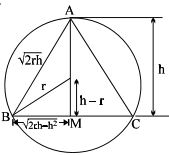
$ABC$ is an isosceles triangle inscribed in a circle of radius $r$. If $AB = AC$ and $h$ is the altitude from $A$ to $BC$,and $P$ is the perimeter of $ABC$,then $\mathop {\lim }\limits_{h \to 0} \frac{\Delta }{{{P^3}}}$ equals (where $\Delta$ is the area of the triangle).
A
$\frac{1}{{32r}}$
B
$\frac{1}{{64r}}$
C
$\frac{1}{{128r}}$
D
None
Solution
(C) Let $M$ be the midpoint of $BC$. In the right triangle $ABM$,$AM = h$. Let $BM = x$. By the property of chords,$x^2 = h(2r - h)$,so $x = \sqrt{2rh - h^2}$.
$AB = AC = \sqrt{h^2 + x^2} = \sqrt{h^2 + 2rh - h^2} = \sqrt{2rh}$.
Perimeter $P = AB + AC + BC = 2\sqrt{2rh} + 2\sqrt{2rh - h^2}$.
Area $\Delta = \frac{1}{2} \times BC \times AM = \frac{1}{2} \times (2\sqrt{2rh - h^2}) \times h = h\sqrt{2rh - h^2}$.
We want to evaluate $\mathop {\lim }\limits_{h \to 0} \frac{\Delta }{{{P^3}}} = \mathop {\lim }\limits_{h \to 0} \frac{h\sqrt{2rh - h^2}}{[2\sqrt{2rh} + 2\sqrt{2rh - h^2}]^3}$.
$= \mathop {\lim }\limits_{h \to 0} \frac{h\sqrt{h}\sqrt{2r - h}}{8[\sqrt{2rh} + \sqrt{2rh - h^2}]^3} = \mathop {\lim }\limits_{h \to 0} \frac{h^{3/2}\sqrt{2r - h}}{8(h^{1/2})^3[\sqrt{2r} + \sqrt{2r - h}]^3}$.
$= \frac{\sqrt{2r}}{8[\sqrt{2r} + \sqrt{2r}]^3} = \frac{\sqrt{2r}}{8[2\sqrt{2r}]^3} = \frac{\sqrt{2r}}{8 \times 8 \times 2r \times \sqrt{2r}} = \frac{1}{128r}$.
$AB = AC = \sqrt{h^2 + x^2} = \sqrt{h^2 + 2rh - h^2} = \sqrt{2rh}$.
Perimeter $P = AB + AC + BC = 2\sqrt{2rh} + 2\sqrt{2rh - h^2}$.
Area $\Delta = \frac{1}{2} \times BC \times AM = \frac{1}{2} \times (2\sqrt{2rh - h^2}) \times h = h\sqrt{2rh - h^2}$.
We want to evaluate $\mathop {\lim }\limits_{h \to 0} \frac{\Delta }{{{P^3}}} = \mathop {\lim }\limits_{h \to 0} \frac{h\sqrt{2rh - h^2}}{[2\sqrt{2rh} + 2\sqrt{2rh - h^2}]^3}$.
$= \mathop {\lim }\limits_{h \to 0} \frac{h\sqrt{h}\sqrt{2r - h}}{8[\sqrt{2rh} + \sqrt{2rh - h^2}]^3} = \mathop {\lim }\limits_{h \to 0} \frac{h^{3/2}\sqrt{2r - h}}{8(h^{1/2})^3[\sqrt{2r} + \sqrt{2r - h}]^3}$.
$= \frac{\sqrt{2r}}{8[\sqrt{2r} + \sqrt{2r}]^3} = \frac{\sqrt{2r}}{8[2\sqrt{2r}]^3} = \frac{\sqrt{2r}}{8 \times 8 \times 2r \times \sqrt{2r}} = \frac{1}{128r}$.
0 likes
View Solution132
AdvancedMCQ
$\mathop {Limit}\limits_{x \to \frac{\pi }{2}} \,\frac{{\sin x}}{{{{\cos }^{ - 1}}\left[ {\frac{1}{4}\,(3\sin x\, - \,\sin 3x)} \right]}}\,$,where $[ \cdot ]$ denotes the greatest integer function,is
A
$\frac{2}{\pi }$
B
$1$
C
$\frac{4}{\pi }$
D
does not exist
Solution
(A) We know that $\sin(3x) = 3\sin x - 4\sin^3 x$.
Therefore,$\frac{1}{4}(3\sin x - \sin 3x) = \sin^3 x$.
The expression becomes $\mathop {Limit}\limits_{x \to \frac{\pi }{2}} \frac{\sin x}{\cos^{-1}[\sin^3 x]}$.
As $x \to \frac{\pi}{2}$,$\sin x \to 1$,so $\sin^3 x \to 1$.
Since $\sin^3 x < 1$ for $x < \frac{\pi}{2}$,the greatest integer $[\sin^3 x] = 0$.
Thus,the limit is $\mathop {Limit}\limits_{x \to \frac{\pi}{2}^-} \frac{\sin x}{\cos^{-1}(0)} = \frac{1}{\frac{\pi}{2}} = \frac{2}{\pi}$.
For $x > \frac{\pi}{2}$,$\sin x < 1$,so $\sin^3 x < 1$,and $[\sin^3 x] = 0$.
The limit is $\frac{2}{\pi}$ from both sides.
Therefore,$\frac{1}{4}(3\sin x - \sin 3x) = \sin^3 x$.
The expression becomes $\mathop {Limit}\limits_{x \to \frac{\pi }{2}} \frac{\sin x}{\cos^{-1}[\sin^3 x]}$.
As $x \to \frac{\pi}{2}$,$\sin x \to 1$,so $\sin^3 x \to 1$.
Since $\sin^3 x < 1$ for $x < \frac{\pi}{2}$,the greatest integer $[\sin^3 x] = 0$.
Thus,the limit is $\mathop {Limit}\limits_{x \to \frac{\pi}{2}^-} \frac{\sin x}{\cos^{-1}(0)} = \frac{1}{\frac{\pi}{2}} = \frac{2}{\pi}$.
For $x > \frac{\pi}{2}$,$\sin x < 1$,so $\sin^3 x < 1$,and $[\sin^3 x] = 0$.
The limit is $\frac{2}{\pi}$ from both sides.
0 likes
View Solution133
AdvancedMCQ
If $\mathop {Lim}\limits_{x \to 0} \frac{\ln(3 + x) - \ln(3 - x)}{x} = k$,the value of $k$ is
A
$\frac{2}{3}$
B
$-\frac{1}{3}$
C
$-\frac{2}{3}$
D
$0$
Solution
(A) Given the limit: $\mathop {Lim}\limits_{x \to 0} \frac{\ln(3 + x) - \ln(3 - x)}{x}$
Using the property $\ln(a) - \ln(b) = \ln(\frac{a}{b})$,we get:
$\mathop {Lim}\limits_{x \to 0} \frac{\ln(\frac{3+x}{3-x})}{x}$
Using the standard limit $\mathop {Lim}\limits_{u \to 0} \frac{\ln(1+u)}{u} = 1$,we rewrite the expression:
$\mathop {Lim}\limits_{x \to 0} \frac{\ln(1 + \frac{x}{3}) - \ln(1 - \frac{x}{3})}{x}$
$= \mathop {Lim}\limits_{x \to 0} \left[ \frac{\ln(1 + \frac{x}{3})}{x} - \frac{\ln(1 - \frac{x}{3})}{x} \right]$
$= \mathop {Lim}\limits_{x \to 0} \left[ \frac{1}{3} \cdot \frac{\ln(1 + \frac{x}{3})}{\frac{x}{3}} - (-\frac{1}{3}) \cdot \frac{\ln(1 - \frac{x}{3})}{-\frac{x}{3}} \right]$
$= \frac{1}{3}(1) + \frac{1}{3}(1) = \frac{2}{3}$
Thus,$k = \frac{2}{3}$.
Using the property $\ln(a) - \ln(b) = \ln(\frac{a}{b})$,we get:
$\mathop {Lim}\limits_{x \to 0} \frac{\ln(\frac{3+x}{3-x})}{x}$
Using the standard limit $\mathop {Lim}\limits_{u \to 0} \frac{\ln(1+u)}{u} = 1$,we rewrite the expression:
$\mathop {Lim}\limits_{x \to 0} \frac{\ln(1 + \frac{x}{3}) - \ln(1 - \frac{x}{3})}{x}$
$= \mathop {Lim}\limits_{x \to 0} \left[ \frac{\ln(1 + \frac{x}{3})}{x} - \frac{\ln(1 - \frac{x}{3})}{x} \right]$
$= \mathop {Lim}\limits_{x \to 0} \left[ \frac{1}{3} \cdot \frac{\ln(1 + \frac{x}{3})}{\frac{x}{3}} - (-\frac{1}{3}) \cdot \frac{\ln(1 - \frac{x}{3})}{-\frac{x}{3}} \right]$
$= \frac{1}{3}(1) + \frac{1}{3}(1) = \frac{2}{3}$
Thus,$k = \frac{2}{3}$.
0 likes
View Solution134
AdvancedMCQ
The function $f(x) = \lim_{n \to \infty} \frac{x^{2n} - 1}{x^{2n} + 1}$ is identical to which of the following functions?
A
$g(x) = \text{sgn}(x - 1)$
B
$h(x) = \text{sgn}(\tan^{-1}x)$
C
$u(x) = \text{sgn}(|x| - 1)$
D
$v(x) = \text{sgn}(\cot^{-1}x)$
Solution
(C) To evaluate $f(x) = \lim_{n \to \infty} \frac{x^{2n} - 1}{x^{2n} + 1}$:
Case $1$: If $|x| < 1$,then $x^{2n} \to 0$ as $n \to \infty$. Thus,$f(x) = \frac{0 - 1}{0 + 1} = -1$.
Case $2$: If $|x| > 1$,then divide numerator and denominator by $x^{2n}$,so $f(x) = \lim_{n \to \infty} \frac{1 - 1/x^{2n}}{1 + 1/x^{2n}} = \frac{1 - 0}{1 + 0} = 1$.
Case $3$: If $x = 1$,$f(1) = \frac{1 - 1}{1 + 1} = 0$. If $x = -1$,$f(-1) = \frac{1 - 1}{1 + 1} = 0$.
Thus,$f(x) = -1$ for $|x| < 1$,$0$ for $|x| = 1$,and $1$ for $|x| > 1$.
Now,consider $u(x) = \text{sgn}(|x| - 1)$:
If $|x| < 1$,$|x| - 1 < 0$,so $\text{sgn}(|x| - 1) = -1$.
If $|x| = 1$,$|x| - 1 = 0$,so $\text{sgn}(|x| - 1) = 0$.
If $|x| > 1$,$|x| - 1 > 0$,so $\text{sgn}(|x| - 1) = 1$.
Therefore,$f(x) = u(x)$.
Case $1$: If $|x| < 1$,then $x^{2n} \to 0$ as $n \to \infty$. Thus,$f(x) = \frac{0 - 1}{0 + 1} = -1$.
Case $2$: If $|x| > 1$,then divide numerator and denominator by $x^{2n}$,so $f(x) = \lim_{n \to \infty} \frac{1 - 1/x^{2n}}{1 + 1/x^{2n}} = \frac{1 - 0}{1 + 0} = 1$.
Case $3$: If $x = 1$,$f(1) = \frac{1 - 1}{1 + 1} = 0$. If $x = -1$,$f(-1) = \frac{1 - 1}{1 + 1} = 0$.
Thus,$f(x) = -1$ for $|x| < 1$,$0$ for $|x| = 1$,and $1$ for $|x| > 1$.
Now,consider $u(x) = \text{sgn}(|x| - 1)$:
If $|x| < 1$,$|x| - 1 < 0$,so $\text{sgn}(|x| - 1) = -1$.
If $|x| = 1$,$|x| - 1 = 0$,so $\text{sgn}(|x| - 1) = 0$.
If $|x| > 1$,$|x| - 1 > 0$,so $\text{sgn}(|x| - 1) = 1$.
Therefore,$f(x) = u(x)$.
0 likes
View Solution135
AdvancedMCQ
The limiting value of the function $f(x) = \frac{2\sqrt{2} - (\cos x + \sin x)^3}{1 - \sin 2x}$ as $x \to \frac{\pi}{4}$ is
A
$\sqrt{2}$
B
$\frac{1}{\sqrt{2}}$
C
$3\sqrt{2}$
D
$\frac{3}{\sqrt{2}}$
Solution
(D) Let $x = \frac{\pi}{4} + h$. As $x \to \frac{\pi}{4}$,$h \to 0$.
Then $\cos x + \sin x = \cos(\frac{\pi}{4} + h) + \sin(\frac{\pi}{4} + h) = \sqrt{2} \cos h$.
Also,$1 - \sin 2x = 1 - \sin(\frac{\pi}{2} + 2h) = 1 - \cos 2h = 2 \sin^2 h$.
The expression becomes $\lim_{h \to 0} \frac{2\sqrt{2} - (\sqrt{2} \cos h)^3}{2 \sin^2 h} = \lim_{h \to 0} \frac{2\sqrt{2}(1 - \cos^3 h)}{2 \sin^2 h} = \sqrt{2} \lim_{h \to 0} \frac{(1 - \cos h)(1 + \cos h + \cos^2 h)}{\sin^2 h}$.
Using $\lim_{h \to 0} \frac{1 - \cos h}{\sin^2 h} = \lim_{h \to 0} \frac{1 - \cos h}{1 - \cos^2 h} = \lim_{h \to 0} \frac{1}{1 + \cos h} = \frac{1}{2}$.
Thus,the limit is $\sqrt{2} \times \frac{1}{2} \times (1 + 1 + 1) = \sqrt{2} \times \frac{3}{2} = \frac{3}{\sqrt{2}}$.
Then $\cos x + \sin x = \cos(\frac{\pi}{4} + h) + \sin(\frac{\pi}{4} + h) = \sqrt{2} \cos h$.
Also,$1 - \sin 2x = 1 - \sin(\frac{\pi}{2} + 2h) = 1 - \cos 2h = 2 \sin^2 h$.
The expression becomes $\lim_{h \to 0} \frac{2\sqrt{2} - (\sqrt{2} \cos h)^3}{2 \sin^2 h} = \lim_{h \to 0} \frac{2\sqrt{2}(1 - \cos^3 h)}{2 \sin^2 h} = \sqrt{2} \lim_{h \to 0} \frac{(1 - \cos h)(1 + \cos h + \cos^2 h)}{\sin^2 h}$.
Using $\lim_{h \to 0} \frac{1 - \cos h}{\sin^2 h} = \lim_{h \to 0} \frac{1 - \cos h}{1 - \cos^2 h} = \lim_{h \to 0} \frac{1}{1 + \cos h} = \frac{1}{2}$.
Thus,the limit is $\sqrt{2} \times \frac{1}{2} \times (1 + 1 + 1) = \sqrt{2} \times \frac{3}{2} = \frac{3}{\sqrt{2}}$.
0 likes
View Solution136
AdvancedMCQ
For $\mathop {\text{Lim}}\limits_{x \to 8} \,\,\frac{{\sin \{ x - 10\} }}{{\{ 10 - x\} }}$ (where $\{ \}$ denotes the fractional part function),determine the existence of the limits.
A
$LHL$ exists but $RHL$ does not exist.
B
$RHL$ exists but $LHL$ does not exist.
C
Neither $LHL$ nor $RHL$ exists.
D
Both $RHL$ and $LHL$ exist and are equal to $1$.
Solution
(B) Let $f(x) = \frac{\sin \{x - 10\}}{\{10 - x\}}$. Since $\{x - 10\} = \{x\}$ and $\{10 - x\} = 1 - \{x\}$ for $x \notin \mathbb{Z}$,the expression becomes $\frac{\sin \{x\}}{1 - \{x\}}$.
For $RHL$: $\mathop {\text{Lim}}\limits_{x \to 8^+} \{x\} = 0$,so $\mathop {\text{Lim}}\limits_{x \to 8^+} \frac{\sin \{x\}}{1 - \{x\}} = \frac{\sin(0)}{1 - 0} = 0$. Thus,$RHL$ exists.
For $LHL$: $\mathop {\text{Lim}}\limits_{x \to 8^-} \{x\} = 1$,so $\mathop {\text{Lim}}\limits_{x \to 8^-} \frac{\sin \{x\}}{1 - \{x\}} = \frac{\sin(1)}{0^+}$,which tends to $\infty$. Thus,$LHL$ does not exist.
For $RHL$: $\mathop {\text{Lim}}\limits_{x \to 8^+} \{x\} = 0$,so $\mathop {\text{Lim}}\limits_{x \to 8^+} \frac{\sin \{x\}}{1 - \{x\}} = \frac{\sin(0)}{1 - 0} = 0$. Thus,$RHL$ exists.
For $LHL$: $\mathop {\text{Lim}}\limits_{x \to 8^-} \{x\} = 1$,so $\mathop {\text{Lim}}\limits_{x \to 8^-} \frac{\sin \{x\}}{1 - \{x\}} = \frac{\sin(1)}{0^+}$,which tends to $\infty$. Thus,$LHL$ does not exist.
0 likes
View Solution137
AdvancedMCQ
$\mathop {Lim}\limits_{n \to \infty } \frac{{{1^2}n + {2^2}(n - 1) + {3^2}(n - 2) + \dots + {n^2} \cdot 1}}{{{1^3} + {2^3} + {3^3} + \dots + {n^3}}}$ is equal to :
A
$\frac{1}{3}$
B
$\frac{2}{3}$
C
$\frac{1}{2}$
D
$\frac{1}{6}$
Solution
(A) Let the numerator be $S_n = \sum_{k=1}^{n} k^2(n - k + 1)$.
$S_n = (n+1) \sum_{k=1}^{n} k^2 - \sum_{k=1}^{n} k^3$.
We know that $\sum_{k=1}^{n} k^2 = \frac{n(n+1)(2n+1)}{6}$ and $\sum_{k=1}^{n} k^3 = \frac{n^2(n+1)^2}{4}$.
The denominator is $D_n = \sum_{k=1}^{n} k^3 = \frac{n^2(n+1)^2}{4}$.
Thus,the limit is $\lim_{n \to \infty} \frac{(n+1) \frac{n(n+1)(2n+1)}{6} - \frac{n^2(n+1)^2}{4}}{\frac{n^2(n+1)^2}{4}}$.
Dividing by $\frac{n^2(n+1)^2}{4}$:
$= \lim_{n \to \infty} \left( \frac{(n+1) n(n+1)(2n+1)}{6} \cdot \frac{4}{n^2(n+1)^2} - 1 \right)$.
$= \lim_{n \to \infty} \left( \frac{4n(n+1)^2(2n+1)}{6n^2(n+1)^2} - 1 \right)$.
$= \lim_{n \to \infty} \left( \frac{4(2n+1)}{6n} - 1 \right) = \frac{8}{6} - 1 = \frac{4}{3} - 1 = \frac{1}{3}$.
$S_n = (n+1) \sum_{k=1}^{n} k^2 - \sum_{k=1}^{n} k^3$.
We know that $\sum_{k=1}^{n} k^2 = \frac{n(n+1)(2n+1)}{6}$ and $\sum_{k=1}^{n} k^3 = \frac{n^2(n+1)^2}{4}$.
The denominator is $D_n = \sum_{k=1}^{n} k^3 = \frac{n^2(n+1)^2}{4}$.
Thus,the limit is $\lim_{n \to \infty} \frac{(n+1) \frac{n(n+1)(2n+1)}{6} - \frac{n^2(n+1)^2}{4}}{\frac{n^2(n+1)^2}{4}}$.
Dividing by $\frac{n^2(n+1)^2}{4}$:
$= \lim_{n \to \infty} \left( \frac{(n+1) n(n+1)(2n+1)}{6} \cdot \frac{4}{n^2(n+1)^2} - 1 \right)$.
$= \lim_{n \to \infty} \left( \frac{4n(n+1)^2(2n+1)}{6n^2(n+1)^2} - 1 \right)$.
$= \lim_{n \to \infty} \left( \frac{4(2n+1)}{6n} - 1 \right) = \frac{8}{6} - 1 = \frac{4}{3} - 1 = \frac{1}{3}$.
0 likes
View Solution138
AdvancedMCQ
The value of $\mathop {\text{Limit}}\limits_{x \to \infty } \frac{{\cot ^{ - 1}}\left( {{x^{ - a}}\log _a x} \right)}{{\sec ^{ - 1}}\left( {{a^x}\log _x a} \right)}$ for $a > 1$ is equal to
A
$1$
B
$0$
C
$\pi / 2$
D
does not exist
Solution
(A) Let the given limit be $L = \mathop {\text{Limit}}\limits_{x \to \infty } \frac{{\cot ^{ - 1}}\left( \frac{\log _a x}{x^a} \right)}{{\sec ^{ - 1}}\left( \frac{a^x}{\log _a x} \right)}$.
As $x \to \infty$,$\frac{\log _a x}{x^a} \to 0$ because exponential growth dominates logarithmic growth for $a > 1$.
Thus,the numerator approaches $\cot ^{ - 1}(0) = \pi / 2$.
As $x \to \infty$,$\frac{a^x}{\log _a x} \to \infty$ because exponential growth dominates logarithmic growth.
Thus,the denominator approaches $\sec ^{ - 1}(\infty) = \pi / 2$.
Therefore,$L = \frac{\pi / 2}{\pi / 2} = 1$.
As $x \to \infty$,$\frac{\log _a x}{x^a} \to 0$ because exponential growth dominates logarithmic growth for $a > 1$.
Thus,the numerator approaches $\cot ^{ - 1}(0) = \pi / 2$.
As $x \to \infty$,$\frac{a^x}{\log _a x} \to \infty$ because exponential growth dominates logarithmic growth.
Thus,the denominator approaches $\sec ^{ - 1}(\infty) = \pi / 2$.
Therefore,$L = \frac{\pi / 2}{\pi / 2} = 1$.
0 likes
View Solution139
AdvancedMCQ
For the function $f(x) = \lim_{n \to \infty} \frac{1}{1 + n \sin^2(\pi x)}$,which of the following holds?
A
The range of $f$ is a singleton set
B
$f$ is continuous on $\mathbb{R}$
C
$f$ is discontinuous for all $x \in \mathbb{Z}$
D
$f$ is discontinuous for some $x \in \mathbb{R}$
Solution
(C) Case $1$: If $x \in \mathbb{Z}$,then $\sin(\pi x) = 0$.
Thus,$f(x) = \lim_{n \to \infty} \frac{1}{1 + n(0)} = 1$.
Case $2$: If $x \notin \mathbb{Z}$,then $\sin^2(\pi x) > 0$.
As $n \to \infty$,$n \sin^2(\pi x) \to \infty$.
Thus,$f(x) = \lim_{n \to \infty} \frac{1}{1 + n \sin^2(\pi x)} = 0$.
Therefore,$f(x) = \begin{cases} 1, & x \in \mathbb{Z} \\ 0, & x \notin \mathbb{Z} \end{cases}$.
Since the function jumps between $0$ and $1$ at every integer value,$f$ is discontinuous for all $x \in \mathbb{Z}$.
Thus,$f(x) = \lim_{n \to \infty} \frac{1}{1 + n(0)} = 1$.
Case $2$: If $x \notin \mathbb{Z}$,then $\sin^2(\pi x) > 0$.
As $n \to \infty$,$n \sin^2(\pi x) \to \infty$.
Thus,$f(x) = \lim_{n \to \infty} \frac{1}{1 + n \sin^2(\pi x)} = 0$.
Therefore,$f(x) = \begin{cases} 1, & x \in \mathbb{Z} \\ 0, & x \notin \mathbb{Z} \end{cases}$.
Since the function jumps between $0$ and $1$ at every integer value,$f$ is discontinuous for all $x \in \mathbb{Z}$.
0 likes
View Solution140
AdvancedMCQ
If $f(x) = \cos x$ when $x = n\pi$ $(n = 0, 1, 2, 3, \dots)$ and $f(x) = 3$ otherwise,and $\phi(x) = \begin{cases} x^2 + 1 & \text{when } x \neq 3, x \neq 0 \\ 3 & \text{when } x = 0 \\ 5 & \text{when } x = 3 \end{cases}$,then find $\lim_{x \to 0} f(\phi(x))$.
A
$1$
B
$3$
C
$5$
D
None of these
Solution
(B) We need to find $\lim_{x \to 0} f(\phi(x))$.
First,let us evaluate $\lim_{x \to 0} \phi(x)$.
For $x \neq 0$ and $x \neq 3$,$\phi(x) = x^2 + 1$.
As $x \to 0$,$\phi(x) \to 0^2 + 1 = 1$.
Since $\phi(x)$ approaches $1$ as $x \to 0$ (and $1 \neq 0, 1 \neq 3$),we look at the definition of $f(x)$ near $1$.
Since $1$ is not of the form $n\pi$ for any integer $n \geq 0$,$f(x) = 3$ for values of $x$ near $1$.
Therefore,$\lim_{x \to 0} f(\phi(x)) = f(1) = 3$.
First,let us evaluate $\lim_{x \to 0} \phi(x)$.
For $x \neq 0$ and $x \neq 3$,$\phi(x) = x^2 + 1$.
As $x \to 0$,$\phi(x) \to 0^2 + 1 = 1$.
Since $\phi(x)$ approaches $1$ as $x \to 0$ (and $1 \neq 0, 1 \neq 3$),we look at the definition of $f(x)$ near $1$.
Since $1$ is not of the form $n\pi$ for any integer $n \geq 0$,$f(x) = 3$ for values of $x$ near $1$.
Therefore,$\lim_{x \to 0} f(\phi(x)) = f(1) = 3$.
0 likes
View Solution141
AdvancedMCQ
$\mathop {Lim}\limits_{x \to {0^ - }} \sin^{-1}([\tan x])$ $= l$,then $\{l\}$ is equal to,where $[\cdot]$ and $\{\cdot\}$ denote the greatest integer and fractional part functions,respectively.
A
$0$
B
$1 - \frac{\pi}{2}$
C
$\frac{\pi}{2} - 1$
D
$2 - \frac{\pi}{2}$
Solution
(D) As $x \to 0^-$,$\tan x$ approaches $0$ from the negative side,i.e.,$-1 < \tan x < 0$.
Therefore,$[\tan x] = -1$.
Substituting this into the limit:
$\mathop {Lim}\limits_{x \to {0^ - }} \sin^{-1}([\tan x]) = \sin^{-1}(-1) = -\frac{\pi}{2}$.
So,$l = -\frac{\pi}{2}$.
We need to find $\{l\} = \{-\frac{\pi}{2}\}$.
Using the property $\{x\} = x - [x]$,we have $\{ -\frac{\pi}{2} \} = -\frac{\pi}{2} - [-\frac{\pi}{2}]$.
Since $-1.57 < -\frac{\pi}{2} < -1$,the greatest integer $[-\frac{\pi}{2}] = -2$.
Thus,$\{ -\frac{\pi}{2} \} = -\frac{\pi}{2} - (-2) = 2 - \frac{\pi}{2}$.
Therefore,$[\tan x] = -1$.
Substituting this into the limit:
$\mathop {Lim}\limits_{x \to {0^ - }} \sin^{-1}([\tan x]) = \sin^{-1}(-1) = -\frac{\pi}{2}$.
So,$l = -\frac{\pi}{2}$.
We need to find $\{l\} = \{-\frac{\pi}{2}\}$.
Using the property $\{x\} = x - [x]$,we have $\{ -\frac{\pi}{2} \} = -\frac{\pi}{2} - [-\frac{\pi}{2}]$.
Since $-1.57 < -\frac{\pi}{2} < -1$,the greatest integer $[-\frac{\pi}{2}] = -2$.
Thus,$\{ -\frac{\pi}{2} \} = -\frac{\pi}{2} - (-2) = 2 - \frac{\pi}{2}$.
0 likes
View Solution142
AdvancedMCQ
Let $f(x) = \frac{\ln(x^2 + e^x)}{\ln(x^4 + e^{2x})}$. If $\lim_{x \to \infty} f(x) = l$ and $\lim_{x \to -\infty} f(x) = m$,then:
A
$l = m$
B
$l = 2m$
C
$2l = m$
D
$l + m = 0$
Solution
(A) For $x \to \infty$,$f(x) = \frac{\ln(e^x(1 + x^2/e^x))}{\ln(e^{2x}(1 + x^4/e^{2x}))} = \frac{x + \ln(1 + x^2/e^x)}{2x + \ln(1 + x^4/e^{2x})}$.
Dividing numerator and denominator by $x$,we get $\lim_{x \to \infty} f(x) = \frac{1 + 0}{2 + 0} = \frac{1}{2}$,so $l = 1/2$.
For $x \to -\infty$,let $t = -x$,so $t \to \infty$. Then $f(-t) = \frac{\ln(t^2 + e^{-t})}{\ln(t^4 + e^{-2t})}$.
As $t \to \infty$,$e^{-t} \to 0$ and $e^{-2t} \to 0$.
Thus,$m = \lim_{t \to \infty} \frac{\ln(t^2)}{\ln(t^4)} = \lim_{t \to \infty} \frac{2 \ln(t)}{4 \ln(t)} = \frac{2}{4} = \frac{1}{2}$.
Since $l = 1/2$ and $m = 1/2$,we have $l = m$.
Dividing numerator and denominator by $x$,we get $\lim_{x \to \infty} f(x) = \frac{1 + 0}{2 + 0} = \frac{1}{2}$,so $l = 1/2$.
For $x \to -\infty$,let $t = -x$,so $t \to \infty$. Then $f(-t) = \frac{\ln(t^2 + e^{-t})}{\ln(t^4 + e^{-2t})}$.
As $t \to \infty$,$e^{-t} \to 0$ and $e^{-2t} \to 0$.
Thus,$m = \lim_{t \to \infty} \frac{\ln(t^2)}{\ln(t^4)} = \lim_{t \to \infty} \frac{2 \ln(t)}{4 \ln(t)} = \frac{2}{4} = \frac{1}{2}$.
Since $l = 1/2$ and $m = 1/2$,we have $l = m$.
0 likes
View Solution143
AdvancedMCQ
$\mathop {Lim}\limits_{n \to \infty } \cos \left( {\pi \sqrt {{n^2} + n} } \right)$ when $n$ is an integer:
A
is equal to $1$
B
is equal to $-1$
C
is equal to $0$
D
does not exist
Solution
(C) We want to evaluate $L = \mathop {Lim}\limits_{n \to \infty } \cos \left( {\pi \sqrt {{n^2} + n} } \right)$.
Since $n$ is an integer,we can write $\cos \left( {\pi \sqrt {{n^2} + n} } \right) = \cos \left( {n\pi - n\pi + \pi \sqrt {{n^2} + n} } \right) = \cos \left( {n\pi - \pi \left( {n - \sqrt {{n^2} + n} } \right)} \right)$.
Using the identity $\cos(n\pi - \theta) = (-1)^n \cos(\theta)$,we have $L = \mathop {Lim}\limits_{n \to \infty } (-1)^n \cos \left( {\pi \left( {n - \sqrt {{n^2} + n} } \right)} \right)$.
Now,rationalize the expression inside the cosine:
$n - \sqrt {{n^2} + n} = \frac{{(n - \sqrt {{n^2} + n} )(n + \sqrt {{n^2} + n} )}}{{n + \sqrt {{n^2} + n} }} = \frac{{{n^2} - ({n^2} + n)}}{{n + \sqrt {{n^2} + n} }} = \frac{{ - n}}{{n + n\sqrt {1 + 1/n} }} = \frac{{ - 1}}{{1 + \sqrt {1 + 1/n} }}$.
As $n \to \infty$,this expression approaches $\frac{{ - 1}}{{1 + 1}} = -1/2$.
Thus,$L = \mathop {Lim}\limits_{n \to \infty } (-1)^n \cos \left( {\pi \left( -\frac{1}{2} \right)} \right) = \mathop {Lim}\limits_{n \to \infty } (-1)^n \cos \left( -\frac{\pi}{2} \right) = \mathop {Lim}\limits_{n \to \infty } (-1)^n \cdot 0 = 0$.
Since $n$ is an integer,we can write $\cos \left( {\pi \sqrt {{n^2} + n} } \right) = \cos \left( {n\pi - n\pi + \pi \sqrt {{n^2} + n} } \right) = \cos \left( {n\pi - \pi \left( {n - \sqrt {{n^2} + n} } \right)} \right)$.
Using the identity $\cos(n\pi - \theta) = (-1)^n \cos(\theta)$,we have $L = \mathop {Lim}\limits_{n \to \infty } (-1)^n \cos \left( {\pi \left( {n - \sqrt {{n^2} + n} } \right)} \right)$.
Now,rationalize the expression inside the cosine:
$n - \sqrt {{n^2} + n} = \frac{{(n - \sqrt {{n^2} + n} )(n + \sqrt {{n^2} + n} )}}{{n + \sqrt {{n^2} + n} }} = \frac{{{n^2} - ({n^2} + n)}}{{n + \sqrt {{n^2} + n} }} = \frac{{ - n}}{{n + n\sqrt {1 + 1/n} }} = \frac{{ - 1}}{{1 + \sqrt {1 + 1/n} }}$.
As $n \to \infty$,this expression approaches $\frac{{ - 1}}{{1 + 1}} = -1/2$.
Thus,$L = \mathop {Lim}\limits_{n \to \infty } (-1)^n \cos \left( {\pi \left( -\frac{1}{2} \right)} \right) = \mathop {Lim}\limits_{n \to \infty } (-1)^n \cos \left( -\frac{\pi}{2} \right) = \mathop {Lim}\limits_{n \to \infty } (-1)^n \cdot 0 = 0$.
0 likes
View Solution144
AdvancedMCQ
$\lim \limits _{x \to 0} \frac{{{{(\sin x - \tan x)}^2} - {{(1 - \cos 2x)}^4} + {x^5}}}{{7\cdot{{({{\tan }^{ - 1}}x)}^7}\, + {{({{\sin }^{ - 1}}x)}^6}+ 3{{\sin }^5}x}}$ is equal to
A
$0$
B
$1/7$
C
$1/3$
D
$1$
Solution
(C) To evaluate the limit $L = \lim \limits _{x \to 0} \frac{{{{(\sin x - \tan x)}^2} - {{(1 - \cos 2x)}^4} + {x^5}}}{{7\cdot{{({{\tan }^{ - 1}}x)}^7}\, + {{({{\sin }^{ - 1}}x)}^6}+ 3{{\sin }^5}x}}$,we analyze the leading terms as $x \to 0$.
Numerator:
$(\sin x - \tan x)^2 = (x - \frac{x^3}{6} - (x + \frac{x^3}{3}))^2 + O(x^8) = (-\frac{x^3}{2})^2 + O(x^8) = \frac{x^6}{4} + O(x^8)$.
$(1 - \cos 2x)^4 = (1 - (1 - \frac{(2x)^2}{2}))^4 = (2x^2)^4 = 16x^8$.
Thus,the numerator is $\frac{x^6}{4} - 16x^8 + x^5 \approx x^5$ as $x \to 0$.
Denominator:
$7(\tan^{-1} x)^7 + (\sin^{-1} x)^6 + 3(\sin x)^5 \approx 7x^7 + x^6 + 3x^5$.
The leading term is $3x^5$.
Limit $L = \lim \limits _{x \to 0} \frac{x^5}{3x^5} = \frac{1}{3}$.
Numerator:
$(\sin x - \tan x)^2 = (x - \frac{x^3}{6} - (x + \frac{x^3}{3}))^2 + O(x^8) = (-\frac{x^3}{2})^2 + O(x^8) = \frac{x^6}{4} + O(x^8)$.
$(1 - \cos 2x)^4 = (1 - (1 - \frac{(2x)^2}{2}))^4 = (2x^2)^4 = 16x^8$.
Thus,the numerator is $\frac{x^6}{4} - 16x^8 + x^5 \approx x^5$ as $x \to 0$.
Denominator:
$7(\tan^{-1} x)^7 + (\sin^{-1} x)^6 + 3(\sin x)^5 \approx 7x^7 + x^6 + 3x^5$.
The leading term is $3x^5$.
Limit $L = \lim \limits _{x \to 0} \frac{x^5}{3x^5} = \frac{1}{3}$.
0 likes
View Solution145
AdvancedMCQ
Let $l = \mathop {\lim}\limits_{x \to 0} \frac{[x]^2}{x^2}$ and $m = \mathop {\lim}\limits_{x \to 0} \frac{[x^2]}{x^2}$,where $[ \cdot ]$ denotes the greatest integer function. Then:
A
$l$ exists but $m$ does not
B
$m$ exists but $l$ does not
C
$l$ and $m$ both exist
D
neither $l$ nor $m$ exists
Solution
(B) For $l = \mathop {\lim}\limits_{x \to 0} \frac{[x]^2}{x^2}$:
As $x \to 0^+$,$[x] = 0$,so $\frac{[x]^2}{x^2} = 0$. Thus,$\mathop {\lim}\limits_{x \to 0^+} \frac{[x]^2}{x^2} = 0$.
As $x \to 0^-$,$[x] = -1$,so $\frac{[x]^2}{x^2} = \frac{1}{x^2} \to \infty$. Thus,$l$ does not exist.
For $m = \mathop {\lim}\limits_{x \to 0} \frac{[x^2]}{x^2}$:
As $x \to 0$,$x^2$ is a small positive value approaching $0$ from the right $(0 < x^2 < 1)$.
Therefore,$[x^2] = 0$ for all $x \neq 0$ in the neighborhood of $0$.
Thus,$\mathop {\lim}\limits_{x \to 0} \frac{0}{x^2} = 0$. So,$m$ exists and $m = 0$.
Conclusion: $m$ exists but $l$ does not.
As $x \to 0^+$,$[x] = 0$,so $\frac{[x]^2}{x^2} = 0$. Thus,$\mathop {\lim}\limits_{x \to 0^+} \frac{[x]^2}{x^2} = 0$.
As $x \to 0^-$,$[x] = -1$,so $\frac{[x]^2}{x^2} = \frac{1}{x^2} \to \infty$. Thus,$l$ does not exist.
For $m = \mathop {\lim}\limits_{x \to 0} \frac{[x^2]}{x^2}$:
As $x \to 0$,$x^2$ is a small positive value approaching $0$ from the right $(0 < x^2 < 1)$.
Therefore,$[x^2] = 0$ for all $x \neq 0$ in the neighborhood of $0$.
Thus,$\mathop {\lim}\limits_{x \to 0} \frac{0}{x^2} = 0$. So,$m$ exists and $m = 0$.
Conclusion: $m$ exists but $l$ does not.
0 likes
View Solution146
AdvancedMCQ
The value of $\mathop {\text{Limit}}\limits_{x \to 0} \frac{\tan(\{x\} - 1) \sin\{x\}}{\{x\}(\{x\} - 1)}$,where $\{x\}$ denotes the fractional part function,is:
A
is $1$
B
is $\tan 1$
C
is $\sin 1$
D
non-existent
Solution
(D) Let $f(x) = \frac{\tan(\{x\} - 1) \sin\{x\}}{\{x\}(\{x\} - 1)}$.
For the right-hand limit $(x \to 0^+)$,$\{x\} = x$ where $x$ is a small positive value $h$:
$\mathop {\text{Limit}}\limits_{h \to 0^+} \frac{\tan(h - 1) \sin h}{h(h - 1)} = \frac{\tan(-1)}{-1} \times \mathop {\text{Limit}}\limits_{h \to 0^+} \frac{\sin h}{h} = \tan 1 \times 1 = \tan 1$.
For the left-hand limit $(x \to 0^-)$,$\{x\} = 1 + x$ where $x$ is a small negative value $-h$ $(h > 0)$:
$\mathop {\text{Limit}}\limits_{h \to 0^+} \frac{\tan(1 - h - 1) \sin(1 - h)}{(1 - h)(1 - h - 1)} = \mathop {\text{Limit}}\limits_{h \to 0^+} \frac{\tan(-h) \sin(1 - h)}{(1 - h)(-h)} = \frac{\sin 1}{1} = \sin 1$.
Since the right-hand limit $(\tan 1)$ is not equal to the left-hand limit $(\sin 1)$,the limit does not exist.
For the right-hand limit $(x \to 0^+)$,$\{x\} = x$ where $x$ is a small positive value $h$:
$\mathop {\text{Limit}}\limits_{h \to 0^+} \frac{\tan(h - 1) \sin h}{h(h - 1)} = \frac{\tan(-1)}{-1} \times \mathop {\text{Limit}}\limits_{h \to 0^+} \frac{\sin h}{h} = \tan 1 \times 1 = \tan 1$.
For the left-hand limit $(x \to 0^-)$,$\{x\} = 1 + x$ where $x$ is a small negative value $-h$ $(h > 0)$:
$\mathop {\text{Limit}}\limits_{h \to 0^+} \frac{\tan(1 - h - 1) \sin(1 - h)}{(1 - h)(1 - h - 1)} = \mathop {\text{Limit}}\limits_{h \to 0^+} \frac{\tan(-h) \sin(1 - h)}{(1 - h)(-h)} = \frac{\sin 1}{1} = \sin 1$.
Since the right-hand limit $(\tan 1)$ is not equal to the left-hand limit $(\sin 1)$,the limit does not exist.
0 likes
View Solution147
AdvancedMCQ
$\mathop {Lim}\limits_{x \to \infty } \frac{2 + 2x + \sin 2x}{(2x + \sin 2x)e^{\sin x}}$ is :
A
equal to zero
B
equal to $1$
C
equal to $-1$
D
non-existent
Solution
(D) We evaluate the limit: $\mathop {Lim}\limits_{x \to \infty } \frac{2 + 2x + \sin 2x}{(2x + \sin 2x)e^{\sin x}}$.
Divide the numerator and denominator by $x$:
$\mathop {Lim}\limits_{x \to \infty } \frac{\frac{2}{x} + 2 + \frac{\sin 2x}{x}}{(2 + \frac{\sin 2x}{x})e^{\sin x}}$.
As $x \to \infty$,$\frac{2}{x} \to 0$ and $\frac{\sin 2x}{x} \to 0$.
The expression simplifies to $\mathop {Lim}\limits_{x \to \infty } \frac{2}{2e^{\sin x}} = \frac{1}{e^{\sin x}}$.
Since $\sin x$ oscillates between $-1$ and $1$ as $x \to \infty$,the value of $e^{\sin x}$ oscillates between $e^{-1}$ and $e^1$.
Therefore,the limit does not exist.
Divide the numerator and denominator by $x$:
$\mathop {Lim}\limits_{x \to \infty } \frac{\frac{2}{x} + 2 + \frac{\sin 2x}{x}}{(2 + \frac{\sin 2x}{x})e^{\sin x}}$.
As $x \to \infty$,$\frac{2}{x} \to 0$ and $\frac{\sin 2x}{x} \to 0$.
The expression simplifies to $\mathop {Lim}\limits_{x \to \infty } \frac{2}{2e^{\sin x}} = \frac{1}{e^{\sin x}}$.
Since $\sin x$ oscillates between $-1$ and $1$ as $x \to \infty$,the value of $e^{\sin x}$ oscillates between $e^{-1}$ and $e^1$.
Therefore,the limit does not exist.
0 likes
View Solution148
AdvancedMCQ
$\mathop {Lim}\limits_{x \to c} f(x)$ does not exist when: (where $[x]$ denotes the greatest integer function and $\{x\}$ denotes the fractional part function.)
A
$f(x) = [[x]] - [2x - 1], c = 3$
B
$f(x) = [x] - x, c = 1$
C
$f(x) = \{x\}^2 - \{-x\}^2, c = 0$
D
Both $(B)$ and $(C)$
Solution
(D) Option $A$: $f(x) = [[x]] - [2x - 1]$ at $c = 3$.
Right hand limit: $\lim_{h \to 0} f(3+h) = \lim_{h \to 0} [[3+h]] - [2(3+h)-1] = 3 - 5 = -2$.
Left hand limit: $\lim_{h \to 0} f(3-h) = \lim_{h \to 0} [[3-h]] - [2(3-h)-1] = 2 - 4 = -2$.
Since $LHL = RHL$,the limit exists.
Option $B$: $f(x) = [x] - x$ at $c = 1$.
Right hand limit: $\lim_{h \to 0} f(1+h) = \lim_{h \to 0} [1+h] - (1+h) = 1 - 1 = 0$.
Left hand limit: $\lim_{h \to 0} f(1-h) = \lim_{h \to 0} [1-h] - (1-h) = 0 - 1 = -1$.
Since $LHL \neq RHL$,the limit does not exist.
Option $C$: $f(x) = \{x\}^2 - \{-x\}^2$ at $c = 0$.
Right hand limit: $\lim_{h \to 0} f(0+h) = \lim_{h \to 0} (h)^2 - (1-h)^2 = 0 - 1 = -1$.
Left hand limit: $\lim_{h \to 0} f(0-h) = \lim_{h \to 0} (1-h)^2 - (h)^2 = 1 - 0 = 1$.
Since $LHL \neq RHL$,the limit does not exist.
Therefore,both $(B)$ and $(C)$ are correct.
Right hand limit: $\lim_{h \to 0} f(3+h) = \lim_{h \to 0} [[3+h]] - [2(3+h)-1] = 3 - 5 = -2$.
Left hand limit: $\lim_{h \to 0} f(3-h) = \lim_{h \to 0} [[3-h]] - [2(3-h)-1] = 2 - 4 = -2$.
Since $LHL = RHL$,the limit exists.
Option $B$: $f(x) = [x] - x$ at $c = 1$.
Right hand limit: $\lim_{h \to 0} f(1+h) = \lim_{h \to 0} [1+h] - (1+h) = 1 - 1 = 0$.
Left hand limit: $\lim_{h \to 0} f(1-h) = \lim_{h \to 0} [1-h] - (1-h) = 0 - 1 = -1$.
Since $LHL \neq RHL$,the limit does not exist.
Option $C$: $f(x) = \{x\}^2 - \{-x\}^2$ at $c = 0$.
Right hand limit: $\lim_{h \to 0} f(0+h) = \lim_{h \to 0} (h)^2 - (1-h)^2 = 0 - 1 = -1$.
Left hand limit: $\lim_{h \to 0} f(0-h) = \lim_{h \to 0} (1-h)^2 - (h)^2 = 1 - 0 = 1$.
Since $LHL \neq RHL$,the limit does not exist.
Therefore,both $(B)$ and $(C)$ are correct.
0 likes
View Solution149
AdvancedMCQ
Let $f(x) = \frac{x \cdot 2^x - x}{1 - \cos x}$ and $g(x) = 2^x \sin \left( \frac{\ln 2}{2^x} \right)$,then:
A
$\lim_{x \to 0} f(x) = \ln 2$
B
$\lim_{x \to \infty} g(x) = \ln 2$
C
$\lim_{x \to 0} f(x) = \ln 4$
D
$(B)$ and $(C)$ are both correct
Solution
(D) For $f(x) = \frac{x(2^x - 1)}{1 - \cos x} = \frac{x(2^x - 1)}{2 \sin^2(x/2)}$.
As $x \to 0$,$f(x) = \frac{x(2^x - 1)}{2 (x/2)^2} = \frac{x(2^x - 1)}{x^2/2} = 2 \frac{2^x - 1}{x}$.
Using the standard limit $\lim_{x \to 0} \frac{a^x - 1}{x} = \ln a$,we get $\lim_{x \to 0} f(x) = 2 \ln 2 = \ln 4$.
Thus,option $(C)$ is correct.
For $g(x) = 2^x \sin \left( \frac{\ln 2}{2^x} \right)$,as $x \to \infty$,$2^x \to \infty$,so $\frac{\ln 2}{2^x} \to 0$.
Let $u = \frac{\ln 2}{2^x}$,then $g(x) = \frac{\ln 2}{u} \sin(u) = \ln 2 \cdot \frac{\sin u}{u}$.
As $x \to \infty$,$u \to 0$,so $\lim_{x \to \infty} g(x) = \ln 2 \cdot 1 = \ln 2$.
Thus,option $(B)$ is correct.
Therefore,$(D)$ is the correct option.
As $x \to 0$,$f(x) = \frac{x(2^x - 1)}{2 (x/2)^2} = \frac{x(2^x - 1)}{x^2/2} = 2 \frac{2^x - 1}{x}$.
Using the standard limit $\lim_{x \to 0} \frac{a^x - 1}{x} = \ln a$,we get $\lim_{x \to 0} f(x) = 2 \ln 2 = \ln 4$.
Thus,option $(C)$ is correct.
For $g(x) = 2^x \sin \left( \frac{\ln 2}{2^x} \right)$,as $x \to \infty$,$2^x \to \infty$,so $\frac{\ln 2}{2^x} \to 0$.
Let $u = \frac{\ln 2}{2^x}$,then $g(x) = \frac{\ln 2}{u} \sin(u) = \ln 2 \cdot \frac{\sin u}{u}$.
As $x \to \infty$,$u \to 0$,so $\lim_{x \to \infty} g(x) = \ln 2 \cdot 1 = \ln 2$.
Thus,option $(B)$ is correct.
Therefore,$(D)$ is the correct option.
0 likes
View SolutionLimits — Concept of limits, Evaluation of algebric limits · Frequently Asked Questions
1Are these Limits questions useful for JEE and NEET?
Yes. All questions in this section are mapped to JEE Main and NEET exam patterns. Previous year questions from JEE Main, NEET, GUJCET and state-level exams are included with full solutions.
2Can I switch to Hindi or Gujarati for these questions?
Yes. Use the language tabs in the hero section or the sidebar to view the same questions and solutions in English, Hindi or Gujarati.
3How do I generate a question paper from this subtopic?
Use the Vedclass Exam Paper Generator — select the chapter and subtopic, set difficulty, and generate Sets A, B, C, D automatically. First 3 chapters of every subject are free.
Vedclass Products
For Students
Vedclass Test Series
Mock tests in real JEE/NEET style with performance analysis. 5-day free trial.
Start Free TrialFor Teachers
Exam Paper Generator
Generate Set A/B/C/D papers from this chapter in 2 minutes. 3 chapters free.
Try FreeFor Institutes
Online Exam Module
Live online exams with unlimited students, 360° analytics & white-label branding.
See DemoFor Teachers & Institutes
Generate a Limits Exam Paper in 2 Minutes
Select subtopic & difficulty — Sets A, B, C, D auto-generated with No Repeat logic.
First 3 chapters of every subject are free — no payment required.