
A English
Properties of binomial coefficients Questions in English
Class 11 Mathematics · Binomial Theorem · Properties of binomial coefficients
156+
Questions
English
Language
100%
With Solutions
Showing 47 of 156 questions in English
101
MediumMCQ
In the expansion of $(1+x)^n$,the sum $\frac{C_1}{C_0} + 2 \frac{C_2}{C_1} + 3 \frac{C_3}{C_2} + \ldots + n \frac{C_n}{C_{n-1}}$ is equal to:
A
$\frac{n(n+1)}{2}$
B
$\frac{n}{2}$
C
$\frac{n+1}{2}$
D
$n(n+1)$
Solution
(A) We know that $C_r = \binom{n}{r} = \frac{n!}{r!(n-r)!}$.
Thus,$\frac{C_r}{C_{r-1}} = \frac{n!}{r!(n-r)!} \times \frac{(r-1)!(n-r+1)!}{n!} = \frac{n-r+1}{r}$.
The given expression is $S = \sum_{r=1}^{n} r \frac{C_r}{C_{r-1}}$.
Substituting the ratio: $S = \sum_{r=1}^{n} r \left( \frac{n-r+1}{r} \right) = \sum_{r=1}^{n} (n-r+1)$.
Expanding the sum: $S = n + (n-1) + (n-2) + \ldots + 1$.
This is the sum of the first $n$ natural numbers,which is $\frac{n(n+1)}{2}$.
Thus,$\frac{C_r}{C_{r-1}} = \frac{n!}{r!(n-r)!} \times \frac{(r-1)!(n-r+1)!}{n!} = \frac{n-r+1}{r}$.
The given expression is $S = \sum_{r=1}^{n} r \frac{C_r}{C_{r-1}}$.
Substituting the ratio: $S = \sum_{r=1}^{n} r \left( \frac{n-r+1}{r} \right) = \sum_{r=1}^{n} (n-r+1)$.
Expanding the sum: $S = n + (n-1) + (n-2) + \ldots + 1$.
This is the sum of the first $n$ natural numbers,which is $\frac{n(n+1)}{2}$.
0 likes
View Solution102
EasyMCQ
The value of ${ }^{10} C_{1}+{ }^{10} C_{2}+{ }^{10} C_{3}+\ldots+{ }^{10} C_{9}$ is
A
$2^{10}$
B
$2^{11}$
C
$2^{10}-2$
D
$2^{10}-1$
Solution
(C) We know that the binomial expansion is given by $(1+x)^{n} = { }^{n} C_{0} + { }^{n} C_{1} x + { }^{n} C_{2} x^{2} + \ldots + { }^{n} C_{n} x^{n}$.
Putting $x=1$ and $n=10$,we get:
$2^{10} = { }^{10} C_{0} + { }^{10} C_{1} + { }^{10} C_{2} + \ldots + { }^{10} C_{9} + { }^{10} C_{10}$.
Since ${ }^{10} C_{0} = 1$ and ${ }^{10} C_{10} = 1$,the equation becomes:
$2^{10} = 1 + ({ }^{10} C_{1} + { }^{10} C_{2} + \ldots + { }^{10} C_{9}) + 1$.
$2^{10} = 2 + ({ }^{10} C_{1} + { }^{10} C_{2} + \ldots + { }^{10} C_{9})$.
Therefore,${ }^{10} C_{1} + { }^{10} C_{2} + \ldots + { }^{10} C_{9} = 2^{10} - 2$.
Putting $x=1$ and $n=10$,we get:
$2^{10} = { }^{10} C_{0} + { }^{10} C_{1} + { }^{10} C_{2} + \ldots + { }^{10} C_{9} + { }^{10} C_{10}$.
Since ${ }^{10} C_{0} = 1$ and ${ }^{10} C_{10} = 1$,the equation becomes:
$2^{10} = 1 + ({ }^{10} C_{1} + { }^{10} C_{2} + \ldots + { }^{10} C_{9}) + 1$.
$2^{10} = 2 + ({ }^{10} C_{1} + { }^{10} C_{2} + \ldots + { }^{10} C_{9})$.
Therefore,${ }^{10} C_{1} + { }^{10} C_{2} + \ldots + { }^{10} C_{9} = 2^{10} - 2$.
0 likes
View Solution103
DifficultMCQ
Let $Q(x)$ be a polynomial of degree $n$. If $Q(1)=1$ and $\frac{Q(2x)}{Q(x+1)}+\frac{56}{x+7}-8=0$,then the value of ${}^nC_0+{}^nC_1+\ldots+{}^nC_n$ is equal to
A
$32$
B
$64$
C
$8$
D
$16$
Solution
(C) $Q(x)$ is a polynomial of degree $n$.
Given $Q(1)=1$ and $\frac{Q(2x)}{Q(x+1)}+\frac{56}{x+7}-8=0 \dots (i)$.
Putting $x=0$ in Eq. $(i)$,we get $\frac{Q(0)}{Q(1)}+\frac{56}{7}-8=0$.
Since $Q(1)=1$,we have $Q(0)+8-8=0$,so $Q(0)=0$.
Rearranging Eq. $(i)$,we get $\frac{Q(2x)}{Q(x+1)} = 8 - \frac{56}{x+7} = \frac{8x+56-56}{x+7} = \frac{8x}{x+7} \dots (ii)$.
Since $Q(0)=0$,$x$ is a factor of $Q(x)$. Let $Q(x) = x P(x)$.
Substituting into $(ii)$,$\frac{2x P(2x)}{(x+1) P(x+1)} = \frac{8x}{x+7} \implies \frac{P(2x)}{P(x+1)} = \frac{4(x+1)}{x+7}$.
For $x=-1$,$P(-2)=0$,so $(x+2)$ is a factor of $P(x)$. Let $P(x) = (x+2) R(x)$.
Then $\frac{(2x+2) R(2x)}{(x+3) R(x+1)} = \frac{4(x+1)}{x+7} \implies \frac{R(2x)}{R(x+1)} = \frac{2(x+3)}{x+7}$.
For $x=-3$,$R(-6)=0$,so $(x+6)$ is a factor of $R(x)$. Let $R(x) = (x+6) S(x)$.
Then $\frac{(2x+6) S(2x)}{(x+7) S(x+1)} = \frac{2(x+3)}{x+7} \implies \frac{S(2x)}{S(x+1)} = 1$.
Thus $S(x)$ is a constant.
So $Q(x) = c \cdot x(x+2)(x+6)$.
Since $Q(1)=1$,$c(1)(3)(7)=1 \implies c = \frac{1}{21}$.
Degree $n=3$.
The value of ${}^nC_0+{}^nC_1+\ldots+{}^nC_n = 2^n = 2^3 = 8$.
Given $Q(1)=1$ and $\frac{Q(2x)}{Q(x+1)}+\frac{56}{x+7}-8=0 \dots (i)$.
Putting $x=0$ in Eq. $(i)$,we get $\frac{Q(0)}{Q(1)}+\frac{56}{7}-8=0$.
Since $Q(1)=1$,we have $Q(0)+8-8=0$,so $Q(0)=0$.
Rearranging Eq. $(i)$,we get $\frac{Q(2x)}{Q(x+1)} = 8 - \frac{56}{x+7} = \frac{8x+56-56}{x+7} = \frac{8x}{x+7} \dots (ii)$.
Since $Q(0)=0$,$x$ is a factor of $Q(x)$. Let $Q(x) = x P(x)$.
Substituting into $(ii)$,$\frac{2x P(2x)}{(x+1) P(x+1)} = \frac{8x}{x+7} \implies \frac{P(2x)}{P(x+1)} = \frac{4(x+1)}{x+7}$.
For $x=-1$,$P(-2)=0$,so $(x+2)$ is a factor of $P(x)$. Let $P(x) = (x+2) R(x)$.
Then $\frac{(2x+2) R(2x)}{(x+3) R(x+1)} = \frac{4(x+1)}{x+7} \implies \frac{R(2x)}{R(x+1)} = \frac{2(x+3)}{x+7}$.
For $x=-3$,$R(-6)=0$,so $(x+6)$ is a factor of $R(x)$. Let $R(x) = (x+6) S(x)$.
Then $\frac{(2x+6) S(2x)}{(x+7) S(x+1)} = \frac{2(x+3)}{x+7} \implies \frac{S(2x)}{S(x+1)} = 1$.
Thus $S(x)$ is a constant.
So $Q(x) = c \cdot x(x+2)(x+6)$.
Since $Q(1)=1$,$c(1)(3)(7)=1 \implies c = \frac{1}{21}$.
Degree $n=3$.
The value of ${}^nC_0+{}^nC_1+\ldots+{}^nC_n = 2^n = 2^3 = 8$.
0 likes
View Solution104
DifficultMCQ
If $(1+x)^n = p_0 + p_1 x + p_2 x^2 + \ldots + p_n x^n$,then the value of $p_0 + p_3 + p_6 + \ldots$ is equal to:
A
$\frac{1}{3} \left[ 2^n + 2 \cos \frac{n \pi}{3} \right]$
B
$\frac{1}{3} \left[ 2^{n-1} + \cos \frac{n \pi}{3} \right]$
C
$\frac{1}{3} \left[ 2^n + \cos \frac{n \pi}{3} \right]$
D
$\frac{1}{3} \left[ 2^{n-1} + 2 \cos \frac{n \pi}{3} \right]$
Solution
(A) Let $\omega$ be a complex cube root of unity,such that $1 + \omega + \omega^2 = 0$ and $\omega^3 = 1$.
Consider the expansion $(1+x)^n = \sum_{k=0}^n p_k x^k$.
Substituting $x = 1, \omega, \omega^2$:
$S_0 = (1+1)^n = 2^n = p_0 + p_1 + p_2 + p_3 + \ldots$
$S_1 = (1+\omega)^n = p_0 + p_1 \omega + p_2 \omega^2 + p_3 \omega^3 + \ldots = p_0 + p_1 \omega + p_2 \omega^2 + p_3 + \ldots$
$S_2 = (1+\omega^2)^n = p_0 + p_1 \omega^2 + p_2 \omega^4 + p_3 \omega^6 + \ldots = p_0 + p_1 \omega^2 + p_2 \omega + p_3 + \ldots$
Using the property $p_0 + p_3 + p_6 + \ldots = \frac{1}{3} [S_0 + S_1 + S_2]$:
$S_1 + S_2 = (1+\omega)^n + (1+\omega^2)^n = (-\omega^2)^n + (-\omega)^n = (-1)^n (\omega^{2n} + \omega^n)$.
Using $1+\omega = -\omega^2$ and $1+\omega^2 = -\omega$:
$S_1 + S_2 = 2 \cos \frac{n \pi}{3} \cdot (-1)^n$ is not quite right; rather,$(1+\omega)^n + (1+\omega^2)^n = 2 \cos \frac{n \pi}{3}$.
Thus,$p_0 + p_3 + p_6 + \ldots = \frac{1}{3} [2^n + 2 \cos \frac{n \pi}{3}]$.
Consider the expansion $(1+x)^n = \sum_{k=0}^n p_k x^k$.
Substituting $x = 1, \omega, \omega^2$:
$S_0 = (1+1)^n = 2^n = p_0 + p_1 + p_2 + p_3 + \ldots$
$S_1 = (1+\omega)^n = p_0 + p_1 \omega + p_2 \omega^2 + p_3 \omega^3 + \ldots = p_0 + p_1 \omega + p_2 \omega^2 + p_3 + \ldots$
$S_2 = (1+\omega^2)^n = p_0 + p_1 \omega^2 + p_2 \omega^4 + p_3 \omega^6 + \ldots = p_0 + p_1 \omega^2 + p_2 \omega + p_3 + \ldots$
Using the property $p_0 + p_3 + p_6 + \ldots = \frac{1}{3} [S_0 + S_1 + S_2]$:
$S_1 + S_2 = (1+\omega)^n + (1+\omega^2)^n = (-\omega^2)^n + (-\omega)^n = (-1)^n (\omega^{2n} + \omega^n)$.
Using $1+\omega = -\omega^2$ and $1+\omega^2 = -\omega$:
$S_1 + S_2 = 2 \cos \frac{n \pi}{3} \cdot (-1)^n$ is not quite right; rather,$(1+\omega)^n + (1+\omega^2)^n = 2 \cos \frac{n \pi}{3}$.
Thus,$p_0 + p_3 + p_6 + \ldots = \frac{1}{3} [2^n + 2 \cos \frac{n \pi}{3}]$.
0 likes
View Solution105
EasyMCQ
$A$ binary sequence is an array of $0$'s and $1$'s. The number of $n$-digit binary sequences which contain an even number of $0$'s is
A
$2^{n-1}$
B
$2^n-1$
C
$2^{n-1}-1$
D
$2^n$
Solution
(A) Let $S$ be the set of all $n$-digit binary sequences. The total number of such sequences is $2^n$.
Let $E$ be the number of sequences with an even number of $0$'s and $O$ be the number of sequences with an odd number of $0$'s.
We know that the sum of binomial coefficients $\binom{n}{0} + \binom{n}{1} + \binom{n}{2} + . . . + \binom{n}{n} = 2^n$.
The number of sequences with an even number of $0$'s is given by the sum of even-indexed binomial coefficients: $E = \binom{n}{0} + \binom{n}{2} + \binom{n}{4} + . . .$.
Using the property of binomial coefficients,$\binom{n}{0} + \binom{n}{2} + \binom{n}{4} + . . . = 2^{n-1}$.
Thus,the number of $n$-digit binary sequences containing an even number of $0$'s is $2^{n-1}$.
Let $E$ be the number of sequences with an even number of $0$'s and $O$ be the number of sequences with an odd number of $0$'s.
We know that the sum of binomial coefficients $\binom{n}{0} + \binom{n}{1} + \binom{n}{2} + . . . + \binom{n}{n} = 2^n$.
The number of sequences with an even number of $0$'s is given by the sum of even-indexed binomial coefficients: $E = \binom{n}{0} + \binom{n}{2} + \binom{n}{4} + . . .$.
Using the property of binomial coefficients,$\binom{n}{0} + \binom{n}{2} + \binom{n}{4} + . . . = 2^{n-1}$.
Thus,the number of $n$-digit binary sequences containing an even number of $0$'s is $2^{n-1}$.
0 likes
View Solution106
MediumMCQ
If $n$ is a positive integer,then $\sum_{r=1}^n r \cdot C_r =$
A
$2^{n-1}$
B
$n 2^{n-1}$
C
$n 2^{n+1}$
D
$2^{n+1}$
Solution
(B) We know that $(1+x)^n = \sum_{r=0}^n C_r x^r$.
Differentiating both sides with respect to $x$,we get:
$n(1+x)^{n-1} = \sum_{r=1}^n r \cdot C_r x^{r-1}$.
Putting $x=1$,we get:
$n(1+1)^{n-1} = \sum_{r=1}^n r \cdot C_r$.
Therefore,$\sum_{r=1}^n r \cdot C_r = n 2^{n-1}$.
Differentiating both sides with respect to $x$,we get:
$n(1+x)^{n-1} = \sum_{r=1}^n r \cdot C_r x^{r-1}$.
Putting $x=1$,we get:
$n(1+1)^{n-1} = \sum_{r=1}^n r \cdot C_r$.
Therefore,$\sum_{r=1}^n r \cdot C_r = n 2^{n-1}$.
0 likes
View Solution107
MediumMCQ
Choose the correct option regarding the following statements:
$1$. $C_0+C_2+C_4+\ldots+C_n=2^{n-1}$,if $n$ is even
$2$. $C_1+C_3+C_5+\ldots+C_{n-1}=2^{n-1}$,if $n$ is even
$1$. $C_0+C_2+C_4+\ldots+C_n=2^{n-1}$,if $n$ is even
$2$. $C_1+C_3+C_5+\ldots+C_{n-1}=2^{n-1}$,if $n$ is even
A
$1$ is true,$2$ is false
B
$1$ is false,$2$ is true
C
Both $1$ and $2$ are false
D
Both $1$ and $2$ are true
Solution
(D) We know that the binomial expansion is given by:
$(1+x)^n = C_0 + C_1 x + C_2 x^2 + C_3 x^3 + \ldots + C_n x^n$
Putting $x=1$,we get:
$2^n = C_0 + C_1 + C_2 + C_3 + \ldots + C_n$ $(i)$
Putting $x=-1$,we get:
$0 = C_0 - C_1 + C_2 - C_3 + \ldots + (-1)^n C_n$ (ii)
If $n$ is even,then $(-1)^n = 1$,so equation (ii) becomes:
$0 = C_0 - C_1 + C_2 - C_3 + \ldots + C_n$ (iii)
Adding $(i)$ and (iii):
$2^n + 0 = 2(C_0 + C_2 + C_4 + \ldots + C_n)$
$\Rightarrow C_0 + C_2 + C_4 + \ldots + C_n = 2^{n-1}$
Subtracting (iii) from $(i)$:
$2^n - 0 = 2(C_1 + C_3 + C_5 + \ldots + C_{n-1})$
$\Rightarrow C_1 + C_3 + C_5 + \ldots + C_{n-1} = 2^{n-1}$
Thus,both statements are true.
$(1+x)^n = C_0 + C_1 x + C_2 x^2 + C_3 x^3 + \ldots + C_n x^n$
Putting $x=1$,we get:
$2^n = C_0 + C_1 + C_2 + C_3 + \ldots + C_n$ $(i)$
Putting $x=-1$,we get:
$0 = C_0 - C_1 + C_2 - C_3 + \ldots + (-1)^n C_n$ (ii)
If $n$ is even,then $(-1)^n = 1$,so equation (ii) becomes:
$0 = C_0 - C_1 + C_2 - C_3 + \ldots + C_n$ (iii)
Adding $(i)$ and (iii):
$2^n + 0 = 2(C_0 + C_2 + C_4 + \ldots + C_n)$
$\Rightarrow C_0 + C_2 + C_4 + \ldots + C_n = 2^{n-1}$
Subtracting (iii) from $(i)$:
$2^n - 0 = 2(C_1 + C_3 + C_5 + \ldots + C_{n-1})$
$\Rightarrow C_1 + C_3 + C_5 + \ldots + C_{n-1} = 2^{n-1}$
Thus,both statements are true.
0 likes
View Solution108
MediumMCQ
If $C_j = {}^{n}C_j$,then $C_0 C_r + C_1 C_{r+1} + C_2 C_{r+2} + \ldots + C_{n-r} C_n = $
A
$\frac{(2n)!}{(n-r)!(n+r)!}$
B
$\frac{(2n)!}{(n-2r)!(n+2r)!}$
C
$^{2n}C_{n+r}$
D
$^{2n}C_{r}$
Solution
(C) We know that $(1+x)^{2n} = (1+x)^n (1+x)^n$.
Expanding both sides:
$(1+x)^{2n} = (C_0 + C_1 x + C_2 x^2 + \ldots + C_n x^n) (C_0 x^n + C_1 x^{n-1} + C_2 x^{n-2} + \ldots + C_n)$.
The coefficient of $x^{n-r}$ in the expansion of $(1+x)^{2n}$ is $^{2n}C_{n-r}$,which is equal to $^{2n}C_{n+r}$.
By multiplying the series,the coefficient of $x^{n-r}$ is $C_0 C_r + C_1 C_{r+1} + C_2 C_{r+2} + \ldots + C_{n-r} C_n$.
Thus,$C_0 C_r + C_1 C_{r+1} + C_2 C_{r+2} + \ldots + C_{n-r} C_n = {}^{2n}C_{n+r}$.
Expanding both sides:
$(1+x)^{2n} = (C_0 + C_1 x + C_2 x^2 + \ldots + C_n x^n) (C_0 x^n + C_1 x^{n-1} + C_2 x^{n-2} + \ldots + C_n)$.
The coefficient of $x^{n-r}$ in the expansion of $(1+x)^{2n}$ is $^{2n}C_{n-r}$,which is equal to $^{2n}C_{n+r}$.
By multiplying the series,the coefficient of $x^{n-r}$ is $C_0 C_r + C_1 C_{r+1} + C_2 C_{r+2} + \ldots + C_{n-r} C_n$.
Thus,$C_0 C_r + C_1 C_{r+1} + C_2 C_{r+2} + \ldots + C_{n-r} C_n = {}^{2n}C_{n+r}$.
0 likes
View Solution109
EasyMCQ
If $A = \left\{ \begin{bmatrix} a_1 & b_1 & c_1 \\ a_2 & b_2 & c_2 \\ a_3 & b_3 & c_3 \end{bmatrix} : a_i, b_i, c_i \in \{ \text{binomial coefficients in the expansion of } (1+x)^{11} \} \right\}$,then the number of elements in set $A$ is: (in $^9$)
A
$9$
B
$6$
C
$11$
D
$12$
Solution
(B) The binomial coefficients in the expansion of $(1+x)^{11}$ are given by $^{11}C_r$ for $r = 0, 1, 2, \dots, 11$.
These are: $^{11}C_0, ^{11}C_1, ^{11}C_2, ^{11}C_3, ^{11}C_4, ^{11}C_5, ^{11}C_6, ^{11}C_7, ^{11}C_8, ^{11}C_9, ^{11}C_{10}, ^{11}C_{11}$.
Using the property $^{n}C_r = ^{n}C_{n-r}$,we have:
$^{11}C_0 = ^{11}C_{11}, ^{11}C_1 = ^{11}C_{10}, ^{11}C_2 = ^{11}C_9, ^{11}C_3 = ^{11}C_8, ^{11}C_4 = ^{11}C_7, ^{11}C_5 = ^{11}C_6$.
Thus,there are $6$ distinct values for the binomial coefficients.
Each of the $9$ entries $(a_1, b_1, c_1, a_2, b_2, c_2, a_3, b_3, c_3)$ in the $3 \times 3$ matrix can be any of these $6$ distinct values.
Therefore,the total number of elements in set $A$ is $6^9$.
These are: $^{11}C_0, ^{11}C_1, ^{11}C_2, ^{11}C_3, ^{11}C_4, ^{11}C_5, ^{11}C_6, ^{11}C_7, ^{11}C_8, ^{11}C_9, ^{11}C_{10}, ^{11}C_{11}$.
Using the property $^{n}C_r = ^{n}C_{n-r}$,we have:
$^{11}C_0 = ^{11}C_{11}, ^{11}C_1 = ^{11}C_{10}, ^{11}C_2 = ^{11}C_9, ^{11}C_3 = ^{11}C_8, ^{11}C_4 = ^{11}C_7, ^{11}C_5 = ^{11}C_6$.
Thus,there are $6$ distinct values for the binomial coefficients.
Each of the $9$ entries $(a_1, b_1, c_1, a_2, b_2, c_2, a_3, b_3, c_3)$ in the $3 \times 3$ matrix can be any of these $6$ distinct values.
Therefore,the total number of elements in set $A$ is $6^9$.
0 likes
View Solution110
MediumMCQ
If $(1+x)^n = a_0 + a_1 x + a_2 x^2 + \ldots + a_n x^n$ and $a_0 - a_2 + a_4 - a_6 + \ldots = k \cos \frac{n \pi}{4}$,then $k = $
A
$2^n$
B
$2^{2n}$
C
$\frac{2^n}{2}$
D
$2^{\frac{n}{2}}$
Solution
(D) Given $(1+x)^n = a_0 + a_1 x + a_2 x^2 + a_3 x^3 + \ldots + a_n x^n$.
Substitute $x = i$ in the expansion:
$(1+i)^n = (a_0 - a_2 + a_4 - a_6 + \ldots) + i(a_1 - a_3 + a_5 - a_7 + \ldots)$.
Express $1+i$ in polar form: $1+i = \sqrt{2}(\cos \frac{\pi}{4} + i \sin \frac{\pi}{4})$.
Using De Moivre's Theorem:
$(1+i)^n = [\sqrt{2}(\cos \frac{\pi}{4} + i \sin \frac{\pi}{4})]^n = 2^{\frac{n}{2}}(\cos \frac{n \pi}{4} + i \sin \frac{n \pi}{4})$.
Equating the real parts:
$a_0 - a_2 + a_4 - a_6 + \ldots = 2^{\frac{n}{2}} \cos \frac{n \pi}{4}$.
Comparing this with the given expression $k \cos \frac{n \pi}{4}$,we get $k = 2^{\frac{n}{2}}$.
Thus,option $D$ is correct.
Substitute $x = i$ in the expansion:
$(1+i)^n = (a_0 - a_2 + a_4 - a_6 + \ldots) + i(a_1 - a_3 + a_5 - a_7 + \ldots)$.
Express $1+i$ in polar form: $1+i = \sqrt{2}(\cos \frac{\pi}{4} + i \sin \frac{\pi}{4})$.
Using De Moivre's Theorem:
$(1+i)^n = [\sqrt{2}(\cos \frac{\pi}{4} + i \sin \frac{\pi}{4})]^n = 2^{\frac{n}{2}}(\cos \frac{n \pi}{4} + i \sin \frac{n \pi}{4})$.
Equating the real parts:
$a_0 - a_2 + a_4 - a_6 + \ldots = 2^{\frac{n}{2}} \cos \frac{n \pi}{4}$.
Comparing this with the given expression $k \cos \frac{n \pi}{4}$,we get $k = 2^{\frac{n}{2}}$.
Thus,option $D$ is correct.
0 likes
View Solution111
MediumMCQ
If the coefficients of $x^9, x^{10}$ and $x^{11}$ in the expansion of $(1+x)^n$ are in arithmetic progression,then $n^2-41n$ is equal to
A
$399$
B
$298$
C
$-398$
D
$198$
Solution
(C) Given that the coefficients of $x^9, x^{10}$ and $x^{11}$ in the expansion of $(1+x)^n$ are in $A$.$P$.
This means ${}^nC_9, {}^nC_{10}$ and ${}^nC_{11}$ are in $A$.$P$.
Therefore,$2({}^nC_{10}) = {}^nC_9 + {}^nC_{11}$.
Dividing by ${}^nC_{10}$,we get $2 = \frac{{}^nC_9}{{}^nC_{10}} + \frac{{}^nC_{11}}{{}^nC_{10}}$.
Using the formula $\frac{{}^nC_r}{{}^nC_{r-1}} = \frac{n-r+1}{r}$,we have:
$2 = \frac{10}{n-9} + \frac{n-10}{11}$.
$2 = \frac{110 + (n-10)(n-9)}{11(n-9)}$.
$22(n-9) = 110 + n^2 - 19n + 90$.
$22n - 198 = n^2 - 19n + 200$.
$n^2 - 41n = -198 - 200 = -398$.
This means ${}^nC_9, {}^nC_{10}$ and ${}^nC_{11}$ are in $A$.$P$.
Therefore,$2({}^nC_{10}) = {}^nC_9 + {}^nC_{11}$.
Dividing by ${}^nC_{10}$,we get $2 = \frac{{}^nC_9}{{}^nC_{10}} + \frac{{}^nC_{11}}{{}^nC_{10}}$.
Using the formula $\frac{{}^nC_r}{{}^nC_{r-1}} = \frac{n-r+1}{r}$,we have:
$2 = \frac{10}{n-9} + \frac{n-10}{11}$.
$2 = \frac{110 + (n-10)(n-9)}{11(n-9)}$.
$22(n-9) = 110 + n^2 - 19n + 90$.
$22n - 198 = n^2 - 19n + 200$.
$n^2 - 41n = -198 - 200 = -398$.
0 likes
View Solution112
MediumMCQ
If $(1+x+x^2)^n = a_0 + a_1 x + a_2 x^2 + \ldots + a_{2n} x^{2n}$,then $a_0 + a_2 + a_4 + \ldots + a_{2n} =$
A
$3^n$
B
$3^n + 1$
C
$\frac{3^n - 1}{2}$
D
$\frac{3^n + 1}{2}$
Solution
(D) Let $f(x) = (1 + x + x^2)^n = a_0 + a_1 x + a_2 x^2 + \ldots + a_{2n} x^{2n}$.
Putting $x = 1$,we get $f(1) = (1 + 1 + 1)^n = 3^n = a_0 + a_1 + a_2 + \ldots + a_{2n}$.
Putting $x = -1$,we get $f(-1) = (1 - 1 + 1)^n = 1^n = 1 = a_0 - a_1 + a_2 - a_3 + \ldots + a_{2n}$.
Adding the two equations:
$f(1) + f(-1) = 3^n + 1 = (a_0 + a_1 + a_2 + \ldots + a_{2n}) + (a_0 - a_1 + a_2 - \ldots + a_{2n})$.
$3^n + 1 = 2(a_0 + a_2 + a_4 + \ldots + a_{2n})$.
Therefore,$a_0 + a_2 + a_4 + \ldots + a_{2n} = \frac{3^n + 1}{2}$.
Putting $x = 1$,we get $f(1) = (1 + 1 + 1)^n = 3^n = a_0 + a_1 + a_2 + \ldots + a_{2n}$.
Putting $x = -1$,we get $f(-1) = (1 - 1 + 1)^n = 1^n = 1 = a_0 - a_1 + a_2 - a_3 + \ldots + a_{2n}$.
Adding the two equations:
$f(1) + f(-1) = 3^n + 1 = (a_0 + a_1 + a_2 + \ldots + a_{2n}) + (a_0 - a_1 + a_2 - \ldots + a_{2n})$.
$3^n + 1 = 2(a_0 + a_2 + a_4 + \ldots + a_{2n})$.
Therefore,$a_0 + a_2 + a_4 + \ldots + a_{2n} = \frac{3^n + 1}{2}$.
0 likes
View Solution113
MediumMCQ
If $P_{n}$ denotes the product of the binomial coefficients in the expansion of $(1+x)^{n}$,then $\frac{P_{n+1}}{P_n}=$
A
$\frac{n+1}{n!}$
B
$\frac{n^{n}}{n!}$
C
$\frac{(n+1)^{n}}{(n+1)!}$
D
$\frac{(n+1)^{n+1}}{(n+1)!}$
Solution
(D) The binomial coefficients in the expansion of $(1+x)^{n}$ are $\binom{n}{0}, \binom{n}{1}, \dots, \binom{n}{n}$.
Thus,$P_{n} = \prod_{k=0}^{n} \binom{n}{k} = \prod_{k=0}^{n} \frac{n!}{k!(n-k)!} = \frac{(n!)^{n+1}}{\prod_{k=0}^{n} k! (n-k)!} = \frac{(n!)^{n+1}}{(n!)^2} = \frac{(n!)^{n-1}}{1} = \frac{(n!)^{n+1}}{(n!)^2} = \frac{(n!)^{n+1}}{(n!)^2}$.
Actually,$P_{n} = \frac{(n!)^{n+1}}{(0! 1! \dots n!)^2}$.
Using the property $\prod_{k=0}^{n} \binom{n}{k} = \frac{(n!)^{n+1}}{(0! 1! \dots n!)^2}$,we find the ratio:
$\frac{P_{n+1}}{P_n} = \frac{(n+1)!^{n+2}}{\prod_{k=0}^{n+1} (k!)^2} \times \frac{\prod_{k=0}^{n} (k!)^2}{(n!)^{n+1}} = \frac{(n+1)^{n+1}}{(n+1)!}$.
Therefore,the correct option is $D$.
Thus,$P_{n} = \prod_{k=0}^{n} \binom{n}{k} = \prod_{k=0}^{n} \frac{n!}{k!(n-k)!} = \frac{(n!)^{n+1}}{\prod_{k=0}^{n} k! (n-k)!} = \frac{(n!)^{n+1}}{(n!)^2} = \frac{(n!)^{n-1}}{1} = \frac{(n!)^{n+1}}{(n!)^2} = \frac{(n!)^{n+1}}{(n!)^2}$.
Actually,$P_{n} = \frac{(n!)^{n+1}}{(0! 1! \dots n!)^2}$.
Using the property $\prod_{k=0}^{n} \binom{n}{k} = \frac{(n!)^{n+1}}{(0! 1! \dots n!)^2}$,we find the ratio:
$\frac{P_{n+1}}{P_n} = \frac{(n+1)!^{n+2}}{\prod_{k=0}^{n+1} (k!)^2} \times \frac{\prod_{k=0}^{n} (k!)^2}{(n!)^{n+1}} = \frac{(n+1)^{n+1}}{(n+1)!}$.
Therefore,the correct option is $D$.
0 likes
View Solution114
MediumMCQ
${ }^{34}C_{10} + 3 \cdot { }^{34}C_{9} + 3 \cdot { }^{34}C_{8} + { }^{34}C_{7} = $
A
${ }^{39}C_{10}$
B
${ }^{36}C_{10}$
C
${ }^{37}C_{10}$
D
${ }^{35}C_{10}$
Solution
(C) Using the identity ${ }^{n}C_{r} + { }^{n}C_{r-1} = { }^{n+1}C_{r}$,we can rewrite the expression as:
${ }^{34}C_{10} + { }^{34}C_{9} + 2 \cdot { }^{34}C_{9} + 2 \cdot { }^{34}C_{8} + { }^{34}C_{8} + { }^{34}C_{7} = $
$({ }^{34}C_{10} + { }^{34}C_{9}) + 2({ }^{34}C_{9} + { }^{34}C_{8}) + ({ }^{34}C_{8} + { }^{34}C_{7}) = $
${ }^{35}C_{10} + 2 \cdot { }^{35}C_{9} + { }^{35}C_{8} = $
${ }^{35}C_{10} + { }^{35}C_{9} + { }^{35}C_{9} + { }^{35}C_{8} = $
${ }^{36}C_{10} + { }^{36}C_{9} = { }^{37}C_{10}$
${ }^{34}C_{10} + { }^{34}C_{9} + 2 \cdot { }^{34}C_{9} + 2 \cdot { }^{34}C_{8} + { }^{34}C_{8} + { }^{34}C_{7} = $
$({ }^{34}C_{10} + { }^{34}C_{9}) + 2({ }^{34}C_{9} + { }^{34}C_{8}) + ({ }^{34}C_{8} + { }^{34}C_{7}) = $
${ }^{35}C_{10} + 2 \cdot { }^{35}C_{9} + { }^{35}C_{8} = $
${ }^{35}C_{10} + { }^{35}C_{9} + { }^{35}C_{9} + { }^{35}C_{8} = $
${ }^{36}C_{10} + { }^{36}C_{9} = { }^{37}C_{10}$
0 likes
View Solution115
DifficultMCQ
If $C_r = { }^n C_r$,then find the sum $C_0 + C_4 + C_8 + C_{12} + \ldots$
A
$\frac{2^{\frac{n}{2}} \left[ \cos \frac{n \pi}{4} + 2^{\frac{n}{2}-1} \right]}{2}$
B
$2^{\frac{n}{2}} \sin \frac{n \pi}{4}$
C
$2^{n-1} \cos \frac{n \pi}{4}$
D
$\frac{2^{\frac{n}{2}} \left[ \sin \frac{n \pi}{4} + 2^{\frac{n}{2}-1} \right]}{2}$
Solution
(A) Let $S = C_0 + C_4 + C_8 + C_{12} + \ldots$
Consider the expansion $(1+x)^n = \sum_{r=0}^n C_r x^r$.
Let $\omega$ be a fourth root of unity,i.e.,$\omega = i$. The roots are $1, i, -1, -i$.
Using the property of roots of unity,$\sum_{k=0}^3 (1 + \omega^k x)^n = \sum_{k=0}^3 \sum_{r=0}^n C_r (\omega^k)^r x^r = \sum_{r=0}^n C_r x^r \sum_{k=0}^3 (\omega^r)^k$.
The inner sum $\sum_{k=0}^3 (\omega^r)^k$ is $4$ if $r$ is a multiple of $4$ (i.e.,$r = 0, 4, 8, \ldots$) and $0$ otherwise.
Thus,$4S = (1+1)^n + (1+i)^n + (1-1)^n + (1-i)^n = 2^n + (1+i)^n + 0^n + (1-i)^n$.
Since $(1+i) = \sqrt{2} e^{i \pi/4}$ and $(1-i) = \sqrt{2} e^{-i \pi/4}$,we have:
$(1+i)^n + (1-i)^n = 2^{n/2} (e^{i n \pi/4} + e^{-i n \pi/4}) = 2^{n/2} \cdot 2 \cos \frac{n \pi}{4} = 2^{n/2+1} \cos \frac{n \pi}{4}$.
Therefore,$4S = 2^n + 2^{n/2+1} \cos \frac{n \pi}{4}$.
$S = \frac{2^n}{4} + \frac{2^{n/2+1}}{4} \cos \frac{n \pi}{4} = 2^{n-2} + 2^{n/2-1} \cos \frac{n \pi}{4}$.
This can be rewritten as $\frac{2^{n/2} [\cos \frac{n \pi}{4} + 2^{n/2-1}]}{2}$.
Consider the expansion $(1+x)^n = \sum_{r=0}^n C_r x^r$.
Let $\omega$ be a fourth root of unity,i.e.,$\omega = i$. The roots are $1, i, -1, -i$.
Using the property of roots of unity,$\sum_{k=0}^3 (1 + \omega^k x)^n = \sum_{k=0}^3 \sum_{r=0}^n C_r (\omega^k)^r x^r = \sum_{r=0}^n C_r x^r \sum_{k=0}^3 (\omega^r)^k$.
The inner sum $\sum_{k=0}^3 (\omega^r)^k$ is $4$ if $r$ is a multiple of $4$ (i.e.,$r = 0, 4, 8, \ldots$) and $0$ otherwise.
Thus,$4S = (1+1)^n + (1+i)^n + (1-1)^n + (1-i)^n = 2^n + (1+i)^n + 0^n + (1-i)^n$.
Since $(1+i) = \sqrt{2} e^{i \pi/4}$ and $(1-i) = \sqrt{2} e^{-i \pi/4}$,we have:
$(1+i)^n + (1-i)^n = 2^{n/2} (e^{i n \pi/4} + e^{-i n \pi/4}) = 2^{n/2} \cdot 2 \cos \frac{n \pi}{4} = 2^{n/2+1} \cos \frac{n \pi}{4}$.
Therefore,$4S = 2^n + 2^{n/2+1} \cos \frac{n \pi}{4}$.
$S = \frac{2^n}{4} + \frac{2^{n/2+1}}{4} \cos \frac{n \pi}{4} = 2^{n-2} + 2^{n/2-1} \cos \frac{n \pi}{4}$.
This can be rewritten as $\frac{2^{n/2} [\cos \frac{n \pi}{4} + 2^{n/2-1}]}{2}$.
0 likes
View Solution116
MediumMCQ
$3 \cdot C_0 + 7 \cdot C_1 + 11 \cdot C_2 + \ldots + (3 + 4n) C_n =$
A
$(2n + 3) 2^n$
B
$(2n + 1) 2^{n-1}$
C
$(2n + 3) 2^{n-1}$
D
$(2n + 1) 2^n$
Solution
(A) The given series is $S = \sum_{r=0}^{n} (3 + 4r) C_r$.
We know that $C_r = \binom{n}{r}$.
So,$S = 3 \sum_{r=0}^{n} C_r + 4 \sum_{r=0}^{n} r C_r$.
We know that $\sum_{r=0}^{n} C_r = 2^n$ and $\sum_{r=0}^{n} r C_r = n 2^{n-1}$.
Substituting these values,we get $S = 3(2^n) + 4(n 2^{n-1})$.
$S = 3 \cdot 2^n + 2n \cdot 2^n = (2n + 3) 2^n$.
We know that $C_r = \binom{n}{r}$.
So,$S = 3 \sum_{r=0}^{n} C_r + 4 \sum_{r=0}^{n} r C_r$.
We know that $\sum_{r=0}^{n} C_r = 2^n$ and $\sum_{r=0}^{n} r C_r = n 2^{n-1}$.
Substituting these values,we get $S = 3(2^n) + 4(n 2^{n-1})$.
$S = 3 \cdot 2^n + 2n \cdot 2^n = (2n + 3) 2^n$.
0 likes
View Solution117
MediumMCQ
If $(1+x)^n = \sum_{r=0}^n C_r x^r$,then the value of $C_0 + (C_0 + C_1) + (C_0 + C_1 + C_2) + \ldots + (C_0 + C_1 + C_2 + \ldots + C_n)$ is
A
$n 2^{n-1}$
B
$2^n + n$
C
$(n+2) 2^n$
D
$(n+2) 2^{n-1}$
Solution
(D) The given expression is $S = \sum_{k=0}^n \sum_{r=0}^k C_r$.
By changing the order of summation,we have $S = \sum_{r=0}^n \sum_{k=r}^n C_r$.
This simplifies to $S = \sum_{r=0}^n C_r (n - r + 1)$.
Expanding this,we get $S = (n+1) \sum_{r=0}^n C_r - \sum_{r=0}^n r C_r$.
We know that $\sum_{r=0}^n C_r = 2^n$ and $\sum_{r=0}^n r C_r = n 2^{n-1}$.
Substituting these values,$S = (n+1) 2^n - n 2^{n-1}$.
$S = 2n 2^{n-1} + 2^n - n 2^{n-1} = n 2^{n-1} + 2^n = (n+2) 2^{n-1}$.
By changing the order of summation,we have $S = \sum_{r=0}^n \sum_{k=r}^n C_r$.
This simplifies to $S = \sum_{r=0}^n C_r (n - r + 1)$.
Expanding this,we get $S = (n+1) \sum_{r=0}^n C_r - \sum_{r=0}^n r C_r$.
We know that $\sum_{r=0}^n C_r = 2^n$ and $\sum_{r=0}^n r C_r = n 2^{n-1}$.
Substituting these values,$S = (n+1) 2^n - n 2^{n-1}$.
$S = 2n 2^{n-1} + 2^n - n 2^{n-1} = n 2^{n-1} + 2^n = (n+2) 2^{n-1}$.
0 likes
View Solution118
DifficultMCQ
Let $S_1 = \sum_{j=1}^{10} j(j-1) \binom{10}{j}$,$S_2 = \sum_{j=1}^{10} j \binom{10}{j}$,and $S_3 = \sum_{j=1}^{10} j^2 \binom{10}{j}$.
Assertion $(A) : S_3 = 55 \times 2^9$
Reason $(R) : S_1 = 90 \times 2^8$ and $S_2 = 10 \times 2^8$
Assertion $(A) : S_3 = 55 \times 2^9$
Reason $(R) : S_1 = 90 \times 2^8$ and $S_2 = 10 \times 2^8$
A
Both $(A)$ and $(R)$ are true and $(R)$ is the correct explanation of $(A)$
B
Both $(A)$ and $(R)$ are true,but $(R)$ is not the correct explanation of $(A)$
C
$(A)$ is true,but $(R)$ is false
D
$(A)$ is false,but $(R)$ is true
Solution
(C) We know that $\sum_{j=0}^{n} \binom{n}{j} x^j = (1+x)^n$.
For $n=10$,$\sum_{j=0}^{10} \binom{10}{j} x^j = (1+x)^{10}$.
Differentiating with respect to $x$: $\sum_{j=1}^{10} j \binom{10}{j} x^{j-1} = 10(1+x)^9$.
Setting $x=1$,$S_2 = \sum_{j=1}^{10} j \binom{10}{j} = 10(2^9) = 5 \times 2^{10} = 20 \times 2^8$.
Thus,the value of $S_2$ in Reason $(R)$ is incorrect.
For $S_1$,$\sum_{j=2}^{10} j(j-1) \binom{10}{j} x^{j-2} = 10 \times 9(1+x)^8$.
Setting $x=1$,$S_1 = 90 \times 2^8$.
Since $S_3 = \sum j^2 \binom{10}{j} = \sum (j(j-1) + j) \binom{10}{j} = S_1 + S_2 = 90 \times 2^8 + 10 \times 2^9 = 90 \times 2^8 + 20 \times 2^8 = 110 \times 2^8 = 55 \times 2^9$.
Assertion $(A)$ is true,but Reason $(R)$ is false because $S_2 = 20 \times 2^8$.
For $n=10$,$\sum_{j=0}^{10} \binom{10}{j} x^j = (1+x)^{10}$.
Differentiating with respect to $x$: $\sum_{j=1}^{10} j \binom{10}{j} x^{j-1} = 10(1+x)^9$.
Setting $x=1$,$S_2 = \sum_{j=1}^{10} j \binom{10}{j} = 10(2^9) = 5 \times 2^{10} = 20 \times 2^8$.
Thus,the value of $S_2$ in Reason $(R)$ is incorrect.
For $S_1$,$\sum_{j=2}^{10} j(j-1) \binom{10}{j} x^{j-2} = 10 \times 9(1+x)^8$.
Setting $x=1$,$S_1 = 90 \times 2^8$.
Since $S_3 = \sum j^2 \binom{10}{j} = \sum (j(j-1) + j) \binom{10}{j} = S_1 + S_2 = 90 \times 2^8 + 10 \times 2^9 = 90 \times 2^8 + 20 \times 2^8 = 110 \times 2^8 = 55 \times 2^9$.
Assertion $(A)$ is true,but Reason $(R)$ is false because $S_2 = 20 \times 2^8$.
0 likes
View Solution119
MediumMCQ
$\sum_{r=1}^{15} r^2 \left( \frac{{}^{15}C_r}{{}^{15}C_{r-1}} \right) = $
A
$560$
B
$680$
C
$840$
D
$1020$
Solution
(B) We know that the property of binomial coefficients is $\frac{{}^{n}C_r}{{}^{n}C_{r-1}} = \frac{n-r+1}{r}$.
Substituting $n=15$,we get $\frac{{}^{15}C_r}{{}^{15}C_{r-1}} = \frac{15-r+1}{r} = \frac{16-r}{r}$.
Now,the given sum is $S = \sum_{r=1}^{15} r^2 \left( \frac{16-r}{r} \right)$.
$S = \sum_{r=1}^{15} r(16-r) = \sum_{r=1}^{15} (16r - r^2)$.
$S = 16 \sum_{r=1}^{15} r - \sum_{r=1}^{15} r^2$.
Using the formulas $\sum_{r=1}^{n} r = \frac{n(n+1)}{2}$ and $\sum_{r=1}^{n} r^2 = \frac{n(n+1)(2n+1)}{6}$ for $n=15$:
$\sum_{r=1}^{15} r = \frac{15 \times 16}{2} = 15 \times 8 = 120$.
$\sum_{r=1}^{15} r^2 = \frac{15 \times 16 \times 31}{6} = 5 \times 8 \times 31 = 1240$.
$S = 16(120) - 1240 = 1920 - 1240 = 680$.
Substituting $n=15$,we get $\frac{{}^{15}C_r}{{}^{15}C_{r-1}} = \frac{15-r+1}{r} = \frac{16-r}{r}$.
Now,the given sum is $S = \sum_{r=1}^{15} r^2 \left( \frac{16-r}{r} \right)$.
$S = \sum_{r=1}^{15} r(16-r) = \sum_{r=1}^{15} (16r - r^2)$.
$S = 16 \sum_{r=1}^{15} r - \sum_{r=1}^{15} r^2$.
Using the formulas $\sum_{r=1}^{n} r = \frac{n(n+1)}{2}$ and $\sum_{r=1}^{n} r^2 = \frac{n(n+1)(2n+1)}{6}$ for $n=15$:
$\sum_{r=1}^{15} r = \frac{15 \times 16}{2} = 15 \times 8 = 120$.
$\sum_{r=1}^{15} r^2 = \frac{15 \times 16 \times 31}{6} = 5 \times 8 \times 31 = 1240$.
$S = 16(120) - 1240 = 1920 - 1240 = 680$.
0 likes
View Solution120
MediumMCQ
If $3 \times { }^5 C_0 + 8 \times { }^5 C_1 + 13 \times { }^5 C_2 + 18 \times { }^5 C_3 + 23 \times { }^5 C_4 + 28 \times { }^5 C_5 = k \times 2^n$,where $n$ is a power of $2$,find $k$. Specifically,if $3 \times { }^5 C_0 + 8 \times { }^5 C_1 + 13 \times { }^5 C_2 + 18 \times { }^5 C_3 + 23 \times { }^5 C_4 + 28 \times { }^5 C_5 = k \times 2^4$,then $k=$
A
$33$
B
$37$
C
$31$
D
$30$
Solution
(C) The given expression is $\sum_{r=0}^{5} (5r + 3) \times { }^5 C_r$.
We know that $\sum_{r=0}^{n} { }^n C_r = 2^n$ and $\sum_{r=0}^{n} r \times { }^n C_r = n \times 2^{n-1}$.
Here,$n = 5$.
So,$\sum_{r=0}^{5} (5r + 3) \times { }^5 C_r = 5 \sum_{r=0}^{5} r \times { }^5 C_r + 3 \sum_{r=0}^{5} { }^5 C_r$.
Substituting the values:
$= 5 \times (5 \times 2^{5-1}) + 3 \times 2^5$
$= 5 \times (5 \times 2^4) + 3 \times (2 \times 2^4)$
$= 25 \times 2^4 + 6 \times 2^4$
$= (25 + 6) \times 2^4 = 31 \times 2^4$.
Given $k \times 2^4 = 31 \times 2^4$,therefore $k = 31$.
We know that $\sum_{r=0}^{n} { }^n C_r = 2^n$ and $\sum_{r=0}^{n} r \times { }^n C_r = n \times 2^{n-1}$.
Here,$n = 5$.
So,$\sum_{r=0}^{5} (5r + 3) \times { }^5 C_r = 5 \sum_{r=0}^{5} r \times { }^5 C_r + 3 \sum_{r=0}^{5} { }^5 C_r$.
Substituting the values:
$= 5 \times (5 \times 2^{5-1}) + 3 \times 2^5$
$= 5 \times (5 \times 2^4) + 3 \times (2 \times 2^4)$
$= 25 \times 2^4 + 6 \times 2^4$
$= (25 + 6) \times 2^4 = 31 \times 2^4$.
Given $k \times 2^4 = 31 \times 2^4$,therefore $k = 31$.
0 likes
View Solution121
MediumMCQ
If the sum of the coefficients of even powers of $x$ in the expansion of $(1-x+x^2)^{2n}$ is $3281$,then $n=$
A
$4$
B
$5$
C
$6$
D
$3$
Solution
(A) Let $(1-x+x^2)^{2n} = a_0 + a_1 x + a_2 x^2 + \dots + a_{4n} x^{4n}$.
Put $x = 1$,we get $1^{2n} = 1 = a_0 + a_1 + a_2 + \dots + a_{4n} \dots (i)$.
Put $x = -1$,we get $(1 - (-1) + (-1)^2)^{2n} = 3^{2n} = a_0 - a_1 + a_2 - \dots + a_{4n} \dots (ii)$.
Adding equations $(i)$ and $(ii)$,we get $1 + 3^{2n} = 2(a_0 + a_2 + a_4 + \dots + a_{4n})$.
The sum of coefficients of even powers of $x$ is $a_0 + a_2 + \dots + a_{4n} = 3281$.
Therefore,$1 + 3^{2n} = 2 \times 3281 = 6562$.
$3^{2n} = 6561$.
Since $3^8 = 6561$,we have $2n = 8$,which implies $n = 4$.
Put $x = 1$,we get $1^{2n} = 1 = a_0 + a_1 + a_2 + \dots + a_{4n} \dots (i)$.
Put $x = -1$,we get $(1 - (-1) + (-1)^2)^{2n} = 3^{2n} = a_0 - a_1 + a_2 - \dots + a_{4n} \dots (ii)$.
Adding equations $(i)$ and $(ii)$,we get $1 + 3^{2n} = 2(a_0 + a_2 + a_4 + \dots + a_{4n})$.
The sum of coefficients of even powers of $x$ is $a_0 + a_2 + \dots + a_{4n} = 3281$.
Therefore,$1 + 3^{2n} = 2 \times 3281 = 6562$.
$3^{2n} = 6561$.
Since $3^8 = 6561$,we have $2n = 8$,which implies $n = 4$.
0 likes
View Solution122
MediumMCQ
If $n$ is a positive integer,then $\sum_{r=1}^n r^2 \cdot C_r = (\ldots \ldots \ldots) 2^{n-2}$
A
$n(n-1)$
B
$n$
C
$n(n+1)$
D
$n+1$
Solution
(C) We know that $(1+x)^n = \sum_{r=0}^n C_r x^r = C_0 + C_1 x + C_2 x^2 + \ldots + C_n x^n$.
Differentiating both sides with respect to $x$:
$n(1+x)^{n-1} = C_1 + 2C_2 x + 3C_3 x^2 + \ldots + nC_n x^{n-1}$.
Multiplying both sides by $x$:
$nx(1+x)^{n-1} = C_1 x + 2C_2 x^2 + 3C_3 x^3 + \ldots + nC_n x^n$.
Differentiating again with respect to $x$:
$n[(1+x)^{n-1} + x(n-1)(1+x)^{n-2}] = C_1 + 2^2 C_2 x + 3^2 C_3 x^2 + \ldots + n^2 C_n x^{n-1}$.
Putting $x=1$:
$\sum_{r=1}^n r^2 C_r = n[2^{n-1} + (n-1)2^{n-2}] = n[2 \cdot 2^{n-2} + (n-1)2^{n-2}] = n(n+1)2^{n-2}$.
Thus,the missing term is $n(n+1)$.
Differentiating both sides with respect to $x$:
$n(1+x)^{n-1} = C_1 + 2C_2 x + 3C_3 x^2 + \ldots + nC_n x^{n-1}$.
Multiplying both sides by $x$:
$nx(1+x)^{n-1} = C_1 x + 2C_2 x^2 + 3C_3 x^3 + \ldots + nC_n x^n$.
Differentiating again with respect to $x$:
$n[(1+x)^{n-1} + x(n-1)(1+x)^{n-2}] = C_1 + 2^2 C_2 x + 3^2 C_3 x^2 + \ldots + n^2 C_n x^{n-1}$.
Putting $x=1$:
$\sum_{r=1}^n r^2 C_r = n[2^{n-1} + (n-1)2^{n-2}] = n[2 \cdot 2^{n-2} + (n-1)2^{n-2}] = n(n+1)2^{n-2}$.
Thus,the missing term is $n(n+1)$.
0 likes
View Solution123
MediumMCQ
Let $a_0, a_1, a_2, \ldots, a_n \in \mathbb{R}$ be in an arithmetic progression and let $C_0, C_1, C_2, \ldots, C_n$ be the binomial coefficients. Then $\sum_{k=0}^n a_k \cdot C_k =$
A
$\frac{1}{2}(a_0+a_n)$
B
$(a_0+a_n) \cdot 2^{n-1}$
C
$(a_0+a_n)$
D
$0$
Solution
(B) Let the sum be $S = \sum_{k=0}^n a_k C_k$. Since $a_k$ is in an arithmetic progression,$a_k = a_0 + kd$,where $d$ is the common difference.
Thus,$S = \sum_{k=0}^n (a_0 + kd) C_k = a_0 \sum_{k=0}^n C_k + d \sum_{k=0}^n k C_k$.
We know that $\sum_{k=0}^n C_k = 2^n$ and $\sum_{k=0}^n k C_k = n 2^{n-1}$.
Substituting these values,$S = a_0 2^n + d n 2^{n-1} = 2^{n-1} (2a_0 + nd)$.
Since $a_n = a_0 + nd$,we have $2a_0 + nd = a_0 + (a_0 + nd) = a_0 + a_n$.
Therefore,$S = (a_0 + a_n) 2^{n-1}$.
Thus,$S = \sum_{k=0}^n (a_0 + kd) C_k = a_0 \sum_{k=0}^n C_k + d \sum_{k=0}^n k C_k$.
We know that $\sum_{k=0}^n C_k = 2^n$ and $\sum_{k=0}^n k C_k = n 2^{n-1}$.
Substituting these values,$S = a_0 2^n + d n 2^{n-1} = 2^{n-1} (2a_0 + nd)$.
Since $a_n = a_0 + nd$,we have $2a_0 + nd = a_0 + (a_0 + nd) = a_0 + a_n$.
Therefore,$S = (a_0 + a_n) 2^{n-1}$.
0 likes
View Solution124
EasyMCQ
The sum of the coefficients of the last $19$ terms in the binomial expansion of $(1+x)^{37}$ is
A
$2^{36}$
B
$2^{37}$
C
$2^{38}$
D
$2^{36}-1$
Solution
(A) The binomial expansion of $(1+x)^{37}$ has $37+1 = 38$ terms. \\ The coefficients are given by $\binom{37}{r}$ for $r = 0, 1, 2, \dots, 37$. \\ The total number of terms is $38$. The last $19$ terms correspond to $r = 19, 20, \dots, 37$. \\ The sum of all coefficients is $\sum_{r=0}^{37} \binom{37}{r} = 2^{37}$. \\ By symmetry,$\binom{37}{r} = \binom{37}{37-r}$. \\ Let $S$ be the sum of the coefficients of the last $19$ terms: $S = \binom{37}{19} + \binom{37}{20} + \dots + \binom{37}{37}$. \\ The sum of the first $19$ terms is $\binom{37}{0} + \binom{37}{1} + \dots + \binom{37}{18}$. \\ Since $\binom{37}{0} = \binom{37}{37}, \binom{37}{1} = \binom{37}{36}, \dots, \binom{37}{18} = \binom{37}{19}$,the sum of the first $19$ terms is equal to the sum of the last $19$ terms. \\ Thus,$2S = \sum_{r=0}^{37} \binom{37}{r} = 2^{37}$. \\ Therefore,$S = \frac{2^{37}}{2} = 2^{36}$.
0 likes
View Solution125
DifficultMCQ
If $(1+x)^n = C_0 + C_1 x + C_2 x^2 + \ldots + C_n x^n$,then $C_0 + 2 C_1 + 3 C_2 + \ldots + (n+1) C_n$ is equal to
A
$(n+2) 2^{n-1}$
B
$2^{n-1} + n \cdot 2^n$
C
$2^n + (n+1) 2^n$
D
$2^{n-1} + (n-1) 2^n$
Solution
(A) Given the expansion $(1+x)^n = \sum_{r=0}^{n} C_r x^r$.
We want to find the sum $S = \sum_{r=0}^{n} (r+1) C_r$.
$S = \sum_{r=0}^{n} r C_r + \sum_{r=0}^{n} C_r$.
We know that $\sum_{r=0}^{n} C_r = 2^n$.
Also,$\sum_{r=0}^{n} r C_r = n 2^{n-1}$.
Therefore,$S = n 2^{n-1} + 2^n$.
$S = n 2^{n-1} + 2 \cdot 2^{n-1} = (n+2) 2^{n-1}$.
We want to find the sum $S = \sum_{r=0}^{n} (r+1) C_r$.
$S = \sum_{r=0}^{n} r C_r + \sum_{r=0}^{n} C_r$.
We know that $\sum_{r=0}^{n} C_r = 2^n$.
Also,$\sum_{r=0}^{n} r C_r = n 2^{n-1}$.
Therefore,$S = n 2^{n-1} + 2^n$.
$S = n 2^{n-1} + 2 \cdot 2^{n-1} = (n+2) 2^{n-1}$.
0 likes
View Solution126
DifficultMCQ
For $z \in \mathbb{C}$,if $(1+z)^n = 1 + { }^n C_1 z + { }^n C_2 z^2 + \ldots + { }^n C_n z^n$ and $\sum_{r=0}^{100} { }^{100} C_r \sin(rx) = \left(2 \cos \frac{x}{2}\right)^{100} \sin(kx)$,then $k =$
A
$25$
B
$100$
C
$50$
D
$75$
Solution
(C) Given the binomial expansion $(1+z)^n = \sum_{r=0}^{n} { }^n C_r z^r$.
Let $z = \cos x + i \sin x = e^{ix}$.
Then $(1 + e^{ix})^n = \sum_{r=0}^{n} { }^n C_r e^{irx}$.
Using $1 + e^{ix} = 1 + \cos x + i \sin x = 2 \cos^2 \frac{x}{2} + 2i \sin \frac{x}{2} \cos \frac{x}{2} = 2 \cos \frac{x}{2} (\cos \frac{x}{2} + i \sin \frac{x}{2}) = 2 \cos \frac{x}{2} e^{i \frac{x}{2}}$.
So,$(1 + e^{ix})^n = (2 \cos \frac{x}{2})^n e^{i \frac{nx}{2}} = (2 \cos \frac{x}{2})^n (\cos \frac{nx}{2} + i \sin \frac{nx}{2})$.
Equating the imaginary parts of $\sum_{r=0}^{n} { }^n C_r e^{irx} = \sum_{r=0}^{n} { }^n C_r (\cos rx + i \sin rx)$,we get $\sum_{r=0}^{n} { }^n C_r \sin(rx) = (2 \cos \frac{x}{2})^n \sin(\frac{nx}{2})$.
For $n = 100$,$\sum_{r=0}^{100} { }^{100} C_r \sin(rx) = (2 \cos \frac{x}{2})^{100} \sin(\frac{100x}{2}) = (2 \cos \frac{x}{2})^{100} \sin(50x)$.
Comparing this with the given expression $(2 \cos \frac{x}{2})^{100} \sin(kx)$,we find $k = 50$.
Let $z = \cos x + i \sin x = e^{ix}$.
Then $(1 + e^{ix})^n = \sum_{r=0}^{n} { }^n C_r e^{irx}$.
Using $1 + e^{ix} = 1 + \cos x + i \sin x = 2 \cos^2 \frac{x}{2} + 2i \sin \frac{x}{2} \cos \frac{x}{2} = 2 \cos \frac{x}{2} (\cos \frac{x}{2} + i \sin \frac{x}{2}) = 2 \cos \frac{x}{2} e^{i \frac{x}{2}}$.
So,$(1 + e^{ix})^n = (2 \cos \frac{x}{2})^n e^{i \frac{nx}{2}} = (2 \cos \frac{x}{2})^n (\cos \frac{nx}{2} + i \sin \frac{nx}{2})$.
Equating the imaginary parts of $\sum_{r=0}^{n} { }^n C_r e^{irx} = \sum_{r=0}^{n} { }^n C_r (\cos rx + i \sin rx)$,we get $\sum_{r=0}^{n} { }^n C_r \sin(rx) = (2 \cos \frac{x}{2})^n \sin(\frac{nx}{2})$.
For $n = 100$,$\sum_{r=0}^{100} { }^{100} C_r \sin(rx) = (2 \cos \frac{x}{2})^{100} \sin(\frac{100x}{2}) = (2 \cos \frac{x}{2})^{100} \sin(50x)$.
Comparing this with the given expression $(2 \cos \frac{x}{2})^{100} \sin(kx)$,we find $k = 50$.
0 likes
View Solution127
MediumMCQ
If $C_0, C_1, C_2, \ldots, C_{10}$ represent the binomial coefficients in the expansion of $(1+x)^{10}$,then $C_0 C_6+C_1 C_7+C_2 C_8+C_3 C_9+C_4 C_{10}=$
A
$9690$
B
$4845$
C
$1615$
D
$3230$
Solution
(B) We know that the binomial coefficients satisfy the property $C_r = C_{n-r}$.
Thus,$C_6 = C_{10-6} = C_4$,$C_7 = C_3$,$C_8 = C_2$,$C_9 = C_1$,and $C_{10} = C_0$.
The given expression is $S = C_0 C_6 + C_1 C_7 + C_2 C_8 + C_3 C_9 + C_4 C_{10}$.
Substituting the values,we get $S = C_0 C_4 + C_1 C_3 + C_2 C_2 + C_3 C_1 + C_4 C_0 = 2(C_0 C_4 + C_1 C_3) + C_2^2$.
Using the identity $\sum_{k=0}^{r} C_k C_{n-k} = C_{2n, n}$,we look for the coefficient of $x^{10}$ in $(1+x)^{10}(1+x)^{10} = (1+x)^{20}$.
The coefficient of $x^{10}$ in $(1+x)^{20}$ is $^{20}C_{10} = 184756$.
However,the given sum is $C_0 C_6 + C_1 C_7 + C_2 C_8 + C_3 C_9 + C_4 C_{10} = \sum_{k=0}^{4} C_k C_{10-(6-k)} = \sum_{k=0}^{4} C_k C_{4-k}$.
This is the coefficient of $x^4$ in the expansion of $(1+x)^{10}(1+x)^{10} = (1+x)^{20}$.
The coefficient of $x^4$ in $(1+x)^{20}$ is $^{20}C_4 = \frac{20 \times 19 \times 18 \times 17}{4 \times 3 \times 2 \times 1} = 4845$.
Thus,$C_6 = C_{10-6} = C_4$,$C_7 = C_3$,$C_8 = C_2$,$C_9 = C_1$,and $C_{10} = C_0$.
The given expression is $S = C_0 C_6 + C_1 C_7 + C_2 C_8 + C_3 C_9 + C_4 C_{10}$.
Substituting the values,we get $S = C_0 C_4 + C_1 C_3 + C_2 C_2 + C_3 C_1 + C_4 C_0 = 2(C_0 C_4 + C_1 C_3) + C_2^2$.
Using the identity $\sum_{k=0}^{r} C_k C_{n-k} = C_{2n, n}$,we look for the coefficient of $x^{10}$ in $(1+x)^{10}(1+x)^{10} = (1+x)^{20}$.
The coefficient of $x^{10}$ in $(1+x)^{20}$ is $^{20}C_{10} = 184756$.
However,the given sum is $C_0 C_6 + C_1 C_7 + C_2 C_8 + C_3 C_9 + C_4 C_{10} = \sum_{k=0}^{4} C_k C_{10-(6-k)} = \sum_{k=0}^{4} C_k C_{4-k}$.
This is the coefficient of $x^4$ in the expansion of $(1+x)^{10}(1+x)^{10} = (1+x)^{20}$.
The coefficient of $x^4$ in $(1+x)^{20}$ is $^{20}C_4 = \frac{20 \times 19 \times 18 \times 17}{4 \times 3 \times 2 \times 1} = 4845$.
0 likes
View Solution128
MediumMCQ
If $^nC_r = C_r$ and $2 \frac{C_1}{C_0} + 4 \frac{C_2}{C_1} + 6 \frac{C_3}{C_2} + \dots + 2n \frac{C_n}{C_{n-1}} = 650$,then $^nC_2 =$
A
$25$
B
$300$
C
$225$
D
$625$
Solution
(B) The general term of the series is $T_r = 2r \frac{C_r}{C_{r-1}}$.
Using the property $\frac{C_r}{C_{r-1}} = \frac{n-r+1}{r}$,we get:
$T_r = 2r \left( \frac{n-r+1}{r} \right) = 2(n-r+1)$.
The sum is $\sum_{r=1}^n T_r = \sum_{r=1}^n 2(n-r+1) = 2 \left[ n^2 - \frac{n(n+1)}{2} + n \right] = 2 \left[ n^2 - \frac{n^2+n}{2} + n \right] = 2 \left[ \frac{2n^2 - n^2 - n + 2n}{2} \right] = n(n+1)$.
Given $n(n+1) = 650$,we have $n^2 + n - 650 = 0$.
Solving for $n$,$(n+26)(n-25) = 0$,so $n = 25$.
Therefore,$^nC_2 = ^{25}C_2 = \frac{25 \times 24}{2} = 300$.
Using the property $\frac{C_r}{C_{r-1}} = \frac{n-r+1}{r}$,we get:
$T_r = 2r \left( \frac{n-r+1}{r} \right) = 2(n-r+1)$.
The sum is $\sum_{r=1}^n T_r = \sum_{r=1}^n 2(n-r+1) = 2 \left[ n^2 - \frac{n(n+1)}{2} + n \right] = 2 \left[ n^2 - \frac{n^2+n}{2} + n \right] = 2 \left[ \frac{2n^2 - n^2 - n + 2n}{2} \right] = n(n+1)$.
Given $n(n+1) = 650$,we have $n^2 + n - 650 = 0$.
Solving for $n$,$(n+26)(n-25) = 0$,so $n = 25$.
Therefore,$^nC_2 = ^{25}C_2 = \frac{25 \times 24}{2} = 300$.
0 likes
View Solution129
EasyMCQ
Let $c_0, c_1, c_2, \ldots, c_n$ be the binomial coefficients in the expansion of $(1+x)^n$. If $S_{n+1} = 5 \cdot c_0 + 8 \cdot c_1 + 11 \cdot c_2 + \ldots$ ($n+1$ terms),then $S_{11} =$
A
$18944$
B
$17920$
C
$20480$
D
$40960$
Solution
(C) The given sum is $S_{n+1} = \sum_{k=0}^{n} (3k+5) C_k$,where $C_k = \binom{n}{k}$.
For $n=10$,we have $S_{11} = \sum_{k=0}^{10} (3k+5) C_k$.
We know that $\sum_{k=0}^{n} C_k = 2^n$ and $\sum_{k=0}^{n} k C_k = n 2^{n-1}$.
Thus,$S_{11} = 3 \sum_{k=0}^{10} k C_k + 5 \sum_{k=0}^{10} C_k$.
Substituting $n=10$: $S_{11} = 3(10 \cdot 2^9) + 5(2^{10})$.
$S_{11} = 30 \cdot 512 + 5 \cdot 1024 = 15360 + 5120 = 20480$.
For $n=10$,we have $S_{11} = \sum_{k=0}^{10} (3k+5) C_k$.
We know that $\sum_{k=0}^{n} C_k = 2^n$ and $\sum_{k=0}^{n} k C_k = n 2^{n-1}$.
Thus,$S_{11} = 3 \sum_{k=0}^{10} k C_k + 5 \sum_{k=0}^{10} C_k$.
Substituting $n=10$: $S_{11} = 3(10 \cdot 2^9) + 5(2^{10})$.
$S_{11} = 30 \cdot 512 + 5 \cdot 1024 = 15360 + 5120 = 20480$.
0 likes
View Solution130
MediumMCQ
If $(1+x)^n = C_0 + C_1 x + C_2 x^2 + \ldots + C_n x^n$ for $n \in N$,then $C_0 + \frac{C_1}{2} + \frac{C_2}{3} + \ldots + \frac{C_n}{n+1} =$
A
$\frac{2^n-1}{n+1}$
B
$\frac{2^n-1}{n}$
C
$\frac{2^{n+1}-1}{n+1}$
D
$\frac{2^{n+1}-1}{n}$
Solution
(C) Given the binomial expansion: $(1+x)^n = C_0 + C_1 x + C_2 x^2 + \ldots + C_n x^n$.
Integrate both sides with respect to $x$ from $0$ to $1$:
$\int_{0}^{1} (1+x)^n dx = \int_{0}^{1} (C_0 + C_1 x + C_2 x^2 + \ldots + C_n x^n) dx$.
Evaluating the integral on the left side:
$\left[ \frac{(1+x)^{n+1}}{n+1} \right]_{0}^{1} = \frac{(1+1)^{n+1}}{n+1} - \frac{(1+0)^{n+1}}{n+1} = \frac{2^{n+1}-1}{n+1}$.
Evaluating the integral on the right side:
$\left[ C_0 x + \frac{C_1 x^2}{2} + \frac{C_2 x^3}{3} + \ldots + \frac{C_n x^{n+1}}{n+1} \right]_{0}^{1} = C_0 + \frac{C_1}{2} + \frac{C_2}{3} + \ldots + \frac{C_n}{n+1}$.
Equating both sides,we get:
$C_0 + \frac{C_1}{2} + \frac{C_2}{3} + \ldots + \frac{C_n}{n+1} = \frac{2^{n+1}-1}{n+1}$.
Integrate both sides with respect to $x$ from $0$ to $1$:
$\int_{0}^{1} (1+x)^n dx = \int_{0}^{1} (C_0 + C_1 x + C_2 x^2 + \ldots + C_n x^n) dx$.
Evaluating the integral on the left side:
$\left[ \frac{(1+x)^{n+1}}{n+1} \right]_{0}^{1} = \frac{(1+1)^{n+1}}{n+1} - \frac{(1+0)^{n+1}}{n+1} = \frac{2^{n+1}-1}{n+1}$.
Evaluating the integral on the right side:
$\left[ C_0 x + \frac{C_1 x^2}{2} + \frac{C_2 x^3}{3} + \ldots + \frac{C_n x^{n+1}}{n+1} \right]_{0}^{1} = C_0 + \frac{C_1}{2} + \frac{C_2}{3} + \ldots + \frac{C_n}{n+1}$.
Equating both sides,we get:
$C_0 + \frac{C_1}{2} + \frac{C_2}{3} + \ldots + \frac{C_n}{n+1} = \frac{2^{n+1}-1}{n+1}$.
0 likes
View Solution131
MediumMCQ
The sum of the coefficients of $x^r$ (where $r=0, 1, 2, \ldots, 15$) in the expansion of $(3x-1)^{15}$ is equal to the sum of the binomial coefficients of which of the following expansions?
$(a)\ (1+x)^{15}$
$(b)\ (1+x)^{16}+(1-x)^{16}$
$(c)\ (1+x)^{16}-(1-x)^{16}$
$(a)\ (1+x)^{15}$
$(b)\ (1+x)^{16}+(1-x)^{16}$
$(c)\ (1+x)^{16}-(1-x)^{16}$
A
$a, b$ and $c$
B
$a$ and $c$ only
C
$b$ and $c$ only
D
$a$ and $b$ only
Solution
(B) To find the sum of the coefficients of all powers of $x$ in an expansion,we substitute $x=1$.
For $(3x-1)^{15}$,the sum of coefficients is $(3(1)-1)^{15} = 2^{15}$.
Now,let us evaluate the sum of coefficients for the given options:
$(a)\ (1+x)^{15}$: Substituting $x=1$,we get $(1+1)^{15} = 2^{15}$. This matches.
$(b)\ (1+x)^{16}+(1-x)^{16}$: Substituting $x=1$,we get $(1+1)^{16} + (1-1)^{16} = 2^{16} + 0 = 2^{16}$. This does not match.
$(c)\ (1+x)^{16}-(1-x)^{16}$: Substituting $x=1$,we get $(1+1)^{16} - (1-1)^{16} = 2^{16} - 0 = 2^{16}$. Wait,the question asks for the sum of the binomial coefficients. The sum of binomial coefficients of $(1+x)^n$ is $2^n$.
For $(1+x)^{15}$,the sum is $2^{15}$.
For $(1+x)^{16}+(1-x)^{16}$,the sum of coefficients is $2 \times (\text{sum of even binomial coefficients}) = 2 \times 2^{15} = 2^{16}$.
For $(1+x)^{16}-(1-x)^{16}$,the sum of coefficients is $2 \times (\text{sum of odd binomial coefficients}) = 2 \times 2^{15} = 2^{16}$.
Re-evaluating: The sum of coefficients of $(3x-1)^{15}$ is $2^{15}$. The sum of binomial coefficients of $(1+x)^{15}$ is $2^{15}$. Thus,$(a)$ is correct. The sum of binomial coefficients of $(1+x)^{16}$ is $2^{16}$. The expression $(1+x)^{16}-(1-x)^{16}$ involves binomial coefficients,but their sum is $2^{15} + 2^{15} = 2^{16}$ if we consider the expansion. However,the sum of coefficients of $x^r$ in $(1+x)^{16}-(1-x)^{16}$ is $2^{15}$. Therefore,$(a)$ and $(c)$ are correct.
For $(3x-1)^{15}$,the sum of coefficients is $(3(1)-1)^{15} = 2^{15}$.
Now,let us evaluate the sum of coefficients for the given options:
$(a)\ (1+x)^{15}$: Substituting $x=1$,we get $(1+1)^{15} = 2^{15}$. This matches.
$(b)\ (1+x)^{16}+(1-x)^{16}$: Substituting $x=1$,we get $(1+1)^{16} + (1-1)^{16} = 2^{16} + 0 = 2^{16}$. This does not match.
$(c)\ (1+x)^{16}-(1-x)^{16}$: Substituting $x=1$,we get $(1+1)^{16} - (1-1)^{16} = 2^{16} - 0 = 2^{16}$. Wait,the question asks for the sum of the binomial coefficients. The sum of binomial coefficients of $(1+x)^n$ is $2^n$.
For $(1+x)^{15}$,the sum is $2^{15}$.
For $(1+x)^{16}+(1-x)^{16}$,the sum of coefficients is $2 \times (\text{sum of even binomial coefficients}) = 2 \times 2^{15} = 2^{16}$.
For $(1+x)^{16}-(1-x)^{16}$,the sum of coefficients is $2 \times (\text{sum of odd binomial coefficients}) = 2 \times 2^{15} = 2^{16}$.
Re-evaluating: The sum of coefficients of $(3x-1)^{15}$ is $2^{15}$. The sum of binomial coefficients of $(1+x)^{15}$ is $2^{15}$. Thus,$(a)$ is correct. The sum of binomial coefficients of $(1+x)^{16}$ is $2^{16}$. The expression $(1+x)^{16}-(1-x)^{16}$ involves binomial coefficients,but their sum is $2^{15} + 2^{15} = 2^{16}$ if we consider the expansion. However,the sum of coefficients of $x^r$ in $(1+x)^{16}-(1-x)^{16}$ is $2^{15}$. Therefore,$(a)$ and $(c)$ are correct.
0 likes
View Solution132
MediumMCQ
Match the expressions in List-$I$ with their values in List-$II$ for the expansion $(1+x+x^2)^n = a_0 + a_1 x + a_2 x^2 + \ldots + a_{2n} x^{2n}$.
The correct match is:
| List-$I$ | List-$II$ |
| $(A)$ $a_0 + a_2 + \ldots + a_{2n}$ | $(I)$ $n \cdot 3^{n-1}$ |
| $(B)$ $a_1 + a_3 + \ldots + a_{2n-1}$ | $(II)$ $n \cdot 3^n$ |
| $(C)$ $a_1 + 2a_2 + 3a_3 + \ldots + 2n a_{2n}$ | $(III)$ $\frac{1}{2}(3^n + 1)$ |
| $(IV)$ $\frac{1}{2}(3^n - 1)$ |
The correct match is:
A
$(a) A-IV, B-I, C-III$
B
$(b) A-IV, B-III, C-I$
C
$(c) A-III, B-I, C-II$
D
$(d) A-III, B-IV, C-II$
Solution
(D) Given the expansion: $(1+x+x^2)^n = a_0 + a_1 x + a_2 x^2 + \ldots + a_{2n} x^{2n}$.
Step $1$: Put $x=1$:
$(1+1+1)^n = a_0 + a_1 + a_2 + \ldots + a_{2n} \implies 3^n = a_0 + a_1 + a_2 + \ldots + a_{2n} \quad (i)$
Step $2$: Put $x=-1$:
$(1-1+1)^n = a_0 - a_1 + a_2 - a_3 + \ldots + a_{2n} \implies 1 = a_0 - a_1 + a_2 - a_3 + \ldots + a_{2n} \quad (ii)$
Step $3$: Adding $(i)$ and $(ii)$:
$3^n + 1 = 2(a_0 + a_2 + a_4 + \ldots) \implies a_0 + a_2 + \ldots = \frac{1}{2}(3^n + 1)$. Thus,$A \rightarrow III$.
Step $4$: Subtracting $(ii)$ from $(i)$:
$3^n - 1 = 2(a_1 + a_3 + a_5 + \ldots) \implies a_1 + a_3 + \ldots = \frac{1}{2}(3^n - 1)$. Thus,$B \rightarrow IV$.
Step $5$: Differentiating the expansion with respect to $x$:
$n(1+x+x^2)^{n-1}(1+2x) = a_1 + 2a_2 x + 3a_3 x^2 + \ldots + 2n a_{2n} x^{2n-1}$.
Put $x=1$:
$n(3)^{n-1}(3) = a_1 + 2a_2 + 3a_3 + \ldots + 2n a_{2n} \implies n \cdot 3^n = a_1 + 2a_2 + 3a_3 + \ldots + 2n a_{2n}$. Thus,$C \rightarrow II$.
Therefore,the correct match is $A-III, B-IV, C-II$.
Step $1$: Put $x=1$:
$(1+1+1)^n = a_0 + a_1 + a_2 + \ldots + a_{2n} \implies 3^n = a_0 + a_1 + a_2 + \ldots + a_{2n} \quad (i)$
Step $2$: Put $x=-1$:
$(1-1+1)^n = a_0 - a_1 + a_2 - a_3 + \ldots + a_{2n} \implies 1 = a_0 - a_1 + a_2 - a_3 + \ldots + a_{2n} \quad (ii)$
Step $3$: Adding $(i)$ and $(ii)$:
$3^n + 1 = 2(a_0 + a_2 + a_4 + \ldots) \implies a_0 + a_2 + \ldots = \frac{1}{2}(3^n + 1)$. Thus,$A \rightarrow III$.
Step $4$: Subtracting $(ii)$ from $(i)$:
$3^n - 1 = 2(a_1 + a_3 + a_5 + \ldots) \implies a_1 + a_3 + \ldots = \frac{1}{2}(3^n - 1)$. Thus,$B \rightarrow IV$.
Step $5$: Differentiating the expansion with respect to $x$:
$n(1+x+x^2)^{n-1}(1+2x) = a_1 + 2a_2 x + 3a_3 x^2 + \ldots + 2n a_{2n} x^{2n-1}$.
Put $x=1$:
$n(3)^{n-1}(3) = a_1 + 2a_2 + 3a_3 + \ldots + 2n a_{2n} \implies n \cdot 3^n = a_1 + 2a_2 + 3a_3 + \ldots + 2n a_{2n}$. Thus,$C \rightarrow II$.
Therefore,the correct match is $A-III, B-IV, C-II$.
0 likes
View Solution133
EasyMCQ
If $n$ is a positive integer greater than $1$,then $3({ }^n C_0) - 8({ }^n C_1) + 13({ }^n C_2) - 18({ }^n C_3) + \ldots$ up to $(n+1)$ terms $=$
A
-$5$
B
$\frac{2^{n+1}-1}{n}$
C
$\frac{2^n-1}{2}$
D
$0$
Solution
(D) The general term of the given series is $T_r = (-1)^r (3 + 5r) { }^n C_r$ for $r = 0, 1, 2, \ldots, n$.
The sum $S_n$ is given by $S_n = \sum_{r=0}^n (-1)^r (3 + 5r) { }^n C_r$.
$S_n = 3 \sum_{r=0}^n (-1)^r { }^n C_r + 5 \sum_{r=0}^n (-1)^r r { }^n C_r$.
For $n > 1$,the first part $3 \sum_{r=0}^n (-1)^r { }^n C_r = 3(1 - 1)^n = 0$.
For the second part,using $r { }^n C_r = n { }^{n-1} C_{r-1}$,we get $5n \sum_{r=1}^n (-1)^r { }^{n-1} C_{r-1} = 5n \sum_{k=0}^{n-1} (-1)^{k+1} { }^{n-1} C_k = -5n (1 - 1)^{n-1} = 0$.
Thus,$S_n = 0 + 0 = 0$.
The sum $S_n$ is given by $S_n = \sum_{r=0}^n (-1)^r (3 + 5r) { }^n C_r$.
$S_n = 3 \sum_{r=0}^n (-1)^r { }^n C_r + 5 \sum_{r=0}^n (-1)^r r { }^n C_r$.
For $n > 1$,the first part $3 \sum_{r=0}^n (-1)^r { }^n C_r = 3(1 - 1)^n = 0$.
For the second part,using $r { }^n C_r = n { }^{n-1} C_{r-1}$,we get $5n \sum_{r=1}^n (-1)^r { }^{n-1} C_{r-1} = 5n \sum_{k=0}^{n-1} (-1)^{k+1} { }^{n-1} C_k = -5n (1 - 1)^{n-1} = 0$.
Thus,$S_n = 0 + 0 = 0$.
0 likes
View Solution134
EasyMCQ
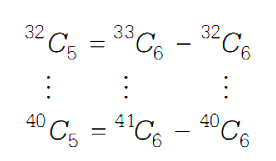
$\sum_{r=0}^{10} {}^{40-r} C_5$ is equal to
A
${}^{41} C_5 - {}^{30} C_5$
B
${}^{41} C_6 - {}^{30} C_6$
C
${}^{41} C_5 + {}^{30} C_5$
D
${}^{41} C_6$
Solution
(B) The given sum is $\sum_{r=0}^{10} {}^{40-r} C_5 = {}^{40} C_5 + {}^{39} C_5 + {}^{38} C_5 + \dots + {}^{30} C_5$.
This can be written as $\sum_{k=30}^{40} {}^{k} C_5$.
Using the identity ${}^{n} C_r + {}^{n} C_{r-1} = {}^{n+1} C_r$,we can rewrite ${}^{k} C_5$ as ${}^{k+1} C_6 - {}^{k} C_6$.
Thus,the sum becomes:
$\sum_{k=30}^{40} ({}^{k+1} C_6 - {}^{k} C_6) = ({}^{31} C_6 - {}^{30} C_6) + ({}^{32} C_6 - {}^{31} C_6) + \dots + ({}^{41} C_6 - {}^{40} C_6)$.
This is a telescoping sum,which simplifies to ${}^{41} C_6 - {}^{30} C_6$.
This can be written as $\sum_{k=30}^{40} {}^{k} C_5$.
Using the identity ${}^{n} C_r + {}^{n} C_{r-1} = {}^{n+1} C_r$,we can rewrite ${}^{k} C_5$ as ${}^{k+1} C_6 - {}^{k} C_6$.
Thus,the sum becomes:
$\sum_{k=30}^{40} ({}^{k+1} C_6 - {}^{k} C_6) = ({}^{31} C_6 - {}^{30} C_6) + ({}^{32} C_6 - {}^{31} C_6) + \dots + ({}^{41} C_6 - {}^{40} C_6)$.
This is a telescoping sum,which simplifies to ${}^{41} C_6 - {}^{30} C_6$.
0 likes
View Solution135
DifficultMCQ
If $(1+x)^n=C_0+C_1 x+C_2 x^2+\ldots+C_n x^n$,then $C_0+2 C_1+3 C_2+\ldots+(n+1) C_n$ is equal to
A
$(n+2) 2^{n-1}$
B
$(n+1) 2^{n-1}$
C
$(n+2) 2^n$
D
$(n+1) 2^n$
Solution
(A) Given the expansion $(1+x)^n = \sum_{r=0}^n C_r x^r$.
We want to find the sum $S = \sum_{r=0}^n (r+1) C_r$.
$S = \sum_{r=0}^n r C_r + \sum_{r=0}^n C_r$.
We know that $\sum_{r=0}^n C_r = 2^n$.
Also,$\sum_{r=0}^n r C_r = n 2^{n-1}$.
Therefore,$S = n 2^{n-1} + 2^n$.
Factoring out $2^{n-1}$,we get $S = 2^{n-1} (n + 2)$.
We want to find the sum $S = \sum_{r=0}^n (r+1) C_r$.
$S = \sum_{r=0}^n r C_r + \sum_{r=0}^n C_r$.
We know that $\sum_{r=0}^n C_r = 2^n$.
Also,$\sum_{r=0}^n r C_r = n 2^{n-1}$.
Therefore,$S = n 2^{n-1} + 2^n$.
Factoring out $2^{n-1}$,we get $S = 2^{n-1} (n + 2)$.
0 likes
View Solution136
MediumMCQ
If $\sum_{r=0}^{20} {}^{20+r}C_r = \frac{p}{q} {}^{40}C_{20}$ and $GCD(p, q) = 1$,then $p^2 - q^2 =$
A
$1302$
B
$1220$
C
$1240$
D
$1364$
Solution
(C) We know the identity ${}^{n}C_r + {}^{n}C_{r+1} = {}^{n+1}C_{r+1}$.
Given the sum $S = \sum_{r=0}^{20} {}^{20+r}C_r = {}^{20}C_0 + {}^{21}C_1 + {}^{22}C_2 + \dots + {}^{40}C_{20}$.
Since ${}^{20}C_0 = 1 = {}^{21}C_0$,we can write $S = {}^{21}C_0 + {}^{21}C_1 + {}^{22}C_2 + \dots + {}^{40}C_{20}$.
Using the identity ${}^{n}C_r + {}^{n}C_{r+1} = {}^{n+1}C_{r+1}$ repeatedly:
${}^{21}C_0 + {}^{21}C_1 = {}^{22}C_1$.
Then ${}^{22}C_1 + {}^{22}C_2 = {}^{23}C_2$.
Continuing this process,the sum telescopes to ${}^{40}C_{20} + {}^{40}C_{21} = {}^{41}C_{21}$.
Now,${}^{41}C_{21} = \frac{41}{21} \times {}^{40}C_{20}$.
Thus,$\frac{p}{q} = \frac{41}{21}$,which gives $p = 41$ and $q = 21$.
Since $GCD(41, 21) = 1$,we calculate $p^2 - q^2 = 41^2 - 21^2 = (41 - 21)(41 + 21) = 20 \times 62 = 1240$.
Given the sum $S = \sum_{r=0}^{20} {}^{20+r}C_r = {}^{20}C_0 + {}^{21}C_1 + {}^{22}C_2 + \dots + {}^{40}C_{20}$.
Since ${}^{20}C_0 = 1 = {}^{21}C_0$,we can write $S = {}^{21}C_0 + {}^{21}C_1 + {}^{22}C_2 + \dots + {}^{40}C_{20}$.
Using the identity ${}^{n}C_r + {}^{n}C_{r+1} = {}^{n+1}C_{r+1}$ repeatedly:
${}^{21}C_0 + {}^{21}C_1 = {}^{22}C_1$.
Then ${}^{22}C_1 + {}^{22}C_2 = {}^{23}C_2$.
Continuing this process,the sum telescopes to ${}^{40}C_{20} + {}^{40}C_{21} = {}^{41}C_{21}$.
Now,${}^{41}C_{21} = \frac{41}{21} \times {}^{40}C_{20}$.
Thus,$\frac{p}{q} = \frac{41}{21}$,which gives $p = 41$ and $q = 21$.
Since $GCD(41, 21) = 1$,we calculate $p^2 - q^2 = 41^2 - 21^2 = (41 - 21)(41 + 21) = 20 \times 62 = 1240$.
0 likes
View Solution137
DifficultMCQ
If ${}^n C_0, {}^n C_1, {}^n C_2, \ldots, {}^n C_n$ are the binomial coefficients in the expansion of $(1+x)^n$,then for $n=10$,the value of $\sum_{r=1}^{10} {}^n C_r \cdot r(r-4)$ is:
A
$5120$
B
$7680$
C
$20480$
D
$28160$
Solution
(B) Given $n=10$,we need to evaluate $S = \sum_{r=1}^{10} {}^n C_r r(r-4)$.
Expanding the term: $r(r-4) = r(r-1) - 3r$.
So,$S = \sum_{r=1}^{10} {}^n C_r r(r-1) - 3 \sum_{r=1}^{10} r {}^n C_r$.
Using the identities $r(r-1) {}^n C_r = n(n-1) {}^{n-2} C_{r-2}$ and $r {}^n C_r = n {}^{n-1} C_{r-1}$:
$S = n(n-1) \sum_{r=2}^{10} {}^{n-2} C_{r-2} - 3n \sum_{r=1}^{10} {}^{n-1} C_{r-1}$.
Since $\sum_{k=0}^{m} {}^m C_k = 2^m$,we have:
$S = n(n-1) 2^{n-2} - 3n 2^{n-1}$.
Substituting $n=10$:
$S = 10(9) 2^8 - 3(10) 2^9 = 90 \cdot 2^8 - 30 \cdot 2 \cdot 2^8$.
$S = 90 \cdot 2^8 - 60 \cdot 2^8 = 30 \cdot 2^8$.
$S = 30 \times 256 = 7680$.
Expanding the term: $r(r-4) = r(r-1) - 3r$.
So,$S = \sum_{r=1}^{10} {}^n C_r r(r-1) - 3 \sum_{r=1}^{10} r {}^n C_r$.
Using the identities $r(r-1) {}^n C_r = n(n-1) {}^{n-2} C_{r-2}$ and $r {}^n C_r = n {}^{n-1} C_{r-1}$:
$S = n(n-1) \sum_{r=2}^{10} {}^{n-2} C_{r-2} - 3n \sum_{r=1}^{10} {}^{n-1} C_{r-1}$.
Since $\sum_{k=0}^{m} {}^m C_k = 2^m$,we have:
$S = n(n-1) 2^{n-2} - 3n 2^{n-1}$.
Substituting $n=10$:
$S = 10(9) 2^8 - 3(10) 2^9 = 90 \cdot 2^8 - 30 \cdot 2 \cdot 2^8$.
$S = 90 \cdot 2^8 - 60 \cdot 2^8 = 30 \cdot 2^8$.
$S = 30 \times 256 = 7680$.
0 likes
View Solution138
MediumMCQ
If $C_0, C_1, C_2, \ldots, C_n$ are the binomial coefficients in the expansion of $(1+x)^n$,then the value of $\sum_{r=0}^{n} r^3 \cdot C_r$ when $n=5$ is
A
$320$
B
$560$
C
$720$
D
$800$
Solution
(D) The general formula for $\sum_{r=0}^{n} r^3 \cdot C_r$ is given by $n(n^2 + 3n)2^{n-3}$.
For $n=5$,we substitute the value into the formula:
$= 5(5^2 + 3(5))2^{5-3}$
$= 5(25 + 15)2^2$
$= 5(40)(4)$
$= 200 \times 4 = 800$.
For $n=5$,we substitute the value into the formula:
$= 5(5^2 + 3(5))2^{5-3}$
$= 5(25 + 15)2^2$
$= 5(40)(4)$
$= 200 \times 4 = 800$.
0 likes
View Solution139
MediumMCQ
If $(1+x-2x^2)^6 = 1+a_1x+a_2x^2+\ldots+a_{12}x^{12}$,then the value of $a_2+a_4+a_6+\ldots+a_{12}$ is
A
$21$
B
$31$
C
$32$
D
$64$
Solution
(B) Given the expansion: $(1+x-2x^2)^6 = 1+a_1x+a_2x^2+\ldots+a_{12}x^{12}$
Let $f(x) = (1+x-2x^2)^6 = 1+a_1x+a_2x^2+a_3x^3+\ldots+a_{12}x^{12}$.
Putting $x=1$:
$f(1) = (1+1-2)^6 = 0^6 = 0$.
So,$0 = 1+a_1+a_2+a_3+a_4+\ldots+a_{12}$ $(i)$
Putting $x=-1$:
$f(-1) = (1-1-2(-1)^2)^6 = (-2)^6 = 64$.
So,$64 = 1-a_1+a_2-a_3+a_4-\ldots+a_{12}$ $(ii)$
Adding $(i)$ and $(ii)$:
$0+64 = (1+a_1+a_2+a_3+a_4+\ldots+a_{12}) + (1-a_1+a_2-a_3+a_4-\ldots+a_{12})$
$64 = 2 + 2(a_2+a_4+a_6+\ldots+a_{12})$
$62 = 2(a_2+a_4+a_6+\ldots+a_{12})$
$a_2+a_4+a_6+\ldots+a_{12} = 31$.
Let $f(x) = (1+x-2x^2)^6 = 1+a_1x+a_2x^2+a_3x^3+\ldots+a_{12}x^{12}$.
Putting $x=1$:
$f(1) = (1+1-2)^6 = 0^6 = 0$.
So,$0 = 1+a_1+a_2+a_3+a_4+\ldots+a_{12}$ $(i)$
Putting $x=-1$:
$f(-1) = (1-1-2(-1)^2)^6 = (-2)^6 = 64$.
So,$64 = 1-a_1+a_2-a_3+a_4-\ldots+a_{12}$ $(ii)$
Adding $(i)$ and $(ii)$:
$0+64 = (1+a_1+a_2+a_3+a_4+\ldots+a_{12}) + (1-a_1+a_2-a_3+a_4-\ldots+a_{12})$
$64 = 2 + 2(a_2+a_4+a_6+\ldots+a_{12})$
$62 = 2(a_2+a_4+a_6+\ldots+a_{12})$
$a_2+a_4+a_6+\ldots+a_{12} = 31$.
0 likes
View Solution140
MediumMCQ
If $n$ is a positive integer,the value of $(2n+1) ^nC_0 + (2n-1) ^nC_1 + (2n-3) ^nC_2 + \ldots + 1 \cdot ^nC_n$ is
A
$(n+1) 2^n$
B
$3^n$
C
$f'(2)$ where $f(x) = x^{n+1}$
D
$(n+1) 2^{n+1}$
Solution
(A) The given expression is $S = \sum_{r=0}^n (2n+1-2r) {^nC_r}$.
Expanding the summation:
$S = (2n+1) \sum_{r=0}^n {^nC_r} - 2 \sum_{r=0}^n r \cdot {^nC_r}$.
We know that $\sum_{r=0}^n {^nC_r} = 2^n$ and $\sum_{r=0}^n r \cdot {^nC_r} = n \cdot 2^{n-1}$.
Substituting these values:
$S = (2n+1) \cdot 2^n - 2 \cdot (n \cdot 2^{n-1}) = (2n+1) \cdot 2^n - n \cdot 2^n = (2n+1-n) \cdot 2^n = (n+1) \cdot 2^n$.
Also, if $f(x) = x^{n+1}$, then $f'(x) = (n+1)x^n$, so $f'(2) = (n+1)2^n$.
Thus, both options $A$ and $C$ are correct.
Expanding the summation:
$S = (2n+1) \sum_{r=0}^n {^nC_r} - 2 \sum_{r=0}^n r \cdot {^nC_r}$.
We know that $\sum_{r=0}^n {^nC_r} = 2^n$ and $\sum_{r=0}^n r \cdot {^nC_r} = n \cdot 2^{n-1}$.
Substituting these values:
$S = (2n+1) \cdot 2^n - 2 \cdot (n \cdot 2^{n-1}) = (2n+1) \cdot 2^n - n \cdot 2^n = (2n+1-n) \cdot 2^n = (n+1) \cdot 2^n$.
Also, if $f(x) = x^{n+1}$, then $f'(x) = (n+1)x^n$, so $f'(2) = (n+1)2^n$.
Thus, both options $A$ and $C$ are correct.
0 likes
View Solution141
DifficultMCQ
The sum of the series $1 + \frac{1}{2} {}^{n}C_{1} + \frac{1}{3} {}^{n}C_{2} + \dots + \frac{1}{n+1} {}^{n}C_{n}$ is equal to
A
$\frac{2^{n+1}-1}{n+1}$
B
$\frac{3(2^{n}-1)}{2n}$
C
$\frac{2^{n}+1}{n+1}$
D
$\frac{2^{n}+1}{2n}$
Solution
(A) Let the sum be $S = \sum_{k=0}^{n} \frac{1}{k+1} {}^{n}C_{k}$.
Using the identity $\frac{1}{k+1} {}^{n}C_{k} = \frac{1}{n+1} {}^{n+1}C_{k+1}$,we have:
$S = \sum_{k=0}^{n} \frac{1}{n+1} {}^{n+1}C_{k+1}$
$S = \frac{1}{n+1} \sum_{k=0}^{n} {}^{n+1}C_{k+1}$
$S = \frac{1}{n+1} [{}^{n+1}C_{1} + {}^{n+1}C_{2} + \dots + {}^{n+1}C_{n+1}]$
Since $\sum_{r=0}^{m} {}^{m}C_{r} = 2^{m}$,we know that $\sum_{r=1}^{m} {}^{m}C_{r} = 2^{m} - {}^{m}C_{0} = 2^{m} - 1$.
Here $m = n+1$,so the sum is $2^{n+1} - 1$.
Therefore,$S = \frac{2^{n+1}-1}{n+1}$.
Using the identity $\frac{1}{k+1} {}^{n}C_{k} = \frac{1}{n+1} {}^{n+1}C_{k+1}$,we have:
$S = \sum_{k=0}^{n} \frac{1}{n+1} {}^{n+1}C_{k+1}$
$S = \frac{1}{n+1} \sum_{k=0}^{n} {}^{n+1}C_{k+1}$
$S = \frac{1}{n+1} [{}^{n+1}C_{1} + {}^{n+1}C_{2} + \dots + {}^{n+1}C_{n+1}]$
Since $\sum_{r=0}^{m} {}^{m}C_{r} = 2^{m}$,we know that $\sum_{r=1}^{m} {}^{m}C_{r} = 2^{m} - {}^{m}C_{0} = 2^{m} - 1$.
Here $m = n+1$,so the sum is $2^{n+1} - 1$.
Therefore,$S = \frac{2^{n+1}-1}{n+1}$.
0 likes
View Solution142
MediumMCQ
Let $(1+x)^{10} = \sum_{r=0}^{10} c_{r} x^{r}$ and $(1+x)^{7} = \sum_{r=0}^{7} d_{r} x^{r}$. If $P = \sum_{r=0}^{5} c_{2r}$ and $Q = \sum_{r=0}^{3} d_{2r+1}$,then $\frac{P}{Q}$ is equal to:
A
$4$
B
$8$
C
$16$
D
$32$
Solution
(B) Given $P = \sum_{r=0}^{5} c_{2r} = c_{0} + c_{2} + c_{4} + c_{6} + c_{8} + c_{10}$.
Since $c_{r} = {}^{10}C_{r}$,we have $P = {}^{10}C_{0} + {}^{10}C_{2} + {}^{10}C_{4} + {}^{10}C_{6} + {}^{10}C_{8} + {}^{10}C_{10} = 2^{10-1} = 2^{9}$.
Given $Q = \sum_{r=0}^{3} d_{2r+1} = d_{1} + d_{3} + d_{5} + d_{7}$.
Since $d_{r} = {}^{7}C_{r}$,we have $Q = {}^{7}C_{1} + {}^{7}C_{3} + {}^{7}C_{5} + {}^{7}C_{7} = 2^{7-1} = 2^{6}$.
Therefore,$\frac{P}{Q} = \frac{2^{9}}{2^{6}} = 2^{9-6} = 2^{3} = 8$.
Since $c_{r} = {}^{10}C_{r}$,we have $P = {}^{10}C_{0} + {}^{10}C_{2} + {}^{10}C_{4} + {}^{10}C_{6} + {}^{10}C_{8} + {}^{10}C_{10} = 2^{10-1} = 2^{9}$.
Given $Q = \sum_{r=0}^{3} d_{2r+1} = d_{1} + d_{3} + d_{5} + d_{7}$.
Since $d_{r} = {}^{7}C_{r}$,we have $Q = {}^{7}C_{1} + {}^{7}C_{3} + {}^{7}C_{5} + {}^{7}C_{7} = 2^{7-1} = 2^{6}$.
Therefore,$\frac{P}{Q} = \frac{2^{9}}{2^{6}} = 2^{9-6} = 2^{3} = 8$.
0 likes
View Solution143
EasyMCQ
$^{15}C_3 + ^{15}C_5 + \ldots + ^{15}C_{15} = ?$
A
$2^{14}$
B
$2^{14} - 15$
C
$2^{14} + 15$
D
$2^{14} - 1$
Solution
(B) We know that the sum of binomial coefficients with odd indices is given by:
$^{n}C_1 + ^{n}C_3 + ^{n}C_5 + \ldots = 2^{n-1}$.
For $n = 15$,we have:
$^{15}C_1 + ^{15}C_3 + ^{15}C_5 + \ldots + ^{15}C_{15} = 2^{15-1} = 2^{14}$.
We need to find the sum $^{15}C_3 + ^{15}C_5 + \ldots + ^{15}C_{15}$.
This is equal to $2^{14} - ^{15}C_1$.
Since $^{15}C_1 = 15$,the sum is $2^{14} - 15$.
$^{n}C_1 + ^{n}C_3 + ^{n}C_5 + \ldots = 2^{n-1}$.
For $n = 15$,we have:
$^{15}C_1 + ^{15}C_3 + ^{15}C_5 + \ldots + ^{15}C_{15} = 2^{15-1} = 2^{14}$.
We need to find the sum $^{15}C_3 + ^{15}C_5 + \ldots + ^{15}C_{15}$.
This is equal to $2^{14} - ^{15}C_1$.
Since $^{15}C_1 = 15$,the sum is $2^{14} - 15$.
0 likes
View Solution144
MediumMCQ
The sum of the last $30$ coefficients in the expansion of $(1+x)^{59}$,when expanded in ascending powers of $x$,is:
A
$2^{59}$
B
$2^{58}$
C
$2^{30}$
D
$2^{29}$
Solution
(B) The expansion of $(1+x)^{59}$ has $59+1 = 60$ terms.
Let the coefficients be $C_0, C_1, C_2, \dots, C_{59}$.
The sum of all coefficients is $\sum_{r=0}^{59} C_r = (1+1)^{59} = 2^{59}$.
Since $C_r = C_{59-r}$,the sum of the first $30$ coefficients is equal to the sum of the last $30$ coefficients.
Let $S$ be the sum of the last $30$ coefficients.
Then $2S = \sum_{r=0}^{59} C_r = 2^{59}$.
Therefore,$S = \frac{2^{59}}{2} = 2^{58}$.
Let the coefficients be $C_0, C_1, C_2, \dots, C_{59}$.
The sum of all coefficients is $\sum_{r=0}^{59} C_r = (1+1)^{59} = 2^{59}$.
Since $C_r = C_{59-r}$,the sum of the first $30$ coefficients is equal to the sum of the last $30$ coefficients.
Let $S$ be the sum of the last $30$ coefficients.
Then $2S = \sum_{r=0}^{59} C_r = 2^{59}$.
Therefore,$S = \frac{2^{59}}{2} = 2^{58}$.
0 likes
View Solution145
DifficultMCQ
If $(1-x+x^2)^n = a_0 + a_1 x + \ldots + a_{2n} x^{2n}$,then the value of $a_0 + a_2 + a_4 + \ldots + a_{2n}$ is
A
$3^n + \frac{1}{2}$
B
$3^n - \frac{1}{2}$
C
$\frac{3^n - 1}{2}$
D
$\frac{3^n + 1}{2}$
Solution
(D) Given the expansion: $(1-x+x^2)^n = a_0 + a_1 x + a_2 x^2 + \ldots + a_{2n} x^{2n}$.
Step $1$: Put $x = 1$ in the expansion:
$(1 - 1 + 1)^n = a_0 + a_1 + a_2 + \ldots + a_{2n}$
$1^n = a_0 + a_1 + a_2 + \ldots + a_{2n} \Rightarrow 1 = a_0 + a_1 + a_2 + \ldots + a_{2n} \quad (i)$
Step $2$: Put $x = -1$ in the expansion:
$(1 - (-1) + (-1)^2)^n = a_0 + a_1(-1) + a_2(-1)^2 + \ldots + a_{2n}(-1)^{2n}$
$(1 + 1 + 1)^n = a_0 - a_1 + a_2 - a_3 + \ldots + a_{2n}$
$3^n = a_0 - a_1 + a_2 - a_3 + \ldots + a_{2n} \quad (ii)$
Step $3$: Add equations $(i)$ and $(ii)$:
$1 + 3^n = (a_0 + a_1 + a_2 + \ldots + a_{2n}) + (a_0 - a_1 + a_2 - \ldots + a_{2n})$
$1 + 3^n = 2(a_0 + a_2 + a_4 + \ldots + a_{2n})$
Therefore,$a_0 + a_2 + a_4 + \ldots + a_{2n} = \frac{3^n + 1}{2}$.
Step $1$: Put $x = 1$ in the expansion:
$(1 - 1 + 1)^n = a_0 + a_1 + a_2 + \ldots + a_{2n}$
$1^n = a_0 + a_1 + a_2 + \ldots + a_{2n} \Rightarrow 1 = a_0 + a_1 + a_2 + \ldots + a_{2n} \quad (i)$
Step $2$: Put $x = -1$ in the expansion:
$(1 - (-1) + (-1)^2)^n = a_0 + a_1(-1) + a_2(-1)^2 + \ldots + a_{2n}(-1)^{2n}$
$(1 + 1 + 1)^n = a_0 - a_1 + a_2 - a_3 + \ldots + a_{2n}$
$3^n = a_0 - a_1 + a_2 - a_3 + \ldots + a_{2n} \quad (ii)$
Step $3$: Add equations $(i)$ and $(ii)$:
$1 + 3^n = (a_0 + a_1 + a_2 + \ldots + a_{2n}) + (a_0 - a_1 + a_2 - \ldots + a_{2n})$
$1 + 3^n = 2(a_0 + a_2 + a_4 + \ldots + a_{2n})$
Therefore,$a_0 + a_2 + a_4 + \ldots + a_{2n} = \frac{3^n + 1}{2}$.
0 likes
View Solution146
DifficultMCQ
If $c_0, c_1, c_2, \ldots, c_n$ denote the coefficients in the expansion of $(1+x)^n$,then the value of $c_1 + 2c_2 + 3c_3 + \ldots + nc_n$ is
A
$n \cdot 2^{n-1}$
B
$(n+1) 2^{n-1}$
C
$(n+1) 2^n$
D
$(n+2) 2^{n-1}$
Solution
(A) The binomial expansion is given by: $(1+x)^n = c_0 + c_1x + c_2x^2 + \ldots + c_nx^n$.
Differentiating both sides with respect to $x$,we get: $n(1+x)^{n-1} = c_1 + 2c_2x + 3c_3x^2 + \ldots + nc_nx^{n-1}$.
To find the sum $c_1 + 2c_2 + 3c_3 + \ldots + nc_n$,we substitute $x = 1$ into the differentiated equation:
$n(1+1)^{n-1} = c_1 + 2c_2(1) + 3c_3(1)^2 + \ldots + nc_n(1)^{n-1}$.
This simplifies to: $n(2)^{n-1} = c_1 + 2c_2 + 3c_3 + \ldots + nc_n$.
Thus,the value is $n \cdot 2^{n-1}$.
Differentiating both sides with respect to $x$,we get: $n(1+x)^{n-1} = c_1 + 2c_2x + 3c_3x^2 + \ldots + nc_nx^{n-1}$.
To find the sum $c_1 + 2c_2 + 3c_3 + \ldots + nc_n$,we substitute $x = 1$ into the differentiated equation:
$n(1+1)^{n-1} = c_1 + 2c_2(1) + 3c_3(1)^2 + \ldots + nc_n(1)^{n-1}$.
This simplifies to: $n(2)^{n-1} = c_1 + 2c_2 + 3c_3 + \ldots + nc_n$.
Thus,the value is $n \cdot 2^{n-1}$.
0 likes
View Solution147
MediumMCQ
The value of the sum $\left({ }^{n} C_{1}\right)^{2}+\left({ }^{n} C_{2}\right)^{2}+\left({ }^{n} C_{3}\right)^{2}+\ldots+\left({ }^{n} C_{n}\right)^{2}$ is
A
$\left({ }^{2 n} C_{n}\right)^{2}$
B
${ }^{2 n} C_{n}$
C
${ }^{2 n} C_{n}+1$
D
${ }^{2 n} C_{n}-1$
Solution
(D) We know that the binomial expansion is given by:
$(1+x)^{n} = { }^{n} C_{0}+{ }^{n} C_{1} x+{ }^{n} C_{2} x^{2}+\ldots+{ }^{n} C_{n} x^{n}$
and $(x+1)^{n} = { }^{n} C_{0} x^{n}+{ }^{n} C_{1} x^{n-1}+{ }^{n} C_{2} x^{n-2}+\ldots+{ }^{n} C_{n}$.
Multiplying these two expressions,we get $(1+x)^{2n} = (1+x)^{n}(x+1)^{n}$.
The coefficient of $x^{n}$ in the expansion of $(1+x)^{2n}$ is ${ }^{2n} C_{n}$.
By multiplying the two series,the coefficient of $x^{n}$ is the sum of the products of corresponding coefficients:
$({ }^{n} C_{0})^{2} + ({ }^{n} C_{1})^{2} + ({ }^{n} C_{2})^{2} + \ldots + ({ }^{n} C_{n})^{2} = { }^{2n} C_{n}$.
The given sum starts from $({ }^{n} C_{1})^{2}$,so we subtract the first term $({ }^{n} C_{0})^{2} = 1$:
$({ }^{n} C_{1})^{2} + ({ }^{n} C_{2})^{2} + \ldots + ({ }^{n} C_{n})^{2} = { }^{2n} C_{n} - ({ }^{n} C_{0})^{2} = { }^{2n} C_{n} - 1$.
$(1+x)^{n} = { }^{n} C_{0}+{ }^{n} C_{1} x+{ }^{n} C_{2} x^{2}+\ldots+{ }^{n} C_{n} x^{n}$
and $(x+1)^{n} = { }^{n} C_{0} x^{n}+{ }^{n} C_{1} x^{n-1}+{ }^{n} C_{2} x^{n-2}+\ldots+{ }^{n} C_{n}$.
Multiplying these two expressions,we get $(1+x)^{2n} = (1+x)^{n}(x+1)^{n}$.
The coefficient of $x^{n}$ in the expansion of $(1+x)^{2n}$ is ${ }^{2n} C_{n}$.
By multiplying the two series,the coefficient of $x^{n}$ is the sum of the products of corresponding coefficients:
$({ }^{n} C_{0})^{2} + ({ }^{n} C_{1})^{2} + ({ }^{n} C_{2})^{2} + \ldots + ({ }^{n} C_{n})^{2} = { }^{2n} C_{n}$.
The given sum starts from $({ }^{n} C_{1})^{2}$,so we subtract the first term $({ }^{n} C_{0})^{2} = 1$:
$({ }^{n} C_{1})^{2} + ({ }^{n} C_{2})^{2} + \ldots + ({ }^{n} C_{n})^{2} = { }^{2n} C_{n} - ({ }^{n} C_{0})^{2} = { }^{2n} C_{n} - 1$.
0 likes
View SolutionBinomial Theorem — Properties of binomial coefficients · Frequently Asked Questions
1Are these Binomial Theorem questions useful for JEE and NEET?
Yes. All questions in this section are mapped to JEE Main and NEET exam patterns. Previous year questions from JEE Main, NEET, GUJCET and state-level exams are included with full solutions.
2Can I switch to Hindi or Gujarati for these questions?
Yes. Use the language tabs in the hero section or the sidebar to view the same questions and solutions in English, Hindi or Gujarati.
3How do I generate a question paper from this subtopic?
Use the Vedclass Exam Paper Generator — select the chapter and subtopic, set difficulty, and generate Sets A, B, C, D automatically. First 3 chapters of every subject are free.
Vedclass Products
For Students
Vedclass Test Series
Mock tests in real JEE/NEET style with performance analysis. 5-day free trial.
Start Free TrialFor Teachers
Exam Paper Generator
Generate Set A/B/C/D papers from this chapter in 2 minutes. 3 chapters free.
Try FreeFor Institutes
Online Exam Module
Live online exams with unlimited students, 360° analytics & white-label branding.
See DemoFor Teachers & Institutes
Generate a Binomial Theorem Exam Paper in 2 Minutes
Select subtopic & difficulty — Sets A, B, C, D auto-generated with No Repeat logic.
First 3 chapters of every subject are free — no payment required.