
A English
Parabola Questions in English
Class 11 Mathematics · 10-2. Parabola, Ellipse, Hyperbola · Parabola
1007+
Questions
English
Language
100%
With Solutions
Showing 47 of 1007 questions in English
951
DifficultMCQ
The equation of a curve in polar coordinates is $\frac{l}{r} = 2 \sin^2 \frac{\theta}{2}$. This equation represents:
A
a straight line
B
a parabola
C
a circle
D
an ellipse
Solution
(B) Given the equation $\frac{l}{r} = 2 \sin^2 \frac{\theta}{2}$.
Using the trigonometric identity $2 \sin^2 \frac{\theta}{2} = 1 - \cos \theta$,we get $\frac{l}{r} = 1 - \cos \theta$.
Rearranging,$l = r(1 - \cos \theta) = r - r \cos \theta$.
Since $x = r \cos \theta$ and $r = \sqrt{x^2 + y^2}$,we have $l = \sqrt{x^2 + y^2} - x$.
Thus,$\sqrt{x^2 + y^2} = x + l$.
Squaring both sides,$x^2 + y^2 = (x + l)^2 = x^2 + 2lx + l^2$.
Simplifying,$y^2 = 2lx + l^2 = 2l(x + \frac{l}{2})$.
This is the standard form of a parabola $Y^2 = 4AX$ with vertex at $(-\frac{l}{2}, 0)$.
Using the trigonometric identity $2 \sin^2 \frac{\theta}{2} = 1 - \cos \theta$,we get $\frac{l}{r} = 1 - \cos \theta$.
Rearranging,$l = r(1 - \cos \theta) = r - r \cos \theta$.
Since $x = r \cos \theta$ and $r = \sqrt{x^2 + y^2}$,we have $l = \sqrt{x^2 + y^2} - x$.
Thus,$\sqrt{x^2 + y^2} = x + l$.
Squaring both sides,$x^2 + y^2 = (x + l)^2 = x^2 + 2lx + l^2$.
Simplifying,$y^2 = 2lx + l^2 = 2l(x + \frac{l}{2})$.
This is the standard form of a parabola $Y^2 = 4AX$ with vertex at $(-\frac{l}{2}, 0)$.
0 likes
View Solution952
EasyMCQ
If $Q$ is the point on the parabola $y^2=4x$ that is nearest to the point $P(2,0)$,then $PQ=$
A
$1$
B
$2$
C
$3$
D
$4$
Solution
(B) Let the coordinates of point $Q$ be $(x, y)$ on the parabola $y^2=4x$.
The distance $PQ$ is given by $PQ = \sqrt{(x-2)^2 + (y-0)^2}$.
Substituting $y^2 = 4x$,we get $PQ = \sqrt{(x-2)^2 + 4x} = \sqrt{x^2 - 4x + 4 + 4x} = \sqrt{x^2 + 4}$.
To find the minimum distance,let $f(x) = x^2 + 4$.
Differentiating with respect to $x$,$f'(x) = 2x$.
Setting $f'(x) = 0$,we get $x = 0$.
Since $f''(x) = 2 > 0$,the function has a minimum at $x = 0$.
The minimum distance is $PQ = \sqrt{0^2 + 4} = \sqrt{4} = 2$.
The distance $PQ$ is given by $PQ = \sqrt{(x-2)^2 + (y-0)^2}$.
Substituting $y^2 = 4x$,we get $PQ = \sqrt{(x-2)^2 + 4x} = \sqrt{x^2 - 4x + 4 + 4x} = \sqrt{x^2 + 4}$.
To find the minimum distance,let $f(x) = x^2 + 4$.
Differentiating with respect to $x$,$f'(x) = 2x$.
Setting $f'(x) = 0$,we get $x = 0$.
Since $f''(x) = 2 > 0$,the function has a minimum at $x = 0$.
The minimum distance is $PQ = \sqrt{0^2 + 4} = \sqrt{4} = 2$.
0 likes
View Solution953
EasyMCQ
$A$ line passes through the point $(-1, 1)$ and makes an angle $\sin^{-1}(\frac{3}{5})$ in the positive direction of the $x$-axis. If this line meets the curve $x^2 = 4y - 9$ at points $A$ and $B$,then the length $|AB|$ is equal to
A
$\frac{4}{5}$ unit
B
$\frac{5}{4}$ unit
C
$\frac{3}{5}$ unit
D
$\frac{5}{3}$ unit
Solution
(B) Given the angle $\theta = \sin^{-1}(\frac{3}{5})$,we have $\tan \theta = \frac{3}{4}$. The slope of the line is $m = \frac{3}{4}$.
The equation of the line passing through $(-1, 1)$ with slope $m = \frac{3}{4}$ is $y - 1 = \frac{3}{4}(x + 1)$,which simplifies to $4y - 4 = 3x + 3$,or $4y = 3x + 7$.
Substitute $4y = 3x + 7$ into the curve equation $x^2 = 4y - 9$:
$x^2 = (3x + 7) - 9$
$x^2 - 3x + 2 = 0$
$(x - 1)(x - 2) = 0$
So,$x = 1$ and $x = 2$.
For $x = 1$,$4y = 3(1) + 7 = 10 \Rightarrow y = \frac{5}{2}$. Point $A = (1, \frac{5}{2})$.
For $x = 2$,$4y = 3(2) + 7 = 13 \Rightarrow y = \frac{13}{4}$. Point $B = (2, \frac{13}{4})$.
The distance $|AB| = \sqrt{(2 - 1)^2 + (\frac{13}{4} - \frac{5}{2})^2} = \sqrt{1^2 + (\frac{13-10}{4})^2} = \sqrt{1 + \frac{9}{16}} = \sqrt{\frac{25}{16}} = \frac{5}{4}$ units.
The equation of the line passing through $(-1, 1)$ with slope $m = \frac{3}{4}$ is $y - 1 = \frac{3}{4}(x + 1)$,which simplifies to $4y - 4 = 3x + 3$,or $4y = 3x + 7$.
Substitute $4y = 3x + 7$ into the curve equation $x^2 = 4y - 9$:
$x^2 = (3x + 7) - 9$
$x^2 - 3x + 2 = 0$
$(x - 1)(x - 2) = 0$
So,$x = 1$ and $x = 2$.
For $x = 1$,$4y = 3(1) + 7 = 10 \Rightarrow y = \frac{5}{2}$. Point $A = (1, \frac{5}{2})$.
For $x = 2$,$4y = 3(2) + 7 = 13 \Rightarrow y = \frac{13}{4}$. Point $B = (2, \frac{13}{4})$.
The distance $|AB| = \sqrt{(2 - 1)^2 + (\frac{13}{4} - \frac{5}{2})^2} = \sqrt{1^2 + (\frac{13-10}{4})^2} = \sqrt{1 + \frac{9}{16}} = \sqrt{\frac{25}{16}} = \frac{5}{4}$ units.
0 likes
View Solution954
DifficultMCQ
The axis of the parabola $x^{2}+2 x y+y^{2}-5 x+5 y-5=0$ is
A
$x+y=0$
B
$x+y-1=0$
C
$x-y+1=0$
D
$x-y=\frac{1}{\sqrt{2}}$
Solution
(A) The given equation is $x^{2}+2 x y+y^{2}-5 x+5 y-5=0$.
This can be rewritten as $(x+y)^{2} = 5x - 5y + 5$.
Let $X = x+y$ and $Y = x-y+1$.
The equation is of the form $X^{2} = 5Y$,which represents a parabola.
The axis of a parabola of the form $(ax+by+c)^2 = k(bx-ay+d)$ is given by $ax+by+c=0$.
Here,$x+y=0$ is the axis of the parabola.
This can be rewritten as $(x+y)^{2} = 5x - 5y + 5$.
Let $X = x+y$ and $Y = x-y+1$.
The equation is of the form $X^{2} = 5Y$,which represents a parabola.
The axis of a parabola of the form $(ax+by+c)^2 = k(bx-ay+d)$ is given by $ax+by+c=0$.
Here,$x+y=0$ is the axis of the parabola.
0 likes
View Solution955
DifficultMCQ
The focus of the conic $x^{2}-6x+4y+1=0$ is
A
$(2,3)$
B
$(3,2)$
C
$(3,1)$
D
$(1,4)$
Solution
(C) Given equation of the conic is $x^{2}-6x+4y+1=0$.
Completing the square for the $x$ terms:
$(x^{2}-6x+9)-9+4y+1=0$
$(x-3)^{2}+4y-8=0$
$(x-3)^{2}=-4(y-2)$.
This is a parabola of the form $(x-h)^{2}=-4a(y-k)$,where $(h,k)=(3,2)$ and $4a=4$,so $a=1$.
The focus of this parabola is given by $(h, k-a)$.
Substituting the values,we get $(3, 2-1) = (3,1)$.
Completing the square for the $x$ terms:
$(x^{2}-6x+9)-9+4y+1=0$
$(x-3)^{2}+4y-8=0$
$(x-3)^{2}=-4(y-2)$.
This is a parabola of the form $(x-h)^{2}=-4a(y-k)$,where $(h,k)=(3,2)$ and $4a=4$,so $a=1$.
The focus of this parabola is given by $(h, k-a)$.
Substituting the values,we get $(3, 2-1) = (3,1)$.
0 likes
View Solution956
EasyMCQ
The equation $y^{2}+4x+4y+k=0$ represents a parabola whose latus rectum is
A
$1$
B
$2$
C
$3$
D
$4$
Solution
(D) Given equation: $y^{2}+4x+4y+k=0$
Complete the square for $y$:
$y^{2}+4y+4-4+4x+k=0$
$(y+2)^{2} = -4x+4-k$
$(y+2)^{2} = -4(x - \frac{4-k}{4})$
Comparing this with the standard form of a parabola $(y-k')^{2} = -4a(x-h')$,we get $4a = 4$.
Therefore,the length of the latus rectum is $4$ units.
Complete the square for $y$:
$y^{2}+4y+4-4+4x+k=0$
$(y+2)^{2} = -4x+4-k$
$(y+2)^{2} = -4(x - \frac{4-k}{4})$
Comparing this with the standard form of a parabola $(y-k')^{2} = -4a(x-h')$,we get $4a = 4$.
Therefore,the length of the latus rectum is $4$ units.
0 likes
View Solution957
EasyMCQ
Find the vertex of the parabola $y^2 + 6x - 2y + 13 = 0$.
A
$(1, -1)$
B
$(-2, 1)$
C
$(\frac{3}{2}, 1)$
D
$(-\frac{7}{2}, 1)$
Solution
(B) Given the equation of the parabola: $y^2 + 6x - 2y + 13 = 0$.
Rearrange the terms to group $y$ variables: $y^2 - 2y = -6x - 13$.
Complete the square for the $y$ terms: $(y^2 - 2y + 1) = -6x - 13 + 1$.
This simplifies to: $(y - 1)^2 = -6x - 12$.
Factor out $-6$ on the right side: $(y - 1)^2 = -6(x + 2)$.
Comparing this with the standard form $(y - k)^2 = 4a(x - h)$,where $(h, k)$ is the vertex:
Here,$h = -2$ and $k = 1$.
Therefore,the vertex is $(-2, 1)$.
Rearrange the terms to group $y$ variables: $y^2 - 2y = -6x - 13$.
Complete the square for the $y$ terms: $(y^2 - 2y + 1) = -6x - 13 + 1$.
This simplifies to: $(y - 1)^2 = -6x - 12$.
Factor out $-6$ on the right side: $(y - 1)^2 = -6(x + 2)$.
Comparing this with the standard form $(y - k)^2 = 4a(x - h)$,where $(h, k)$ is the vertex:
Here,$h = -2$ and $k = 1$.
Therefore,the vertex is $(-2, 1)$.
0 likes
View Solution958
MediumMCQ
The coordinates of a moving point $P$ are $(2t^2+4, 4t+6)$. Then its locus will be a
A
circle
B
straight line
C
parabola
D
ellipse
Solution
(C) Given the coordinates of the point $P$ are $x = 2t^2 + 4$ and $y = 4t + 6$.
From the second equation,we have $4t = y - 6$,which implies $t = \frac{y - 6}{4}$.
Substituting this value of $t$ into the equation for $x$:
$x = 2\left(\frac{y - 6}{4}\right)^2 + 4$
$x - 4 = 2 \cdot \frac{(y - 6)^2}{16}$
$x - 4 = \frac{(y - 6)^2}{8}$
$(y - 6)^2 = 8(x - 4)$
This equation is of the form $(y - k)^2 = 4a(x - h)$,which represents a parabola.
From the second equation,we have $4t = y - 6$,which implies $t = \frac{y - 6}{4}$.
Substituting this value of $t$ into the equation for $x$:
$x = 2\left(\frac{y - 6}{4}\right)^2 + 4$
$x - 4 = 2 \cdot \frac{(y - 6)^2}{16}$
$x - 4 = \frac{(y - 6)^2}{8}$
$(y - 6)^2 = 8(x - 4)$
This equation is of the form $(y - k)^2 = 4a(x - h)$,which represents a parabola.
0 likes
View Solution959
MediumMCQ
If $P$ is a point on the parabola $y^{2}=4ax$ with focus $F$. Let $Q$ denote the foot of the perpendicular from $P$ onto the directrix. Then,$\frac{\tan \angle PQF}{\tan \angle PFQ}$ is
A
$1$
B
$\frac{1}{2}$
C
$2$
D
$\frac{1}{4}$
Solution
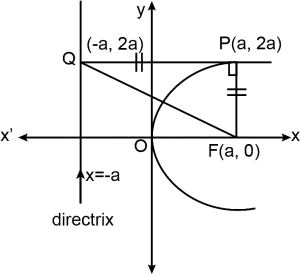
(A) The equation of the parabola is $y^{2}=4ax$.
Let the coordinates of point $P$ on the parabola be $(at^{2}, 2at)$.
The focus $F$ is $(a, 0)$ and the directrix is $x = -a$.
The foot of the perpendicular $Q$ from $P(at^{2}, 2at)$ onto the directrix $x = -a$ is $(-a, 2at)$.
By the definition of a parabola,the distance $PF$ is equal to the distance $PQ$.
$PQ = \sqrt{(at^{2} - (-a))^{2} + (2at - 2at)^{2}} = \sqrt{(a(t^{2}+1))^{2}} = a(t^{2}+1)$.
$PF = \sqrt{(at^{2}-a)^{2} + (2at-0)^{2}} = \sqrt{a^{2}(t^{2}-1)^{2} + 4a^{2}t^{2}} = \sqrt{a^{2}(t^{4}-2t^{2}+1+4t^{2})} = \sqrt{a^{2}(t^{2}+1)^{2}} = a(t^{2}+1)$.
Since $PQ = PF$,the triangle $\triangle PQF$ is an isosceles triangle with $PQ = PF$.
In an isosceles triangle,the angles opposite to the equal sides are equal,so $\angle PQF = \angle PFQ$.
Therefore,$\tan \angle PQF = \tan \angle PFQ$.
Hence,$\frac{\tan \angle PQF}{\tan \angle PFQ} = 1$.
Let the coordinates of point $P$ on the parabola be $(at^{2}, 2at)$.
The focus $F$ is $(a, 0)$ and the directrix is $x = -a$.
The foot of the perpendicular $Q$ from $P(at^{2}, 2at)$ onto the directrix $x = -a$ is $(-a, 2at)$.
By the definition of a parabola,the distance $PF$ is equal to the distance $PQ$.
$PQ = \sqrt{(at^{2} - (-a))^{2} + (2at - 2at)^{2}} = \sqrt{(a(t^{2}+1))^{2}} = a(t^{2}+1)$.
$PF = \sqrt{(at^{2}-a)^{2} + (2at-0)^{2}} = \sqrt{a^{2}(t^{2}-1)^{2} + 4a^{2}t^{2}} = \sqrt{a^{2}(t^{4}-2t^{2}+1+4t^{2})} = \sqrt{a^{2}(t^{2}+1)^{2}} = a(t^{2}+1)$.
Since $PQ = PF$,the triangle $\triangle PQF$ is an isosceles triangle with $PQ = PF$.
In an isosceles triangle,the angles opposite to the equal sides are equal,so $\angle PQF = \angle PFQ$.
Therefore,$\tan \angle PQF = \tan \angle PFQ$.
Hence,$\frac{\tan \angle PQF}{\tan \angle PFQ} = 1$.
0 likes
View Solution960
EasyMCQ
$AB$ is a chord of a parabola $y^2 = 4ax, (a > 0)$ with vertex $A$. $BC$ is drawn perpendicular to $AB$ meeting the axis at $C$. The projection of $BC$ on the axis of the parabola is
A
$a$ unit
B
$2a$ unit
C
$8a$ unit
D
$4a$ unit
Solution
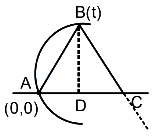
(D) Let the coordinates of point $B$ be $(at^2, 2at)$. The vertex $A$ is at $(0, 0)$.
The slope of $AB$ is $m_{AB} = \frac{2at - 0}{at^2 - 0} = \frac{2}{t}$.
Since $BC \perp AB$,the slope of $BC$ is $m_{BC} = -\frac{1}{m_{AB}} = -\frac{t}{2}$.
The equation of line $BC$ passing through $B(at^2, 2at)$ with slope $-\frac{t}{2}$ is:
$y - 2at = -\frac{t}{2}(x - at^2)$
To find the point $C$ on the axis of the parabola $(y = 0)$:
$0 - 2at = -\frac{t}{2}(x - at^2)$
$4at = t(x - at^2)$
$4a = x - at^2$
$x = 4a + at^2$
So,the coordinates of $C$ are $(4a + at^2, 0)$.
The projection of $BC$ on the axis is the distance $DC$,where $D$ is the projection of $B$ on the axis,i.e.,$D(at^2, 0)$.
$DC = |x_C - x_D| = |(4a + at^2) - at^2| = 4a$ units.
The slope of $AB$ is $m_{AB} = \frac{2at - 0}{at^2 - 0} = \frac{2}{t}$.
Since $BC \perp AB$,the slope of $BC$ is $m_{BC} = -\frac{1}{m_{AB}} = -\frac{t}{2}$.
The equation of line $BC$ passing through $B(at^2, 2at)$ with slope $-\frac{t}{2}$ is:
$y - 2at = -\frac{t}{2}(x - at^2)$
To find the point $C$ on the axis of the parabola $(y = 0)$:
$0 - 2at = -\frac{t}{2}(x - at^2)$
$4at = t(x - at^2)$
$4a = x - at^2$
$x = 4a + at^2$
So,the coordinates of $C$ are $(4a + at^2, 0)$.
The projection of $BC$ on the axis is the distance $DC$,where $D$ is the projection of $B$ on the axis,i.e.,$D(at^2, 0)$.
$DC = |x_C - x_D| = |(4a + at^2) - at^2| = 4a$ units.
0 likes
View Solution961
MediumMCQ
If $P_1 P_2$ and $P_3 P_4$ are two focal chords of the parabola $y^2 = 4ax$,then the chords $P_1 P_3$ and $P_2 P_4$ intersect on the
A
directrix of the parabola
B
axis of the parabola
C
latus-rectum of the parabola
D
$y$-axis
Solution
(A) Let the coordinates of the points be $P_i(at_i^2, 2at_i)$ for $i = 1, 2, 3, 4$.
Since $P_1 P_2$ and $P_3 P_4$ are focal chords,we have $t_1 t_2 = -1$ and $t_3 t_4 = -1$.
The equation of the chord joining $P_i$ and $P_j$ is $(t_i + t_j)y = 2x + 2at_i t_j$.
For $P_1 P_3$,the equation is $(t_1 + t_3)y = 2x + 2at_1 t_3$ ... $(1)$.
For $P_2 P_4$,the equation is $(t_2 + t_4)y = 2x + 2at_2 t_4$ ... $(2)$.
Since $t_2 = -1/t_1$ and $t_4 = -1/t_3$,substituting these into $(2)$ gives $( -1/t_1 - 1/t_3 )y = 2x + 2a(-1/t_1)(-1/t_3)$,which simplifies to $-(t_1 + t_3)y = 2xt_1 t_3 + 2a$.
Solving the system of equations $(1)$ and $(2)$ shows that the intersection point lies on the line $x = -a$,which is the directrix of the parabola.
Since $P_1 P_2$ and $P_3 P_4$ are focal chords,we have $t_1 t_2 = -1$ and $t_3 t_4 = -1$.
The equation of the chord joining $P_i$ and $P_j$ is $(t_i + t_j)y = 2x + 2at_i t_j$.
For $P_1 P_3$,the equation is $(t_1 + t_3)y = 2x + 2at_1 t_3$ ... $(1)$.
For $P_2 P_4$,the equation is $(t_2 + t_4)y = 2x + 2at_2 t_4$ ... $(2)$.
Since $t_2 = -1/t_1$ and $t_4 = -1/t_3$,substituting these into $(2)$ gives $( -1/t_1 - 1/t_3 )y = 2x + 2a(-1/t_1)(-1/t_3)$,which simplifies to $-(t_1 + t_3)y = 2xt_1 t_3 + 2a$.
Solving the system of equations $(1)$ and $(2)$ shows that the intersection point lies on the line $x = -a$,which is the directrix of the parabola.
0 likes
View Solution962
MediumMCQ
The length of the chord of the parabola $y^{2}=4ax$ $(a>0)$ which passes through the vertex and makes an acute angle $\alpha$ with the axis of the parabola is
A
$\pm 4a \cot \alpha \operatorname{cosec} \alpha$
B
$4a \cot \alpha \operatorname{cosec} \alpha$
C
$-4a \cot \alpha \operatorname{cosec} \alpha$
D
$4a \operatorname{cosec}^{2} \alpha$
Solution
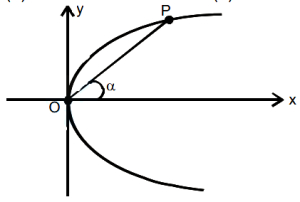
(B) The vertex of the parabola $y^{2}=4ax$ is at the origin $O(0,0)$.
The line passing through the vertex $O$ making an angle $\alpha$ with the $x$-axis is $y = x \tan \alpha$.
To find the intersection point $P$ of this line and the parabola,substitute $y = x \tan \alpha$ into $y^{2}=4ax$:
$(x \tan \alpha)^{2} = 4ax$
$x^{2} \tan^{2} \alpha = 4ax$
Since $P$ is not the origin,$x \neq 0$,so $x \tan^{2} \alpha = 4a$,which gives $x = 4a \cot^{2} \alpha$.
Then $y = (4a \cot^{2} \alpha) \tan \alpha = 4a \cot \alpha$.
Thus,the coordinates of $P$ are $(4a \cot^{2} \alpha, 4a \cot \alpha)$.
The length of the chord $OP$ is the distance from $(0,0)$ to $(4a \cot^{2} \alpha, 4a \cot \alpha)$:
$OP = \sqrt{(4a \cot^{2} \alpha)^{2} + (4a \cot \alpha)^{2}}$
$OP = \sqrt{16a^{2} \cot^{4} \alpha + 16a^{2} \cot^{2} \alpha}$
$OP = 4a \cot \alpha \sqrt{\cot^{2} \alpha + 1}$
$OP = 4a \cot \alpha \operatorname{cosec} \alpha$ (since $0 < \alpha < 90^{\circ}$,$\cot \alpha > 0$ and $\operatorname{cosec} \alpha > 0$).
The line passing through the vertex $O$ making an angle $\alpha$ with the $x$-axis is $y = x \tan \alpha$.
To find the intersection point $P$ of this line and the parabola,substitute $y = x \tan \alpha$ into $y^{2}=4ax$:
$(x \tan \alpha)^{2} = 4ax$
$x^{2} \tan^{2} \alpha = 4ax$
Since $P$ is not the origin,$x \neq 0$,so $x \tan^{2} \alpha = 4a$,which gives $x = 4a \cot^{2} \alpha$.
Then $y = (4a \cot^{2} \alpha) \tan \alpha = 4a \cot \alpha$.
Thus,the coordinates of $P$ are $(4a \cot^{2} \alpha, 4a \cot \alpha)$.
The length of the chord $OP$ is the distance from $(0,0)$ to $(4a \cot^{2} \alpha, 4a \cot \alpha)$:
$OP = \sqrt{(4a \cot^{2} \alpha)^{2} + (4a \cot \alpha)^{2}}$
$OP = \sqrt{16a^{2} \cot^{4} \alpha + 16a^{2} \cot^{2} \alpha}$
$OP = 4a \cot \alpha \sqrt{\cot^{2} \alpha + 1}$
$OP = 4a \cot \alpha \operatorname{cosec} \alpha$ (since $0 < \alpha < 90^{\circ}$,$\cot \alpha > 0$ and $\operatorname{cosec} \alpha > 0$).
0 likes
View Solution963
MediumMCQ
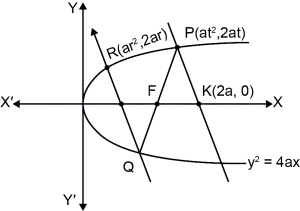
Let $P(at^{2}, 2at)$,$Q$,and $R(ar^{2}, 2ar)$ be three points on the parabola $y^{2}=4ax$. If $PQ$ is a focal chord and $PK$ is parallel to $QR$,where the coordinates of $K$ are $(2a, 0)$,then the value of $r$ is:
A
$\frac{t}{1-t^{2}}$
B
$\frac{1-t^{2}}{t}$
C
$\frac{t^{2}+1}{t}$
D
$\frac{t^{2}-1}{t}$
Solution
(D) Since $PQ$ is a focal chord with $P(at^{2}, 2at)$,the coordinates of $Q$ are $(\frac{a}{t^{2}}, \frac{-2a}{t})$.
Slope of $QR = \frac{2ar - (-2a/t)}{ar^{2} - a/t^{2}} = \frac{2a(r + 1/t)}{a(r - 1/t)(r + 1/t)} = \frac{2}{r - 1/t} = \frac{2t}{rt - 1}$.
Slope of $PK = \frac{2at - 0}{at^{2} - 2a} = \frac{2at}{a(t^{2} - 2)} = \frac{2t}{t^{2} - 2}$.
Since $PK \parallel QR$,their slopes are equal:
$\frac{2t}{rt - 1} = \frac{2t}{t^{2} - 2}$.
Assuming $t \neq 0$,we have $rt - 1 = t^{2} - 2$.
$rt = t^{2} - 1$.
$r = \frac{t^{2} - 1}{t}$.
Slope of $QR = \frac{2ar - (-2a/t)}{ar^{2} - a/t^{2}} = \frac{2a(r + 1/t)}{a(r - 1/t)(r + 1/t)} = \frac{2}{r - 1/t} = \frac{2t}{rt - 1}$.
Slope of $PK = \frac{2at - 0}{at^{2} - 2a} = \frac{2at}{a(t^{2} - 2)} = \frac{2t}{t^{2} - 2}$.
Since $PK \parallel QR$,their slopes are equal:
$\frac{2t}{rt - 1} = \frac{2t}{t^{2} - 2}$.
Assuming $t \neq 0$,we have $rt - 1 = t^{2} - 2$.
$rt = t^{2} - 1$.
$r = \frac{t^{2} - 1}{t}$.
0 likes
View Solution964
MediumMCQ
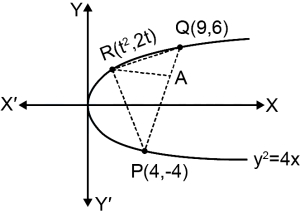
Consider the parabola $y^{2}=4x$. Let $P$ and $Q$ be points on the parabola where $P(4, -4)$ and $Q(9, 6)$. Let $R$ be a point on the arc of the parabola between $P$ and $Q$. Then,the area of $\Delta PQR$ is largest when
A
$\angle PQA=90^{\circ}$
B
$R(4, 4)$
C
$R\left(\frac{1}{4}, 1\right)$
D
$R\left(1, \frac{1}{4}\right)$
Solution
(C) The area of $\Delta PQR$ is maximized when the distance from $R$ to the line $PQ$ is maximum.
Let $R$ be $(t^{2}, 2t)$. The line $PQ$ passes through $P(4, -4)$ and $Q(9, 6)$.
The slope of $PQ$ is $m = \frac{6 - (-4)}{9 - 4} = \frac{10}{5} = 2$.
The equation of line $PQ$ is $y - 6 = 2(x - 9) \Rightarrow 2x - y - 12 = 0$.
The perpendicular distance from $R(t^{2}, 2t)$ to $2x - y - 12 = 0$ is $d = \frac{|2t^{2} - 2t - 12|}{\sqrt{2^{2} + (-1)^{2}}} = \frac{|2(t^{2} - t - 6)|}{\sqrt{5}} = \frac{2|t - 3||t + 2|}{\sqrt{5}}$.
For $R$ to be on the arc between $P$ and $Q$,the parameter $t$ must lie between $-2$ and $3$.
Let $f(t) = t^{2} - t - 6$. To maximize the distance,we find the critical point of $f(t)$ by setting $f'(t) = 2t - 1 = 0$,which gives $t = \frac{1}{2}$.
At $t = \frac{1}{2}$,the coordinates of $R$ are $\left(\left(\frac{1}{2}\right)^{2}, 2\left(\frac{1}{2}\right)\right) = \left(\frac{1}{4}, 1\right)$.
Let $R$ be $(t^{2}, 2t)$. The line $PQ$ passes through $P(4, -4)$ and $Q(9, 6)$.
The slope of $PQ$ is $m = \frac{6 - (-4)}{9 - 4} = \frac{10}{5} = 2$.
The equation of line $PQ$ is $y - 6 = 2(x - 9) \Rightarrow 2x - y - 12 = 0$.
The perpendicular distance from $R(t^{2}, 2t)$ to $2x - y - 12 = 0$ is $d = \frac{|2t^{2} - 2t - 12|}{\sqrt{2^{2} + (-1)^{2}}} = \frac{|2(t^{2} - t - 6)|}{\sqrt{5}} = \frac{2|t - 3||t + 2|}{\sqrt{5}}$.
For $R$ to be on the arc between $P$ and $Q$,the parameter $t$ must lie between $-2$ and $3$.
Let $f(t) = t^{2} - t - 6$. To maximize the distance,we find the critical point of $f(t)$ by setting $f'(t) = 2t - 1 = 0$,which gives $t = \frac{1}{2}$.
At $t = \frac{1}{2}$,the coordinates of $R$ are $\left(\left(\frac{1}{2}\right)^{2}, 2\left(\frac{1}{2}\right)\right) = \left(\frac{1}{4}, 1\right)$.
0 likes
View Solution965
DifficultMCQ
$A$ line passing through the point of intersection of $x+y=4$ and $x-y=2$ makes an angle $\tan^{-1}\left(\frac{3}{4}\right)$ with the $X$-axis. It intersects the parabola $y^{2}=4(x-3)$ at points $(x_{1}, y_{1})$ and $(x_{2}, y_{2})$,respectively. Then $|x_{1}-x_{2}|$ is equal to
A
$\frac{16}{9}$
B
$\frac{32}{9}$
C
$\frac{40}{9}$
D
$\frac{80}{9}$
Solution
(B) Given equations are $x+y=4$ $(i)$ and $x-y=2$ $(ii)$.
Solving $(i)$ and $(ii)$,we get $x=3$ and $y=1$.
The line passing through $(3, 1)$ with slope $m = \tan(\tan^{-1}(3/4)) = 3/4$ is given by:
$(y-1) = \frac{3}{4}(x-3) \Rightarrow y = \frac{3x-5}{4}$.
Substituting this into the parabola equation $y^{2}=4(x-3)$:
$\left(\frac{3x-5}{4}\right)^{2} = 4(x-3)$
$\frac{9x^{2}-30x+25}{16} = 4x-12$
$9x^{2}-30x+25 = 64x-192$
$9x^{2}-94x+217 = 0$.
For this quadratic equation,$x_{1}+x_{2} = \frac{94}{9}$ and $x_{1}x_{2} = \frac{217}{9}$.
Then $|x_{1}-x_{2}| = \sqrt{(x_{1}+x_{2})^{2}-4x_{1}x_{2}}$
$= \sqrt{\left(\frac{94}{9}\right)^{2} - 4\left(\frac{217}{9}\right)}$
$= \sqrt{\frac{8836}{81} - \frac{868}{9}} = \sqrt{\frac{8836-7812}{81}} = \sqrt{\frac{1024}{81}} = \frac{32}{9}$.
Solving $(i)$ and $(ii)$,we get $x=3$ and $y=1$.
The line passing through $(3, 1)$ with slope $m = \tan(\tan^{-1}(3/4)) = 3/4$ is given by:
$(y-1) = \frac{3}{4}(x-3) \Rightarrow y = \frac{3x-5}{4}$.
Substituting this into the parabola equation $y^{2}=4(x-3)$:
$\left(\frac{3x-5}{4}\right)^{2} = 4(x-3)$
$\frac{9x^{2}-30x+25}{16} = 4x-12$
$9x^{2}-30x+25 = 64x-192$
$9x^{2}-94x+217 = 0$.
For this quadratic equation,$x_{1}+x_{2} = \frac{94}{9}$ and $x_{1}x_{2} = \frac{217}{9}$.
Then $|x_{1}-x_{2}| = \sqrt{(x_{1}+x_{2})^{2}-4x_{1}x_{2}}$
$= \sqrt{\left(\frac{94}{9}\right)^{2} - 4\left(\frac{217}{9}\right)}$
$= \sqrt{\frac{8836}{81} - \frac{868}{9}} = \sqrt{\frac{8836-7812}{81}} = \sqrt{\frac{1024}{81}} = \frac{32}{9}$.
0 likes
View Solution966
MediumMCQ
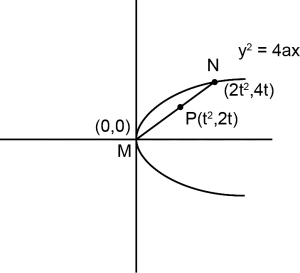
Let $P$ be the mid-point of a chord joining the vertex of the parabola $y^{2}=8x$ to another point on it. Then,the locus of $P$ is
A
$y^{2}=2x$
B
$y^{2}=4x$
C
$\frac{x^{2}}{4}+y^{2}=1$
D
$x^{2}+\frac{y^{2}}{4}=1$
Solution
(B) The vertex of the parabola $y^{2}=8x$ is $M(0,0)$.
Let the other point on the parabola be $N(2t^{2}, 4t)$,where $t$ is a parameter.
Let $P(x, y)$ be the mid-point of the chord $MN$.
Using the mid-point formula,we have:
$x = \frac{0 + 2t^{2}}{2} = t^{2}$
$y = \frac{0 + 4t}{2} = 2t$
From the second equation,$t = \frac{y}{2}$.
Substituting this into the first equation:
$x = (\frac{y}{2})^{2}$
$x = \frac{y^{2}}{4}$
$y^{2} = 4x$
Thus,the locus of $P$ is $y^{2}=4x$.
Let the other point on the parabola be $N(2t^{2}, 4t)$,where $t$ is a parameter.
Let $P(x, y)$ be the mid-point of the chord $MN$.
Using the mid-point formula,we have:
$x = \frac{0 + 2t^{2}}{2} = t^{2}$
$y = \frac{0 + 4t}{2} = 2t$
From the second equation,$t = \frac{y}{2}$.
Substituting this into the first equation:
$x = (\frac{y}{2})^{2}$
$x = \frac{y^{2}}{4}$
$y^{2} = 4x$
Thus,the locus of $P$ is $y^{2}=4x$.
0 likes
View Solution967
EasyMCQ
If $t_1$ and $t_2$ are the parameters of the end points of a focal chord for the parabola $y^2 = 4ax$,then which one is true?
A
$t_1 t_2 = 1$
B
$\frac{t_1}{t_2} = 1$
C
$t_1 t_2 = -1$
D
$t_1 + t_2 = -1$
Solution
(C) For a parabola $y^2 = 4ax$,the coordinates of any point on it can be represented as $(at^2, 2at)$.
Let the two end points of a focal chord be $P(at_1^2, 2at_1)$ and $Q(at_2^2, 2at_2)$.
The slope of the chord $PQ$ is $m = \frac{2at_2 - 2at_1}{at_2^2 - at_1^2} = \frac{2(t_2 - t_1)}{(t_2 - t_1)(t_2 + t_1)} = \frac{2}{t_1 + t_2}$.
Since the chord passes through the focus $(a, 0)$,the slope is also $m = \frac{2at_1 - 0}{at_1^2 - a} = \frac{2at_1}{a(t_1^2 - 1)} = \frac{2t_1}{t_1^2 - 1}$.
Equating the slopes: $\frac{2}{t_1 + t_2} = \frac{2t_1}{t_1^2 - 1}$.
$t_1^2 - 1 = t_1(t_1 + t_2) = t_1^2 + t_1 t_2$.
$-1 = t_1 t_2$.
Therefore,$t_1 t_2 = -1$.
Let the two end points of a focal chord be $P(at_1^2, 2at_1)$ and $Q(at_2^2, 2at_2)$.
The slope of the chord $PQ$ is $m = \frac{2at_2 - 2at_1}{at_2^2 - at_1^2} = \frac{2(t_2 - t_1)}{(t_2 - t_1)(t_2 + t_1)} = \frac{2}{t_1 + t_2}$.
Since the chord passes through the focus $(a, 0)$,the slope is also $m = \frac{2at_1 - 0}{at_1^2 - a} = \frac{2at_1}{a(t_1^2 - 1)} = \frac{2t_1}{t_1^2 - 1}$.
Equating the slopes: $\frac{2}{t_1 + t_2} = \frac{2t_1}{t_1^2 - 1}$.
$t_1^2 - 1 = t_1(t_1 + t_2) = t_1^2 + t_1 t_2$.
$-1 = t_1 t_2$.
Therefore,$t_1 t_2 = -1$.
0 likes
View Solution968
MediumMCQ
The line $y - \sqrt{3}x + 3 = 0$ cuts the parabola $y^2 = x + 2$ at the points $P$ and $Q$. If the coordinates of the point $X$ are $(\sqrt{3}, 0)$,then the value of $XP \cdot XQ$ is
A
$\frac{4(2+\sqrt{3})}{3}$
B
$\frac{4(2-\sqrt{3})}{2}$
C
$\frac{5(2+\sqrt{3})}{3}$
D
$\frac{5(2-\sqrt{3})}{3}$
Solution
(A) The line equation is $y = \sqrt{3}x - 3$. The slope $m = \sqrt{3}$,so $\tan \theta = \sqrt{3} \Rightarrow \theta = 60^\circ$.
Any point on the line at a distance $r$ from $X(\sqrt{3}, 0)$ is given by $x = \sqrt{3} + r \cos 60^\circ = \sqrt{3} + \frac{r}{2}$ and $y = 0 + r \sin 60^\circ = \frac{r\sqrt{3}}{2}$.
Substituting these into the parabola equation $y^2 = x + 2$:
$(\frac{r\sqrt{3}}{2})^2 = (\sqrt{3} + \frac{r}{2}) + 2$
$\frac{3r^2}{4} = \sqrt{3} + 2 + \frac{r}{2}$
$3r^2 - 2r - 4(\sqrt{3} + 2) = 0$.
Let $r_1$ and $r_2$ be the roots of this quadratic equation,which represent the directed distances $XP$ and $XQ$.
The product of the roots $r_1 r_2 = \frac{-4(\sqrt{3} + 2)}{3}$.
Since $XP \cdot XQ = |r_1 r_2|$,we have $XP \cdot XQ = |\frac{-4(\sqrt{3} + 2)}{3}| = \frac{4(2 + \sqrt{3})}{3}$.
Any point on the line at a distance $r$ from $X(\sqrt{3}, 0)$ is given by $x = \sqrt{3} + r \cos 60^\circ = \sqrt{3} + \frac{r}{2}$ and $y = 0 + r \sin 60^\circ = \frac{r\sqrt{3}}{2}$.
Substituting these into the parabola equation $y^2 = x + 2$:
$(\frac{r\sqrt{3}}{2})^2 = (\sqrt{3} + \frac{r}{2}) + 2$
$\frac{3r^2}{4} = \sqrt{3} + 2 + \frac{r}{2}$
$3r^2 - 2r - 4(\sqrt{3} + 2) = 0$.
Let $r_1$ and $r_2$ be the roots of this quadratic equation,which represent the directed distances $XP$ and $XQ$.
The product of the roots $r_1 r_2 = \frac{-4(\sqrt{3} + 2)}{3}$.
Since $XP \cdot XQ = |r_1 r_2|$,we have $XP \cdot XQ = |\frac{-4(\sqrt{3} + 2)}{3}| = \frac{4(2 + \sqrt{3})}{3}$.
0 likes
View Solution969
MediumMCQ
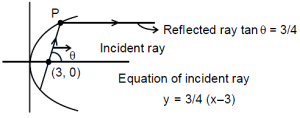
From the focus of the parabola $y^2 = 12x$,a ray of light is directed in a direction making an angle $\tan^{-1} \frac{3}{4}$ with the $x$-axis. Then the equation of the line along which the reflected ray leaves the parabola is
A
$y = 2$
B
$y = 18$
C
$y = 9$
D
$y = 36$
Solution
(B) The parabola is $y^2 = 12x$,so $4a = 12$,which implies $a = 3$. The focus is $(3, 0)$.
The incident ray passes through the focus $(3, 0)$ with slope $m = \tan(\tan^{-1} \frac{3}{4}) = \frac{3}{4}$.
The equation of the incident ray is $y - 0 = \frac{3}{4}(x - 3)$,or $x = \frac{4y}{3} + 3$.
Substituting this into the parabola equation $y^2 = 12x$:
$y^2 = 12(\frac{4y}{3} + 3) = 16y + 36$.
$y^2 - 16y - 36 = 0$.
$(y - 18)(y + 2) = 0$.
Since the ray is directed into the first quadrant,we take $y = 18$.
$A$ property of the parabola states that any ray passing through the focus reflects parallel to the axis of the parabola.
The axis of the parabola $y^2 = 12x$ is the $x$-axis $(y = 0)$.
Thus,the reflected ray is a horizontal line passing through the point $P$ with $y$-coordinate $18$.
The equation of the reflected ray is $y = 18$.
The incident ray passes through the focus $(3, 0)$ with slope $m = \tan(\tan^{-1} \frac{3}{4}) = \frac{3}{4}$.
The equation of the incident ray is $y - 0 = \frac{3}{4}(x - 3)$,or $x = \frac{4y}{3} + 3$.
Substituting this into the parabola equation $y^2 = 12x$:
$y^2 = 12(\frac{4y}{3} + 3) = 16y + 36$.
$y^2 - 16y - 36 = 0$.
$(y - 18)(y + 2) = 0$.
Since the ray is directed into the first quadrant,we take $y = 18$.
$A$ property of the parabola states that any ray passing through the focus reflects parallel to the axis of the parabola.
The axis of the parabola $y^2 = 12x$ is the $x$-axis $(y = 0)$.
Thus,the reflected ray is a horizontal line passing through the point $P$ with $y$-coordinate $18$.
The equation of the reflected ray is $y = 18$.
0 likes
View Solution970
EasyMCQ
The equation of the latus rectum of a parabola is $x+y=8$ and the equation of the tangent at the vertex is $x+y=12$. Then the length of the latus rectum is
A
$4 \sqrt{2} \text{ units}$
B
$2 \sqrt{2} \text{ units}$
C
$8 \text{ units}$
D
$8 \sqrt{2} \text{ units}$
Solution
(D) The distance between the latus rectum and the tangent at the vertex of a parabola is equal to $a$,where $4a$ is the length of the latus rectum.
Given the equations $x+y-8=0$ and $x+y-12=0$.
The distance $a$ between these two parallel lines is given by the formula $d = \frac{|c_1 - c_2|}{\sqrt{A^2 + B^2}}$.
$a = \frac{|-8 - (-12)|}{\sqrt{1^2 + 1^2}} = \frac{4}{\sqrt{2}} = 2 \sqrt{2}$.
The length of the latus rectum is $4a$.
Length $= 4 \times (2 \sqrt{2}) = 8 \sqrt{2} \text{ units}$.
Given the equations $x+y-8=0$ and $x+y-12=0$.
The distance $a$ between these two parallel lines is given by the formula $d = \frac{|c_1 - c_2|}{\sqrt{A^2 + B^2}}$.
$a = \frac{|-8 - (-12)|}{\sqrt{1^2 + 1^2}} = \frac{4}{\sqrt{2}} = 2 \sqrt{2}$.
The length of the latus rectum is $4a$.
Length $= 4 \times (2 \sqrt{2}) = 8 \sqrt{2} \text{ units}$.
0 likes
View Solution971
MediumMCQ
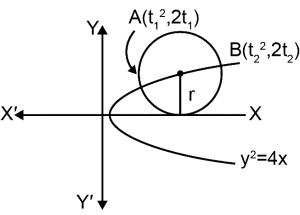
Let $A$ and $B$ be two distinct points on the parabola $y^{2}=4x$. If the axis of the parabola touches a circle of radius $r$ having $AB$ as its diameter,then the slope of the line $AB$ is
A
$-\frac{1}{r}$
B
$\frac{1}{r}$
C
$\frac{2}{r}$
D
None of the above
Solution
(D) Let the coordinates of points $A$ and $B$ be $(t_{1}^{2}, 2t_{1})$ and $(t_{2}^{2}, 2t_{2})$ respectively.
The center of the circle with diameter $AB$ is given by $(\frac{t_{1}^{2}+t_{2}^{2}}{2}, t_{1}+t_{2})$.
The axis of the parabola $y^{2}=4x$ is the $x$-axis,which has the equation $y=0$.
Since the circle touches the $x$-axis,the radius of the circle is equal to the absolute value of the $y$-coordinate of the center.
Thus,$r = |t_{1}+t_{2}|$,which implies $t_{1}+t_{2} = \pm r$.
The slope of the line $AB$ is given by $m = \frac{2t_{2}-2t_{1}}{t_{2}^{2}-t_{1}^{2}} = \frac{2(t_{2}-t_{1})}{(t_{2}-t_{1})(t_{2}+t_{1})} = \frac{2}{t_{1}+t_{2}}$.
Substituting $t_{1}+t_{2} = \pm r$,we get the slope $m = \frac{2}{\pm r} = \pm \frac{2}{r}$.
Since $\pm \frac{2}{r}$ is not explicitly listed in the options $A, B,$ or $C$,the correct choice is $D$.
The center of the circle with diameter $AB$ is given by $(\frac{t_{1}^{2}+t_{2}^{2}}{2}, t_{1}+t_{2})$.
The axis of the parabola $y^{2}=4x$ is the $x$-axis,which has the equation $y=0$.
Since the circle touches the $x$-axis,the radius of the circle is equal to the absolute value of the $y$-coordinate of the center.
Thus,$r = |t_{1}+t_{2}|$,which implies $t_{1}+t_{2} = \pm r$.
The slope of the line $AB$ is given by $m = \frac{2t_{2}-2t_{1}}{t_{2}^{2}-t_{1}^{2}} = \frac{2(t_{2}-t_{1})}{(t_{2}-t_{1})(t_{2}+t_{1})} = \frac{2}{t_{1}+t_{2}}$.
Substituting $t_{1}+t_{2} = \pm r$,we get the slope $m = \frac{2}{\pm r} = \pm \frac{2}{r}$.
Since $\pm \frac{2}{r}$ is not explicitly listed in the options $A, B,$ or $C$,the correct choice is $D$.
0 likes
View Solution972
MediumMCQ
If the parabola $x^{2}=ay$ makes an intercept of length $\sqrt{40}$ units on the line $y-2x=1$,then $a$ is equal to
A
$1$
B
$-2$
C
$-1$
D
$2$
Solution
(A, B) Given,the equation of the parabola is $x^{2}=ay$,which implies $y=\frac{x^{2}}{a}$.
The equation of the line is $y=2x+1$.
Substituting $y$ in the parabola equation: $\frac{x^{2}}{a}=2x+1 \Rightarrow x^{2}-2ax-a=0$.
Let the roots be $x_{1}$ and $x_{2}$. Then $x_{1}+x_{2}=2a$ and $x_{1}x_{2}=-a$.
The difference $|x_{1}-x_{2}| = \sqrt{(x_{1}+x_{2})^{2}-4x_{1}x_{2}} = \sqrt{4a^{2}+4a} = 2\sqrt{a^{2}+a}$.
Since the points lie on $y=2x+1$,the distance $d$ between points $(x_{1}, y_{1})$ and $(x_{2}, y_{2})$ is $d = \sqrt{(x_{2}-x_{1})^{2}+(y_{2}-y_{1})^{2}}$.
Since $y_{2}-y_{1} = 2(x_{2}-x_{1})$,we have $d = \sqrt{(x_{2}-x_{1})^{2}+4(x_{2}-x_{1})^{2}} = |x_{2}-x_{1}|\sqrt{5}$.
Given $d=\sqrt{40}$,so $\sqrt{40} = 2\sqrt{a^{2}+a} \cdot \sqrt{5} \Rightarrow \sqrt{40} = \sqrt{20(a^{2}+a)}$.
Squaring both sides: $40 = 20(a^{2}+a) \Rightarrow a^{2}+a-2=0$.
$(a+2)(a-1)=0$,so $a=1$ or $a=-2$.
The equation of the line is $y=2x+1$.
Substituting $y$ in the parabola equation: $\frac{x^{2}}{a}=2x+1 \Rightarrow x^{2}-2ax-a=0$.
Let the roots be $x_{1}$ and $x_{2}$. Then $x_{1}+x_{2}=2a$ and $x_{1}x_{2}=-a$.
The difference $|x_{1}-x_{2}| = \sqrt{(x_{1}+x_{2})^{2}-4x_{1}x_{2}} = \sqrt{4a^{2}+4a} = 2\sqrt{a^{2}+a}$.
Since the points lie on $y=2x+1$,the distance $d$ between points $(x_{1}, y_{1})$ and $(x_{2}, y_{2})$ is $d = \sqrt{(x_{2}-x_{1})^{2}+(y_{2}-y_{1})^{2}}$.
Since $y_{2}-y_{1} = 2(x_{2}-x_{1})$,we have $d = \sqrt{(x_{2}-x_{1})^{2}+4(x_{2}-x_{1})^{2}} = |x_{2}-x_{1}|\sqrt{5}$.
Given $d=\sqrt{40}$,so $\sqrt{40} = 2\sqrt{a^{2}+a} \cdot \sqrt{5} \Rightarrow \sqrt{40} = \sqrt{20(a^{2}+a)}$.
Squaring both sides: $40 = 20(a^{2}+a) \Rightarrow a^{2}+a-2=0$.
$(a+2)(a-1)=0$,so $a=1$ or $a=-2$.
0 likes
View Solution973
MediumMCQ
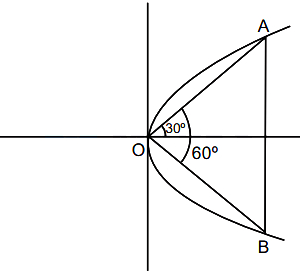
$\triangle OAB$ is an equilateral triangle inscribed in the parabola $y^2 = 4ax, a > 0$ with $O$ as the vertex. Then the length of the side of $\triangle OAB$ is
A
$8a\sqrt{3}$ unit
B
$8a$ unit
C
$4a\sqrt{3}$ unit
D
$4a$ unit
Solution
(A) Since $\triangle OAB$ is an equilateral triangle and $O$ is the vertex $(0,0)$,the axis of the parabola (the $x$-axis) bisects the angle $\angle AOB$.
Thus,the angle that $OA$ makes with the $x$-axis is $30^{\circ}$.
The slope of $OA$ is $m = \tan 30^{\circ} = \frac{1}{\sqrt{3}}$.
The equation of line $OA$ is $y = \frac{1}{\sqrt{3}}x$.
Substituting $y = \frac{x}{\sqrt{3}}$ into the parabola equation $y^2 = 4ax$:
$\left(\frac{x}{\sqrt{3}}\right)^2 = 4ax \Rightarrow \frac{x^2}{3} = 4ax$.
Since $x \neq 0$ for point $A$,we have $x = 12a$.
Then $y = \frac{12a}{\sqrt{3}} = 4\sqrt{3}a$.
Point $A$ is $(12a, 4\sqrt{3}a)$.
Since $AB$ is perpendicular to the $x$-axis,the length $AB = 2y_A = 2(4\sqrt{3}a) = 8\sqrt{3}a$.
Since $\triangle OAB$ is equilateral,the side length is $8\sqrt{3}a$.
Thus,the angle that $OA$ makes with the $x$-axis is $30^{\circ}$.
The slope of $OA$ is $m = \tan 30^{\circ} = \frac{1}{\sqrt{3}}$.
The equation of line $OA$ is $y = \frac{1}{\sqrt{3}}x$.
Substituting $y = \frac{x}{\sqrt{3}}$ into the parabola equation $y^2 = 4ax$:
$\left(\frac{x}{\sqrt{3}}\right)^2 = 4ax \Rightarrow \frac{x^2}{3} = 4ax$.
Since $x \neq 0$ for point $A$,we have $x = 12a$.
Then $y = \frac{12a}{\sqrt{3}} = 4\sqrt{3}a$.
Point $A$ is $(12a, 4\sqrt{3}a)$.
Since $AB$ is perpendicular to the $x$-axis,the length $AB = 2y_A = 2(4\sqrt{3}a) = 8\sqrt{3}a$.
Since $\triangle OAB$ is equilateral,the side length is $8\sqrt{3}a$.
0 likes
View Solution974
EasyMCQ
The point of contact of the tangent to the parabola $y^2=9x$ which passes through the point $(4, 10)$ and makes an angle $\theta$ with the positive side of the axis of the parabola where $\tan \theta > 2$,is
A
$\left(\frac{4}{9}, 2\right)$
B
$(4, 6)$
C
$(4, 5)$
D
$\left(\frac{1}{4}, \frac{1}{6}\right)$
Solution
(A) The equation of the tangent to the parabola $y^2 = 4ax$ at point $(at^2, 2at)$ is $yt = x + at^2$.
Here,$4a = 9$,so $a = \frac{9}{4}$.
The tangent passes through $(4, 10)$,so $10t = 4 + \frac{9}{4}t^2$.
Multiplying by $4$,we get $40t = 16 + 9t^2$,or $9t^2 - 40t + 16 = 0$.
Factoring the quadratic: $(9t - 4)(t - 4) = 0$,which gives $t = 4$ or $t = \frac{4}{9}$.
The slope of the tangent is $m = \frac{1}{t} = \tan \theta$.
Given $\tan \theta > 2$,we have $\frac{1}{t} > 2$,which implies $t < \frac{1}{2}$.
Thus,$t = \frac{4}{9}$ is the valid parameter.
The point of contact is $(at^2, 2at) = \left(\frac{9}{4} \times \left(\frac{4}{9}\right)^2, 2 \times \frac{9}{4} \times \frac{4}{9}\right) = \left(\frac{4}{9}, 2\right)$.
Here,$4a = 9$,so $a = \frac{9}{4}$.
The tangent passes through $(4, 10)$,so $10t = 4 + \frac{9}{4}t^2$.
Multiplying by $4$,we get $40t = 16 + 9t^2$,or $9t^2 - 40t + 16 = 0$.
Factoring the quadratic: $(9t - 4)(t - 4) = 0$,which gives $t = 4$ or $t = \frac{4}{9}$.
The slope of the tangent is $m = \frac{1}{t} = \tan \theta$.
Given $\tan \theta > 2$,we have $\frac{1}{t} > 2$,which implies $t < \frac{1}{2}$.
Thus,$t = \frac{4}{9}$ is the valid parameter.
The point of contact is $(at^2, 2at) = \left(\frac{9}{4} \times \left(\frac{4}{9}\right)^2, 2 \times \frac{9}{4} \times \frac{4}{9}\right) = \left(\frac{4}{9}, 2\right)$.
0 likes
View Solution975
MediumMCQ
Let the tangent and normal at any point $P(at^2, 2at)$,$(a > 0)$,on the parabola $y^2 = 4ax$ meet the axis of the parabola at $T$ and $G$ respectively. Then the radius of the circle through $P, T$ and $G$ is
A
$a(1+t^2)$
B
$(1+t^2)$
C
$a(1-t^2)$
D
$(1-t^2)$
Solution
(A) The coordinates of point $P$ are $(at^2, 2at)$.
The equation of the tangent at $P$ is $ty = x + at^2$. Setting $y=0$,we get $x = -at^2$,so $T = (-at^2, 0)$.
The equation of the normal at $P$ is $y = -tx + 2at + at^3$. Setting $y=0$,we get $x = 2a + at^2$,so $G = (2a + at^2, 0)$.
Since the tangent and normal are perpendicular,$\angle PTG = 90^\circ$,which implies that $TG$ is the diameter of the circle passing through $P, T,$ and $G$.
The length of the diameter $TG = |(2a + at^2) - (-at^2)| = |2a + 2at^2| = 2a(1+t^2)$.
Therefore,the radius of the circle is $\frac{1}{2} TG = a(1+t^2)$.
The equation of the tangent at $P$ is $ty = x + at^2$. Setting $y=0$,we get $x = -at^2$,so $T = (-at^2, 0)$.
The equation of the normal at $P$ is $y = -tx + 2at + at^3$. Setting $y=0$,we get $x = 2a + at^2$,so $G = (2a + at^2, 0)$.
Since the tangent and normal are perpendicular,$\angle PTG = 90^\circ$,which implies that $TG$ is the diameter of the circle passing through $P, T,$ and $G$.
The length of the diameter $TG = |(2a + at^2) - (-at^2)| = |2a + 2at^2| = 2a(1+t^2)$.
Therefore,the radius of the circle is $\frac{1}{2} TG = a(1+t^2)$.
0 likes
View Solution976
MediumMCQ
If the line $y=x$ is a tangent to the parabola $y=ax^{2}+bx+c$ at the point $(1,1)$ and the curve passes through $(-1,0)$,then
A
$a=b=-1, c=3$
B
$a=b=\frac{1}{2}, c=0$
C
$a=c=\frac{1}{4}, b=\frac{1}{2}$
D
$a=0, b=c=\frac{1}{2}$
Solution
(C) The equation of the parabola is $y = ax^2 + bx + c$.
Since the point $(1,1)$ lies on the parabola,we have $1 = a(1)^2 + b(1) + c$,which gives $a + b + c = 1$ ...$(1)$.
Since the point $(-1,0)$ lies on the parabola,we have $0 = a(-1)^2 + b(-1) + c$,which gives $a - b + c = 0$ ...$(2)$.
Subtracting $(2)$ from $(1)$,we get $2b = 1$,so $b = \frac{1}{2}$.
Substituting $b = \frac{1}{2}$ into $(1)$,we get $a + c = \frac{1}{2}$ ...$(3)$.
The slope of the tangent to the parabola at any point $(x,y)$ is given by $\frac{dy}{dx} = 2ax + b$.
At the point $(1,1)$,the slope of the tangent is $2a(1) + b = 2a + b$.
Since the line $y=x$ is tangent at $(1,1)$,its slope is $1$. Thus,$2a + b = 1$.
Substituting $b = \frac{1}{2}$,we get $2a + \frac{1}{2} = 1$,which implies $2a = \frac{1}{2}$,so $a = \frac{1}{4}$.
From $(3)$,$c = \frac{1}{2} - a = \frac{1}{2} - \frac{1}{4} = \frac{1}{4}$.
Thus,$a = \frac{1}{4}, b = \frac{1}{2}, c = \frac{1}{4}$.
Since the point $(1,1)$ lies on the parabola,we have $1 = a(1)^2 + b(1) + c$,which gives $a + b + c = 1$ ...$(1)$.
Since the point $(-1,0)$ lies on the parabola,we have $0 = a(-1)^2 + b(-1) + c$,which gives $a - b + c = 0$ ...$(2)$.
Subtracting $(2)$ from $(1)$,we get $2b = 1$,so $b = \frac{1}{2}$.
Substituting $b = \frac{1}{2}$ into $(1)$,we get $a + c = \frac{1}{2}$ ...$(3)$.
The slope of the tangent to the parabola at any point $(x,y)$ is given by $\frac{dy}{dx} = 2ax + b$.
At the point $(1,1)$,the slope of the tangent is $2a(1) + b = 2a + b$.
Since the line $y=x$ is tangent at $(1,1)$,its slope is $1$. Thus,$2a + b = 1$.
Substituting $b = \frac{1}{2}$,we get $2a + \frac{1}{2} = 1$,which implies $2a = \frac{1}{2}$,so $a = \frac{1}{4}$.
From $(3)$,$c = \frac{1}{2} - a = \frac{1}{2} - \frac{1}{4} = \frac{1}{4}$.
Thus,$a = \frac{1}{4}, b = \frac{1}{2}, c = \frac{1}{4}$.
0 likes
View Solution977
MediumMCQ
If the vertex of the conic $y^{2}-4y=4x-4a$ always lies between the straight lines $x+y=3$ and $2x+2y-1=0$,then:
A
$2 < a < 4$
B
$-\frac{1}{2} < a < 2$
C
$0 < a < 2$
D
$-\frac{1}{2} < a < \frac{3}{2}$
Solution
(B) The given equation is $y^{2}-4y=4x-4a$.
Completing the square for $y$,we get $(y-2)^{2}-4=4x-4a$.
This simplifies to $(y-2)^{2}=4x-4a+4$,or $(y-2)^{2}=4(x-(a-1))$.
Comparing this with the standard form $(y-k)^{2}=4A(x-h)$,the vertex is $(h, k) = (a-1, 2)$.
The vertex lies between the lines $L_1: x+y-3=0$ and $L_2: 2x+2y-1=0$.
For a point $(x_0, y_0)$ to lie between two parallel lines $ax+by+c_1=0$ and $ax+by+c_2=0$,the expressions $(ax_0+by_0+c_1)$ and $(ax_0+by_0+c_2)$ must have opposite signs,i.e.,$(ax_0+by_0+c_1)(ax_0+by_0+c_2) < 0$.
Substituting the vertex $(a-1, 2)$ into the lines:
$L_1(a-1, 2) = (a-1)+2-3 = a-2$.
$L_2(a-1, 2) = 2(a-1)+2(2)-1 = 2a-2+4-1 = 2a+1$.
Thus,$(a-2)(2a+1) < 0$.
Solving this inequality,we find $a \in \left(-\frac{1}{2}, 2\right)$.
Completing the square for $y$,we get $(y-2)^{2}-4=4x-4a$.
This simplifies to $(y-2)^{2}=4x-4a+4$,or $(y-2)^{2}=4(x-(a-1))$.
Comparing this with the standard form $(y-k)^{2}=4A(x-h)$,the vertex is $(h, k) = (a-1, 2)$.
The vertex lies between the lines $L_1: x+y-3=0$ and $L_2: 2x+2y-1=0$.
For a point $(x_0, y_0)$ to lie between two parallel lines $ax+by+c_1=0$ and $ax+by+c_2=0$,the expressions $(ax_0+by_0+c_1)$ and $(ax_0+by_0+c_2)$ must have opposite signs,i.e.,$(ax_0+by_0+c_1)(ax_0+by_0+c_2) < 0$.
Substituting the vertex $(a-1, 2)$ into the lines:
$L_1(a-1, 2) = (a-1)+2-3 = a-2$.
$L_2(a-1, 2) = 2(a-1)+2(2)-1 = 2a-2+4-1 = 2a+1$.
Thus,$(a-2)(2a+1) < 0$.
Solving this inequality,we find $a \in \left(-\frac{1}{2}, 2\right)$.
0 likes
View Solution978
MediumMCQ
If $y=4x+3$ is parallel to a tangent to the parabola $y^{2}=12x$,then its distance from the normal parallel to the given line is
A
$\frac{213}{\sqrt{17}}$
B
$\frac{219}{\sqrt{17}}$
C
$\frac{211}{\sqrt{17}}$
D
$\frac{210}{\sqrt{17}}$
Solution
(B) The equation of the parabola is $y^{2}=12x$. Comparing with $y^{2}=4ax$,we get $4a=12$,so $a=3$.
The slope of the given line $y=4x+3$ is $m=4$.
The slope of the normal to the parabola $y^{2}=4ax$ at point $(x_{1}, y_{1})$ is given by $m_{n} = -\frac{y_{1}}{2a}$.
Since the normal is parallel to the line $y=4x+3$,its slope must be $4$. Thus,$-\frac{y_{1}}{2(3)} = 4$,which gives $y_{1} = -24$.
Substituting $y_{1} = -24$ into the parabola equation $y^{2}=12x$,we get $(-24)^{2} = 12x$,so $576 = 12x$,which gives $x_{1} = 48$.
The point on the parabola is $(48, -24)$.
The equation of the normal at $(48, -24)$ is $y - (-24) = 4(x - 48)$,which simplifies to $y + 24 = 4x - 192$,or $4x - y - 216 = 0$.
The given line is $4x - y + 3 = 0$.
The distance between two parallel lines $Ax + By + C_{1} = 0$ and $Ax + By + C_{2} = 0$ is given by $d = \frac{|C_{1} - C_{2}|}{\sqrt{A^{2} + B^{2}}}$.
Here,$d = \frac{|3 - (-216)|}{\sqrt{4^{2} + (-1)^{2}}} = \frac{|3 + 216|}{\sqrt{16 + 1}} = \frac{219}{\sqrt{17}}$.
The slope of the given line $y=4x+3$ is $m=4$.
The slope of the normal to the parabola $y^{2}=4ax$ at point $(x_{1}, y_{1})$ is given by $m_{n} = -\frac{y_{1}}{2a}$.
Since the normal is parallel to the line $y=4x+3$,its slope must be $4$. Thus,$-\frac{y_{1}}{2(3)} = 4$,which gives $y_{1} = -24$.
Substituting $y_{1} = -24$ into the parabola equation $y^{2}=12x$,we get $(-24)^{2} = 12x$,so $576 = 12x$,which gives $x_{1} = 48$.
The point on the parabola is $(48, -24)$.
The equation of the normal at $(48, -24)$ is $y - (-24) = 4(x - 48)$,which simplifies to $y + 24 = 4x - 192$,or $4x - y - 216 = 0$.
The given line is $4x - y + 3 = 0$.
The distance between two parallel lines $Ax + By + C_{1} = 0$ and $Ax + By + C_{2} = 0$ is given by $d = \frac{|C_{1} - C_{2}|}{\sqrt{A^{2} + B^{2}}}$.
Here,$d = \frac{|3 - (-216)|}{\sqrt{4^{2} + (-1)^{2}}} = \frac{|3 + 216|}{\sqrt{16 + 1}} = \frac{219}{\sqrt{17}}$.
0 likes
View Solution979
MediumMCQ
The point on the parabola $y^{2}=64x$ which is nearest to the line $4x+3y+35=0$ has coordinates
A
$(9, -24)$
B
$(1, 81)$
C
$(4, -16)$
D
$(-9, -24)$
Solution
(A) The given equation of the parabola is $y^{2} = 64x$ $(i)$.
The point on the parabola nearest to the line $4x + 3y + 35 = 0$ is the point where the tangent is parallel to the given line.
The slope of the line $4x + 3y + 35 = 0$ is $m = -\frac{4}{3}$.
Differentiating $(i)$ with respect to $x$,we get $2y \frac{dy}{dx} = 64$,which implies $\frac{dy}{dx} = \frac{32}{y}$.
Since the tangent is parallel to the line,their slopes must be equal:
$\frac{32}{y} = -\frac{4}{3} \Rightarrow y = -24$.
Substituting $y = -24$ into $(i)$:
$(-24)^{2} = 64x$ $\Rightarrow 576 = 64x$ $\Rightarrow x = 9$.
Thus,the required point is $(9, -24)$.
The point on the parabola nearest to the line $4x + 3y + 35 = 0$ is the point where the tangent is parallel to the given line.
The slope of the line $4x + 3y + 35 = 0$ is $m = -\frac{4}{3}$.
Differentiating $(i)$ with respect to $x$,we get $2y \frac{dy}{dx} = 64$,which implies $\frac{dy}{dx} = \frac{32}{y}$.
Since the tangent is parallel to the line,their slopes must be equal:
$\frac{32}{y} = -\frac{4}{3} \Rightarrow y = -24$.
Substituting $y = -24$ into $(i)$:
$(-24)^{2} = 64x$ $\Rightarrow 576 = 64x$ $\Rightarrow x = 9$.
Thus,the required point is $(9, -24)$.
0 likes
View Solution980
DifficultMCQ
Suppose that the equation $f(x) = x^{2} + bx + c = 0$ has two distinct real roots $\alpha$ and $\beta$. The angle between the tangent to the curve $y = f(x)$ at the point $\left(\frac{\alpha + \beta}{2}, f\left(\frac{\alpha + \beta}{2}\right)\right)$ and the positive direction of the $x$-axis is (in $^{\circ}$)
A
$0$
B
$30$
C
$60$
D
$90$
Solution
(A) Given that $\alpha$ and $\beta$ are the roots of $f(x) = x^{2} + bx + c = 0$.
By the properties of quadratic equations,the sum of roots is $\alpha + \beta = -b$.
The vertex of the parabola $y = f(x)$ occurs at $x = -\frac{b}{2} = \frac{\alpha + \beta}{2}$.
Now,find the derivative of $f(x)$:
$f'(x) = \frac{dy}{dx} = 2x + b$.
At the point $x = \frac{\alpha + \beta}{2} = -\frac{b}{2}$,the slope of the tangent is:
$f'\left(-\frac{b}{2}\right) = 2\left(-\frac{b}{2}\right) + b = -b + b = 0$.
$A$ slope of $0$ indicates that the tangent line is horizontal,meaning it is parallel to the $x$-axis.
Therefore,the angle between the tangent and the positive direction of the $x$-axis is $0^{\circ}$.
By the properties of quadratic equations,the sum of roots is $\alpha + \beta = -b$.
The vertex of the parabola $y = f(x)$ occurs at $x = -\frac{b}{2} = \frac{\alpha + \beta}{2}$.
Now,find the derivative of $f(x)$:
$f'(x) = \frac{dy}{dx} = 2x + b$.
At the point $x = \frac{\alpha + \beta}{2} = -\frac{b}{2}$,the slope of the tangent is:
$f'\left(-\frac{b}{2}\right) = 2\left(-\frac{b}{2}\right) + b = -b + b = 0$.
$A$ slope of $0$ indicates that the tangent line is horizontal,meaning it is parallel to the $x$-axis.
Therefore,the angle between the tangent and the positive direction of the $x$-axis is $0^{\circ}$.
0 likes
View Solution981
MediumMCQ
The number of common tangents to the parabolas $y = x^{2}$ and $y = -x^{2} + 4x - 4$ is:
A
$1$
B
$2$
C
$3$
D
$4$
Solution
(A) Given parabolas are $y = x^{2}$ and $y = -(x-2)^{2}$.
Let the tangent to $y = x^{2}$ be $y = mx - \frac{m^{2}}{4}$.
This line is also a tangent to $y = -(x-2)^{2}$,which can be written as $(y-0) = -1(x-2)^{2}$.
The condition for a line $y = mx + c$ to be a tangent to $y = a(x-h)^{2} + k$ is $c = k - \frac{m^{2}}{4a}$.
Here,$a = -1, h = 2, k = 0$. So,$c = 0 - \frac{m^{2}}{4(-1)} = \frac{m^{2}}{4}$.
Equating the two expressions for $c$:
$-\frac{m^{2}}{4} = \frac{m^{2}}{4}$ $\Rightarrow \frac{m^{2}}{2} = 0$ $\Rightarrow m = 0$.
For $m = 0$,the tangent is $y = 0$.
Since there is only one value of $m$,there is only $1$ common tangent.
Let the tangent to $y = x^{2}$ be $y = mx - \frac{m^{2}}{4}$.
This line is also a tangent to $y = -(x-2)^{2}$,which can be written as $(y-0) = -1(x-2)^{2}$.
The condition for a line $y = mx + c$ to be a tangent to $y = a(x-h)^{2} + k$ is $c = k - \frac{m^{2}}{4a}$.
Here,$a = -1, h = 2, k = 0$. So,$c = 0 - \frac{m^{2}}{4(-1)} = \frac{m^{2}}{4}$.
Equating the two expressions for $c$:
$-\frac{m^{2}}{4} = \frac{m^{2}}{4}$ $\Rightarrow \frac{m^{2}}{2} = 0$ $\Rightarrow m = 0$.
For $m = 0$,the tangent is $y = 0$.
Since there is only one value of $m$,there is only $1$ common tangent.
0 likes
View Solution982
DifficultMCQ
The maximum number of common normals of $y^2=4ax$ and $x^2=4by$ is equal to
A
$3$
B
$4$
C
$5$
D
$6$
Solution
(C) The equations of the parabolas are $y^2=4ax$ and $x^2=4by$.
The equation of the normal to $y^2=4ax$ with slope $m$ is $y=mx-2am-am^3$.
The equation of the normal to $x^2=4by$ with slope $m$ is $y=mx+2b+\frac{b}{m^2}$.
For a common normal,the equations must be identical,so $-2am-am^3 = 2b+\frac{b}{m^2}$.
Multiplying by $m^2$,we get $-2am^3-am^5 = 2bm^2+b$.
Rearranging the terms,we obtain $am^5+2am^3+2bm^2+b=0$.
Since this is a polynomial equation of degree $5$ in $m$,there are at most $5$ real roots for $m$.
Therefore,the maximum number of common normals is $5$.
The equation of the normal to $y^2=4ax$ with slope $m$ is $y=mx-2am-am^3$.
The equation of the normal to $x^2=4by$ with slope $m$ is $y=mx+2b+\frac{b}{m^2}$.
For a common normal,the equations must be identical,so $-2am-am^3 = 2b+\frac{b}{m^2}$.
Multiplying by $m^2$,we get $-2am^3-am^5 = 2bm^2+b$.
Rearranging the terms,we obtain $am^5+2am^3+2bm^2+b=0$.
Since this is a polynomial equation of degree $5$ in $m$,there are at most $5$ real roots for $m$.
Therefore,the maximum number of common normals is $5$.
0 likes
View Solution983
EasyMCQ
From a point $(d, 0)$,three normals are drawn to the parabola $y^{2} = x$. Then:
A
$d = \frac{1}{2}$
B
$d > \frac{1}{2}$
C
$d < \frac{1}{2}$
D
$d = \frac{1}{3}$
Solution
(B) The equation of the parabola is $y^{2} = x$,which is of the form $y^{2} = 4ax$,where $4a = 1$,so $a = \frac{1}{4}$.
For a parabola $y^{2} = 4ax$,the condition for three distinct normals to be drawn from a point $(h, k)$ is that $h > 2a$.
Here,the point is $(d, 0)$,so $h = d$.
Substituting the values,we get $d > 2 \times \frac{1}{4}$.
Therefore,$d > \frac{1}{2}$.
For a parabola $y^{2} = 4ax$,the condition for three distinct normals to be drawn from a point $(h, k)$ is that $h > 2a$.
Here,the point is $(d, 0)$,so $h = d$.
Substituting the values,we get $d > 2 \times \frac{1}{4}$.
Therefore,$d > \frac{1}{2}$.
0 likes
View Solution984
EasyMCQ
From the point $(-1, -6)$,two tangents are drawn to the parabola $y^2 = 4x$. The angle between the two tangents is:
A
$\pi / 3$
B
$\pi / 4$
C
$\pi / 6$
D
$\pi / 2$
Solution
(D) The equation of the parabola is $y^2 = 4ax$,where $4a = 4$,so $a = 1$.
The directrix of the parabola $y^2 = 4x$ is given by $x = -a$,which is $x = -1$.
The given point is $(-1, -6)$.
Since the $x$-coordinate of the point is $-1$,the point $(-1, -6)$ lies on the directrix of the parabola.
It is a standard property of parabolas that the tangents drawn from any point on the directrix to the parabola are perpendicular to each other.
Therefore,the angle between the two tangents is $\pi / 2$.
The directrix of the parabola $y^2 = 4x$ is given by $x = -a$,which is $x = -1$.
The given point is $(-1, -6)$.
Since the $x$-coordinate of the point is $-1$,the point $(-1, -6)$ lies on the directrix of the parabola.
It is a standard property of parabolas that the tangents drawn from any point on the directrix to the parabola are perpendicular to each other.
Therefore,the angle between the two tangents is $\pi / 2$.
0 likes
View Solution985
MediumMCQ
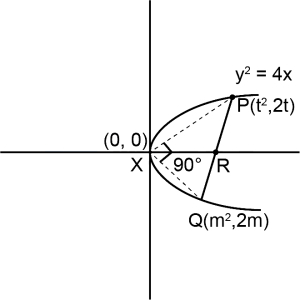
Let $P$ and $Q$ be points on the parabola $y^{2}=4x$ such that the line segment $PQ$ subtends a right angle at the vertex. If $PQ$ intersects the axis of the parabola at $R$,then the distance of the vertex from $R$ is
A
$1$
B
$2$
C
$4$
D
$6$
Solution
(C) Let the coordinates of points $P$ and $Q$ on the parabola $y^{2}=4x$ be $(t^{2}, 2t)$ and $(m^{2}, 2m)$ respectively. The vertex of the parabola is $X(0, 0)$.
Since $PQ$ subtends a right angle at the vertex $X$,the product of the slopes of $XP$ and $XQ$ is $-1$.
Slope of $XP = \frac{2t-0}{t^{2}-0} = \frac{2}{t}$.
Slope of $XQ = \frac{2m-0}{m^{2}-0} = \frac{2}{m}$.
Given,$(\frac{2}{t}) \times (\frac{2}{m}) = -1 \Rightarrow tm = -4$.
The equation of the line $PQ$ passing through $(t^{2}, 2t)$ and $(m^{2}, 2m)$ is:
$y - 2t = \frac{2m-2t}{m^{2}-t^{2}}(x - t^{2})$
$y - 2t = \frac{2(m-t)}{(m-t)(m+t)}(x - t^{2})$
$y - 2t = \frac{2}{m+t}(x - t^{2})$.
Since $PQ$ intersects the axis of the parabola ($x$-axis) at $R(\alpha, 0)$,we substitute $y=0$ and $x=\alpha$:
$0 - 2t = \frac{2}{m+t}(\alpha - t^{2})$
$-t(m+t) = \alpha - t^{2}$
$-tm - t^{2} = \alpha - t^{2}$
$\alpha = -tm$.
Since $tm = -4$,we have $\alpha = -(-4) = 4$.
Thus,the distance of the vertex $X(0, 0)$ from $R(4, 0)$ is $4$.
Since $PQ$ subtends a right angle at the vertex $X$,the product of the slopes of $XP$ and $XQ$ is $-1$.
Slope of $XP = \frac{2t-0}{t^{2}-0} = \frac{2}{t}$.
Slope of $XQ = \frac{2m-0}{m^{2}-0} = \frac{2}{m}$.
Given,$(\frac{2}{t}) \times (\frac{2}{m}) = -1 \Rightarrow tm = -4$.
The equation of the line $PQ$ passing through $(t^{2}, 2t)$ and $(m^{2}, 2m)$ is:
$y - 2t = \frac{2m-2t}{m^{2}-t^{2}}(x - t^{2})$
$y - 2t = \frac{2(m-t)}{(m-t)(m+t)}(x - t^{2})$
$y - 2t = \frac{2}{m+t}(x - t^{2})$.
Since $PQ$ intersects the axis of the parabola ($x$-axis) at $R(\alpha, 0)$,we substitute $y=0$ and $x=\alpha$:
$0 - 2t = \frac{2}{m+t}(\alpha - t^{2})$
$-t(m+t) = \alpha - t^{2}$
$-tm - t^{2} = \alpha - t^{2}$
$\alpha = -tm$.
Since $tm = -4$,we have $\alpha = -(-4) = 4$.
Thus,the distance of the vertex $X(0, 0)$ from $R(4, 0)$ is $4$.
0 likes
View Solution986
EasyMCQ
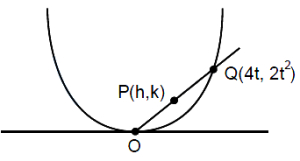
Let $O$ be the vertex and $Q$ be any point on the parabola $x^2=8y$. If the point $P$ divides the line segment $OQ$ internally in the ratio $1:3$,then the locus of $P$ is
A
$x^2=y$
B
$y^2=x$
C
$y^2=2x$
D
$x^2=2y$
Solution
(D) The vertex of the parabola $x^2=8y$ is $O(0, 0)$.
Let the coordinates of point $Q$ be $(x_1, y_1)$. Since $Q$ lies on the parabola,$x_1^2 = 8y_1$.
Let the coordinates of point $P$ be $(h, k)$.
Since $P$ divides $OQ$ in the ratio $1:3$,by the section formula:
$h = \frac{1 \cdot x_1 + 3 \cdot 0}{1+3} = \frac{x_1}{4} \Rightarrow x_1 = 4h$
$k = \frac{1 \cdot y_1 + 3 \cdot 0}{1+3} = \frac{y_1}{4} \Rightarrow y_1 = 4k$
Substituting these into the parabola equation $x_1^2 = 8y_1$:
$(4h)^2 = 8(4k)$
$16h^2 = 32k$
$h^2 = 2k$
Replacing $(h, k)$ with $(x, y)$,the locus of $P$ is $x^2 = 2y$.
Let the coordinates of point $Q$ be $(x_1, y_1)$. Since $Q$ lies on the parabola,$x_1^2 = 8y_1$.
Let the coordinates of point $P$ be $(h, k)$.
Since $P$ divides $OQ$ in the ratio $1:3$,by the section formula:
$h = \frac{1 \cdot x_1 + 3 \cdot 0}{1+3} = \frac{x_1}{4} \Rightarrow x_1 = 4h$
$k = \frac{1 \cdot y_1 + 3 \cdot 0}{1+3} = \frac{y_1}{4} \Rightarrow y_1 = 4k$
Substituting these into the parabola equation $x_1^2 = 8y_1$:
$(4h)^2 = 8(4k)$
$16h^2 = 32k$
$h^2 = 2k$
Replacing $(h, k)$ with $(x, y)$,the locus of $P$ is $x^2 = 2y$.
0 likes
View Solution987
EasyMCQ
Let $P$ be the point $(2, 0)$ and $Q$ be a variable point on the parabola $(y - 6)^2 = 2(x - 4)$. Then the locus of the mid-point of $PQ$ is:
A
$y^2 + x + 6y + 12 = 0$
B
$y^2 - x + 6y + 12 = 0$
C
$y^2 + x - 6y + 12 = 0$
D
$y^2 - x - 6y + 12 = 0$
Solution
(D) Let the coordinates of point $Q$ on the parabola $(y - 6)^2 = 2(x - 4)$ be $(4 + \frac{t^2}{2}, 6 + t)$.
Given $P = (2, 0)$.
Let the mid-point of $PQ$ be $R(h, k)$.
Then $h = \frac{2 + 4 + \frac{t^2}{2}}{2} = 3 + \frac{t^2}{4}$ and $k = \frac{0 + 6 + t}{2} = 3 + \frac{t}{2}$.
From the second equation,$\frac{t}{2} = k - 3$,so $t = 2(k - 3)$.
Substituting $t$ into the equation for $h$:
$h = 3 + \frac{(2(k - 3))^2}{4} = 3 + \frac{4(k - 3)^2}{4} = 3 + (k - 3)^2$.
$h - 3 = (k - 3)^2$.
Replacing $(h, k)$ with $(x, y)$,we get $(y - 3)^2 = x - 3$.
$y^2 - 6y + 9 = x - 3$.
$y^2 - 6y - x + 12 = 0$.
Given $P = (2, 0)$.
Let the mid-point of $PQ$ be $R(h, k)$.
Then $h = \frac{2 + 4 + \frac{t^2}{2}}{2} = 3 + \frac{t^2}{4}$ and $k = \frac{0 + 6 + t}{2} = 3 + \frac{t}{2}$.
From the second equation,$\frac{t}{2} = k - 3$,so $t = 2(k - 3)$.
Substituting $t$ into the equation for $h$:
$h = 3 + \frac{(2(k - 3))^2}{4} = 3 + \frac{4(k - 3)^2}{4} = 3 + (k - 3)^2$.
$h - 3 = (k - 3)^2$.
Replacing $(h, k)$ with $(x, y)$,we get $(y - 3)^2 = x - 3$.
$y^2 - 6y + 9 = x - 3$.
$y^2 - 6y - x + 12 = 0$.
0 likes
View Solution988
MediumMCQ
The locus of the vertices of the family of parabolas $6y = 2a^3x^2 + 3a^2x - 12a$ is
A
$xy = \frac{105}{64}$
B
$xy = \frac{64}{105}$
C
$xy = \frac{35}{16}$
D
$xy = \frac{16}{35}$
Solution
(A) The given equation is $6y = 2a^3x^2 + 3a^2x - 12a$.
Dividing by $2a^3$ (assuming $a \neq 0$),we get $x^2 + \frac{3}{2a}x = \frac{6y + 12a}{2a^3}$.
Completing the square for $x$: $(x + \frac{3}{4a})^2 = \frac{6y + 12a}{2a^3} + \frac{9}{16a^2} = \frac{48y + 96a + 9a}{16a^3} = \frac{48y + 105a}{16a^3}$.
Thus,$(x + \frac{3}{4a})^2 = \frac{3}{a^2}(y + \frac{35a}{16})$.
The vertex $(h, k)$ is given by $h = -\frac{3}{4a}$ and $k = -\frac{35a}{16}$.
From $h = -\frac{3}{4a}$,we have $a = -\frac{3}{4h}$.
Substituting $a$ into $k$: $k = -\frac{35}{16} \times (-\frac{3}{4h}) = \frac{105}{64h}$.
Therefore,$hk = \frac{105}{64}$.
The locus is $xy = \frac{105}{64}$.
Dividing by $2a^3$ (assuming $a \neq 0$),we get $x^2 + \frac{3}{2a}x = \frac{6y + 12a}{2a^3}$.
Completing the square for $x$: $(x + \frac{3}{4a})^2 = \frac{6y + 12a}{2a^3} + \frac{9}{16a^2} = \frac{48y + 96a + 9a}{16a^3} = \frac{48y + 105a}{16a^3}$.
Thus,$(x + \frac{3}{4a})^2 = \frac{3}{a^2}(y + \frac{35a}{16})$.
The vertex $(h, k)$ is given by $h = -\frac{3}{4a}$ and $k = -\frac{35a}{16}$.
From $h = -\frac{3}{4a}$,we have $a = -\frac{3}{4h}$.
Substituting $a$ into $k$: $k = -\frac{35}{16} \times (-\frac{3}{4h}) = \frac{105}{64h}$.
Therefore,$hk = \frac{105}{64}$.
The locus is $xy = \frac{105}{64}$.
0 likes
View Solution989
DifficultMCQ
The locus of the mid-points of all chords of the parabola $y^{2}=4ax$ passing through its vertex is another parabola with directrix:
A
$x=-a$
B
$x=a$
C
$x=0$
D
$x=-\frac{a}{2}$
Solution
(D) Let the chord pass through the vertex $V(0, 0)$ and intersect the parabola $y^{2}=4ax$ at $P(at^{2}, 2at)$.
Let $(h, k)$ be the mid-point of the chord $VP$.
Then,$h = \frac{at^{2}+0}{2} = \frac{at^{2}}{2}$ and $k = \frac{2at+0}{2} = at$.
From $k = at$,we have $t = \frac{k}{a}$.
Substituting $t$ in the expression for $h$: $h = \frac{a}{2} \left(\frac{k}{a}\right)^{2} = \frac{k^{2}}{2a}$.
Thus,$k^{2} = 2ah$.
The locus of the mid-point $(h, k)$ is $y^{2} = 2ax$.
This can be rewritten as $(y-0)^{2} = 4\left(\frac{a}{2}\right)(x-0)$.
For a parabola $Y^{2} = 4AX$,the directrix is $X = -A$.
Here,$A = \frac{a}{2}$,so the directrix is $x = -\frac{a}{2}$.
Let $(h, k)$ be the mid-point of the chord $VP$.
Then,$h = \frac{at^{2}+0}{2} = \frac{at^{2}}{2}$ and $k = \frac{2at+0}{2} = at$.
From $k = at$,we have $t = \frac{k}{a}$.
Substituting $t$ in the expression for $h$: $h = \frac{a}{2} \left(\frac{k}{a}\right)^{2} = \frac{k^{2}}{2a}$.
Thus,$k^{2} = 2ah$.
The locus of the mid-point $(h, k)$ is $y^{2} = 2ax$.
This can be rewritten as $(y-0)^{2} = 4\left(\frac{a}{2}\right)(x-0)$.
For a parabola $Y^{2} = 4AX$,the directrix is $X = -A$.
Here,$A = \frac{a}{2}$,so the directrix is $x = -\frac{a}{2}$.
0 likes
View Solution990
MediumMCQ
The value of $\lambda$ for which the curve $(7x+5)^{2}+(7y+3)^{2}=\lambda^{2}(4x+3y-24)^{2}$ represents a parabola is
A
$\pm \frac{6}{5}$
B
$\pm \frac{7}{5}$
C
$\pm \frac{1}{5}$
D
$\pm \frac{2}{5}$
Solution
(B) The given equation is $(7x+5)^{2}+(7y+3)^{2}=\lambda^{2}(4x+3y-24)^{2}$.
This is of the form $SP^{2} = \lambda^{2} PM^{2}$,where $S$ is the focus,$P$ is a point on the curve,and $PM$ is the perpendicular distance from $P$ to the directrix.
For the curve to be a parabola,the eccentricity $e$ must be equal to $1$.
Here,the distance from the point $(x, y)$ to the focus $S$ is $\sqrt{(x - x_s)^2 + (y - y_s)^2}$.
Rewriting the equation: $\frac{(7x+5)^{2}+(7y+3)^{2}}{49} = \lambda^{2} \frac{(4x+3y-24)^{2}}{49}$.
$\left(\sqrt{(x + 5/7)^2 + (y + 3/7)^2}\right)^2 = \lambda^{2} \left(\frac{4x+3y-24}{7}\right)^2$.
Comparing this with the definition of a conic $SP = e PM$,we have $e = \lambda \cdot \frac{\sqrt{4^2+3^2}}{7} = \lambda \cdot \frac{5}{7}$.
For a parabola,$e = 1$,so $\lambda \cdot \frac{5}{7} = 1$.
Thus,$\lambda = \pm \frac{7}{5}$.
This is of the form $SP^{2} = \lambda^{2} PM^{2}$,where $S$ is the focus,$P$ is a point on the curve,and $PM$ is the perpendicular distance from $P$ to the directrix.
For the curve to be a parabola,the eccentricity $e$ must be equal to $1$.
Here,the distance from the point $(x, y)$ to the focus $S$ is $\sqrt{(x - x_s)^2 + (y - y_s)^2}$.
Rewriting the equation: $\frac{(7x+5)^{2}+(7y+3)^{2}}{49} = \lambda^{2} \frac{(4x+3y-24)^{2}}{49}$.
$\left(\sqrt{(x + 5/7)^2 + (y + 3/7)^2}\right)^2 = \lambda^{2} \left(\frac{4x+3y-24}{7}\right)^2$.
Comparing this with the definition of a conic $SP = e PM$,we have $e = \lambda \cdot \frac{\sqrt{4^2+3^2}}{7} = \lambda \cdot \frac{5}{7}$.
For a parabola,$e = 1$,so $\lambda \cdot \frac{5}{7} = 1$.
Thus,$\lambda = \pm \frac{7}{5}$.
0 likes
View Solution991
EasyMCQ
The locus of the middle points of all chords of the parabola $y^2 = 4ax$ passing through the vertex is
A
a straight line
B
an ellipse
C
a parabola
D
a circle
Solution
(C) Let the midpoint of a chord passing through the vertex $(0, 0)$ be $(h, k)$.
Since the chord passes through the vertex $(0, 0)$ and the midpoint $(h, k)$,the equation of the chord is $y - 0 = \frac{k - 0}{h - 0}(x - 0)$,which simplifies to $y = \frac{k}{h}x$.
Substituting this into the parabola equation $y^2 = 4ax$,we get $(\frac{k}{h}x)^2 = 4ax$.
$\frac{k^2}{h^2}x^2 = 4ax$.
Since $x=0$ is the vertex,for the chord,we consider $x \neq 0$,so $\frac{k^2}{h^2}x = 4a$,which gives $x = \frac{4ah^2}{k^2}$.
However,the midpoint $(h, k)$ must satisfy the chord equation $k = \frac{k}{h}h$,which is trivial.
The condition for $(h, k)$ to be the midpoint of a chord of $y^2 = 4ax$ is $k^2 = 2a(h - x_1)$ where $x_1$ is the other end. For a chord through the vertex,the equation of the chord with midpoint $(h, k)$ is $T = S_1$,i.e.,$yk - 2a(x + h) = k^2 - 4ah$.
Since it passes through $(0, 0)$,we have $0 - 2ah = k^2 - 4ah$,which simplifies to $k^2 = 2ah$.
Replacing $(h, k)$ with $(x, y)$,the locus is $y^2 = 2ax$,which is a parabola.
Since the chord passes through the vertex $(0, 0)$ and the midpoint $(h, k)$,the equation of the chord is $y - 0 = \frac{k - 0}{h - 0}(x - 0)$,which simplifies to $y = \frac{k}{h}x$.
Substituting this into the parabola equation $y^2 = 4ax$,we get $(\frac{k}{h}x)^2 = 4ax$.
$\frac{k^2}{h^2}x^2 = 4ax$.
Since $x=0$ is the vertex,for the chord,we consider $x \neq 0$,so $\frac{k^2}{h^2}x = 4a$,which gives $x = \frac{4ah^2}{k^2}$.
However,the midpoint $(h, k)$ must satisfy the chord equation $k = \frac{k}{h}h$,which is trivial.
The condition for $(h, k)$ to be the midpoint of a chord of $y^2 = 4ax$ is $k^2 = 2a(h - x_1)$ where $x_1$ is the other end. For a chord through the vertex,the equation of the chord with midpoint $(h, k)$ is $T = S_1$,i.e.,$yk - 2a(x + h) = k^2 - 4ah$.
Since it passes through $(0, 0)$,we have $0 - 2ah = k^2 - 4ah$,which simplifies to $k^2 = 2ah$.
Replacing $(h, k)$ with $(x, y)$,the locus is $y^2 = 2ax$,which is a parabola.
0 likes
View Solution992
DifficultMCQ
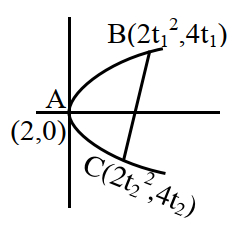
Let $A$ be the focus of the parabola $y^{2}=8x$. Let the line $y=mx+c$ intersect the parabola at two distinct points $B$ and $C$. If the centroid of the triangle $ABC$ is $(\frac{7}{3},\frac{4}{3})$,then $(BC)^{2}$ is equal to:
A
$41$
B
$80$
C
$89$
D
$32$
Solution
(B) The parabola is $y^{2}=8x$,so $4a=8 \Rightarrow a=2$. The focus $A$ is $(2,0)$.
Let the points $B$ and $C$ be $(2t_{1}^{2}, 4t_{1})$ and $(2t_{2}^{2}, 4t_{2})$ respectively.
The centroid of $\triangle ABC$ is given by $(\frac{2t_{1}^{2}+2t_{2}^{2}+2}{3}, \frac{4t_{1}+4t_{2}+0}{3}) = (\frac{7}{3}, \frac{4}{3})$.
Equating the coordinates:
$2(t_{1}^{2}+t_{2}^{2}+1) = 7 \Rightarrow t_{1}^{2}+t_{2}^{2} = \frac{5}{2}$.
$4(t_{1}+t_{2}) = 4 \Rightarrow t_{1}+t_{2} = 1$.
Now,$(t_{1}-t_{2})^{2} = (t_{1}+t_{2})^{2} - 4t_{1}t_{2}$.
Since $t_{1}^{2}+t_{2}^{2} = (t_{1}+t_{2})^{2} - 2t_{1}t_{2} = \frac{5}{2}$,we have $1 - 2t_{1}t_{2} = \frac{5}{2}$ $\Rightarrow 2t_{1}t_{2} = -\frac{3}{2}$ $\Rightarrow t_{1}t_{2} = -\frac{3}{4}$.
Thus,$(t_{1}-t_{2})^{2} = 1 - 4(-\frac{3}{4}) = 1+3 = 4$.
$(BC)^{2} = (2t_{1}^{2}-2t_{2}^{2})^{2} + (4t_{1}-4t_{2})^{2} = 4(t_{1}^{2}-t_{2}^{2})^{2} + 16(t_{1}-t_{2})^{2}$.
$(BC)^{2} = 4(t_{1}+t_{2})^{2}(t_{1}-t_{2})^{2} + 16(t_{1}-t_{2})^{2} = 4(1)^{2}(4) + 16(4) = 16 + 64 = 80$.
Let the points $B$ and $C$ be $(2t_{1}^{2}, 4t_{1})$ and $(2t_{2}^{2}, 4t_{2})$ respectively.
The centroid of $\triangle ABC$ is given by $(\frac{2t_{1}^{2}+2t_{2}^{2}+2}{3}, \frac{4t_{1}+4t_{2}+0}{3}) = (\frac{7}{3}, \frac{4}{3})$.
Equating the coordinates:
$2(t_{1}^{2}+t_{2}^{2}+1) = 7 \Rightarrow t_{1}^{2}+t_{2}^{2} = \frac{5}{2}$.
$4(t_{1}+t_{2}) = 4 \Rightarrow t_{1}+t_{2} = 1$.
Now,$(t_{1}-t_{2})^{2} = (t_{1}+t_{2})^{2} - 4t_{1}t_{2}$.
Since $t_{1}^{2}+t_{2}^{2} = (t_{1}+t_{2})^{2} - 2t_{1}t_{2} = \frac{5}{2}$,we have $1 - 2t_{1}t_{2} = \frac{5}{2}$ $\Rightarrow 2t_{1}t_{2} = -\frac{3}{2}$ $\Rightarrow t_{1}t_{2} = -\frac{3}{4}$.
Thus,$(t_{1}-t_{2})^{2} = 1 - 4(-\frac{3}{4}) = 1+3 = 4$.
$(BC)^{2} = (2t_{1}^{2}-2t_{2}^{2})^{2} + (4t_{1}-4t_{2})^{2} = 4(t_{1}^{2}-t_{2}^{2})^{2} + 16(t_{1}-t_{2})^{2}$.
$(BC)^{2} = 4(t_{1}+t_{2})^{2}(t_{1}-t_{2})^{2} + 16(t_{1}-t_{2})^{2} = 4(1)^{2}(4) + 16(4) = 16 + 64 = 80$.
0 likes
View Solution993
DifficultMCQ
Let the image of the parabola $x^{2} = 4y$ in the line $x - y = 1$ be $(y + a)^{2} = b(x - c)$,where $a, b, c \in \mathbb{N}$. Then $a + b + c$ is equal to
A
$12$
B
$4$
C
$6$
D
$8$
Solution
(C) The parametric point $P$ on the parabola $x^2 = 4y$ is $(2t, t^2)$.
Let the mirror image of $P$ in the line $x - y - 1 = 0$ be $Q(h, k)$.
Using the reflection formula $\frac{h - x_1}{a} = \frac{k - y_1}{b} = -2 \frac{ax_1 + by_1 + c}{a^2 + b^2}$,we get:
$\frac{h - 2t}{1} = \frac{k - t^2}{-1} = -2 \frac{2t - t^2 - 1}{1^2 + (-1)^2} = -(2t - t^2 - 1) = t^2 - 2t + 1$.
Thus,$h = 2t + t^2 - 2t + 1 = t^2 + 1$ and $k = t^2 - (t^2 - 2t + 1) = 2t - 1$.
From $k = 2t - 1$,we have $t = \frac{k + 1}{2}$.
Substituting $t$ into $h = t^2 + 1$,we get $h = (\frac{k + 1}{2})^2 + 1$.
$h - 1 = \frac{(k + 1)^2}{4} \implies (k + 1)^2 = 4(h - 1)$.
Replacing $(h, k)$ with $(x, y)$,the equation of the image parabola is $(y + 1)^2 = 4(x - 1)$.
Comparing this with $(y + a)^2 = b(x - c)$,we get $a = 1, b = 4, c = 1$.
Therefore,$a + b + c = 1 + 4 + 1 = 6$.
Let the mirror image of $P$ in the line $x - y - 1 = 0$ be $Q(h, k)$.
Using the reflection formula $\frac{h - x_1}{a} = \frac{k - y_1}{b} = -2 \frac{ax_1 + by_1 + c}{a^2 + b^2}$,we get:
$\frac{h - 2t}{1} = \frac{k - t^2}{-1} = -2 \frac{2t - t^2 - 1}{1^2 + (-1)^2} = -(2t - t^2 - 1) = t^2 - 2t + 1$.
Thus,$h = 2t + t^2 - 2t + 1 = t^2 + 1$ and $k = t^2 - (t^2 - 2t + 1) = 2t - 1$.
From $k = 2t - 1$,we have $t = \frac{k + 1}{2}$.
Substituting $t$ into $h = t^2 + 1$,we get $h = (\frac{k + 1}{2})^2 + 1$.
$h - 1 = \frac{(k + 1)^2}{4} \implies (k + 1)^2 = 4(h - 1)$.
Replacing $(h, k)$ with $(x, y)$,the equation of the image parabola is $(y + 1)^2 = 4(x - 1)$.
Comparing this with $(y + a)^2 = b(x - c)$,we get $a = 1, b = 4, c = 1$.
Therefore,$a + b + c = 1 + 4 + 1 = 6$.
0 likes
View Solution994
DifficultMCQ
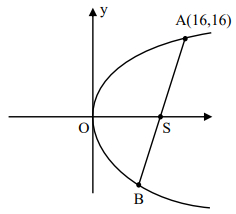
Let one end of a focal chord of the parabola $y^{2}=16x$ be $(16, 16)$. If $P(\alpha, \beta)$ divides this focal chord internally in the ratio $5 : 2$,then the minimum value of $\alpha+\beta$ is equal to:
A
$22$
B
$7$
C
$5$
D
$16$
Solution
(B) The equation of the parabola is $y^{2}=16x$,which is of the form $y^{2}=4ax$ with $a=4$.
Let the coordinates of point $A$ be $(at_{1}^{2}, 2at_{1}) = (16, 16)$.
Thus,$2(4)t_{1} = 16 \Rightarrow t_{1}=2$.
Since $AB$ is a focal chord,the product of the parameters of its endpoints is $t_{1}t_{2}=-1$.
Therefore,$2t_{2}=-1 \Rightarrow t_{2}=-\frac{1}{2}$.
The coordinates of point $B$ are $(at_{2}^{2}, 2at_{2}) = (4(-\frac{1}{2})^{2}, 2(4)(-\frac{1}{2})) = (1, -4)$.
Point $P(\alpha, \beta)$ divides the chord $AB$ internally in the ratio $5:2$.
Case $1$: $P$ divides $AB$ in ratio $5:2$ (from $A$ to $B$):
$\alpha = \frac{5(1) + 2(16)}{5+2} = \frac{37}{7}$,$\beta = \frac{5(-4) + 2(16)}{5+2} = \frac{12}{7}$.
$\alpha+\beta = \frac{37+12}{7} = \frac{49}{7} = 7$.
Case $2$: $P$ divides $BA$ in ratio $5:2$ (from $B$ to $A$):
$\alpha = \frac{5(16) + 2(1)}{5+2} = \frac{82}{7}$,$\beta = \frac{5(16) + 2(-4)}{5+2} = \frac{72}{7}$.
$\alpha+\beta = \frac{82+72}{7} = \frac{154}{7} = 22$.
The minimum value of $\alpha+\beta$ is $7$.
Let the coordinates of point $A$ be $(at_{1}^{2}, 2at_{1}) = (16, 16)$.
Thus,$2(4)t_{1} = 16 \Rightarrow t_{1}=2$.
Since $AB$ is a focal chord,the product of the parameters of its endpoints is $t_{1}t_{2}=-1$.
Therefore,$2t_{2}=-1 \Rightarrow t_{2}=-\frac{1}{2}$.
The coordinates of point $B$ are $(at_{2}^{2}, 2at_{2}) = (4(-\frac{1}{2})^{2}, 2(4)(-\frac{1}{2})) = (1, -4)$.
Point $P(\alpha, \beta)$ divides the chord $AB$ internally in the ratio $5:2$.
Case $1$: $P$ divides $AB$ in ratio $5:2$ (from $A$ to $B$):
$\alpha = \frac{5(1) + 2(16)}{5+2} = \frac{37}{7}$,$\beta = \frac{5(-4) + 2(16)}{5+2} = \frac{12}{7}$.
$\alpha+\beta = \frac{37+12}{7} = \frac{49}{7} = 7$.
Case $2$: $P$ divides $BA$ in ratio $5:2$ (from $B$ to $A$):
$\alpha = \frac{5(16) + 2(1)}{5+2} = \frac{82}{7}$,$\beta = \frac{5(16) + 2(-4)}{5+2} = \frac{72}{7}$.
$\alpha+\beta = \frac{82+72}{7} = \frac{154}{7} = 22$.
The minimum value of $\alpha+\beta$ is $7$.
0 likes
View Solution995
DifficultMCQ
Let $y^{2}=12x$ be the parabola with its vertex at $O(0,0)$. Let $P$ be a point on the parabola and $A$ be a point on the $x$-axis such that $\angle OPA=90^{\circ}$. Then the locus of the centroid of such triangles $OPA$ is:
A
$y^{2}-6x+4=0$
B
$y^{2}-9x+6=0$
C
$y^{2}-2x+8=0$
D
$y^{2}-4x+8=0$
Solution
(C) The parabola is $y^{2}=12x$,so $4a=12 \Rightarrow a=3$. Any point $P$ on the parabola can be represented as $(3t^{2}, 6t)$.
The slope of $OP$ is $m_{OP} = \frac{6t-0}{3t^{2}-0} = \frac{2}{t}$.
Since $\angle OPA=90^{\circ}$,$OP \perp PA$,so the slope of $PA$ is $m_{PA} = -\frac{t}{2}$.
The equation of line $PA$ is $y-6t = -\frac{t}{2}(x-3t^{2})$.
For point $A$ on the $x$-axis,set $y=0$: $-6t = -\frac{t}{2}(x-3t^{2})$ $\Rightarrow 12 = x-3t^{2}$ $\Rightarrow x = 3t^{2}+12$.
Thus,$A = (3t^{2}+12, 0)$.
Let the centroid of $\triangle OPA$ be $G(h, k)$.
$h = \frac{0+3t^{2}+3t^{2}+12}{3} = \frac{6t^{2}+12}{3} = 2t^{2}+4$.
$k = \frac{0+6t+0}{3} = 2t$.
From $k=2t$,we have $t = \frac{k}{2}$.
Substituting into $h$: $h = 2(\frac{k}{2})^{2}+4 = \frac{k^{2}}{2}+4$.
$2h = k^{2}+8 \Rightarrow k^{2} = 2h-8$.
The locus is $y^{2} = 2x-8$,which can be written as $y^{2}-2x+8=0$.
The slope of $OP$ is $m_{OP} = \frac{6t-0}{3t^{2}-0} = \frac{2}{t}$.
Since $\angle OPA=90^{\circ}$,$OP \perp PA$,so the slope of $PA$ is $m_{PA} = -\frac{t}{2}$.
The equation of line $PA$ is $y-6t = -\frac{t}{2}(x-3t^{2})$.
For point $A$ on the $x$-axis,set $y=0$: $-6t = -\frac{t}{2}(x-3t^{2})$ $\Rightarrow 12 = x-3t^{2}$ $\Rightarrow x = 3t^{2}+12$.
Thus,$A = (3t^{2}+12, 0)$.
Let the centroid of $\triangle OPA$ be $G(h, k)$.
$h = \frac{0+3t^{2}+3t^{2}+12}{3} = \frac{6t^{2}+12}{3} = 2t^{2}+4$.
$k = \frac{0+6t+0}{3} = 2t$.
From $k=2t$,we have $t = \frac{k}{2}$.
Substituting into $h$: $h = 2(\frac{k}{2})^{2}+4 = \frac{k^{2}}{2}+4$.
$2h = k^{2}+8 \Rightarrow k^{2} = 2h-8$.
The locus is $y^{2} = 2x-8$,which can be written as $y^{2}-2x+8=0$.
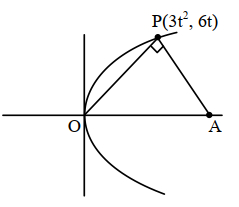
0 likes
View Solution996
DifficultMCQ
Let the locus of the mid-point of the chord through the origin $O$ of the parabola $y^{2}=4x$ be the curve $S$. Let $P$ be any point on $S$. Then the locus of the point,which internally divides $OP$ in the ratio $3:1$,is:
A
$3y^2=2x$
B
$2y^2=3x$
C
$3x^2=2y$
D
$2x^2=3y$
Solution
(B) Let the parabola be $y^2=4x$. Any point on the parabola is $P(t^2, 2t)$.
The chord passes through the origin $O(0,0)$ and $P(t^2, 2t)$.
The mid-point $M(h, k)$ of the chord $OP$ is given by $h = \frac{t^2+0}{2} = \frac{t^2}{2}$ and $k = \frac{2t+0}{2} = t$.
Substituting $t=k$ into $h = \frac{t^2}{2}$,we get $h = \frac{k^2}{2}$,so $k^2=2h$.
The locus $S$ is $y^2=2x$.
Let $P(x_0, y_0)$ be a point on $S$,so $y_0^2=2x_0$. Since $P$ is on $S$,we can write $P$ as $(2t^2, 2t)$ because $(2t)^2 = 2(2t^2)$.
Let $R(x, y)$ be the point that divides $OP$ internally in the ratio $3:1$. Using the section formula:
$x = \frac{3(2t^2) + 1(0)}{3+1} = \frac{6t^2}{4} = \frac{3t^2}{2}$
$y = \frac{3(2t) + 1(0)}{3+1} = \frac{6t}{4} = \frac{3t}{2}$
From $y = \frac{3t}{2}$,we get $t = \frac{2y}{3}$.
Substituting $t$ into $x = \frac{3t^2}{2}$:
$x = \frac{3}{2} \left(\frac{2y}{3}\right)^2 = \frac{3}{2} \cdot \frac{4y^2}{9} = \frac{2y^2}{3}$
Thus,$3x = 2y^2$,or $2y^2=3x$.
The chord passes through the origin $O(0,0)$ and $P(t^2, 2t)$.
The mid-point $M(h, k)$ of the chord $OP$ is given by $h = \frac{t^2+0}{2} = \frac{t^2}{2}$ and $k = \frac{2t+0}{2} = t$.
Substituting $t=k$ into $h = \frac{t^2}{2}$,we get $h = \frac{k^2}{2}$,so $k^2=2h$.
The locus $S$ is $y^2=2x$.
Let $P(x_0, y_0)$ be a point on $S$,so $y_0^2=2x_0$. Since $P$ is on $S$,we can write $P$ as $(2t^2, 2t)$ because $(2t)^2 = 2(2t^2)$.
Let $R(x, y)$ be the point that divides $OP$ internally in the ratio $3:1$. Using the section formula:
$x = \frac{3(2t^2) + 1(0)}{3+1} = \frac{6t^2}{4} = \frac{3t^2}{2}$
$y = \frac{3(2t) + 1(0)}{3+1} = \frac{6t}{4} = \frac{3t}{2}$
From $y = \frac{3t}{2}$,we get $t = \frac{2y}{3}$.
Substituting $t$ into $x = \frac{3t^2}{2}$:
$x = \frac{3}{2} \left(\frac{2y}{3}\right)^2 = \frac{3}{2} \cdot \frac{4y^2}{9} = \frac{2y^2}{3}$
Thus,$3x = 2y^2$,or $2y^2=3x$.
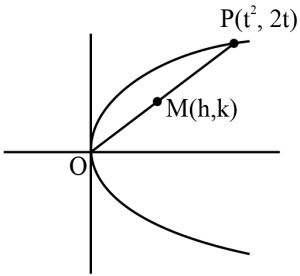
0 likes
View Solution997
DifficultMCQ
If the chord joining the points $P_{1}(x_{1}, y_{1})$ and $P_{2}(x_{2}, y_{2})$ on the parabola $y^{2} = 12x$ subtends a right angle at the vertex of the parabola,then $x_{1}x_{2} - y_{1}y_{2}$ is equal to
A
$288$
B
$280$
C
$284$
D
$292$
Solution
(A) For the parabola $y^{2} = 4ax$,where $4a = 12$,we have $a = 3$. The points on the parabola are $P_{1}(3t_{1}^{2}, 6t_{1})$ and $P_{2}(3t_{2}^{2}, 6t_{2})$.
Since the chord $P_{1}P_{2}$ subtends a right angle at the vertex $(0, 0)$,the product of the slopes of $OP_{1}$ and $OP_{2}$ is $-1$.
Slope $m_{1} = \frac{6t_{1}}{3t_{1}^{2}} = \frac{2}{t_{1}}$ and $m_{2} = \frac{6t_{2}}{3t_{2}^{2}} = \frac{2}{t_{2}}$.
Thus,$(\frac{2}{t_{1}})(\frac{2}{t_{2}}) = -1 \implies t_{1}t_{2} = -4$.
Now,$x_{1}x_{2} = (3t_{1}^{2})(3t_{2}^{2}) = 9(t_{1}t_{2})^{2} = 9(-4)^{2} = 9(16) = 144$.
And $y_{1}y_{2} = (6t_{1})(6t_{2}) = 36(t_{1}t_{2}) = 36(-4) = -144$.
Therefore,$x_{1}x_{2} - y_{1}y_{2} = 144 - (-144) = 144 + 144 = 288$.
Since the chord $P_{1}P_{2}$ subtends a right angle at the vertex $(0, 0)$,the product of the slopes of $OP_{1}$ and $OP_{2}$ is $-1$.
Slope $m_{1} = \frac{6t_{1}}{3t_{1}^{2}} = \frac{2}{t_{1}}$ and $m_{2} = \frac{6t_{2}}{3t_{2}^{2}} = \frac{2}{t_{2}}$.
Thus,$(\frac{2}{t_{1}})(\frac{2}{t_{2}}) = -1 \implies t_{1}t_{2} = -4$.
Now,$x_{1}x_{2} = (3t_{1}^{2})(3t_{2}^{2}) = 9(t_{1}t_{2})^{2} = 9(-4)^{2} = 9(16) = 144$.
And $y_{1}y_{2} = (6t_{1})(6t_{2}) = 36(t_{1}t_{2}) = 36(-4) = -144$.
Therefore,$x_{1}x_{2} - y_{1}y_{2} = 144 - (-144) = 144 + 144 = 288$.
0 likes
View Solution10-2. Parabola, Ellipse, Hyperbola — Parabola · Frequently Asked Questions
1Are these 10-2. Parabola, Ellipse, Hyperbola questions useful for JEE and NEET?
Yes. All questions in this section are mapped to JEE Main and NEET exam patterns. Previous year questions from JEE Main, NEET, GUJCET and state-level exams are included with full solutions.
2Can I switch to Hindi or Gujarati for these questions?
Yes. Use the language tabs in the hero section or the sidebar to view the same questions and solutions in English, Hindi or Gujarati.
3How do I generate a question paper from this subtopic?
Use the Vedclass Exam Paper Generator — select the chapter and subtopic, set difficulty, and generate Sets A, B, C, D automatically. First 3 chapters of every subject are free.
Vedclass Products
For Students
Vedclass Test Series
Mock tests in real JEE/NEET style with performance analysis. 5-day free trial.
Start Free TrialFor Teachers
Exam Paper Generator
Generate Set A/B/C/D papers from this chapter in 2 minutes. 3 chapters free.
Try FreeFor Institutes
Online Exam Module
Live online exams with unlimited students, 360° analytics & white-label branding.
See DemoFor Teachers & Institutes
Generate a 10-2. Parabola, Ellipse, Hyperbola Exam Paper in 2 Minutes
Select subtopic & difficulty — Sets A, B, C, D auto-generated with No Repeat logic.
First 3 chapters of every subject are free — no payment required.