
A English
Carbon family Questions in English
Class 11 Chemistry · p-Block Elements (Class 11) · Carbon family
635+
Questions
English
Language
100%
With Solutions
Showing 50 of 635 questions in English
151
MediumMCQ
Which of the following forms cyclic silicones on hydrolysis?
A
$R_2SiCl_2$
B
$R_3SiCl$
C
$RSiCl_3$
D
None of these
Solution
(A) The hydrolysis of $R_2SiCl_2$ (dialkyldichlorosilane) leads to the formation of linear or cyclic silicones.
Specifically,the hydrolysis of $R_2SiCl_2$ produces $R_2Si(OH)_2$,which undergoes condensation polymerization to form linear chains or cyclic structures like $(R_2SiO)_n$.
Specifically,the hydrolysis of $R_2SiCl_2$ produces $R_2Si(OH)_2$,which undergoes condensation polymerization to form linear chains or cyclic structures like $(R_2SiO)_n$.
0 likes
View Solution152
EasyMCQ
The gas which turns lime water milky is
A
$CO_2$
B
$SO_2$
C
Both
D
None
Solution
(C) Lime water is a solution of calcium hydroxide,$Ca(OH)_2$.
When carbon dioxide $(CO_2)$ is passed through lime water,it forms an insoluble precipitate of calcium carbonate $(CaCO_3)$,which turns the solution milky:
$Ca(OH)_2(aq) + CO_2(g) \rightarrow CaCO_3(s) + H_2O(l)$.
Similarly,sulfur dioxide $(SO_2)$ also reacts with lime water to form calcium sulfite $(CaSO_3)$,which is also an insoluble white precipitate,turning the solution milky:
$Ca(OH)_2(aq) + SO_2(g) \rightarrow CaSO_3(s) + H_2O(l)$.
Therefore,both gases turn lime water milky.
When carbon dioxide $(CO_2)$ is passed through lime water,it forms an insoluble precipitate of calcium carbonate $(CaCO_3)$,which turns the solution milky:
$Ca(OH)_2(aq) + CO_2(g) \rightarrow CaCO_3(s) + H_2O(l)$.
Similarly,sulfur dioxide $(SO_2)$ also reacts with lime water to form calcium sulfite $(CaSO_3)$,which is also an insoluble white precipitate,turning the solution milky:
$Ca(OH)_2(aq) + SO_2(g) \rightarrow CaSO_3(s) + H_2O(l)$.
Therefore,both gases turn lime water milky.
0 likes
View Solution153
MediumMCQ
$X \xrightarrow{CoCl_2} CaCl_2 + Y \uparrow$; the effective ingredient of $X$ is
A
$OCl^{-}$
B
$Cl^{-}$
C
$OCl^{+}$
D
$OCl_2^-$
Solution
(A) The reaction represents the catalytic decomposition of bleaching powder $(CaOCl_2)$ in the presence of cobalt chloride $(CoCl_2)$.
Bleaching powder is represented as $Ca(OCl)Cl$.
When $CaOCl_2$ reacts with $CoCl_2$,it decomposes to form calcium chloride $(CaCl_2)$ and oxygen gas $(O_2)$: $2CaOCl_2 \xrightarrow{CoCl_2} 2CaCl_2 + O_2 \uparrow$.
The effective oxidizing or active ingredient in bleaching powder is the hypochlorite ion,$OCl^-$,which is responsible for its bleaching and oxidizing properties.
Bleaching powder is represented as $Ca(OCl)Cl$.
When $CaOCl_2$ reacts with $CoCl_2$,it decomposes to form calcium chloride $(CaCl_2)$ and oxygen gas $(O_2)$: $2CaOCl_2 \xrightarrow{CoCl_2} 2CaCl_2 + O_2 \uparrow$.
The effective oxidizing or active ingredient in bleaching powder is the hypochlorite ion,$OCl^-$,which is responsible for its bleaching and oxidizing properties.
0 likes
View Solution154
MediumMCQ
An inorganic compound $(A)$ made of the two most occurring elements in the earth's crust,having a polymeric tetrahedral network structure. With carbon,compound $(A)$ produces a poisonous gas $(B)$ which is the most stable diatomic molecule. Compounds $(A)$ and $(B)$ are:
A
$SiO_2, CO_2$
B
$SiO_2, CO$
C
$SiC, CO$
D
$SiO_2, N_2$
Solution
(B) The two most abundant elements in the earth's crust are oxygen and silicon. The inorganic compound $(A)$ with a polymeric tetrahedral network structure is silica,$SiO_2$.
When $SiO_2$ reacts with carbon at high temperatures,it produces silicon and carbon monoxide gas:
$SiO_2 + 2C \rightarrow Si + 2CO$
Compound $(B)$ is carbon monoxide $(CO)$,which is a poisonous gas and is known to be the most stable diatomic molecule due to its high bond dissociation energy.
Therefore,the compounds are $(A) = SiO_2$ and $(B) = CO$.
When $SiO_2$ reacts with carbon at high temperatures,it produces silicon and carbon monoxide gas:
$SiO_2 + 2C \rightarrow Si + 2CO$
Compound $(B)$ is carbon monoxide $(CO)$,which is a poisonous gas and is known to be the most stable diatomic molecule due to its high bond dissociation energy.
Therefore,the compounds are $(A) = SiO_2$ and $(B) = CO$.
0 likes
View Solution155
EasyMCQ
$RCl$ $\xrightarrow[Si]{Cu \text{ powder}} R_2SiCl_2$ $\xrightarrow{H_2O} R_2Si(OH)_2$ $\xrightarrow{\text{condensation}} A$
Compound $(A)$ is:
Compound $(A)$ is:
A
a linear silicone
B
a chlorosilane
C
a linear silane
D
a network silane
Solution
(A) The hydrolysis of $R_2SiCl_2$ yields dialkyl silanediol,$R_2Si(OH)_2$.
Upon condensation (polymerization),these silanediol units eliminate water molecules to form a linear polymeric chain with alternating silicon and oxygen atoms,known as a linear silicone.
The reaction sequence is:
$RCl$ $\xrightarrow[Si]{Cu \text{ powder}} R_2SiCl_2$ $\xrightarrow{H_2O} R_2Si(OH)_2$ $\xrightarrow{\text{condensation}} -(O-SiR_2)_n-$
Therefore,compound $(A)$ is a linear silicone.
Upon condensation (polymerization),these silanediol units eliminate water molecules to form a linear polymeric chain with alternating silicon and oxygen atoms,known as a linear silicone.
The reaction sequence is:
$RCl$ $\xrightarrow[Si]{Cu \text{ powder}} R_2SiCl_2$ $\xrightarrow{H_2O} R_2Si(OH)_2$ $\xrightarrow{\text{condensation}} -(O-SiR_2)_n-$
Therefore,compound $(A)$ is a linear silicone.
0 likes
View Solution156
MediumMCQ
What products will be formed when calcium carbide reacts with nitrogen at $1000 \ ^oC$?
A
$Ca_3N_2 + C$
B
$CaCN_2 + C$
C
$Ca(CN)_2$
D
$Ca_2C_3 + (CN)_2$
Solution
(B) When calcium carbide $(CaC_2)$ reacts with nitrogen $(N_2)$ at approximately $1000 \ ^oC$,it forms calcium cyanamide $(CaCN_2)$ and carbon $(C)$.
This reaction is represented by the chemical equation:
$CaC_2 + N_2 \xrightarrow{1000 \ ^oC} CaCN_2 + C$
This mixture of $CaCN_2$ and $C$ is known as nitrolim,which is used as a fertilizer.
This reaction is represented by the chemical equation:
$CaC_2 + N_2 \xrightarrow{1000 \ ^oC} CaCN_2 + C$
This mixture of $CaCN_2$ and $C$ is known as nitrolim,which is used as a fertilizer.
0 likes
View Solution157
MediumMCQ
Which of the following salts cannot exist?
A
Sodium hydrogen hypophosphite
B
Sodium dihydrogen pyrophosphate
C
Sodium hydrogen hypophosphate
D
Sodium dihydrogen hypophosphate
Solution
(A) The formula for hypophosphorous acid $(H_3PO_2)$ is $H(H_2PO_2)$. It is a monobasic acid because it contains only one $P-OH$ bond. Therefore,it can only form one type of salt,which is $NaH_2PO_2$ (sodium hypophosphite). It cannot form a 'sodium hydrogen hypophosphite' salt because there are no replaceable hydrogen atoms left after the formation of the primary salt. Thus,option $A$ is not possible.
0 likes
View Solution158
MediumMCQ
Choose the correct statement about silicones.
A
Silicones are used as antifoaming agents in sewage disposal,beer making,and in cooking oil used to prepare potato chips.
B
In the preparation of $R_2SiCl_2$ from $Si$,copper powder is used as a catalyst.
C
Using $R_3SiCl$ in a certain proportion,we can control the chain length of the polymer.
D
All of these.
Solution
(D) Silicones are organosilicon polymers with the general formula $(R_2SiO)_n$.
Statement $A$ is correct: Silicones are hydrophobic and are widely used as antifoaming agents in various industrial processes.
Statement $B$ is correct: The direct synthesis of alkylchlorosilanes involves the reaction of silicon with alkyl chlorides in the presence of copper powder as a catalyst at $570 \ K$.
Statement $C$ is correct: The chain length of the silicone polymer can be controlled by adding $R_3SiCl$,which acts as a chain terminator by blocking the end of the polymer chain.
Since all statements are correct,the correct option is $D$.
Statement $A$ is correct: Silicones are hydrophobic and are widely used as antifoaming agents in various industrial processes.
Statement $B$ is correct: The direct synthesis of alkylchlorosilanes involves the reaction of silicon with alkyl chlorides in the presence of copper powder as a catalyst at $570 \ K$.
Statement $C$ is correct: The chain length of the silicone polymer can be controlled by adding $R_3SiCl$,which acts as a chain terminator by blocking the end of the polymer chain.
Since all statements are correct,the correct option is $D$.
0 likes
View Solution159
DifficultMCQ
Consider the following reactions:
$Me_3SiCl \xrightarrow{H_2O} A$
$Me_2SiCl_2 \xrightarrow{H_2O} B$
$MeSiCl_3 \xrightarrow{H_2O} C$
$A$,$B$,and $C$ are known as . . . . . . , . . . . . . ,and . . . . . . respectively in silicones formation.
$Me_3SiCl \xrightarrow{H_2O} A$
$Me_2SiCl_2 \xrightarrow{H_2O} B$
$MeSiCl_3 \xrightarrow{H_2O} C$
$A$,$B$,and $C$ are known as . . . . . . , . . . . . . ,and . . . . . . respectively in silicones formation.
A
Terminal group,chain forming group,branching and bridging group
B
Chain forming group,branching,bridging ground and terminal group
C
Terminal group,branching and bridging group and chain forming group
D
Branching and bridging group,Terminal group and chain forming group
Solution
(A) The hydrolysis of chlorosilanes is the first step in the formation of silicones.
$1$. $Me_3SiCl + H_2O \rightarrow Me_3SiOH + HCl$. This product $(A)$ has only one reactive site and acts as a $Terminal \ group$ to stop chain growth.
$2$. $Me_2SiCl_2 + 2H_2O \rightarrow Me_2Si(OH)_2 + 2HCl$. This product $(B)$ has two reactive sites and acts as a $Chain \ forming \ group$ to extend the polymer chain.
$3$. $MeSiCl_3 + 3H_2O \rightarrow MeSi(OH)_3 + 3HCl$. This product $(C)$ has three reactive sites and acts as a $Branching \ and \ bridging \ group$ to create cross-linked structures.
Therefore,the correct sequence is $Terminal \ group$,$Chain \ forming \ group$,and $Branching \ and \ bridging \ group$.
$1$. $Me_3SiCl + H_2O \rightarrow Me_3SiOH + HCl$. This product $(A)$ has only one reactive site and acts as a $Terminal \ group$ to stop chain growth.
$2$. $Me_2SiCl_2 + 2H_2O \rightarrow Me_2Si(OH)_2 + 2HCl$. This product $(B)$ has two reactive sites and acts as a $Chain \ forming \ group$ to extend the polymer chain.
$3$. $MeSiCl_3 + 3H_2O \rightarrow MeSi(OH)_3 + 3HCl$. This product $(C)$ has three reactive sites and acts as a $Branching \ and \ bridging \ group$ to create cross-linked structures.
Therefore,the correct sequence is $Terminal \ group$,$Chain \ forming \ group$,and $Branching \ and \ bridging \ group$.
0 likes
View Solution160
MediumMCQ
Sulphur is most soluble in
A
$CS_2$
B
$Et_2O$
C
Ethanol
D
$H_2O$
Solution
(A) Sulphur is a non-polar covalent molecule.
According to the principle of 'like dissolves like',it is highly soluble in non-polar organic solvents.
$CS_2$ (carbon disulphide) is a non-polar solvent,making it the best solvent for sulphur.
Sulphur is insoluble in water $(H_2O)$.
According to the principle of 'like dissolves like',it is highly soluble in non-polar organic solvents.
$CS_2$ (carbon disulphide) is a non-polar solvent,making it the best solvent for sulphur.
Sulphur is insoluble in water $(H_2O)$.
0 likes
View Solution161
MediumMCQ
The formula of $3$ membered discrete chain silicate is
A
$Si_3O_9^{6-}$
B
$Si_3O_{10}^{8-}$
C
$Si_3O_6^{3-}$
D
$Si_3O_{12}^{12-}$
Solution
(A) In cyclic silicates,$n$ number of $SiO_4^{4-}$ tetrahedra are linked together by sharing $2$ oxygen atoms per tetrahedron to form a ring structure.
The general formula for cyclic silicates is $(SiO_3)_n^{2n-}$.
For a $3$ membered ring,$n = 3$.
Substituting $n = 3$ into the formula,we get $(SiO_3)_3^{2(3)-} = Si_3O_9^{6-}$.
Therefore,the correct formula is $Si_3O_9^{6-}$.
The general formula for cyclic silicates is $(SiO_3)_n^{2n-}$.
For a $3$ membered ring,$n = 3$.
Substituting $n = 3$ into the formula,we get $(SiO_3)_3^{2(3)-} = Si_3O_9^{6-}$.
Therefore,the correct formula is $Si_3O_9^{6-}$.
0 likes
View Solution162
DifficultMCQ
If in a mineral $1000$ tetrahedral basic unit of silicates are arranged in a chain,then what will be the formula of the anion of that mineral?
A
$Si_{1000}O_{3000}^{-2000}$
B
$Si_{1000}O_{3001}^{-2004}$
C
$Si_{1000}O_{3000}^{-2001}$
D
$Si_{1000}O_{3001}^{-2002}$
Solution
(D) In a chain silicate,each $SiO_4^{4-}$ tetrahedron shares two oxygen atoms with other tetrahedra.
For a chain consisting of $n$ units,the general formula for the silicate anion is $(SiO_3)_n^{2n-}$.
Given $n = 1000$,the formula becomes $Si_{1000}O_{3000}^{2000-}$.
However,the terminal oxygen atoms in the chain are not shared,meaning each end unit has one additional oxygen atom and carries an extra negative charge.
For a linear chain of $n$ units,the formula is $(Si_nO_{3n+1})^{(2n+2)-}$.
Substituting $n = 1000$:
$Si_{1000}O_{3(1000)+1}^{(2(1000)+2)-} = Si_{1000}O_{3001}^{2002-}$.
Thus,the correct option is $D$.
For a chain consisting of $n$ units,the general formula for the silicate anion is $(SiO_3)_n^{2n-}$.
Given $n = 1000$,the formula becomes $Si_{1000}O_{3000}^{2000-}$.
However,the terminal oxygen atoms in the chain are not shared,meaning each end unit has one additional oxygen atom and carries an extra negative charge.
For a linear chain of $n$ units,the formula is $(Si_nO_{3n+1})^{(2n+2)-}$.
Substituting $n = 1000$:
$Si_{1000}O_{3(1000)+1}^{(2(1000)+2)-} = Si_{1000}O_{3001}^{2002-}$.
Thus,the correct option is $D$.
0 likes
View Solution163
AdvancedMCQ
$NaHSO_3$ is heated to produce $H_2O$ and compound $'A'$. Which of the following statements is $INCORRECT$ about $'A'$?
A
$A$ has $S-O-S$ type of linkage
B
$S$ atoms have $sp^3$ hybridisation
C
$A$ has $S-S$ linkage
D
One $S$ has one lone pair
Solution
(A) The reaction is: $2NaHSO_3 \xrightarrow{\Delta} Na_2S_2O_5 + H_2O$.
Compound $'A'$ is sodium metabisulphite $(Na_2S_2O_5)$.
The structure of the $[S_2O_5]^{2-}$ ion shows a direct $S-S$ bond between the two sulphur atoms.
In this structure,one sulphur atom is bonded to three oxygen atoms and the other sulphur atom,and it has a lone pair. The other sulphur atom is bonded to four oxygen atoms (including the $S-S$ bond) and has no lone pair.
Thus,the statement that '$A$ has $S-O-S$ type of linkage' is $INCORRECT$ because it contains an $S-S$ bond,not an $S-O-S$ bond.
Compound $'A'$ is sodium metabisulphite $(Na_2S_2O_5)$.
The structure of the $[S_2O_5]^{2-}$ ion shows a direct $S-S$ bond between the two sulphur atoms.
In this structure,one sulphur atom is bonded to three oxygen atoms and the other sulphur atom,and it has a lone pair. The other sulphur atom is bonded to four oxygen atoms (including the $S-S$ bond) and has no lone pair.
Thus,the statement that '$A$ has $S-O-S$ type of linkage' is $INCORRECT$ because it contains an $S-S$ bond,not an $S-O-S$ bond.
0 likes
View Solution164
MediumMCQ
Silicon has a strong tendency to form polymers like silicones. The chain length of silicone polymer can be controlled by adding :-
A
$RSiCl_3$
B
$R_3SiCl$
C
$R_2SiCl_2$
D
$R_4Si$
Solution
(B) Silicones are synthetic organosilicon polymers with the general formula $(R_2SiO)_n$.
They are produced by the hydrolysis of alkyl-substituted chlorosilanes.
To control the chain length of the silicone polymer,a monofunctional unit like $R_3SiCl$ is added.
This unit acts as a chain terminator because it can only form one siloxane bond,preventing further polymerization at that end of the chain.
They are produced by the hydrolysis of alkyl-substituted chlorosilanes.
To control the chain length of the silicone polymer,a monofunctional unit like $R_3SiCl$ is added.
This unit acts as a chain terminator because it can only form one siloxane bond,preventing further polymerization at that end of the chain.
0 likes
View Solution165
MediumMCQ
Consider the following reaction:
$R_2SiCl_2 + H_2O \to (1) \xrightarrow{\text{polymerisation}} (2)$
Compound $(2)$ in the above reaction is:
$R_2SiCl_2 + H_2O \to (1) \xrightarrow{\text{polymerisation}} (2)$
Compound $(2)$ in the above reaction is:
A
Dimer silicone
B
Linear silicone
C
Cross-linked silicone
D
Polymerisation of $(1)$ does not occur
Solution
(B) The hydrolysis of dialkyldichlorosilane $(R_2SiCl_2)$ proceeds as follows:
$R_2SiCl_2 + 2H_2O \to R_2Si(OH)_2 + 2HCl$
Compound $(1)$ is the silanediol $(R_2Si(OH)_2)$.
Upon polymerization,these silanediol units undergo condensation to form linear silicone polymers:
$n R_2Si(OH)_2 \to -[Si(R)_2-O]_n- + nH_2O$
Thus,compound $(2)$ is a linear silicone.
$R_2SiCl_2 + 2H_2O \to R_2Si(OH)_2 + 2HCl$
Compound $(1)$ is the silanediol $(R_2Si(OH)_2)$.
Upon polymerization,these silanediol units undergo condensation to form linear silicone polymers:
$n R_2Si(OH)_2 \to -[Si(R)_2-O]_n- + nH_2O$
Thus,compound $(2)$ is a linear silicone.
0 likes
View Solution166
DifficultMCQ
The formula of the following silicate anion structure is,where $\cdot = Si$ atom,$o = O$ atom.
A
$SiO_4^{4-}$
B
$Si_2O_7^{6-}$
C
$Si_3O_{10}^{8-}$
D
$Si_3O_9^{6-}$
Solution
(C) The structure shows $3$ $SiO_4^{4-}$ tetrahedra linked by sharing $2$ oxygen atoms in total.
Each of the two terminal $Si$ atoms shares $1$ oxygen atom with the central $Si$ atom.
Number of $Si$ atoms = $3$.
Number of shared oxygen atoms = $2$.
Number of unshared oxygen atoms = $3 \times 4 - 2 \times 2 = 8$.
Total oxygen atoms = $8 + 2 = 10$.
The formula is $Si_3O_{10}^{8-}$.
Each of the two terminal $Si$ atoms shares $1$ oxygen atom with the central $Si$ atom.
Number of $Si$ atoms = $3$.
Number of shared oxygen atoms = $2$.
Number of unshared oxygen atoms = $3 \times 4 - 2 \times 2 = 8$.
Total oxygen atoms = $8 + 2 = 10$.
The formula is $Si_3O_{10}^{8-}$.
0 likes
View Solution167
MediumMCQ
Holme's signals can be given by using
A
$CaC_2 + CaCN_2$
B
$CaC_2 + Ca_3P_2$
C
$CaC_2 + CaCO_3$
D
$Ca_3P_2 + CaCN_2$
Solution
(B) Holmes signals are produced using a mixture of calcium carbide $(CaC_2)$ and calcium phosphide $(Ca_3P_2)$.
When this mixture is placed in a container and thrown into the sea,it reacts with water.
$CaC_2 + 2H_2O \rightarrow Ca(OH)_2 + C_2H_2$ (Acetylene gas)
$Ca_3P_2 + 6H_2O \rightarrow 3Ca(OH)_2 + 2PH_3$ (Phosphine gas)
The phosphine gas $(PH_3)$ catches fire spontaneously upon contact with air,which ignites the acetylene gas $(C_2H_2)$,creating a bright flame that serves as a signal for ships.
When this mixture is placed in a container and thrown into the sea,it reacts with water.
$CaC_2 + 2H_2O \rightarrow Ca(OH)_2 + C_2H_2$ (Acetylene gas)
$Ca_3P_2 + 6H_2O \rightarrow 3Ca(OH)_2 + 2PH_3$ (Phosphine gas)
The phosphine gas $(PH_3)$ catches fire spontaneously upon contact with air,which ignites the acetylene gas $(C_2H_2)$,creating a bright flame that serves as a signal for ships.
0 likes
View Solution168
MediumMCQ
Which of the following units is used to form cross-linked silicone?
A
$RSiCl_3$
B
$R_2SiCl_2$
C
$R_3SiCl$
D
All
Solution
(A) $RSiCl_3$ is used to form cross-linked silicones because it has three reactive chlorine atoms,allowing for branching in three directions.
$R_2SiCl_2$ is used to form linear chain polymers.
$R_3SiCl$ is used to terminate the chain,forming a dimer.
$R_2SiCl_2$ is used to form linear chain polymers.
$R_3SiCl$ is used to terminate the chain,forming a dimer.
0 likes
View Solution169
DifficultMCQ
$(Me)_2SiCl_2$ on condensation after hydrolysis will produce
A
$Si(OH)_4$
B
$(Me)_2Si = O$
C
$[-(Me)_2SiO-]_n$
D
$Me_2SiCl(OH)$
Solution
(C) The hydrolysis of $(Me)_2SiCl_2$ involves the replacement of chlorine atoms by hydroxyl groups to form $(Me)_2Si(OH)_2$.
This intermediate undergoes condensation polymerization by eliminating water molecules to form a linear silicone polymer with the repeating unit $[-(Me)_2SiO-]_n$.
This intermediate undergoes condensation polymerization by eliminating water molecules to form a linear silicone polymer with the repeating unit $[-(Me)_2SiO-]_n$.
0 likes
View Solution170
MediumMCQ
Name the type of the structure of silicate in which one oxygen atom of $[SiO_4]^{4-}$ is shared?
A
Linear chain silicate
B
Sheet silicate
C
Pyrosilicate
D
Three dimensional silicate
Solution
(C) In pyrosilicates,two $[SiO_4]^{4-}$ tetrahedral units are joined by sharing one oxygen atom at one corner. This results in the formation of the $[Si_2O_7]^{6-}$ anion. Therefore,the structure is known as pyrosilicate.
0 likes
View Solution171
MediumMCQ
Match the following:
| List-$I$ (Compound) | List-$II$ (Silicate) |
|---|---|
| $A$. Zircon $(ZrSiO_4)$ | $P$. Ring/Cyclic |
| $B$. Talc $(Mg_3(OH)_2(Si_2O_5)_2)$ | $Q$. Ortho |
| $C$. Thortveitite $(Sc_2Si_2O_7)$ | $R$. Pyro |
| $D$. Benitoite $(BaTiSi_3O_9)$ | $S$. Sheet |
A
$A \to Q, B \to S, C \to P, D \to R$
B
$A \to S, B \to Q, C \to R, D \to P$
C
$A \to Q, B \to S, C \to R, D \to P$
D
$A \to Q, B \to R, C \to P, D \to S$
Solution
(C) . Zircon $(ZrSiO_4)$ is an orthosilicate containing discrete $SiO_4^{4-}$ units. Thus,$A \to Q$.
$B$. Talc $(Mg_3(OH)_2(Si_2O_5)_2)$ is a sheet silicate where $SiO_4$ tetrahedra share three oxygen atoms. Thus,$B \to S$.
$C$. Thortveitite $(Sc_2Si_2O_7)$ is a pyrosilicate containing $Si_2O_7^{6-}$ units. Thus,$C \to R$.
$D$. Benitoite $(BaTiSi_3O_9)$ is a cyclic (ring) silicate containing $Si_3O_9^{6-}$ units. Thus,$D \to P$.
Therefore,the correct match is $A \to Q, B \to S, C \to R, D \to P$.
$B$. Talc $(Mg_3(OH)_2(Si_2O_5)_2)$ is a sheet silicate where $SiO_4$ tetrahedra share three oxygen atoms. Thus,$B \to S$.
$C$. Thortveitite $(Sc_2Si_2O_7)$ is a pyrosilicate containing $Si_2O_7^{6-}$ units. Thus,$C \to R$.
$D$. Benitoite $(BaTiSi_3O_9)$ is a cyclic (ring) silicate containing $Si_3O_9^{6-}$ units. Thus,$D \to P$.
Therefore,the correct match is $A \to Q, B \to S, C \to R, D \to P$.
0 likes
View Solution172
EasyMCQ
Inert pair effect is predominant in
A
$Si$
B
$Pb$
C
$Ge$
D
$Sn$
Solution
(B) The inert pair effect refers to the tendency of the electrons in the outermost $s$-subshell of post-transition elements to remain unshared and not participate in bonding.
This effect becomes more pronounced as we move down a group in the $p$-block elements (Groups $13, 14, 15$).
It is primarily attributed to the poor shielding effect of the intervening $d$ and $f$ electrons,which causes the $s$-electrons to be held more tightly by the nucleus.
In Group $14$,the stability of the $+2$ oxidation state increases down the group $(C < Si < Ge < Sn < Pb)$.
Therefore,$Pb$ (lead) exhibits the most significant inert pair effect,making its $+2$ oxidation state more stable than its $+4$ oxidation state.
Hence,option $B$ is correct.
This effect becomes more pronounced as we move down a group in the $p$-block elements (Groups $13, 14, 15$).
It is primarily attributed to the poor shielding effect of the intervening $d$ and $f$ electrons,which causes the $s$-electrons to be held more tightly by the nucleus.
In Group $14$,the stability of the $+2$ oxidation state increases down the group $(C < Si < Ge < Sn < Pb)$.
Therefore,$Pb$ (lead) exhibits the most significant inert pair effect,making its $+2$ oxidation state more stable than its $+4$ oxidation state.
Hence,option $B$ is correct.
0 likes
View Solution173
DifficultMCQ
$P_4 + NaOH + H_2O \to x + y$; find the sum of total $P-H$ bonds in $x$ and $y$.
A
$3$
B
$4$
C
$5$
D
$2$
Solution
(C) The balanced chemical equation for the reaction is: $P_4 + 3NaOH + 3H_2O \to PH_3 + 3NaH_2PO_2$.
Here,$x = PH_3$ and $y = NaH_2PO_2$.
In $PH_3$ (phosphine),there are $3$ $P-H$ bonds.
In $NaH_2PO_2$ (sodium hypophosphite),the structure is $Na^+[H_2PO_2]^-$,where the anion contains $2$ $P-H$ bonds.
Total $P-H$ bonds $= 3 + 2 = 5$.
Here,$x = PH_3$ and $y = NaH_2PO_2$.
In $PH_3$ (phosphine),there are $3$ $P-H$ bonds.
In $NaH_2PO_2$ (sodium hypophosphite),the structure is $Na^+[H_2PO_2]^-$,where the anion contains $2$ $P-H$ bonds.
Total $P-H$ bonds $= 3 + 2 = 5$.
0 likes
View Solution174
DifficultMCQ
For correct statement use $T$ and for incorrect use $F$:
$(A)$ Hydrolysis of Marshall's acid gives $H_2SO_4$ and $H_2O_2$ as final products.
$(B)$ In $SCNSiH_3$ structure,the geometry around $N$ is bent.
$(C)$ The basic unit for silicates is $SiO_4^{4-}$.
$(D)$ $NH_4Cl + NaOH \to NH_3 \uparrow$.
$(A)$ Hydrolysis of Marshall's acid gives $H_2SO_4$ and $H_2O_2$ as final products.
$(B)$ In $SCNSiH_3$ structure,the geometry around $N$ is bent.
$(C)$ The basic unit for silicates is $SiO_4^{4-}$.
$(D)$ $NH_4Cl + NaOH \to NH_3 \uparrow$.
A
$TTTT$
B
$FTFT$
C
$TFTT$
D
$FFTT$
Solution
(C) Marshall's acid $(H_2S_2O_8)$ undergoes hydrolysis to give sulfuric acid and hydrogen peroxide: $H_2S_2O_8 + 2H_2O \to 2H_2SO_4 + H_2O_2$. (True)
$(B)$ In $H_3SiNCS$,due to $p\pi-d\pi$ back-bonding from $N$ to $Si$,the $Si-N-C$ bond angle is $180^\circ$ (linear),not bent. (False)
$(C)$ The basic structural unit of all silicates is the $SiO_4^{4-}$ tetrahedron. (True)
$(D)$ Ammonium salts react with strong bases to release ammonia gas: $NH_4Cl + NaOH \to NaCl + NH_3 \uparrow + H_2O$. (True)
Therefore,the correct sequence is $TFTT$.
$(B)$ In $H_3SiNCS$,due to $p\pi-d\pi$ back-bonding from $N$ to $Si$,the $Si-N-C$ bond angle is $180^\circ$ (linear),not bent. (False)
$(C)$ The basic structural unit of all silicates is the $SiO_4^{4-}$ tetrahedron. (True)
$(D)$ Ammonium salts react with strong bases to release ammonia gas: $NH_4Cl + NaOH \to NaCl + NH_3 \uparrow + H_2O$. (True)
Therefore,the correct sequence is $TFTT$.
0 likes
View Solution175
DifficultMCQ
$Si_3O_9^{-6}$ (having three tetrahedral units) is represented as:
A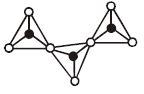
B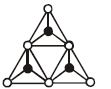
C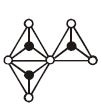
D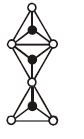
Solution
(B) $Si_3O_9^{-6}$ is a cyclic silicate anion.
In this structure,three $SiO_4^{4-}$ tetrahedral units are linked together in a cyclic ring by sharing two oxygen atoms per tetrahedron.
Option $B$ represents a cyclic structure where three tetrahedral units are connected in a ring,which corresponds to the formula $Si_3O_9^{-6}$.
In this structure,three $SiO_4^{4-}$ tetrahedral units are linked together in a cyclic ring by sharing two oxygen atoms per tetrahedron.
Option $B$ represents a cyclic structure where three tetrahedral units are connected in a ring,which corresponds to the formula $Si_3O_9^{-6}$.
0 likes
View Solution176
MediumMCQ
Select the correct order of melting point:
A
$C > Si$
B
$N < P$
C
Both $(A)$ and $(B)$
D
$NaCl > SiO_2$
Solution
(C) Carbon $(C)$ has a higher melting point than Silicon $(Si)$ because the $C-C$ bond is stronger than the $Si-Si$ bond in their giant covalent network structures.
Nitrogen $(N_2)$ exists as a diatomic gas at room temperature due to weak van der Waals forces,while Phosphorus $(P_4)$ is a solid due to stronger intermolecular forces,hence $N < P$.
$SiO_2$ is a network covalent solid with a very high melting point,whereas $NaCl$ is an ionic solid with a lower melting point compared to $SiO_2$.
Therefore,both $(A)$ and $(B)$ are correct.
Nitrogen $(N_2)$ exists as a diatomic gas at room temperature due to weak van der Waals forces,while Phosphorus $(P_4)$ is a solid due to stronger intermolecular forces,hence $N < P$.
$SiO_2$ is a network covalent solid with a very high melting point,whereas $NaCl$ is an ionic solid with a lower melting point compared to $SiO_2$.
Therefore,both $(A)$ and $(B)$ are correct.
0 likes
View Solution177
EasyMCQ
$C_{60}$ contains:
A
$20$ pentagons and $12$ hexagons
B
$12$ pentagons and $20$ hexagons
C
$30$ pentagons and $30$ hexagons
D
$24$ pentagons and $36$ hexagons
Solution
(B) Buckminsterfullerene is a type of fullerene with the formula $C_{60}$.
It has a cage-like fused-ring structure that resembles a football.
It is composed of $12$ pentagons and $20$ hexagons,with a carbon atom at each vertex of each polygon and a bond along each polygon edge.
It has a cage-like fused-ring structure that resembles a football.
It is composed of $12$ pentagons and $20$ hexagons,with a carbon atom at each vertex of each polygon and a bond along each polygon edge.
0 likes
View Solution178
MediumMCQ
Silicon has a strong tendency to form polymers like silicones. The chain length of silicone polymers can be controlled by adding:
A
$MeSiCl_3$
B
$Me_2SiCl_2$
C
$Me_3SiCl$
D
$Me_4Si$
Solution
(C) The chain length of silicone polymers is controlled by adding $Me_{3}SiCl$ (trimethylchlorosilane).
$Me_{3}SiCl$ acts as a chain terminator because it has only one chlorine atom,which can react with the silanol group to block the end of the polymer chain.
The reaction is as follows:
$Me_{3}SiCl + H_{2}O \rightarrow Me_{3}SiOH + HCl$
This $Me_{3}SiOH$ unit caps the growing polymer chain,preventing further polymerization and thus controlling the chain length.
$Me_{3}SiCl$ acts as a chain terminator because it has only one chlorine atom,which can react with the silanol group to block the end of the polymer chain.
The reaction is as follows:
$Me_{3}SiCl + H_{2}O \rightarrow Me_{3}SiOH + HCl$
This $Me_{3}SiOH$ unit caps the growing polymer chain,preventing further polymerization and thus controlling the chain length.
0 likes
View Solution179
MediumMCQ
Which of the following oxides does not react with $NaOH$ as well as with $HCl$?
A
$Al_2O_3$
B
$ZnO$
C
$N_2O$
D
All
Solution
(C) Oxides that react with both acids and bases are called amphoteric oxides.
$Al_2O_3$ and $ZnO$ are well-known amphoteric oxides,meaning they react with both $HCl$ (acid) and $NaOH$ (base).
$N_2O$ (nitrous oxide) is a neutral oxide.
Neutral oxides do not react with either acids or bases.
Therefore,$N_2O$ is the correct answer.
$Al_2O_3$ and $ZnO$ are well-known amphoteric oxides,meaning they react with both $HCl$ (acid) and $NaOH$ (base).
$N_2O$ (nitrous oxide) is a neutral oxide.
Neutral oxides do not react with either acids or bases.
Therefore,$N_2O$ is the correct answer.
0 likes
View Solution180
MediumMCQ
Which of the following is an incorrect match regarding the hydrolysis products of organosilicon chlorides?
A
$Me_3SiCl$ $-$ Dimer of silicones
B
$Me_2SiCl_2$ $-$ Linear chain silicones
C
$Ph_2SiCl_3$ $-$ Cross linked silicones
D
$MeSiCl_3$ $-$ Cross linked silicones
Solution
(C) The hydrolysis of organosilicon chlorides leads to the formation of silicones:
$1$. $Me_3SiCl$ on hydrolysis gives $(Me_3Si)_2O$,which is a dimer.
$2$. $Me_2SiCl_2$ on hydrolysis gives linear chain silicones.
$3$. $MeSiCl_3$ on hydrolysis gives cross-linked silicones.
$4$. $Ph_2SiCl_2$ (not $Ph_2SiCl_3$) would be required to form linear silicones; $Ph_2SiCl_3$ is not a standard precursor for cross-linked silicones in this context,and the formula $Ph_2SiCl_3$ is chemically incorrect as silicon typically forms four bonds. Thus,option $C$ is the incorrect match.
$1$. $Me_3SiCl$ on hydrolysis gives $(Me_3Si)_2O$,which is a dimer.
$2$. $Me_2SiCl_2$ on hydrolysis gives linear chain silicones.
$3$. $MeSiCl_3$ on hydrolysis gives cross-linked silicones.
$4$. $Ph_2SiCl_2$ (not $Ph_2SiCl_3$) would be required to form linear silicones; $Ph_2SiCl_3$ is not a standard precursor for cross-linked silicones in this context,and the formula $Ph_2SiCl_3$ is chemically incorrect as silicon typically forms four bonds. Thus,option $C$ is the incorrect match.
0 likes
View Solution181
MediumMCQ
Deep sea divers use a mixture of ....... for respiration.
A
Oxygen and argon
B
Oxygen and helium
C
Oxygen and nitrogen
D
Oxygen and hydrogen
Solution
(B) Deep sea divers use a mixture of $He$ (helium) and $O_2$ (oxygen) for respiration.
This mixture is used because helium is less soluble in blood than nitrogen under high pressure.
This prevents the condition known as 'bends' or decompression sickness,which occurs when nitrogen bubbles form in the blood during rapid ascent.
This mixture is used because helium is less soluble in blood than nitrogen under high pressure.
This prevents the condition known as 'bends' or decompression sickness,which occurs when nitrogen bubbles form in the blood during rapid ascent.
0 likes
View Solution182
MediumMCQ
Which of the following is least stable?
A
$CI_4$
B
$SnI_4$
C
$GeI_4$
D
$PbI_4$
Solution
(D) The stability of tetrahalides of group $14$ elements decreases down the group due to the increasing size of the central metal atom and the inert pair effect.
Specifically,$Pb^{4+}$ is a strong oxidizing agent because the $+2$ oxidation state is more stable than the $+4$ oxidation state for lead due to the inert pair effect.
Therefore,$PbI_4$ is highly unstable and tends to decompose into $PbI_2$ and $I_2$ according to the reaction: $Pb^{4+} + 2I^{-} \rightarrow Pb^{2+} + I_2$.
Thus,$PbI_4$ is the least stable among the given options.
Specifically,$Pb^{4+}$ is a strong oxidizing agent because the $+2$ oxidation state is more stable than the $+4$ oxidation state for lead due to the inert pair effect.
Therefore,$PbI_4$ is highly unstable and tends to decompose into $PbI_2$ and $I_2$ according to the reaction: $Pb^{4+} + 2I^{-} \rightarrow Pb^{2+} + I_2$.
Thus,$PbI_4$ is the least stable among the given options.
0 likes
View Solution183
DifficultMCQ
Which of the following species is not a pseudohalide?
A
$CNO^{-}$
B
$RCOO^{-}$
C
$OCN^{-}$
D
$N_3^{-}$
Solution
(B) Pseudohalides are polyatomic anions that resemble halide ions in their chemical properties.
They consist of two or more electronegative atoms,with at least one being nitrogen.
Common examples include $CN^{-}$,$OCN^{-}$,$SCN^{-}$,$N_3^{-}$,and $CNO^{-}$.
$RCOO^{-}$ (carboxylate ion) does not possess these characteristics and is not a pseudohalide.
Therefore,the correct option is $B$.
They consist of two or more electronegative atoms,with at least one being nitrogen.
Common examples include $CN^{-}$,$OCN^{-}$,$SCN^{-}$,$N_3^{-}$,and $CNO^{-}$.
$RCOO^{-}$ (carboxylate ion) does not possess these characteristics and is not a pseudohalide.
Therefore,the correct option is $B$.
0 likes
View Solution184
EasyMCQ
Which one of the following is present in the chain structure of silicates?
A
$(Si_2O_5^{2-})_n$
B
$(SiO_3^{2-})_n$
C
$(SiO_4)^{4-}$
D
$Si_2O_7^{6-}$
Solution
(B) Chain silicates are formed by sharing two oxygen atoms per $SiO_4^{4-}$ tetrahedron.
There are two main types of chain silicates:
$1$. Simple chain silicates (pyroxenes) which have the general formula $(SiO_3^{2-})_n$.
$2$. Double chain silicates (amphiboles) which have the general formula $(Si_4O_{11}^{6-})_n$.
Examples of simple chain silicates include spodumene $LiAl(SiO_3)_2$ and enstatite $MgSiO_3$.
Therefore,the correct option is $B$.
There are two main types of chain silicates:
$1$. Simple chain silicates (pyroxenes) which have the general formula $(SiO_3^{2-})_n$.
$2$. Double chain silicates (amphiboles) which have the general formula $(Si_4O_{11}^{6-})_n$.
Examples of simple chain silicates include spodumene $LiAl(SiO_3)_2$ and enstatite $MgSiO_3$.
Therefore,the correct option is $B$.
0 likes
View Solution185
MediumMCQ
$(BN)_n$ exists in
A
Benzene like structure
B
graphite like structure
C
both form
D
it does not exist
Solution
(B) Boron nitride $(BN)_n$ is known as inorganic graphite.
It has a layered structure similar to graphite,where layers are composed of hexagonal rings of $B$ and $N$ atoms.
Therefore,$(BN)_n$ exists in a graphite-like structure.
It has a layered structure similar to graphite,where layers are composed of hexagonal rings of $B$ and $N$ atoms.
Therefore,$(BN)_n$ exists in a graphite-like structure.
0 likes
View Solution186
DifficultMCQ
Match the items in Column $I$ with its main use listed in Column $II$.
| Column $I$ | Column $II$ |
|---|---|
| $A$. Silica gel | $i$. Transistor |
| $B$. Silicon | $ii$. Ion-exchanger |
| $C$. Silicone | $iii$. Drying agent |
| $D$. Silicate | $iv$. Sealant |
A
$A-iii, B-i, C-iv, D-ii$
B
$A-iv, B-i, C-ii, D-iii$
C
$A-ii, B-i, C-iv, D-iii$
D
$A-ii, B-iv, C-i, D-iii$
Solution
(A) . Silica gel is used as a drying agent to absorb moisture.
$B$. Silicon is a semiconductor used in the manufacturing of transistors.
$C$. Silicones are synthetic polymers used as sealants,greases,and electrical insulators.
$D$. Silicates are used as ion-exchangers in water softening processes.
Therefore,the correct matching is $A-iii, B-i, C-iv, D-ii$.
$B$. Silicon is a semiconductor used in the manufacturing of transistors.
$C$. Silicones are synthetic polymers used as sealants,greases,and electrical insulators.
$D$. Silicates are used as ion-exchangers in water softening processes.
Therefore,the correct matching is $A-iii, B-i, C-iv, D-ii$.
0 likes
View Solution187
MediumMCQ
Example of a three-dimensional silicate is
A
Zeolites
B
Ultramarines
C
Feldspars
D
Beryls
Solution
(C) Feldspars are the most abundant aluminosilicate minerals on the Earth's surface.
In these structures,silicon and aluminium atoms occupy the centers of interlinked tetrahedra of $SiO_4^{4-}$ and $AlO_4^{5-}$.
These tetrahedra connect at each corner to other tetrahedra,forming an intricate,three-dimensional,negatively charged framework.
Cations like $Na^+$,$K^+$,or $Ca^{2+}$ occupy the voids within this structure.
In these structures,silicon and aluminium atoms occupy the centers of interlinked tetrahedra of $SiO_4^{4-}$ and $AlO_4^{5-}$.
These tetrahedra connect at each corner to other tetrahedra,forming an intricate,three-dimensional,negatively charged framework.
Cations like $Na^+$,$K^+$,or $Ca^{2+}$ occupy the voids within this structure.
0 likes
View Solution188
DifficultMCQ
Identify the incorrect statement.
A
In $(Si_3O_9)^{6-}$,tetrahedral $SiO_4$ units share two oxygen atoms.
B
Trialkylchlorosilane on hydrolysis gives $R_3SiOH$.
C
$SiCl_4$ undergoes hydrolysis to give $H_4SiO_4$.
D
$(Si_3O_9)^{6-}$ has cyclic structure.
Solution
(B) The hydrolysis of trialkylchlorosilane $(R_3SiCl)$ yields a disiloxane $(R_3Si-O-SiR_3)$ and $HCl$,not $R_3SiOH$. Therefore,the statement in option $B$ is incorrect.
0 likes
View Solution189
MediumMCQ
The catenation tendency of $C, Si$ and $Ge$ is in the order $Ge < Si < C$. The bond energies (in $kJ \ mol^{-1}$) of $C-C, Si-Si$ and $Ge-Ge$ bonds are respectively:
A
$348, 297, 260$
B
$297, 348, 260$
C
$348, 260, 297$
D
$260, 297, 348$
Solution
(A) The ability of atoms of the same element to link together to form long chains or rings is known as catenation.
This property is primarily dependent on the bond dissociation energy of the $M-M$ bond.
As we move down the group from $C$ to $Ge$,the atomic size increases,which leads to a decrease in the strength of the $M-M$ bond.
The bond dissociation energies for $C-C$,$Si-Si$,and $Ge-Ge$ are approximately $348 \ kJ \ mol^{-1}$,$297 \ kJ \ mol^{-1}$,and $260 \ kJ \ mol^{-1}$ respectively.
Therefore,the order of catenation tendency follows the order of bond energies: $C > Si > Ge$.
This property is primarily dependent on the bond dissociation energy of the $M-M$ bond.
As we move down the group from $C$ to $Ge$,the atomic size increases,which leads to a decrease in the strength of the $M-M$ bond.
The bond dissociation energies for $C-C$,$Si-Si$,and $Ge-Ge$ are approximately $348 \ kJ \ mol^{-1}$,$297 \ kJ \ mol^{-1}$,and $260 \ kJ \ mol^{-1}$ respectively.
Therefore,the order of catenation tendency follows the order of bond energies: $C > Si > Ge$.
0 likes
View Solution190
DifficultMCQ
Correct statements among $(i)$ to $(iv)$ regarding silicones are:
$(i)$ they are polymers with hydrophobic character
$(ii)$ they are biocompatible
$(iii)$ in general,they have high thermal stability and low dielectric strength
$(iv)$ usually they are resistant to oxidation and used as greases.
$(i)$ they are polymers with hydrophobic character
$(ii)$ they are biocompatible
$(iii)$ in general,they have high thermal stability and low dielectric strength
$(iv)$ usually they are resistant to oxidation and used as greases.
A
$(i), (ii), (iii)$ and $(iv)$
B
$(i), (ii)$ and $(iii)$
C
$(i)$ and $(ii)$ only
D
$(i), (ii)$ and $(iv)$
Solution
(D) Silicones are organosilicon polymers with the general formula $(R_2SiO)_n$.
$(i)$ They possess organic groups (alkyl/aryl) which make them hydrophobic. This is correct.
$(ii)$ Silicones are biocompatible and are used in medical implants. This is correct.
$(iii)$ Silicones have high thermal stability and high dielectric strength,not low. This is incorrect.
$(iv)$ They are resistant to oxidation and are used as greases and lubricants. This is correct.
Therefore,statements $(i), (ii),$ and $(iv)$ are correct.
$(i)$ They possess organic groups (alkyl/aryl) which make them hydrophobic. This is correct.
$(ii)$ Silicones are biocompatible and are used in medical implants. This is correct.
$(iii)$ Silicones have high thermal stability and high dielectric strength,not low. This is incorrect.
$(iv)$ They are resistant to oxidation and are used as greases and lubricants. This is correct.
Therefore,statements $(i), (ii),$ and $(iv)$ are correct.
0 likes
View Solution191
DifficultMCQ
The chloride that $can \ not$ get hydrolysed is
A
$PbCl_4$
B
$CCl_4$
C
$SnCl_4$
D
$SiCl_4$
Solution
(B) Hydrolysis of a chloride requires the presence of a vacant $d$-orbital on the central atom to accept the lone pair of electrons from the oxygen atom of the water molecule.
In $CCl_4$,the central carbon atom belongs to the second period and does not have any vacant $d$-orbitals.
Therefore,$CCl_4$ cannot undergo hydrolysis.
In $CCl_4$,the central carbon atom belongs to the second period and does not have any vacant $d$-orbitals.
Therefore,$CCl_4$ cannot undergo hydrolysis.
0 likes
View Solution192
DifficultMCQ
The element that does $NOT$ show catenation is
A
$Ge$
B
$Si$
C
$Sn$
D
$Pb$
Solution
(D) Catenation is the ability of an element to form bonds with its own atoms to form long chains or rings.
In the carbon family $(Group \ 14)$,the tendency for catenation decreases down the group due to the decrease in bond dissociation energy of the $M-M$ bond as the atomic size increases.
$Pb$ (lead) does not show catenation because the $Pb-Pb$ bond energy is extremely low,making such bonds unstable.
In the carbon family $(Group \ 14)$,the tendency for catenation decreases down the group due to the decrease in bond dissociation energy of the $M-M$ bond as the atomic size increases.
$Pb$ (lead) does not show catenation because the $Pb-Pb$ bond energy is extremely low,making such bonds unstable.
0 likes
View Solution193
MediumMCQ
The element that shows greater ability to form $p\pi - p\pi$ multiple bonds is
A
$Sn$
B
$C$
C
$Ge$
D
$Si$
Solution
(B) The ability to form $p\pi - p\pi$ multiple bonds depends on the atomic size of the element.
Smaller atoms have effective side-on overlap of their $p$-orbitals.
Among the given elements $(C, Si, Ge, Sn)$,carbon $(C)$ has the smallest atomic size,which allows for the most effective $p\pi - p\pi$ overlap.
Smaller atoms have effective side-on overlap of their $p$-orbitals.
Among the given elements $(C, Si, Ge, Sn)$,carbon $(C)$ has the smallest atomic size,which allows for the most effective $p\pi - p\pi$ overlap.
0 likes
View Solution194
DifficultMCQ
$C_{60}$,an allotrope of carbon,contains:
A
$20$ hexagons and $12$ pentagons.
B
$12$ hexagons and $20$ pentagons.
C
$18$ hexagons and $14$ pentagons.
D
$16$ hexagons and $16$ pentagons.
Solution
(A) The $C_{60}$ molecule,also known as Buckminsterfullerene,has a truncated icosahedron structure.
It consists of $60$ carbon atoms arranged in a cage-like structure.
This structure is composed of $20$ hexagonal rings and $12$ pentagonal rings.
Therefore,the correct option is $A$.
It consists of $60$ carbon atoms arranged in a cage-like structure.
This structure is composed of $20$ hexagonal rings and $12$ pentagonal rings.
Therefore,the correct option is $A$.
0 likes
View Solution195
DifficultMCQ
The amorphous form of silica is
A
quartz
B
kieselguhr
C
cristobalite
D
tridymite
Solution
(B) Silica $(SiO_2)$ exists in both crystalline and amorphous forms. Quartz,cristobalite,and tridymite are crystalline forms of silica. Kieselguhr is an amorphous form of silica,which is a diatomaceous earth.
0 likes
View Solution196
DifficultMCQ
The correct order of catenation is
A
$C > Sn > Si \approx Ge$
B
$Ge > Sn > Si > C$
C
$Si > Sn > C > Ge$
D
$C > Si > Ge \approx Sn$
Solution
(D) The order of catenation is based on the self-linking property through covalent bonding.For group $14$ elements,the bond energy decreases as the atomic size increases,which leads to a decrease in the strength of catenation.The correct order is $C > Si > Ge \approx Sn$.In $C$,there is strong $2p-2p$ overlapping,followed by $3p-3p$ in $Si$,and so on.The extent of overlapping decreases as: $2p-2p > 3p-3p > 4p-4p \approx 5p-5p$.
0 likes
View Solution197
DifficultMCQ
The basic structural unit of feldspar,zeolites,mica and asbestos is
A
$[ - Si(R)_2 - O - ]_n$ (where $R = Me$)
B
$(SiO_3)^{2-}$
C
$SiO_2$
D
$(SiO_4)^{4-}$
Solution
(D) The minerals feldspar,zeolites,mica,and asbestos are all classified as silicate minerals.
The fundamental structural unit of all silicate minerals is the tetrahedral $(SiO_4)^{4-}$ anion,where one silicon atom is bonded to four oxygen atoms.
The fundamental structural unit of all silicate minerals is the tetrahedral $(SiO_4)^{4-}$ anion,where one silicon atom is bonded to four oxygen atoms.
0 likes
View Solution198
DifficultMCQ
The $C-C$ bond length is maximum in
A
graphite
B
$C_{70}$
C
diamond
D
$C_{60}$
Solution
(C) In $diamond$, each carbon atom is $sp^3$ hybridized and forms four single $C-C$ sigma bonds.
The bond length of a pure $C-C$ single bond is $154 \ pm$.
In $graphite$ and fullerenes ($C_{60}$, $C_{70}$), the carbon atoms are $sp^2$ hybridized, resulting in resonance and partial double bond character.
Partial double bond character leads to a shorter bond length (approximately $141.5 \ pm$ in graphite).
Therefore, the $C-C$ bond length is maximum in diamond.
The bond length of a pure $C-C$ single bond is $154 \ pm$.
In $graphite$ and fullerenes ($C_{60}$, $C_{70}$), the carbon atoms are $sp^2$ hybridized, resulting in resonance and partial double bond character.
Partial double bond character leads to a shorter bond length (approximately $141.5 \ pm$ in graphite).
Therefore, the $C-C$ bond length is maximum in diamond.
0 likes
View Solution199
MediumMCQ
Pyrosilicate ion is
A
$SiO_2^{2-}$
B
$SiO_4^{4-}$
C
$Si_2O_6^{7-}$
D
$Si_2O_7^{6-}$
Solution
(D) pyrosilicate ion is formed by sharing one oxygen atom between two $SiO_4^{4-}$ tetrahedral units.
This results in the formula $Si_2O_7^{6-}$.
The structure consists of two silicon atoms,each surrounded by four oxygen atoms,with one oxygen atom acting as a bridge between the two silicon atoms.
This results in the formula $Si_2O_7^{6-}$.
The structure consists of two silicon atoms,each surrounded by four oxygen atoms,with one oxygen atom acting as a bridge between the two silicon atoms.
0 likes
View Solution200
MediumMCQ
Dry bleaching is done by
A
$Cl_2$
B
$SO_2$
C
$O_3$
D
$H_2O_2$
Solution
(C) $O_3$ acts as a powerful oxidizing agent due to the release of nascent oxygen:
$O_3 \to O_2 + [O]$
This nascent oxygen $[O]$ reacts with coloured substances to form colourless products.
$O_3$ is commonly used for dry bleaching of delicate materials like ivory,flour,starch,and oils.
$O_3 \to O_2 + [O]$
This nascent oxygen $[O]$ reacts with coloured substances to form colourless products.
$O_3$ is commonly used for dry bleaching of delicate materials like ivory,flour,starch,and oils.
0 likes
View Solutionp-Block Elements (Class 11) — Carbon family · Frequently Asked Questions
1Are these p-Block Elements (Class 11) questions useful for JEE and NEET?
Yes. All questions in this section are mapped to JEE Main and NEET exam patterns. Previous year questions from JEE Main, NEET, GUJCET and state-level exams are included with full solutions.
2Can I switch to Hindi or Gujarati for these questions?
Yes. Use the language tabs in the hero section or the sidebar to view the same questions and solutions in English, Hindi or Gujarati.
3How do I generate a question paper from this subtopic?
Use the Vedclass Exam Paper Generator — select the chapter and subtopic, set difficulty, and generate Sets A, B, C, D automatically. First 3 chapters of every subject are free.
Vedclass Products
For Students
Vedclass Test Series
Mock tests in real JEE/NEET style with performance analysis. 5-day free trial.
Start Free TrialFor Teachers
Exam Paper Generator
Generate Set A/B/C/D papers from this chapter in 2 minutes. 3 chapters free.
Try FreeFor Institutes
Online Exam Module
Live online exams with unlimited students, 360° analytics & white-label branding.
See DemoFor Teachers & Institutes
Generate a p-Block Elements (Class 11) Exam Paper in 2 Minutes
Select subtopic & difficulty — Sets A, B, C, D auto-generated with No Repeat logic.
First 3 chapters of every subject are free — no payment required.