
A English
Environmental Study Questions in English
Class 11 Chemistry · Environmental Chemistry · Environmental Study
655+
Questions
English
Language
100%
With Solutions
Showing 50 of 655 questions in English
151
EasyMCQ
Environmental pollution is the effect of undesirable changes in the properties of our air,land,water,or soil that may harmfully affect...
A
Desirable and harmful to humans
B
Desirable and useful to humans
C
Undesirable and harmful to humans
D
Undesirable and useful to humans
Solution
(C) Environmental pollution is defined as the effect of undesirable changes in the properties of air,land,water,or soil that may harmfully affect human life or other species. These changes are caused by the introduction of pollutants into the environment.
0 likes
View Solution152
EasyMCQ
Petroleum is a source of energy that is:
A
Renewable
B
Non-renewable
C
Synthetic and biodegradable
D
Infinite and unnecessary
Solution
(B) Petroleum is a fossil fuel formed over millions of years from the remains of ancient marine organisms. Because its formation rate is extremely slow compared to its consumption rate,it is classified as a $Non-renewable$ energy source.
0 likes
View Solution153
MediumMCQ
How are aldehydes produced in the atmosphere?
A
By the reduction of secondary alcohols.
B
By the reduction of alkenes.
C
By the reaction of oxygen atoms with hydrocarbons.
D
By the reaction of oxygen atoms with ozone.
Solution
(C) In the atmosphere,aldehydes are produced by the reaction of oxygen atoms with hydrocarbons.
0 likes
View Solution154
MediumMCQ
The poisonous gas that is released during the combustion of petrol in a car engine is
A
$CH_4$
B
$C_2H_6$
C
$CO_2$
D
$CO$
Solution
(D) The incomplete combustion of petrol in a car engine releases carbon monoxide $(CO)$.
$CO$ is a highly toxic and poisonous gas that binds to hemoglobin in the blood,preventing oxygen transport.
$CO$ is a highly toxic and poisonous gas that binds to hemoglobin in the blood,preventing oxygen transport.
0 likes
View Solution155
MediumMCQ
Aldehydes are produced in the atmosphere by:
A
Oxidation of secondary alcohols
B
Reduction of alkenes
C
Reaction of oxygen atoms with hydrocarbons
D
Reaction of oxygen atoms with ozone
Solution
(C) The correct answer is $(C)$.
In the atmosphere,hydrocarbons react with oxygen atoms (often generated by the photolysis of ozone or $NO_2$) to form various oxygenated products,including aldehydes.
In the atmosphere,hydrocarbons react with oxygen atoms (often generated by the photolysis of ozone or $NO_2$) to form various oxygenated products,including aldehydes.
0 likes
View Solution156
MediumMCQ
Which of the following is a sink for $CO$?
A
Plants
B
Oceans
C
Haemoglobin
D
Microorganisms present in the soil
Solution
(D) Micro-organisms present in the soil act as a sink for $CO$ (carbon monoxide) by oxidizing it to $CO_2$.
0 likes
View Solution157
MediumMCQ
Which one of the following is not a common component of Photochemical smog?
A
Ozone
B
Acrolein
C
Peroxyacetyl nitrate
D
Chlorofluorocarbons
Solution
(D) Photochemical smog is formed by the reaction of nitrogen oxides $(NO_x)$,volatile organic compounds $(VOCs)$,and sunlight.
Common components of photochemical smog include ozone $(O_3)$,acrolein $(CH_2=CH-CHO)$,formaldehyde,and peroxyacetyl nitrate $(PAN)$.
Chlorofluorocarbons $(CFCs)$ are primarily responsible for the depletion of the ozone layer in the stratosphere and are not components of photochemical smog.
Common components of photochemical smog include ozone $(O_3)$,acrolein $(CH_2=CH-CHO)$,formaldehyde,and peroxyacetyl nitrate $(PAN)$.
Chlorofluorocarbons $(CFCs)$ are primarily responsible for the depletion of the ozone layer in the stratosphere and are not components of photochemical smog.
0 likes
View Solution158
MediumMCQ
Which one of the following statements is not true?
A
Clean water would have a $BOD$ value of $5 \ ppm$.
B
Fluoride deficiency in drinking water is harmful. Soluble fluoride is often used to bring its concentration up to $1 \ ppm$.
C
When the $pH$ of rain water is higher than $6.5$,it is called acid rain.
D
Dissolved Oxygen $(DO)$ in cold water can reach a concentration up to $10 \ ppm$.
Solution
(C) The correct option is $C$. The statement "When the $pH$ of rain water is higher than $6.5$,it is called acid rain" is incorrect.
Acid rain is defined as rain water having a $pH$ value less than $5.6$ due to the presence of dissolved oxides of sulfur and nitrogen.
Acid rain is defined as rain water having a $pH$ value less than $5.6$ due to the presence of dissolved oxides of sulfur and nitrogen.
0 likes
View Solution159
MediumMCQ
Which one of the following statements regarding photochemical smog is not correct?
A
Carbon monoxide does not play any role in photochemical smog formation.
B
Photochemical smog is an oxidising agent in character.
C
Photochemical smog is formed through photochemical reaction involving solar energy.
D
Photochemical smog does not cause irritation in eyes and throat.
Solution
(D) Photochemical smog is formed in warm and sunny climates during the daytime by the action of sunlight on primary pollutants like nitrogen oxides and hydrocarbons.
It contains components such as nitrogen oxides,ozone $(O_3)$,and peroxyacetyl nitrate $(PAN)$,which are oxidising in nature.
Therefore,photochemical smog is an oxidising agent in character.
It is well-known to cause irritation in the eyes and throat,making statement $D$ incorrect.
It contains components such as nitrogen oxides,ozone $(O_3)$,and peroxyacetyl nitrate $(PAN)$,which are oxidising in nature.
Therefore,photochemical smog is an oxidising agent in character.
It is well-known to cause irritation in the eyes and throat,making statement $D$ incorrect.
0 likes
View Solution160
MediumMCQ
Which one of the following statements is not true?
A
$pH$ of drinking water should be between $5.5 - 9.5$.
B
Concentration of $DO$ below $6 \ ppm$ is good for the growth of fish.
C
Clean water would have a $BOD$ value of less than $5 \ ppm$.
D
Oxides of sulphur,nitrogen and carbon are the most widespread air pollutants.
Solution
(B) The concentration of $DO$ (Dissolved Oxygen) in water is crucial for aquatic life. The growth of fish is inhibited if the concentration of $DO$ falls below $6 \ ppm$. Therefore,the statement that a concentration below $6 \ ppm$ is good for the growth of fish is false.
0 likes
View Solution161
MediumMCQ
Green chemistry means such reactions which
A
are related to the depletion of ozone layer
B
study the reactions in plants
C
produce colour during reactions
D
reduce the use and production of hazardous chemicals
Solution
(D) Green chemistry refers to the design of chemical products and processes that reduce or eliminate the use and generation of hazardous substances.
It aims to minimize the environmental impact of chemical production by preventing pollution at the source.
Therefore,it is an alternative tool for reducing pollution.
It aims to minimize the environmental impact of chemical production by preventing pollution at the source.
Therefore,it is an alternative tool for reducing pollution.
0 likes
View Solution162
EasyMCQ
What is $DDT$ among the following?
A
Greenhouse gas
B
$A$ fertilizer
C
Biodegradable pollutant
D
Non-biodegradable pollutant
Solution
(D) Those pollutants which cannot be broken down into simpler,harmless substances in nature are called non-biodegradable pollutants.
$DDT$,plastics,polythene,insecticides,pesticides,mercury,lead,arsenic,metal articles,synthetic fibers,glass objects,and iron products are examples of non-biodegradable pollutants.
Therefore,$DDT$ is a non-biodegradable pollutant.
$DDT$,plastics,polythene,insecticides,pesticides,mercury,lead,arsenic,metal articles,synthetic fibers,glass objects,and iron products are examples of non-biodegradable pollutants.
Therefore,$DDT$ is a non-biodegradable pollutant.
0 likes
View Solution163
MediumMCQ
Identify the wrong statement among the following:
A
Chlorofluorocarbons are responsible for ozone layer depletion.
B
Greenhouse effect is responsible for global warming.
C
Ozone layer does not permit infrared radiation from the sun to reach the earth.
D
Acid rain is mostly because of oxides of nitrogen and sulphur.
Solution
(C) The ozone layer primarily absorbs ultraviolet $(UV)$ radiation from the sun,preventing it from reaching the earth's surface. It does not block infrared radiation. Therefore,statement $C$ is incorrect. All other statements are scientifically accurate.
0 likes
View Solution164
DifficultMCQ
The concentration of fluoride,lead,nitrate and iron in a water sample from an underground lake was found to be $1000 \ ppb, 40 \ ppb, 100 \ ppm$ and $0.2 \ ppm,$ respectively. This water is unsuitable for drinking due to high concentration of:
A
Nitrate
B
Iron
C
Fluoride
D
Lead
Solution
(A) First,convert all concentrations to $ppm$ $(1 \ ppm = 1000 \ ppb)$:
$1.$ Fluoride: $1000 \ ppb = 1 \ ppm$ (Permissible limit is $1 \ ppm$)
$2.$ Lead: $40 \ ppb = 0.04 \ ppm$ (Permissible limit is $0.05 \ ppm$)
$3.$ Nitrate: $100 \ ppm$ (Permissible limit is $45 \ ppm$)
$4.$ Iron: $0.2 \ ppm$ (Permissible limit is $0.2 \ ppm$)
The concentration of nitrate $(100 \ ppm)$ is significantly higher than the permissible limit of $45 \ ppm$. Excess nitrate in drinking water causes methemoglobinemia,also known as blue baby syndrome.
$1.$ Fluoride: $1000 \ ppb = 1 \ ppm$ (Permissible limit is $1 \ ppm$)
$2.$ Lead: $40 \ ppb = 0.04 \ ppm$ (Permissible limit is $0.05 \ ppm$)
$3.$ Nitrate: $100 \ ppm$ (Permissible limit is $45 \ ppm$)
$4.$ Iron: $0.2 \ ppm$ (Permissible limit is $0.2 \ ppm$)
The concentration of nitrate $(100 \ ppm)$ is significantly higher than the permissible limit of $45 \ ppm$. Excess nitrate in drinking water causes methemoglobinemia,also known as blue baby syndrome.
0 likes
View Solution165
MediumMCQ
$A$ water sample has $ppm$ level concentration of following anions:
$F^- = 10; \, SO_4^{2-} = 100; \, NO_3^- = 50$
The anion/anions that make/makes the water sample unsuitable for drinking is/are:
$F^- = 10; \, SO_4^{2-} = 100; \, NO_3^- = 50$
The anion/anions that make/makes the water sample unsuitable for drinking is/are:
A
only $NO_3^-$
B
both $SO_4^{2-}$ and $NO_3^-$
C
only $F^-$
D
only $SO_4^{2-}$
Solution
(C) According to the World Health Organization $(WHO)$ and Indian standards for drinking water,the maximum permissible concentration of fluoride $(F^-)$ is $1.0 \; ppm$. Concentrations above $2 \; ppm$ cause fluorosis (brown mottling of teeth).
The maximum permissible limit for nitrate $(NO_3^-)$ is $50 \; ppm$. Since the given concentration is $50 \; ppm$,it is at the threshold limit and generally considered acceptable.
The maximum permissible limit for sulphate $(SO_4^{2-})$ is $500 \; ppm$. Since the given concentration is $100 \; ppm$,it is well within the safe limit.
Therefore,only fluoride $(F^-)$ at $10 \; ppm$ makes the water unsuitable for drinking.
The maximum permissible limit for nitrate $(NO_3^-)$ is $50 \; ppm$. Since the given concentration is $50 \; ppm$,it is at the threshold limit and generally considered acceptable.
The maximum permissible limit for sulphate $(SO_4^{2-})$ is $500 \; ppm$. Since the given concentration is $100 \; ppm$,it is well within the safe limit.
Therefore,only fluoride $(F^-)$ at $10 \; ppm$ makes the water unsuitable for drinking.
0 likes
View Solution166
EasyMCQ
Which of the following is not a component of photochemical smog?
A
$O_3$
B
$H_2$
C
$CH_3-C(=O)-O-O-NO_2$
D
$CH_2=CH-CHO$
Solution
(B) Photochemical smog is formed by the action of sunlight on unsaturated hydrocarbons and nitrogen oxides.
Its primary components include ozone $(O_3)$,peroxyacetyl nitrate ($PAN$,$CH_3-C(=O)-O-O-NO_2$),and acrolein $(CH_2=CH-CHO)$.
Hydrogen gas $(H_2)$ is not a component of photochemical smog.
Its primary components include ozone $(O_3)$,peroxyacetyl nitrate ($PAN$,$CH_3-C(=O)-O-O-NO_2$),and acrolein $(CH_2=CH-CHO)$.
Hydrogen gas $(H_2)$ is not a component of photochemical smog.
0 likes
View Solution167
DifficultMCQ
Some statements are given:
$(S_1) \ CO_2$ is a greenhouse gas.
$(S_2)$ Classical smog contains smoke,fog,and a high concentration of $SO_2$.
$(S_3) \ DDT$ is biodegradable.
$(S_4)$ Drinking water should have a high $B.O.D.$
Which is the correct sequence of true $(T)$ or false $(F)$ regarding the above statements?
$(S_1) \ CO_2$ is a greenhouse gas.
$(S_2)$ Classical smog contains smoke,fog,and a high concentration of $SO_2$.
$(S_3) \ DDT$ is biodegradable.
$(S_4)$ Drinking water should have a high $B.O.D.$
Which is the correct sequence of true $(T)$ or false $(F)$ regarding the above statements?
A
$TFFF$
B
$TFFT$
C
$FTFT$
D
$TTFF$
Solution
(D) Statement $(S_1)$ is true because $CO_2$ is a major greenhouse gas.
Statement $(S_2)$ is true because classical smog is a mixture of smoke,fog,and $SO_2$.
Statement $(S_3)$ is false because $DDT$ is a non-biodegradable pollutant.
Statement $(S_4)$ is false because clean drinking water must have a low $B.O.D.$ (Biochemical Oxygen Demand).
Therefore,the sequence is $T, T, F, F$.
Statement $(S_2)$ is true because classical smog is a mixture of smoke,fog,and $SO_2$.
Statement $(S_3)$ is false because $DDT$ is a non-biodegradable pollutant.
Statement $(S_4)$ is false because clean drinking water must have a low $B.O.D.$ (Biochemical Oxygen Demand).
Therefore,the sequence is $T, T, F, F$.
0 likes
View Solution168
DifficultMCQ
Choose the incorrect statement.
A
The $F^-$ ion makes the enamel on teeth much harder by converting hydroxyapatite,$[3Ca_3(PO_4)_2 \cdot Ca(OH)_2]$,the enamel on the surface of the teeth,into much harder fluoroapatite $[3Ca_3(PO_4)_2 \cdot CaF_2]$.
B
Excess nitrate in drinking water can cause diseases such as methemoglobinemia (blue baby syndrome).
C
Hydrogen peroxide $(H_2O_2)$ is used for the purpose of bleaching clothes in the process of laundry.
D
None of these
Solution
(D) $1$. The statement in option $A$ is correct. Fluoride ions react with hydroxyapatite to form fluoroapatite,which is harder and more resistant to decay.
$2$. The statement in option $B$ is correct. High levels of nitrate in drinking water reduce the oxygen-carrying capacity of blood,leading to methemoglobinemia.
$3$. The statement in option $C$ is correct. Hydrogen peroxide acts as a mild bleaching agent and is commonly used in laundry for whitening clothes.
$4$. Since all the given statements are correct,the incorrect statement is 'None of these'.
$2$. The statement in option $B$ is correct. High levels of nitrate in drinking water reduce the oxygen-carrying capacity of blood,leading to methemoglobinemia.
$3$. The statement in option $C$ is correct. Hydrogen peroxide acts as a mild bleaching agent and is commonly used in laundry for whitening clothes.
$4$. Since all the given statements are correct,the incorrect statement is 'None of these'.
0 likes
View Solution169
DifficultMCQ
Which of the following is least biodegradable?
A
$C_{17}H_{35}COONa$
B
$CH_3(CH_2)_{11}SO_3Na$
C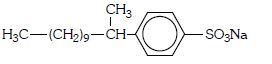
D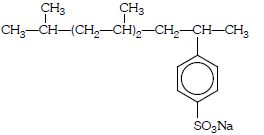
Solution
(D) Biodegradability of surfactants depends on the structure of the hydrocarbon chain.
Straight-chain alkylbenzene sulfonates are more easily degraded by microorganisms than branched-chain ones.
Highly branched alkylbenzene sulfonates,such as the one shown in option $D$,are resistant to microbial attack because the branching hinders the enzymatic degradation process.
Therefore,the highly branched structure makes it the least biodegradable.
Straight-chain alkylbenzene sulfonates are more easily degraded by microorganisms than branched-chain ones.
Highly branched alkylbenzene sulfonates,such as the one shown in option $D$,are resistant to microbial attack because the branching hinders the enzymatic degradation process.
Therefore,the highly branched structure makes it the least biodegradable.
0 likes
View Solution170
EasyMCQ
Which of the following is not a greenhouse gas $(GHG)$?
A
$CO_2$
B
$N_2O$
C
$O_3$
D
$NO$
Solution
(D) Greenhouse gases $(GHGs)$ are gases that trap heat in the atmosphere,such as $CO_2$,$CH_4$,$N_2O$,$O_3$,and water vapor.
$NO$ (Nitric oxide) is not considered a greenhouse gas.
Therefore,the correct option is $D$.
$NO$ (Nitric oxide) is not considered a greenhouse gas.
Therefore,the correct option is $D$.
0 likes
View Solution171
MediumMCQ
Which of the following air pollutants is likely $NOT$ to produce photochemical smog?
A
$NO$
B
$CH_2=CH-CHO$
C
$CH_3-CO-O-O-NO_2$
D
$CO_2$
Solution
(D) Photochemical smog is formed by the reaction of sunlight with nitrogen oxides $(NO_x)$ and volatile organic compounds $(VOCs)$.
Primary components include $NO$,$NO_2$,and hydrocarbons.
Secondary components include ozone $(O_3)$,peroxyacetyl nitrate ($PAN$,$CH_3-CO-O-O-NO_2$),and aldehydes like acrolein $(CH_2=CH-CHO)$.
Carbon dioxide $(CO_2)$ is a greenhouse gas but does not contribute to the formation of photochemical smog.
Primary components include $NO$,$NO_2$,and hydrocarbons.
Secondary components include ozone $(O_3)$,peroxyacetyl nitrate ($PAN$,$CH_3-CO-O-O-NO_2$),and aldehydes like acrolein $(CH_2=CH-CHO)$.
Carbon dioxide $(CO_2)$ is a greenhouse gas but does not contribute to the formation of photochemical smog.
0 likes
View Solution172
MediumMCQ
Which of the following is $FALSE$ regarding acid rain?
A
Acid rain has $pH$ below $5.6$.
B
$CO_2$ and $CO$ are major contributors of acid rain.
C
Acid rain washes away plant nutrients needed for their growth.
D
Acid rain is responsible for change of colour of Tajmahal.
Solution
(B) Acid rain is primarily caused by the emission of sulfur dioxide $(SO_2)$ and nitrogen oxides $(NO_x)$ into the atmosphere,which react with water to form sulfuric acid $(H_2SO_4)$ and nitric acid $(HNO_3)$.
Normal rain has a $pH$ of about $5.6$ due to the presence of dissolved $CO_2$,but acid rain has a $pH$ lower than $5.6$.
$CO_2$ and $CO$ are not the major contributors to acid rain; rather,$SO_2$ and $NO_x$ are the primary pollutants.
Acid rain leaches essential nutrients from the soil,affecting plant growth,and it reacts with calcium carbonate $(CaCO_3)$ in monuments like the Taj Mahal,causing discoloration and degradation.
Normal rain has a $pH$ of about $5.6$ due to the presence of dissolved $CO_2$,but acid rain has a $pH$ lower than $5.6$.
$CO_2$ and $CO$ are not the major contributors to acid rain; rather,$SO_2$ and $NO_x$ are the primary pollutants.
Acid rain leaches essential nutrients from the soil,affecting plant growth,and it reacts with calcium carbonate $(CaCO_3)$ in monuments like the Taj Mahal,causing discoloration and degradation.
0 likes
View Solution173
DifficultMCQ
$A$ water sample has $ppm$ level concentration of following anions: $F^{-} = 10 \ ppm$,$SO_4^{2-} = 100 \ ppm$,$NO_3^{-} = 50 \ ppm$. The anion/anions that make the water sample unsuitable for drinking is/are:
A
only $SO_4^{2-}$
B
only $NO_3^{-}$
C
Both $SO_4^{2-}$ and $NO_3^{-}$
D
only $F^{-}$
Solution
(D) According to the standards for drinking water:
$1$. The concentration of $F^{-}$ should be up to $1 \ ppm$ to $2 \ ppm$. Concentrations above $2 \ ppm$ cause brown mottling of teeth and harmful effects on bones. Here,$[F^{-}] = 10 \ ppm$,which is much higher than the limit.
$2$. The concentration of $SO_4^{2-}$ is considered harmful if it exceeds $500 \ ppm$. Here,$[SO_4^{2-}] = 100 \ ppm$,which is within the safe limit.
$3$. The concentration of $NO_3^{-}$ is considered harmful if it exceeds $50 \ ppm$. Here,$[NO_3^{-}] = 50 \ ppm$,which is at the threshold limit but generally considered safe.
Therefore,only $F^{-}$ makes the water sample unsuitable for drinking.
$1$. The concentration of $F^{-}$ should be up to $1 \ ppm$ to $2 \ ppm$. Concentrations above $2 \ ppm$ cause brown mottling of teeth and harmful effects on bones. Here,$[F^{-}] = 10 \ ppm$,which is much higher than the limit.
$2$. The concentration of $SO_4^{2-}$ is considered harmful if it exceeds $500 \ ppm$. Here,$[SO_4^{2-}] = 100 \ ppm$,which is within the safe limit.
$3$. The concentration of $NO_3^{-}$ is considered harmful if it exceeds $50 \ ppm$. Here,$[NO_3^{-}] = 50 \ ppm$,which is at the threshold limit but generally considered safe.
Therefore,only $F^{-}$ makes the water sample unsuitable for drinking.
0 likes
View Solution174
DifficultMCQ
The two strong acids present in the acid rain are
A
$HNO_2$ and $HNO_3$
B
$H_2SO_4$ and $HNO_3$
C
$H_2SO_3$ and $H_2SO_4$
D
$H_2CO_3$ and $HCl$
Solution
(B) Acid rain is primarily caused by the emission of sulfur dioxide $(SO_2)$ and nitrogen oxides $(NO_x)$ into the atmosphere.
These gases react with water vapor in the presence of oxygen to form $H_2SO_4$ and $HNO_3$,which are strong acids.
These gases react with water vapor in the presence of oxygen to form $H_2SO_4$ and $HNO_3$,which are strong acids.
0 likes
View Solution175
MediumMCQ
$SO_2$ pollution is indicated by
A
Grass
B
Lichens
C
Fossils
D
All
Solution
(B) Lichens are highly sensitive to sulfur dioxide $(SO_2)$ pollution in the atmosphere. They do not grow in areas where the concentration of $SO_2$ is high. Therefore,they act as biological indicators of air pollution,specifically for $SO_2$.
0 likes
View Solution176
MediumMCQ
Water pollution is caused due to
A
Sewage and other wastes
B
Industrial effluents
C
Agricultural run-off
D
All of these
Solution
(D) Anthropogenic (environmental pollution originating in human activity) sources of water pollution include domestic waste,sewage,soaps,detergents,run-off from agricultural fields having fertilizers and pesticides,industrial wastes as effluents,heat,waste from animal sheds and slaughterhouses,oil spills,etc. Since all the options listed contribute to water pollution,the correct answer is $D$.
0 likes
View Solution177
EasyMCQ
Lead is considered as
A
Water pollutant
B
Soil pollutant
C
Air pollutant
D
Radioactive pollutant
Solution
(C) Lead $(Pb)$ is primarily released into the atmosphere through industrial processes,combustion of leaded gasoline,and waste incineration. Therefore,it is considered an air pollutant.
0 likes
View Solution178
EasyMCQ
London smog is found in
A
Summer,during day time
B
Summer,during morning time
C
Winter,during morning time
D
Winter,during day time
Solution
(C) $London$-type smog or classical smog is caused mainly by air pollution due to the combustion of coal and emission of sulphur dioxide and dust.
It is formed in the morning of winter season especially.
It is formed in the morning of winter season especially.
0 likes
View Solution179
MediumMCQ
Excess nitrate in drinking water can cause
A
Methemoglobinemia
B
Laxative effect
C
Leucoderma
D
Eye damage
Solution
(A) Excess nitrate in drinking water reacts with hemoglobin to form methemoglobin,which prevents the blood from carrying oxygen effectively. This condition is known as methemoglobinemia,often referred to as the 'blue baby syndrome'.
0 likes
View Solution180
EasyMCQ
Photochemical smog consists of an excessive amount of $X$ in addition to aldehydes,ketones,$PAN$,etc. $X$ is:
A
Methane
B
Carbon monoxide
C
Carbon dioxide
D
Ozone
Solution
(D) Photochemical smog is formed by the action of sunlight on nitrogen oxides and hydrocarbons.
It consists of primary pollutants like nitrogen oxides $(NO_x)$ and secondary pollutants like ozone $(O_3)$,formaldehyde,acrolein,and peroxyacetyl nitrate $(PAN)$.
Among the given options,ozone $(O_3)$ is a major component of photochemical smog.
It consists of primary pollutants like nitrogen oxides $(NO_x)$ and secondary pollutants like ozone $(O_3)$,formaldehyde,acrolein,and peroxyacetyl nitrate $(PAN)$.
Among the given options,ozone $(O_3)$ is a major component of photochemical smog.
0 likes
View Solution181
DifficultMCQ
$BOD$ value of water is $20 \ ppm$. Then what can you conclude regarding water?
A
Polluted water
B
Less polluted water
C
Pure water
D
Highly polluted water
Solution
(D) The $BOD$ (Biochemical Oxygen Demand) is a measure of the amount of dissolved oxygen required by bacteria to decompose organic matter present in a water sample.
- Clean water has a $BOD$ value of less than $5 \ ppm$.
- Moderately polluted water has a $BOD$ value between $5 \ ppm$ and $10 \ ppm$.
- Highly polluted water has a $BOD$ value of $17 \ ppm$ or more.
Since the given $BOD$ value is $20 \ ppm$,which is greater than $17 \ ppm$,the water is considered highly polluted.
- Clean water has a $BOD$ value of less than $5 \ ppm$.
- Moderately polluted water has a $BOD$ value between $5 \ ppm$ and $10 \ ppm$.
- Highly polluted water has a $BOD$ value of $17 \ ppm$ or more.
Since the given $BOD$ value is $20 \ ppm$,which is greater than $17 \ ppm$,the water is considered highly polluted.
0 likes
View Solution182
EasyMCQ
The $Taj \ Mahal$ is threatened by pollution from:
A
$Sulphur \ dioxide$
B
$Hydrogen \ sulphide$
C
$Chlorine$
D
$Carbon \ dioxide$
Solution
(A) The reaction of $Sulphur \ dioxide$ $(SO_2)$ with water molecules present in the atmosphere forms $Sulphuric \ acid$ $(H_2SO_4)$,which leads to acid rain.
This acid rain reacts with the calcium carbonate $(CaCO_3)$ of the marble,causing decolouring,cracks,and decomposition of the monument.
The proximity of the $Mathura \ Refinery$ to the $Taj \ Mahal$ is a major source of $SO_2$ emissions.
Therefore,the correct answer is $Sulphur \ dioxide$.
This acid rain reacts with the calcium carbonate $(CaCO_3)$ of the marble,causing decolouring,cracks,and decomposition of the monument.
The proximity of the $Mathura \ Refinery$ to the $Taj \ Mahal$ is a major source of $SO_2$ emissions.
Therefore,the correct answer is $Sulphur \ dioxide$.
0 likes
View Solution183
DifficultMCQ
Biochemical oxygen demand $(BOD)$ value can be a measure of water pollution caused by organic matter. Which of the following statements is correct?
A
Polluted water has $BOD$ value higher than $10 \ ppm$
B
Aerobic bacteria decreases the $BOD$ value
C
Anaerobic bacteria increases the $BOD$ value
D
Clean water has $BOD$ value higher than $10 \ ppm$
Solution
(A) The $BOD$ value is a measure of the amount of dissolved oxygen required by bacteria to decompose organic matter present in a water sample.
Clean water has a $BOD$ value of less than $5 \ ppm$.
Polluted water has a $BOD$ value of $17 \ ppm$ or higher,typically considered higher than $10 \ ppm$.
Therefore,the statement that polluted water has a $BOD$ value higher than $10 \ ppm$ is correct.
Clean water has a $BOD$ value of less than $5 \ ppm$.
Polluted water has a $BOD$ value of $17 \ ppm$ or higher,typically considered higher than $10 \ ppm$.
Therefore,the statement that polluted water has a $BOD$ value higher than $10 \ ppm$ is correct.
0 likes
View Solution184
DifficultMCQ
Identify the pollutant gases largely responsible for the discoloured and lustreless nature of marble of the Taj Mahal.
A
$O_3$ and $CO_2$
B
$CO_2$ and $NO_2$
C
$SO_2$ and $NO_2$
D
$SO_2$ and $O_3$
Solution
(C) The marble of the Taj Mahal is primarily composed of calcium carbonate $(CaCO_3)$.
Pollutant gases like $SO_2$ and $NO_2$ react with moisture in the atmosphere to form sulfuric acid $(H_2SO_4)$ and nitric acid $(HNO_3)$,respectively.
These acids cause acid rain,which reacts with the marble to form soluble salts,leading to the discolouration and loss of lustre of the monument.
Pollutant gases like $SO_2$ and $NO_2$ react with moisture in the atmosphere to form sulfuric acid $(H_2SO_4)$ and nitric acid $(HNO_3)$,respectively.
These acids cause acid rain,which reacts with the marble to form soluble salts,leading to the discolouration and loss of lustre of the monument.
0 likes
View Solution185
DifficultMCQ
Which of the following is a set of greenhouse gases?
A
$CH_4, O_3, N_2, SO_2$
B
$O_3, N_2, CO_2, NO_2$
C
$O_3, NO_2, SO_2, Cl_2$
D
$CO_2, CH_4, N_2O, O_3$
Solution
(D) Greenhouse gases are those gases that absorb and emit radiation within the thermal $IR$ range.
This process is the fundamental cause of the greenhouse effect.
The primary greenhouse gases include $CO_2, CH_4, N_2O,$ and $O_3$.
This process is the fundamental cause of the greenhouse effect.
The primary greenhouse gases include $CO_2, CH_4, N_2O,$ and $O_3$.
0 likes
View Solution186
EasyMCQ
$BOD$ stands for
A
Biochemical Oxidation Demand
B
Biological Ozon Demand
C
Biochemical Oxygen Demand
D
Bacterial Oxidation Demand
Solution
(C) $BOD$ stands for Biochemical Oxygen Demand. It is a measure of the amount of dissolved oxygen required by aerobic microorganisms to decompose the organic matter present in a given water sample at a specific temperature over a specific time period.
0 likes
View Solution187
MediumMCQ
Which one of the following substances used in dry cleaning is a better strategy to control environmental pollution?
A
Sulphur dioxide
B
Carbon dioxide
C
Nitrogen dioxide
D
Tetrachloroethylene
Solution
(B) Liquefied $CO_2$ is considered a better strategy for dry cleaning because it is environmentally friendly and replaces the use of hazardous solvents like $Cl_2C=CCl_2$ (Tetrachloroethylene),which is a suspected carcinogen and groundwater pollutant. Therefore,$CO_2$ is the preferred choice for sustainable dry cleaning.
0 likes
View Solution188
MediumMCQ
Photochemical smog consists of an excessive amount of $X$,in addition to aldehydes,ketones,peroxyacetyl nitrate $(PAN)$,and so forth. $X$ is
A
$CO$
B
$CH_4$
C
$O_3$
D
$CO_2$
Solution
(C) Photochemical smog is formed by the action of sunlight on nitrogen oxides and hydrocarbons.
It consists of primary pollutants like nitrogen oxides ($NO$ and $NO_2$) and secondary pollutants such as ozone $(O_3)$,formaldehyde,acrolein,and peroxyacetyl nitrate $(PAN)$.
Among the given options,$O_3$ is a major component of photochemical smog.
It consists of primary pollutants like nitrogen oxides ($NO$ and $NO_2$) and secondary pollutants such as ozone $(O_3)$,formaldehyde,acrolein,and peroxyacetyl nitrate $(PAN)$.
Among the given options,$O_3$ is a major component of photochemical smog.
0 likes
View Solution189
DifficultMCQ
Addition of phosphate fertilisers to water bodies causes
A
increase in amount of dissolved oxygen in water
B
deposition of calcium phosphate
C
increase in fish population
D
enhanced growth of algae
Solution
(D) The addition of phosphate-containing fertilisers to water bodies leads to a process known as $Eutrophication$.
Phosphates act as limiting nutrients for aquatic plants.
When these fertilisers enter water bodies,they promote the excessive growth of algae,which is known as an algal bloom.
This excessive growth eventually leads to the depletion of dissolved oxygen in the water,which can harm aquatic life.
Phosphates act as limiting nutrients for aquatic plants.
When these fertilisers enter water bodies,they promote the excessive growth of algae,which is known as an algal bloom.
This excessive growth eventually leads to the depletion of dissolved oxygen in the water,which can harm aquatic life.
0 likes
View Solution190
DifficultMCQ
Which of the following statements about the depletion of ozone layer is correct?
A
The problem of ozone depletion is less serious at poles because $NO_2$ solidifies and is not available for consuming $ClO^{\bullet}$ radicals.
B
The problem of ozone depletion is more serious at poles because ice crystals in the clouds over poles act as catalyst for photochemical reactions involving the decomposition of ozone by $Cl^{\bullet}$ and $ClO^{\bullet}$ radicals.
C
Freons,chlorofluorocarbons,are inert. Chemically,they do not react with ozone in stratosphere.
D
Oxides of nitrogen also do not react with ozone in stratosphere.
Solution
(B) Freons and chlorofluorocarbons reach the stratosphere without being destroyed in the troposphere due to their low reactivity.
In the stratosphere,the $Cl$ and $Br$ atoms are liberated from the parent compound by the action of ultraviolet light.
For example:
$CF_2Cl_2 + h\nu \to CF_2Cl^{\bullet} + Cl^{\bullet}$
$CFCl_3 + h\nu \to CFCl_2^{\bullet} + Cl^{\bullet}$
The $Cl^{\bullet}$ atoms destroy ozone molecules through catalytic cycles.
The problem is more serious at the poles because ice crystals in polar stratospheric clouds provide a surface for these reactions to occur more efficiently.
In the stratosphere,the $Cl$ and $Br$ atoms are liberated from the parent compound by the action of ultraviolet light.
For example:
$CF_2Cl_2 + h\nu \to CF_2Cl^{\bullet} + Cl^{\bullet}$
$CFCl_3 + h\nu \to CFCl_2^{\bullet} + Cl^{\bullet}$
The $Cl^{\bullet}$ atoms destroy ozone molecules through catalytic cycles.
The problem is more serious at the poles because ice crystals in polar stratospheric clouds provide a surface for these reactions to occur more efficiently.
0 likes
View Solution191
MediumMCQ
Global warming is due to an increase of:
A
methane and nitrous oxide in the atmosphere
B
methane and $CO_2$ in the atmosphere
C
methane and $O_3$ in the atmosphere
D
methane and $CO$ in the atmosphere
Solution
(B) Global warming is primarily caused by the increase in greenhouse gases in the atmosphere. The most significant contributor is $CO_2$ (carbon dioxide),followed by methane $(CH_4)$. These gases trap heat in the Earth's atmosphere,leading to a rise in global temperatures.
0 likes
View Solution192
MediumMCQ
Greenhouse gases can be arranged in the 'Global Warming Potential' $(GWP)$ sequence as:
A
$N_2O > CFC > CH_4 > CO_2$
B
$CFC > N_2O > CH_4 > CO_2$
C
$CFC > CO_2 > N_2O > CH_4$
D
$CO_2 > CFC > N_2O > CH_4$
Solution
(B) The Global Warming Potential $(GWP)$ is a measure of how much heat a greenhouse gas traps in the atmosphere relative to carbon dioxide $(CO_2)$.
Comparing the $GWP$ values (over a $100$-year horizon):
$CFCs$ (Chlorofluorocarbons) have a very high $GWP$ (ranging from thousands to tens of thousands).
$N_2O$ (Nitrous oxide) has a $GWP$ of approximately $273$.
$CH_4$ (Methane) has a $GWP$ of approximately $28$.
$CO_2$ (Carbon dioxide) is the reference gas with a $GWP$ of $1$.
Therefore,the correct sequence is $CFC > N_2O > CH_4 > CO_2$.
Comparing the $GWP$ values (over a $100$-year horizon):
$CFCs$ (Chlorofluorocarbons) have a very high $GWP$ (ranging from thousands to tens of thousands).
$N_2O$ (Nitrous oxide) has a $GWP$ of approximately $273$.
$CH_4$ (Methane) has a $GWP$ of approximately $28$.
$CO_2$ (Carbon dioxide) is the reference gas with a $GWP$ of $1$.
Therefore,the correct sequence is $CFC > N_2O > CH_4 > CO_2$.
0 likes
View Solution193
DifficultMCQ
$A$ water sample is reported to be highly polluted if the $BOD$ (Biological Oxygen Demand) value of the sample becomes:
A
more than $17 \ ppm$
B
equal to $10 \ ppm$
C
equal to $5 \ ppm$
D
less than $5 \ ppm$
Solution
(A) The $BOD$ (Biological Oxygen Demand) value is a measure of the amount of dissolved oxygen required by bacteria to decompose organic matter in a water sample.
Clean water has a $BOD$ value of less than $5 \ ppm$,whereas highly polluted water has a $BOD$ value of more than $17 \ ppm$.
Clean water has a $BOD$ value of less than $5 \ ppm$,whereas highly polluted water has a $BOD$ value of more than $17 \ ppm$.
0 likes
View Solution194
DifficultMCQ
Which one of the following depletes the ozone layer?
A
$CO$
B
$NO$ and freons
C
$SO_2$
D
$CO_2$
Solution
(B) $NO$ (nitric oxide) and freons (chlorofluorocarbons) are responsible for the depletion of the ozone layer in the stratosphere.
0 likes
View Solution195
DifficultMCQ
$A$ water sample has $ppm$ level concentration of the following metals: $Fe = 0.2$,$Mn = 0.05$,$Cu = 3.0$,$Zn = 5.0$. The metal that makes the water sample unsuitable for drinking is
A
$Cu$
B
$Mn$
C
$Fe$
D
$Zn$
Solution
(B) According to the $WHO$ and $BIS$ standards for drinking water,the permissible limits for these metals are as follows:
$Fe$: $0.2 \ ppm$
$Mn$: $0.05 \ ppm$
$Cu$: $3.0 \ ppm$
$Zn$: $5.0 \ ppm$
In the given sample,the concentration of $Mn$ is $0.05 \ ppm$. While this is at the threshold,$Mn$ is highly sensitive; even slight variations above this limit cause staining and taste issues,making it the most critical metal among the choices that renders water unsuitable for drinking if concentrations exceed the limit.
$Fe$: $0.2 \ ppm$
$Mn$: $0.05 \ ppm$
$Cu$: $3.0 \ ppm$
$Zn$: $5.0 \ ppm$
In the given sample,the concentration of $Mn$ is $0.05 \ ppm$. While this is at the threshold,$Mn$ is highly sensitive; even slight variations above this limit cause staining and taste issues,making it the most critical metal among the choices that renders water unsuitable for drinking if concentrations exceed the limit.
0 likes
View Solution196
DifficultMCQ
Which of the following conditions in drinking water causes methemoglobinemia?
A
$> 50 \ ppm$ of lead
B
$> 50 \ ppm$ of chloride
C
$> 50 \ ppm$ of nitrate
D
$> 100 \ ppm$ of sulphate
Solution
(C) Methemoglobinemia,also known as 'blue baby syndrome',is caused by the presence of excess nitrate ions in drinking water.
When the concentration of nitrate in drinking water exceeds $50 \ ppm$,it reacts with hemoglobin in the blood to form methemoglobin,which is unable to transport oxygen effectively.
Therefore,the correct condition is $> 50 \ ppm$ of nitrate.
When the concentration of nitrate in drinking water exceeds $50 \ ppm$,it reacts with hemoglobin in the blood to form methemoglobin,which is unable to transport oxygen effectively.
Therefore,the correct condition is $> 50 \ ppm$ of nitrate.
0 likes
View Solution197
DifficultMCQ
Water filled in two glasses $A$ and $B$ have $BOD$ values of $10$ and $20$ respectively. The correct statement regarding them is:
A
$B$ is more polluted than $A$
B
$A$ is suitable for drinking,whereas $B$ is not
C
both $A$ and $B$ are suitable for drinking
D
$A$ is more polluted than $B$
Solution
(A) Biological Oxygen Demand $(BOD)$ is a measure of the amount of dissolved oxygen required by aerobic microorganisms to decompose the organic matter present in a given volume of water.
Higher $BOD$ values indicate a higher concentration of organic pollutants in the water.
Since the $BOD$ value of glass $B$ $(20)$ is higher than that of glass $A$ $(10)$,glass $B$ is more polluted than glass $A$.
Higher $BOD$ values indicate a higher concentration of organic pollutants in the water.
Since the $BOD$ value of glass $B$ $(20)$ is higher than that of glass $A$ $(10)$,glass $B$ is more polluted than glass $A$.
0 likes
View Solution198
DifficultMCQ
The reaction that is $NOT$ involved in the ozone layer depletion mechanism in the stratosphere is
A
$CF_2Cl_{2(g)} \xrightarrow{hv} \dot{Cl}_{(g)} + \dot{C}F_2Cl_{(g)}$
B
$Cl\dot{O}_{(g)} + O_{(g)} \to \dot{Cl}_{(g)} + O_{2(g)}$
C
$CH_4 + 2O_3 \to 3CH_2=O + 3H_2O$
D
$HOCl_{(g)} \xrightarrow{hv} \dot{O}H_{(g)} + \dot{C}l_{(g)}$
Solution
(C) The depletion of the ozone layer in the stratosphere is primarily caused by chlorofluorocarbons $(CFCs)$.
$CF_2Cl_2$ undergoes photolysis to release chlorine radicals,which then react with ozone.
$HOCl$ also acts as a reservoir species that releases reactive radicals upon photolysis.
Option $C$ represents a reaction that is not part of the standard ozone depletion mechanism in the stratosphere,as $CH_4$ reacts with chlorine radicals to terminate the chain reaction rather than depleting ozone directly in the manner described.
$CF_2Cl_2$ undergoes photolysis to release chlorine radicals,which then react with ozone.
$HOCl$ also acts as a reservoir species that releases reactive radicals upon photolysis.
Option $C$ represents a reaction that is not part of the standard ozone depletion mechanism in the stratosphere,as $CH_4$ reacts with chlorine radicals to terminate the chain reaction rather than depleting ozone directly in the manner described.
0 likes
View Solution199
DifficultMCQ
The concentration of dissolved oxygen $(DO)$ in cold water can go up to ......... $ppm$.
A
$14$
B
$8$
C
$10$
D
$16$
Solution
(C) The solubility of gases in liquids decreases with an increase in temperature.
Therefore,cold water can hold a higher concentration of dissolved oxygen compared to warm water.
The concentration of dissolved oxygen $(DO)$ in cold water can reach up to $10 \ ppm$.
Therefore,cold water can hold a higher concentration of dissolved oxygen compared to warm water.
The concentration of dissolved oxygen $(DO)$ in cold water can reach up to $10 \ ppm$.
0 likes
View Solution200
DifficultMCQ
Peroxyacetyl nitrate $(PAN)$,an eye irritant,is produced by:
A
classical smog
B
acid rain
C
organic waste
D
photochemical smog
Solution
(D) Photochemical smog is formed by the action of sunlight on nitrogen oxides and hydrocarbons. It produces secondary pollutants such as formaldehyde,acrolein,and peroxyacetyl nitrate $(PAN)$,which are powerful eye irritants.
0 likes
View SolutionEnvironmental Chemistry — Environmental Study · Frequently Asked Questions
1Are these Environmental Chemistry questions useful for JEE and NEET?
Yes. All questions in this section are mapped to JEE Main and NEET exam patterns. Previous year questions from JEE Main, NEET, GUJCET and state-level exams are included with full solutions.
2Can I switch to Hindi or Gujarati for these questions?
Yes. Use the language tabs in the hero section or the sidebar to view the same questions and solutions in English, Hindi or Gujarati.
3How do I generate a question paper from this subtopic?
Use the Vedclass Exam Paper Generator — select the chapter and subtopic, set difficulty, and generate Sets A, B, C, D automatically. First 3 chapters of every subject are free.
Vedclass Products
For Students
Vedclass Test Series
Mock tests in real JEE/NEET style with performance analysis. 5-day free trial.
Start Free TrialFor Teachers
Exam Paper Generator
Generate Set A/B/C/D papers from this chapter in 2 minutes. 3 chapters free.
Try FreeFor Institutes
Online Exam Module
Live online exams with unlimited students, 360° analytics & white-label branding.
See DemoFor Teachers & Institutes
Generate a Environmental Chemistry Exam Paper in 2 Minutes
Select subtopic & difficulty — Sets A, B, C, D auto-generated with No Repeat logic.
First 3 chapters of every subject are free — no payment required.