
A English
Photorespiration Questions in English
Class 11 Biology · Photosynthesis in Higher Plants · Photorespiration
115+
Questions
English
Language
100%
With Solutions
Showing 49 of 115 questions in English
51
MediumMCQ
Which cell organelles are involved in photorespiration?
A
Chloroplast and Mitochondria
B
Chloroplast only
C
Chloroplast,Mitochondria,and Ribosome
D
Chloroplast,Mitochondria,and Peroxisome
Solution
(D) Photorespiration is a metabolic pathway that occurs in photosynthetic organisms.
It involves the coordinated action of three specific cell organelles:
$1$. $Chloroplast$: Where the oxygenation of $RuBP$ occurs by the enzyme $RuBisCO$.
$2$. $Peroxisome$: Where the glycolate produced in the chloroplast is processed.
$3$. $Mitochondria$: Where glycine is converted into serine,releasing $CO_2$ and $NH_3$.
Therefore,the correct answer is $D$.
It involves the coordinated action of three specific cell organelles:
$1$. $Chloroplast$: Where the oxygenation of $RuBP$ occurs by the enzyme $RuBisCO$.
$2$. $Peroxisome$: Where the glycolate produced in the chloroplast is processed.
$3$. $Mitochondria$: Where glycine is converted into serine,releasing $CO_2$ and $NH_3$.
Therefore,the correct answer is $D$.
0 likes
View Solution52
MediumMCQ
Peroxisomes are associated with ..........
A
Respiration
B
Photorespiration
C
Photosynthesis
D
Photophosphorylation
Solution
(B) Peroxisomes are small,membrane-bound organelles found in the cytoplasm of eukaryotic cells.
They play a crucial role in the process of photorespiration in plants.
During photorespiration,peroxisomes work in coordination with chloroplasts and mitochondria to metabolize glycolate,a byproduct of the oxygenase activity of RuBisCO.
Therefore,they are specifically associated with photorespiration.
They play a crucial role in the process of photorespiration in plants.
During photorespiration,peroxisomes work in coordination with chloroplasts and mitochondria to metabolize glycolate,a byproduct of the oxygenase activity of RuBisCO.
Therefore,they are specifically associated with photorespiration.
0 likes
View Solution53
MediumMCQ
The process which makes a major difference between $C_3$ and $C_4$ plants is
A
glycolysis
B
Calvin cycle
C
photorespiration
D
respiration
Solution
(C) : Photorespiration is the light-dependent process of oxygenation of ribulose bisphosphate $(RuBP)$ and the release of carbon dioxide by the photosynthetic organs of a plant.
It leads to the oxidation of a considerable amount of photosynthetic products into $CO_2$ and $H_2O$ without the production of useful energy.
Photorespiration occurs significantly in $C_3$ plants because,at high temperatures and high oxygen concentrations,the enzyme $RuBP$ carboxylase acts as $RuBP$ oxygenase.
Photorespiration is essentially absent in $C_4$ plants due to their specialized anatomy (Kranz anatomy) which maintains a high $CO_2$ concentration around the enzyme.
Peroxisomes and mitochondria are required for completing this process.
It leads to the oxidation of a considerable amount of photosynthetic products into $CO_2$ and $H_2O$ without the production of useful energy.
Photorespiration occurs significantly in $C_3$ plants because,at high temperatures and high oxygen concentrations,the enzyme $RuBP$ carboxylase acts as $RuBP$ oxygenase.
Photorespiration is essentially absent in $C_4$ plants due to their specialized anatomy (Kranz anatomy) which maintains a high $CO_2$ concentration around the enzyme.
Peroxisomes and mitochondria are required for completing this process.
0 likes
View Solution54
MediumMCQ
$A$ process that makes an important difference between $C_3$ and $C_4$ plants is
A
transpiration
B
glycolysis
C
photosynthesis
D
photorespiration
Solution
(D) $C_4$ plants are distinguished from $C_3$ plants primarily by the absence of photorespiration in the former.
Photorespiration is a light-dependent process involving the oxygenation of ribulose bisphosphate $(RuBP)$ and the release of carbon dioxide by photosynthetic organs.
In $C_3$ plants,at high temperatures and high oxygen concentrations,the enzyme $RuBP$ carboxylase acts as an oxygenase,leading to the oxidation of photosynthetic products into $CO_2$ and $H_2O$ without producing useful energy ($ATP$ or $NADPH$).
$C_4$ plants have evolved a mechanism to concentrate $CO_2$ around the enzyme,thereby suppressing photorespiration.
Peroxisomes and mitochondria are essential organelles for completing the photorespiratory pathway.
Photorespiration is a light-dependent process involving the oxygenation of ribulose bisphosphate $(RuBP)$ and the release of carbon dioxide by photosynthetic organs.
In $C_3$ plants,at high temperatures and high oxygen concentrations,the enzyme $RuBP$ carboxylase acts as an oxygenase,leading to the oxidation of photosynthetic products into $CO_2$ and $H_2O$ without producing useful energy ($ATP$ or $NADPH$).
$C_4$ plants have evolved a mechanism to concentrate $CO_2$ around the enzyme,thereby suppressing photorespiration.
Peroxisomes and mitochondria are essential organelles for completing the photorespiratory pathway.
0 likes
View Solution55
MediumMCQ
The correct sequence of cell organelles during photorespiration is
A
chloroplast,Golgi bodies,mitochondria
B
chloroplast,rough endoplasmic reticulum,dictyosomes
C
chloroplast,mitochondria,peroxisome
D
chloroplast,vacuole,peroxisome
Solution
(C) The correct sequence of cell organelles involved in photorespiration is chloroplast,peroxisome,and mitochondria.
Photorespiration is a light-dependent process involving the oxygenation of ribulose bisphosphate $(RuBP)$ and the release of carbon dioxide by photosynthetic organs.
It leads to the oxidation of photosynthetic products into $CO_2$ and $H_2O$ without the production of $ATP$ or $NADPH$.
This process occurs primarily in $C_3$ plants when high temperatures and high oxygen concentrations cause the enzyme $RuBP$ carboxylase to function as $RuBP$ oxygenase.
Photorespiration is absent in $C_4$ plants due to their specialized anatomy and mechanism to concentrate $CO_2$ around the enzyme.
Photorespiration is a light-dependent process involving the oxygenation of ribulose bisphosphate $(RuBP)$ and the release of carbon dioxide by photosynthetic organs.
It leads to the oxidation of photosynthetic products into $CO_2$ and $H_2O$ without the production of $ATP$ or $NADPH$.
This process occurs primarily in $C_3$ plants when high temperatures and high oxygen concentrations cause the enzyme $RuBP$ carboxylase to function as $RuBP$ oxygenase.
Photorespiration is absent in $C_4$ plants due to their specialized anatomy and mechanism to concentrate $CO_2$ around the enzyme.
0 likes
View Solution56
MediumMCQ
$C_4$ plants are more efficient in photosynthesis than $C_3$ plants due to
A
higher leaf area
B
presence of larger number of chloroplasts in the leaf cells
C
presence of thin cuticle
D
lower rate of photorespiration.
Solution
(D) $C_4$ plants are more efficient in photosynthesis because they have a mechanism to minimize photorespiration.
In $C_3$ plants,the enzyme $RuBisCO$ acts as an oxygenase in the presence of high $O_2$ concentrations,leading to photorespiration,which is a wasteful process that consumes energy and releases $CO_2$.
$C_4$ plants possess a specialized anatomy called $Kranz$ anatomy,which separates the initial $CO_2$ fixation from the Calvin cycle.
This spatial separation ensures that $RuBisCO$ always operates in a high $CO_2$ environment,effectively suppressing photorespiration.
Therefore,the lower rate of photorespiration in $C_4$ plants makes them more photosynthetically efficient compared to $C_3$ plants.
In $C_3$ plants,the enzyme $RuBisCO$ acts as an oxygenase in the presence of high $O_2$ concentrations,leading to photorespiration,which is a wasteful process that consumes energy and releases $CO_2$.
$C_4$ plants possess a specialized anatomy called $Kranz$ anatomy,which separates the initial $CO_2$ fixation from the Calvin cycle.
This spatial separation ensures that $RuBisCO$ always operates in a high $CO_2$ environment,effectively suppressing photorespiration.
Therefore,the lower rate of photorespiration in $C_4$ plants makes them more photosynthetically efficient compared to $C_3$ plants.
0 likes
View Solution57
MediumMCQ
During photorespiration,the oxygen-consuming reaction$(s)$ occur in:
A
Stroma of chloroplasts
B
Stroma of chloroplasts and mitochondria
C
Stroma of chloroplasts and peroxisomes
D
Grana of chloroplasts and peroxisomes
Solution
(C) Photorespiration is a wasteful process that occurs in $C_3$ plants. The oxygen-consuming reactions occur in two main locations:
$1$. In the $Stroma$ of chloroplasts,the enzyme $RuBisCO$ acts as an oxygenase,where $O_2$ is consumed during the oxygenation of $RuBP$.
$2$. In the $Peroxisomes$,the enzyme $Glycolate$ oxidase consumes $O_2$ to convert glycolate into glyoxylate.
Therefore,the correct answer is $C$.
$1$. In the $Stroma$ of chloroplasts,the enzyme $RuBisCO$ acts as an oxygenase,where $O_2$ is consumed during the oxygenation of $RuBP$.
$2$. In the $Peroxisomes$,the enzyme $Glycolate$ oxidase consumes $O_2$ to convert glycolate into glyoxylate.
Therefore,the correct answer is $C$.
0 likes
View Solution58
MediumMCQ
Which process does not occur in $C_4$ plants?
A
Photosynthesis
B
Decarboxylation
C
Photorespiration
D
Carbon fixation
Solution
(C) $C_4$ plants are specifically adapted to minimize photorespiration.
In $C_4$ plants,the enzyme $RuBisCO$ is located in the bundle sheath cells,which maintain a high concentration of $CO_2$ around the enzyme.
This high $CO_2$ concentration ensures that $RuBisCO$ functions primarily as a carboxylase rather than an oxygenase.
Therefore,photorespiration is negligible or absent in $C_4$ plants compared to $C_3$ plants.
In $C_4$ plants,the enzyme $RuBisCO$ is located in the bundle sheath cells,which maintain a high concentration of $CO_2$ around the enzyme.
This high $CO_2$ concentration ensures that $RuBisCO$ functions primarily as a carboxylase rather than an oxygenase.
Therefore,photorespiration is negligible or absent in $C_4$ plants compared to $C_3$ plants.
0 likes
View Solution59
MediumMCQ
How many carbons are found in phosphoglycolate?
A
$4$
B
$5$
C
$3$
D
$2$
Solution
(D) Phosphoglycolate is a $2$-carbon compound produced during the process of photorespiration.
In the $C_3$ cycle,when the enzyme $RuBisCO$ acts as an oxygenase instead of a carboxylase,it reacts with $O_2$ to form one molecule of $3$-phosphoglycerate ($3$-carbon) and one molecule of phosphoglycolate ($2$-carbon).
Therefore,the correct answer is $2$ carbons.
In the $C_3$ cycle,when the enzyme $RuBisCO$ acts as an oxygenase instead of a carboxylase,it reacts with $O_2$ to form one molecule of $3$-phosphoglycerate ($3$-carbon) and one molecule of phosphoglycolate ($2$-carbon).
Therefore,the correct answer is $2$ carbons.
0 likes
View Solution60
MediumMCQ
$C_4$ plants are more efficient in photosynthesis than $C_3$ plants due to
A
Higher leaf area
B
Presence of a lower number of chloroplasts in the leaf cells
C
Presence of a thin cuticle
D
Lower rate of photorespiration
Solution
(D) $C_4$ plants are more efficient in photosynthesis compared to $C_3$ plants primarily because they have evolved a mechanism to minimize photorespiration.
In $C_3$ plants,the enzyme $RuBisCO$ acts as an oxygenase under high $O_2$ and low $CO_2$ concentrations,leading to photorespiration,which is a wasteful process that consumes energy and releases $CO_2$.
$C_4$ plants utilize the $Kranz$ anatomy to spatially separate the initial $CO_2$ fixation (in mesophyll cells) and the $Calvin$ cycle (in bundle sheath cells).
This mechanism ensures that $RuBisCO$ always operates in an environment with high $CO_2$ concentration,thereby suppressing the oxygenase activity of $RuBisCO$ and significantly reducing the rate of photorespiration.
In $C_3$ plants,the enzyme $RuBisCO$ acts as an oxygenase under high $O_2$ and low $CO_2$ concentrations,leading to photorespiration,which is a wasteful process that consumes energy and releases $CO_2$.
$C_4$ plants utilize the $Kranz$ anatomy to spatially separate the initial $CO_2$ fixation (in mesophyll cells) and the $Calvin$ cycle (in bundle sheath cells).
This mechanism ensures that $RuBisCO$ always operates in an environment with high $CO_2$ concentration,thereby suppressing the oxygenase activity of $RuBisCO$ and significantly reducing the rate of photorespiration.
0 likes
View Solution61
MediumMCQ
Which statement is wrong about photorespiration?
A
Photorespiration occurs in $C_3$ plants and not $C_4$ plants.
B
There is no synthesis of $ATP$ or $NADPH$.
C
$RuBisCO$ has higher affinity for $CO_2$ than $O_2$.
D
$RuBP$ binds with $O_2$ to form two molecules of glycolate.
Solution
(C) Photorespiration is a wasteful process that occurs in $C_3$ plants.
In this process,the enzyme $RuBisCO$ acts as an oxygenase,meaning it has an affinity for $O_2$ when $O_2$ concentration is high and $CO_2$ concentration is low.
Therefore,the statement '$RuBisCO$ has higher affinity for $CO_2$ than $O_2$' is technically incorrect in the context of the oxygenase activity that triggers photorespiration,as $RuBisCO$ actually has a significant affinity for $O_2$ under specific conditions,and the statement implies it never prefers $O_2$.
More specifically,$RuBP$ binds with $O_2$ instead of $CO_2$ to form one molecule of phosphoglycerate and one molecule of phosphoglycolate (which is later converted to glycolate).
Photorespiration does not produce $ATP$ or $NADPH$ and results in the loss of fixed carbon.
In this process,the enzyme $RuBisCO$ acts as an oxygenase,meaning it has an affinity for $O_2$ when $O_2$ concentration is high and $CO_2$ concentration is low.
Therefore,the statement '$RuBisCO$ has higher affinity for $CO_2$ than $O_2$' is technically incorrect in the context of the oxygenase activity that triggers photorespiration,as $RuBisCO$ actually has a significant affinity for $O_2$ under specific conditions,and the statement implies it never prefers $O_2$.
More specifically,$RuBP$ binds with $O_2$ instead of $CO_2$ to form one molecule of phosphoglycerate and one molecule of phosphoglycolate (which is later converted to glycolate).
Photorespiration does not produce $ATP$ or $NADPH$ and results in the loss of fixed carbon.
0 likes
View Solution62
MediumMCQ
$I-$ It is the characteristic of $C_4-$ plants
$II-$ It is the characteristic of $C_3-$ plants
$III-$ It occurs in chloroplast
$IV-$ It occurs in day time
$V-$ It occurs in night
Select the correct option in relation to photorespiration:
Correct Sentences $-$ Incorrect Sentences
$II-$ It is the characteristic of $C_3-$ plants
$III-$ It occurs in chloroplast
$IV-$ It occurs in day time
$V-$ It occurs in night
Select the correct option in relation to photorespiration:
Correct Sentences $-$ Incorrect Sentences
A
$(I, IV) - (II, III, V)$
B
$(II, III, IV) - (I, V)$
C
$(I, II, III) - (IV, V)$
D
$(IV, V) - (I, II, III)$
Solution
(B) Photorespiration is a wasteful process that occurs in $C_3$ plants,not $C_4$ plants.
It involves three organelles: chloroplast,peroxisome,and mitochondria.
It occurs in the presence of light (daytime) when the concentration of $O_2$ is high and $CO_2$ is low,leading to the oxygenase activity of $RuBisCO$.
Therefore,the correct statements regarding photorespiration are:
$II$ (Characteristic of $C_3$ plants),$III$ (Occurs in chloroplast - as part of the pathway),and $IV$ (Occurs in daytime).
The incorrect statements are:
$I$ (It is not a characteristic of $C_4$ plants) and $V$ (It does not occur at night).
Thus,the correct option is $(II, III, IV) - (I, V)$.
It involves three organelles: chloroplast,peroxisome,and mitochondria.
It occurs in the presence of light (daytime) when the concentration of $O_2$ is high and $CO_2$ is low,leading to the oxygenase activity of $RuBisCO$.
Therefore,the correct statements regarding photorespiration are:
$II$ (Characteristic of $C_3$ plants),$III$ (Occurs in chloroplast - as part of the pathway),and $IV$ (Occurs in daytime).
The incorrect statements are:
$I$ (It is not a characteristic of $C_4$ plants) and $V$ (It does not occur at night).
Thus,the correct option is $(II, III, IV) - (I, V)$.
0 likes
View Solution63
MediumMCQ
Which condition is favorable for photorespiration?
A
Excess amount of $O_2$.
B
Increased temperature.
C
Less amount of $O_2$.
D
Presence of $CO_2$.
Solution
(A) Photorespiration is a wasteful process that occurs in $C_3$ plants when the enzyme $RuBisCO$ acts as an oxygenase rather than a carboxylase.
This happens primarily under conditions of high $O_2$ concentration and low $CO_2$ concentration.
Additionally,high temperatures favor the oxygenase activity of $RuBisCO$.
Therefore,an excess amount of $O_2$ relative to $CO_2$ is the primary condition that triggers photorespiration.
This happens primarily under conditions of high $O_2$ concentration and low $CO_2$ concentration.
Additionally,high temperatures favor the oxygenase activity of $RuBisCO$.
Therefore,an excess amount of $O_2$ relative to $CO_2$ is the primary condition that triggers photorespiration.
0 likes
View Solution64
MediumMCQ
Photorespiration is a characteristic of which plant?
A
$C_4$
B
$C_3$
C
$CAM$
D
All above
Solution
(B) Photorespiration is a wasteful process that occurs in $C_3$ plants.
In $C_3$ plants,the enzyme $RuBisCO$ has an affinity for both $CO_2$ and $O_2$.
When $O_2$ concentration is high or $CO_2$ concentration is low,$RuBisCO$ binds with $O_2$ instead of $CO_2$,leading to the photorespiratory pathway.
$C_4$ plants have evolved a mechanism to minimize photorespiration by concentrating $CO_2$ around the $RuBisCO$ enzyme in bundle sheath cells.
In $C_3$ plants,the enzyme $RuBisCO$ has an affinity for both $CO_2$ and $O_2$.
When $O_2$ concentration is high or $CO_2$ concentration is low,$RuBisCO$ binds with $O_2$ instead of $CO_2$,leading to the photorespiratory pathway.
$C_4$ plants have evolved a mechanism to minimize photorespiration by concentrating $CO_2$ around the $RuBisCO$ enzyme in bundle sheath cells.
0 likes
View Solution65
MediumMCQ
In the $C_4$ cycle,more food (carbohydrates) is produced compared to the $C_3$ cycle. The reason is:
A
Presence of $CO_2$
B
Presence of malic acid
C
Absence of photorespiration
D
Presence of enzyme RuBiSCO
Solution
(C) $C_4$ plants are more efficient in photosynthesis than $C_3$ plants because they have evolved a mechanism to minimize photorespiration.
In $C_3$ plants,the enzyme RuBiSCO can bind to $O_2$ instead of $CO_2$ under certain conditions,leading to photorespiration,which consumes energy and releases $CO_2$ without producing sugars.
$C_4$ plants utilize a specialized anatomy called Kranz anatomy and a $CO_2$ concentrating mechanism that ensures RuBiSCO always operates in a high $CO_2$ environment.
This effectively eliminates photorespiration,allowing for higher rates of carbon fixation and greater production of carbohydrates.
In $C_3$ plants,the enzyme RuBiSCO can bind to $O_2$ instead of $CO_2$ under certain conditions,leading to photorespiration,which consumes energy and releases $CO_2$ without producing sugars.
$C_4$ plants utilize a specialized anatomy called Kranz anatomy and a $CO_2$ concentrating mechanism that ensures RuBiSCO always operates in a high $CO_2$ environment.
This effectively eliminates photorespiration,allowing for higher rates of carbon fixation and greater production of carbohydrates.
0 likes
View Solution66
MediumMCQ
Match the following regarding the photorespiration pathway:
| Column-$I$ | Column-$II$ |
| $(1)$ Molecule transport from chloroplast to peroxisome | $(p)$ Glycine |
| $(2)$ Molecule transport from peroxisome to mitochondria | $(q)$ Serine |
| $(3)$ Molecule transport from mitochondria to peroxisome | $(r)$ Glycerate |
| $(4)$ Molecule transport from peroxisome to chloroplast | $(s)$ Glycolate |
A
$(1-s), (2-p), (3-q), (4-r)$
B
$(1-r), (2-q), (3-p), (4-s)$
C
$(1-s), (2-r), (3-q), (4-p)$
D
$(1-p), (2-q), (3-r), (4-s)$
Solution
(A) In the photorespiration pathway ($C_2$ cycle),the transport of molecules occurs as follows:
$1$. Glycolate is produced in the chloroplast and transported to the peroxisome $(1-s)$.
$2$. In the peroxisome,Glycolate is converted to Glycine,which is then transported to the mitochondria $(2-p)$.
$3$. In the mitochondria,Glycine is converted to Serine,which is transported back to the peroxisome $(3-q)$.
$4$. In the peroxisome,Serine is converted to Glycerate,which is then transported to the chloroplast $(4-r)$.
Therefore,the correct matching is $(1-s), (2-p), (3-q), (4-r)$.
$1$. Glycolate is produced in the chloroplast and transported to the peroxisome $(1-s)$.
$2$. In the peroxisome,Glycolate is converted to Glycine,which is then transported to the mitochondria $(2-p)$.
$3$. In the mitochondria,Glycine is converted to Serine,which is transported back to the peroxisome $(3-q)$.
$4$. In the peroxisome,Serine is converted to Glycerate,which is then transported to the chloroplast $(4-r)$.
Therefore,the correct matching is $(1-s), (2-p), (3-q), (4-r)$.
0 likes
View Solution67
MediumMCQ
In photorespiration,......... is not found.
A
Synthesis of $ATP$
B
Production of $CO_2$
C
Use of $O_2$
D
All of the above
Solution
(A) Photorespiration is a wasteful process that occurs in $C_3$ plants when the enzyme $RuBisCO$ acts as an oxygenase instead of a carboxylase.
During this process,$O_2$ is consumed (Use of $O_2$),and $CO_2$ is released (Production of $CO_2$) as a byproduct.
However,photorespiration does not result in the synthesis of $ATP$ or $NADPH$. Instead,it consumes energy,making it an energetically expensive process for the plant.
Therefore,the synthesis of $ATP$ is not found in photorespiration.
During this process,$O_2$ is consumed (Use of $O_2$),and $CO_2$ is released (Production of $CO_2$) as a byproduct.
However,photorespiration does not result in the synthesis of $ATP$ or $NADPH$. Instead,it consumes energy,making it an energetically expensive process for the plant.
Therefore,the synthesis of $ATP$ is not found in photorespiration.
0 likes
View Solution68
MediumMCQ
Photorespiration is catalyzed by
A
Hexokinase
B
Fructose isomerase
C
RuBisCo
D
Amylase
Solution
(C) Photorespiration is a process that occurs in $C_3$ plants when the enzyme $RuBisCo$ (Ribulose$-1,5-$bisphosphate carboxylase-oxygenase) acts as an oxygenase instead of a carboxylase.
In the presence of high $O_2$ concentration and low $CO_2$ concentration,$RuBisCo$ binds with $O_2$ to initiate the photorespiratory pathway.
Therefore,the enzyme responsible for catalyzing the initial step of photorespiration is $RuBisCo$.
In the presence of high $O_2$ concentration and low $CO_2$ concentration,$RuBisCo$ binds with $O_2$ to initiate the photorespiratory pathway.
Therefore,the enzyme responsible for catalyzing the initial step of photorespiration is $RuBisCo$.
0 likes
View Solution69
MediumMCQ
Glycolate diffuses out of the chloroplast and enters the organelle called ......... . Here it is ...... and becomes .......... which is used in the synthesis of ..............
A
Mitochondria,oxidised,glycine,serine.
B
Peroxisome,oxidised,serine,glyoxylate.
C
Mitochondria,reduction,glyoxylate,glycine.
D
Peroxisome,oxidised,glyoxylate,glycine.
Solution
(D) In the process of photorespiration,glycolate is produced in the chloroplast.
It diffuses out of the chloroplast and enters the peroxisome.
Inside the peroxisome,glycolate is oxidised to form glyoxylate.
Glyoxylate is then converted into the amino acid glycine.
Therefore,the correct sequence is: Peroxisome,oxidised,glyoxylate,glycine.
It diffuses out of the chloroplast and enters the peroxisome.
Inside the peroxisome,glycolate is oxidised to form glyoxylate.
Glyoxylate is then converted into the amino acid glycine.
Therefore,the correct sequence is: Peroxisome,oxidised,glyoxylate,glycine.
0 likes
View Solution70
MediumMCQ
$A -$ In the photorespiratory pathway,there is synthesis of $ATP$ or $NADPH$.
$R -$ In $C_4$ plants,photorespiration does not occur.
$R -$ In $C_4$ plants,photorespiration does not occur.
A
$A$ and $R$ both are correct.
B
$A$ and $R$ both are incorrect.
C
$A$ is correct,$R$ is incorrect.
D
$A$ is incorrect,$R$ is correct.
Solution
(D) Assertion $(A)$ is incorrect because the photorespiratory pathway (also known as the $C_2$ cycle) is a wasteful process that consumes energy rather than producing it. It does not synthesize $ATP$ or $NADPH$; instead,it consumes $ATP$ and results in the loss of fixed carbon.
Reason $(R)$ is correct because $C_4$ plants have a specialized anatomy known as Kranz anatomy. This anatomy allows them to concentrate $CO_2$ around the enzyme $RuBisCO$ in bundle sheath cells,which effectively minimizes the oxygenase activity of $RuBisCO$ and prevents photorespiration.
Reason $(R)$ is correct because $C_4$ plants have a specialized anatomy known as Kranz anatomy. This anatomy allows them to concentrate $CO_2$ around the enzyme $RuBisCO$ in bundle sheath cells,which effectively minimizes the oxygenase activity of $RuBisCO$ and prevents photorespiration.
0 likes
View Solution71
MediumMCQ
In plant cells,peroxisomes are associated with which of the following?
A
Photorespiration
B
Phototropism
C
Photoperiodism
D
Photosynthesis
Solution
(A) In plant cells,peroxisomes (specifically leaf peroxisomes) play a crucial role in the process of $Photorespiration$ (also known as the $C_2$ cycle). During this process,they work in coordination with chloroplasts and mitochondria to metabolize glycolate,which is a byproduct of the oxygenase activity of $RuBisCO$.
0 likes
View Solution72
MediumMCQ
What induces the opening of stomata in the presence of glycolate?
A
Presence of oxygen
B
Low concentration of $CO_2$
C
High concentration of $CO_2$
D
Absence of $CO_2$
Solution
(B) Glycolate is a product of photorespiration. In the presence of light,glycolate is produced in the chloroplasts. This glycolate is converted into glyoxylate in the peroxisomes,which leads to the production of $H_2O_2$. The metabolism of glycolate is associated with the reduction of $CO_2$ concentration within the guard cells. $A$ low concentration of $CO_2$ in the guard cells triggers the opening of stomata. Therefore,glycolate induces stomatal opening by lowering the internal $CO_2$ concentration.
0 likes
View Solution73
MediumMCQ
Which of the following is the substrate for photorespiration?
A
Phosphoglyceric acid
B
Glycolate
C
Serine
D
Glycine
Solution
(B) Photorespiration is a process that occurs in $C_3$ plants when the enzyme $RuBisCO$ acts as an oxygenase instead of a carboxylase.
In this process,$RuBP$ $(Ribulose-1,5-bisphosphate)$ reacts with $O_2$ to form one molecule of $3-phosphoglycerate$ and one molecule of $2-phosphoglycolate$.
$2-phosphoglycolate$ is then dephosphorylated to form $Glycolate$.
$Glycolate$ serves as the primary substrate that enters the photorespiratory pathway (also known as the $C_2$ cycle) in the peroxisomes.
Therefore,$Glycolate$ is the correct substrate for photorespiration.
In this process,$RuBP$ $(Ribulose-1,5-bisphosphate)$ reacts with $O_2$ to form one molecule of $3-phosphoglycerate$ and one molecule of $2-phosphoglycolate$.
$2-phosphoglycolate$ is then dephosphorylated to form $Glycolate$.
$Glycolate$ serves as the primary substrate that enters the photorespiratory pathway (also known as the $C_2$ cycle) in the peroxisomes.
Therefore,$Glycolate$ is the correct substrate for photorespiration.
0 likes
View Solution74
MediumMCQ
What induces photorespiration?
A
High $O_2$ and low $CO_2$ concentrations
B
Low light and high $O_2$ concentration
C
Low temperature and high $O_2$ concentration
D
Low $O_2$ concentration and high $CO_2$ concentration
Solution
(A) Photorespiration is a process that occurs in $C_3$ plants when the enzyme $RuBisCO$ acts as an oxygenase instead of a carboxylase.
This happens primarily when the concentration of $O_2$ is high and the concentration of $CO_2$ is low in the vicinity of the enzyme.
Under these conditions,$RuBisCO$ binds with $O_2$ instead of $CO_2$,leading to the formation of one molecule of phosphoglycerate and one molecule of phosphoglycolate,which initiates the photorespiratory pathway.
Therefore,high $O_2$ and low $CO_2$ concentrations induce photorespiration.
This happens primarily when the concentration of $O_2$ is high and the concentration of $CO_2$ is low in the vicinity of the enzyme.
Under these conditions,$RuBisCO$ binds with $O_2$ instead of $CO_2$,leading to the formation of one molecule of phosphoglycerate and one molecule of phosphoglycolate,which initiates the photorespiratory pathway.
Therefore,high $O_2$ and low $CO_2$ concentrations induce photorespiration.
0 likes
View Solution75
MediumMCQ
Which of the following statements regarding photorespiration is incorrect?
A
It is a characteristic of $C_3$ plants.
B
It occurs in the chloroplast.
C
It occurs only during the daytime.
D
It is a characteristic of $C_4$ plants.
Solution
(D) Photorespiration is a wasteful process that occurs in $C_3$ plants because the enzyme $RuBisCO$ has an affinity for both $CO_2$ and $O_2$. In $C_3$ plants,when $O_2$ levels are high,$RuBisCO$ binds with $O_2$ instead of $CO_2$,leading to photorespiration. This process involves three organelles: chloroplasts,peroxisomes,and mitochondria. It occurs only in the presence of light (daytime). $C_4$ plants have evolved a mechanism to minimize photorespiration by concentrating $CO_2$ around the $RuBisCO$ enzyme in bundle sheath cells,thus preventing $RuBisCO$ from binding with $O_2$. Therefore,photorespiration is not a characteristic of $C_4$ plants.
0 likes
View Solution76
MediumMCQ
During photorespiration,where does the consumption of $O_2$ occur in the processes?
A
In the stroma of chloroplast and peroxisome
B
In the grana of chloroplast and peroxisome
C
In the stroma of chloroplast
D
In the stroma of chloroplast and mitochondria
Solution
(A) Photorespiration is a light-dependent process that occurs in three organelles: the chloroplast,the peroxisome,and the mitochondria.
$1$. In the chloroplast,the enzyme $RuBisCO$ acts as an oxygenase,where $O_2$ is consumed during the oxygenation of $RuBP$ to form $2$-phosphoglycolate.
$2$. In the peroxisome,glycolate is oxidized to glyoxylate,a process that also consumes $O_2$.
$3$. Therefore,the consumption of $O_2$ occurs in both the chloroplast (stroma) and the peroxisome.
$1$. In the chloroplast,the enzyme $RuBisCO$ acts as an oxygenase,where $O_2$ is consumed during the oxygenation of $RuBP$ to form $2$-phosphoglycolate.
$2$. In the peroxisome,glycolate is oxidized to glyoxylate,a process that also consumes $O_2$.
$3$. Therefore,the consumption of $O_2$ occurs in both the chloroplast (stroma) and the peroxisome.
0 likes
View Solution77
MediumMCQ
The correct sequence of cell organelles involved in photorespiration is:
A
Chloroplast - Golgi body - Mitochondria
B
Chloroplast - Rough $ER$ - Dictyosomes
C
Chloroplast - Mitochondria - Peroxisomes
D
Chloroplast - Vacuole - Peroxisomes
Solution
(C) Photorespiration is a metabolic pathway that occurs in $C_3$ plants when the enzyme $RuBisCO$ acts as an oxygenase instead of a carboxylase.
This process involves the coordinated activity of three specific cell organelles in a specific sequence:
$1$. $Chloroplast$: Where $RuBP$ reacts with $O_2$ to form $2$-phosphoglycolate.
$2$. $Peroxisome$: Where glycolate is converted into glycine.
$3$. $Mitochondria$: Where two molecules of glycine are converted into one molecule of serine, releasing $CO_2$ and $NH_3$.
Therefore, the correct sequence is $Chloroplast \rightarrow Peroxisome \rightarrow Mitochondria$.
This process involves the coordinated activity of three specific cell organelles in a specific sequence:
$1$. $Chloroplast$: Where $RuBP$ reacts with $O_2$ to form $2$-phosphoglycolate.
$2$. $Peroxisome$: Where glycolate is converted into glycine.
$3$. $Mitochondria$: Where two molecules of glycine are converted into one molecule of serine, releasing $CO_2$ and $NH_3$.
Therefore, the correct sequence is $Chloroplast \rightarrow Peroxisome \rightarrow Mitochondria$.
0 likes
View Solution78
MediumMCQ
The process that represents a significant difference between $C_3$ and $C_4$ plants is ..........
A
Transpiration
B
Glycolysis
C
Photosynthesis
D
Photorespiration
Solution
(D) Photorespiration is a process that occurs in $C_3$ plants but is absent or negligible in $C_4$ plants.
In $C_3$ plants,the enzyme $RuBisCO$ can bind with both $CO_2$ and $O_2$.
When $O_2$ binds to $RuBisCO$,it leads to photorespiration,which results in the loss of fixed carbon and energy.
$C_4$ plants have evolved a mechanism to concentrate $CO_2$ around the $RuBisCO$ enzyme in bundle sheath cells,thereby minimizing photorespiration and increasing photosynthetic efficiency.
In $C_3$ plants,the enzyme $RuBisCO$ can bind with both $CO_2$ and $O_2$.
When $O_2$ binds to $RuBisCO$,it leads to photorespiration,which results in the loss of fixed carbon and energy.
$C_4$ plants have evolved a mechanism to concentrate $CO_2$ around the $RuBisCO$ enzyme in bundle sheath cells,thereby minimizing photorespiration and increasing photosynthetic efficiency.
0 likes
View Solution79
EasyMCQ
Assertion : Under conditions of high light intensity and limited $CO_2$ supply,photorespiration has a useful role in protecting the plants from photo-oxidative damage.
Reason : If enough $CO_2$ is not available to utilize light energy for carboxylation to proceed,the excess energy may not cause damage to plants.
Reason : If enough $CO_2$ is not available to utilize light energy for carboxylation to proceed,the excess energy may not cause damage to plants.
A
If both Assertion and Reason are correct and the Reason is a correct explanation of the Assertion.
B
If both Assertion and Reason are correct but Reason is not a correct explanation of the Assertion.
C
If the Assertion is correct but Reason is incorrect.
D
If both the Assertion and Reason are incorrect.
Solution
(C) Photorespiration is a process that occurs when $CO_2$ levels are low and $O_2$ levels are high,causing the enzyme $RuBisCO$ to act as an oxygenase rather than a carboxylase.
Under high light intensity,if $CO_2$ is limited,the light energy absorbed by the photosynthetic apparatus cannot be fully utilized for the Calvin cycle.
This excess energy can lead to the formation of reactive oxygen species $(ROS)$,which cause photo-oxidative damage to the plant cells.
Photorespiration helps dissipate this excess energy by consuming $O_2$ and $ATP$,thereby protecting the photosynthetic machinery from damage.
Therefore,the Assertion is correct,but the Reason is incorrect because the excess energy,if not utilized,$DOES$ cause damage to the plants.
Under high light intensity,if $CO_2$ is limited,the light energy absorbed by the photosynthetic apparatus cannot be fully utilized for the Calvin cycle.
This excess energy can lead to the formation of reactive oxygen species $(ROS)$,which cause photo-oxidative damage to the plant cells.
Photorespiration helps dissipate this excess energy by consuming $O_2$ and $ATP$,thereby protecting the photosynthetic machinery from damage.
Therefore,the Assertion is correct,but the Reason is incorrect because the excess energy,if not utilized,$DOES$ cause damage to the plants.
0 likes
View Solution80
Easy
Describe photorespiration.
Solution
(N/A) Photorespiration is a process of respiration that occurs in the presence of light within the chloroplasts.
To understand photorespiration, one must consider the first step of the Calvin cycle:
In this reaction, $RuBP$ combines with $CO_2$ to form $2$ molecules of $3-PGA$, a reaction catalyzed by the enzyme $RuBisCO$.
$RuBP + CO_2 \xrightarrow{RuBisCO} 2 \times 3-PGA$
$RuBisCO$ (Ribulose bisphosphate carboxylase-oxygenase) is the most abundant enzyme in the world.
Characteristic: Its active site can bind to both $CO_2$ and $O_2$.
Specialty: $RuBisCO$ has a much greater affinity for $CO_2$ than for $O_2$.
Mechanism: The relative concentration of $O_2$ and $CO_2$ determines which molecule binds to the enzyme.
In $C_3$ plants, some $O_2$ binds to $RuBisCO$ instead of $CO_2$, which decreases the efficiency of $CO_2$ fixation.
In this pathway, $RuBP$ binds with $O_2$ to form one molecule of phosphoglycerate $(3C)$ and one molecule of phosphoglycolate $(2C)$. This pathway is known as photorespiration.
$5C-RuBP + O_2 \xrightarrow{\text{Photorespiration}} 1 \times \text{phosphoglycerate} (3C) + 1 \times \text{phosphoglycolate} (2C)$
In the photorespiratory pathway, there is no synthesis of sugars or $ATP$.
Instead, it results in the release of $CO_2$ and the consumption of $ATP$.
Furthermore, there is no synthesis of $ATP$ or $NADPH$ in this pathway.
Therefore, photorespiration is considered a wasteful process.
To understand photorespiration, one must consider the first step of the Calvin cycle:
In this reaction, $RuBP$ combines with $CO_2$ to form $2$ molecules of $3-PGA$, a reaction catalyzed by the enzyme $RuBisCO$.
$RuBP + CO_2 \xrightarrow{RuBisCO} 2 \times 3-PGA$
$RuBisCO$ (Ribulose bisphosphate carboxylase-oxygenase) is the most abundant enzyme in the world.
Characteristic: Its active site can bind to both $CO_2$ and $O_2$.
Specialty: $RuBisCO$ has a much greater affinity for $CO_2$ than for $O_2$.
Mechanism: The relative concentration of $O_2$ and $CO_2$ determines which molecule binds to the enzyme.
In $C_3$ plants, some $O_2$ binds to $RuBisCO$ instead of $CO_2$, which decreases the efficiency of $CO_2$ fixation.
In this pathway, $RuBP$ binds with $O_2$ to form one molecule of phosphoglycerate $(3C)$ and one molecule of phosphoglycolate $(2C)$. This pathway is known as photorespiration.
$5C-RuBP + O_2 \xrightarrow{\text{Photorespiration}} 1 \times \text{phosphoglycerate} (3C) + 1 \times \text{phosphoglycolate} (2C)$
In the photorespiratory pathway, there is no synthesis of sugars or $ATP$.
Instead, it results in the release of $CO_2$ and the consumption of $ATP$.
Furthermore, there is no synthesis of $ATP$ or $NADPH$ in this pathway.
Therefore, photorespiration is considered a wasteful process.
0 likes
View Solution81
MediumMCQ
Which phenomenon does not occur in $C_4$ plants?
A
Photorespiration
B
Photolysis of water
C
Calvin cycle
D
Non-cyclic photophosphorylation
Solution
(A) Photorespiration is a wasteful process that occurs in $C_3$ plants when the enzyme $RuBisCO$ acts as an oxygenase instead of a carboxylase.
$C_4$ plants have evolved a specialized leaf anatomy called $Kranz$ anatomy,which physically separates the initial $CO_2$ fixation from the Calvin cycle.
In $C_4$ plants,$CO_2$ is initially fixed in mesophyll cells by $PEP$ carboxylase,which has a high affinity for $CO_2$ and does not bind with $O_2$.
This $CO_2$ is then transported to bundle sheath cells,where it is released at a high concentration around $RuBisCO$.
This high concentration of $CO_2$ effectively suppresses the oxygenase activity of $RuBisCO$,thereby preventing photorespiration.
$C_4$ plants have evolved a specialized leaf anatomy called $Kranz$ anatomy,which physically separates the initial $CO_2$ fixation from the Calvin cycle.
In $C_4$ plants,$CO_2$ is initially fixed in mesophyll cells by $PEP$ carboxylase,which has a high affinity for $CO_2$ and does not bind with $O_2$.
This $CO_2$ is then transported to bundle sheath cells,where it is released at a high concentration around $RuBisCO$.
This high concentration of $CO_2$ effectively suppresses the oxygenase activity of $RuBisCO$,thereby preventing photorespiration.
0 likes
View Solution82
Medium
Give scientific reasons: $(1)$ Photorespiration does not take place in $C_4$ plants.
Solution
(N/A) Photorespiration is a wasteful process that occurs when the enzyme $RuBisCO$ binds with $O_2$ instead of $CO_2$.
$C_4$ plants have a special leaf anatomy called $Kranz$ anatomy,which separates the initial $CO_2$ fixation and the Calvin cycle into different cell types (mesophyll and bundle sheath cells).
In $C_4$ plants,$CO_2$ is initially fixed in mesophyll cells to form a $4C$ compound (oxaloacetate),which is then transported to the bundle sheath cells.
In the bundle sheath cells,this $4C$ compound is broken down to release a high concentration of $CO_2$ around the $RuBisCO$ enzyme.
This high concentration of $CO_2$ ensures that $RuBisCO$ functions primarily as a carboxylase rather than an oxygenase,thereby effectively preventing photorespiration.
$C_4$ plants have a special leaf anatomy called $Kranz$ anatomy,which separates the initial $CO_2$ fixation and the Calvin cycle into different cell types (mesophyll and bundle sheath cells).
In $C_4$ plants,$CO_2$ is initially fixed in mesophyll cells to form a $4C$ compound (oxaloacetate),which is then transported to the bundle sheath cells.
In the bundle sheath cells,this $4C$ compound is broken down to release a high concentration of $CO_2$ around the $RuBisCO$ enzyme.
This high concentration of $CO_2$ ensures that $RuBisCO$ functions primarily as a carboxylase rather than an oxygenase,thereby effectively preventing photorespiration.
0 likes
View Solution83
Medium
What conditions enable $RuBisCO$ to function as an oxygenase? Explain the ensuing process.
Solution
(N/A) $RuBisCO$ is an enzyme that acts as both a carboxylase and an oxygenase.
Its function depends primarily on the relative concentrations of $CO_2$ and $O_2$.
When $O_2$ concentration is high and $CO_2$ concentration is low,$RuBisCO$ binds with $O_2$ instead of $CO_2$.
This process is known as photorespiration.
In this pathway,$RuBP$ combines with $O_2$ to form one molecule of $3$-phosphoglycerate and one molecule of phosphoglycolate.
This process is considered wasteful because it does not produce $ATP$ or $NADPH$ and results in the loss of previously fixed carbon as $CO_2$.
Its function depends primarily on the relative concentrations of $CO_2$ and $O_2$.
When $O_2$ concentration is high and $CO_2$ concentration is low,$RuBisCO$ binds with $O_2$ instead of $CO_2$.
This process is known as photorespiration.
In this pathway,$RuBP$ combines with $O_2$ to form one molecule of $3$-phosphoglycerate and one molecule of phosphoglycolate.
This process is considered wasteful because it does not produce $ATP$ or $NADPH$ and results in the loss of previously fixed carbon as $CO_2$.
0 likes
View Solution84
MediumMCQ
$A$ cyclic process occurs in $C_3$ plants,which is light-dependent and requires $O_2$. This process does not produce energy; rather,it consumes energy. Can you name the given process?
A
Glycolysis
B
Photorespiration
C
Calvin cycle
D
Krebs cycle
Solution
(B) Photorespiration is a light-dependent process that occurs in $C_3$ plants. In this process,the enzyme $RuBisCO$ acts as an oxygenase instead of a carboxylase,leading to the consumption of $O_2$ and the release of $CO_2$. Unlike photosynthesis,photorespiration does not produce $ATP$ or $NADPH$; instead,it consumes energy,making it a wasteful process.
0 likes
View Solution85
EasyMCQ
$A$ cyclic process is occurring in $C_3$ plants,which is light-dependent and requires $O_2$. This process does not produce energy; rather,it consumes energy. Is it essential for survival?
A
Yes,it is essential for survival.
B
No,it is not essential for survival.
C
It is essential only during the night.
D
It is essential for $CO_2$ fixation.
Solution
(B) The process described is photorespiration.
In $C_3$ plants,photorespiration occurs when the enzyme RuBisCO acts as an oxygenase instead of a carboxylase.
This process is light-dependent,consumes $O_2$,releases $CO_2$,and utilizes energy $(ATP)$ without producing any sugar or $ATP$.
It is considered a wasteful process and is not essential for the survival of $C_3$ plants.
In $C_3$ plants,photorespiration occurs when the enzyme RuBisCO acts as an oxygenase instead of a carboxylase.
This process is light-dependent,consumes $O_2$,releases $CO_2$,and utilizes energy $(ATP)$ without producing any sugar or $ATP$.
It is considered a wasteful process and is not essential for the survival of $C_3$ plants.
0 likes
View Solution86
MediumMCQ
$A$ cyclic process occurs in $C_3$ plants,which is light-dependent and requires $O_2$. This process does not produce energy; rather,it consumes energy. What are the end products of this process?
A
Phosphoglycerate and Phosphoglycolate
B
Glucose and $O_2$
C
$ATP$ and $NADPH$
D
None of the above
Solution
(A) The process described is photorespiration,which occurs in $C_3$ plants.
It involves the oxygenase activity of the enzyme RuBisCO,where $O_2$ binds to RuBP instead of $CO_2$.
This process consumes $ATP$ and $NADPH$ and releases $CO_2$ without producing any energy.
The final products of the photorespiratory pathway are phosphoglycerate $(PGA)$ and phosphoglycolate,and eventually,$H_2O_2$ is produced in the peroxisome as a byproduct.
It involves the oxygenase activity of the enzyme RuBisCO,where $O_2$ binds to RuBP instead of $CO_2$.
This process consumes $ATP$ and $NADPH$ and releases $CO_2$ without producing any energy.
The final products of the photorespiratory pathway are phosphoglycerate $(PGA)$ and phosphoglycolate,and eventually,$H_2O_2$ is produced in the peroxisome as a byproduct.
0 likes
View Solution87
MediumMCQ
$A$ cyclic process is occurring in $C_3$ plants,which is light-dependent and requires $O_2$. This process does not produce energy; rather,it consumes energy. Where does it occur?
A
Chloroplast only
B
Chloroplast and Peroxisome
C
Chloroplast,Peroxisome,and Mitochondria
D
Mitochondria only
Solution
(C) The process described is photorespiration,which is a light-dependent process occurring in $C_3$ plants.
It involves the consumption of $O_2$ and the release of $CO_2$ without the production of $ATP$ or $NADPH$.
This metabolic pathway involves the coordinated action of three distinct cell organelles:
$(1)$ Chloroplast
$(2)$ Peroxisome
$(3)$ Mitochondria
It involves the consumption of $O_2$ and the release of $CO_2$ without the production of $ATP$ or $NADPH$.
This metabolic pathway involves the coordinated action of three distinct cell organelles:
$(1)$ Chloroplast
$(2)$ Peroxisome
$(3)$ Mitochondria
0 likes
View Solution88
EasyMCQ
The oxygenation activity of $RuBisCo$ enzyme in photorespiration leads to the formation of
A
$1$ molecule of $4-C$ compound and $1$ molecule of $2-C$ compound.
B
$2$ molecules of $3-C$ compound
C
$1$ molecule of $3-C$ compound and $1$ molecule of $2-C$ compound.
D
$1$ molecule of $6-C$ compound
Solution
(C) In photorespiration, the $RuBisCo$ enzyme acts as an oxygenase. It catalyzes the reaction between $RuBP$ ($5-C$ compound) and $O_2$. This reaction results in the formation of one molecule of $3-phosphoglycerate$ ($3-C$ compound) and one molecule of $phosphoglycolate$ ($2-C$ compound).
0 likes
View Solution89
MediumMCQ
During photorespiration, the oxygenation reaction of the $RuBisCo$ enzyme produces:
A
$2$ molecules of a $3-C$ compound
B
$1$ molecule of a $3-C$ compound and $1$ molecule of a $2-C$ compound
C
$1$ molecule of a $6-C$ compound
D
$1$ molecule of a $4-C$ compound and $1$ molecule of a $2-C$ compound
Solution
(B) In photorespiration, the $RuBisCo$ enzyme acts as an oxygenase instead of a carboxylase.
It reacts with $RuBP$ ($5-C$ compound) and $O_2$ to produce one molecule of $3-phosphoglycerate$ ($3-C$ compound) and one molecule of $phosphoglycolate$ ($2-C$ compound).
Therefore, the correct option is $B$.
It reacts with $RuBP$ ($5-C$ compound) and $O_2$ to produce one molecule of $3-phosphoglycerate$ ($3-C$ compound) and one molecule of $phosphoglycolate$ ($2-C$ compound).
Therefore, the correct option is $B$.
0 likes
View Solution90
MediumMCQ
In plants,glycolate metabolism takes place in
A
Low concentration of carbon dioxide
B
High concentration of oxygen
C
Low concentration of oxygen
D
Both $(a)$ and $(b)$
Solution
(D) In plants,glycolate metabolism,also known as photorespiration or the $C_{2}$ cycle,occurs when the enzyme $RuBisCO$ acts as an oxygenase rather than a carboxylase.
This happens under conditions of low $CO_{2}$ concentration and high $O_{2}$ concentration.
Under these conditions,$RuBisCO$ binds with $O_{2}$ instead of $CO_{2}$,leading to the formation of phosphoglycolate,which is subsequently converted into glycolate.
Therefore,both low $CO_{2}$ and high $O_{2}$ concentrations promote glycolate metabolism.
This happens under conditions of low $CO_{2}$ concentration and high $O_{2}$ concentration.
Under these conditions,$RuBisCO$ binds with $O_{2}$ instead of $CO_{2}$,leading to the formation of phosphoglycolate,which is subsequently converted into glycolate.
Therefore,both low $CO_{2}$ and high $O_{2}$ concentrations promote glycolate metabolism.
0 likes
View Solution91
MediumMCQ
$A$ wastage process is
A
Respiration
B
Photosynthesis
C
Photorespiration
D
Movement
Solution
(C) Photorespiration is considered a wasteful process because it does not produce $ATP$ or $NADPH$.
Instead,it consumes energy and leads to the release of previously fixed carbon dioxide.
During this process,the enzyme $RuBisCO$ acts as an oxygenase rather than a carboxylase,which reduces the efficiency of photosynthesis.
Therefore,it is a light-induced oxidation of photosynthetic intermediates that results in a loss of energy and carbon.
Instead,it consumes energy and leads to the release of previously fixed carbon dioxide.
During this process,the enzyme $RuBisCO$ acts as an oxygenase rather than a carboxylase,which reduces the efficiency of photosynthesis.
Therefore,it is a light-induced oxidation of photosynthetic intermediates that results in a loss of energy and carbon.
0 likes
View Solution92
MediumMCQ
Photorespiration could easily be detected in
A
$C_{3}$-plants
B
$C_{4}$-plants
C
Both $(a)$ and $(b)$
D
None of these
Solution
(A) Photorespiration is a wasteful process that occurs in $C_{3}$-plants because the enzyme $RuBisCO$ has an affinity for both $CO_{2}$ and $O_{2}$.
In $C_{4}$-plants,photorespiration does not occur (or is negligible) because they have a mechanism that increases the concentration of $CO_{2}$ at the enzyme site,which minimizes the oxygenase activity of $RuBisCO$.
In $C_{4}$-plants,photorespiration does not occur (or is negligible) because they have a mechanism that increases the concentration of $CO_{2}$ at the enzyme site,which minimizes the oxygenase activity of $RuBisCO$.
0 likes
View Solution93
MediumMCQ
In photorespiration,what is the role of peroxisome?
A
Helps in oxidation of glycolate
B
Helps in oxygenation of glycolate
C
Helps in synthesis of $PGA$
D
Helps in reduction of glyoxylate
Solution
(A) Photorespiration occurs in three cell organelles: chloroplast,peroxisome,and mitochondria.
In the chloroplast,$2$-phosphoglycolate is converted into glycolate.
This glycolate then moves into the peroxisome.
In the peroxisome,glycolate is oxidized to glyoxylate by the enzyme glycolate oxidase.
Subsequently,glyoxylate is converted into the amino acid glycine via transamination.
In the chloroplast,$2$-phosphoglycolate is converted into glycolate.
This glycolate then moves into the peroxisome.
In the peroxisome,glycolate is oxidized to glyoxylate by the enzyme glycolate oxidase.
Subsequently,glyoxylate is converted into the amino acid glycine via transamination.
0 likes
View Solution94
MediumMCQ
In which type of reactions related to plant photosynthesis are peroxisomes involved?
A
Glycolate cycle
B
Calvin cycle
C
Bacterial photosynthesis
D
Glyoxylate cycle
Solution
(A) The process of photorespiration involves three organelles: chloroplasts,peroxisomes,and mitochondria.
Photorespiration is also known as the $C_2$ cycle or the glycolate cycle,as glycolate is the primary substrate that undergoes oxidation in the peroxisomes.
Photorespiration is also known as the $C_2$ cycle or the glycolate cycle,as glycolate is the primary substrate that undergoes oxidation in the peroxisomes.
0 likes
View Solution95
MediumMCQ
Which of the following organelles is/are not related to photorespiration?
$I.$ Lysosome $II.$ Chloroplast $III.$ Peroxisome $IV.$ Mitochondria
Choose the correct option.
$I.$ Lysosome $II.$ Chloroplast $III.$ Peroxisome $IV.$ Mitochondria
Choose the correct option.
A
Only $I$
B
Only $II$
C
Only $III$
D
Only $IV$
Solution
(A) Photorespiration is a metabolic pathway that occurs in $C_3$ plants under conditions of high light intensity,high temperature,and high oxygen concentration.
This process involves the coordinated activity of three distinct cell organelles: the chloroplast,the peroxisome,and the mitochondrion.
$1$. Chloroplast: The process begins here with the oxygenation of RuBP by the enzyme RuBisCO.
$2$. Peroxisome: Glycolate produced in the chloroplast is transported to the peroxisome for further processing.
$3$. Mitochondrion: Glycine is transported to the mitochondrion,where it is converted into serine,releasing $CO_2$ and $NH_3$.
Lysosomes are digestive organelles containing hydrolytic enzymes and are not involved in the photorespiratory pathway.
Therefore,only the lysosome is not related to photorespiration.
This process involves the coordinated activity of three distinct cell organelles: the chloroplast,the peroxisome,and the mitochondrion.
$1$. Chloroplast: The process begins here with the oxygenation of RuBP by the enzyme RuBisCO.
$2$. Peroxisome: Glycolate produced in the chloroplast is transported to the peroxisome for further processing.
$3$. Mitochondrion: Glycine is transported to the mitochondrion,where it is converted into serine,releasing $CO_2$ and $NH_3$.
Lysosomes are digestive organelles containing hydrolytic enzymes and are not involved in the photorespiratory pathway.
Therefore,only the lysosome is not related to photorespiration.
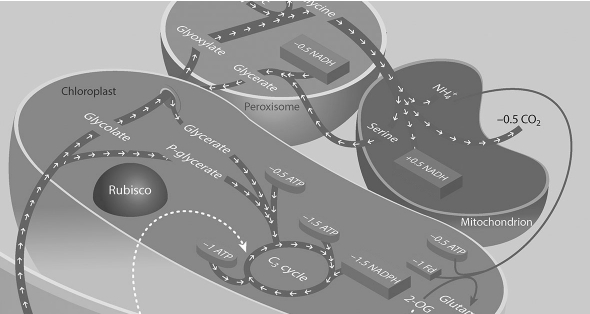
0 likes
View Solution96
MediumMCQ
Find out the reason that creates an important difference between $C_{3}$ and $C_{4}$ plants.
A
Photorespiration
B
Calvin cycle
C
Glycolysis
D
Pressure of cuticle
Solution
(A) In $C_{3}$ plants,photorespiration occurs,which leads to a loss of fixed carbon.
However,$C_{4}$ plants have evolved a mechanism to minimize or eliminate photorespiration by concentrating $CO_{2}$ around the enzyme $RuBisCO$ in bundle sheath cells.
Therefore,the presence or absence of photorespiration is a key physiological difference between $C_{3}$ and $C_{4}$ plants.
However,$C_{4}$ plants have evolved a mechanism to minimize or eliminate photorespiration by concentrating $CO_{2}$ around the enzyme $RuBisCO$ in bundle sheath cells.
Therefore,the presence or absence of photorespiration is a key physiological difference between $C_{3}$ and $C_{4}$ plants.
0 likes
View Solution97
MediumMCQ
The Warburg effect is the:
A
Inhibition of $C_{3}$-cycle by $O_{2}$
B
Inhibition of $C_{4}$-cycle by $O_{2}$
C
Inhibition of $C_{3}$-cycle by $CO_{2}$
D
Inhibition of $C_{4}$-cycle by $CO_{2}$
Solution
(A) Otto Warburg observed that high concentrations of $O_{2}$ inhibit the rate of photosynthesis in $C_{3}$ plants. This phenomenon is known as the Warburg effect.
It occurs because $O_{2}$ competes with $CO_{2}$ for the active site of the enzyme RuBisCo.
When $O_{2}$ binds to RuBisCo,it initiates photorespiration ($C_{2}$-cycle) instead of the Calvin cycle ($C_{3}$-cycle),thereby reducing the efficiency of photosynthesis.
Therefore,the Warburg effect is the inhibition of the $C_{3}$-cycle by $O_{2}$.
It occurs because $O_{2}$ competes with $CO_{2}$ for the active site of the enzyme RuBisCo.
When $O_{2}$ binds to RuBisCo,it initiates photorespiration ($C_{2}$-cycle) instead of the Calvin cycle ($C_{3}$-cycle),thereby reducing the efficiency of photosynthesis.
Therefore,the Warburg effect is the inhibition of the $C_{3}$-cycle by $O_{2}$.
0 likes
View Solution98
MediumMCQ
In $C_{3}$ plants,when $O_{2}$ concentration is high,$O_{2}$ binds to $Rubisco$ and $RuBP$ is converted into:
A
$2$ molecules of $PGA$
B
$2$ molecules of phosphoglycerate
C
$2$ molecules of phosphoglycolate
D
One molecule each of phosphoglycerate and phosphoglycolate
Solution
(D) In $C_{3}$ plants,the enzyme $Rubisco$ can act as both a carboxylase and an oxygenase.
When the concentration of $O_{2}$ is high,$Rubisco$ functions as an oxygenase.
Instead of fixing $CO_{2}$,it catalyzes the reaction of $RuBP$ with $O_{2}$,a process known as photorespiration.
This reaction produces one molecule of $3$-phosphoglycerate $(3-PGA)$ and one molecule of $2$-phosphoglycolate.
When the concentration of $O_{2}$ is high,$Rubisco$ functions as an oxygenase.
Instead of fixing $CO_{2}$,it catalyzes the reaction of $RuBP$ with $O_{2}$,a process known as photorespiration.
This reaction produces one molecule of $3$-phosphoglycerate $(3-PGA)$ and one molecule of $2$-phosphoglycolate.
0 likes
View Solution99
MediumMCQ
How many molecules of glycine are required to release one $CO_{2}$ molecule in photorespiration?
A
One
B
Two
C
Three
D
Four
Solution
(B) In the photorespiratory pathway (C2 cycle),two molecules of glycine $(C_{2}H_{5}NO_{2})$ are converted into one molecule of serine $(C_{3}H_{7}NO_{3})$,one molecule of $CO_{2}$,and one molecule of $NH_{3}$ in the mitochondria. Therefore,two molecules of glycine are required to release one molecule of $CO_{2}$.
0 likes
View SolutionPhotosynthesis in Higher Plants — Photorespiration · Frequently Asked Questions
1Are these Photosynthesis in Higher Plants questions useful for JEE and NEET?
Yes. All questions in this section are mapped to JEE Main and NEET exam patterns. Previous year questions from JEE Main, NEET, GUJCET and state-level exams are included with full solutions.
2Can I switch to Hindi or Gujarati for these questions?
Yes. Use the language tabs in the hero section or the sidebar to view the same questions and solutions in English, Hindi or Gujarati.
3How do I generate a question paper from this subtopic?
Use the Vedclass Exam Paper Generator — select the chapter and subtopic, set difficulty, and generate Sets A, B, C, D automatically. First 3 chapters of every subject are free.
Vedclass Products
For Students
Vedclass Test Series
Mock tests in real JEE/NEET style with performance analysis. 5-day free trial.
Start Free TrialFor Teachers
Exam Paper Generator
Generate Set A/B/C/D papers from this chapter in 2 minutes. 3 chapters free.
Try FreeFor Institutes
Online Exam Module
Live online exams with unlimited students, 360° analytics & white-label branding.
See DemoFor Teachers & Institutes
Generate a Photosynthesis in Higher Plants Exam Paper in 2 Minutes
Select subtopic & difficulty — Sets A, B, C, D auto-generated with No Repeat logic.
First 3 chapters of every subject are free — no payment required.