
A English
Mix Examples- Photosynthesis in Higher Plants Questions in English
Class 11 Biology · Photosynthesis in Higher Plants · Mix Examples- Photosynthesis in Higher Plants
235+
Questions
English
Language
100%
With Solutions
Showing 50 of 235 questions in English
151
Medium
Give scientific reasons:
$(1)$ Green plants form the basis of life on Earth.
$(2)$ Photosynthesis is a complex metabolic process.
$(1)$ Green plants form the basis of life on Earth.
$(2)$ Photosynthesis is a complex metabolic process.
Solution
(N/A) $(1)$ All animals depend directly or indirectly on green plants for their nutrition. Green plants produce food through photosynthesis,which herbivores consume to sustain their lives. Furthermore,the oxygen released during this process is essential for the respiration of all aerobic living organisms.
$(2)$ The process of photosynthesis occurs within the chloroplasts. The light-dependent reaction takes place in the grana,where $ATP$ and $NADPH$ are synthesized. These substances are subsequently utilized in the fixation of $CO_{2}$ during the light-independent reaction (Calvin cycle) to produce glucose. Thus,photosynthesis is a complex anabolic metabolic process.
$(2)$ The process of photosynthesis occurs within the chloroplasts. The light-dependent reaction takes place in the grana,where $ATP$ and $NADPH$ are synthesized. These substances are subsequently utilized in the fixation of $CO_{2}$ during the light-independent reaction (Calvin cycle) to produce glucose. Thus,photosynthesis is a complex anabolic metabolic process.
0 likes
View Solution152
Medium
Give scientific reasons:
$(1)$ The productivity of $C_4$ plants is more than $C_3$ plants.
$(2)$ It is necessary that the Calvin cycle runs for six times.
$(1)$ The productivity of $C_4$ plants is more than $C_3$ plants.
$(2)$ It is necessary that the Calvin cycle runs for six times.
Solution
(N/A) $(1)$ In the $C_4$ pathway,the concentration of $CO_2$ in the chloroplasts of bundle sheath cells remains high. Since the biosynthetic process of carbon fixation occurs in these cells,more $CO_2$ is available,leading to higher carbohydrate production.
Furthermore,the Kranz anatomy prevents $O_2$ produced in the light reaction of mesophyll cells from reaching the bundle sheath cells. Consequently,there is no possibility of photorespiration. Thus,the productivity of the $C_4$ pathway is higher than that of the $C_3$ pathway.
$(2)$ $ATP$ and $NADPH$ produced during the light reaction are utilized in the biosynthetic phase. $CO_2$ combines with the molecule $RuBP$ to form $PGA$. If this cycle runs six times,$6$ molecules of $RuBP$ combine with $6$ molecules of $CO_2$ to form $12$ molecules of $PGAL$. During reduction,two molecules of $PGAL$ are used to synthesize one molecule of glucose,while the remaining $10$ molecules of $PGAL$ regenerate $6$ molecules of $RuBP$. Thus,the cycle continues,allowing for the fixation of atmospheric $CO_2$ and the synthesis of glucose.
Furthermore,the Kranz anatomy prevents $O_2$ produced in the light reaction of mesophyll cells from reaching the bundle sheath cells. Consequently,there is no possibility of photorespiration. Thus,the productivity of the $C_4$ pathway is higher than that of the $C_3$ pathway.
$(2)$ $ATP$ and $NADPH$ produced during the light reaction are utilized in the biosynthetic phase. $CO_2$ combines with the molecule $RuBP$ to form $PGA$. If this cycle runs six times,$6$ molecules of $RuBP$ combine with $6$ molecules of $CO_2$ to form $12$ molecules of $PGAL$. During reduction,two molecules of $PGAL$ are used to synthesize one molecule of glucose,while the remaining $10$ molecules of $PGAL$ regenerate $6$ molecules of $RuBP$. Thus,the cycle continues,allowing for the fixation of atmospheric $CO_2$ and the synthesis of glucose.
0 likes
View Solution153
Medium
Provide definitions/explanations for the following terms:
$(1)$ Dark reaction
$(2)$ Photophosphorylation
$(1)$ Dark reaction
$(2)$ Photophosphorylation
Solution
(N/A) $(1)$ The dark reaction,also known as the biosynthetic phase of photosynthesis,is the process that utilizes the products of the light reaction ($ATP$ and $NADPH$) to fix $CO_2$ into carbohydrates. It does not directly require light,but it is dependent on the products of the light-dependent reactions.
$(2)$ Photophosphorylation is the process in which $ADP$ combines with inorganic phosphate $(Pi)$ to form $ATP$ using the energy derived from light (photons) during the light-dependent reactions of photosynthesis.
$(2)$ Photophosphorylation is the process in which $ADP$ combines with inorganic phosphate $(Pi)$ to form $ATP$ using the energy derived from light (photons) during the light-dependent reactions of photosynthesis.
0 likes
View Solution154
Easy
Identify the location and function of the following structures in a chloroplast:
$(1)$ Thylakoid
$(2)$ Stroma
$(1)$ Thylakoid
$(2)$ Stroma
Solution
(N/A) $(1)$ Location: Small coin-like structures stacked to form grana.
Function: Site of light-dependent reactions where chlorophyll pigments capture light energy to produce $ATP$ and $NADPH$.
$(2)$ Location: The fluid-filled matrix of the chloroplast surrounding the thylakoids.
Function: Site of the biosynthetic phase (Calvin cycle) where $CO_2$ is fixed to form glucose.
Function: Site of light-dependent reactions where chlorophyll pigments capture light energy to produce $ATP$ and $NADPH$.
$(2)$ Location: The fluid-filled matrix of the chloroplast surrounding the thylakoids.
Function: Site of the biosynthetic phase (Calvin cycle) where $CO_2$ is fixed to form glucose.
0 likes
View Solution155
Medium
Provide the full names for the following abbreviations:
$(1)$ $NADP$
$(2)$ $ATP$
$(1)$ $NADP$
$(2)$ $ATP$
Solution
(N/A) $(1)$ $NADP$ stands for Nicotinamide Adenine Dinucleotide Phosphate.
$(2)$ $ATP$ stands for Adenosine Triphosphate.
$(2)$ $ATP$ stands for Adenosine Triphosphate.
0 likes
View Solution156
Medium
Provide the full names for the following abbreviations:
$(1)$ $PGA$
$(2)$ $OAA$
$(1)$ $PGA$
$(2)$ $OAA$
Solution
(N/A) $(1)$ $PGA$ stands for Phosphoglyceric acid, which is the first stable product of the $C_3$ cycle (Calvin cycle) in photosynthesis.
$(2)$ $OAA$ stands for Oxaloacetic acid, which is the first stable product of the $C_4$ cycle (Hatch-Slack pathway) in photosynthesis.
$(2)$ $OAA$ stands for Oxaloacetic acid, which is the first stable product of the $C_4$ cycle (Hatch-Slack pathway) in photosynthesis.
0 likes
View Solution157
MediumMCQ
If a green plant is kept in the dark with proper ventilation,can this plant carry out photosynthesis? Can anything be given as a supplement to maintain its growth or survival?
A
Yes,it can perform photosynthesis; light is not required.
B
No,it cannot perform photosynthesis; light is essential for the process.
C
Yes,it can perform photosynthesis if provided with extra water.
D
No,it cannot perform photosynthesis,but it can survive indefinitely without any supplements.
Solution
(B) Green plants cannot perform photosynthesis in complete darkness because light energy is essential for the light-dependent reactions of photosynthesis.
Photosynthesis requires light to convert $CO_2$ and $H_2O$ into glucose and oxygen.
To maintain its survival in the dark,the plant can be provided with organic nutrients (like glucose or sucrose) through the soil or by external application,as it cannot synthesize its own food.
However,it will eventually die if kept in the dark for a prolonged period due to the lack of light-dependent metabolic processes.
Photosynthesis requires light to convert $CO_2$ and $H_2O$ into glucose and oxygen.
To maintain its survival in the dark,the plant can be provided with organic nutrients (like glucose or sucrose) through the soil or by external application,as it cannot synthesize its own food.
However,it will eventually die if kept in the dark for a prolonged period due to the lack of light-dependent metabolic processes.
0 likes
View Solution158
Medium
$RuBP$ carboxylase,$PEPcase$,pyruvate dehydrogenase,$ATPase$,cytochrome oxidase,hexokinase,lactate dehydrogenase. Select/choose enzymes from the list above which are involved in $(a)$ Photosynthesis $(b)$ Respiration $(c)$ Both in photosynthesis and respiration.
Solution
(A-D) - $RuBP$ Carboxylase: It is involved in the dark reaction (Calvin cycle) for the fixation of $CO_2$ in the $C_3$ pathway.
- $PEPcase$: It is involved in the fixation of $CO_2$ in photosynthesis,specifically in the $C_4$ pathway,where it forms $4C$ oxaloacetate.
- Pyruvate dehydrogenase: It is involved in aerobic respiration,catalyzing the conversion of pyruvic acid into Acetyl $CoA$.
- $ATPase$: It is involved in both respiration and photosynthesis. In both processes,it is associated with the proton pump in the electron transport system,where it synthesizes $ATP$ using the proton gradient.
- Cytochrome oxidase: It is involved in both respiration and photosynthesis as an electron carrier substance in the electron transport chain.
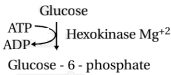
- Hexokinase: It is involved in glycolysis (respiration),where it converts glucose to glucose-$6$-phosphate,consuming one $ATP$.
- Lactate dehydrogenase: It is involved in anaerobic respiration (e.g.,in Lactobacillus),converting pyruvic acid to lactic acid.
- $PEPcase$: It is involved in the fixation of $CO_2$ in photosynthesis,specifically in the $C_4$ pathway,where it forms $4C$ oxaloacetate.
- Pyruvate dehydrogenase: It is involved in aerobic respiration,catalyzing the conversion of pyruvic acid into Acetyl $CoA$.
- $ATPase$: It is involved in both respiration and photosynthesis. In both processes,it is associated with the proton pump in the electron transport system,where it synthesizes $ATP$ using the proton gradient.
- Cytochrome oxidase: It is involved in both respiration and photosynthesis as an electron carrier substance in the electron transport chain.
- Hexokinase: It is involved in glycolysis (respiration),where it converts glucose to glucose-$6$-phosphate,consuming one $ATP$.
- Lactate dehydrogenase: It is involved in anaerobic respiration (e.g.,in Lactobacillus),converting pyruvic acid to lactic acid.
0 likes
View Solution159
MediumMCQ
Suppose $Euphorbia$ and $Maize$ are grown in a tropical area. Which one of them do you think will be able to survive better under such conditions?
A
$Euphorbia$
B
$Maize$
C
Both will survive equally well
D
None of them will survive
Solution
(A) $Euphorbia$ is a $CAM$ (Crassulacean Acid Metabolism) plant.
$CAM$ plants are specifically adapted to hot and arid environments because they perform $CO_{2}$ fixation at night when the temperature is lower,which minimizes water loss through transpiration.
$Maize$ is a $C_{4}$ plant,which is also adapted to high temperatures,but $Euphorbia$ (often exhibiting $CAM$ or $C_{4}$ pathways depending on the species) is highly specialized for extreme tropical heat and water stress.
Therefore,$Euphorbia$ is better adapted to survive in harsh tropical conditions.
$CAM$ plants are specifically adapted to hot and arid environments because they perform $CO_{2}$ fixation at night when the temperature is lower,which minimizes water loss through transpiration.
$Maize$ is a $C_{4}$ plant,which is also adapted to high temperatures,but $Euphorbia$ (often exhibiting $CAM$ or $C_{4}$ pathways depending on the species) is highly specialized for extreme tropical heat and water stress.
Therefore,$Euphorbia$ is better adapted to survive in harsh tropical conditions.
0 likes
View Solution160
Medium
Is it correct to say that photosynthesis occurs only in the leaves of a plant? Besides leaves,what are the other parts that may be capable of carrying out photosynthesis? Justify.
Solution
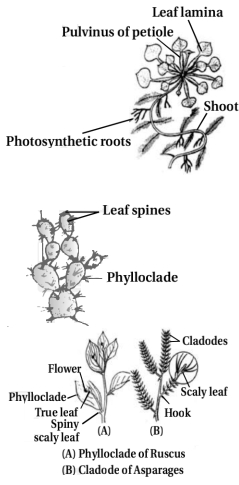
(N/A) No,it is not correct to say that photosynthesis occurs only in the leaves. While leaves are the primary sites,other green parts of the plant can also perform photosynthesis.
$1$. Photosynthesis by roots: When roots possess chloroplasts and perform photosynthesis,they are called assimilatory roots. Example: $Tinospora$.
$2$. Photosynthesis by stems: In plants like $Opuntia$ (cactus),the stem is modified to act like a leaf. It is green-colored,flat,thick,and fleshy,and it performs photosynthesis. This structure is called a phylloclade.
$3$. Photosynthesis by petioles: In some plants like Australian Acacia,the leaflets fall off very quickly,and the petiole becomes green,flat,and leaf-like to perform photosynthesis. This modified petiole is called a phyllode (often referred to as a cladode in specific contexts).
$4$. Other structures: In plants like $Ruscus$,the stem branches are modified into leaf-like structures called cladodes,which perform photosynthesis.
$1$. Photosynthesis by roots: When roots possess chloroplasts and perform photosynthesis,they are called assimilatory roots. Example: $Tinospora$.
$2$. Photosynthesis by stems: In plants like $Opuntia$ (cactus),the stem is modified to act like a leaf. It is green-colored,flat,thick,and fleshy,and it performs photosynthesis. This structure is called a phylloclade.
$3$. Photosynthesis by petioles: In some plants like Australian Acacia,the leaflets fall off very quickly,and the petiole becomes green,flat,and leaf-like to perform photosynthesis. This modified petiole is called a phyllode (often referred to as a cladode in specific contexts).
$4$. Other structures: In plants like $Ruscus$,the stem branches are modified into leaf-like structures called cladodes,which perform photosynthesis.
0 likes
View Solution161
Medium
Name the two important enzymes of $C_3$ and $C_4$ pathways, respectively. What important role do they play in fixing $CO_2$?
Solution
(N/A) In $C_3$ plants, the enzyme $RuBisCO$ (Ribulose-1,5-bisphosphate carboxylase-oxygenase) is present. It catalyzes the carboxylation of $5C$ $RuBP$ to form $3$-phosphoglycerate $(PGA)$, which is the first stable product of the $C_3$ pathway.
$5C \text{ } RuBP + CO_2 \xrightarrow{RuBisCO} 2 \text{ } PGA$
In $C_4$ plants, the enzyme $PEP$ carboxylase $(PEPCase)$ is present. It catalyzes the carboxylation of phosphoenolpyruvate $(PEP)$ to form oxaloacetic acid $(OAA)$, a $4C$ compound, which is the first stable product of the $C_4$ pathway.
$PEP + CO_2 \xrightarrow{PEPCase} OAA$
$5C \text{ } RuBP + CO_2 \xrightarrow{RuBisCO} 2 \text{ } PGA$
In $C_4$ plants, the enzyme $PEP$ carboxylase $(PEPCase)$ is present. It catalyzes the carboxylation of phosphoenolpyruvate $(PEP)$ to form oxaloacetic acid $(OAA)$, a $4C$ compound, which is the first stable product of the $C_4$ pathway.
$PEP + CO_2 \xrightarrow{PEPCase} OAA$
0 likes
View Solution162
MediumMCQ
Analogy type question:
$(1)$ Biosynthetic phase : Based on $CO_2$ and $H_2O$ :: Phosphorylation : ......
$(2)$ First product of $C_3$ cycle : $PGA$ :: First product of $C_4$ cycle : ......
$(1)$ Biosynthetic phase : Based on $CO_2$ and $H_2O$ :: Phosphorylation : ......
$(2)$ First product of $C_3$ cycle : $PGA$ :: First product of $C_4$ cycle : ......
A
$(1)$ $ATP$ synthesis,$(2)$ $OAA$
B
$(1)$ $NADP$ reduction,$(2)$ $RuBP$
C
$(1)$ $CO_2$ fixation,$(2)$ $PEP$
D
$(1)$ $H_2O$ splitting,$(2)$ $Malic$ acid
Solution
(A) $(1)$ The biosynthetic phase (dark reaction) involves the assimilation of $CO_2$ and $H_2O$ to form carbohydrates. Similarly,phosphorylation (specifically photophosphorylation) involves the synthesis of $ATP$ from $ADP$ and inorganic phosphate using light energy.
$(2)$ In the $C_3$ cycle,the first stable product formed after $CO_2$ fixation is $3$-phosphoglyceric acid $(PGA)$. In the $C_4$ cycle,the first stable product formed after $CO_2$ fixation is oxaloacetic acid $(OAA)$.
$(2)$ In the $C_3$ cycle,the first stable product formed after $CO_2$ fixation is $3$-phosphoglyceric acid $(PGA)$. In the $C_4$ cycle,the first stable product formed after $CO_2$ fixation is oxaloacetic acid $(OAA)$.
0 likes
View Solution163
MediumMCQ
Analogy type questions:
$(1)$ $C_4$ plants : Show $CO_2$ saturation at $360 \,\mu l L^{-1}$ :: $C_3$ plants : Show $CO_2$ saturation at concentrations above ............
$(2)$ Green plants : $H_2O$ as hydrogen donor :: Green sulfur bacteria : ............
$(1)$ $C_4$ plants : Show $CO_2$ saturation at $360 \,\mu l L^{-1}$ :: $C_3$ plants : Show $CO_2$ saturation at concentrations above ............
$(2)$ Green plants : $H_2O$ as hydrogen donor :: Green sulfur bacteria : ............
A
$(1) 450 \,\mu l L^{-1}, (2) H_2S$
B
$(1) 360 \,\mu l L^{-1}, (2) H_2O$
C
$(1) 450 \,\mu l L^{-1}, (2) CO_2$
D
$(1) 200 \,\mu l L^{-1}, (2) H_2S$
Solution
(A) $(1)$ $C_3$ plants respond to higher $CO_2$ concentrations and show saturation only beyond $450 \,\mu l L^{-1}$.
$(2)$ In photosynthesis,green plants use $H_2O$ as a hydrogen donor,whereas green sulfur bacteria use $H_2S$ (hydrogen sulfide) as a hydrogen donor.
$(2)$ In photosynthesis,green plants use $H_2O$ as a hydrogen donor,whereas green sulfur bacteria use $H_2S$ (hydrogen sulfide) as a hydrogen donor.
0 likes
View Solution164
MediumMCQ
Select the correct option:
$(1)$ Julius von Sachs / $T$. $W$. Engelmann proved with evidence that glucose is produced when plants grow.
$(2)$ In $PS-II$,maximum light absorption occurs at a wavelength of $680 \, nm / 800 \, nm$.
$(1)$ Julius von Sachs / $T$. $W$. Engelmann proved with evidence that glucose is produced when plants grow.
$(2)$ In $PS-II$,maximum light absorption occurs at a wavelength of $680 \, nm / 800 \, nm$.
A
Only $(1)$ is correct
B
Only $(2)$ is correct
C
Both $(1)$ and $(2)$ are correct
D
Both $(1)$ and $(2)$ are incorrect
Solution
(D) $(1)$ Julius von Sachs provided evidence for the production of glucose when plants grow. He demonstrated that glucose is usually stored as starch.
$(2)$ In $PS-II$ (Photosystem-$II$),the reaction center chlorophyll-$a$ has an absorption peak at $680 \, nm$. Therefore,it is also called $P680$.
$(3)$ Since both statements contain incorrect pairings or values in the original prompt,we identify the correct scientific facts: Julius von Sachs is the correct scientist for the glucose/starch experiment,and $680 \, nm$ is the correct wavelength for $PS-II$.
$(2)$ In $PS-II$ (Photosystem-$II$),the reaction center chlorophyll-$a$ has an absorption peak at $680 \, nm$. Therefore,it is also called $P680$.
$(3)$ Since both statements contain incorrect pairings or values in the original prompt,we identify the correct scientific facts: Julius von Sachs is the correct scientist for the glucose/starch experiment,and $680 \, nm$ is the correct wavelength for $PS-II$.
0 likes
View Solution165
MediumMCQ
Choose the correct option:
$(1)$ The first product of the $C_3$ pathway in the Calvin cycle is $PGA / OAA$.
$(2)$ The primary acceptor of $CO_2$ in the $C_4$ pathway is $PEP / OAA$.
$(1)$ The first product of the $C_3$ pathway in the Calvin cycle is $PGA / OAA$.
$(2)$ The primary acceptor of $CO_2$ in the $C_4$ pathway is $PEP / OAA$.
A
$(1) = PGA, (2) = PEP$
B
$(1) = OAA, (2) = PEP$
C
$(1) = PGA, (2) = OAA$
D
$(1) = OAA, (2) = OAA$
Solution
(A) $(1)$ In the $C_3$ cycle (Calvin cycle),the first stable product formed after the carboxylation of $RuBP$ is a $3$-carbon compound called $3$-phosphoglyceric acid $(PGA)$.
$(2)$ In the $C_4$ pathway (Hatch-Slack pathway),the primary $CO_2$ acceptor is phosphoenolpyruvate $(PEP)$,which is a $3$-carbon compound,and it combines with $CO_2$ to form oxaloacetic acid $(OAA)$.
$(2)$ In the $C_4$ pathway (Hatch-Slack pathway),the primary $CO_2$ acceptor is phosphoenolpyruvate $(PEP)$,which is a $3$-carbon compound,and it combines with $CO_2$ to form oxaloacetic acid $(OAA)$.
0 likes
View Solution166
MediumMCQ
Select the correct option:
$(1)$ Maize / Sunflower is a $C_4$ plant.
$(2)$ Rubisco / Oxygenase is the most abundant enzyme in the world.
$(1)$ Maize / Sunflower is a $C_4$ plant.
$(2)$ Rubisco / Oxygenase is the most abundant enzyme in the world.
A
$(1)$ Maize,$(2)$ Rubisco
B
$(1)$ Sunflower,$(2)$ Oxygenase
C
$(1)$ Maize,$(2)$ Oxygenase
D
$(1)$ Sunflower,$(2)$ Rubisco
Solution
(A) $(1)$ Maize ($Zea$ $mays$) is a $C_4$ plant,whereas Sunflower is a $C_3$ plant.
$(2)$ Rubisco ($Ribulose$ $1,5-bisphosphate$ $carboxylase-oxygenase$) is the most abundant enzyme in the world because it is essential for the Calvin cycle in all photosynthetic plants.
$(2)$ Rubisco ($Ribulose$ $1,5-bisphosphate$ $carboxylase-oxygenase$) is the most abundant enzyme in the world because it is essential for the Calvin cycle in all photosynthetic plants.
0 likes
View Solution167
MediumMCQ
Select the correct option:
$(1)$ $C_4$ plants have double the efficiency of carbon fixation compared to $C_3$ plants.
$(2)$ Sugar is transported from source to sink through the $\text{phloem}$ / $\text{xylem}$ tissue.
$(1)$ $C_4$ plants have double the efficiency of carbon fixation compared to $C_3$ plants.
$(2)$ Sugar is transported from source to sink through the $\text{phloem}$ / $\text{xylem}$ tissue.
A
$(1)$ $C_4$ plants,$(2)$ $\text{phloem}$
B
$(1)$ $C_3$ plants,$(2)$ $\text{xylem}$
C
$(1)$ $C_4$ plants,$(2)$ $\text{xylem}$
D
$(1)$ $C_3$ plants,$(2)$ $\text{phloem}$
Solution
(A) $(1)$ $C_4$ plants are more efficient in carbon fixation than $C_3$ plants because they possess the $\text{Kranz}$ anatomy and the $\text{PEP}$ carboxylase enzyme, which minimizes photorespiration.
$(2)$ The translocation of sugars (sucrose) from the source (leaves) to the sink (roots, fruits, or storage organs) occurs through the $\text{phloem}$ tissue, as described by the pressure-flow hypothesis.
$(2)$ The translocation of sugars (sucrose) from the source (leaves) to the sink (roots, fruits, or storage organs) occurs through the $\text{phloem}$ tissue, as described by the pressure-flow hypothesis.
0 likes
View Solution168
MediumMCQ
Which one of the following organisms does not evolve oxygen during photosynthesis?
A
Blue-green algae
B
Red algae
C
Photosynthetic bacteria
D
$C_{4}$ plants
Solution
(C) Photosynthetic bacteria,such as purple and green sulphur bacteria,perform photosynthesis in anoxic (oxygen-free) environments.
These organisms use bacteriochlorophyll instead of chlorophyll $a$.
Instead of water $(H_{2}O)$,they use other hydrogen donors like hydrogen sulphide $(H_{2}S)$ or organic compounds.
Because water is not split during this process,oxygen is not evolved as a byproduct.
These organisms use bacteriochlorophyll instead of chlorophyll $a$.
Instead of water $(H_{2}O)$,they use other hydrogen donors like hydrogen sulphide $(H_{2}S)$ or organic compounds.
Because water is not split during this process,oxygen is not evolved as a byproduct.
0 likes
View Solution169
MediumMCQ
Select the correct statement.
A
Water can be absorbed passively by roots.
B
Ions are generally absorbed from soil by both active and passive transport.
C
$C_{4}$ photosynthetic system is evolved for maximizing the availability of $CO_{2}$ and to minimize the loss of water.
D
All of the above.
Solution
(D) Passive absorption of water by the root system occurs due to the tension created in the xylem water column,which is a result of transpiration.
Absorption of ions from the soil occurs through both active and passive transport mechanisms.
The $C_{4}$ photosynthetic system is an adaptation found in many tropical plants (e.g.,maize,sugarcane,sorghum,Amaranthus) to maximize $CO_{2}$ availability and minimize water loss through photorespiration.
Therefore,all the given statements are correct.
Absorption of ions from the soil occurs through both active and passive transport mechanisms.
The $C_{4}$ photosynthetic system is an adaptation found in many tropical plants (e.g.,maize,sugarcane,sorghum,Amaranthus) to maximize $CO_{2}$ availability and minimize water loss through photorespiration.
Therefore,all the given statements are correct.
0 likes
View Solution170
MediumMCQ
Diffusion, a process that occurs along the concentration gradient, is actively involved in:
A
Transpiration
B
Respiration
C
Photosynthesis
D
All of these
Solution
(D) Diffusion is a passive process where molecules move from a region of higher concentration to a region of lower concentration along the concentration gradient.
It plays a crucial role in various biological processes:
$1$. In $Transpiration$, water vapor diffuses out of the stomata into the atmosphere.
$2$. In $Respiration$, oxygen diffuses into cells and carbon dioxide diffuses out.
$3$. In $Photosynthesis$, carbon dioxide diffuses into the leaves from the atmosphere, and oxygen diffuses out.
Therefore, it is involved in all of these processes.
It plays a crucial role in various biological processes:
$1$. In $Transpiration$, water vapor diffuses out of the stomata into the atmosphere.
$2$. In $Respiration$, oxygen diffuses into cells and carbon dioxide diffuses out.
$3$. In $Photosynthesis$, carbon dioxide diffuses into the leaves from the atmosphere, and oxygen diffuses out.
Therefore, it is involved in all of these processes.
0 likes
View Solution171
MediumMCQ
Which of the following statements is/are not true?
$I.$ In $CAM$ plants,stomata open during dark and remain closed during the day.
$II.$ Role of $Na^+$ in stomatal opening is now universally accepted.
$III.$ The water potential of root cells is higher than the water potential of soil.
$IV.$ Capillarity theory is the most accepted theory of water movement through plants.
$V.$ The walls of xylem vessels made up of ligno-cellulose have strong affinity for water molecules.
$I.$ In $CAM$ plants,stomata open during dark and remain closed during the day.
$II.$ Role of $Na^+$ in stomatal opening is now universally accepted.
$III.$ The water potential of root cells is higher than the water potential of soil.
$IV.$ Capillarity theory is the most accepted theory of water movement through plants.
$V.$ The walls of xylem vessels made up of ligno-cellulose have strong affinity for water molecules.
A
$II, III$ and $IV$
B
$II, III$ and $V$
C
$I, II$ and $III$
D
$II$ and $III$
Solution
(A) $I.$ True: $CAM$ plants open stomata at night to minimize water loss.
$II.$ False: The role of $Na^+$ in stomatal opening is not universally accepted; $K^+$ is the primary ion involved.
$III.$ False: For water absorption,the water potential of root cells must be lower than that of the soil.
$IV.$ False: The Cohesion-Tension (Transpiration Pull) theory is the most widely accepted theory for water transport.
$V.$ True: Xylem walls are hydrophilic due to ligno-cellulose,facilitating water movement.
Therefore,statements $II, III,$ and $IV$ are not true.
$II.$ False: The role of $Na^+$ in stomatal opening is not universally accepted; $K^+$ is the primary ion involved.
$III.$ False: For water absorption,the water potential of root cells must be lower than that of the soil.
$IV.$ False: The Cohesion-Tension (Transpiration Pull) theory is the most widely accepted theory for water transport.
$V.$ True: Xylem walls are hydrophilic due to ligno-cellulose,facilitating water movement.
Therefore,statements $II, III,$ and $IV$ are not true.
0 likes
View Solution172
MediumMCQ
$I.$ In $C_{3}$-plants,the Calvin pathway takes place in mesophyll cells.
$II.$ In $C_{4}$-plants,the Calvin pathway takes place in the mesophyll cells.
Which of the following statements is true?
$II.$ In $C_{4}$-plants,the Calvin pathway takes place in the mesophyll cells.
Which of the following statements is true?
A
Statement $I$ is incorrect,$II$ is correct.
B
Statement $II$ is incorrect,$I$ is correct.
C
Both are incorrect.
D
Both are correct.
Solution
(B) In $C_{3}$-plants,the entire Calvin cycle occurs within the mesophyll cells.
In $C_{4}$-plants,the Calvin cycle is restricted to the bundle sheath cells,while the initial carbon fixation occurs in the mesophyll cells.
Therefore,statement $I$ is correct,and statement $II$ is incorrect.
In $C_{4}$-plants,the Calvin cycle is restricted to the bundle sheath cells,while the initial carbon fixation occurs in the mesophyll cells.
Therefore,statement $I$ is correct,and statement $II$ is incorrect.
0 likes
View Solution173
MediumMCQ
Which would do maximum harm to a tree?
A
Loss of half of its branches
B
Loss of all its bark
C
Loss of all its leaves
D
Loss of half of its leaves
Solution
(C) Loss of all leaves would do maximum harm to a tree.
Leaves are the primary sites for photosynthesis,which is the process by which plants produce their food.
Without leaves,the plant cannot synthesize glucose,leading to a complete cessation of energy production.
This results in the starvation of the plant and the eventual cessation of all metabolic activities,leading to the death of the tree.
Leaves are the primary sites for photosynthesis,which is the process by which plants produce their food.
Without leaves,the plant cannot synthesize glucose,leading to a complete cessation of energy production.
This results in the starvation of the plant and the eventual cessation of all metabolic activities,leading to the death of the tree.
0 likes
View Solution174
MediumMCQ
Which of the following is/are the raw material$(s)$ for photosynthesis?
$I$. $H_{2}O$
$II$. $CO_{2}$
$III$. Light
$IV$. Chlorophyll
Choose the correct option.
$I$. $H_{2}O$
$II$. $CO_{2}$
$III$. Light
$IV$. Chlorophyll
Choose the correct option.
A
$II, III$ and $IV$
B
$I$ and $IV$
C
$I, II$ and $III$
D
$I, II, III$ and $IV$
Solution
(D) Photosynthesis is the process by which green plants synthesize their own food using specific components.
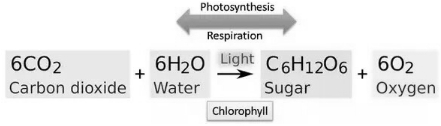
According to the chemical equation for photosynthesis: $6CO_{2} + 6H_{2}O \xrightarrow{\text{Light, Chlorophyll}} C_{6}H_{12}O_{6} + 6O_{2}$.
From this equation,it is evident that $H_{2}O$ (water) and $CO_{2}$ (carbon dioxide) are the chemical raw materials,while light and chlorophyll are essential requirements for the process to occur.
Therefore,all the listed items $(I, II, III, IV)$ are necessary for photosynthesis.
According to the chemical equation for photosynthesis: $6CO_{2} + 6H_{2}O \xrightarrow{\text{Light, Chlorophyll}} C_{6}H_{12}O_{6} + 6O_{2}$.
From this equation,it is evident that $H_{2}O$ (water) and $CO_{2}$ (carbon dioxide) are the chemical raw materials,while light and chlorophyll are essential requirements for the process to occur.
Therefore,all the listed items $(I, II, III, IV)$ are necessary for photosynthesis.
0 likes
View Solution175
EasyMCQ
The two pigment system theory of photosynthesis was proposed by
A
Blackman
B
Hill
C
Emerson
D
Arnon
Solution
(C) The two pigment system theory of photosynthesis,which describes the existence of $PS-I$ and $PS-II$,was proposed by $Emerson$ et al. based on the observation of the enhancement effect in photosynthesis.
0 likes
View Solution176
EasyMCQ
Most abundant protein of the biological world is
A
Rubisco
B
Ligase
C
Permease
D
$RuBP$
Solution
(A) RuBisCo is the most abundant protein in the biological world.
It constitutes approximately $16 \%$ of the total chloroplast proteins.
It is an enzyme that plays a crucial role in the Calvin cycle during photosynthesis.
It is located on the outer surface of the thylakoid membrane.
It constitutes approximately $16 \%$ of the total chloroplast proteins.
It is an enzyme that plays a crucial role in the Calvin cycle during photosynthesis.
It is located on the outer surface of the thylakoid membrane.
0 likes
View Solution177
MediumMCQ
The statement "We are created by chloroplast" suggests the idea that:
A
All life forms possess chloroplasts.
B
All life forms depend on photosynthesis.
C
All life forms are plants.
D
Plants are the first organisms on Earth.
Solution
(B) All life forms are supported by plants, whether they are herbivores or carnivores. Chloroplasts present in plants trap solar energy and convert it into chemical energy in the form of starch. This process is known as photosynthesis. Therefore, the statement "We are created by chloroplast" implies that all life forms depend on photosynthesis for their survival and energy requirements.
0 likes
View Solution178
MediumMCQ
Which of the following statements with regard to photosynthesis is/are correct?
$I$. In $C_{4}$-plants,the primary $CO_{2}$ acceptor is $PEP$.
$II$. In the photosynthetic process,$PS-II$ absorbs energy at or just below $680 \;nm$.
$III$. The pigment that is present in the Pigment System-$I$ is $P680$.
$I$. In $C_{4}$-plants,the primary $CO_{2}$ acceptor is $PEP$.
$II$. In the photosynthetic process,$PS-II$ absorbs energy at or just below $680 \;nm$.
$III$. The pigment that is present in the Pigment System-$I$ is $P680$.
A
$II$ and $III$ only
B
$I$ only
C
$III$ only
D
$I$ and $II$ only
Solution
(D) $C_{4}$-plants exhibit Kranz anatomy. In these plants,the primary carbon dioxide acceptor in mesophyll cells is phosphoenol pyruvate $(PEP)$.
In the light reaction of photosynthesis,$PS-II$ absorbs energy at or just below $680 \;nm$,which is why its reaction center is called $P680$.
$PS-I$ absorbs energy at $700 \;nm$,and its reaction center is called $P700$.
Therefore,statements $I$ and $II$ are correct,while statement $III$ is incorrect because $P680$ is the reaction center of $PS-II$,not $PS-I$.
In the light reaction of photosynthesis,$PS-II$ absorbs energy at or just below $680 \;nm$,which is why its reaction center is called $P680$.
$PS-I$ absorbs energy at $700 \;nm$,and its reaction center is called $P700$.
Therefore,statements $I$ and $II$ are correct,while statement $III$ is incorrect because $P680$ is the reaction center of $PS-II$,not $PS-I$.
0 likes
View Solution179
MediumMCQ
Plants in which the first product of $CO_{2}$ fixation is $C_{3}$ acid,i.e.,the ...$A$... pathway,and those in which the first product was $C_{4}$ acid $(OAA)$,i.e.,the ...$B$... pathway. Complete the given statement by filling appropriate options in the given blanks.
A
$A - C_{2}; B - C_{3}$
B
$A - C_{3}; B - C_{4}$
C
$A - C_{4}; B - C_{2}$
D
$A - C_{2}; B - C_{3}$
Solution
(B) $CO_{2}$ assimilation during photosynthesis generally takes place in two ways in plants:
$(i)$ $C_{3}$ pathway: Those plants in which the first stable product of $CO_{2}$ fixation is a $C_{3}$ acid,specifically $3$-phosphoglyceric acid $(PGA)$,are said to follow the $C_{3}$ pathway.
$(ii)$ $C_{4}$ pathway: Those plants in which the first stable product of $CO_{2}$ fixation is a $C_{4}$ acid,specifically oxaloacetic acid $(OAA)$,are said to follow the $C_{4}$ pathway.
$(i)$ $C_{3}$ pathway: Those plants in which the first stable product of $CO_{2}$ fixation is a $C_{3}$ acid,specifically $3$-phosphoglyceric acid $(PGA)$,are said to follow the $C_{3}$ pathway.
$(ii)$ $C_{4}$ pathway: Those plants in which the first stable product of $CO_{2}$ fixation is a $C_{4}$ acid,specifically oxaloacetic acid $(OAA)$,are said to follow the $C_{4}$ pathway.
0 likes
View Solution180
MediumMCQ
Which of the following is true for photosynthesis?
A
Reduction of $CO_2$ and water
B
Oxidation of $CO_2$ and water
C
Reduction of $CO_2$ and oxidation of water
D
Oxidation of $CO_2$ and reduction of water
Solution
(C) Photosynthesis is an anabolic process of manufacturing organic compounds.
It is characterized by the reduction of $CO_2$ to carbohydrates and the oxidation of water to $O_2$.
This process decreases the concentration of $CO_2$ in the atmosphere and increases the concentration of $O_2$.
It is characterized by the reduction of $CO_2$ to carbohydrates and the oxidation of water to $O_2$.
This process decreases the concentration of $CO_2$ in the atmosphere and increases the concentration of $O_2$.
0 likes
View Solution181
MediumMCQ
In which of the following,oxygen does not evolve during photosynthesis?
A
Photosynthetic red algae
B
Photosynthetic green algae
C
Photosynthetic blue-green algae
D
Photosynthetic bacteria
Solution
(D) In oxygenic photosynthesis,water $(H_2O)$ acts as an electron donor,and oxygen $(O_2)$ is released as a byproduct. This occurs in plants,algae,and cyanobacteria (blue-green algae).
In contrast,photosynthetic bacteria (such as purple and green sulphur bacteria) perform anoxygenic photosynthesis.
In these bacteria,compounds like hydrogen sulphide $(H_2S)$ or other inorganic substances act as electron donors instead of water.
Consequently,these bacteria do not evolve oxygen during the process of photosynthesis.
In contrast,photosynthetic bacteria (such as purple and green sulphur bacteria) perform anoxygenic photosynthesis.
In these bacteria,compounds like hydrogen sulphide $(H_2S)$ or other inorganic substances act as electron donors instead of water.
Consequently,these bacteria do not evolve oxygen during the process of photosynthesis.
0 likes
View Solution182
MediumMCQ
$I.$ Initial $CO_{2}$ acceptor
$II.$ Extent of photorespiration
$III.$ Enzyme catalyzing reaction that fixes $CO_{2}$
$IV.$ Presence of Calvin cycle
$V.$ Leaf anatomy
Which one does not differ in a $C_{3}$ and $C_{4}$ plant?
$II.$ Extent of photorespiration
$III.$ Enzyme catalyzing reaction that fixes $CO_{2}$
$IV.$ Presence of Calvin cycle
$V.$ Leaf anatomy
Which one does not differ in a $C_{3}$ and $C_{4}$ plant?
A
$I$ and $V$
B
Only $IV$
C
$II$ and $III$
D
Only $II$
Solution
(B) The Calvin cycle is present in both $C_{3}$ and $C_{4}$ plants.
In $C_{3}$ plants,the Calvin cycle occurs in the mesophyll cells.
In $C_{4}$ plants,the Calvin cycle occurs in the bundle sheath cells.
Since the Calvin cycle is a fundamental process for carbon fixation in both types of plants,its presence does not differ between them.
Other factors like the initial $CO_{2}$ acceptor (RuBP in $C_{3}$,$PEP$ in $C_{4}$),extent of photorespiration (higher in $C_{3}$,negligible in $C_{4}$),enzymes (RuBisCO in $C_{3}$,$PEP$ carboxylase and RuBisCO in $C_{4}$),and leaf anatomy (Kranz anatomy in $C_{4}$) differ significantly.
In $C_{3}$ plants,the Calvin cycle occurs in the mesophyll cells.
In $C_{4}$ plants,the Calvin cycle occurs in the bundle sheath cells.
Since the Calvin cycle is a fundamental process for carbon fixation in both types of plants,its presence does not differ between them.
Other factors like the initial $CO_{2}$ acceptor (RuBP in $C_{3}$,$PEP$ in $C_{4}$),extent of photorespiration (higher in $C_{3}$,negligible in $C_{4}$),enzymes (RuBisCO in $C_{3}$,$PEP$ carboxylase and RuBisCO in $C_{4}$),and leaf anatomy (Kranz anatomy in $C_{4}$) differ significantly.
0 likes
View Solution183
MediumMCQ
Which statement about photosynthesis is false?
A
The electron carriers involved in photophosphorylation are located on the thylakoid membranes.
B
Photosynthesis is a redox process,in which water is oxidized and carbon dioxide is reduced.
C
The enzymes required for carbon fixation are located only in the grana of chloroplasts.
D
In green plants,both $PS-I$ and $PS-II$ are required for the formation of $NADPH + H^+$.
Solution
(C) The statement in option $C$ is false because carbon dioxide fixation (Calvin cycle) occurs in the stroma of the chloroplast,not in the grana. The stroma contains the necessary enzymes,such as $RuBisCO$,which are essential for the fixation of carbon dioxide and the subsequent synthesis of sugars. The grana are primarily the sites for the light-dependent reactions.
0 likes
View Solution184
MediumMCQ
Photosynthesis is:
$I.$ Endergonic process
$II.$ Exergonic process
$III.$ Chemical process
$IV.$ Physical process
Select the correct option.
$I.$ Endergonic process
$II.$ Exergonic process
$III.$ Chemical process
$IV.$ Physical process
Select the correct option.
A
$II, III$ and $IV$
B
$I, III$ and $IV$
C
$I, II$ and $IV$
D
$I$ and $III$
Solution
(D) Photosynthesis is an endergonic process because it requires the input of energy (light energy) to synthesize organic compounds.
It is a chemical process as it involves the conversion of inorganic raw materials ($CO_2$ and $H_2O$) into organic compounds (glucose) through a series of chemical reactions.
It is not an exergonic process (which releases energy) nor is it a purely physical process.
Therefore,statements $I$ and $III$ are correct.
It is a chemical process as it involves the conversion of inorganic raw materials ($CO_2$ and $H_2O$) into organic compounds (glucose) through a series of chemical reactions.
It is not an exergonic process (which releases energy) nor is it a purely physical process.
Therefore,statements $I$ and $III$ are correct.
0 likes
View Solution185
MediumMCQ
Water is
A
used in dark reaction
B
$A$ reactant in light reaction
C
Both $(a)$ and $(b)$
D
Involved nowhere in photosynthesis
Solution
(C) Water $(H_2O)$ plays a crucial role in photosynthesis.
$1$. In the light reaction,water undergoes photolysis (splitting of water) to provide electrons,protons $(H^+)$,and oxygen $(O_2)$. Thus,it acts as a reactant.
$2$. Water is also involved in the dark reaction (Calvin cycle) as it is required for various metabolic processes and is a product of the condensation reactions occurring during sugar synthesis.
Therefore,water is involved in both light and dark reactions.
$1$. In the light reaction,water undergoes photolysis (splitting of water) to provide electrons,protons $(H^+)$,and oxygen $(O_2)$. Thus,it acts as a reactant.
$2$. Water is also involved in the dark reaction (Calvin cycle) as it is required for various metabolic processes and is a product of the condensation reactions occurring during sugar synthesis.
Therefore,water is involved in both light and dark reactions.
0 likes
View Solution186
DifficultMCQ
What is the effect of high $CO_{2}$ concentration and higher values of $ATP/ADP$ ratio?
A
Rate of Calvin cycle increased
B
Rate of Kreb cycle decreased
C
Rate of glycolate cycle decreased
D
All of the above
Solution
(D) High $CO_{2}$ concentration promotes the carboxylation reaction of $RuBisCO$,thereby increasing the rate of the Calvin cycle to synthesize carbohydrates.
High $ATP/ADP$ ratio indicates an energy-rich state,which further supports the Calvin cycle.
These conditions inhibit photorespiration (glycolate cycle) because $RuBisCO$ acts as a carboxylase rather than an oxygenase.
Additionally,metabolic regulation often leads to a decrease in the rate of the Kreb cycle under these conditions to balance cellular energy requirements.
High $ATP/ADP$ ratio indicates an energy-rich state,which further supports the Calvin cycle.
These conditions inhibit photorespiration (glycolate cycle) because $RuBisCO$ acts as a carboxylase rather than an oxygenase.
Additionally,metabolic regulation often leads to a decrease in the rate of the Kreb cycle under these conditions to balance cellular energy requirements.
0 likes
View Solution187
MediumMCQ
$I.$ Photosystem-$I$ is a photosynthetic pigment system located on the appressed part of grana and thylakoids.
$II.$ Photosystem-$II$ is a photosynthetic pigment system located on the non-appressed part of stroma only.
Identify whether the given statements are correct or incorrect and choose the correct option accordingly.
$II.$ Photosystem-$II$ is a photosynthetic pigment system located on the non-appressed part of stroma only.
Identify whether the given statements are correct or incorrect and choose the correct option accordingly.
A
Statement $I$ is correct,while $II$ is incorrect.
B
Statement $II$ is correct,while $I$ is incorrect.
C
Both statements are correct.
D
Both statements are incorrect.
Solution
(D) $PS-I$ (Photosystem-$I$) is a photosynthetic pigment system along with some electron carriers that is located on both the non-appressed parts of grana thylakoids as well as stroma thylakoids.
$PS-II$ (Photosystem-$II$) is a photosynthetic pigment system along with some electron carriers that is located in the appressed part of grana thylakoids.
Therefore,both statements $I$ and $II$ are incorrect.
$PS-II$ (Photosystem-$II$) is a photosynthetic pigment system along with some electron carriers that is located in the appressed part of grana thylakoids.
Therefore,both statements $I$ and $II$ are incorrect.
0 likes
View Solution188
MediumMCQ
Consider the following statements.
$I.$ The portion of the spectrum between $300-500 \;nm$ is also referred to as Photosynthetically Active Radiation $(PAR)$.
$II.$ Magnesium,calcium and chloride ions play prominent roles in the photolysis of water.
$III.$ In cyclic photophosphorylation,oxygen is not released (as there is no photolysis of water) and $NADPH$ is also not produced.
$I.$ The portion of the spectrum between $300-500 \;nm$ is also referred to as Photosynthetically Active Radiation $(PAR)$.
$II.$ Magnesium,calcium and chloride ions play prominent roles in the photolysis of water.
$III.$ In cyclic photophosphorylation,oxygen is not released (as there is no photolysis of water) and $NADPH$ is also not produced.
A
$I$ is true; but $II$ and $III$ are false
B
$I$ and $II$ are false; but $III$ is true
C
$II$ is true; but $I$ and $III$ are false
D
$I$ and $II$ are true; but $III$ is false
Solution
(B) Statement $I$ is false because Photosynthetically Active Radiation $(PAR)$ ranges between $400-700 \;nm$,not $300-500 \;nm$.
Statement $II$ is false because manganese $(Mn^{2+})$ and chloride $(Cl^-)$ ions are essential for the photolysis of water,not magnesium or calcium.
Statement $III$ is true because cyclic photophosphorylation involves only Photosystem $I$ $(PSI)$,where water is not split (no photolysis),thus no oxygen is released and no $NADPH$ is formed.
Statement $II$ is false because manganese $(Mn^{2+})$ and chloride $(Cl^-)$ ions are essential for the photolysis of water,not magnesium or calcium.
Statement $III$ is true because cyclic photophosphorylation involves only Photosystem $I$ $(PSI)$,where water is not split (no photolysis),thus no oxygen is released and no $NADPH$ is formed.
0 likes
View Solution189
MediumMCQ
Choose the incorrect statement with respect to photosynthesis.
A
It is a physico-chemical process.
B
Oxygen is evolved as a by-product in all photosynthetic organisms.
C
Occurs in unicellular and multicellular photoautotrophs.
D
Anabolic and reductive process.
Solution
(B) Photosynthesis is a physico-chemical process by which green plants use light energy to drive the synthesis of organic compounds.
It is an anabolic and reductive process.
It occurs in both unicellular and multicellular photoautotrophs.
However,oxygen is not evolved as a by-product in all photosynthetic organisms. For example,in purple and green sulfur bacteria,$H_2S$ is used as a hydrogen donor instead of $H_2O$,and therefore,sulfur or sulfate is produced instead of $O_2$.
It is an anabolic and reductive process.
It occurs in both unicellular and multicellular photoautotrophs.
However,oxygen is not evolved as a by-product in all photosynthetic organisms. For example,in purple and green sulfur bacteria,$H_2S$ is used as a hydrogen donor instead of $H_2O$,and therefore,sulfur or sulfate is produced instead of $O_2$.
0 likes
View Solution190
MediumMCQ
The $C_4$ and $C_3$ plants differ from each other in
A
Type of pigments involved in photosynthesis
B
The primary acceptor of $CO_2$ during carbon fixation
C
Type of end products of photosynthesis
D
Number of $NADPH$ that are consumed during the starch synthesis process
Solution
(B) In $C_3$ plants,the primary $CO_2$ acceptor is $RuBP$ (Ribulose$-1,5-$bisphosphate),which is a $5$-carbon compound.
In $C_4$ plants,the primary $CO_2$ acceptor is $PEP$ (Phosphoenolpyruvate),which is a $3$-carbon compound.
Therefore,$C_4$ and $C_3$ plants differ significantly in their primary $CO_2$ acceptor during the carbon fixation process.
In $C_4$ plants,the primary $CO_2$ acceptor is $PEP$ (Phosphoenolpyruvate),which is a $3$-carbon compound.
Therefore,$C_4$ and $C_3$ plants differ significantly in their primary $CO_2$ acceptor during the carbon fixation process.
0 likes
View Solution191
MediumMCQ
Which of the following statements is correct regarding $C_4$ plants?
A
The carbon fixation is catalysed by $PEP$ carboxylase
B
Mesophyll cells lack the $RuBisCO$ enzyme
C
Photorespiration is absent
D
More than one option is correct
Solution
(D) In $C_4$ plants,the primary carbon fixation occurs in mesophyll cells and is catalysed by $PEP$ carboxylase.
Additionally,mesophyll cells lack the $RuBisCO$ enzyme,which is instead restricted to the bundle sheath cells.
Furthermore,$C_4$ plants have a mechanism that increases the concentration of $CO_2$ around the $RuBisCO$ enzyme,which effectively minimizes or eliminates photorespiration.
Since all three statements ($A$,$B$,and $C$) are correct,the correct option is $D$.
Additionally,mesophyll cells lack the $RuBisCO$ enzyme,which is instead restricted to the bundle sheath cells.
Furthermore,$C_4$ plants have a mechanism that increases the concentration of $CO_2$ around the $RuBisCO$ enzyme,which effectively minimizes or eliminates photorespiration.
Since all three statements ($A$,$B$,and $C$) are correct,the correct option is $D$.
0 likes
View Solution192
MediumMCQ
Select the correct match.
| Column-$I$ | Column-$II$ |
| $a.$ $OEC$ | $(i)$ Primary e-acceptor |
| $b.$ $NADP$ reductase | $(ii)$ Photolysis of $H_2O$ |
| $c.$ Succinyl $CoA$ | $(iii)$ Outer surface of thylakoid membrane |
| $d.$ Phaeophytin | $(iv)$ Chlorophyll synthesis |
A
$a(ii), b(iii), c(iv), d(i)$
B
$a(ii), b(iii), c(i), d(iv)$
C
$a(iii), b(i), c(ii), d(iv)$
D
$a(i), b(ii), c(iii), d(iv)$
Solution
(A) The correct matches are as follows:
$1$. $OEC$ (Oxygen Evolving Complex) is responsible for the photolysis of $H_2O$ $(a-ii)$.
$2$. $NADP$ reductase enzyme is located on the outer surface of the thylakoid membrane, where it reduces $NADP^+$ to $NADPH$ $(b-iii)$.
$3$. Succinyl $CoA$ is a precursor molecule involved in the biosynthesis of chlorophyll $(c-iv)$.
$4$. Phaeophytin acts as the primary electron acceptor in the electron transport chain of Photosystem-$II$ $(d-i)$.
Therefore, the correct sequence is $a(ii), b(iii), c(iv), d(i)$.
$1$. $OEC$ (Oxygen Evolving Complex) is responsible for the photolysis of $H_2O$ $(a-ii)$.
$2$. $NADP$ reductase enzyme is located on the outer surface of the thylakoid membrane, where it reduces $NADP^+$ to $NADPH$ $(b-iii)$.
$3$. Succinyl $CoA$ is a precursor molecule involved in the biosynthesis of chlorophyll $(c-iv)$.
$4$. Phaeophytin acts as the primary electron acceptor in the electron transport chain of Photosystem-$II$ $(d-i)$.
Therefore, the correct sequence is $a(ii), b(iii), c(iv), d(i)$.
0 likes
View Solution193
MediumMCQ
Photosynthesis of maize plant differs from wheat plant in
A
Number of $ATP$ required per $CO_2$ fixation
B
Having spatial separation in both carboxylations
C
Having $PEP$case activity
D
All of these
Solution
(D) Maize is a $C_4$ plant,while wheat is a $C_3$ plant.
$C_4$ plants like maize require more $ATP$ ($30$ $ATP$ per glucose) compared to $C_3$ plants like wheat ($18$ $ATP$ per glucose) for $CO_2$ fixation.
$C_4$ plants exhibit spatial separation of carboxylations (mesophyll and bundle sheath cells),whereas $C_3$ plants do not.
$C_4$ plants utilize $PEP$case enzyme for the initial $CO_2$ fixation,which is absent in $C_3$ plants.
Therefore,all the given options represent differences between maize and wheat photosynthesis.
$C_4$ plants like maize require more $ATP$ ($30$ $ATP$ per glucose) compared to $C_3$ plants like wheat ($18$ $ATP$ per glucose) for $CO_2$ fixation.
$C_4$ plants exhibit spatial separation of carboxylations (mesophyll and bundle sheath cells),whereas $C_3$ plants do not.
$C_4$ plants utilize $PEP$case enzyme for the initial $CO_2$ fixation,which is absent in $C_3$ plants.
Therefore,all the given options represent differences between maize and wheat photosynthesis.
0 likes
View Solution194
MediumMCQ
$A$: Light harvesting complexes $(LHC)$ on thylakoid membrane broaden the range of light absorption.
$R$: They transfer electrons to the reaction centre.
$R$: They transfer electrons to the reaction centre.
A
Assertion and Reason both are correct and Reason is the correct explanation of Assertion.
B
Assertion and Reason both are correct but Reason is not the correct explanation of Assertion.
C
Assertion is correct,but Reason is incorrect.
D
Both Assertion and Reason are incorrect.
Solution
(A) The Light Harvesting Complexes $(LHC)$ consist of hundreds of pigment molecules bound to proteins. Each complex contains all pigments except one molecule of chlorophyll $a$,forming a light-harvesting system (also called antenna molecules).
These pigments absorb light at different wavelengths,thereby broadening the range of light absorption for photosynthesis.
The energy absorbed by these antenna molecules is transferred to the reaction centre (chlorophyll $a$) via resonance.
Therefore,both the Assertion and the Reason are correct,and the Reason explains why the $LHC$ is effective in light absorption.
These pigments absorb light at different wavelengths,thereby broadening the range of light absorption for photosynthesis.
The energy absorbed by these antenna molecules is transferred to the reaction centre (chlorophyll $a$) via resonance.
Therefore,both the Assertion and the Reason are correct,and the Reason explains why the $LHC$ is effective in light absorption.
0 likes
View Solution195
MediumMCQ
$A$: For every $CO_2$ molecule entering the $C_3$ cycle,three molecules of $ATP$ and two molecules of $NADPH$ are required.
$R$: Cyclic photophosphorylation takes place to meet the difference in the number of $ATP$ molecules.
$R$: Cyclic photophosphorylation takes place to meet the difference in the number of $ATP$ molecules.
A
Assertion and Reason both are correct and Reason is the correct explanation of Assertion.
B
Assertion and Reason both are correct but Reason is not the correct explanation of Assertion.
C
Assertion is correct,but Reason is incorrect.
D
Both Assertion and Reason are incorrect.
Solution
(B) $1$. In the $C_3$ cycle (Calvin cycle),the fixation of one molecule of $CO_2$ requires $3$ $ATP$ and $2$ $NADPH$ molecules.
$2$. The light reaction produces $ATP$ and $NADPH$ in a specific ratio. However,the $C_3$ cycle requires a higher ratio of $ATP$ to $NADPH$ than what is produced by non-cyclic photophosphorylation alone.
$3$. Cyclic photophosphorylation occurs to produce additional $ATP$ to compensate for this deficit.
$4$. While both statements are scientifically accurate,the Reason does not directly explain why the $C_3$ cycle specifically requires $3$ $ATP$ and $2$ $NADPH$; it only explains how the cell manages the $ATP$ demand. Therefore,the Reason is not the correct explanation for the Assertion.
$2$. The light reaction produces $ATP$ and $NADPH$ in a specific ratio. However,the $C_3$ cycle requires a higher ratio of $ATP$ to $NADPH$ than what is produced by non-cyclic photophosphorylation alone.
$3$. Cyclic photophosphorylation occurs to produce additional $ATP$ to compensate for this deficit.
$4$. While both statements are scientifically accurate,the Reason does not directly explain why the $C_3$ cycle specifically requires $3$ $ATP$ and $2$ $NADPH$; it only explains how the cell manages the $ATP$ demand. Therefore,the Reason is not the correct explanation for the Assertion.
0 likes
View Solution196
MediumMCQ
$A$ : Most of the photosynthesis takes place in the blue and red regions of the spectrum.
$R$ : Action spectrum shows the amount of energy of different wavelengths of light absorbed by pigments.
$R$ : Action spectrum shows the amount of energy of different wavelengths of light absorbed by pigments.
A
Assertion and Reason both are correct and Reason is the correct explanation of Assertion.
B
Assertion and Reason both are correct but Reason is not the correct explanation of Assertion.
C
Assertion is correct,but Reason is incorrect.
D
Both Assertion and Reason are incorrect.
Solution
(C) The Assertion is correct because chlorophyll $a$ and $b$ absorb light most efficiently in the blue and red regions of the visible spectrum,leading to higher rates of photosynthesis in these regions.
The Reason is incorrect because an action spectrum depicts the magnitude of a biological response (such as the rate of photosynthesis) as a function of light wavelength. It does not show the amount of energy absorbed by pigments; that is the definition of an absorption spectrum.
The Reason is incorrect because an action spectrum depicts the magnitude of a biological response (such as the rate of photosynthesis) as a function of light wavelength. It does not show the amount of energy absorbed by pigments; that is the definition of an absorption spectrum.
0 likes
View Solution197
EasyMCQ
In eukaryotes,photosynthesis occurs in
A
Chloroplast
B
Stomatal opening
C
Bark
D
Roots
Solution
(A) In eukaryotes,photosynthesis takes place within specialized organelles known as chloroplasts. These organelles contain chlorophyll pigments that capture light energy. In contrast,prokaryotic organisms,which lack membrane-bound organelles,perform photosynthesis in the cytoplasm or specialized plasma membrane extensions.
0 likes
View Solution198
MediumMCQ
Read the following table and choose the correct pair.
$I$. $DCMU$ Herbicide: Inhibitor of non-cyclic electron transport
$II$. $PMA$ Fungicide: Reduces transpiration
$III$. Colchicine Alkaloid: Causes male sterility
$IV$. Soilrite Sodium alginate: Encapsulation of somatic embryos
$I$. $DCMU$ Herbicide: Inhibitor of non-cyclic electron transport
$II$. $PMA$ Fungicide: Reduces transpiration
$III$. Colchicine Alkaloid: Causes male sterility
$IV$. Soilrite Sodium alginate: Encapsulation of somatic embryos
A
$I, II$
B
$I, III$
C
$II, III$
D
$II, IV$
Solution
(A) $DCMU$ ($3$-($3$,$4$-dichlorophenyl)$-1,1-$dimethylurea) is a herbicide that acts as an inhibitor of non-cyclic electron transport by blocking the plastoquinone binding site.
$PMA$ (Phenylmercuric acetate) is a fungicide that also acts as an anti-transpirant by reducing the rate of transpiration in plants.
Colchicine is an alkaloid that inhibits mitosis by preventing the formation of spindle fibers; it does not cause male sterility.
Soilrite is a commercial mixture of expanded perlite and vermiculite,not sodium alginate. Sodium alginate is used for the encapsulation of somatic embryos in synthetic seed production.
$PMA$ (Phenylmercuric acetate) is a fungicide that also acts as an anti-transpirant by reducing the rate of transpiration in plants.
Colchicine is an alkaloid that inhibits mitosis by preventing the formation of spindle fibers; it does not cause male sterility.
Soilrite is a commercial mixture of expanded perlite and vermiculite,not sodium alginate. Sodium alginate is used for the encapsulation of somatic embryos in synthetic seed production.
0 likes
View Solution199
MediumMCQ
Read the following and choose the option containing the correct pair:
$I.$ $DCMU$: Herbicide,Inhibitor of non-cyclic electron transport
$II.$ $PMA$: Fungicide,Reduces transpiration
$III.$ Colchicine: Alkaloid,Causes male sterility
$IV.$ Soilrite: Sodium alginate,Encapsulation of somatic embryos
$I.$ $DCMU$: Herbicide,Inhibitor of non-cyclic electron transport
$II.$ $PMA$: Fungicide,Reduces transpiration
$III.$ Colchicine: Alkaloid,Causes male sterility
$IV.$ Soilrite: Sodium alginate,Encapsulation of somatic embryos
A
$I$ and $II$
B
$I$ and $III$
C
$II$ and $III$
D
$II$ and $IV$
Solution
(A) $DCMU$ ($3$-($3$,$4$-dichlorophenyl)$-1,1-$dimethylurea) is a herbicide that acts as an inhibitor of non-cyclic electron transport in photosynthesis.
$PMA$ (Phenylmercuric acetate) is a fungicide that also acts as an anti-transpirant by reducing transpiration.
Colchicine is an alkaloid that inhibits mitosis by preventing the formation of spindle fibers; it does not cause male sterility.
Soilrite is a commercial medium used for the encapsulation of somatic embryos,but it is not composed of sodium alginate (sodium alginate is used for the encapsulation process itself).
Therefore,the correct pairs are $I$ and $II$.
$PMA$ (Phenylmercuric acetate) is a fungicide that also acts as an anti-transpirant by reducing transpiration.
Colchicine is an alkaloid that inhibits mitosis by preventing the formation of spindle fibers; it does not cause male sterility.
Soilrite is a commercial medium used for the encapsulation of somatic embryos,but it is not composed of sodium alginate (sodium alginate is used for the encapsulation process itself).
Therefore,the correct pairs are $I$ and $II$.
0 likes
View Solution200
MediumMCQ
Sugars extracted from sugarcane and sugar beet differ in:
A
Taste
B
Colour
C
$C^{13} / C^{12}$ ratio
D
The one extracted from sugarcane is sucrose while from sugar beet is fructose
Solution
(C) Sugarcane is a $C_4$ plant,while sugar beet is a $C_3$ plant.
These two types of plants follow different photosynthetic pathways,which leads to a difference in the fractionation of stable carbon isotopes.
Specifically,$C_4$ plants like sugarcane incorporate more $C^{13}$ relative to $C^{12}$ compared to $C_3$ plants like sugar beet.
Therefore,the $C^{13} / C^{12}$ ratio is a reliable marker used to distinguish between the sugar derived from these two sources.
These two types of plants follow different photosynthetic pathways,which leads to a difference in the fractionation of stable carbon isotopes.
Specifically,$C_4$ plants like sugarcane incorporate more $C^{13}$ relative to $C^{12}$ compared to $C_3$ plants like sugar beet.
Therefore,the $C^{13} / C^{12}$ ratio is a reliable marker used to distinguish between the sugar derived from these two sources.
0 likes
View SolutionPhotosynthesis in Higher Plants — Mix Examples- Photosynthesis in Higher Plants · Frequently Asked Questions
1Are these Photosynthesis in Higher Plants questions useful for JEE and NEET?
Yes. All questions in this section are mapped to JEE Main and NEET exam patterns. Previous year questions from JEE Main, NEET, GUJCET and state-level exams are included with full solutions.
2Can I switch to Hindi or Gujarati for these questions?
Yes. Use the language tabs in the hero section or the sidebar to view the same questions and solutions in English, Hindi or Gujarati.
3How do I generate a question paper from this subtopic?
Use the Vedclass Exam Paper Generator — select the chapter and subtopic, set difficulty, and generate Sets A, B, C, D automatically. First 3 chapters of every subject are free.
Vedclass Products
For Students
Vedclass Test Series
Mock tests in real JEE/NEET style with performance analysis. 5-day free trial.
Start Free TrialFor Teachers
Exam Paper Generator
Generate Set A/B/C/D papers from this chapter in 2 minutes. 3 chapters free.
Try FreeFor Institutes
Online Exam Module
Live online exams with unlimited students, 360° analytics & white-label branding.
See DemoFor Teachers & Institutes
Generate a Photosynthesis in Higher Plants Exam Paper in 2 Minutes
Select subtopic & difficulty — Sets A, B, C, D auto-generated with No Repeat logic.
First 3 chapters of every subject are free — no payment required.