
Two parallel beams of protons and electrons,carrying equal currents,are fixed at a separation $d$. The protons and electrons move in opposite directions. $P$ is a point on a line joining the beams,at a distance $x$ from the proton beam. The magnetic field at $P$ is $B$. If $B$ is plotted against $x$,which of the following best represents the resulting curve?
- A
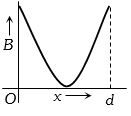
- B
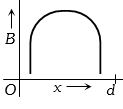
- C
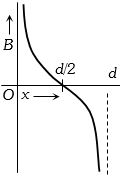
- D
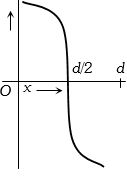
Explore More
Similar Questions
The adjoining figure shows a very long semi-cylindrical conducting shell of radius $R$ carrying a current $i$. An infinitely long straight current-carrying conductor is lying along the axis of the semi-cylinder. If the current flowing through the straight wire is $i_0$,then the force per unit length on the conducting wire is
Difficult
View Solution$A$ loop of irregular shape made of flexible conducting wire carrying a clockwise current is placed in a uniform inward magnetic field,such that its plane is perpendicular to the field. Then the loop:
Easy
View SolutionSix point charges,each of magnitude $q$,are arranged in different manners as shown in the image. In each case,a point $M$ and a line $PQ$ passing through $M$ are shown. Let $E$ be the electric field and $V$ be the electric potential at $M$ (potential at infinity is zero) due to the given charge distribution when it is at rest. Now,the whole system is set into rotation with a constant angular velocity about the line $PQ$. Let $B$ be the magnetic field at $M$ and $\mu$ be the magnetic moment of the system in this condition. Assume each rotating charge to be equivalent to a steady current. Match the conditions in Column $I$ with the configurations in Column $II$.
Column $I$ Column $II$ $(A)$ $E=0$ $(p)$ Charges at corners of a regular hexagon. $M$ is the centre. $PQ$ is perpendicular to the plane. $(B)$ $V \neq 0$ $(q)$ Charges on a line perpendicular to $PQ$ at equal intervals. $M$ is the mid-point. $(C)$ $B=0$ $(r)$ Charges on two coplanar concentric rings. $M$ is the common centre. $PQ$ is perpendicular to the plane. $(D)$ $\mu \neq 0$ $(s)$ Charges at corners and mid-points of a rectangle. $M$ is the centre. $PQ$ is parallel to the longer sides. $(t)$ Charges on two coplanar,identical rings. $M$ is the mid-point between centres. $PQ$ is perpendicular to the line joining centres.
| Column $I$ | Column $II$ |
| $(A)$ $E=0$ | $(p)$ Charges at corners of a regular hexagon. $M$ is the centre. $PQ$ is perpendicular to the plane. |
| $(B)$ $V \neq 0$ | $(q)$ Charges on a line perpendicular to $PQ$ at equal intervals. $M$ is the mid-point. |
| $(C)$ $B=0$ | $(r)$ Charges on two coplanar concentric rings. $M$ is the common centre. $PQ$ is perpendicular to the plane. |
| $(D)$ $\mu \neq 0$ | $(s)$ Charges at corners and mid-points of a rectangle. $M$ is the centre. $PQ$ is parallel to the longer sides. |
| $(t)$ Charges on two coplanar,identical rings. $M$ is the mid-point between centres. $PQ$ is perpendicular to the line joining centres. |
DifficultIIT 2009
View SolutionTwo parallel long wires carry currents $i_1$ and $i_2$ with $i_1 > i_2$. When the currents are in the same direction,the magnetic field midway between the wires is $10 \, \mu T$. When the direction of $i_2$ is reversed,it becomes $40 \, \mu T$. The ratio $i_1/i_2$ is
Difficult
View Solution$A$ compass needle free to turn in a horizontal plane is placed at the centre of a circular coil of $30$ turns and radius $12 \;cm$. The coil is in a vertical plane making an angle of $45^{\circ}$ with the magnetic meridian. When the current in the coil is $0.35 \;A$,the needle points west to east.
$(a)$ Determine the horizontal component of the earth's magnetic field at the location.
$(b)$ The current in the coil is reversed,and the coil is rotated about its vertical axis by an angle of $90^{\circ}$ in the anticlockwise sense looking from above. Predict the direction of the needle. Take the magnetic declination at the place to be zero.
$(a)$ Determine the horizontal component of the earth's magnetic field at the location.
$(b)$ The current in the coil is reversed,and the coil is rotated about its vertical axis by an angle of $90^{\circ}$ in the anticlockwise sense looking from above. Predict the direction of the needle. Take the magnetic declination at the place to be zero.
Medium
View SolutionVedclass Products
For Students
Vedclass Test Series
Mock tests in real JEE/NEET style with performance analysis. 5-day free trial.
Start Free TrialFor Teachers
Exam Paper Generator
Generate Set A/B/C/D exam papers from 7.5L+ questions in 2 minutes. 3 chapters free.
Try FreeFor Institutes
Online Exam Module
Live online exams with unlimited students, 360° analytics & white-label branding.
See Demo