
Two bodies $A$ and $B$ of same mass,area,and surface finish with specific heats $S_A$ and $S_B$ $(S_A > S_B)$ are allowed to cool for a given temperature range. The temperature varies with time as shown in the graphs. Which graph correctly represents the cooling process?
- A
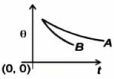
- B
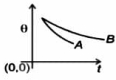
- C
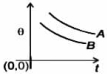
- D
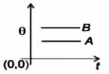
Explore More
Similar Questions
On what does the proportionality constant depend in Newton's law of cooling?
Easy
View SolutionTwo solid spheres of radii $R_1$ and $R_2$ are made of the same material and have similar surfaces. The spheres are raised to the same temperature and then allowed to cool under identical conditions. Assuming the spheres to be perfect conductors of heat,the ratio of their initial rates of cooling is:
$A$ body cools from $80^{\circ} C$ to $50^{\circ} C$ in $5 \text{ min}$. In the next time of $t \text{ min}$, the body continues to cool from $50^{\circ} C$ to $30^{\circ} C$. The total time taken by the body to cool from $80^{\circ} C$ to $30^{\circ} C$ is
[The temperature of the surroundings is $20^{\circ} C$.] (in $\text{ min}$)
[The temperature of the surroundings is $20^{\circ} C$.] (in $\text{ min}$)
Two liquids of equal volume are cooled under identical conditions from $60^{\circ}C$ to $50^{\circ}C$ in $324 \; sec$ and $810 \; sec$ respectively. If the ratio of their specific heats is $3:4$,find the ratio of their densities. (The water equivalent of the calorimeter is negligible.)
Medium
View Solution$A$ body cools from $60\,^oC$ to $50\,^oC$ in $10\, minutes$. If the room temperature is $25\,^oC$ and assuming Newton's law of cooling to hold good,the temperature of the body at the end of the next $10\, minutes$ will be ....... $^oC$
Difficult
View SolutionVedclass Products
For Students
Vedclass Test Series
Mock tests in real JEE/NEET style with performance analysis. 5-day free trial.
Start Free TrialFor Teachers
Exam Paper Generator
Generate Set A/B/C/D exam papers from 7.5L+ questions in 2 minutes. 3 chapters free.
Try FreeFor Institutes
Online Exam Module
Live online exams with unlimited students, 360° analytics & white-label branding.
See Demo