
Easy
Three uncharged capacitors of capacitances $C_1$,$C_2$,and $C_3$ are connected as shown in the figure. If $A$,$B$,and $C$ are at potentials $V_1$,$V_2$,and $V_3$ respectively,then the potential at point $O$ is:
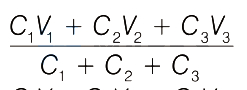
- A$\frac{C_1 V_1 + C_2 V_2 + C_3 V_3}{C_1 + C_2 + C_3}$
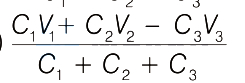
- B$\frac{C_1 V_1 + C_2 V_2 - C_3 V_3}{C_1 + C_2 + C_3}$
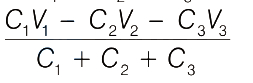
- C$\frac{C_1 V_1 - C_2 V_2 - C_3 V_3}{C_1 + C_2 + C_3}$
- Dzero
Explore More
Similar Questions
The separation between the plates of an isolated charged parallel plate capacitor is increased. Which of the following quantities will change?
Medium
View SolutionIn the network shown below,the charge accumulated in the capacitor in steady state will be ........... $\mu C$.
The figure shows two identical parallel plate capacitors $A$ and $B$ of capacitances $C$ connected to a battery. The key $K$ is initially closed. The switch is now opened and the free spaces between the plates of the capacitors are filled with a dielectric of dielectric constant $K=3$. Then which of the following statement$(s)$ is/are true?
MediumWBJEE 2023
View SolutionFor the shown situation, in the steady state condition, what is the ratio of the charge stored in the first capacitor to the charge stored in the last $(n^{th})$ capacitor?
Medium
View Solution$125$ identical drops,each charged to a potential of $50\;V$,are combined to form a single drop. The potential of the new drop will be......$V$.
Medium
View SolutionVedclass Products
For Students
Vedclass Test Series
Mock tests in real JEE/NEET style with performance analysis. 5-day free trial.
Start Free TrialFor Teachers
Exam Paper Generator
Generate Set A/B/C/D exam papers from 7.5L+ questions in 2 minutes. 3 chapters free.
Try FreeFor Institutes
Online Exam Module
Live online exams with unlimited students, 360° analytics & white-label branding.
See Demo