
The potential in an electric field varies as $V = (x^2 - y^2)$. The electric lines of force in the $X-Y$ plane are
- A
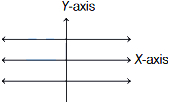
- B
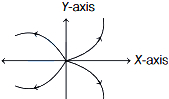
- C
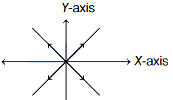
- D
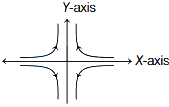
Explore More
Similar Questions
$(a)$ Consider an arbitrary electrostatic field configuration. $A$ small test charge is placed at a null point (i.e.,where $E = 0$) of the configuration. Show that the equilibrium of the test charge is necessarily unstable.
$(b)$ Verify this result for the simple configuration of two charges of the same magnitude and sign placed a certain distance apart.
$(b)$ Verify this result for the simple configuration of two charges of the same magnitude and sign placed a certain distance apart.
Medium
View SolutionTwo point charges $+8q$ and $-2q$ are placed at $x = 0$ and $x = L$ respectively. The net electric field due to these two point charges will be zero at a point on the $x$-axis at:
Medium
View SolutionThree equal charges $+q$ each are placed at the three vertices of an equilateral triangle. The electric field at the centroid of the triangle is . . . . . . . ('$r$' is the length of the side of the triangle).
The figures below show regular hexagons with charges at the vertices. In which of the following cases is the electric field at the center $NOT$ zero?
Medium
View SolutionThe electric field at the centre $O$ of a semicircle of radius $a$ having a linear charge density $\lambda$ is given by:
DifficultAIPMT 2000
View SolutionVedclass Products
For Students
Vedclass Test Series
Mock tests in real JEE/NEET style with performance analysis. 5-day free trial.
Start Free TrialFor Teachers
Exam Paper Generator
Generate Set A/B/C/D exam papers from 7.5L+ questions in 2 minutes. 3 chapters free.
Try FreeFor Institutes
Online Exam Module
Live online exams with unlimited students, 360° analytics & white-label branding.
See Demo