
The oscillation of a body on a smooth horizontal surface is represented by the equation $x = A \cos \omega t$,where $x$ is the displacement at time $t$ and $\omega$ is the angular frequency of oscillation. Which one of the following graphs correctly shows the variation of acceleration $a$ with time $t$?
- A
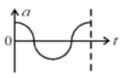
- B
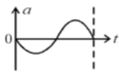
- C
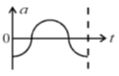
- D
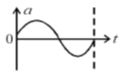
Explore More
Similar Questions
Values of the acceleration $A$ of a particle moving in simple harmonic motion as a function of its displacement $x$ are given in the table below:
$A \ (mm \ s^{-2})$ $16$ $8$ $0$ $-8$ $-16$ $x \ (mm)$ $-4$ $-2$ $0$ $2$ $4$
The period of the motion is:
| $A \ (mm \ s^{-2})$ | $16$ | $8$ | $0$ | $-8$ | $-16$ |
| $x \ (mm)$ | $-4$ | $-2$ | $0$ | $2$ | $4$ |
The period of the motion is:
Difficult
View SolutionThe displacement-time graph of a particle executing $S.H.M.$ is as shown in the figure. The corresponding force-time graph of the particle is:
Easy
View SolutionThe displacement of a particle performing $S.H.M.$ is given by $x=5 \sin (3 t+3)$,where $x$ is in $cm$ and $t$ is in $s$. The maximum acceleration of the particle will be (in $cm \ s^{-2}$)
The variation of the acceleration $a$ of a particle executing $S.H.M.$ with displacement $x$ is as shown in the figure. Which of the following graphs correctly represents this relationship?
Easy
View Solution$A$ particle is executing simple harmonic motion with an amplitude of $0.02 \ m$ and frequency $50 \ Hz$. The maximum acceleration of the particle is
Easy
View SolutionVedclass Products
For Students
Vedclass Test Series
Mock tests in real JEE/NEET style with performance analysis. 5-day free trial.
Start Free TrialFor Teachers
Exam Paper Generator
Generate Set A/B/C/D exam papers from 7.5L+ questions in 2 minutes. 3 chapters free.
Try FreeFor Institutes
Online Exam Module
Live online exams with unlimited students, 360° analytics & white-label branding.
See Demo