
The graph showing the dependence of intensity of transmitted light on the angle between polariser and analyser is ($I_0$ is intensity of plane polarised light)
- A
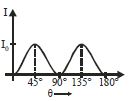
- B
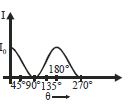
- C
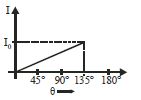
- D
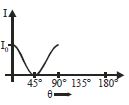
Explore More
Similar Questions
Four polaroids are placed such that the optic axis of each is inclined at an angle of $30^{\circ}$ with the optic axis of the preceding one. If unpolarised light of intensity $I_0$ falls on the first polaroid,the intensity of light transmitted from the fourth polaroid is $[\cos 30^{\circ} = \sqrt{3} / 2]$.
An unpolarised light of intensity $I$ is passed through two polaroids kept one after the other with their planes parallel to each other. The intensity of light emerging from the second polaroid is $\frac{I}{4}$. The angle between the pass axes of the polaroids is (in $^{\circ}$)
$A$ plane polarised light passes through successive polarisers which are rotated by $30^{\circ}$ with respect to each other in the clockwise direction. Neglecting absorption by the polarisers and given that the first polariser's axis is parallel to the plane of polarisation of the incident light,the intensity of light at the exit of the fifth polariser is closest to
MediumKVPY 2011
View SolutionTwo Nicols are oriented with their principal planes making an angle of $60^\circ$. The percentage of incident unpolarized light which passes through the system is......$\%$
Medium
View Solution$A$ polaroid is placed at $45^{\circ}$ to an incoming linearly polarized light of intensity $I_0$. The intensity of light passing through the polaroid after polarization will be:
Medium
View SolutionVedclass Products
For Students
Vedclass Test Series
Mock tests in real JEE/NEET style with performance analysis. 5-day free trial.
Start Free TrialFor Teachers
Exam Paper Generator
Generate Set A/B/C/D exam papers from 7.5L+ questions in 2 minutes. 3 chapters free.
Try FreeFor Institutes
Online Exam Module
Live online exams with unlimited students, 360° analytics & white-label branding.
See Demo