
If you are provided with three resistors of $2 \,\Omega$,$3 \,\Omega$,and $6 \,\Omega$,how will you connect them to obtain an equivalent resistance of $4 \,\Omega$?
- A
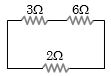
- B
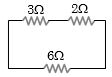
- C
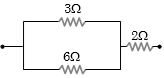
- DNone of these
Explore More
Similar Questions
In the given circuit,the value of $I_{2}$ is: (in $A$)
Two resistances are joined in parallel whose resultant is $6/8 \, \Omega$. One of the resistance wires is broken and the effective resistance becomes $2 \, \Omega$. Then the resistance in ohm of the wire that got broken was:
Medium
View Solution$A$ wire of resistance $20 \Omega$ is divided into $10$ equal parts. $A$ combination of two parts are connected in parallel and so on. Now,the resulting pairs of parallel combinations are connected in series. The equivalent resistance of the final combination is . . . . . . $\Omega$.
DifficultJEE MAIN 2024
View SolutionNet resistance of the given circuit between $X$ and $Y$ is ............... $\Omega$.
Medium
View SolutionThree unequal resistors in parallel are equivalent to a resistance $1 \ \Omega$. If two of them are in the ratio $1:2$ and if no resistance value is fractional,then the largest of the three resistances in ohms is
DifficultAP EAMCET 2003
View SolutionVedclass Products
For Students
Vedclass Test Series
Mock tests in real JEE/NEET style with performance analysis. 5-day free trial.
Start Free TrialFor Teachers
Exam Paper Generator
Generate Set A/B/C/D exam papers from 7.5L+ questions in 2 minutes. 3 chapters free.
Try FreeFor Institutes
Online Exam Module
Live online exams with unlimited students, 360° analytics & white-label branding.
See Demo