
Medium
For an exothermic reaction,the following two steps are involved:
Step $1$: $A + B \to I$ $(slow)$
Step $2$: $I \to AB$ $(fast)$
Which of the following graphs correctly represents this reaction?
Step $1$: $A + B \to I$ $(slow)$
Step $2$: $I \to AB$ $(fast)$
Which of the following graphs correctly represents this reaction?
- A
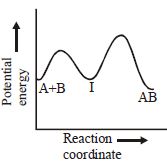
- B
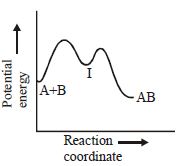
- C
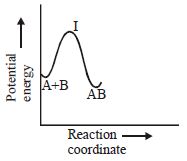
- D
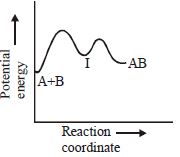
Explore More
Similar Questions
The number of correct statement/s from the following is:
$A.$ Larger the activation energy,smaller is the value of the rate constant.
$B.$ The higher is the activation energy,higher is the value of the temperature coefficient.
$C.$ At lower temperatures,the increase in temperature causes a larger change in the value of $k$ than at higher temperatures.
$D.$ $A$ plot of $\ln k$ vs $\frac{1}{T}$ is a straight line with a slope equal to $-\frac{E_a}{R}$.
$A.$ Larger the activation energy,smaller is the value of the rate constant.
$B.$ The higher is the activation energy,higher is the value of the temperature coefficient.
$C.$ At lower temperatures,the increase in temperature causes a larger change in the value of $k$ than at higher temperatures.
$D.$ $A$ plot of $\ln k$ vs $\frac{1}{T}$ is a straight line with a slope equal to $-\frac{E_a}{R}$.
DifficultJEE MAIN 2023
View SolutionFor a gaseous reaction,a large increase in the rate of reaction with a small increase in temperature indicates:
Easy
View SolutionFor $A + B \longrightarrow C + D$; $\Delta H = -20 \ kJ \ mol^{-1}$,the activation energy of the forward reaction is $85 \ kJ \ mol^{-1}$. The activation energy for the backward reaction is.....$kJ \ mol^{-1}$
Medium
View SolutionThe rate of a reaction quadruples when temperature changes from $27^{\circ} C$ to $57^{\circ} C$. Calculate the energy of activation.
Given $R=8.314 \ J \ K^{-1} \ mol^{-1}, \log 4=0.6021$
Given $R=8.314 \ J \ K^{-1} \ mol^{-1}, \log 4=0.6021$
MediumNEET 2024
View SolutionThe influence of temperature on the rate of reaction can be found out by
Easy
View SolutionVedclass Products
For Students
Vedclass Test Series
Mock tests in real JEE/NEET style with performance analysis. 5-day free trial.
Start Free TrialFor Teachers
Exam Paper Generator
Generate Set A/B/C/D exam papers from 7.5L+ questions in 2 minutes. 3 chapters free.
Try FreeFor Institutes
Online Exam Module
Live online exams with unlimited students, 360° analytics & white-label branding.
See Demo