
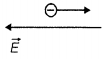
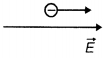
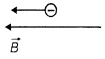
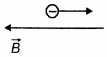
The figure shows four situations in which an electron is moving in an electric or magnetic field. In which case is the de Broglie wavelength of the electron increasing?
- A
- B
- C
- D
Explore More
Similar Questions
The voltage applied to an electron microscope to produce electrons of wavelength $0.50 \text{ Å}$ is (in $\text{ V}$)
$A$ particle having electric charge $3 \times 10^{-19} \text{ C}$ and mass $6 \times 10^{-27} \text{ kg}$ is accelerated by applying an electric potential of $1.21 \text{ V}$. The wavelength of the matter wave associated with the particle is $\alpha \times 10^{-12} \text{ m}$. The value of $\alpha$ is . . . . . . . (Take Planck's constant $h = 6.6 \times 10^{-34} \text{ J} \cdot \text{s}$)
The ratio of de-Broglie wavelength of molecules of hydrogen and helium in two jars kept separately at temperatures of $27\,^{\circ}\text{C}$ and $127\,^{\circ}\text{C}$ respectively is
Difficult
View Solution$A$ proton and an electron are accelerated by the same potential difference. Let $\lambda_e$ and $\lambda_p$ denote the de-Broglie wavelengths of the electron and the proton,respectively.
Medium
View SolutionWhen energy is added to an electron,its de Broglie wavelength decreases from $10^{-10} \ m$ to $0.5 \times 10^{-10} \ m$. The added energy is:
Difficult
View SolutionVedclass Products
For Students
Vedclass Test Series
Mock tests in real JEE/NEET style with performance analysis. 5-day free trial.
Start Free TrialFor Teachers
Exam Paper Generator
Generate Set A/B/C/D exam papers from 7.5L+ questions in 2 minutes. 3 chapters free.
Try FreeFor Institutes
Online Exam Module
Live online exams with unlimited students, 360° analytics & white-label branding.
See Demo