
The figure shows an incident pulse $P$ reflected from a rigid support. Which one of $A, B, C, D$ represents the reflected pulse correctly?
- A
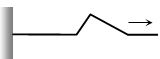
- B
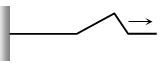
- C
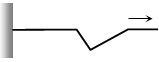
- D
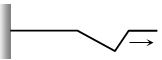
Explore More
Similar Questions
For a stationary wave,$Y = 10 \sin \left( \frac{\pi x}{15} \right) \cos (48 \pi t) \text{ cm}$,the distance between a node and the successive antinode is (in $\text{ cm}$)
$(i)$ For the wave $y(x, t) = 0.06 \sin \left(\frac{2 \pi}{3} x\right) \cos (120 \pi t)$,where $x$ and $y$ are in $m$ and $t$ is in $s$. The length of the string is $1.5 \, m$ and its mass is $3.0 \times 10^{-2} \, kg$. Do all the points on the string oscillate with the same $(a)$ frequency,$(b)$ phase,$(c)$ amplitude? Explain your answers.
$(ii)$ What is the amplitude of a point $0.375 \, m$ away from one end?
$(ii)$ What is the amplitude of a point $0.375 \, m$ away from one end?
Medium
View SolutionIn a stationary wave,all the particles:
Easy
View SolutionWhat will be the phase difference of particles in successive intervals of stationary waves?
Medium
View SolutionIn stationary waves,all particles between two consecutive nodes pass through the mean position:
Easy
View SolutionVedclass Products
For Students
Vedclass Test Series
Mock tests in real JEE/NEET style with performance analysis. 5-day free trial.
Start Free TrialFor Teachers
Exam Paper Generator
Generate Set A/B/C/D exam papers from 7.5L+ questions in 2 minutes. 3 chapters free.
Try FreeFor Institutes
Online Exam Module
Live online exams with unlimited students, 360° analytics & white-label branding.
See Demo