
$A$ uniform dense rod with non-uniform Young's modulus is hanging from the ceiling under gravity. If the elastic energy density at every point is the same,then how will Young's modulus change with $x$ as shown in the graphs?
- A
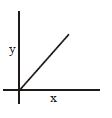
- B
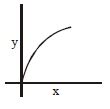
- C
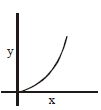
- D
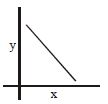
Explore More
Similar Questions
Two blocks of mass $2 \ kg$ and $4 \ kg$ are connected by a metal wire going over a smooth pulley as shown in the figure. The radius of the wire is $4.0 \times 10^{-5} \ m$ and Young's modulus of the metal is $2.0 \times 10^{11} \ N/m^2$. The longitudinal strain developed in the wire is $\frac{1}{\alpha \pi}$. The value of $\alpha$ is [Use $g = 10 \ m/s^2$].
DifficultJEE MAIN 2024
View SolutionTwo wires each of radius $0.2\,cm$ and negligible mass, one made of steel and the other made of brass, are loaded as shown in the figure. The elongation of the steel wire is $.........\times 10^{-6}\,m$. [Young's modulus for steel $= 2 \times 10^{11}\,N/m^2$ and $g = 10\,m/s^2$]
DifficultJEE MAIN 2023
View SolutionThe following four wires of length $L$ and radius $r$ are made of the same material. Which of these will have the largest extension,when the same tension is applied?
MediumKCET 2011
View SolutionWhich of the following graphs correctly depicts the spring constant $k$ versus the length $l$ of the spring?
Medium
View SolutionWhen a certain weight is suspended from a long uniform wire,its length increases by $1 \ cm$. If the same weight is suspended from another wire of the same material and length but having a diameter half of the first one,then the increase in length will be ........ $cm$.
Medium
View SolutionVedclass Products
For Students
Vedclass Test Series
Mock tests in real JEE/NEET style with performance analysis. 5-day free trial.
Start Free TrialFor Teachers
Exam Paper Generator
Generate Set A/B/C/D exam papers from 7.5L+ questions in 2 minutes. 3 chapters free.
Try FreeFor Institutes
Online Exam Module
Live online exams with unlimited students, 360° analytics & white-label branding.
See Demo