
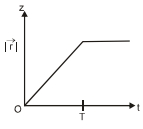
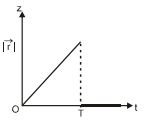
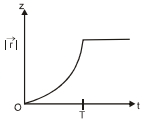
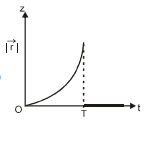
$A$ thin uniform rod,pivoted at $O$,is rotating in the horizontal plane with constant angular speed $\omega$,as shown in the figure. At time $t = 0$,a small insect of mass $m$ starts from $O$ and moves with constant speed $v$ with respect to the rod towards the other end. It reaches the end of the rod at time $t = T$ and stops. The angular speed of the system remains $\omega$ throughout. The magnitude of the torque $(|\vec{\tau}|)$ on the system about $O$,as a function of time,is best represented by which plot?
- A$A$ plot showing a linear increase of torque with time for $t < T$ and zero for $t > T$.
- B$A$ plot showing a constant torque for $t < T$ and zero for $t > T$.
- C$A$ plot showing a parabolic increase of torque with time for $t < T$ and zero for $t > T$.
- D$A$ plot showing a linear decrease of torque with time for $t < T$ and zero for $t > T$.
Explore More
Similar Questions
$A$ uniform disc is acted upon by two equal forces of magnitude $F$. One of them acts tangentially to the disc,while the other acts at the central point of the disc. The friction between the disc surface and the ground surface is $nF$. If $r$ is the radius of the disc,then the value of $n$ would be:
DifficultAIIMS 2015
View Solution$A$ solid sphere of mass $M$ and radius $R$ is divided into two unequal parts. The smaller part having mass $M/8$ is converted into a sphere of radius $r$ and the larger part is converted into a circular disc of thickness $t$ and radius $2R$. If $I_1$ is the moment of inertia of a sphere having radius $r$ about an axis through its centre and $I_2$ is the moment of inertia of a disc about its diameter,the ratio of their moment of inertia $I_2/I_1 = . . . . . . $.
DifficultJEE MAIN 2026
View Solution$A$ metal sphere of radius $r$ and specific heat $S$ is rotated about an axis passing through its centre at a speed of $f$ rotations per second. It is suddenly stopped,and $50\%$ of its rotational kinetic energy is used in increasing its temperature. The rise in temperature of the sphere is
Difficult
View Solution$A$ particle executes uniform circular motion with angular momentum $L$. Its rotational kinetic energy becomes half,when the angular frequency is doubled. Its new angular momentum is
$A$ disc of circumference $s$ is at rest at a point $A$ on a horizontal surface when a constant horizontal force begins to act on its centre. Between $A$ and $B$ there is sufficient friction to prevent slipping,and the surface is smooth to the right of $B$. $AB = s$. The disc moves from $A$ to $B$ in time $T$. To the right of $B$,
Vedclass Products
For Students
Vedclass Test Series
Mock tests in real JEE/NEET style with performance analysis. 5-day free trial.
Start Free TrialFor Teachers
Exam Paper Generator
Generate Set A/B/C/D exam papers from 7.5L+ questions in 2 minutes. 3 chapters free.
Try FreeFor Institutes
Online Exam Module
Live online exams with unlimited students, 360° analytics & white-label branding.
See Demo