
$A$ region in the form of an equilateral triangle (in $x-y$ plane) of height $L$ has a uniform magnetic field $\vec{B}$ pointing in the $+z$-direction. $A$ conducting loop $PQR$,in the form of an equilateral triangle of the same height $L$,is placed in the $x-y$ plane with its vertex $P$ at $x=0$ in the orientation shown in the figure. At $t=0$,the loop starts entering the region of the magnetic field with a uniform velocity $\vec{v}$ along the $+x$-direction. The plane of the loop and its orientation remain unchanged throughout its motion.
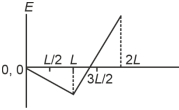
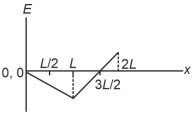
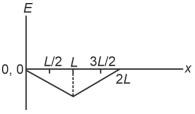
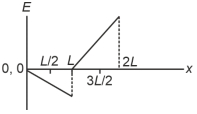
Which of the following graphs best depicts the variation of the induced emf $(E)$ in the loop as a function of the distance $(x)$ starting from $x=0$?
Which of the following graphs best depicts the variation of the induced emf $(E)$ in the loop as a function of the distance $(x)$ starting from $x=0$?
- A
- B
- C
- D
Explore More
Similar Questions
The direction of current induced in a wire moving in a magnetic field is found using
$A$ conducting bar of length $L$ is free to slide on two parallel conducting rails as shown in the figure. Two resistors $R_{1}$ and $R_{2}$ are connected across the ends of the rails. There is a uniform magnetic field $\vec{B}$ pointing into the page. An external agent pulls the bar to the left at a constant speed $v$. The correct statement about the directions of induced currents $I_{1}$ and $I_{2}$ flowing through $R_{1}$ and $R_{2}$ respectively is:
$A$ vertical rod of length $l$ is moved with constant velocity $v$ towards the east. If the vertical component of the Earth's magnetic field is $B$ and the angle of dip is $\theta$,then the induced $emf$ in the rod is:
Medium
View Solution$A$ conducting circular loop is placed in the $X-Y$ plane in the presence of a magnetic field $\overrightarrow{B} = (3t^3 \hat{j} + 3t^2 \hat{k})$ in $SI$ units. If the radius of the loop is $1 \ m$,the induced emf in the loop at time $t = 2 \ s$ is $n\pi \ V$. The value of $n$ is:
$A$ simple pendulum made of a mass of $10 \ g$ and a metallic wire of length $10 \ cm$ is suspended vertically in a uniform magnetic field of $2 \ T$. The magnetic field direction is perpendicular to the plane of oscillations of the pendulum. If the pendulum is released from an angle of $60^{\circ}$ with the vertical,then the maximum induced $EMF$ between the point of suspension and the point of oscillation is . . . . . . $mV$. (Take $g = 10 \ m/s^2$)
Vedclass Products
For Students
Vedclass Test Series
Mock tests in real JEE/NEET style with performance analysis. 5-day free trial.
Start Free TrialFor Teachers
Exam Paper Generator
Generate Set A/B/C/D exam papers from 7.5L+ questions in 2 minutes. 3 chapters free.
Try FreeFor Institutes
Online Exam Module
Live online exams with unlimited students, 360° analytics & white-label branding.
See Demo