
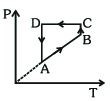
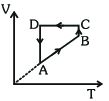
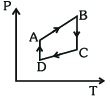
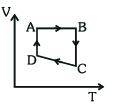
$A$ cyclic process $ABCDA$ is shown in the $P-V$ diagram. Which of the following curves represent the same process?
- A
- B
- C
- D
Explore More
Similar Questions
When $Q_1$ amount of heat is supplied to a monatomic gas,the work done by the gas is $W$. When $Q_2$ amount of heat is supplied to a diatomic gas,the work done by the gas is $2W$. Then $Q_1: Q_2=$
DifficultTS EAMCET 2024
View Solution$A$ monoatomic gas at pressure $P$,having volume $V$ expands isothermally to a volume $2V$ and then adiabatically to a volume $16V$. The final pressure of the gas is (Take $\gamma = 5/3$)
For the given $P-V$ diagram of a thermodynamic system,match the curves with their respective thermodynamic processes. ($P$ = Pressure and $V$ = Volume)
Curve Process $I$ $a)$ Adiabatic $II$ $b)$ Isobaric $III$ $c)$ Isochoric $IV$ $d)$ Isothermal
| Curve | Process |
| $I$ | $a)$ Adiabatic |
| $II$ | $b)$ Isobaric |
| $III$ | $c)$ Isochoric |
| $IV$ | $d)$ Isothermal |
$A$ cyclic process $ABCA$ is shown in the $V-T$ diagram. The process on the $P-V$ diagram is:
Medium
View Solution$A$ reversible cyclic process for an ideal gas is shown below. Here,$P, V$,and $T$ are pressure,volume,and temperature,respectively. The thermodynamic parameters $q, w, H$,and $U$ are heat,work,enthalpy,and internal energy,respectively.
The correct option$(s)$ is (are):
$(A)$ $q_{AC} = \Delta U_{BC}$ and $W_{AB} = P_2(V_2 - V_1)$
$(B)$ $W_{BC} = P_2(V_2 - V_1)$ and $q_{BC} = H_{AC}$
$(C)$ $\Delta H_{CA} < \Delta U_{CA}$ and $q_{AC} = \Delta U_{BC}$
$(D)$ $q_{BC} = \Delta H_{AC}$ and $\Delta H_{CA} > \Delta U_{CA}$
The correct option$(s)$ is (are):
$(A)$ $q_{AC} = \Delta U_{BC}$ and $W_{AB} = P_2(V_2 - V_1)$
$(B)$ $W_{BC} = P_2(V_2 - V_1)$ and $q_{BC} = H_{AC}$
$(C)$ $\Delta H_{CA} < \Delta U_{CA}$ and $q_{AC} = \Delta U_{BC}$
$(D)$ $q_{BC} = \Delta H_{AC}$ and $\Delta H_{CA} > \Delta U_{CA}$
Vedclass Products
For Students
Vedclass Test Series
Mock tests in real JEE/NEET style with performance analysis. 5-day free trial.
Start Free TrialFor Teachers
Exam Paper Generator
Generate Set A/B/C/D exam papers from 7.5L+ questions in 2 minutes. 3 chapters free.
Try FreeFor Institutes
Online Exam Module
Live online exams with unlimited students, 360° analytics & white-label branding.
See Demo