
$A$ uniformly charged sphere has a total charge $Q$ and radius $R$. The electric field $E$ is a function of the distance $r$ from the center. Which of the following graphs represents this relationship?
- A
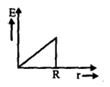
- B
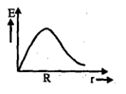
- C
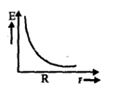
- D
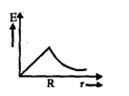
Explore More
Similar Questions
Four equal charges of value $+Q$ are placed at four vertices of a regular hexagon of side $a$. By suitably choosing the vertices,what can be the maximum possible magnitude of the electric field at the centre of the hexagon?
MediumWBJEE 2018
View SolutionTwo charges $+Q$ and $-2 Q$ are located at points $A$ and $B$ on a horizontal line as shown below. The electric field is zero at a point which is located at a finite distance:
MediumKVPY 2011
View SolutionFour point charges $-q, +q, +q$ and $-q$ are placed on the $y$-axis at $y = -2d, y = -d, y = +d$ and $y = +2d$,respectively. The magnitude of the electric field $E$ at a point on the $x$-axis at $x = D$,with $D >> d$,will vary as:
DifficultJEE MAIN 2019
View Solution$A$ thin non-conducting ring of radius $r$ has a linear charge density $\lambda = \lambda_0 \cos \phi$,where $\lambda_0$ is a constant and $\phi$ is the azimuthal angle. The magnitude of the electric field strength at the centre of the ring is
DifficultTS EAMCET 2021
View SolutionTwo equal positive point charges are separated by a distance $2a$. The distance of a point from the centre of the line joining two charges on the equatorial line (perpendicular bisector) at which the force experienced by a test charge $q_0$ becomes maximum is $\frac{a}{\sqrt{x}}$. The value of $x$ is $................$
DifficultJEE MAIN 2023
View SolutionVedclass Products
For Students
Vedclass Test Series
Mock tests in real JEE/NEET style with performance analysis. 5-day free trial.
Start Free TrialFor Teachers
Exam Paper Generator
Generate Set A/B/C/D exam papers from 7.5L+ questions in 2 minutes. 3 chapters free.
Try FreeFor Institutes
Online Exam Module
Live online exams with unlimited students, 360° analytics & white-label branding.
See Demo